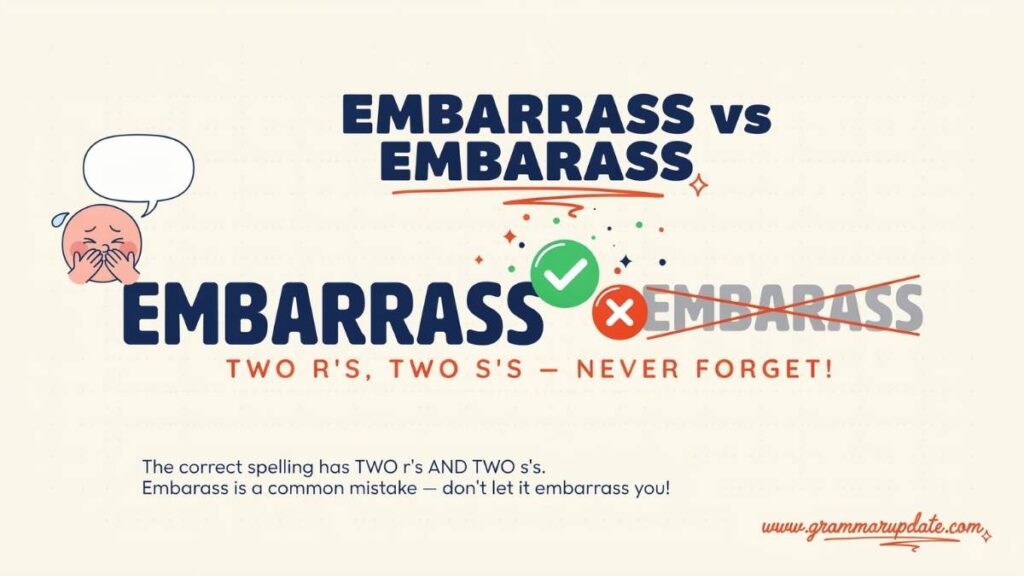
English spelling can be tricky, and embarrass is a perfect example. Many people are unsure whether the correct spelling is embarrass vs embarass because the two words look almost the same. The pronunciation does not help much either, so it is easy to leave out a letter when writing quickly. The good news is that the difference is simple: embarrass is correct, while embarass is a misspelling. In this guide, you will learn the meaning of embarrass, how to use it correctly, its common forms, and an easy way to remember the spelling. By the end, this confusing word should feel much easier to handle.
Quick Answer
The correct spelling is embarrass.
Embarass is incorrect.
The word embarrass has two r letters and two s letters:
embarrass
The incorrect form removes one r:
embarass
Here is a simple comparison:
| Word | Correct? | Meaning |
|---|---|---|
| embarrass | Yes | To make someone feel ashamed, awkward, or uncomfortable |
| embarass | No | Common misspelling of embarrass |
For example:
She did not mean to embarrass him in front of his friends.
It would be incorrect to write:
She did not mean to embarass him in front of his friends.
Learn the difference between confusing more English words
Existence vs Existance which one is correct?
Why Do People Confuse Embarrass vs Embarass?
The spelling of embarrass is easy to get wrong because several letters appear twice in a row. When you pronounce the word, you do not clearly hear every letter in its spelling.
The pronunciation is closer to “em-bair-uhs” than the written form might suggest. Because of this, it is easy to write embarass with only one r.
Another reason for the confusion is that English contains many words with double letters, while others use only one. When you are writing quickly, it is easy to remember the general shape of the word but forget which letters are doubled.
The safest spelling to remember is:
embarrass = rr + ss
That small pattern can prevent the most common spelling mistake.
What Does Embarrass Mean?
Embarrass is a verb. It means to make someone feel uncomfortable, ashamed, self-conscious, or awkward, especially in front of other people.
For example:
His joke embarrassed his sister.
The mistake did not embarrass me as much as I expected.
I did not want to embarrass her by mentioning the incident.
The word can describe both small moments of awkwardness and situations that cause stronger feelings of shame or discomfort.
For example, forgetting someone’s name during a conversation might embarrass you. Giving the wrong answer during an important presentation could also embarrass you.
What Does Embarass Mean?
Embarass is not the standard English spelling.
If you write embarass in an essay, email, article, school assignment, or professional document, it should be corrected to embarrass.
The mistake usually happens because the writer remembers the word as “embarass” and leaves out the second r.
A useful way to check the spelling is to look at the middle of the word:
em + barrass
The correct spelling contains rr before the final ss.
Learn the difference between confusing more English words
Foreign vs Foriegn difference and usage?
How to Spell Embarrass Correctly
The spelling of embarrass becomes easier when you break it into parts:
em + barrass
The important part is barrass, which contains both double letters:
rr
ss
So the complete spelling is:
embarrass
A simple memory trick is:
Embarrass has two reasons to feel embarrassed: double r and double s.
You can also remember it as:
embarrass = 2 Rs + 2 Ss
This is much easier to recall when you are unsure about the spelling.
Embarrass vs Embarrassed
The Embarrass and embarrassed come from the same word, but they have different grammatical uses.
Embarrass is the base verb.
Embarrassed is the past tense and past participle of embarrass. It can also function as an adjective to describe how someone feels.
For example:
I do not want to embarrass him.
She embarrassed herself during the meeting.
He felt embarrassed after forgetting the answer.
The spelling changes slightly when you add -ed, but the double r remains:
embarrass
embarrassed
The word embarrassed has double r and double s before the ending.
Learn the difference between confusing more English words
Bougie vs Boujee which one is correct?
Embarrassing vs Embarrassed
Embarrassing and embarrassed are also related, but they describe different things.
Embarrassed usually describes a person’s feelings.
I was embarrassed when I made the mistake.
Embarrassing usually describes the situation or thing that causes those feelings.
The situation was embarrassing.
This difference is useful because people sometimes confuse the two forms.
Compare these sentences:
I felt embarrassed.
The situation was embarrassing.
You are embarrassed because something makes you feel uncomfortable or ashamed. Something is embarrassing because it causes that feeling.
Examples of Embarrass in a Sentence
Here are some natural examples of embarrass:
I did not mean to embarrass you.
Please do not embarrass me in front of everyone.
His question might embarrass her.
The teacher did not want to embarrass the student.
That old photograph could embarrass him.
She tried not to embarrass her friend.
It can also be used in situations where someone causes another person to lose confidence or feel uncomfortable:
The unexpected question embarrassed the speaker.
His parents embarrassed him by telling the story to his friends.
She was worried that the mistake would embarrass the entire team.
Learn the difference between confusing more English words
Colleague vs Colleage which one is correct ?
Examples of Embarrass vs Embarass
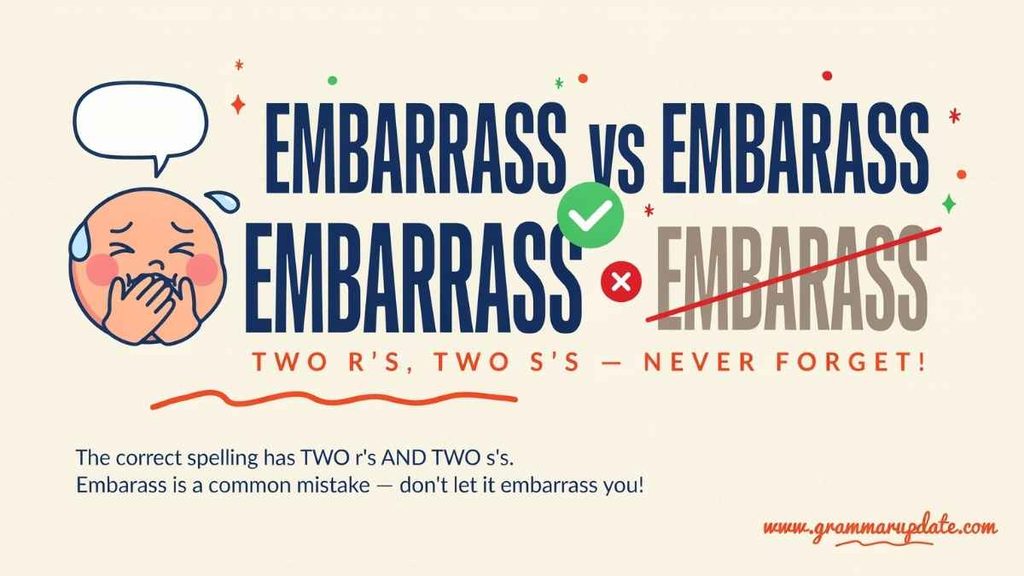
Because embarass is a common spelling mistake, it helps to see the difference directly.
Correct:
I did not want to embarrass my brother.
Incorrect:
I did not want to embarass my brother.
Correct:
The incident embarrassed her.
Incorrect:
The incident embarassed her.
Correct:
It would be embarrassing to forget his name.
Incorrect:
It would be embarassing to forget his name.
Notice that the correct forms keep the double r:
embarrass
embarrassed
embarrassing
Learn the difference between confusing more English words
Changeable vs Changable Which one Is Correct?
Common Forms of Embarrass
Understanding the different forms of the word can make the spelling easier to remember.
| Form | Example |
|---|---|
| embarrass | I do not want to embarrass you. |
| embarrasses | His behavior embarrasses his family. |
| embarrassed | She felt embarrassed by the mistake. |
| embarrassing | That was an embarrassing moment. |
All of these forms retain the double r.
The double s also remains in the spelling of the base word and its common forms.
Synonyms for Embarrass
Depending on the situation, several words can have a similar meaning to embarrass.
Some useful alternatives include:
humiliate
awkward
shame
mortify
disconcert
fluster
unsettle
make uncomfortable
These words are not always exact replacements. Their meaning and emotional strength can differ depending on the context.
For example, humiliate usually suggests a stronger and more painful experience than embarrass.
If you simply make someone feel awkward, embarrass may be the better choice.
Learn the difference between confusing word pairs
Acknowledge Vs Acknowlege Which one Is Correct?
Is Embarrass an American or British Spelling?
Embarrass is the standard spelling in both American and British English.
There is no standard American spelling “embarass” and British spelling “embarrass.” The difference is not related to regional English.
Whether you are writing for an American, British, Canadian, or Australian audience, the standard spelling is embarrass.
The same applies to related forms such as embarrassed and embarrassing.
Is Embarass Ever Correct?
No. Embarass is generally considered a misspelling of embarrass.
You may see it online, in informal messages, or in user-generated content because people frequently make spelling mistakes. Its appearance in those contexts does not make it a standard spelling.
If you are writing something that needs correct English, use embarrass.
Learn the difference between confusing word pairs
Dilemma vs Dilema which one is correct ?
Common Mistakes With Embarrass
The most common mistake is dropping one of the r letters:
embarass
Another common mistake is writing the word with only one s:
embarrass → correct
embarass → incorrect
embarass can feel natural because the pronunciation does not strongly emphasize the double letters. That is why relying only on pronunciation can lead to mistakes.
Instead, remember the written pattern:
em + barrass
Once you have memorized this pattern, the related forms become easier too:
embarrass
embarrassed
embarrassing
How to Remember the Correct Spelling
If you regularly confuse embarrass vs embarass, use a simple visual trick.
Think of embarrass as having four repeated letters in two pairs:
RR + SS
The word starts with “em” and then contains “barrass”:
EM + BARRASS
You can also connect the spelling to the feeling. Being embarrassed can make you feel like you want to hide, but the word itself does not hide its extra letters. It has two Rs and two Ss.
The key is to memorize the correct form rather than trying to reconstruct it every time you write it.
Learn the difference between confusing word pairs
Definite vs Definitive difference and usage?
Embarrass vs Embarass in Everyday Writing
You may encounter this word in conversations, emails, school assignments, articles, social media posts, and professional writing.
In informal texting, people sometimes misspell words without noticing. However, spelling matters more in formal communication.
If you are writing a resume, academic paper, business email, website article, or professional document, always use embarrass.
For example:
Correct: I did not want to embarrass my colleague.
Incorrect: I did not want to embarass my colleague.
The difference is only one letter, but that one letter determines whether the spelling is correct.
The Spelling Pattern Behind Embarrass
The correct spelling is embarrass, with two r’s and two s’s. The double letters can make the word look unusual, especially when you write it quickly. The spelling pattern stays the same in related words such as embarrassed, embarrassing, and embarrassment. Remembering this pattern makes it easier to spell the whole word family correctly.
Learn the difference between confusing word pairs
Disappoint vs Disapoint difference and usage?
How Embarrass Changes in Different Forms
Embarrass is a verb, but it changes slightly when you use it in different forms. The past tense is embarrassed, while the present participle is embarrassing. You can also use embarrasses for the third-person singular form and embarrassingly as an adverb. The double r and double s remain important throughout these forms.
Situations That Can Cause Embarrassment
People can feel embarrassed when they make a mistake, forget someone’s name, say something awkward, or attract unwanted attention. For example, forgetting your lines during a presentation might embarrass you. These situations often create feelings of awkwardness or discomfort. The word embarrass describes the action that causes this feeling, while embarrassment describes the feeling itself.
Simple Ways to Avoid This Spelling Mistake
A quick memory trick can help you avoid writing embarass by accident. Think of embarrass as having two pairs of double letters: rr and ss. You can remember it as “embarrass has room for two R’s and two S’s.” When you check your writing, look at the middle and end of the word. If either pair has only one letter, the spelling needs correction.
Learn the difference between confusing word pairs
Exhilarate vs Exhilirate difference and usage?
Practice Session Embarrass vs Embarass
Fill in each blank with the correct form of the word. Embarrass vs Embarass
- I did not mean to ______ you in front of your friends.
- She felt ______ when she realized everyone had heard her mistake.
- His parents sometimes ______ him by telling funny stories about his childhood.
- It was an ______ moment for everyone in the room.
- Please do not ______ your brother during the ceremony.
- He was deeply ______ by what happened at school.
- The teacher did not want to ______ the student in front of the class.
- Forgetting her lines during the performance was very ______.
- She tried not to ______ herself during the interview.
- I would be ______ if I forgot his name again.
- His behavior ______ his entire family.
- The mistake did not ______ me as much as I expected.
- She accidentally ______ herself when she gave the wrong answer.
- It can be ______ when you make a mistake in front of a large audience.
- I never want to ______ my parents.
- He looked ______ after everyone started laughing.
- The story was so ______ that she wished she had never told it.
- Do not let one small mistake ______ you.
- She was worried that the incident would ______ her friend.
- He became ______ when his classmates mentioned the old photograph.
- The correct spelling is ______, not embarass.
- The word “embarrass” contains two ___ letters and two ___ letters.
- I did not want my question to ______ her.
- That was one of the most ______ moments of my life.
- Even though he felt ______, he continued speaking.
Answers
- embarrass
- embarrassed
- embarrass
- embarrassing
- embarrass
- embarrassed
- embarrass
- embarrassing
- embarrass
- embarrassed
- embarrasses
- embarrass
- embarrassed
- embarrassing
- embarrass
- embarrassed
- embarrassing
- embarrass
- embarrass
- embarrassed
- embarrass
- r, s
- embarrass
- embarrassing
- embarrassed
Here’s a trusted source for clear word meanings:
FAQs
Is embarrass vs embarass correct?
Embarrass is the correct spelling. Embarass is a common misspelling and is not considered correct in standard English.
How do you use embarrass in a sentence?
Embarrass is a verb that means to make someone feel awkward, uncomfortable, or ashamed. For example: “I did not mean to embarrass you in front of your friends.”
What does embarrass mean?
Embarrass means to make someone feel uncomfortable, self-conscious, or ashamed, especially because of something that happens in front of other people.
What does embarass mean?
Embarass is not a separate English word with its own meaning. It is a misspelling of embarrass. The correct form is embarrass.
Is “I feel embarrassed” correct?
Yes, “I feel embarrassed” is grammatically correct. It means you are experiencing a feeling of awkwardness, discomfort, or shame.
Is “embarrassing” spelled correctly?
Yes, embarrassing is the correct spelling. It contains two r letters and two s letters: embarrassing.
Does embarrassed have two Rs?
Yes. Embarrassed has two r letters and two s letters. The correct spelling is embarrassed, not embarassed.
What is another word for embarrass?
Depending on the context, synonyms for embarrass include humiliate, shame, mortify, disconcert, and fluster. These words can differ in strength and meaning.
What is another word for embarrassed?
Common alternatives for embarrassed include ashamed, awkward, uncomfortable, self-conscious, humiliated, and mortified. The best choice depends on the situation.
What is a stronger word than embarrassed?
Mortified and humiliated can express stronger feelings than embarrassed. Mortified usually suggests an intense feeling of shame or embarrassment.
What is a lighter word for embarrassed?
Words such as awkward, uncomfortable, or self-conscious can express a milder feeling than embarrassed, depending on the context.
What is the opposite of embarrassed?
Possible opposites of embarrassed include confident, comfortable, composed, and unashamed. The appropriate word depends on the meaning you want to express.
Is it “embarrassed by” or “embarrassed of”?
“Embarrassed by” is commonly used when you identify the person, thing, or event that caused the embarrassment. For example: “She was embarrassed by her mistake.” “Embarrassed about” is also common when referring to a situation or personal matter.
How do you say “I am embarrassed” professionally?
In a professional setting, you can say “I apologize for the mistake,” “I regret the error,” or “I feel uncomfortable about the situation.” The best expression depends on what happened.
What is a slang word for embarrassed?
In casual English, words such as awkward and cringe can describe embarrassment. Slang varies by age, region, and context, so these expressions may not suit formal situations.
What is a slang word for embarrassing?
“Cringe” and “cringey” are common informal expressions for something that feels embarrassing, awkward, or uncomfortable, especially when describing someone else’s behavior.
What are some idioms for embarrassment?
Common expressions include “wish the ground would swallow me up,” “hide my face,” and “die of embarrassment.” These idioms emphasize a strong desire to escape an uncomfortable situation.
What emotion is associated with embarrassment?
Embarrassment is a self-conscious emotion often associated with awkwardness, shame, discomfort, and concern about how other people perceive you.
What do you call someone who gets embarrassed easily?
Someone who gets embarrassed easily can be described as self-conscious, sensitive, or easily embarrassed. “Self-conscious” is useful when the person often worries about how others see them.
What do you call someone who does not get embarrassed?
Someone who rarely feels embarrassed may be described as confident, composed, unfazed, or unselfconscious. In informal English, you can also say that the person has “thick skin.”
What is a metaphor for embarrassment?
A common metaphor for embarrassment is “wanting the ground to swallow you up.” It describes the strong desire to disappear from an uncomfortable situation.
What is a metaphor for being embarrassed?
“Turning red with embarrassment” is a common expression that connects embarrassment with blushing. It is often used when someone’s face becomes noticeably red because they feel embarrassed.
What should you say when someone embarrasses you?
You can respond calmly with phrases such as “That made me uncomfortable,” “Please do not do that,” or “I would rather you not put me in that situation.” The right response depends on the circumstances.
What should you say to someone who is embarrassed?
You can reassure them by saying, “It is okay,” “Everyone makes mistakes,” or “Do not worry about it.” A simple, supportive response can help someone feel less uncomfortable.
Is embarrass spelled the same in American and British English?
Yes. Embarrass has the same spelling in American and British English. Both use two r letters and two s letters.
How do you spell embarrassing in British English?
In British English, the correct spelling is embarrassing. It is spelled the same way in American English and contains double r and double s.
What is a formal word for embarrassing?
Mortifying, humiliating, or awkward can be used instead of embarrassing, depending on the context. Mortifying and humiliating usually sound stronger than embarrassing.
What is a stronger word for embarrassment?
Humiliation and mortification can describe stronger forms of embarrassment. Both words suggest a more intense experience than ordinary embarrassment.
Learn the difference between confusing word pairs
Caught vs Cauhgt difference and usage?
Conclusion
The difference between embarrass vs embarass is simple once you know the correct spelling. Embarrass is the right word, while embarass is a common misspelling.
The easiest way to remember it is to look at the middle of the word. Embarrass has two r letters and two s letters: rr and ss. The same spelling pattern appears in embarrassed and embarrassing.
The confusion often happens because the pronunciation does not make the double letters obvious. That is why many people accidentally leave out an r when writing the word.
So, when you need to describe an awkward or uncomfortable situation, use embarrass. Just remember: two Rs and two Ss. Keep those letters together, and the spelling will no longer be an embarrassing mistake.

Jhon AJS, the creative mind behind Grammar Update, is an experienced blogger passionate about simplifying English grammar. He focuses on explaining confusing word vs word differences, grammar rules, punctuation, and sentence structure in a clear and practical way. Through easy to understand guides and examples, Jhon helps readers improve their writing and communicate with confidence. With years of blogging experience, he continues to share helpful insights that make learning grammar simple, useful, and accessible for everyone.