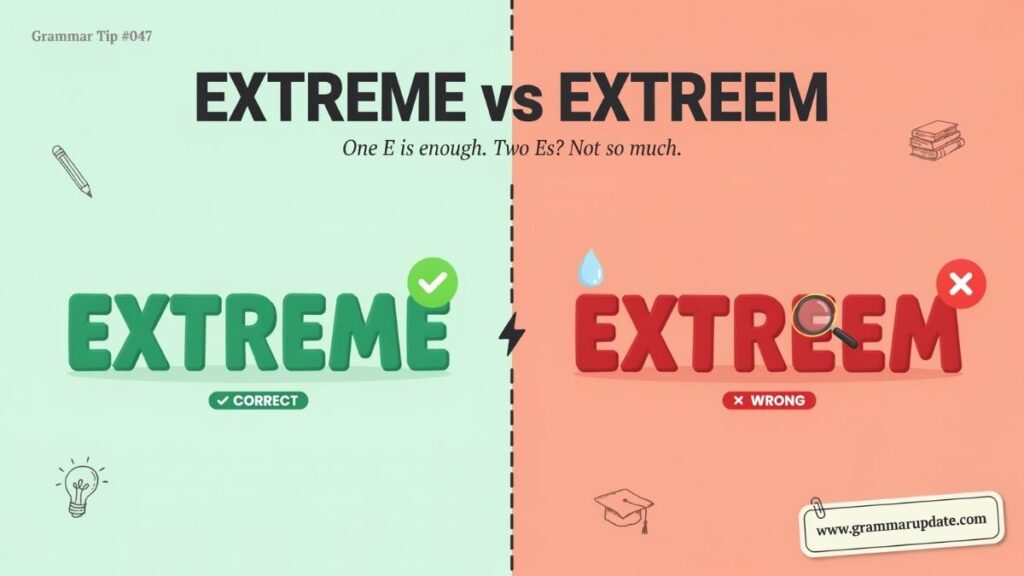
The confusion between extreme vs extreem is easy to clear up once you know the correct spelling. Extreme is the standard spelling, while extreem is a common misspelling. The mistake often happens because the ending of extreme sounds like “eem,” which can make “extreem” seem reasonable at first glance. However, the correct spelling ends with “eme.” Extreme describes something very intense, severe, unusual, or far beyond normal. You might talk about extreme weather, extreme pressure, or an extreme reaction. In this article, we will look at extreme vs extreem, explain the difference, and give you a simple way to remember the correct spelling.
quick answer
The main difference between extreme vs extreem spelling is simple. Extreme is the standard English spelling. Extreem is an incorrect spelling of the same word.
| Word | Status | Meaning | Example |
|---|---|---|---|
| Extreme | Correct | Very intense, severe, excessive, or far from ordinary | The region experienced extreme heat. |
| Extreem | Incorrect | Not the standard spelling of extreme | The correct form is extreme. |
The correct spelling of extreme is e-x-t-r-e-m-e. The word extreem does not represent a standard spelling variation.
That distinction matters in schoolwork, professional writing, articles, emails, and other forms of standard English. A spelling mistake may not change the meaning of a sentence, but it can still make the writing look less polished.
Learn the difference between tricky grammar more words
Believe Vs Belive Which one Is Correct?
What Does Extreme Mean?
The extreme meaning centers on the idea of going beyond what is usual or moderate.
A simple extreme definition is something that reaches a very high or very low degree. It can describe something intense, severe, excessive, exceptional, or far from ordinary.
For example:
The hikers faced extreme weather conditions.
Here, extreme tells us that the weather was unusually severe.
Consider another example:
She felt extreme pressure before the competition.
In this sentence, extreme describes a very high degree of pressure.
The word can also refer to the farthest point of something or to an end of a range.
The two opinions represent opposite extremes.
Here, extremes refers to positions at opposite ends of a range.
Extreme as an Adjective
Extreme is most commonly used as an adjective. It describes a noun and shows that something has reached an unusually high or low level.
For example:
The city experienced extreme heat.
The patient reported extreme pain.
The climbers faced extreme conditions.
The company took extreme measures to solve the problem.
His reaction seemed extreme.
In each example, extreme adds the idea of unusual intensity or degree.
The meaning changes slightly depending on the noun that follows it. Extreme heat means unusually intense heat. And Extreme measures means unusually drastic actions. Extreme pain means very severe pain.
That flexibility makes extreme a useful word in everyday English vocabulary.
Extreme as a Noun
Extreme can also function as a noun. In this form, it can refer to an outer limit, a far-reaching condition, or one end of a range.
For example:
The temperature moved from one extreme to the other.
In this sentence, extreme refers to an end of the temperature range.
You can also say:
The two groups represent opposite extremes.
Here, extremes refers to positions at opposite ends of a spectrum.
The plural form is extremes.
For example:
The experiment tested the extremes of the material.
Understanding both uses helps you recognize why extreme appears in different types of sentences.
Learn the difference between tricky grammar more words
Cemetery vs Cemetary Which one Is Correct?
What Does Extreem Mean?
If you are searching for extreem meaning, there is an important point to remember. Extreem does not have a standard English meaning as an accepted spelling of extreme.
When someone writes extreem, they usually intend to write extreme.
For example:
Incorrect: The weather was extreem.
Correct: The weather was extreme.
The intended meaning is obvious in the first sentence, but the spelling is still incorrect.
Is Extreem a Word?
So, is extreem a word? In standard English usage, you should not use extreem as the spelling of the word meaning unusually intense, severe, or far from ordinary.
You may occasionally see extreem online because people make spelling mistakes. A misspelled form can appear repeatedly on websites, social media, comments, or informal messages. That does not turn it into the standard spelling.
For correct English writing, use extreme.
Is Extreem Correct?
Is extreem correct? No, not when you mean the standard English word.
The correct form is extreme.
This applies whether you are writing about extreme weather, extreme sports, extreme emotions, extreme conditions, or extreme opinions.
Learn the difference between tricky grammar more words
Caught vs Cauhgt difference and usage?
Why Do People Confuse Extreme vs Extreem?
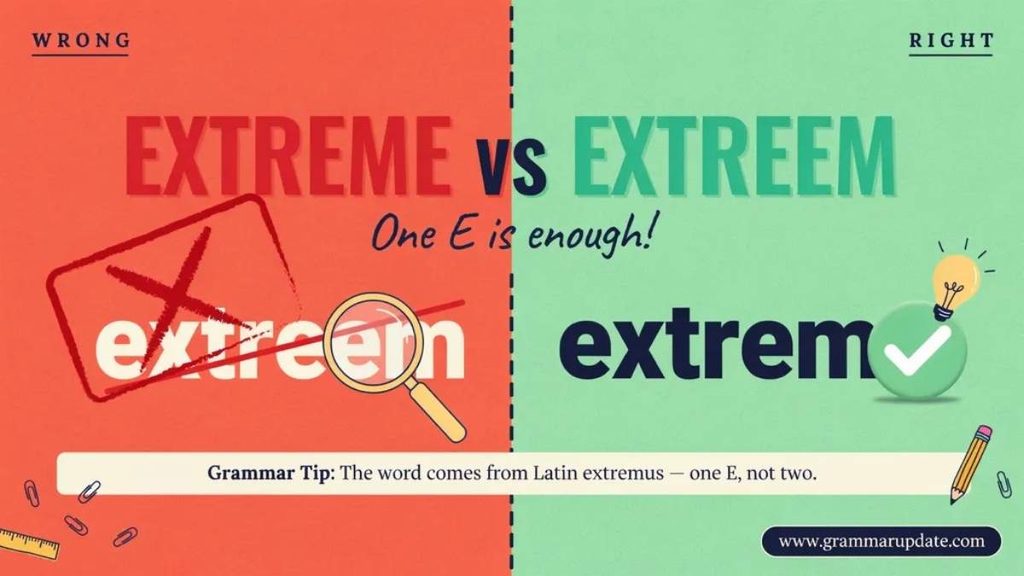
The main reason for the confusion is pronunciation.
The final sound in extreme can make the word seem as if it should end in “ee.” When people spell a word based mainly on how it sounds, they may replace the final e with ee and produce extreem.
That seems reasonable at first glance. English spelling, however, contains many patterns that cannot be predicted perfectly from pronunciation.
A sound may have several possible spellings, while a particular word has only one standard written form.
This is why spelling a word by sound alone can lead to common English errors.
The safest approach is to learn the pronunciation and spelling together. Once you become familiar with extreme, the correct form becomes much easier to recognize.
Extreme Spelling Pattern Explained
The spelling of extreme is:
E-X-T-R-E-M-E
The ending deserves special attention because it is where the mistake usually occurs.
Extreme ends in “eme,” not “eem.”
This small pattern can help you remember the correct spelling.
The word also connects naturally with several related forms:
1.Extreme → extremely
2.Extreme → extremity
3.Extreme → extremes
Seeing these words together makes the spelling pattern easier to remember.
Learn the difference between tricky grammar more words
Category vs Catagory Which one Is Correct?
Extreme vs Extremely
The Extreme and extremely are related, but they serve different grammatical purposes.
Extreme is usually an adjective.
It was an extreme situation.
Extremely is an adverb.
The situation was extremely difficult.
In the first sentence, extreme describes the noun situation. In the second sentence, extremely modifies the adjective difficult.
This distinction is useful when working on English grammar because changing the word form can change how the word functions in a sentence.
How to Spell Extremely
If you are wondering how to spell extremely, the correct spelling is:
E-X-T-R-E-M-E-L-Y
The word comes from extreme with the addition of -ly.
Extreme → extremely
The incorrect form extreemly comes from the same spelling mistake discussed throughout this article.
Remember the base word first. Once extreme is correct, extremely becomes much easier to spell.
Learn the difference between tricky grammar more words
Atheist Vs Athiest Which Spelling Is Correct?
Extreme vs Extreem Spelling in Everyday Sentences
The easiest way to understand the difference is to see the words in context.
Incorrect:
The area experienced extreem rainfall.
Correct:
The area experienced extreme rainfall.
Incorrect:
He showed extreem patience.
Correct:
He showed extreme patience.
Incorrect:
The climbers faced extreem cold.
Correct:
The climbers faced extreme cold.
Incorrect:
The situation required extreem measures.
Correct:
The situation required extreme measures.
In every case, the meaning remains clear even when the spelling is wrong. However, standard English requires extreme.
Common Mistakes With Extreme
One of the most common spelling mistakes is writing extreem instead of extreme.
This usually happens when a writer remembers the sound but not the exact spelling.
Another mistake is writing extreemly instead of extremely. Once the incorrect spelling becomes familiar, it can easily carry over into related forms.
There is also a tendency to assume that extreme vs extreem might be spelling variations. They are not standard alternatives in ordinary English.
The simple spelling correction is:
extreem → extreme
extreemly → extremely
That is all you need to remember.
Learn the difference between tricky grammar more words
Acquire Vs Aquire Which one Is Correct?
Extreme Synonyms and Meaning
The best extreme synonym depends on the context. Words such as intense, severe, excessive, drastic, exceptional, and extraordinary can work in particular situations, but they are not always interchangeable.
| Phrase | Possible alternative | Meaning |
|---|---|---|
| Extreme heat | Intense heat | Very strong heat |
| Extreme pain | Severe pain | Very serious or strong pain |
| Extreme measures | Drastic measures | Strong or far-reaching actions |
| Extreme behavior | Excessive behavior | Behavior beyond what is considered normal |
| Extreme difference | Extraordinary difference | An unusually large difference |
| Extreme conditions | Severe conditions | Difficult or harsh conditions |
For example, intense works naturally with heat, pain, pressure, or emotion. Drastic works especially well with actions and decisions. Severe often describes difficult or harmful conditions.
Choosing the right synonym depends on the sentence, so replacing extreme automatically is not always the best choice.
Learn the difference between confusing more English words
Daiquiri Vs Dacquiri Which one Is Correct?
Examples of Extreme in Different Contexts
Extreme appears in many areas of English because the basic idea of unusually high intensity or degree applies to countless situations.
Weather:
The town experienced extreme weather during the storm.
Temperature:
The equipment can operate in extreme temperatures.
Sports:
Extreme sports often involve greater physical risk than ordinary recreational activities.
Emotions:
She felt extreme relief after hearing the good news.
Pressure:
The workers operated under extreme pressure.
Opinions:
His position was considered extreme by some members of the group.
Conditions:
The explorers survived extreme conditions in the mountains.
Behavior:
The situation led to an extreme response.
These examples show how the surrounding words help determine the precise meaning of extreme.
Extreme Pronunciation and Spelling
Extreme pronunciation can contribute to the spelling mistake because the final sound does not clearly reveal the written form.
The word has two syllables, with the main stress on the second syllable.
For English learners, this provides a useful lesson: pronunciation and spelling work together, but they are not always identical.
If you are learning how to pronounce extreme, practice saying the word while also looking at its written form. This creates a stronger connection between its sound and spelling.
That approach can help prevent spelling mistakes later.
Is Extreme a Word?
Yes. Extreme is a standard English word.
It works as both an adjective and a noun.
As an adjective:
The region experienced extreme temperatures.
As a noun:
The two solutions represent opposite extremes.
The word is well established in standard English and appears in formal writing, everyday conversation, journalism, academic writing, and technical contexts.
So, if you are asking is extreme a word, the answer is clearly yes.
Learn the difference between confusing more English words
Becoming vs Becomeing Which one Is Correct?
Extreme and Its Related Word Forms
Learning related words can make spelling easier because you start recognizing the same word family.
| Word | Part of speech | Meaning |
|---|---|---|
| Extreme | Adjective | Very intense, severe, excessive, or far from ordinary |
| Extreme | Noun | An outer limit or far-reaching condition |
| Extremely | Adverb | To a very great degree |
| Extremity | Noun | An outermost part or extreme condition |
| Extremes | Plural noun | More than one extreme |
For example:
The weather was extreme.
The weather was extremely hot.
The hikers reached an extreme point.
The injury affected an extremity.
The two positions represented opposite extremes.
Once you recognize the relationship between these words, their spelling becomes easier to remember.
Is Extreem a Misspelling?
Yes. If someone intends to write the standard English word extreme, then extreem is a misspelling.
The spelling correction is straightforward:
Extreem → Extreme
The mistake does not usually prevent readers from understanding the sentence. However, correct spelling matters when you want your writing to look accurate and professional.
This is especially important in articles, reports, applications, school assignments, business communication, and other formal writing.
Why Is Extreem Wrong?
The question why is extreem wrong comes down to standard spelling.
The English word has an established written form: extreme.
Although the pronunciation can make the “ee” spelling seem tempting, the standard form uses the letters e-m-e at the end.
Compare the two:
Extreme
Extreem
The difference is only one letter, but that letter determines whether the spelling follows standard English usage.
There is no need to create a separate meaning for extreem. When you see it in ordinary writing, the intended word is generally extreme.
Learn the difference between confusing more English words
Controversy vs Contraversy which one is correct?
Extreme English Spelling A Simple Memory Trick
A quick memory trick can make the spelling stick.
Remember this:
Extreme ends with “eme.”
Do not change the ending to “eem.”
You can also connect the word with its related forms:
Extreme → extremely → extremity
This gives you more than one way to recognize the correct spelling.
If you are writing quickly and suddenly wonder how to spell extreme correctly, look for the final e.
E-X-T-R-E-M-E
That quick mental check can prevent the common spelling error.
Learn the difference between confusing more English words
Conscious vs Conscience Difference and which is correct?
Practice Session Extreme vs Extreem
Fill in each blank with the correct word:Extreme vs Extreem
- The hikers faced ______ weather conditions during the climb.
- The doctor said the patient was experiencing ______ pain.
- The company took ______ measures to solve the problem.
- The region experienced ______ heat last summer.
- His reaction to the situation seemed ______.
- The explorers survived ______ conditions in the mountains.
- The workers were under ______ pressure to finish the project.
- She felt ______ relief after hearing the good news.
- The sentence contains the misspelled word “______.”
- The correct spelling is ______, not “extreem.”
- The climbers prepared for ______ cold at high altitude.
- The two opinions represent opposite ______.
- The equipment can operate in ______ temperatures.
- His behavior became ______ after several stressful events.
- The storm caused ______ damage across the area.
- The athlete showed ______ determination during the competition.
- The situation required ______ action.
- The word “extreem” is an incorrect spelling of ______.
- The weather conditions were too ______ for normal travel.
- She experienced ______ anxiety before the important exam.
- The two groups hold ______ positions on the issue.
- The rescue team worked in ______ conditions.
- Remember that ______ ends with “eme,” not “eem.”
- The adjective form is ______, while the adverb form is “extremely.”
- If you are unsure how to spell the word, write ______.
Answers
- extreme
- extreme
- extreme
- extreme
- extreme
- extreme
- extreme
- extreme
- extreem
- extreme
- extreme
- extremes
- extreme
- extreme
- extreme
- extreme
- extreme
- extreme
- extreme
- extreme
- extreme
- extreme
- extreme
- extreme
- extreme
Here’s a trusted source for clear word meanings:
FAQs
Why is “extreem” often misspelled?
“Extreem” usually appears when people spell the word according to how it sounds. The ending may sound like “eem,” but the correct spelling uses “eme.” The standard form is “extreme.”
Does “extreem” have a meaning in English?
No. “Extreem” is not a standard English word when it is used as a spelling of “extreme.” It is generally a misspelling, so use “extreme” in correct English writing.
Why does extreme end with “eme”?
English spelling does not always follow pronunciation exactly. Although the ending of “extreme” sounds similar to “eem,” the standard written form ends in “eme.” Remembering this pattern can help prevent the common spelling mistake.
Can extreme describe something positive?
Yes. “Extreme” does not always describe something negative. It can describe a very high degree of something positive, negative, or neutral. For example, someone can feel extreme excitement, face extreme difficulty, or experience extreme weather.
Can extreme describe a person’s opinions?
Yes. We can use “extreme” to describe opinions or views that sit far from moderate or commonly held positions. The exact meaning depends on the context in which the word appears.
What is the plural of extreme?
The plural noun form is “extremes.” For example, you might say, “The two approaches represent opposite extremes.”
What is the adverb form of extreme?
The adverb form is “extremely.” For example, “The road was extremely dangerous” uses “extremely” to modify the adjective “dangerous.”
What related noun comes from extreme?
“Extremity” is a related noun. Depending on the context, it can refer to an extreme condition or the outermost part of something.
Can extreme come before a noun?
Yes. “Extreme” commonly works as an adjective before a noun. Common combinations include “extreme weather,” “extreme pressure,” “extreme temperatures,” and “extreme conditions.”
Can extreme function as a noun?
Yes. “Extreme” can function as a noun when it refers to an outer limit or one end of a range. For example, “The two opinions represent opposite extremes.”
Does extreme always have a negative meaning?
No. “Extreme” simply describes something that goes far beyond a normal, moderate, or expected level. Whether that quality is good, bad, or neutral depends on the context.
What is the easiest way to remember how to spell extreme?
Remember the ending “eme.” The correct spelling is E-X-T-R-E-M-E. Avoid changing the ending to “eem,” which produces the incorrect form “extreem.”
Is “extreem” acceptable in formal writing?
No. Standard formal English uses “extreme.” Although “extreem” may appear because of a spelling mistake, it is not the accepted spelling of the word.
How can you quickly check whether to use extreme vs extreem?
Ask yourself whether you mean the standard English word describing something very intense, severe, unusual, or far beyond normal. If so, write “extreme.” The form “extreem” is incorrect.
What common words are related to extreme?
Several useful forms come from “extreme,” including “extremely,” “extremity,” and “extremes.” Each form has a different grammatical role, so choose the one that fits your sentence.
Can extreme describe physical conditions?
Yes. “Extreme” often describes harsh or unusually intense physical conditions. For example, “The workers had to operate in extreme temperatures.”
Can extreme describe emotions?
Yes. We commonly use “extreme” with strong emotions or emotional states. Phrases such as “extreme excitement,” “extreme fear,” and “extreme sadness” describe emotions that reach a very high level.
What is the difference between extreme and extremely?
“Extreme” usually works as an adjective or noun, while “extremely” works as an adverb. For example, “The weather was extreme” uses “extreme” as an adjective, while “The weather was extremely cold” uses “extremely” as an adverb.
What does extreme mean in everyday English?
In everyday English, “extreme” describes something that goes far beyond what is normal, moderate, or expected. It can describe intensity, degree, conditions, behavior, emotions, or opinions.
Is “extreem” a spelling variation of extreme?
No. “Extreem” is not a standard spelling variation. When you mean the English word “extreme,” use the spelling E-X-T-R-E-M-E.
How can you stop making the extreem spelling mistake?
Focus on the written form instead of the pronunciation. Remember the ending “eme” in “extreme.” Writing the word correctly in several different sentences can also make the spelling easier to remember.
Learn the difference between confusing more English words
Apparent Vs Aparent Which one Is Correct?
Conclusion
The confusion between extreme vs extreem is easy to clear up. Extreme is the correct spelling, while extreem is a common misspelling. The word extreme describes something very intense, severe, unusual, or far beyond what is normal. You can use it as both an adjective and a noun, with related forms such as extremely, extremity, and extremes.
The main reason people write extreem is pronunciation. The ending may sound like “eem,” but the spelling uses “eme.” So, when you need this word, remember E-X-T-R-E-M-E. Once you remember that simple pattern, the extreme vs extreem confusion becomes much easier to avoid.

Jhon AJS, the creative mind behind Grammar Update, is an experienced blogger passionate about simplifying English grammar. He focuses on explaining confusing word vs word differences, grammar rules, punctuation, and sentence structure in a clear and practical way. Through easy to understand guides and examples, Jhon helps readers improve their writing and communicate with confidence. With years of blogging experience, he continues to share helpful insights that make learning grammar simple, useful, and accessible for everyone.