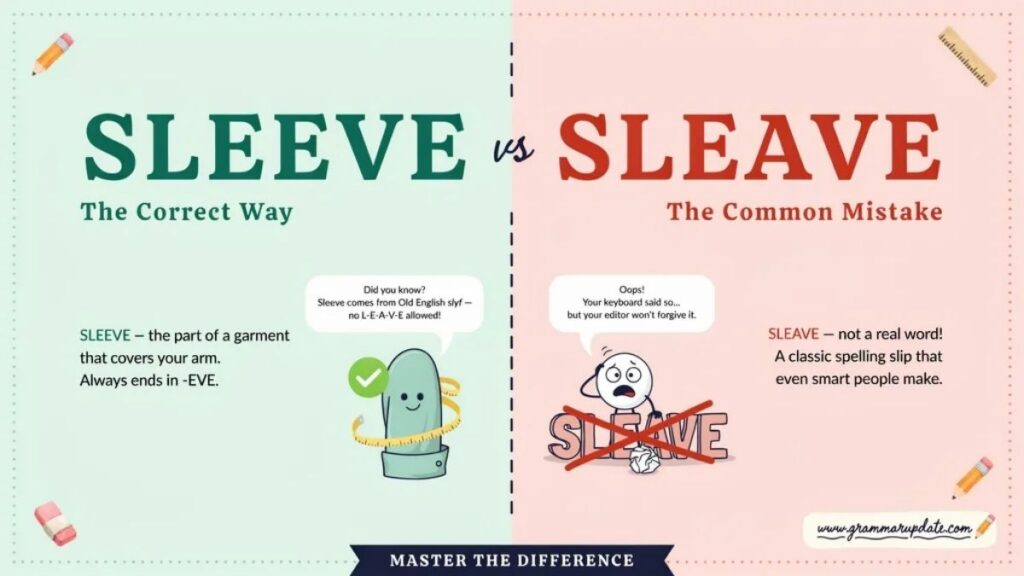
Sleeve vs sleave is a small spelling difference that can cause a surprisingly big amount of confusion. The two words look almost identical and can sound the same, but they don’t carry the same meaning. Sleeve is the familiar word you use for the part of a shirt, jacket, coat, or dress that covers the arm. Sleave, on the other hand, is a rare historical word connected with silk, thread, and textile work. So, which one should you use? This guide will clear up the confusion, explain the meanings in simple terms, and show you the correct spelling with practical examples. By the end, the difference will be easy to remember.
Sleeve vs Sleave Quick Answer
The sleeve vs sleave meaning becomes much easier when you compare the words side by side.
| Word | Meaning | Modern usage | Example |
|---|---|---|---|
| Sleeve | A part of clothing that covers some or all of the arm | Very common | The sleeve of my shirt is too long. |
| Sleeve | A protective cover | Common | Put the record back in its sleeve. |
| Sleeve | A tubular covering or component | Common in technical contexts | The shaft fits inside the sleeve. |
| Sleeve | A tattoo covering much of the arm | Common | He has a full sleeve tattoo. |
| Sleave | A skein or mass of thread, especially silk | Rare and archaic | The word appears in historical textile writing. |
| Sleave | To separate silk thread into filaments | Obsolete | The old textile term referred to processing silk. |
So, if you’re writing about a shirt, jacket, coat, dress, or tattoo, use sleeve.
If you’re studying historical English, Shakespearean language, or old textile terminology, you may encounter sleave.
Learn the difference between tricky grammar more words
Height vs Hight difference and Which one Is Correct?
What Does Sleeve Mean?
The most common sleeve definition is simple: a sleeve is the part of a garment that covers some or all of the arm.
That makes sleeve an everyday clothing term. You see it in conversations about shirts, jackets, dresses, coats, sweaters, uniforms, and many other garments.
A sleeve can have different lengths, shapes, cuts, and designs. The word stays the same even when the garment itself changes.
For example:
- The sleeve of the shirt is too tight.
- She rolled up her sleeves.
- This jacket has a wide sleeve opening.
- He bought a long-sleeved shirt.
- The short-sleeved shirt is perfect for summer.
The basic idea remains the same: the sleeve forms part of the garment and covers the arm.
Sleeve Meaning in Clothing
When people search for sleeve vs sleave clothing, they’re usually trying to confirm the spelling of a familiar clothing term.
The correct word is sleeve.
A clothing sleeve can cover the upper arm, the lower arm, or the entire arm. Its exact length depends on the garment and the style.
Common types include:
- Short sleeves
- Long sleeves
- Three-quarter sleeves
- Bell sleeves
- Puff sleeves
- Raglan sleeves
- Dolman sleeves
- Kimono sleeves
- Set-in sleeves
- Sleeveless designs
A short sleeve might end above the elbow. A long sleeve generally extends toward the wrist. Some fashion designs use sleeves that are deliberately oversized, fitted, gathered, or flared.
None of these variations changes the spelling.
Long Sleeve and Short Sleeve
The terms long sleeve and short sleeve appear frequently in clothing descriptions.
For example:
A long-sleeved shirt covers most of the arm.
A short-sleeved shirt leaves much of the lower arm uncovered.
You may also see the words written with a hyphen when they function as adjectives before a noun:
- long-sleeved shirt
- short-sleeved shirt
- long-sleeved dress
- short-sleeved jacket
The important point is that all of these forms come from sleeve.
There is no clothing context in which sleave becomes the standard spelling.
Learn the difference between tricky grammar more words
To Small vs Too Small Which one Is Correct?
Sleeve vs Sleave Shirt Which One Is Correct?
The answer to sleeve vs sleave shirt is straightforward.
Use shirt sleeve.
For example:
The sleeve of my shirt is too long.
You can also say:
My shirt sleeve is torn.
Or:
The shirt has short sleeves.
The incorrect spelling would be sleave.
A sentence such as “The sleave of my shirt is too long” doesn’t use the standard English word for the garment part.
This mistake happens because sleeve and sleave sound alike. When someone hears the word rather than sees it written, the spelling isn’t obvious.
That’s where context helps.
If the sentence talks about fabric, arms, shirts, jackets, or clothing, sleeve is the correct word.
What Is a Sleeve on a Shirt?
A shirt sleeve is the section of a shirt that extends from the shoulder or upper part of the garment down along the arm.
The construction can vary depending on the shirt.
A traditional fitted shirt may have a sleeve attached at the shoulder seam. A T-shirt can have a relatively simple short sleeve. A dress shirt often has a longer sleeve that reaches the wrist and ends with a cuff.
The sleeve also affects the overall fit of a garment.
For example, a sleeve that’s too narrow can restrict movement. A sleeve that’s too long can bunch around the wrist. A sleeve that’s too short may leave more of the forearm exposed than intended.
That’s why sleeve length matters in tailoring and clothing design.
Sleeve Length and Sleeve Design
Sleeve length is one of the basic measurements used when making or buying clothing.
Designers also pay attention to sleeve design because sleeves can change the appearance of an entire garment. A fitted sleeve creates a different silhouette from a loose or flowing sleeve.
Common sleeve design choices include:
- Fitted sleeves
- Loose sleeves
- Flared sleeves
- Gathered sleeves
- Bell sleeves
- Puff sleeves
- Raglan sleeves
- Batwing sleeves
The sleeve opening also affects comfort and movement. A narrow opening may create a close fit around the wrist, while a wider opening can give the garment a looser feel.
These details matter in fashion, sewing, tailoring, and clothing construction. Yet the basic word remains sleeve.
What Does Sleave Mean?
The sleave meaning is much less familiar because the word has largely disappeared from everyday English.
Sleave is a genuine word. However, it doesn’t mean the sleeve of a shirt.
Merriam-Webster records sleave as a noun referring to a skein and labels that sense archaic. It also records a verb meaning to separate silk thread into filaments and labels that sense obsolete.
In simple terms, sleave belongs to historical textile vocabulary.
It connects with materials such as silk and thread rather than with the arm covering found on modern clothing.
That gives you an easy distinction:
Sleeve relates to clothing and coverings.
Sleave relates to old textile terminology involving thread and silk.
Sleave Meaning in Textiles
The sleave meaning becomes clearer when you look at the history of textile production.
Before modern industrial processes made fabrics and threads widely available, textile workers handled raw fibers and threads through many stages of preparation. Terms that described these materials became part of specialized vocabulary.
Sleave referred to a skein or loose mass of thread, particularly silk.
A skein is a length or bundle of yarn or thread loosely wound into a form that makes it easier to handle. In historical textile contexts, the word could describe material that had not yet taken the form of a tightly organized finished thread.
This is why searches for sleave silk thread or sleave textile meaning often lead to historical sources.
The word belongs to a very different vocabulary from modern clothing terms such as shirt sleeve, jacket sleeve, and sleeve length.
Sleave as a Verb
Sleave also appears as a verb.
Historically, to sleave meant to separate silk thread into individual filaments.
This meaning is even less common today. Modern readers are most likely to encounter it while studying historical English, textile terminology, or older literature.
The forms may include:
- sleave
- sleaves
- sleaved
- sleaving
These forms shouldn’t be confused with the ordinary forms of sleeve.
For example, sleeves is the plural of sleeve.
It does not mean the plural of the historical textile noun in ordinary modern writing.
Is Sleave a Word?
Yes. If you’re asking, “Is sleave a word?” the answer is yes.
However, that answer needs some context.
Sleave is a rare English word with historical meanings. Its existence doesn’t make it an alternative spelling for sleeve.
This distinction matters because dictionaries contain many words that modern speakers rarely use. Some survive mainly because they appear in historical documents, literature, specialized terminology, or regional usage.
So there are two separate questions:
Is sleave a real word?
Yes.
Is sleave the correct spelling for the arm covering of a shirt?
No.
That is the key difference.
Is Sleave a Real Word?
Yes, sleave is a real word in English.
If you’re searching for is sleave a real word, is sleave a word in English, or sleave dictionary, you’ll find evidence that it has legitimate historical meanings.
However, don’t mistake dictionary recognition for modern everyday usage.
For example, English dictionaries preserve many archaic words that most people never use in conversation. These words remain useful because they help readers understand older texts.
Sleave falls into that category.
It’s real, but it’s uncommon.
Learn the difference between tricky grammar more words
Taylored vs Tailored Which one Is Correct?
Sleave vs Sleeve Why the Confusion Happens
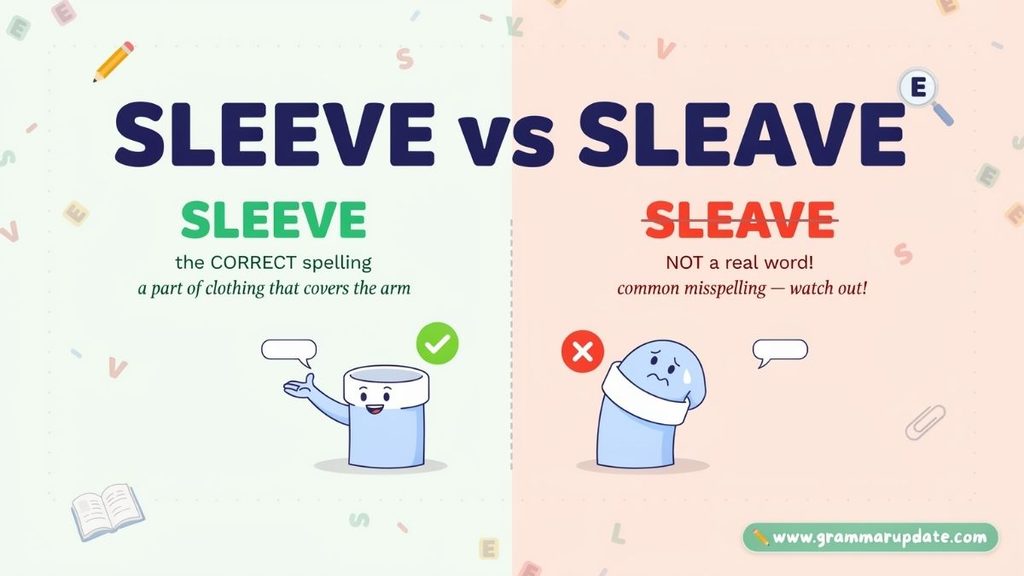
The sleeve vs sleave spelling difference comes down to two small letters:
sleeve
sleave
The first uses ee.
The second uses ea.
That tiny difference creates a surprisingly persistent spelling problem because the words are pronounced alike or almost alike.
If someone says “sleeve” aloud, you have to know the context to determine how to spell it.
You can’t reliably hear whether the speaker means sleeve or sleave.
That makes these words a useful example of how English spelling doesn’t always follow pronunciation neatly.
Sleeve Pronunciation and Sleave Pronunciation
The sleeve pronunciation is /sliːv/.
Sleave has essentially the same pronunciation.
That means both words sound like “sleev.”
This explains why people sometimes write sleave when they actually mean sleeve.
When you hear:
“The sleeve is too short.”
Nothing in the pronunciation tells you that the spelling requires ee.
You have to rely on your knowledge of English spelling and the context of the sentence.
For everyday writing, the easiest rule is still the best one:
If you’re talking about clothing, write sleeve.
Sleeve Spelling vs Sleave Spelling
The sleeve spelling contains ee:
sleeve
The sleave spelling contains ea:
sleave
Although both spellings exist, they don’t function as interchangeable versions of the same word.
Compare these:
The sleeve of my jacket is torn.
The sleave of my jacket is torn.
The first sentence uses the correct modern clothing term. The second uses a historical word in a context where it doesn’t belong.
This is a classic example of why correct spelling depends on meaning.
A spelling checker may flag sleave in a clothing sentence, but understanding the distinction requires more than simply asking whether a word exists. You need to know what the word means.
What Is the Difference Between Sleeve and Sleave?
The difference between sleeve and sleave is mainly semantic and historical.
Sleeve is a common modern English word.
Sleave is a rare historical word.
The two words can sound identical, but their meanings differ sharply.
Sleeve has several modern meanings:
- A part of a garment
- A protective cover
- A tubular component
- A tattoo covering the arm
- Part of several common idioms
Sleave has historical meanings connected with:
- Thread
- Silk
- Skeins
- Loose fibers
- Textile work
That makes the sleeve and sleave difference easy to summarize:
Sleeve belongs to everyday English.
Sleave belongs mainly to historical or specialized English.
Learn the difference between tricky grammar more words
Camouflage Vs Camoflage Which one Is Correct?
Sleeve vs Sleave Quick Comparison
| Feature | Sleeve | Sleave |
|---|---|---|
| Common modern word | Yes | No |
| Used for clothing | Yes | No |
| Used for shirts | Yes | No |
| Used for jackets | Yes | No |
| Used for tattoos | Yes | No |
| Related to thread and silk | Not primarily | Yes |
| Historical usage | Yes | Yes |
| Archaic | No in its common meanings | Yes |
| Obsolete sense | Not generally | Yes, as a verb |
| Everyday US English | Very common | Extremely rare |
The table captures the practical answer without making the issue more complicated than it needs to be.
Sleeve vs Sleave in Clothing
When the topic is clothing, the answer doesn’t really change.
Use sleeve.
That applies to:
- Shirt sleeves
- Jacket sleeves
- Coat sleeves
- Dress sleeves
- Sweater sleeves
- Long sleeves
- Short sleeves
- Sleeve length
- Sleeve design
- Sleeve openings
The phrase clothing sleeve is standard.
The phrase clothing sleave is not.
This remains true whether you’re talking about everyday clothes, sewing patterns, fashion design, tailoring, or clothing measurements.
Sleeve or Sleave for a Jacket
The correct phrase is jacket sleeve.
For example:
The jacket sleeve is too long.
Or:
The tailor shortened the jacket sleeves.
The same rule applies to a coat sleeve.
You don’t switch to sleave simply because the garment is different.
Sleeve vs Sleave Tattoo
The correct phrase is sleeve tattoo.
A tattoo sleeve is a large tattoo that covers much or most of the arm.
You may see terms such as:
- full sleeve tattoo
- half sleeve tattoo
- tattoo sleeve
- sleeve tattoo design
- arm sleeve tattoo
All use sleeve.
The spelling sleave does not apply to this modern tattoo meaning.
Learn the difference between tricky grammar more words
Buoyant vs Bouyant Which one Is Correct?
Why Context Matters More Than the Spelling Alone
The most important lesson from sleeve vs sleave is that dictionaries don’t always give you a simple “real word versus fake word” answer.
Both words exist.
Only one fits the usual clothing context.
Imagine seeing the sentence:
She rolled up her sleeves before starting work.
The meaning is immediately clear.
Now imagine:
The historian studied an old reference to sleave.
That sentence also works, but the context is completely different.
The first sentence belongs to everyday English.
The second belongs to historical or specialized language.
Context tells you which word belongs.
A Simple Memory Trick for Sleeve vs Sleave
If you often forget the correct spelling of sleeve, connect it with the arm.
Think:
sleeve → shirt → arm
For sleave, think:
sleave → silk → thread
That gives you two simple mental pictures.
A shirt has sleeves.
An old textile reference may contain sleave.
The distinction is much easier to remember once each word has its own meaning instead of being treated as two random spellings.
Sleeve vs Sleave Meaning in Everyday English
The most useful way to understand sleeve vs sleave meaning is to look at frequency and context.
Sleeve is an ordinary modern English word. You might use it several times in a week without thinking about it. It appears in conversations about clothing, shopping, sewing, fashion, sports uniforms, tattoos, packaging, records, and machinery.
Sleave is different. Most people encounter it only while reading older literature, studying the history of English, researching textiles, or consulting a dictionary.
That difference gives you a practical rule:
Use sleeve for normal modern writing.
Use sleave only when its historical or specialized meaning fits the context.
Learn the difference between tricky grammar more words
Humorous vs Humerous Which one Is Correct?
What Does Sleeve Mean Beyond Clothing?
Although clothing provides the most familiar sleeve definition, the word has several other established meanings.
At its core, many of these meanings involve the idea of something that covers, surrounds, or fits around another object.
That connection explains why the word appears in such different fields.
Sleeve as a Protective Cover
A sleeve can protect another object from damage, dirt, friction, or exposure.
You might encounter:
- protective sleeve
- paper sleeve
- record sleeve
- album sleeve
- document sleeve
- cable sleeve
- packaging sleeve
For example:
The vinyl record came in a paper sleeve.
Here, sleeve doesn’t refer to clothing at all. It refers to a cover designed to hold and protect another object.
The basic concept remains similar, though. A clothing sleeve surrounds an arm. A protective sleeve surrounds an object.
Record Sleeve and Album Sleeve
Record sleeve is a well-established expression.
A record sleeve holds and protects a vinyl record. Depending on the context, people may also talk about an album sleeve when referring to the artwork or physical cover associated with a record.
For example:
The album sleeve features artwork from the original release.
In American English, record jacket or album cover can also appear in related contexts. The exact terminology depends on the format and region.
The spelling remains sleeve.
Not sleave.
Sleeve as a Mechanical Component
Technical English uses sleeve for a tubular component that fits around another part.
For example:
The mechanic replaced the worn sleeve around the shaft.
This meaning appears in engineering, manufacturing, automotive work, plumbing, and other technical fields.
A mechanical sleeve can help support, protect, align, reinforce, or separate components.
Although this use seems far removed from clothing, the underlying idea is still related to a covering or tube that fits around something else.
What Does Sleave Mean in English?
If you’re asking what does sleave mean in English, the answer needs a historical explanation.
Sleave is associated with thread, especially silk thread, and with a skein or tangled mass of fibers. Its recorded meanings belong to older English vocabulary.
The noun is uncommon enough that many modern speakers have never encountered it.
The verb is even rarer.
Historically, to sleave meant to separate silk thread into its individual filaments.
This is why searches for sleave meaning, sleave definition in English, and sleave word meaning often lead to discussions of old textiles and historical literature.
Sleave Definition in English
A practical sleave definition in English would be:
Sleave is an archaic noun for a skein or mass of thread, particularly silk. As an obsolete verb, it refers to separating silk thread into filaments.
The exact wording can vary between dictionaries, but the important distinction remains the same.
Sleave belongs to the vocabulary of thread and textile production.
It does not mean the sleeve of a shirt.
The Historical Connection Between Sleave and Silk
Textile production once required specialized knowledge that isn’t common today.
People worked with raw fibers, yarn, silk, thread, and woven materials through many stages of preparation. As a result, historical English developed a large vocabulary for describing these materials and processes.
Sleave belongs to that world.
The word could describe a loose or tangled mass of fibers or thread. The related verb described working with silk filaments.
Modern clothing still uses thread and fabric, of course. What has changed is the vocabulary surrounding the production process.
Most people today don’t need a special word for a particular mass of silk fibers. That’s one reason sleave became rare.
Sleave and Shakespeare
One of the best-known literary appearances of sleave comes from William Shakespeare’s Macbeth.
Shakespeare uses the phrase “raveled sleave of care” when describing sleep and its relationship to human worries.
The expression is a strong example of historical metaphor.
Think of tangled thread. It twists around itself, forming a difficult knot that needs to be loosened.
Shakespeare uses that image to represent tangled worries and cares.
The meaning makes more sense once you know the old textile sense of sleave.
Without that background, a modern reader might assume the word refers to a sleeve on a shirt. It doesn’t.
Why the Shakespeare Example Matters
The Shakespeare connection helps explain why sleave remains visible in English dictionaries.
A word can become rare in everyday speech while remaining important in literature.
Readers studying Shakespeare, historical English, or older vocabulary may encounter sleave even though they never use it in ordinary conversation.
This is also a good reminder that modern English and historical English don’t always use words in the same way.
Sleeve Word Origin
The history of sleeve reaches back to Old English and other Germanic forms.
Merriam-Webster traces the word through Middle English forms to Old English forms including slīefe and slēfe. The word has related forms in other Germanic languages as well.
Over time, spelling changed as English developed.
The modern form sleeve eventually became established as the standard spelling.
This long history explains why the word shouldn’t be treated as a recently invented clothing term. People have used related forms of the word for centuries.
Sleave Word Origin
Sleave also has a long history, but its development belongs to a different branch of vocabulary.
Its older meanings relate to silk, thread, skeins, and loose fibers.
The historical textile connection explains the word’s presence in older literary texts.
That distinction is important because sleeve and sleave aren’t simply two competing spellings that English happened to keep.
They developed as separate words with separate meanings, even though their modern pronunciations overlap.
Sleeve Spelling vs Sleave Spelling
The spelling difference is small:
sleeve
sleave
The pronunciation doesn’t provide much help because both are pronounced with the long e sound followed by v.
That leaves the spelling to memory and context.
For modern clothing, remember:
sleeve has ee.
For the rare textile word, remember:
sleave has ea.
The spelling alone doesn’t tell the whole story. Meaning does.
Learn the difference between confusing word pairs
Tomorrow vs Tommorow Which one Is Correct?
Common Mistakes With Sleeve and Sleave
These words cause predictable errors.
“My Shirt Sleave Is Too Long”
Incorrect:
My shirt sleave is too long.
Correct:
My shirt sleeve is too long.
The sentence refers to clothing, so sleeve is required.
“Roll Up Your Sleaves”
Incorrect:
Roll up your sleaves.
Correct:
Roll up your sleeves.
The expression uses the plural form of sleeve.
“She Bought a Sleave Shirt”
Incorrect:
She bought a sleave shirt.
Correct:
She bought a shirt with sleeves.
Or:
She bought a long-sleeved shirt.
The spelling sleave doesn’t describe a shirt’s arm covering.
“The Jacket Sleave Is Torn”
Incorrect:
The jacket sleave is torn.
Correct:
The jacket sleeve is torn.
This remains true for coats, dresses, sweaters, uniforms, and other garments.
“He Has a Sleave Tattoo”
Incorrect:
He has a full sleave tattoo.
Correct:
He has a full sleeve tattoo.
The modern tattoo term comes from the visual idea of a sleeve covering the arm.tent.
Sleeve vs Sleave for a Shirt
The sleeve vs sleave for a shirt question has one clear answer.
Use sleeve.
Examples:
The shirt sleeve is too tight.
His shirt sleeves were rolled up.
She chose a long-sleeved shirt.
The sleeve opening feels uncomfortable.
Every sentence uses the modern spelling.
The word sleave doesn’t become appropriate simply because the sentence discusses fabric.or garment construction, sleeve is the correct English word.
Sleeve vs Sleave Tattoo
The correct expression is sleeve tattoo.
A sleeve tattoo can cover much of the arm and may extend from the shoulder toward the wrist.
Tattoo terminology commonly includes:
- full sleeve
- half sleeve
- quarter sleeve
- sleeve tattoo
- tattoo sleeve
- sleeve tattoo design
Again, all of these use sleeve.
Sleave has no standard modern tattoo meaning.
Learn the difference between confusing word pairs
Chief vs Chef difference and Which One Is Correct?
Sleeve Design and Clothing Terminology
Sleeve design plays an important role in fashion.
A designer can change the character of a garment simply by changing the sleeve. A narrow fitted sleeve creates a different silhouette from a wide bell sleeve. A puff sleeve adds volume near the shoulder. A raglan sleeve changes the construction of the garment and creates a distinctive diagonal seam.
This is why terms such as sleeve design, sleeve length, sleeve opening, and garment sleeve appear frequently in fashion and sewing vocabulary.
For example:
The designer used a wide sleeve design to create a relaxed silhouette.
The spelling is always sleeve.
Sleeve Length Why It Matters
Sleeve length affects both appearance and comfort.
A sleeve that ends above the wrist can create a casual look. A sleeve that reaches the wrist provides more coverage. In formal clothing, sleeve length also influences how much of a shirt cuff appears beneath a jacket sleeve.
Tailors often measure sleeve length carefully because even a small adjustment can change the fit.
For example, if a jacket sleeve is too long, the cuff may disappear beneath it. If it’s too short, too much of the shirt sleeve may show.
These details demonstrate why sleeve is more than a basic clothing word. It’s an important part of garment construction and fit.
Sleeve vs Sleave in Modern English
Modern English strongly favors sleeve in ordinary writing.
You can see the difference in how frequently the words appear across everyday contexts.
Sleeve appears in:
- Clothing descriptions
- Sewing instructions
- Fashion articles
- Shopping listings
- Tailoring
- Tattoo discussions
- Packaging
- Music and vinyl terminology
- Engineering
- Manufacturing
- Idioms
Sleave mainly appears in:
- Historical dictionaries
- Shakespeare studies
- Historical literature
- Textile history
- Etymology
- Rare-word discussions
That contrast makes the practical choice easy.
Learn the difference between commonly mixed-up more words
Awful vs Awfull Which one Is Correct?
Is Sleave Used in Modern English?
Sleave survives, but it has a very limited role in modern English.
Most contemporary readers won’t use it in normal conversation.
You may encounter it when reading an older text or researching the history of English. A dictionary may also preserve the word because dictionaries document historical vocabulary rather than only the words people use every day.
This is why the phrase rare English word accurately describes sleave in practical terms.
It isn’t imaginary.
It simply isn’t part of most people’s active vocabulary.
Is Sleave an Old English Word?
It’s safer to describe sleave as an old or historical English word rather than simply calling it an Old English word.
Old English refers specifically to the earliest historical stage of the English language, roughly before the Norman Conquest and through the later Old English period.
Sleave belongs to the historical development of English but is best discussed through its later Middle English and Early Modern English usage when explaining its literary and textile history.
This distinction matters because “old English” and “Old English” can mean different things.
If you’re discussing Shakespeare, for example, you’re dealing with Early Modern English, not Old English.
Is Sleave Still a Useful Word?
For most modern writing, no.
There are situations where it can be useful, though.
You might need sleave if you’re:
- Analyzing Shakespeare
- Studying historical English
- Researching textile history
- Reading an old dictionary
- Examining historical silk production
- Writing about obsolete vocabulary
- Studying the development of English spelling
Outside those contexts, sleeve will almost always be the word you need.
When to Use Sleeve
Use sleeve when you’re talking about:
- A shirt
- A jacket
- A coat
- A dress
- A sweater
- A uniform
- A tattoo
- A record cover
- A protective cover
- A mechanical component
- A common idiom
Examples:
The sleeve of the coat is torn.
She bought a short-sleeved shirt.
He has a sleeve tattoo.
The record came in a paper sleeve.
The mechanic installed a new sleeve.
She still had another trick up her sleeve.
All of these are standard modern uses.
When to Use Sleave
Use sleave only when its specific historical meaning fits.
That usually means a context involving:
- Silk
- Thread
- Skeins
- Loose fibers
- Historical textile terminology
- Older literature
For example:
The passage uses sleave in an old textile sense.
That is an appropriate modern sentence because you’re talking about the historical word itself.
Learn the difference between commonly mixed-up more words
Ingenuine vs Ungenuine Which one Is Correct?
How to Remember the Difference Between Sleeve and Sleave
A simple two-word association works well:
Sleeve = arm.
Sleave = silk.
Picture a shirt when you think of sleeve.
Picture loose silk fibers when you think of sleave.
This approach works better than trying to memorize a complicated spelling rule.
You don’t need to remember dozens of exceptions. You only need to connect each spelling with its meaning.
Sleeve vs Sleave Real-World Examples
Consider these examples.
Example Clothing
The sleeve of the shirt is stained.
Correct: sleeve.
The sentence refers to a part of clothing.
Example Fashion
The designer changed the sleeve design.
Correct: sleeve.
The sentence discusses garment construction.
Example Tattoo
She spent several months planning her sleeve tattoo.
Correct: sleeve.
The word describes tattoo coverage on the arm.
Example Historical Language
The writer uses sleave as an old textile term.
Correct: sleave.
Here, the sentence discusses the historical word itself.
Example Shakespeare
The passage contains the word sleave in a historical literary context.
Correct: sleave.
The word belongs to the older textile sense.
The context changes the answer.
Sleeve vs Sleave What Writers Should Remember
Writers don’t need to avoid sleave simply because it’s rare. They need to use it accurately.
If a historical text requires the word, use it.
If you’re writing about a shirt, don’t use it.
That distinction is especially important in educational content, product descriptions, fashion writing, sewing instructions, and general US English.
A reader searching for “shirt sleeve” expects the standard modern word. Writing “shirt sleave” creates an avoidable spelling mistake.
Likewise, changing the spelling to sleave in a tattoo article doesn’t make the language more sophisticated. It simply makes the sentence incorrect.
Learn the difference between commonly mixed-up more words
Ironic vs Unironic which one is correct and usage?
Practice Session Sleeve vs Sleave
Fill in each blank with the correct word: sleeve vs sleave. Use the context to decide which spelling fits.
- The ______ of my shirt is too long.
- She rolled up her ______ before washing the dishes.
- The tailor shortened the jacket ______.
- He bought a long-sleeved shirt with loose ______.
- Her full ______ tattoo covers most of her arm.
- The record came in a protective paper ______.
- The historian explained the old textile meaning of ______.
- Shakespeare used the word ______ in an older literary context.
- The coat ______ was torn near the cuff.
- The researcher studied references to silk ______ in historical texts.
- This short-sleeved shirt has wide ______.
- The designer changed the ______ length to improve the fit.
- The old passage uses ______ to describe tangled silk fibers.
- He pushed his ______ above his elbows.
- The tailor repaired both jacket ______.
- The dictionary lists ______ as an archaic textile term.
- The paper ______ protects the vinyl record from dust.
- Her dress has decorative ______ with gathered fabric.
- The literary scholar discussed the historical word ______.
- The ______ opening was too narrow around the wrist.
- The phrase “raveled sleave of care” contains the historical word ______.
- The shirt ______ became damaged during washing.
- The old textile document refers to ______ in connection with silk thread.
- He prefers long sleeves because they provide more arm ______.
- When you’re talking about a shirt, always use ______ rather than sleave.
Answers
- sleeve
- sleeves
- sleeve
- sleeves
- sleeve
- sleeve
- sleave
- sleave
- sleeve
- sleave
- sleeves
- sleeve
- sleave
- sleeves
- sleeves
- sleave
- sleeve
- sleeves
- sleave
- sleeve
- sleave
- sleeve
- sleave
- sleeve
- sleeve
Here’s a trusted source for clear word meanings:
FAQs
Is “sleave” a word in English?
Yes. Sleave is a real English word, but it’s rare in modern usage. It traditionally refers to a skein or tangled mass of thread, especially silk. It can also function as an old verb related to separating silk fibers.
Is “sleve” the same as “sleave”?
No. Sleve is not the standard spelling of either sleeve or sleave. If you mean the part of clothing that covers the arm, the correct word is sleeve.
Why do “sleeve” and “sleave” sound the same?
The two words can share the same pronunciation even though they have different spellings and meanings. That makes them easy to confuse when you hear them rather than see them written.
Can “sleave” mean the part of a shirt that covers the arm?
No. In modern English, that part of a shirt is called a sleeve. Sleave has a separate historical meaning associated with silk, thread, and textile materials.
Is “sleave” commonly used today?
No. Sleave has very limited use in contemporary English. You’re most likely to encounter it in historical literature, dictionary entries, Shakespearean studies, or research involving traditional textile terminology.
What does “sleave” mean in textile terminology?
In historical textile terminology, sleave can refer to a skein or loose mass of thread, particularly silk. As an old verb, it could also describe separating silk thread into individual filaments.
Why does Shakespeare use the word “sleave”?
Shakespeare uses sleave in Macbeth as part of the phrase “raveled sleave of care.” The word draws on the image of tangled thread to represent tangled worries and troubles.
Is “sleave” an archaic word?
Yes. Sleave has an archaic noun sense and an obsolete verb sense. Its historical meanings center on silk, thread, and textile work.
Is “sleave” the plural of “sleeve”?
No. The plural of sleeve is sleeves. For example, “The jacket has long sleeves.” Sleave has no role in forming the plural of sleeve.
What is the plural of “sleeve”?
The plural is sleeves. Simply add s to sleeve while keeping the original spelling: sleeve → sleeves.
What is the difference between “sleeve” and “sleave”?
Sleeve is the common modern word for a garment covering the arm. Sleave is a rare historical word associated with silk, thread, and textile materials.
Can “sleave” be used in modern clothing descriptions?
No. Modern clothing descriptions should use sleeve. Write “shirt sleeve,” “jacket sleeve,” “long sleeve,” or “short sleeve.” Sleave doesn’t work as a modern clothing term.
Why do people spell “sleeve” as “sleave”?
Pronunciation causes much of the confusion. Because sleeve and sleave can sound alike, someone who has only heard the word may choose the wrong spelling when writing it.
Is “sleave” an alternative spelling of “sleeve”?
No. Sleave isn’t an alternative spelling of sleeve. The two words developed with different meanings, even though their spellings and pronunciations are similar.
Does “sleave” have anything to do with a sleeve tattoo?
No. A tattoo that covers a large portion of the arm is called a sleeve tattoo. Sleave doesn’t carry this modern meaning.
What does “sleave” mean in older literature?
In older literature, sleave can refer to a skein or mass of thread, especially silk. Understanding this historical meaning can make passages containing the word much easier to interpret.
How can you remember the correct spelling of “sleeve”?
Connect sleeve with the arm and clothing. If you’re thinking about a shirt, jacket, coat, or tattoo, use sleeve with ee.
How can you remember the spelling of “sleave”?
Associate sleave with historical silk and thread. The rare word uses ea and generally appears in older or specialized contexts.
Does “sleave” appear in Shakespeare?
Yes. Shakespeare uses sleave in Macbeth. The word appears in the phrase “raveled sleave of care,” where tangled thread creates an image of complicated worries.
Should you use “sleave” in everyday writing?
Usually, no. Unless you’re discussing historical vocabulary, older literature, or textile history, sleeve is the word you need. For modern clothing, always choose sleeve.
Conclusion
The sleeve vs sleave confusion is easy to clear up once you focus on meaning instead of pronunciation. The two words look almost identical and can sound the same, but they don’t mean the same thing.
When you’re talking about a shirt, jacket, coat, dress, or tattoo, use sleeve. You roll up your sleeves, wear a long-sleeved shirt, adjust a jacket sleeve, and get a sleeve tattoo. In all of these cases, sleeve is the correct spelling.
Sleave is a real English word, but you won’t normally need it in everyday writing. It has an old, specialized meaning connected with silk, thread, and tangled fibers. You might come across it while reading Shakespeare or studying historical English, but it’s not another spelling of sleeve.
Here’s the easiest way to remember it:
Sleeve = clothing and the arm.
Sleave = old textile language involving thread and silk.
So, if you’ve been writing “sleave” when you mean the part of a shirt, don’t worry. It’s an easy mistake because the words sound so similar. Now you know the difference, and there’s no reason to let this little spelling trap trip you up again.

Jhon AJS, the creative mind behind Grammar Update, is an experienced blogger passionate about simplifying English grammar. He focuses on explaining confusing word vs word differences, grammar rules, punctuation, and sentence structure in a clear and practical way. Through easy to understand guides and examples, Jhon helps readers improve their writing and communicate with confidence. With years of blogging experience, he continues to share helpful insights that make learning grammar simple, useful, and accessible for everyone.