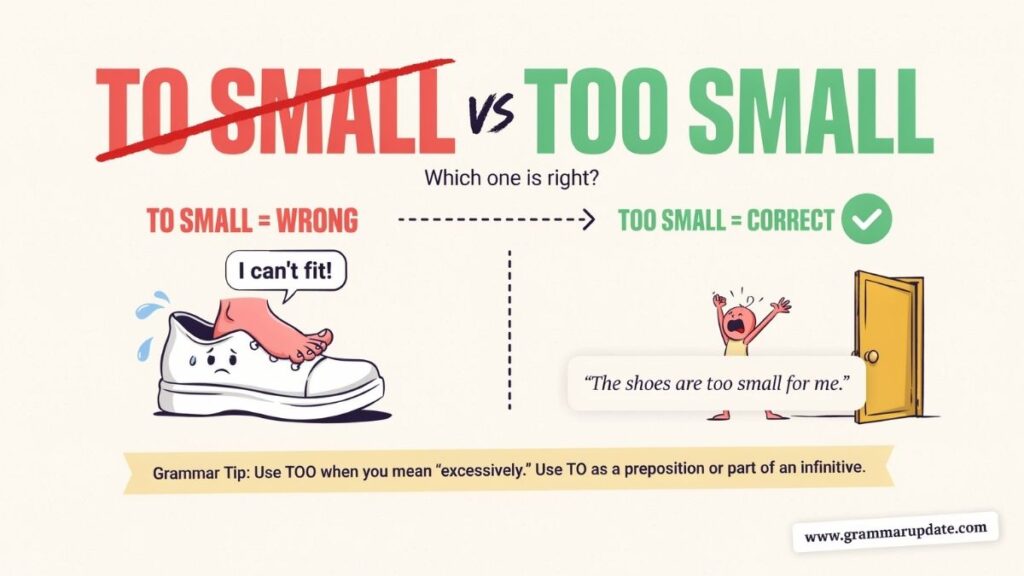
English has a talent for turning two tiny words into a surprisingly big grammar problem. “To” and “too” sound the same in everyday speech, yet they play very different roles in writing. That’s why To Small vs Too Small can leave you second-guessing a simple sentence. Should you write “to small” or “too small”? The answer is easier than it looks. If you’re describing something that isn’t large enough, “too small” is the correct phrase. In this guide, you’ll learn the difference between “to” and “too,” understand why “to small” is incorrect in this context, and see simple examples that make the rule easy to remember.
To Small vs Too Small quick answer
The correct phrase is “too small” when you mean that something has less size than needed, expected, suitable, or acceptable.
Consider these examples:
| Sentence | Correct? | Why? |
|---|---|---|
| This shirt is too small for me. | Yes | The shirt doesn’t fit because it lacks enough size. |
| The box is too small for these books. | Yes | The box doesn’t have enough space. |
| The text is too small to read. | Yes | The text’s size makes reading difficult. |
| This room is too small for six people. | Yes | The available space isn’t sufficient. |
| This shirt is to small for me. | No | “To” doesn’t modify “small” in this construction. |
| The box is to small for these books. | No | “Too” is needed to express insufficient size. |
So, if you’re asking, “Is it too small or to small?” the answer is too small when you’re describing something that doesn’t have enough size.
This applies to many everyday situations:
- The shoes are too small.
- The jacket is too small for him.
- The screen is too small to read comfortably.
- The container is too small for the ingredients.
- The apartment is too small for the family.
- The font is too small for older readers.
The phrase works because “too” modifies the adjective “small.”
Learn the difference between confusing word pairs
Bases vs Basis difference and Which One Is Correct?
What Does Too Small Mean?
The too small meaning is simple: something is smaller than necessary, suitable, comfortable, or acceptable for a particular situation.
For example:
“The shoes are too small.”
This sentence usually means the shoes don’t fit properly because they aren’t large enough.
“The box is too small for the books.”
Here, the box may not look tiny in an absolute sense. It simply doesn’t provide enough space for the books.
That’s an important point. Something doesn’t have to be extremely tiny to be too small.
A suitcase can be a normal size and still be too small for a two-week trip. A dining table can look perfectly reasonable and still be too small for a large family. A phone screen can be large enough for checking messages but too small for detailed editing.
The meaning depends on context.
Too Small Means Smaller Than the Situation Requires
Compare these two sentences:
“The room is very small.”
“The room is too small for six people.”
The first sentence simply describes the room. The second explains that the room’s size creates a problem.
That difference matters.
Very small tells you about size. Too small tells you that the size doesn’t meet a particular need or expectation.
The same idea appears in everyday conversations:
“The shoes are very small.”
This could simply describe their size.
“The shoes are too small for me.”
Now we know that the size causes a practical problem. They don’t fit.
Too Small vs Very Small
The difference between too small and very small often confuses English learners because both expressions describe a high degree of smallness. However, they don’t communicate exactly the same idea.
Very small simply describes something as small to a noticeable degree.
Too small adds a sense of limitation.
Compare:
“The puppy is very small.”
This sentence gives you information about the puppy’s size.
“The puppy is too small to climb the stairs.”
Now the puppy’s size affects what it can do.
Another example:
“The apartment is very small.”
This tells you about the apartment.
“The apartment is too small for four people.”
This tells you that the available space doesn’t meet the needs of four people.
In other words, “too” introduces an implied standard. Something has fallen outside the range that works for the
situation.
Learn the difference between confusing word pairs
Taylored vs Tailored Which one Is Correct?
Too Small vs To Small Why Is Too Correct?
The difference between to small and too small becomes clearer when you look at the grammatical role of “too.”
In “too small,” the word “too” acts as an adverb. It modifies the adjective “small” and tells us about its degree.
The basic pattern is:
too + adjective
This pattern appears throughout English:
- too small
- too large
- too expensive
- too difficult
- too heavy
- too short
- too long
- too cold
- too noisy
- too complicated
For example:
“The box is small.”
This simply describes the box.
“The box is too small.”
Now the sentence tells us that its size isn’t suitable for the situation.
That extra meaning comes from “too.”
Too as an Adverb
Understanding “too as an adverb” helps explain the grammar behind the phrase.
An adverb can modify an adjective to show degree. In the phrase “too small,” “too” modifies “small.”
The same structure appears in:
- too expensive
- too difficult
- too heavy
- too slow
- too crowded
- too complicated
So, “too small” follows a standard English grammar pattern.
This is why “too small” is grammatically correct while “to small” doesn’t work when you want to describe insufficient size.
Learn the difference between confusing word pairs
Scrapped vs Scraped difference Which One Is Correct?
What Does To Mean in English?
To has several important functions in English. Understanding its common uses makes the difference between to and too much easier to remember.
One major use of “to” is to show direction or destination.
Examples include:
- She walked to school.
- We drove to the airport.
- He went to work.
- They traveled to Chicago.
- Send the package to my office.
In these sentences, “to” connects an action with a destination or direction.
It doesn’t describe size.
To as an Infinitive Marker
Another major use of “to” appears before the base form of a verb.
Examples include:
- to learn
- to write
- to read
- to study
- to work
- to improve
- to become
For example:
“I want to learn English.”
“She needs to leave early.”
“They decided to study together.”
Here, “to” works as an infinitive marker.
This explains an important part of the difference between to and too. “To” commonly appears before a verb, while “too” can appear before an adjective to express an excessive degree.
For example:
“I want to learn.”
“The text is too small.”
The structures are completely different.
Learn the difference between confusing word pairs
Camouflage Vs Camoflage Which one Is Correct?
To Small Meaning Is “To Small” Ever Correct?
The phrase “to small meaning” can be confusing because “to small” does not normally function as a standard English phrase meaning that something lacks enough size.
If someone writes:
“The shoes are to small.”
they almost certainly mean:
“The shoes are too small.”
The first sentence contains a grammar mistake and incorrect word usage.
However, the words “to” and “small” can appear in the same sentence without creating an error. What matters is the sentence structure.
For example:
“She wants to make the room small.”
Here, “to” belongs with the verb “make.” It doesn’t modify “small.”
Another example is:
“He decided to keep the font small.”
Again, “to” introduces the verb “keep.”
This distinction is useful because it prevents an overly broad rule. The problem isn’t that “to” and “small” can never appear near each other. The problem occurs when someone uses “to” instead of “too” to describe an insufficient degree of size.
Learn the difference between tricky grammar more words
Costumer vs Customer difference and Which One Is Correct?
To vs Too The Basic Difference
The difference between to and too becomes much easier when you compare their most common functions.
| Word | Common function | Example |
| to | Direction | We went to the store. |
| to | Destination | She traveled to New York. |
| to | Infinitive marker | I want to read. |
| to | Relationship | This is similar to that. |
| too | More than necessary | The shirt is too small. |
| too | Also | I want one too. |
A simple way to think about them is this:
“To” often points toward something.
“Too” can mean “also” or indicate that something has gone beyond an acceptable or necessary degree.
That distinction won’t explain every possible use of the two words. It will, however, help you avoid many common grammar errors.
Learn the difference between tricky grammar more words
Cancell vs Cancel Which One Is Correct?
Why Do People Confuse To and Too?
Pronunciation plays a major role.
In ordinary speech, “to” and “too” usually sound the same. When someone says:
“The shoes are too small.”
you can’t hear the extra “o.”
Writing is different. The spelling tells you which word the writer intended.
This makes to and too classic homophones and commonly confused words.
English contains many similar pairs:
- to / too / two
- your / you’re
- there / their / they’re
- its / it’s
- hear / here
These words can sound alike or nearly alike while performing different jobs in a sentence.
For English learners, the best solution isn’t to memorize isolated spellings. Instead, learn what each word does.
When you understand the grammar, the spelling becomes much easier to choose correctly.
Too Small Spelling How Do You Spell It?
The correct too small spelling is:
“too small”
The word “too” contains two o’s.
If you’re describing something that lacks enough size, use “too.”
For example:
- too small
- too large
- too expensive
- too difficult
- too heavy
The incorrect form is:
“to small”
This spelling doesn’t express the intended meaning.
A useful memory trick is to associate the extra “o” in “too” with the idea of something extra or beyond a limit.
For example:
“The shirt is too small.”
The shirt doesn’t provide enough room.
“The coffee is too hot.”
The temperature is beyond a comfortable level.
“The suitcase is too heavy.”
The weight exceeds what you can comfortably carry.
The same basic idea appears in all three sentences.
When to Use Too
Knowing when to use too is essential for correct English usage.
Use “too” before an adjective when you want to show that the adjective describes a degree beyond what is appropriate, useful, comfortable, or acceptable.
The basic pattern is:
too + adjective
Examples include:
- too small
- too big
- too short
- too long
- too expensive
- too difficult
- too heavy
- too noisy
Consider:
1.”The shoes are too small.”
2.”The shoes are too expensive.”
3.”The shoes are too uncomfortable.”
In each sentence, “too” signals a problem with the degree of the adjective.
Too Small for
Use “too small for” when you want to identify the person, object, or situation that creates the size requirement.
Examples:
- The shirt is too small for me.
- The shoes are too small for my feet.
- The box is too small for the books.
- The table is too small for six people.
- The room is too small for an office.
- The container is too small for all the ingredients.
The basic structure is:
too + adjective + for + noun or pronoun
This construction appears frequently in everyday English.
Too Small to Another Common Pattern
Another useful structure is “too small to.”
The pattern is:
too + adjective + to + verb
For example:
- The box is too small to hold the books.
- The child is too small to reach the shelf.
- The text is too small to read.
- The opening is too small to fit through.
- The shoes are too small to wear comfortably.
This construction connects size with an action or result.
The size creates a limitation.
Too Small for vs Too Small to
| Structure | What follows | Example |
| too small for | Noun or pronoun | The box is too small for the shoes. |
| too small to | Base-form verb | The box is too small to hold the shoes. |
Both forms are correct. The choice depends on what you want to emphasize.
“Too small for the shoes” focuses on the object that doesn’t fit.
“Too small to hold the shoes” focuses on what the box cannot do.
Learn the difference between tricky grammar more words
Chief vs Chef difference and Which One Is Correct?
Common Mistakes With To Small vs Too Small
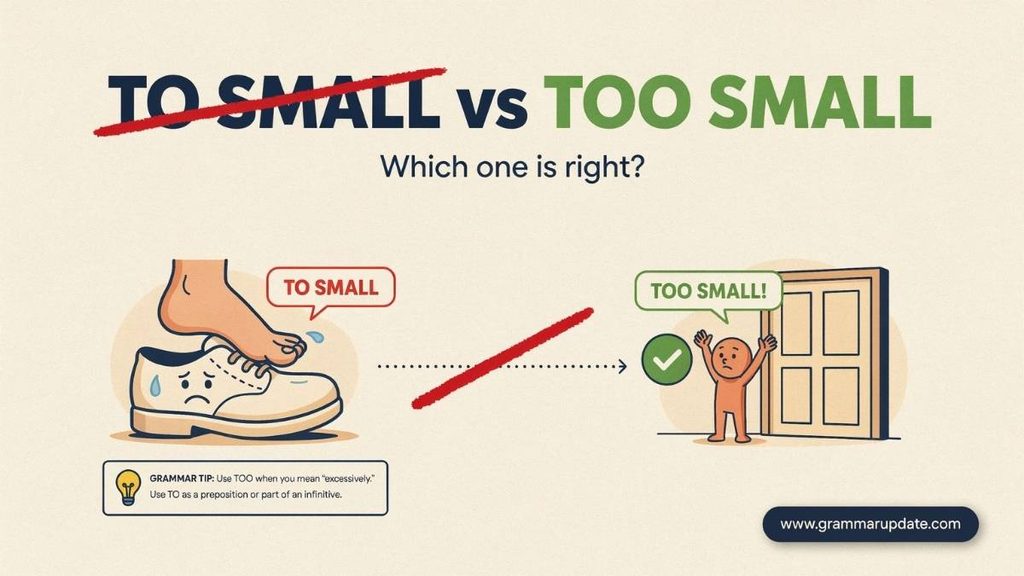
The most common mistake occurs when someone chooses “to” because it sounds right.
For example:
Incorrect: “This shirt is to small.”
Correct: “This shirt is too small.”
The mistake doesn’t usually come from a complicated grammar rule. It comes from confusing two words that sound alike.
Using To Instead of Too
If you’re describing something as smaller than necessary, use “too.”
Incorrect:
“The font is to small.”
Correct:
“The font is too small.”
Using Too Instead of To
The opposite mistake also occurs.
Incorrect:
“I want too go home.”
Correct:
“I want to go home.”
Here, “to” introduces the verb “go.”
This is why understanding the sentence structure matters more than simply memorizing one spelling.
Confusing To, Too, and Two
The three words sound similar but have different meanings.
To can indicate direction, destination, or an infinitive.
Example:
“She went to school.”
Too can mean also or more than necessary.
Examples:
“I want one too.”
“The box is too small.”
Two represents the number 2.
Example:
“I have two books.”
A quick comparison makes the distinction clear:
| Word | Meaning | Example |
| to | Direction, destination, or infinitive marker | I want to leave. |
| too | Also or more than necessary | It is too small. |
| two | Number 2 | I have two bags. |
Learn the difference between tricky grammar more words
Insue vs Ensue Which One Is Correct?
Too Small in Everyday Situations
The phrase appears in many ordinary conversations because people constantly compare size with purpose.
Clothing and Shoes
Clothing provides some of the most familiar examples.
“These jeans are too small for me.”
“This shirt is too small around the shoulders.”
“These shoes are too small to wear comfortably.”
The key idea is fit. The clothing doesn’t provide enough room for the person wearing it.
Furniture
Furniture can also be too small for a particular space or purpose.
“This desk is too small for two monitors.”
“The table is too small for the dining room.”
“The chair is too small for an adult.”
Again, the object isn’t necessarily tiny. It simply doesn’t meet the requirements of the situation.
Technology
Screen size and text size often create similar problems.
“The screen is too small for detailed editing.”
“The text is too small to read comfortably.”
“The buttons are too small to use easily.”
In these examples, size affects usability.
Containers and Packages
You might say:
“The box is too small for the package.”
“This bag is too small to hold my laptop.”
“The container is too small for all the ingredients.”
The intended meaning remains the same: there isn’t enough physical space.
Too Small vs Too Little
The difference between too small and too little is worth understanding because the two phrases can sometimes appear in the same sentence.
Use “too small” when you’re talking about physical size, dimensions, scale, or capacity.
Use “too little” when you’re talking about an insufficient amount of something.
Compare:
“The bottle is too small.”
The physical container doesn’t have enough capacity.
“There is too little water.”
The amount of water isn’t sufficient.
You can combine both ideas:
“The bottle is too small because it holds too little water.”
Here, “small” describes the container while “little” describes the amount of water.
Learn the difference between basic English word mistakes
Weighed vs Weighted Which One Is Correct?
Too Small Sentence Examples
Here are more natural examples that show how the phrase works in different contexts.
Clothing
- This shirt is too small for me.
- The sleeves are too small around the wrists.
- Those shoes are too small to wear comfortably.
- The jacket is too small across the shoulders.
Furniture
- The desk is too small for two computers.
- This table is too small for the entire family.
- The chair is too small for an adult.
Rooms and Buildings
- The room is too small for six people.
- The apartment is too small for a growing family.
- The office is too small for the entire team.
Technology
- The screen is too small for detailed work.
- The text is too small to read.
- The buttons are too small to tap accurately.
Objects and Containers
- The box is too small for the books.
- This bag is too small to hold my laptop.
- The container is too small for all the ingredients.
Children and Animals
- The child is too small to reach the handle.
- The puppy is too small to jump onto the couch.
- The kitten is too small to climb over the gate.
These examples show how flexible the phrase can be. The underlying grammar doesn’t change.
Learn the difference between basic English word mistakes
Favour vs Favor Which Spelling Is Correct?
How to Use Too Small in a Sentence
If you’re wondering how to use too small in a sentence, start by identifying what makes the size insufficient.
You can use the phrase by itself:
“The shirt is too small.”
You can identify who or what needs more space:
“The shirt is too small for me.”
You can describe an action that isn’t possible:
“The shirt is too small to wear comfortably.”
You can also explain the practical consequence:
“The box is too small to store all the files.”
These sentence patterns cover most everyday uses of the phrase.
Is “Too Small” Grammatically Correct?
Yes. “Too small” is grammatically correct.
It follows the standard pattern:
too + adjective
“Small” is an adjective because it describes the size of something.
“Too” modifies that adjective and indicates that the degree of smallness creates a problem or falls beyond what the situation requires.
For example:
“The suitcase is too small.”
The basic sentence structure is:
- The suitcase — subject
- is — linking verb
- too small — adjective phrase
The phrase “too small” describes the subject.
This is standard English grammar and correct English usage.
Is “To Small” Grammatically Correct?
“To small” is not grammatically correct when you intend to say that something lacks sufficient size.
For example:
“The box is to small.”
This sentence contains a grammatical error.
The correct version is:
“The box is too small.”
However, “to” and “small” can appear in the same sentence when “to” serves another grammatical function.
For example:
“They want to keep the room small.”
Here, “to” introduces the verb “keep.” The word “small” comes later as an adjective describing the room.
Another example:
“She decided to make the font small.”
Again, “to” belongs with the verb “make.”
This is an important distinction in English language rules. The problem isn’t the physical combination of the two words. The problem is using “to” where the grammar requires “too.”
How Can You Remember To vs Too?
A simple memory trick can help.
Think about the extra “o” in “too.”
Too can suggest something extra or more than necessary.
“The box is too small.”
“The coffee is too hot.”
“The bag is too heavy.”
“The lesson is too difficult.”
In each example, the quality has crossed a practical limit.
By contrast, “to” often connects an action with a destination or introduces a verb.
“Go to school.”
“Drive to work.”
“Want to learn.”
“Need to leave.”
Another useful strategy is to examine what comes after the word.
If “to” introduces a base-form verb, it may be the infinitive marker:
- to read
- to write
- to study
- to learn
If you’re describing an adjective as excessive or beyond a useful limit, “too” may be the right choice:
- too small
- too large
- too expensive
- too difficult
This simple check can catch many common grammar errors before they reach the final version of your writing.
Learn the difference between basic English word mistakes
Drily vs Dryly Which One Is Correct?
Practice Session To Small vs Too Small
Fill in each blank with the correct word: To Small vs Too Small
- This shirt is ___ small for me.
- I need ___ buy a larger shirt.
- These shoes are ___ small to wear comfortably.
- She went ___ the store to buy new clothes.
- The box is ___ small for all these books.
- He wants ___ make the room smaller.
- The font is ___ small to read easily.
- We walked ___ the shopping center.
- This bag is ___ small for my laptop.
- I want ___ choose a different size.
- The table is ___ small for six people.
- She decided ___ order a larger table.
- These gloves are ___ small for my hands.
- He went ___ the store ___ buy a new pair of shoes.
- The container is ___ small to hold all the ingredients.
- I need ___ find a box that is larger.
- The apartment is ___ small for a family of five.
- They traveled ___ the city ___ look for a bigger apartment.
- The text on this screen is ___ small to read.
- She wants ___ make the letters larger.
- This suitcase is ___ small for a two-week trip.
- He needs ___ take the suitcase ___ the airport.
- The opening is ___ small to fit the package through.
- I tried ___ put the books in the box ___ but it was ___ small.
- The shoes were ___ small for me ___ so I returned them ___ the store.
Answers
- too
- to
- too
- to
- too
- to
- too
- to
- too
- to
- too
- to
- too
- to, to
- too
- to
- too
- to, to
- too
- to
- too
- to, to
- too
- to, too
- too, so, to
Here’s a trusted source for clear word meanings:
FAQs
Can “too small” describe something that still fits?
Yes. “Too small” can describe something that fits but doesn’t fit comfortably or appropriately. For example, a shirt may technically fit while feeling too tight around the shoulders. In that case, “too small” still works.
Can I say “too small” without explaining what it is too small for?
Yes. You can simply say, “The box is too small.” The context usually makes the comparison clear. If the reader already knows what you want to put inside it, you don’t need to state the purpose again.
Does “too small” always refer to physical size?
No. “Too small” can describe size in a broader sense. For example, “The sample size is too small to support a reliable conclusion.” Here, “small” refers to the number of participants rather than physical dimensions.
When should I use “too small” instead of “too little”?
Use “too small” when you’re describing size, dimensions, space, or capacity. Use “too little” when you’re talking about an insufficient amount of something.
For example:
- “The bottle is too small.”
- “There is too little water in the bottle.”
The first sentence describes the container. The second describes the amount of water.
Can “too small” be followed by a verb?
Yes. The pattern “too small to + verb” is common in English.
For example:
- “The opening is too small to enter.”
- “The text is too small to read.”
- “The box is too small to hold everything.”
This structure explains what the size prevents someone or something from doing.
Can I use “too small for” in a sentence?
Yes. Use “too small for” when you want to identify the person, object, or situation that requires more space.
Examples:
- “The shirt is too small for me.”
- “The box is too small for these books.”
- “The table is too small for six people.”
The basic pattern is “too + adjective + for + noun or pronoun.”
Does “too small” always mean something is bad?
No. The phrase doesn’t automatically mean something is bad. It means the size doesn’t meet a particular requirement or purpose.
For example, a small backpack might work perfectly for a short walk. The same backpack could be too small for a week-long trip.
Can “too small” describe text or images?
Yes. You can use “too small” for text, images, icons, buttons, and other visual elements.
For example:
“The text is too small to read comfortably.”
“The icons are too small to identify easily.”
In both cases, the size affects how easily someone can use or understand the content.
Can “too small” describe a room or other space?
Yes. “Too small” commonly describes rooms, offices, apartments, storage areas, and other spaces.
For example:
“The office is too small for the entire team.”
“The bedroom is too small for two large beds.”
The phrase indicates that the available space doesn’t meet the needs of the situation.
Can “too small” describe clothing?
Yes. Clothing provides one of the most common uses of “too small.”
You can say:
- “This shirt is too small.”
- “These jeans are too small for me.”
- “The shoes are too small.”
- “This jacket is too small around the shoulders.”
In each example, the clothing doesn’t provide a suitable or comfortable fit.
Can “too small” describe a person’s physical size?
Yes, when physical size matters to the situation.
For example:
“The child is too small to reach the shelf.”
“The puppy is too small to jump over the gate.”
In these sentences, “too small” explains why the person or animal can’t perform a particular action.
Can “too small” describe a number or sample?
Yes. “Too small” can describe the size of a group, sample, or set when you’re talking about how many items or people it contains.
For example:
“The sample size is too small to draw a reliable conclusion.”
Here, “small” refers to the number of observations rather than physical dimensions.
What are the most common sentence patterns with “too small”?
Several useful patterns appear regularly in English:
- “The box is too small.”
- “The box is too small for the books.”
- “The box is too small to hold the books.”
- “The box is far too small for the package.”
The basic grammar is “too + adjective.” In “too small,” the word “too” modifies the adjective “small” and indicates that the size falls below what the situation requires.
conclusion
The confusion between “to small” and “too small” is easy to fix once you know what each word does. They sound alike, but they don’t mean the same thing.
When you mean that something isn’t large enough, use “too small.”
“The shirt is too small.”
“The box is too small for the books.”
“The text is too small to read.”
In each sentence, “too” shows that the size isn’t enough for the situation. The word “to” has a different job. It usually shows direction or comes before a verb, as in “go to school” or “want to learn.”
So, the next time you pause over To Small vs Too Small, don’t let the extra “o” trip you up. If something doesn’t fit, doesn’t have enough space, or isn’t large enough for its purpose, choose “too small.”
It’s a tiny spelling difference with a simple rule: too small is correct when you mean not large enough. Once that clicks, this common grammar mistake becomes much easier to avoid.

Jhon AJS, the creative mind behind Grammar Update, is an experienced blogger passionate about simplifying English grammar. He focuses on explaining confusing word vs word differences, grammar rules, punctuation, and sentence structure in a clear and practical way. Through easy to understand guides and examples, Jhon helps readers improve their writing and communicate with confidence. With years of blogging experience, he continues to share helpful insights that make learning grammar simple, useful, and accessible for everyone.