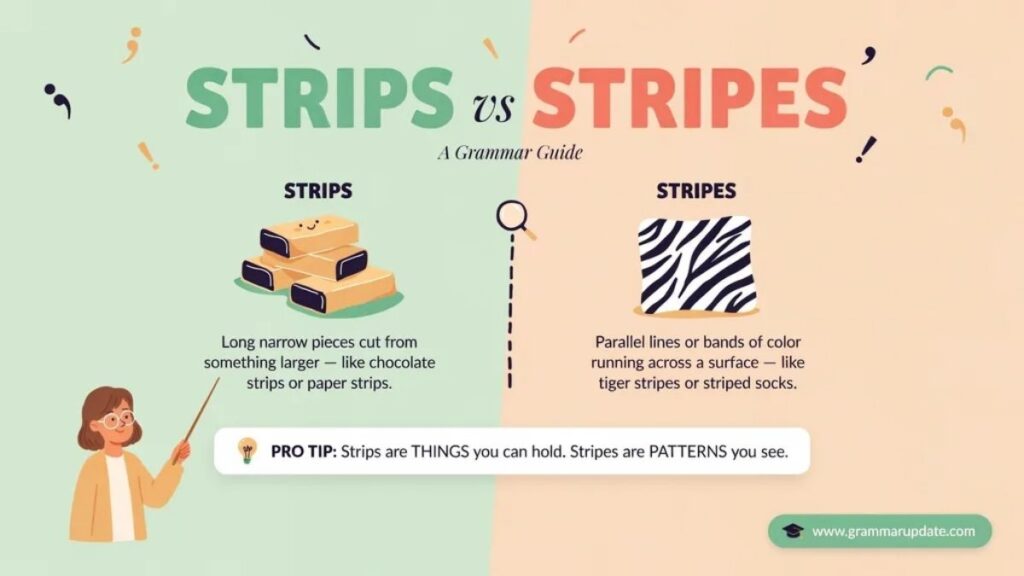
Strips vs stripes can cause more confusion than two words this short deserve. They look almost the same, but they don’t mean the same thing. You cut paper into strips, wear a shirt with stripes, and see stripes on a zebra. Simple, right? Usually. The confusion starts when one extra letter changes the meaning of your sentence. Understanding the strips vs stripes meaning becomes easy when you remember one basic rule: a strip is usually a narrow piece or section, while a stripe is a line, band, or marking. This guide clears up the difference with simple explanations, examples, pronunciation tips, and common mistakes.
Strips vs Stripes The Quick Answer
Both “strips” and “stripes” are correct English words. The difference lies in their meanings and how you use them.
A strip usually means a narrow piece, section, or area of something. A stripe usually means a long, narrow line or band that appears on a surface, often as a color or pattern.
Compare these examples:
“Cut the paper into strips.”
“The shirt has blue stripes.”
In the first sentence, “strips” refers to separate pieces of paper. In the second, “stripes” refers to colored bands on the shirt.
The easiest rule to remember is:
Strip = a narrow piece or section.
Stripe = a narrow line or band, usually a marking or pattern.
That simple distinction answers the basic question, “What is the difference between strips vs stripes?”
| Word | Basic meaning | Example |
|---|---|---|
| Strip | A narrow piece or section | Cut the paper into strips. |
| Stripe | A long, narrow line or band | The shirt has blue stripes. |
| Strips | Plural of “strip” or a verb form | She cut the fabric into strips. |
| Stripes | Plural of “stripe” | The zebra has black and white stripes. |
Neither word is more correct than the other. The correct choice depends entirely on the context.
Learn the difference between commonly misused words
Bellwether vs Bellweather difference and usage?
What Is a Strip?
The strip definition is fairly straightforward. A strip is a long, narrow piece, section, or area of something.
A strip can be made from almost any material. You might have a strip of paper, a strip of fabric, a strip of metal, or a strip of wood. The word can also describe a narrow area of land.
For example:
“She cut a strip of paper from the sheet.”
“A narrow strip of land runs along the river.”
“The carpenter attached a wooden strip to the frame.”
In each sentence, “strip” refers to a narrow physical piece or section.
This physical meaning is one of the easiest ways to understand the strip meaning.
Strip as a Noun
As a noun, “strip” commonly describes something narrow and elongated.
Here are some everyday examples:
- a strip of paper
- a strip of fabric
- a strip of leather
- a strip of metal
- a strip of wood
- a strip of land
- a strip of bacon
- a strip of chicken
Notice what these examples have in common. Each “strip” can be understood as a separate piece or section.
For example, when a recipe says to cut chicken into strips, it means you should divide the chicken into narrow pieces.
“The chef sliced the chicken into thin strips.”
The chicken pieces aren’t decorative lines. They are physical pieces of food.
That distinction becomes important when you compare “strips” with “stripes.”
Strip as a Verb
“Strip” can also work as a verb. In this form, it usually means to remove something.
For example:
“They stripped the old paint from the wall.”
“She stripped the wire before connecting it.”
“The workers stripped the damaged flooring.”
The verb can also refer to removing clothing:
“He stripped off his wet jacket.”
So, the word “strip” can involve either a narrow physical piece or the action of removing something. The surrounding words tell you which meaning applies.
What Are Strips?
“Strips” is the plural form of the noun “strip.”
For example:
- one strip of paper
- two strips of paper
- one strip of fabric
- several strips of fabric
- one strip of bacon
- several strips of bacon
Consider this sentence:
“She cut the fabric into strips.”
Here, “strips” means several narrow pieces of fabric.
However, “strips” can also function as a verb.
“He strips the wire before installing it.”
In this sentence, “strips” means removes part of the wire’s covering. It isn’t a plural noun.
Understanding this grammatical difference can help you avoid confusion when reading or writing.
Learn the difference between commonly misused words
Acreage vs Acrag difference and Which Spelling Is Correct?
What Is a Stripe?
The stripe definition is different from the strip definition.
A stripe is a long, narrow line or band that differs from the surrounding surface, usually because of color, texture, or design.
Stripes commonly appear as patterns or markings.
Examples include:
- a red stripe
- blue stripes on a shirt
- black-and-white stripes
- zebra stripes
- racing stripes
- road stripes
- stripes on a flag
For example:
“The shirt has three blue stripes.”
The stripes aren’t separate pieces of the shirt. They are colored bands that form part of the shirt’s design.
That’s the main idea behind the stripe meaning.
Stripe as a Noun
In everyday English, “stripe” most often functions as a noun.
For example:
“The flag has a wide red stripe.”
“The shirt has horizontal stripes.”
“The zebra has distinctive black-and-white stripes.”
In each case, the word refers to a visible line or band.
A stripe can vary in size, direction, color, and purpose. It might be thin or wide. and it might run horizontally, vertically, or diagonally. It can be decorative or functional.
Stripe as a Verb
“Stripe” can also function as a verb, although this use is less common in everyday conversation.
As a verb, “stripe” means to mark or decorate something with stripes.
For example:
“The vehicle was striped with the team’s colors.”
“Workers striped the surface with bright markings.”
In most everyday situations, however, you’re more likely to encounter “stripe” as a noun or “striped” as an adjective.
Learn the difference between commonly misused words
Lend vs Lent difference and which is Correct?
Strips vs Stripes Meaning The Main Difference
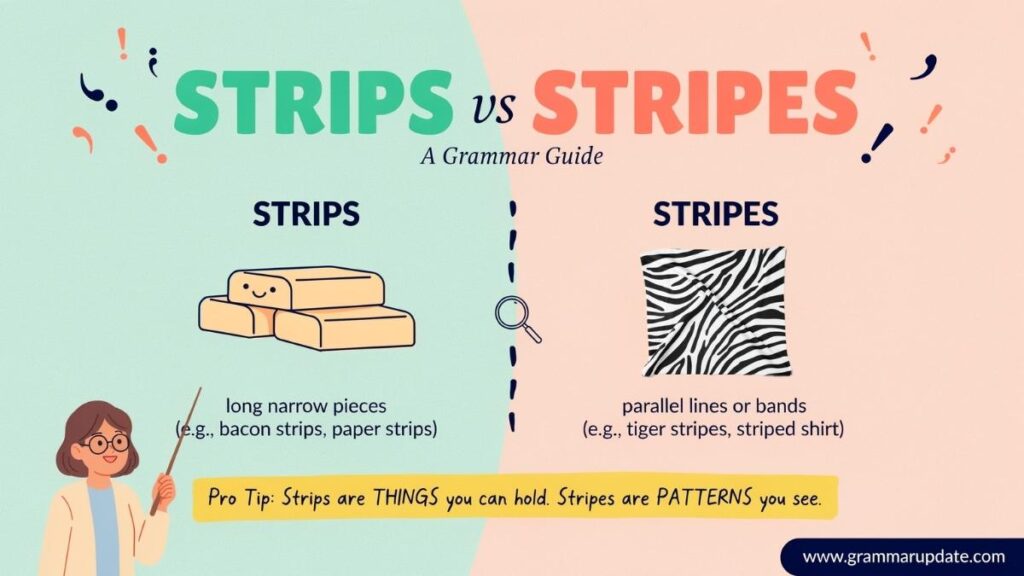
The strip and stripe difference becomes much clearer when you focus on whether you’re describing a physical piece or a visible marking.
A strip is generally a narrow piece, section, or area.
A stripe is generally a narrow line or band that appears on a surface.
Think about a piece of fabric.
If you cut that fabric into narrow pieces, you have strips of fabric.
If you decorate the fabric with colored bands, you have stripes on the fabric.
The material hasn’t necessarily been cut in the second example. Instead, its appearance has changed.
| Situation | Correct word | Example |
|---|---|---|
| Narrow pieces of paper | Strips | strips of paper |
| Colored bands on paper | Stripes | blue stripes on paper |
| Narrow pieces of fabric | Strips | strips of fabric |
| Pattern on a shirt | Stripes | stripes on a shirt |
| Narrow pieces of chicken | Strips | strips of chicken |
| Animal markings | Stripes | zebra stripes |
| Narrow pieces of metal | Strips | metal strips |
| Painted road markings | Stripes | road stripes |
This is the heart of the difference between strip and stripe.
Learn the difference between confusing word pairs
Agast vs Aghast difference and Which one Is Correct?
Strips vs Stripes in Clothing
Clothing is one of the most common places where people confuse these words.
When you’re describing a pattern on clothing, “stripes” is normally the correct word.
For example:
“The shirt has blue stripes.”
“She bought a black-and-white striped dress.”
“The jacket has three horizontal stripes.”
“The pants have narrow vertical stripes.”
In these examples, the stripes are part of the clothing’s appearance.
Strips vs Stripes Clothing Why It Matters
Compare these two sentences:
“The designer cut the fabric into strips.”
“The designer added red stripes to the shirt.”
The first sentence describes pieces of fabric. The second describes a visual pattern.
That small difference changes the entire meaning.
If a shirt has red bands printed or woven into its design, those are stripes. If a tailor cuts fabric into narrow pieces to use in construction or decoration, those pieces are strips.
What Is a Stripe in Clothing?
A stripe in clothing is a long, narrow band that forms part of the garment’s pattern or design.
Stripes can be:
- horizontal
- vertical
- diagonal
- narrow
- wide
- evenly spaced
- unevenly spaced
- single-colored
- multicolored
For example:
“The striped shirt has thin vertical lines.”
Here, “striped” means the shirt has a stripe pattern.
What Is a Strip in Clothing?
A strip in clothing usually means a narrow piece of fabric or another material.
For example:
“The designer used strips of black fabric to decorate the costume.”
The strips are actual pieces of material.
This gives you an easy comparison:
A striped shirt has stripes.
A shirt made with narrow pieces of fabric may contain strips.
Learn the difference between confusing word pairs
Achieve vs Achive Difference Which Spelling Is Correct?
Strip vs Stripe Pronunciation
The strip vs stripe pronunciation difference is another useful clue.
Although the words look similar, they don’t sound the same.
“Strip” has a short “i” sound. It sounds like the beginning of words such as “trip” and “ship.”
“Stripe” has a long “i” sound. It sounds like “type” and “like.”
A simple pronunciation comparison is:
Strip → sounds like “trip.”
Stripe → sounds like “type.”
The same difference appears in the plural forms:
Strips → short “i” sound.
Stripes → long “i” sound.
How to Pronounce Strip and Stripe
If you’re asking, “How do you pronounce strip and stripe?” try this simple memory trick:
“Strip” rhymes with “trip.”
“Stripe” rhymes with “type.”
The final silent “e” in “stripe” helps create the long vowel sound.
So don’t pronounce “stripe” like “strip.” The words are spelled similarly, but their vowel sounds are different.
Strip vs Stripe Examples
Seeing the words in context makes the distinction much easier.
Strip in a Sentence
“She cut a narrow strip of paper from the sheet.”
Here, “strip” means a physical piece.
Stripe in a Sentence
“The shirt has a bright red stripe across the front.”
Here, “stripe” means a visible band of color.
Strips in a Sentence
“The recipe calls for thin strips of bell pepper.”
Here, “strips” refers to multiple pieces.
Stripes in a Sentence
“The zebra has dark stripes across its body.”
Here, “stripes” refers to visible markings.
More Strip Examples
- “He cut the leather into narrow strips.”
- “The worker removed a strip of damaged flooring.”
- “A thin strip of land separates the road from the river.”
- “Add two strips of bacon to the sandwich.”
- “The artist used strips of paper to make the collage.”
More Stripe Examples
- “The shirt has three horizontal stripes.”
- “The road has white stripes between the lanes.”
- “The car has two racing stripes.”
- “The flag contains several colored stripes.”
- “The tiger has dark stripes across its coat.”
The examples show why replacing one word with the other can create an entirely different meaning.
Learn the difference between confusing word pairs
Amateur vs Amatuer difference and Which one Is Correct?
A Simple Way to Remember Strips vs Stripes
When you’re unsure, ask yourself one question:
Am I talking about a piece, or am I talking about a marking?
If you mean a physical piece or narrow section, use “strip.”
If you mean a visible line, band, or pattern, use “stripe.”
For example:
Cut it → strip.
See it as a pattern → stripe.
“Cut the paper into strips.”
“The paper has blue stripes.”
Once you connect “strip” with a piece and “stripe” with a pattern, the confusion becomes much easier to clear up.
Strip Meaning in Medicine
The word “strip” appears often in medical and healthcare language because many medical products are made as narrow physical pieces.
One of the most familiar examples is a test strip. A test strip is a narrow piece designed to work with a particular testing method or device. Depending on the test, the strip may interact with a sample and produce a result that can be interpreted according to the product’s instructions.
Common examples include:
- glucose test strips
- urine test strips
- pregnancy test strips
- laboratory test strips
- pH test strips
The important language point is that “strip” refers to the physical testing material.
For example:
“The technician placed the sample on the test strip.”
Here, “strip” identifies a physical object.
Strip or Stripe of Medicine?
The phrase “strip or stripe of medicine” can be confusing because both words describe something long and narrow in some contexts. However, they don’t have the same meaning.
When you mean a physical piece used for testing, packaging, application, or another specific purpose, “strip” is generally the appropriate word.
For example:
“The package contains several test strips.”
Calling them “test stripes” would suggest that they are lines or bands of color rather than physical testing pieces.
However, “stripe” can still appear in medical descriptions when the subject is a visible line, band, or marking.
For example:
“The image shows a dark stripe.”
Here, “stripe” describes something visible rather than a physical strip that you can handle.
So, the distinction remains consistent:
Strip → physical piece or section.
Stripe → visible line or band.
Adhesive Strip
“Adhesive strip” is another common expression.
An adhesive strip is a narrow piece of material with an adhesive surface. It may be used to secure, cover, support, or hold something in place, depending on the product and situation.
For example:
“She placed an adhesive strip over the small cut.”
Again, “strip” refers to the physical piece.
This is similar to other expressions such as:
- strip of tape
- strip of material
- strip of fabric
- test strip
- metal strip
The word describes the shape and physical form of the object.
Learn the difference between confusing word pairs
Absorption vs Absorbsion difference and Which Is Correct?
Strips vs Stripes in Everyday English
Everyday English provides countless examples of the difference between these words.
You might hear “strips” when talking about food, paper, fabric, wood, metal, or land. You might hear “stripes” when talking about clothing, animals, flags, vehicles, roads, or decorative patterns.
The context usually tells you which word belongs.
Strips of Food
When food is cut into narrow pieces, “strips” is the natural choice.
Examples include:
- strips of bacon
- strips of chicken
- strips of beef
- strips of pork
- strips of bell pepper
- strips of carrot
- strips of cucumber
For example:
“Cut the chicken into thin strips before cooking.”
The word “strips” describes separate pieces of chicken.
You wouldn’t normally call those pieces “stripes” because they aren’t lines printed or displayed on the food. They are pieces that have been cut from it.
Strips of Paper
Paper is another straightforward example.
“The students cut the paper into strips.”
The original sheet has been divided into narrow pieces.
You can also say:
“She glued several strips of paper together.”
Here, each strip is a separate piece of paper.
However, if you’re talking about a design printed on paper, “stripes” may be the right choice.
“The wrapping paper has red and green stripes.”
The paper remains one sheet. The stripes are part of its visual design.
Strips of Fabric
“Strip of fabric” refers to a narrow physical piece of cloth.
For example:
“The designer cut several strips of fabric for the project.”
The fabric has been divided into pieces.
This differs from:
“The fabric has several blue stripes.”
In the second sentence, the blue bands are part of the fabric’s design.
That difference between a physical piece and a visual marking is one of the most useful ways to remember the strip vs stripe meaning.
Strips of Land
“Strip” doesn’t only refer to manufactured materials.
It can also describe a narrow area of land.
For example:
“A narrow strip of land runs between the houses.”
Here, “strip” means a long, narrow area.
You might also see phrases such as:
- strip of land
- strip of coastline
- strip of forest
- strip of farmland
The word doesn’t mean that the land has been physically cut out. It simply describes its narrow shape or area.
Stripes in Nature and Animals
“Stripe” is especially common when describing natural markings.
Zebras are the classic example.
“The zebra has black-and-white stripes.”
Tigers also have stripes:
“The tiger’s dark stripes contrast with its lighter coat.”
In these examples, stripes are surface markings. They aren’t separate pieces of the animal.
This is why “stripes” is the natural word when describing many animal patterns.
Zebra Stripes
Zebra stripes are one of the clearest examples of the stripe definition.
The stripes form a repeated visual pattern across the animal’s coat. Their arrangement, width, and appearance can vary among individual zebras and species.
For English learners, the important point is simple:
A zebra has stripes, not strips.
The same basic idea applies to many descriptions of patterned surfaces.
Stripes in Clothing
Clothing is another major area where “stripes” appears.
A striped shirt may have:
- horizontal stripes
- vertical stripes
- diagonal stripes
- thin stripes
- wide stripes
- alternating colors
- multiple color bands
For example:
“The striped shirt has narrow blue and white bands.”
The word “striped” tells the reader that the garment has a stripe pattern.
Horizontal Stripes
Horizontal stripes run from side to side.
For example:
“The shirt has horizontal blue and white stripes.”
Vertical Stripes
Vertical stripes run from top to bottom.
For example:
“The dress has narrow vertical stripes.”
Diagonal Stripes
Diagonal stripes run at an angle.
For example:
“The jacket features diagonal black stripes.”
These descriptions all use “stripes” because they refer to a visual pattern.
Learn the difference between confusing word pairs
Presant vs Present which is Correct Spelling and Usage?
Strips vs Stripes Physical Object or Visual Pattern?
This distinction solves most confusion between the words.
Ask whether you’re describing the object itself or something appearing on its surface.
If you’re describing the object as a narrow piece, use “strip.”
If you’re describing a line or band appearing on the object, use “stripe.”
Consider a piece of fabric.
“The tailor cut the fabric into strips.”
1.The fabric has become separate narrow pieces.
2.“The fabric has red stripes.”
3.The fabric remains intact, and the red bands form part of its design.
The same distinction works with paper.
“The children cut the paper into strips.”
“The wrapping paper has colorful stripes.”
The words look similar, but the ideas are different.
Strip vs Stripe vs Strap
“Strip,” “stripe,” and “strap” can all describe something narrow and elongated. That’s where another layer of confusion begins.
However, each word has its own meaning.
| Word | Main meaning | Example |
|---|---|---|
| Strip | A narrow piece or section | a strip of paper |
| Stripe | A narrow line or band | a blue stripe |
| Strap | A narrow band used to hold, carry, secure, or support something | a backpack strap |
The easiest way to separate them is to think about purpose.
A strip is usually a piece.
A stripe is usually a marking.
A strap usually performs a function.
Strip vs Strap
A strip doesn’t necessarily hold anything together.
For example:
“I cut a strip of leather.”
The leather is simply a narrow piece.
A strap, however, is generally designed to hold, secure, carry, fasten, or support something.
For example:
“The bag has a leather strap.”
The strap has a specific practical purpose.
Stripe vs Strap
A stripe is mainly visual.
For example:
“The shirt has a red stripe.”
A strap is functional.
For example:
“The watch has a black strap.”
This gives you a useful three-word comparison:
Strip → piece.
Stripe → marking.
Strap → support or fastening.
Learn the difference between confusing word pairs
Payed vs Paid Difference and Which One is Correct?
Strips vs Stripes Common Mistakes
The biggest mistakes usually happen when writers focus on the appearance of the object rather than its meaning.
Mistake: “The Shirt Has Red Strips”
If you mean red bands that form a pattern on the shirt, “stripes” is the correct choice.
Correct:
“The shirt has red stripes.”
Why?
Because the red areas are visual bands on the shirt.
Mistake: “Cut the Paper Into Stripes”
If you’re physically cutting the paper into narrow pieces, use “strips.”
Correct:
“Cut the paper into strips.”
The paper is being divided into separate pieces.
Mistake: “The Zebra Has Black and White Strips”
The standard expression is:
“The zebra has black-and-white stripes.”
The markings are part of the animal’s appearance.
Mistake: “The Car Has Two White Strips”
If you mean decorative bands painted onto the vehicle, “stripes” is more accurate.
Correct:
“The car has two white racing stripes.”
Mistake: “Add Three Stripes of Fabric”
If you’re referring to three narrow pieces of fabric, use “strips.”
Correct:
“Add three strips of fabric.”
If you’re describing colored bands printed or woven into fabric, use “stripes.”
Correct:
“The fabric has three blue stripes.”
Stripped vs Striped
“Stripped” and “striped” are another pair that often causes confusion.
They come from different words.
Stripped comes from “strip.”
Striped comes from “stripe.”
Their meanings are completely different.
What Does Stripped Mean?
“Stripped” is the past tense and past participle of “strip.”
It usually means that something was removed.
For example:
“The workers stripped the old paint from the wall.”
“The room was stripped of its furniture.”
“He stripped the wire before making the connection.”
The word can also refer to removing clothing.
“He stripped off his jacket.”
The common idea is removal.
What Does Striped Mean?
“Striped” comes from “stripe.”
It means marked or decorated with stripes.
For example:
“She wore a striped shirt.”
“The wall was painted with a striped pattern.”
“The animal has a striped coat.”
The common idea is a visible pattern of lines or bands.
Stripped vs Striped Comparison
| Word | Related word | Meaning | Example |
|---|---|---|---|
| Stripped | Strip | Had something removed | The wall was stripped of paint. |
| Striped | Stripe | Marked with stripes | She wore a striped shirt. |
A quick memory trick helps:
Stripped → something was taken away.
Striped → stripes were added or are present.
Striping vs Stripping
“Striping” and “stripping” create a similar spelling problem.
They come from different verbs.
Striping comes from “stripe.”
Stripping comes from “strip.”
Striping Meaning
Striping means marking or decorating something with stripes.
For example:
“The crew is striping the parking lot.”
Here, the workers are adding painted lines to define spaces or markings.
You might also encounter striping when discussing:
- roads
- parking lots
- vehicles
- sports fields
- decorative surfaces
The action involves creating or adding stripes.
Stripping Meaning
Stripping means removing something.
For example:
“The workers are stripping the old paint from the door.”
Other examples include:
- stripping wallpaper
- stripping paint
- stripping insulation
- stripping a wire
- stripping a surface
The action involves taking something away.
Striping vs Stripping Comparison
| Word | Comes from | Meaning | Example |
|---|---|---|---|
| Striping | Stripe | Adding or marking with stripes | striping a parking lot |
| Stripping | Strip | Removing something | stripping old paint |
The difference is easy once you connect each word to its base form.
Stripe → striping.
Strip → stripping.
Learn the difference between confusing word pairs
Straight vs Strait Difference and Which Is Correct and Usage?
Striped vs Stripping A Quick Grammar Check
These words belong to different grammatical forms.
“Striped” is commonly used as an adjective.
Example:
“She bought a striped dress.”
“Stripping” is the present participle of the verb “strip.”
Example:
“They are stripping the old paint.”
The first describes appearance.
The second describes an action.
That gives you another useful comparison:
Striped → pattern.
Stripping → removal.
Strip and Stripe Difference in Grammar
Both “strip” and “stripe” can function as nouns and verbs, but their common uses differ.
Strip as a Noun
“I found a strip of paper.”
Here, “strip” names a thing.
Strip as a Verb
“They strip the old paint.”
Here, “strip” describes an action.
Stripe as a Noun
“The shirt has a blue stripe.”
Here, “stripe” names a visible band.
Stripe as a Verb
“The workers striped the surface.”
Here, “stripe” describes the action of marking something with stripes.
Understanding the noun and verb forms can make the grammar much clearer.
Strips Definition and Stripes Definition
For a quick vocabulary reference, here are the basic definitions.
Strips Definition
“Strips” can be the plural noun form of “strip,” meaning multiple narrow pieces or sections.
Example:
“She cut the paper into strips.”
“Strips” can also be a third-person singular verb form.
Example:
“He strips the wire before connecting it.”
Stripes Definition
“Stripes” is the plural noun form of “stripe.”
It usually refers to multiple long, narrow lines or bands that differ from the surrounding surface.
Example:
“The flag has several colored stripes.”
The context tells you whether you’re dealing with a noun or a verb.
Learn the difference between confusing word pairs
Mobil vs Mobile Which Is Correct and Usage?
What Is the Difference Between a Strip and a Stripe?
A strip is generally a narrow piece, section, or area.
A stripe is generally a narrow line or band that appears as a marking, design, or pattern.
Compare:
“She cut the fabric into strips.”
“The fabric has blue stripes.”
In the first sentence, the fabric has been divided into pieces.
In the second, the fabric has a visual pattern.
This is the clearest answer to the question, “What is the difference between a strip and a stripe?”
Are Strips vs Stripes the Same?
No. They aren’t the same, even though they can describe things with similar shapes.
A strip is usually something you can think of as a narrow piece or section.
A stripe is usually something you can see as a narrow line or band.
For example:
- strips of paper
- strips of fabric
- strips of chicken
- stripes on clothing
- stripes on animals
- stripes on roads
The distinction is based on meaning and context rather than simply on spelling.
Can Strip and Stripe Be Used Interchangeably?
In most situations, no.
Changing “strip” to “stripe” can change the meaning of the sentence.
Compare:
“Cut the paper into strips.”
This means physically cut the paper.
“Cut the paper into stripes.”
This would suggest cutting along or creating lines, but it doesn’t express the ordinary meaning intended in the first sentence.
Now compare:
“The shirt has blue stripes.”
Replacing “stripes” with “strips” would suggest that the shirt contains separate pieces of blue material rather than a blue pattern.
The words may look close, but they perform different jobs.
Strip vs Stripe Which Is Correct?
Both are correct words. The question is what you mean.
Choose “strip” when you mean:
- a narrow physical piece
- a narrow section
- a narrow area
- a piece of material
- something being removed
Choose “stripe” when you mean:
- a narrow line
- a band of color
- a surface marking
- a decorative pattern
- an animal marking
- a painted marking
For example:
1.“a strip of paper”
2.“a strip of land”
3.“a strip of fabric”
“a red stripe”
“zebra stripes”
“racing stripes”
Once you identify whether you’re describing a piece or a marking, the correct word usually becomes obvious.
Learn the difference between tricky grammar more words
Rancor vs Rancour Difference and Which Spelling Is Correct?
Strips vs Stripes in Real-World Examples
The difference between strips vs stripes becomes much easier when you see how each word works in everyday situations. The same basic rule keeps appearing: a strip is usually a narrow piece or section, while a stripe is usually a visible line, band, or pattern.
Food: Strips
When food is cut into narrow pieces, “strips” is the natural choice.
Examples include:
- strips of chicken
- strips of beef
- strips of bacon
- strips of bell pepper
- strips of carrot
- strips of cucumber
For example:
“The cook sliced the chicken into thin strips.”
The chicken has been divided into separate pieces. Nothing about the word suggests a decorative pattern.
Clothing: Stripes
When you’re describing a pattern on clothing, “stripes” is the natural choice.
Examples include:
- striped shirt
- striped dress
- striped pants
- horizontal stripes
- vertical stripes
- diagonal stripes
- black-and-white stripes
For example:
“She wore a blue shirt with white stripes.”
The stripes are part of the shirt’s appearance.
Paper: Strips
When paper is physically cut into narrow pieces, use “strips.”
For example:
“The students cut the paper into long strips.”
Each strip is a separate piece.
However, if you’re describing a design printed on the paper, use “stripes.”
“The wrapping paper has red and green stripes.”
The paper hasn’t been divided into pieces. The stripes are part of its pattern.
Fabric: Strips vs Stripes?
Fabric can use either word, depending on what you mean.
Use “strips” when you’re talking about separate pieces:
“The designer cut the fabric into narrow strips.”
Use “stripes” when you’re talking about a pattern:
“The fabric has narrow blue stripes.”
This is one of the best examples of the difference between strip and stripe because the same material can contain both.
A piece of fabric can be cut into strips and still have stripes printed on it.
Animals: Stripes
Animals can have stripes as part of their natural markings.
For example:
- zebra stripes
- tiger stripes
- striped fish
- striped cats
A natural example is:
“The tiger has dark stripes across its coat.”
The stripes are colored or visually distinct markings. They aren’t separate pieces of the animal.
Roads: Stripes
Road markings are commonly described as stripes when you’re referring to visible painted lines or bands.
For example:
“The road has white stripes separating the lanes.”
You can also talk about:
- road stripes
- parking lot stripes
- lane stripes
- painted stripes
- road markings
Here, “stripes” describes the visible markings on the surface.
Cars: Racing Stripes
“Racing stripes” is a familiar phrase for decorative bands placed on vehicles.
For example:
“The sports car has two black racing stripes.”
The stripes are part of the car’s visual design.
Calling them “racing strips” would suggest physical pieces of material rather than decorative markings.
Land: Strips
“Strip” can describe a narrow area of land.
For example:
“A narrow strip of land lies between the highway and the river.”
Here, “strip” refers to an area rather than a separate manufactured piece.
You can also have:
- a strip of coastline
- a strip of farmland
- a strip of forest
- a strip of beach
The word describes the narrow shape or area of the land.
Learn the difference between tricky grammar more words
Inclosed vs Enclosed Which Spelling Is Correct?
Strip vs Stripe Examples in Sentences
Sometimes the fastest way to understand a vocabulary difference is to compare complete sentences.
Strip Example Sentences
“She cut the cardboard into thin strips.”
“Add two strips of bacon to the sandwich.”
“The artist glued strips of paper onto the poster.”
“A narrow strip of land separates the two properties.”
“The technician used a test strip.”
“The carpenter attached a wooden strip to the frame.”
In every example, “strip” refers to a narrow piece or section.
Stripe Example Sentences
“The shirt has three blue stripes.”
“The zebra’s stripes form a distinctive pattern.”
“The flag contains several horizontal stripes.”
“The car has two racing stripes.”
“White stripes mark the parking spaces.”
“The wall has a decorative stripe along the top.”
In each example, “stripe” refers to a visible line, band, or marking.
Strips vs Stripes Examples Compare the Meaning
These paired examples show how changing one word can change the entire idea.
| Strips | Stripes |
|---|---|
| strips of paper | stripes on paper |
| strips of fabric | stripes on fabric |
| strips of chicken | stripes on a design |
| strips of metal | stripes on metal |
| strips of leather | stripes on leather |
| strips of wood | stripes painted on wood |
| strips of land | stripes on a map or image |
Consider these two sentences:
“The designer cut the fabric into strips.”
“The designer printed stripes on the fabric.”
The first sentence describes cutting. The second describes decoration or design.
That is the strip and stripe difference in action.
Different Types of Stripes
The word “stripe” covers more than one type of pattern. Stripes can differ in direction, width, spacing, color, and purpose.
Horizontal Stripes
Horizontal stripes run from one side to the other.
Example:
“The shirt has wide horizontal stripes.”
Vertical Stripes
Vertical stripes run from top to bottom.
Example:
“The curtains have narrow vertical stripes.”
Diagonal Stripes
Diagonal stripes run at an angle.
Example:
“The uniform has diagonal stripes across the sleeves.”
Alternating Color Stripes
Some designs use two or more colors that repeat across a surface.
Example:
“The blanket has alternating red and white stripes.”
Racing Stripes
Racing stripes are decorative bands commonly associated with cars and other vehicles.
Example:
“The car has two silver racing stripes.”
Road Stripes
Road stripes are painted markings used to organize traffic, separate lanes, or indicate boundaries.
Example:
“Drivers should stay between the road stripes.”
Parking Lot Stripes
Parking lot stripes mark spaces and other areas within a parking facility.
Example:
“The parking lot needs fresh stripes.”
In this context, “striping” can describe the process of adding those markings.
Learn the difference between tricky grammar more words
Speach vs Speech Which Spelling Is Correct in English?
What Does “Different Stripes” Mean?
The phrase “different stripes” can have a literal or figurative meaning.
In a literal sense, different stripes can simply mean bands that vary in color, width, direction, or design.
For example:
“The shirt has stripes of different widths.”
The phrase can also appear in the expression “of a different stripe.”
When used figuratively, it means someone or something belongs to a different type, category, or character.
For example:
“She is a leader of a different stripe.”
Here, “stripe” isn’t describing an actual line on a surface. It refers to a type or kind of person.
This is a useful reminder that English words can develop figurative meanings beyond their physical definitions.
Strip vs Stripe Pronunciation A Final Comparison
The pronunciation difference is easy to remember once you hear the vowel sounds.
“Strip” has the short “i” sound.
“Stripe” has the long “i” sound.
Compare:
- strip → trip
- stripe → type
- strips → trips
- stripes → types
If you’re practicing the strip vs stripe pronunciation, say the pairs aloud.
“Strip, trip.”
“Stripe, type.”
That contrast makes the vowel difference much easier to hear.
The spelling also provides a clue. “Stripe” contains a final silent “e,” while “strip” does not.
Strip vs Stripe Meaning in English
The strip vs stripe meaning in English can be summarized through three ideas: shape, function, and context.
A strip is usually a narrow piece or section.
A stripe is usually a narrow line or band.
A strip may be physically separated from something.
A stripe usually remains part of the surface on which it appears.
For example:
“A strip of paper”
The paper is a physical piece.
“A stripe on paper”
The stripe is a visual marking on the paper.
This distinction applies across many contexts, which is why understanding the core meaning is more useful than memorizing isolated phrases.
What Does Strip Mean?
“Strip” has several related meanings.
As a noun, it can mean a narrow piece or section.
Example:
“A strip of cloth.”
As a verb, it can mean to remove something.
Example:
“They stripped the old paint.”
It can also refer to removing clothing.
Example:
“He stripped off his coat.”
The surrounding context determines the exact meaning.
What Does Stripe Mean?
“Stripe” usually refers to a long, narrow line or band that differs from its surroundings.
Example:
“A red stripe runs across the wall.”
It can describe:
- color
- design
- animal markings
- road markings
- decorative bands
- uniform markings
As a verb, “stripe” can mean to mark or decorate something with stripes.
Strip vs Stripe vs Strap Final Comparison
Because these words can all describe narrow things, a final comparison can help.
| Word | Core idea | Typical use | Example |
| Strip | Piece | Physical material or section | a strip of paper |
| Stripe | Marking | Color, design, or surface pattern | a blue stripe |
| Strap | Support | Holding, carrying, securing, or fastening | a bag strap |
Think of three objects:
A strip of leather is simply a narrow piece of leather.
A stripe of color is a narrow band of color.
A leather strap holds or secures something.
The shape may be similar, but the purpose and meaning are different.
Stripped vs Striped Quick Review
The difference between “stripped” and “striped” is directly connected to the difference between “strip” and “stripe.”
Stripped comes from strip.
Striped comes from stripe.
Compare:
“The old wall was stripped of paint.”
“The wall was painted with stripes.”
In the first sentence, paint was removed.
In the second sentence, a pattern was added.
The words may look similar, but their meanings point in opposite directions: one involves removal, while the other describes a pattern.
Learn the difference between tricky grammar more words
Oftentimes vs Often Times Which One Is Correct?
Striping vs Stripping Quick Review
The same principle applies to “striping” and “stripping.”
Striping comes from stripe and usually means adding or creating stripes.
Stripping comes from strip and means removing something.
Examples:
“The crew is striping the parking lot.”
“The crew is stripping the old paint.”
This distinction matters in professional writing because using the wrong word can describe the opposite action.
Is It Strip or Stripe?
Use “strip” when you mean a narrow piece, section, or area.
Examples:
- strip of paper
- strip of fabric
- strip of metal
- strip of land
- strip of bacon
Use “stripe” when you mean a narrow line, band, or marking.
Examples:
- stripe on a shirt
- stripe on a flag
- zebra stripe
- racing stripe
- road stripe
Is It Strips vs Stripes?
Use “strips” when you’re referring to multiple narrow pieces or sections.
Example:
“She cut the fabric into strips.”
Use “stripes” when you’re referring to multiple lines or bands.
Example:
“The fabric has blue and white stripes.”
A quick substitution test can help:
If “pieces” makes sense, choose “strips.”
If “lines” or “bands” makes sense, choose “stripes.”
For example:
“Cut the paper into pieces.”
Therefore:
“Cut the paper into strips.”
Now consider:
“The shirt has blue lines.”
Therefore:
“The shirt has blue stripes.”
It isn’t perfect for every context, but it works well for everyday usage.
Is a Strip or Stripe of Medicine Correct?
When discussing a physical medical product, “strip” is usually the appropriate term.
Examples include:
- test strip
- adhesive strip
- medical strip
- testing strip
The word “stripe” is more appropriate when you’re describing a visible line or band.
For example:
“The test showed a colored stripe.”
Here, “stripe” describes the visible marking, while “strip” describes the physical testing material.
This distinction is especially important because the same test can involve both words in one description:
“The test strip showed a colored stripe.”
The strip is the object.
The stripe is the visible line.
That’s a perfect example of how the two words can appear together without being interchangeable.
Strips vs Stripes in American English
Both words are standard in American English, and the difference between them isn’t mainly a regional spelling issue.
American English uses:
- strip
- strips
- stripe
- stripes
- striped
- stripped
- striping
- stripping
The meanings remain distinct.
If you’re writing for a US audience, the same basic rule applies:
Strip = narrow piece or section.
Stripe = narrow line, band, or marking.
Learn the difference between tricky grammar more words
Workday vs Work Day Which One Is Correct?
Practice Session Strips vs Stripes
Fill in each blank with the correct word Strips vs Stripes or form: strip, strips, stripe, stripes, striped, stripped, striping, or stripping.
- The zebra has black and white ______ across its body.
- Please cut the paper into several narrow ______.
- She wore a blue shirt with white ______.
- The chef cut the chicken into thin ______.
- The designer added two red ______ to the car.
- He cut a long ______ of fabric for the project.
- The workers are ______ the old paint from the wall.
- The crew is ______ the parking lot this afternoon.
- She bought a beautifully ______ dress for the party.
- The workers ______ the damaged paint from the door.
- The recipe calls for three ______ of bacon.
- A narrow ______ of land runs along the river.
- The flag has several horizontal ______.
- The technician placed the sample on a test ______.
- The test showed a dark ______ on the surface.
- The artist glued several ______ of paper onto the poster.
- The wall has decorative blue ______ running across it.
- The tailor cut the leather into thin ______.
- The sports car has two white racing ______.
- The old building is being ______ of its damaged exterior material.
- The workers are ______ the road with fresh white markings.
- The tiger’s dark ______ are easy to see.
- She used narrow ______ of cloth to decorate the costume.
- The wrapping paper has colorful red and green ______.
- The children painted several blue ______ on the wooden board.
Answers
- stripes
- strips
- stripes
- strips
- stripes
- strip
- stripping
- striping
- striped
- stripped
- strips
- strip
- stripes
- strip
- stripe
- strips
- stripes
- strips
- stripes
- stripped
- striping
- stripes
- strips
- stripes
- stripes
Here’s a trusted source for clear word meanings:
FAQs
Can “strip” describe a narrow area of land?
Yes. “Strip” can describe a long, narrow area of land. For example, “A narrow strip of land separates the two properties.” In this use, “strip” refers to the shape or extent of the land rather than a painted marking.
Can “stripe” describe something other than clothing?
Yes. “Stripe” isn’t limited to clothing. You can use it for animal markings, road markings, flags, painted surfaces, vehicles, and decorative designs. Examples include zebra stripes, road stripes, and racing stripes.
Can one object have both strips vs stripes?
Yes. A single object can contain both. For example, a piece of fabric may have colored stripes and later be cut into narrow strips. “Stripes” describes the pattern, while “strips” describes the resulting pieces.
Does “strip” always mean something was cut?
No. A strip doesn’t necessarily result from cutting. It can describe any narrow piece, section, or area. For example, a strip of land isn’t necessarily cut from anything.
Does “stripe” always have to be a different color?
No. Color is common, but it isn’t required. A stripe can also differ from the surrounding surface through texture, material, shading, or another visible feature.
Can “strip” describe a section of a surface?
Yes. “Strip” can refer to a narrow section of a surface or area. For example, “The workers cleaned a strip of the floor” describes a narrow section rather than a separate piece.
Can “stripe” be used for military or uniform markings?
Yes. “Stripe” can describe a band or marking on a uniform that indicates rank or status. The exact meaning depends on the uniform system and context.
Can “strip” be used as a countable noun?
Yes. You can say “one strip,” “two strips,” or “several strips.” The plural “strips” refers to multiple narrow pieces or sections.
Can “stripe” be a countable noun?
Yes. You can have one stripe, two stripes, or several stripes. For example, “The flag has five stripes.”
Why does “striped” describe a pattern?
“Striped” comes from the noun “stripe.” It describes something that has stripes as part of its appearance. For example, “a striped shirt” means a shirt decorated with stripes or having a stripe pattern.
Can “striped” be used for animals?
Yes. “Striped” commonly describes animals with stripes. For example, “a striped tiger” means a tiger with visible stripe markings.
Can “stripped” describe a surface?
Yes. “Stripped” can describe a surface from which a layer has been removed. For example, “The stripped wall was ready for new paint.” Here, “stripped” comes from the verb “strip.”
Is “strip” related to the word “stripe”?
Yes, the words are historically related, but modern English gives them distinct meanings. “Strip” generally focuses on a narrow piece, section, or removal, while “stripe” focuses on a line, band, or marking.
Can “stripe” be used as a verb in modern English?
Yes. “Stripe” can function as a verb meaning to mark or decorate something with stripes. However, the noun “stripe” and adjective “striped” are much more common in everyday writing.
What is the opposite idea of “striping”?
In the context of marking a surface, “striping” means adding or creating stripes. It should not be confused with “stripping,” which generally means removing something.
Can “striping” refer to road work?
Yes. “Striping” can describe painting or applying lines to roads, parking lots, and other surfaces. For example, “The crew finished striping the parking lot.”
Can “stripping” refer to removing paint?
Yes. “Stripping paint” means removing paint from a surface. For example, “They spent the afternoon stripping paint from the wooden door.”
Is “stripe” used in technology or data descriptions?
Yes. In technical contexts, “stripe” can describe a long band, line, or repeated visual element. Its exact meaning depends on the field, so context remains important.
What is the easiest test for choosing “strip” or “stripe”?
Ask whether you mean a piece or a marking. If you mean a narrow piece or section, choose “strip.” If you mean a visible line or band, choose “stripe.” This simple test works in most everyday situations.
Can “strips” and “stripes” appear in the same sentence?
Yes. For example, “The artist cut strips of paper with colorful stripes.” Here, “strips” identifies the pieces of paper, while “stripes” identifies the pattern printed on them.
Does “strip” have meanings unrelated to narrow pieces?
Yes. As a verb, “strip” can mean remove something, take away clothing, or deprive someone of a right, title, or possession. The intended meaning depends on the surrounding words.
Does “stripe” have figurative meanings?
Yes. “Stripe” can have figurative uses meaning a type, category, or characteristic, especially in expressions such as “people of a different stripe.” In that context, it doesn’t refer to a literal line.
Is “stripe” only used for straight lines?
No. In everyday descriptions, stripes are often straight or roughly parallel, but the word can describe bands or markings with different shapes. The defining idea is a distinct elongated marking rather than a strict geometric requirement.
Can a stripe be wide?
Yes. A stripe can be thin, wide, narrow, broad, or somewhere in between. Width doesn’t determine whether something is a stripe. Its role as a visible band or marking matters more.
Can a strip be wide?
Yes, although “strip” usually suggests something relatively narrow compared with its length. A strip can vary in width depending on the object and context.
What is the key difference between a strip and a stripe in one sentence?
A strip is usually a narrow piece or section, while a stripe is usually a narrow line, band, or marking on a surface.
Conclusion
Strips vs stripes may look almost identical, but their meanings are clearly different. A strip is usually a narrow piece, section, or area of something. A stripe is a long, narrow line, band, or marking on a surface. You cut paper into strips, add stripes to a shirt, and see stripes on a zebra. The words may look like close cousins, but they don’t do the same job.
The confusion becomes even easier to avoid when you remember their related forms. Stripped means something has been removed, while striped means something has stripes. Stripping means removing something, while striping means adding or creating stripes.
Here’s the simplest rule to remember: a strip is a piece, while a stripe is a marking. If you can separate it, think strip. If you can see it as a line or pattern, think stripe.
So, when you’re stuck between strips vs stripes, don’t let one extra letter trip you up. Check the meaning, look at the context, and choose the word that matches what you actually mean. Once you remember “piece versus marking,” the strips vs stripes confusion becomes surprisingly easy to beat.

Jhon AJS, the creative mind behind Grammar Update, is an experienced blogger passionate about simplifying English grammar. He focuses on explaining confusing word vs word differences, grammar rules, punctuation, and sentence structure in a clear and practical way. Through easy to understand guides and examples, Jhon helps readers improve their writing and communicate with confidence. With years of blogging experience, he continues to share helpful insights that make learning grammar simple, useful, and accessible for everyone.