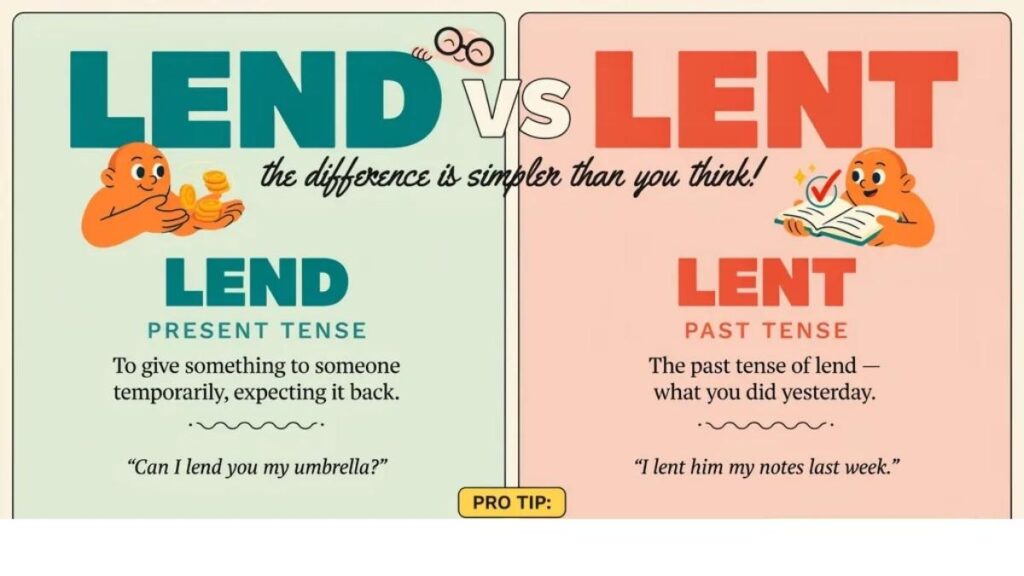
“Did I lend it or lent it?” It’s a tiny grammar question that can suddenly make a simple sentence feel like a tricky quiz. The good news is that lend vs lent is easier than it looks. Both words come from the same verb, but you use them in different situations. Lend is the base and present form, while lent is the past and past participle. Once you understand the difference, the confusion clears up quickly. In this guide, you’ll learn when to use lend or lent, see common mistakes, and explore simple examples that make the rule stick. No more guessing, just clear grammar.
Lend vs Lent The Quick Answer
The easiest way to understand lend vs lent is to look at the verb form and tense.
- Lend is the base form and present form of the verb.
- Lent is the simple past form.
- Lent is also the past participle.
- Lended is not the standard form of the verb.
Here’s the basic pattern:
| Word | Grammatical function | Example |
|---|---|---|
| lend | Base/present form | I lend books to my friends. |
| lent | Simple past | I lent him a book yesterday. |
| lent | Past participle | I have lent her my notes. |
Compare these sentences:
“Can you lend me your pen?”
“She lent me her pen yesterday.”
“I have lent him my pen before.”
The word itself doesn’t change its basic meaning. The grammatical form changes because the sentence describes a different time or uses a different verb structure.
Learn the difference between often confused words
Pretty vs Prety difference and Which Spelling Is Correct ?
What Is the Difference Between Lend and Lent?
The difference between lend and lent is mainly grammatical.
Both words describe giving something to someone temporarily, usually with the expectation that it will be returned. However, you use each form in different situations.
Use lend when you need the base or present form:
- I lend my books to my friends.
- Can you lend me your charger?
- I’ll lend you my notes.
- She wants to lend him her car.
Use lent when you’re talking about a completed past action or when the sentence requires a past participle:
- I lent him my charger yesterday.
- She lent me $20 last week.
- They have lent us their equipment.
- He had lent her his car before.
The simple rule is this: lend is used for the base or present form, while lent is used for the past and past participle.
What Does Lend Mean?
The lend meaning in English is to give something to another person temporarily, usually expecting that person to return it.
You can lend many different things, including:
- Money
- Books
- Clothes
- Tools
- Electronics
- Vehicles
- Equipment
- Support or assistance
For example:
“Can you lend me your pen?”
“My sister lent me her laptop.”
“The bank lends money to customers.”
The verb can also have a figurative meaning. In this use, lend can mean to add or contribute a quality.
For example:
“The curtains lend the room a softer appearance.”
“Her voice lends warmth to the speech.”
“The music lends the scene an emotional quality.”
In these sentences, nobody is physically handing something over. Lend means to contribute something to a person, place, situation, or experience.
Lend Someone Money
Money is one of the most common things people lend.
You might say:
“Can you lend me $50?”
“I don’t usually lend someone money.”
“She agreed to lend him the money.”
“The bank lends money to qualified borrowers.”
A common sentence structure is:
lend + person + thing
For example:
“She lent me $50.”
You can also use:
lend + thing + to + person
For example:
“She lent $50 to me.”
Both structures are grammatically correct.
Lend Someone a Book
The same structure works when you lend an object.
“I’ll lend you my book.”
“She lends her textbooks to classmates.”
“He agreed to lend his friend a novel.”
If someone gives you an item temporarily and expects you to return it, lend is usually the natural verb.
Learn the difference between often confused words
Agast vs Aghast difference and Which one Is Correct?
What Does Lent Mean?
The lent meaning in English depends on how the word appears in a sentence.
As a verb, lent is the simple past and past participle of lend.
For example:
“She lent me her umbrella.”
Here, lent describes a completed action in the past.
Now compare:
“She has lent me her umbrella several times.”
Here, lent is the past participle.
The basic pattern looks like this:
- I lend.
- I lent.
- I have lent.
Consider these three examples:
1.“I lend my car to him.”
2.“I lent my car to him yesterday.”
3.“I have lent my car to him before.”
The first sentence uses the present form. The second uses the past form. The third uses the past participle.
That’s why understanding English verb tenses makes the difference between lend and lent much easier.
Learn the difference between often confused words
Achieve vs Achive Difference Which Spelling Is Correct?
Lend vs Lent Grammar The Three Forms You Need
The main verb forms of lend are:
| Verb form | Word |
| Base form | lend |
| Present | lend / lends |
| Simple past | lent |
| Past participle | lent |
| Present participle | lending |
Examples include:
- I lend.
- She lends.
- I lent.
- I have lent.
- I am lending.
Lend is an irregular verb. It doesn’t form its past tense by simply adding “-ed.”
Compare:
- walk → walked
- talk → talked
- play → played
But:
- lend → lent
- send → sent
- spend → spent
This is one reason learners sometimes try to create the incorrect form “lended.”
Can I Say Lended?
No. “Lended” is not the standard past or past participle form of lend.
Use lent instead.
Correct:
“I lent him my car.”
“She lent me some money.”
“They lent us their equipment.”
Incorrect:
“I lended him my car.”
“She lended me some money.”
“They lended us their equipment.”
If you’re learning English, remember this simple pattern:
lend → lent → lent
There’s no “lended” in the standard verb forms.
Is Lent the Past Tense of Lend?
Yes. If you’re asking, “Is lent the past tense of lend?” the answer is yes.
The simple past form is:
lend → lent
For example:
Present: “I lend my notes to Sarah.”
Past: “I lent my notes to Sarah yesterday.”
However, lent is not only the past tense. It also works as the past participle.
For example:
“I have lent him my notes.”
“She has lent me her laptop.”
“They had lent us the equipment.”
So, a complete explanation is:
Lent is both the simple past and past participle of lend.
Learn the difference between often confused words
Amateur vs Amatuer difference and Which one Is Correct?
When Should I Use Lend?
Use lend when the sentence needs the base or present form.
It commonly appears with present actions, habits, modal verbs, and infinitives.
Lend for Present Actions
Use lend for regular or habitual actions.
“I lend my books to friends.”
“She often lends money to her sister.”
“The library lends books to students.”
Remember that the third-person singular form becomes lends.
- I lend
- You lend
- We lend
- They lend
- He lends
- She lends
- It lends
Lend After Modal Verbs
After modal verbs such as can, could, will, would, should, and might, use the base form lend.
Correct:
“Can you lend me your pen?”
“Could you lend me your notes?”
“I will lend you my car.”
“She might lend him the money.”
Incorrect:
“Can you lent me your pen?”
“I will lent you my car.”
The rule is simple:
modal verb + base verb
So:
can + lend
not:
can + lent
Lend After “To”
The infinitive also uses the base form.
“I want to lend you this book.”
“She agreed to lend him her car.”
“They decided to lend us the equipment.”
The correct structure is:
to + lend
Not “to lent.”
Learn the difference between tricky grammar more words
Absorption vs Absorbsion difference and Which Is Correct?
When Should I Use Lent?
Use lent for completed past actions and as the past participle.
Lent for Completed Past Actions
When an action happened and finished in the past, use lent.
“I lent him my jacket yesterday.”
“She lent me $100 last month.”
“We lent our neighbors some chairs.”
“He lent his brother a bicycle.”
Past-time expressions often help you identify the correct form:
- yesterday
- last night
- last week
- last month
- last year
- two days ago
- earlier this morning
For example:
“She lent me her umbrella last night.”
The phrase “last night” clearly places the action in the past.
Lent With Have, Has, or Had
Use lent after have, has, or had.
“I have lent him money before.”
“She has lent me several books.”
“They have lent us their equipment.”
“He had lent her his car before.”
This is one of the most useful grammar rules for lend to remember:
have/has/had + lent
Not:
have/has/had + lend
And not:
have/has/had + lended
Lend vs Lent With Examples
The easiest way to understand lend vs lent usage is to compare similar sentences.
| Present or base form | Past form | Perfect form |
| I lend him books. | I lent him a book yesterday. | I have lent him several books. |
| She lends me money. | She lent me money last week. | She has lent me money before. |
| We lend our car to friends. | We lent our car to Tom. | We have lent our car to Tom before. |
| They lend equipment. | They lent us equipment. | They had lent us equipment. |
The action stays essentially the same. The verb form changes because the grammar changes.
That is the key to understanding the lend and lent difference. You don’t need to memorize them as two unrelated words. Think of them as two forms of the same irregular verb.
Learn the difference between tricky grammar more words
Ether vs Either which is correct and Difference?
Lend vs Lent Sentence Examples
Here are practical lend vs lent sentence examples from everyday situations.
Money
Present:
“I don’t usually lend people money.”
Past:
“I lent my brother $40 yesterday.”
Perfect:
“I have lent him money several times.”
Books
Present:
“I often lend books to my classmates.”
Past:
“I lent Maria my favorite novel last week.”
Perfect:
“I have lent that book to three people.”
Technology
Present:
“Can you lend me your charger?”
Past:
“She lent me her charger this morning.”
Perfect:
“He has lent me his laptop before.”
Vehicles
Present:
“My parents sometimes lend me their car.”
Past:
“My father lent me his car on Saturday.”
Perfect:
“He has lent me his car several times.”
These examples show how the surrounding grammar determines which form you need.
Learn the difference between tricky grammar more words
In-Person vs In Person What’s the Difference?
Common Mistakes With Lend and Lent

Some errors appear again and again because learners apply the wrong verb pattern.
“I Have Lend It to Him”
Incorrect:
“I have lend it to him.”
Correct:
“I have lent it to him.”
The reason is simple. Have requires the past participle, and the past participle of lend is lent.
“Yesterday, I Lend Him My Car”
Incorrect:
“Yesterday, I lend him my car.”
Correct:
“Yesterday, I lent him my car.”
The word “yesterday” indicates a completed past action.
“Can You Lent Me Your Pen?”
Incorrect:
“Can you lent me your pen?”
Correct:
“Can you lend me your pen?”
Can is a modal verb, so the verb that follows it must use the base form.
“I Will Lent You Some Money”
Incorrect:
“I will lent you some money.”
Correct:
“I will lend you some money.”
Will also takes the base form.
“I Have Lended It”
Incorrect:
“I have lended it.”
Correct:
“I have lent it.”
Lend is irregular, so adding “-ed” doesn’t produce the correct past form.
Did You Lend or Did You Lent?
This is one of the most common questions about lend vs lent grammar.
The correct sentence is:
“Did you lend him the money?”
Not:
“Did you lent him the money?”
Why? Because did already marks the sentence as past tense. The main verb returns to its base form.
The same pattern appears with many irregular verbs:
- Did you go?
- Did she see it?
- Did they take it?
- Did you lend it?
Not:
- Did you went?
- Did she saw it?
- Did they took it?
- Did you lent it?
So remember:
did + lend
Never:
did + lent
Have You Lend or Have You Lent?
The correct sentence is:
“Have you lent it to him?”
Not:
“Have you lend it to him?”
After have, has, or had, use the past participle.
Therefore:
- have lent
- has lent
- had lent
Examples:
“Have you lent her the book?”
“Has he lent you money?”
“Had they lent you the equipment?”
This is another useful rule that can eliminate many common mistakes with lend.
Learn the difference between tricky grammar more words
Rosin vs Resin Difference and Which is Correct?
Lend vs Borrow What’s the Difference?
The lend vs borrow distinction is based on direction.
When you lend something, you give it temporarily to another person.
When you borrow something, you receive it temporarily from another person and generally expect to return it.
Think of the exchange like this:
Owner → lends → item → borrower
Borrower → borrows → item → owner
For example:
“Can you lend me your pen?”
From the receiver’s perspective:
“Can I borrow your pen?”
Both sentences describe the same exchange.
Lend and Borrow Examples
| Lend | Borrow |
| Can you lend me your book? | Can I borrow your book? |
| She lent me $20. | I borrowed $20 from her. |
| He lent his car to me. | I borrowed his car. |
| They lent us their tools. | We borrowed their tools. |
The words borrowed vs lent often appear together because they describe opposite sides of the same temporary exchange.
The easiest rule is:
Lend = give temporarily.
Borrow = receive temporarily.
Lend vs Lent vs Loan
The phrase lend vs lent vs loan brings three related words together, but they don’t all have the same grammatical role.
- Lend is a verb.
- Lent is the past and past participle form of lend.
- Loan is commonly a noun and can also function as a verb.
For example:
“The bank will lend me money.”
“The bank lent me money.”
“I applied for a loan.”
You can also say:
“The bank loaned me the money.”
The loan meaning is generally connected with something provided temporarily, especially money, with the expectation that it will eventually be repaid or returned.
Loan vs Lend Difference
The loan vs lend difference becomes clearer when you examine how each word functions.
Loan as a noun:
“She took out a loan.”
Lend as a verb:
“The bank agreed to lend her money.”
Loan as a verb:
“The bank loaned her the money.”
In financial contexts, loan is particularly common as a noun. Lend remains the straightforward verb for providing something temporarily.
Loaned vs Lent Are They the Same?
Loaned and lent can overlap when loan is used as a verb.
For example:
“The bank lent him $5,000.”
“The bank loaned him $5,000.”
Both sentences can describe the same basic action.
However, loaned is the past form of loan, while lent is the past form of lend. They are separate verbs even when they describe similar actions.
Learn the difference between tricky grammar more words
Waving vs Waiving Which is correct and Difference?
Lend vs Lent in English Does American English Change the Rule?
No. The basic lend vs lent in English rule is the same in American English and British English.
In both varieties:
- lend is the base and present form
- lent is the simple past form
- lent is the past participle
For example:
“I lend him my books.”
“I lent him my book yesterday.”
The grammar doesn’t change.
Some differences can appear in how speakers use loan as a verb, but that doesn’t affect the basic conjugation of lend.
Lend and Lent Pronunciation
The Lend and lent sound very similar.
Lend ends with a /d/ sound, while lent ends with a /t/ sound. Both contain the same short vowel sound found in words such as send and sent.
Compare:
- lend
- lent
- send
- sent
The pronunciation difference is small, but the grammatical difference is important.
Why Is Lent Irregular?
A natural question is, “Why is lent irregular?”
Lend belongs to a group of irregular verbs that don’t form their past tense by simply adding “-ed.”
For example:
- send → sent
- spend → spent
- build → built
- keep → kept
- lend → lent
You don’t need to memorize the history of English to use these forms correctly. For everyday grammar, remembering the verb family is enough:
lend → lent → lent
This is a useful part of learning English grammar because many common verbs follow irregular patterns.
How to Remember Lend vs Lent
If the rules start feeling like a pile of tangled headphones, use a simple timeline.
Present or general action → lend
Completed past action → lent
Have, has, or had → lent
For example:
1.“I lend him my books.”
2.“I lent him my book yesterday.”
3.“I have lent him several books.”
Another useful shortcut is to remember the verbs that control the form.
Did → lend
Have/has/had → lent
Will → lend
Can/could → lend
So:
“Did you lend it?”
“Have you lent it?”
“I will lend it.”
“Can you lend it?”
Once these patterns become familiar, choosing between lend and lent becomes almost automatic.
Learn the difference between confusing word pairs
Performing vs Preforming difference and Which One Is Correct?
When to Use Lend vs Lent A Quick Decision Guide
If you’re unsure when to use lend or lent, ask yourself a few simple questions.
Is the verb after can, could, will, would, should, or might?
Use lend.
“Could you lend me your notes?”
Is the action a completed event in the past?
Use lent.
“She lent me her notes yesterday.”
Does have, has, or had come before the verb?
Use lent.
“She has lent me her notes.”
Does did come before the verb?
Use lend.
“Did she lend you her notes?”
This quick check covers most everyday uses.
Lend vs Lent for Students and Beginners
For students and beginners, learning the basic verb pattern is more useful than memorizing dozens of disconnected sentences.
Start with:
lend → lent → lent
Then practice it in different structures:
- I lend.
- She lends.
- I lent.
- I have lent.
- I am lending.
- I will lend.
- Can you lend?
- Did you lend?
This gives learners a practical understanding of English verb conjugation lend without overwhelming them with complicated terminology.
A Simple Example
Imagine that Alex owns a calculator.
Today:
“Alex can lend me his calculator.”
Yesterday:
“Alex lent me his calculator.”
After several occasions:
“Alex has lent me his calculator many times.”
The object stays the same. The tense changes.
That simple comparison captures the core of lend vs lent explained.
Learn the difference between confusing word pairs
Tomatoes vs Tomatos difference and Which Is Correct?
Lend vs Lent Sentence Examples for Everyday Situations
Here are more examples you can use in real conversations.
Asking for something:
“Could you lend me your phone for a minute?”
Talking about the past:
“She lent me her phone yesterday.”
Talking about previous experience:
“I’ve lent my phone to him before.”
Talking about a habit:
“I often lend my books to friends.”
Talking about the future:
“I’ll lend you my notes tomorrow.”
Talking about money:
“He lent me $100 last month.”
Talking about repeated actions:
“She has lent money to several family members.”
These examples of lend and lent show how the correct form depends on the sentence structure.
Learn the difference between confusing word pairs
Sneek vs Sneak Which Spelling Is Correct and Use It?
Lend vs Lent Catholic Why Does “Lent” Also Have a Religious Meaning?
If you searched for lend vs lent catholic, you may have seen a completely different meaning of “Lent.”
In Christianity, Lent is the religious season leading up to Easter. In Catholic tradition, it is associated with prayer, fasting, repentance, and spiritual preparation for Easter.
This meaning has nothing to do with the verb lend.
Compare:
“She lent me her book.”
Here, lent is the past tense of lend.
Now compare:
“Lent is a season of preparation before Easter.”
Here, Lent is a religious term and is capitalized because it is the name of a specific season.
The two words happen to look identical, but they have completely different origins and meanings.
Lent Season Meaning
The Lent season meaning refers to the Christian observance before Easter.
In the Catholic tradition, Lent is traditionally associated with 40 days of preparation. Sundays are treated differently when counting the period, which is why the calendar span from Ash Wednesday to Easter can extend beyond 40 calendar days.
So if you see “Lent” capitalized in a religious context, don’t confuse it with “lent,” the past form of the verb lend.
Context tells you which meaning applies.
Learn the difference between confusing word pairs
Connector vs Connecter Which Spelling Is Correct?
Common Confusing English Words Why Context Matters
Lend and lent are a good example of how confusing English words become easier when you study them in context.
Consider these verb patterns:
- lend → lent
- send → sent
- spend → spent
Learn the difference between confusing word pairs
Acception vs Exception Difference and Usage?
Practice Session Lend vs Lent
Fill in each blank with the correct form of the word in parentheses.
- Can you ______ me your pen for a few minutes?
- Sarah ______ me her laptop yesterday.
- I have ______ my notes to several classmates.
- My brother often ______ me his headphones.
- Will you ______ me some money until Friday?
- She ______ her car to me last weekend.
- Did you ______ him your calculator?
- They have ______ us their camping equipment.
- I usually ______ my books to my friends.
- He is ______ me his bike for the afternoon.
- Could you ______ me your charger?
- She had ______ her jacket to Maria before the party.
- I ______ him $50 two weeks ago.
- My parents sometimes ______ me their car.
- Have you ever ______ your computer to someone?
- I want to ______ you my favorite book.
- He ______ his umbrella to his friend during the rain.
- We will ______ you the equipment you need.
- She has ______ me several books this year.
- Did your teacher ______ you a dictionary?
- I am ______ my notes to a classmate today.
- They ______ us some chairs for the party yesterday.
- Can you ______ me your phone for a moment?
- He had ______ his friend some money before the trip.
- I have never ______ my car to anyone before.
Answers
- lend
- lent
- lent
- lends
- lend
- lent
- lend
- lent
- lend
- lending
- lend
- lent
- lent
- lend
- lent
- lend
- lent
- lend
- lent
- lend
- lending
- lent
- lend
- lent
- lent
Here’s a trusted source for clear word meanings:
FAQs
What is the correct verb form after “did” with lend?
Use lend after did because did already shows that the sentence is in the past tense. The correct form is “Did you lend me your book?” not “Did you lent me your book?”
Why is “lended” incorrect?
“Lended” is not the standard English form because lend is an irregular verb. Its correct past and past participle forms are both lent.
Should I say “I have lend” or “I have lent”?
Use “I have lent.” The verb have requires the past participle, and lent is the past participle of lend.
Why do we say “I will lend” instead of “I will lent”?
After will, English uses the base form of the verb. Since lend is the base form, “I will lend” is correct.
What form of lend comes after “can”?
Use lend after can. For example, “Can you lend me your notebook?” Modal verbs such as can, could, should, and might take the base form of the main verb.
What is the third-person singular form of lend?
The third-person singular present form is lends. For example, “She lends her books to her classmates.”
What is the continuous form of lend?
The continuous form is lending. For example, “He is lending his car to his brother this weekend.”
Can “lend” describe something other than money or objects?
Yes. Lend can also mean to add or contribute a quality. For example, “The soft lighting lends the room a relaxing atmosphere.”
Can “lent” be used with “was” or “were”?
Yes, but the meaning depends on the construction. For example, “The books were lent to students” uses lent as part of a passive construction. This is different from the active sentence “She lent the students the books.”
What sentence pattern can I use with lend?
A common pattern is “lend + person + thing,” as in “She lent me her calculator.” Another pattern is “lend + thing + to + person,” as in “She lent her calculator to me.”
Can lend be followed directly by an object?
Yes. For example, “The library lends books.” You can also specify the person receiving the item: “The library lends students books.”
Is “lend to” grammatically correct?
Yes. “Lend to” is correct when you identify the person receiving the item. For example, “I lent my bicycle to my neighbor.”
Is “lend someone” grammatically correct?
Yes, when another object follows it. For example, “Can you lend me your dictionary?” Here, “me” identifies the person receiving the dictionary.
Can lend be used for services or help?
Yes. In some expressions, lend means to provide or contribute something abstract. For example, “She lent her support to the project.”
Does lend always mean that something must be returned?
Usually, lend refers to giving something temporarily with the expectation that it will be returned. However, figurative uses such as “lend support” don’t involve returning a physical object.
Can lend be used for permanent transfers?
Generally, no. If you permanently give something to someone, give or donate is usually more appropriate than lend. Lend normally suggests temporary possession.
What is the difference between “lend me” and “lend to me”?
Both can be correct. “Lend me your pen” uses the indirect-object pattern, while “lend your pen to me” uses the “to” construction. The first is usually more natural in everyday conversation.
Can “lent” appear without a past-time word?
Yes. A past-time expression such as yesterday isn’t required. For example, “She lent me her car” is grammatically complete even without specifying when it happened.
Can “lend” refer to a future action?
Yes. The base form lend can appear after future auxiliaries or modal verbs. For example, “I will lend you my notes tomorrow.”
Does “lend” change to “lends” in every present-tense sentence?
No. Lends is used with third-person singular subjects such as he, she, and it. With I, you, we, and they, use lend.
What is the difference between “lent” and “lending”?
Lent is the simple past and past participle of lend. Lending is the present participle and gerund form. For example, “She lent me a book” describes a past action, while “She is lending me a book” describes an ongoing action.
Can “lend” be used as a noun?
In standard modern English, lend is primarily used as a verb. Nouns such as loan are more appropriate when referring to the thing or amount provided temporarily.
Is “lend” a transitive verb?
Yes. Lend is normally a transitive verb because it takes an object. For example, “She lent me her car” and “The bank lends money.”
Can lend have two objects?
Yes. Lend can take both a person and a thing. For example, “He lent Sarah his laptop.” Here, Sarah is the indirect object and laptop is the direct object.
What is the fastest way to check whether lend or lent belongs in a sentence?
Look at the words around the verb. After did, can, could, will, or to, use lend. After have, has, or had, use lent. For a completed simple past action, use lent.
Why do lend and lent look so different if they are forms of one verb?
Lend is an irregular verb. Instead of forming its past with “-ed,” it changes to lent. Similar patterns occur in verbs such as send → sent and spend → spent.
Can “lend” and “loan” always replace each other?
No. Although they can overlap when loan is used as a verb, their grammatical roles differ. Loan is very common as a noun, while lend is a standard verb for temporarily giving something to another person.
How can learners remember the verb forms of lend?
Use the simple pattern “lend, lent, lent.” The first form is the base form, while the second and third forms are both lent. A useful sentence set is “I lend,” “I lent,” and “I have lent.”
Conclusion
Lend vs lent can seem confusing at first, but the rule is easier than it looks. Lend is the base and present form, while lent is the past and past participle. You lend someone a book today, but you lent it to them yesterday. If you have already given it to them, you have lent it.
Most mistakes happen when the wrong verb form follows words like did, can, will, or have. Just remember: did + lend, can + lend, will + lend, and have/has/had + lent. And no, “lended” isn’t the answer. English decided to make this one irregular.
Once you understand these simple patterns, lend vs lent becomes much easier to use. A little practice is all it takes to stop second-guessing yourself and choose the right word with confidence.

Jhon AJS, the creative mind behind Grammar Update, is an experienced blogger passionate about simplifying English grammar. He focuses on explaining confusing word vs word differences, grammar rules, punctuation, and sentence structure in a clear and practical way. Through easy to understand guides and examples, Jhon helps readers improve their writing and communicate with confidence. With years of blogging experience, he continues to share helpful insights that make learning grammar simple, useful, and accessible for everyone.