The Straight vs Strait confusion causes many English mistakes because both words sound exactly the same but have different meanings. Many people write strait line instead of straight line or use Straight of Hormuz when the correct name is Strait of Hormuz. These mistakes are very common in schoolwork, professional writing, and everyday English. The good news is that the difference is easy to understand. Straight means direct, honest, or not curved, while strait refers to a narrow water passage or a difficult situation. This guide clears the confusion, explains the meanings, corrects common mistakes, and helps you understand when to use each word correctly and confidently in your writing.
Straight vs Strait The Quick Answer
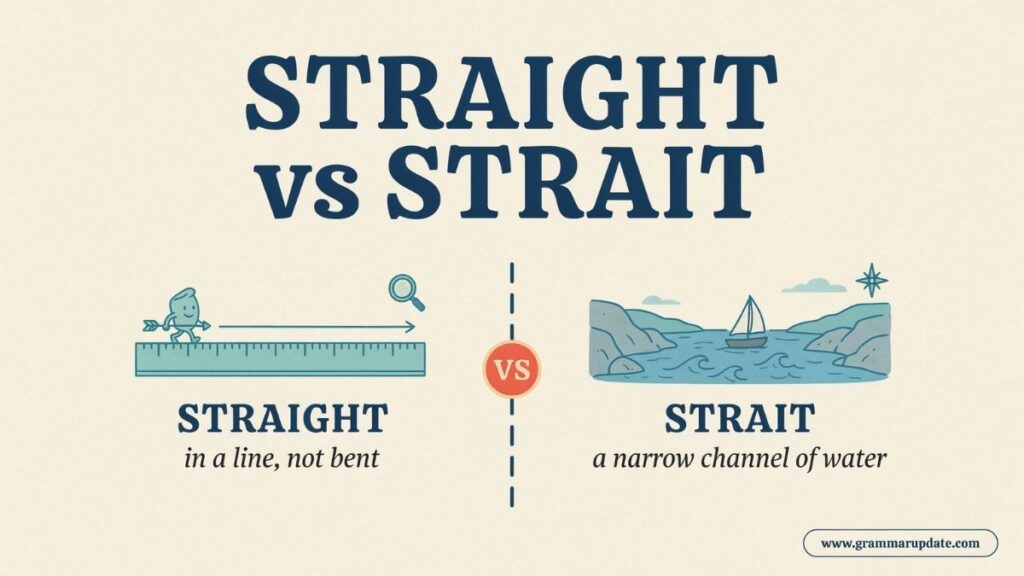
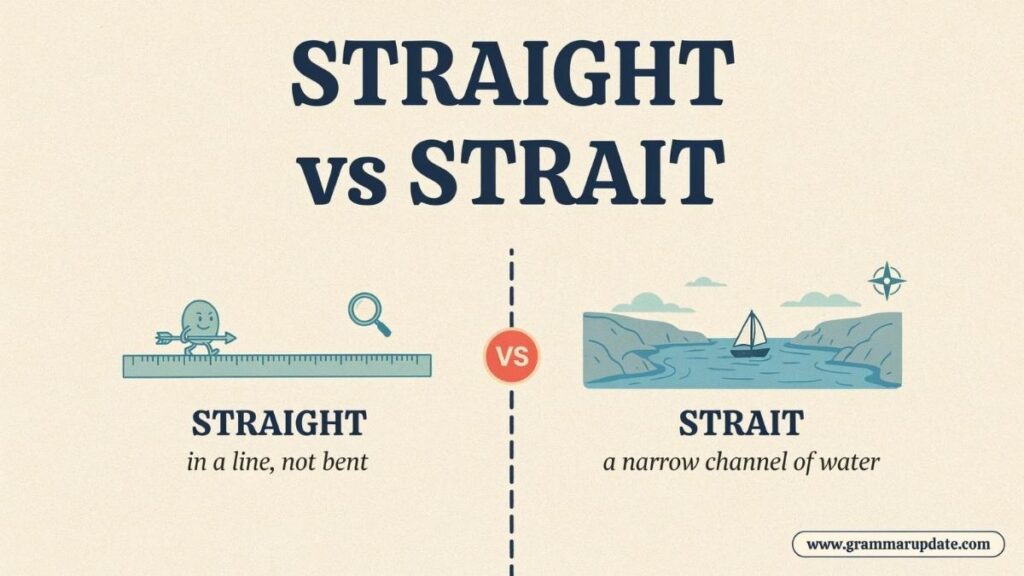
The simplest explanation of Straight vs strait meaning is this:
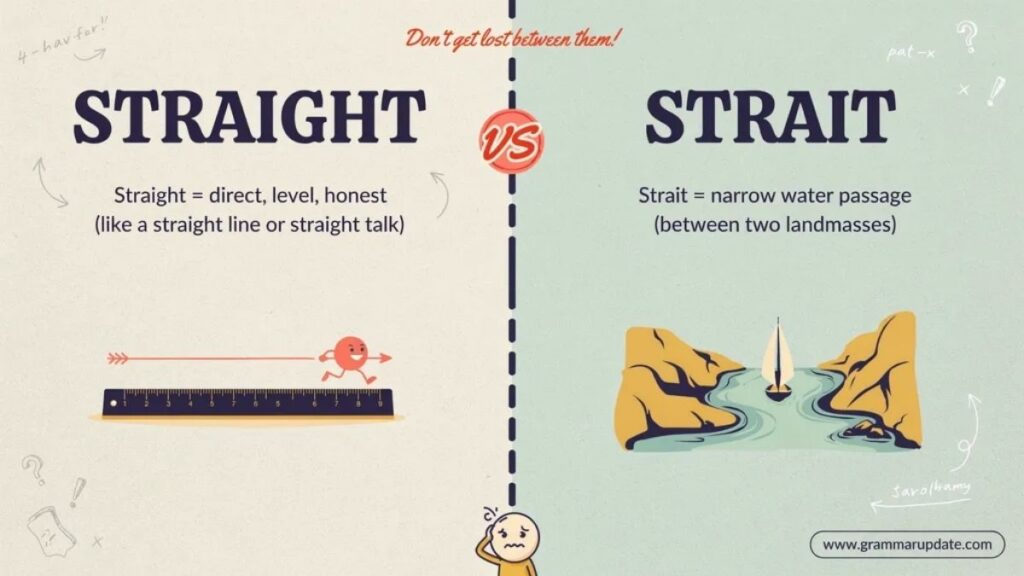
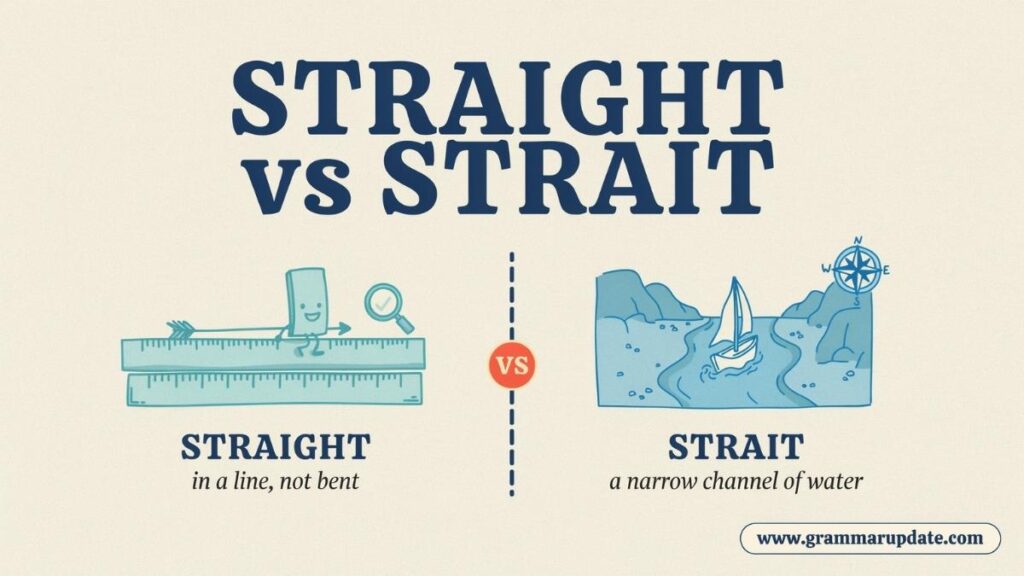
- Straight means direct, not curved, honest, or level.
- Strait means a narrow passage of water connecting two larger bodies of water.
Examples:
The road continues straight for several miles.
The Strait of Gibraltar connects the Atlantic Ocean and the Mediterranean Sea.
Although the pronunciation is identical, the meanings are completely different.
| Word | Part of Speech | Meaning | Example |
|---|---|---|---|
| Straight | Adjective, adverb, noun | Direct, honest, not curved | A straight road |
| Strait | Noun | Narrow water passage | The Bering Strait |
This distinction forms the foundation of all Straight vs strait grammar rules.
What Does Straight Mean?
The Straight meaning is broad and versatile. The word appears in everyday conversation, academic writing, mathematics, transportation, communication, and countless idiomatic expressions.
Straight can function as an adjective, adverb, and noun, making it one of the most flexible words in English.
Straight as an Adjective
As an adjective, straight generally means:
- not curved
- direct
- level
- upright
- honest
- orderly
Examples include:
- a straight line
- a straight road
- straight hair
- a straight answer
- a straight posture
Example:
The highway runs in a straight line across the desert.
In geometry, a straight line has no curves or bends.
communication, a straight answer means a truthful and direct response.
In appearance, straight hair refers to hair without curls or waves.
Straight as an Adverb
Straight often functions as an adverb meaning directly, immediately, or without interruption.
Examples:
Go straight ahead.
She came straight home after work.
He walked straight into the office.
In these examples, straight describes movement or action without deviation.
Straight as a Noun
Although less common, straight can also function as a noun.
In card games, a straight is a sequence of consecutive cards.
Example:
She won the game with a straight.
In some social contexts, straight may also refer to a heterosexual person.
Because of these multiple uses, straight appears far more frequently than strait in everyday English.
Learn how to use confusing more words correctly
Unselect vs Deselect Which Term Is Correct?
Straight Definition
The standard Straight definition is:
Extending continuously in the same direction without curves, bends, or deviations.
Over time, additional meanings developed, including:
- honest or truthful
- direct or immediate
- orderly or organized
- upright or level
The flexibility of the word explains why straight appears in thousands of English expressions and sentences.
What Does Strait Mean?
The Strait meaning is much narrower and more specialized.
A strait is a narrow body of water that connects two larger bodies of water.
Straits are important in:
- geography
- maritime navigation
- international trade
- shipping routes
- political geography
Unlike straight, strait functions primarily as a noun.
Learn the difference between tricky more English words
It’s Called vs It Called Which Phrase Is Grammatically Correct?
Strait Definition
The standard Strait definition is:
A narrow water passage connecting two larger bodies of water.
For example:
The Strait of Hormuz connects the Persian Gulf to the Gulf of Oman.
The word can also describe a condition of hardship or difficulty.
Examples include:
- financial straits
- dire straits
- economic straits
Although this figurative meaning is less common today, it remains important in literature and formal writing.
Learn the difference between tricky more English words
Envolved vs Involved Which Is Correct?
Straight vs Strait Meaning
Understanding Straight vs strait meaning becomes easier when the two words are compared directly.
| Feature | Straight | Strait |
|---|---|---|
| Main Meaning | Direct or not curved | Narrow water passage |
| Part of Speech | Adjective, adverb, noun | Noun |
| Usage | Everyday English | Geography and formal expressions |
| Frequency | Very common | Less common |
| Example | Straight line | Strait of Hormuz |
Straight describes direction, shape, honesty, or movement.
Strait refers to waterways or difficult circumstances.
The meanings never overlap.
Why People Confuse Straight and Strait
Several factors make these words difficult for writers.
Identical Pronunciation
Straight and strait are perfect examples of homophones in English.
Homophones:
- sound the same
- have different spellings
- have different meanings
Other examples include:
- right and write
- there and their
- sea and see
Because pronunciation offers no clues, the meaning must determine the spelling.
Similar Spelling
Only two letters separate the words:
- straight
- strait
This similarity causes many spelling mistakes, especially when typing quickly.
Unequal Usage
Straight appears constantly in everyday English.
Examples include:
- straight line
- straight road
- straight answer
- straight ahead
Strait appears mainly in geography, navigation, and a few fixed expressions.
As a result, many writers automatically choose straight even when strait is correct.
Learn the difference between tricky more English words
Propose vs Purpose Which Is Correct?
Straight vs Strait Pronunciation
One major reason for the confusion is pronunciation.
Both words are pronounced exactly the same.
American English
Both words are pronounced:
STRAYT
British English
Both words are also pronounced:
STRAYT
Because there is no pronunciation difference, context becomes essential.
Straight vs Strait Geography
The word strait is particularly important in geography.
A strait is a naturally formed, narrow waterway that connects larger bodies of water while separating land masses.
Straits are significant because they often control:
- international shipping routes
- trade networks
- military movement
- maritime navigation
Many of the world’s most important transportation routes pass through straits.
Learn the difference between tricky more English words
Gray vs Grey Which Spelling Is Correct and Difference?
Famous Straits Around the World
Bering Strait
The Bering Strait separates Alaska and Russia while connecting the Arctic Ocean and the Pacific Ocean.
Strait of Gibraltar
The Strait of Gibraltar connects the Atlantic Ocean and the Mediterranean Sea while separating Europe and Africa.
Strait of Hormuz
The Strait of Hormuz serves as one of the world’s most important oil transportation routes.
Taiwan Strait
The Taiwan Strait separates Taiwan from mainland China.
Strait of Malacca
The Strait of Malacca is one of the busiest shipping lanes in the world.
Bosporus Strait
The Bosporus connects the Black Sea and the Sea of Marmara while dividing Europe and Asia.
These examples demonstrate why straits hold great geographical, political, and economic importance.
Strait vs Channel
Students often ask about Strait vs channel.
Although both involve waterways, they are not identical.
| Strait | Channel |
|---|---|
| Naturally narrow | Usually wider |
| Connects larger water bodies | May not connect oceans |
| Located between land masses | Can be natural or artificial |
| Specific geographic term | More general term |
Examples:
- Strait of Gibraltar
- English Channel
- Suez Canal
A strait forms naturally.
Learn the difference between tricky more English words
Rancor vs Rancour Difference and Which Spelling Is Correct?
Common Expressions Using Straight
Straight appears in many common English expressions.
Straight line
A line without bends or curves.
Straight ahead
Directly forward.
Straight answer
An honest response.
Straight face
A serious expression without smiling.
Straight road
A road without turns.
Straight hair
Hair without curls.
Straight angle
An angle measuring 180 degrees.
Straightforward
Simple, clear, and direct.
These expressions make straight one of the most widely used words in English vocabulary.
Learn the difference between tricky more English words
Mobil vs Mobile Which Is Correct and Usage?
Common Expressions Using Strait
The figurative meaning of strait survives in several established expressions.
In Dire Straits
This phrase means severe difficulty or serious problems.
Example:
The company found itself in dire straits after the recession.
Financial Straits
This expression refers to economic hardship.
Example:
Many families experienced financial straits during the economic crisis.
These meanings reflect the older sense of strait as something narrow, restrictive, or difficult.
Straightforward or Straitforward?
One of the most common questions is:
Is it straight or strait forward?
The correct spelling is:
straightforward
The incorrect spelling is:
straitforward
The word combines:
- straight
- forward
Together, they mean direct, clear, and easy to understand.
Example:
Her explanation was straightforward and easy to follow.
The spelling straitforward is always incorrect.
Learn the difference between tricky more English words
Phoenix vs Pheonix Difference and Usage
Straitjacket or Straightjacket?
Historically, the original spelling was:
straitjacket
The word described a restrictive garment used to limit movement.
The older meaning of strait referred to tightness or restriction.
Today, many writers use:
- straightjacket
Modern dictionaries often recognize both spellings, although straitjacket remains the traditional form.
Fix common more word mistakes in English
Flys vs Flies Correct Spelling and Common Mistakes
Straight vs Strait Examples in Sentences
One of the most effective ways to master Straight vs strait examples is to examine both words in real sentences. Since these words are pronounced identically, context is the only reliable way to determine which spelling is correct. Seeing them used naturally helps writers recognize their meanings and avoid common mistakes.
Straight in a Sentence
The word straight usually refers to something direct, not curved, honest, level, or immediate.
Please walk straight ahead until you reach the station.
The architect drew a straight line across the design.
She gave the interviewer a straight answer.
The highway continues straight for several miles.
He stood with a straight posture during the ceremony.
Her straight hair reached below her shoulders.
The students wrote their names in straight rows.
In all of these examples, straight describes direction, shape, honesty, movement, or appearance.
Strait in a Sentence
The word strait has a much narrower meaning. It usually refers to a natural water passage connecting two larger bodies of water. In some expressions, it also refers to hardship or difficult circumstances.
The Bering Strait separates Asia and North America.
Oil tankers travel through the Strait of Hormuz every day.
The Strait of Gibraltar connects the Atlantic Ocean to the Mediterranean Sea.
The company found itself in financial straits.
Many families experienced economic straits during the recession.
Ships regularly pass through the Malacca Strait.
These examples show that strait belongs primarily to geography and certain established expressions.
Incorrect Usage Examples
Many spelling mistakes occur because writers choose the wrong homophone.
| Incorrect | Correct |
|---|---|
| Strait line | Straight line |
| Strait answer | Straight answer |
| Straight of Hormuz | Strait of Hormuz |
| Strait ahead | Straight ahead |
| Strait hair | Straight hair |
| Straight of Gibraltar | Strait of Gibraltar |
| Strait road | Straight road |
| Straitforward | Straightforward |
These errors demonstrate why understanding meaning is more important than pronunciation.
Fix common more word mistakes in English
Submission vs Submittion learn the Difference
Common Straight vs Strait Mistakes
The confusion between these words often produces predictable grammar and spelling errors.
Using Strait for Direction
Incorrect:
Go strait ahead.
Correct:
Go straight ahead.
Straight refers to a direct path or movement.
Using Straight for Geography
Incorrect:
The Straight of Hormuz is an important shipping route.
Correct:
The Strait of Hormuz is an important shipping route.
Whenever the subject involves a narrow water passage, the correct word is strait.
Writing Straitforward
Incorrect:
The explanation was straitforward.
Correct:
The explanation was straightforward.
The word straightforward comes from straight, meaning direct or uncomplicated.
Confusing Straitjacket and Straightjacket
Historically, the correct spelling is:
straitjacket
The original meaning relates to restraint or restriction. Although some modern dictionaries accept straightjacket, straitjacket remains the traditional spelling.
Fix common more word mistakes in English
Meating vs Meeting Difference and Usage
How to Remember Straight vs Strait
Many students search for How to remember straight vs strait because the pronunciation offers no clues.
Several simple techniques can help.
Straight Means Direct
The word straight often describes:
- a direct route
- an honest answer
- a line without curves
- movement without deviation
Examples include:
- straight road
- straight answer
- straight line
- straight ahead
Whenever the meaning involves direction, honesty, or shape, straight is usually correct.
Strait Means Narrow
A strait is a narrow passage of water connecting larger bodies of water.
Examples:
- Bering Strait
- Taiwan Strait
- Strait of Gibraltar
- Strait of Hormuz
Many learners remember that the shorter word describes the narrower space.
Use Context as Your Guide
If the sentence discusses:
- roads
- directions
- honesty
- lines
- movement
- appearance
Use straight.
If the sentence discusses:
- oceans
- waterways
- navigation
- geography
- shipping routes
- hardship
Use strait.
Meaning always determines the correct spelling.
Straight vs Strait in Professional Writing
Correct word choice is especially important in professional and academic writing.
Academic Writing
Geography, environmental science, history, and political studies frequently use the word strait.
Examples:
- Bering Strait
- Bosporus Strait
- Strait of Malacca
- Strait of Gibraltar
Using straight in these contexts creates factual and grammatical errors.
Business Communication
Business writing often uses straight to express clarity and honesty.
Examples include:
- straight answer
- straightforward explanation
- straight communication
Professional writing values direct language, making straight an important word in workplace communication.
Journalism and News Writing
News organizations frequently use both words.
Examples:
Oil exports through the Strait of Hormuz increased this year.
The minister gave reporters a straight answer.
Because both words regularly appear in journalism, accurate spelling is essential.
Straight vs Strait in Geography
The geographical meaning of strait is one of the most important aspects of this word.
A strait is:
- naturally formed
- narrow
- navigable
- located between land masses
- connecting larger bodies of water
Straits play an essential role in global trade, transportation, and international relations.
Important Straits Around the World
| Strait | Location | Importance |
|---|---|---|
| Bering Strait | Russia and Alaska | Connects Arctic and Pacific Oceans |
| Strait of Hormuz | Middle East | Major oil transportation route |
| Strait of Gibraltar | Spain and Morocco | Connects Atlantic and Mediterranean |
| Taiwan Strait | East Asia | Significant trade route |
| Malacca Strait | Southeast Asia | One of the world’s busiest shipping lanes |
| Bosporus | Turkey | Connects Europe and Asia |
Many of these waterways influence international commerce and global politics.
What Does “Dire Straits” Mean?
The phrase dire straits means severe hardship, serious difficulty, or extremely challenging circumstances.
Examples:
The business was in dire straits after losing several important contracts.
The country entered economic straits during the financial crisis.
This expression preserves an older meaning of strait that refers to restriction, difficulty, or hardship.
The phrase became internationally famous through the British rock band Dire Straits, whose name introduced the expression to millions of people.
Is Strait an Adjective?
In modern English, strait functions almost entirely as a noun.
Historically, it could act as an adjective meaning:
- narrow
- restricted
- difficult
Today, these uses are uncommon.
Most modern speakers encounter strait only as:
- a geographical term
- part of established expressions such as dire straits
Can Straight Be a Noun?
Yes. Straight can function as a noun in several contexts.
Examples:
She won the game with a straight.
The race ended with a long straight.
In poker, a straight is a sequence of consecutive cards.
In racing, a straight refers to a section of track without curves.
This flexibility helps explain why straight appears far more often than strait in everyday English.
What Dictionaries Say About Straight and Strait
Major dictionaries clearly separate these words.
Merriam-Webster
- Straight: extending without bends or curves.
- Strait: a narrow passage connecting larger bodies of water.
Cambridge Dictionary
- Straight: continuing in one direction without bending.
- Strait: a narrow area of water joining two larger areas.
Oxford English Dictionary
Oxford recognizes two meanings of strait:
- a narrow waterway
- a condition of difficulty or hardship
All major dictionaries agree that these words are distinct and should never be used interchangeably.
Straight vs Strait Quick Reference Table
| Situation | Correct Word |
|---|---|
| A direct route | Straight |
| An honest answer | Straight |
| A narrow waterway | Strait |
| The Bering Strait | Strait |
| Straight hair | Straight |
| Financial hardship | Strait |
| Straight line | Straight |
| Strait of Hormuz | Strait |
| Straightforward explanation | Straight |
| Dire straits | Strait |
When to Use Straight vs Strait
Understanding When to use straight vs strait becomes simple once you focus on meaning.
Use straight when discussing:
- direction
- honesty
- movement
- shape
- appearance
- communication
Use strait when discussing:
- waterways
- geography
- navigation
- shipping routes
- difficult circumstances
If the meaning involves something direct, level, honest, or not curved, use straight.
If the meaning involves a narrow water passage or hardship, use strait.
Practice Session Straight vs Strait
Choose the correct word: straight or strait.
- Please walk __________ ahead until you reach the library.
- The ship passed through the __________ of Gibraltar.
- Draw a __________ line across the paper.
- The company found itself in financial __________.
- The road continues __________ for several miles.
- The Bering __________ separates Asia and North America.
- She gave me a __________ answer.
- Oil tankers travel through the __________ of Hormuz.
- His hair is naturally __________.
- The family was in dire __________ after losing their business.
- Drive __________ until you see the traffic lights.
- The Taiwan __________ is an important shipping route.
- The teacher asked the students to sit in __________ rows.
- The country experienced economic __________ during the recession.
- The highway runs __________ across the desert.
- The ship entered the narrow __________ at sunset.
- Please give me a __________ answer.
- The Malacca __________ is one of the world’s busiest waterways.
- She walked __________ into the classroom.
- The sailors crossed the __________ safely.
- His posture remained __________ during the ceremony.
- The Bosporus __________ separates Europe and Asia.
- The ruler helps students draw __________ lines.
- Many businesses were left in financial __________.
- Go __________ ahead and turn left at the next corner.
Answers
- straight
- Strait
- straight
- straits
- straight
- Strait
- straight
- Strait
- straight
- straits
- straight
- Strait
- straight
- straits
- straight
- strait
- straight
- Strait
- straight
- strait
- straight
- Strait
- straight
- straits
- straight
Here’s a trusted source for clear word meanings:
FAQs
Is it home straight or home strait?
The correct phrase is home straight. It refers to the final stage of a race, competition, or any activity that is almost finished.
Is it the final strait or the final straight?
The correct expression is the final straight. It means the last part of a journey, race, or process before reaching the end.
Is it straight-laced or strait-laced?
The correct spelling is strait-laced. It describes someone who is very strict, serious, or follows traditional rules and values.
Is it a straight line or strait line?
The correct phrase is straight line because straight means direct and not curved.
When should I use strait instead of straight?
Use strait for a narrow water passage, such as the Strait of Gibraltar, or in expressions like dire straits. Use straight for directions, lines, honesty, or anything that is not curved.
Is a strait always straight?
No. A strait is simply a narrow body of water connecting two larger bodies of water. It does not have to be physically straight.
What does straight mean?
Straight means direct, honest, level, or not curved. It can describe roads, lines, answers, hair, or movement.
What is the opposite of a strait?
In geography, the opposite of a strait is generally considered an open sea or a broad ocean area.
Why is it spelled strait?
The word strait comes from older English and Latin words meaning narrow or restricted, which explains its unique spelling.
Is it straightjacket or straitjacket?
The traditional and historically correct spelling is straitjacket, although some modern dictionaries also accept straightjacket.
What is correct: strait or straits?
Both are correct depending on the context. Strait refers to one waterway, while straits appears in expressions such as dire straits or certain place names.
Is it straight up or strait up?
The correct phrase is straight up. It means honestly, directly, or without exaggeration.
What is the most famous strait?
The Strait of Hormuz is one of the world’s most famous straits because it is an important international shipping route.
Is strait the same as straight?
No. Straight means direct or not curved, while strait refers to a narrow waterway or a difficult situation.
What is a narrow channel of sea called?
A narrow passage of water connecting two larger bodies of water is called a strait.
What is a synonym for strait?
For the geographical meaning, synonyms include channel, passage, waterway, and narrows.
Why is it called a strait?
The word originally meant narrow or confined, which accurately describes a narrow water passage between two larger bodies of water.
What is a strait in the Bible?
In Biblical English, strait means narrow, difficult, or restricted. The phrase strait gate refers to a narrow or challenging path.
Which is correct: Strait of Hormuz or Straits of Hormuz?
The correct geographical name is Strait of Hormuz because it refers to one specific waterway.
Is the Niagara River a river or a strait?
The Niagara River is a river, not a strait. It connects Lake Erie and Lake Ontario.
Conclusion
The Straight vs Strait confusion ends once you remember one simple rule: straight means direct, honest, or not curved, while strait means a narrow water passage or a difficult situation. Use straight for roads, lines, answers, and directions, and use strait for waterways such as the Strait of Hormuz or expressions like dire straits. Many people mistakenly write strait line or Straight of Gibraltar because both words sound the same, but their meanings are completely different. By understanding this difference and practicing the examples in this guide, you can avoid common grammar mistakes, choose the correct spelling every time, and keep your writing clear, accurate, and free from confusion.

Jhon AJS, the creative mind behind Grammar Update, is an experienced blogger passionate about simplifying English grammar. He focuses on explaining confusing word vs word differences, grammar rules, punctuation, and sentence structure in a clear and practical way. Through easy to understand guides and examples, Jhon helps readers improve their writing and communicate with confidence. With years of blogging experience, he continues to share helpful insights that make learning grammar simple, useful, and accessible for everyone.