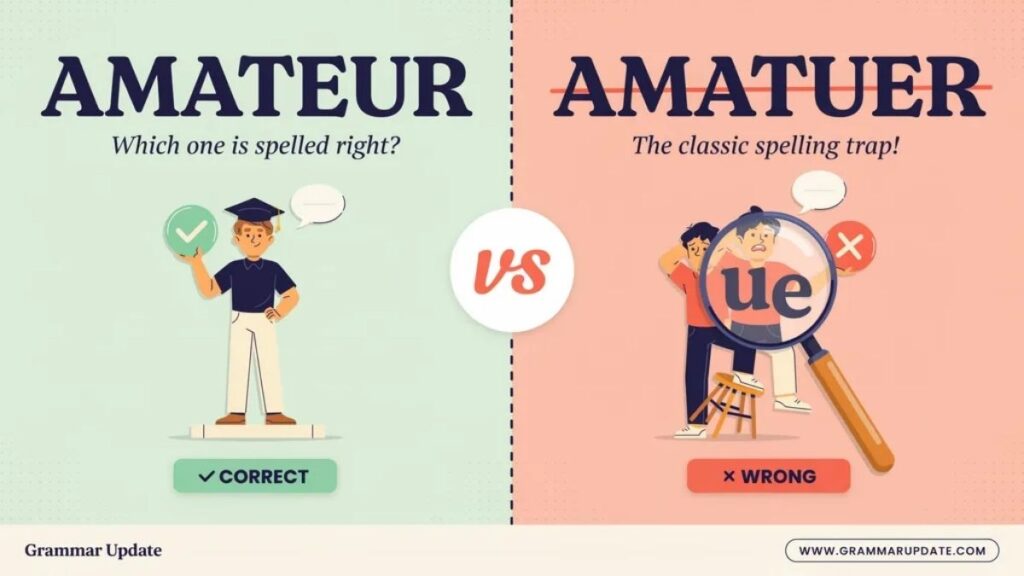
Have you ever written “Amateur,” looked at it twice, and wondered, “Should that be Amatuer instead?” Don’t worry you are just stumbled into one of English’s most common spelling traps. The confusion between Amateur vs Amatuer happens because the letters seem like they should be in a different order. The good news is that only one spelling is correct, and it’s easy to remember once you know the rule. In this guide, you’ll clear up the confusion, learn the correct spelling and meaning, understand why this mistake is so common, and discover simple examples and tips that will help you use “amateur” with confidence every time.
Quick Answer
If you’re looking for the short answer, here it is.
| Word | Correct? | Meaning |
|---|---|---|
| Amateur | ✓ Yes | A person who does something for enjoyment instead of as a profession. |
| Amatuer | ✗ No | A common spelling mistake. It is not an English word. |
The amateur spelling correct form is always “amateur.”
Many people search for questions like:
- How to spell amateur
- Correct spelling of amateur
- Is amateur spelled correctly?
- Amateur or amature?
- Is amatuer a real word?
The answer remains the same every time.
Amateur is the correct spelling.
Amatuer is a misspelling caused by switching the letters “e” and “u.”
Learn the difference between often confused words
Pretty vs Prety difference and Which Spelling Is Correct ?
What Does Amateur Mean?
Understanding the amateur meaning makes it easier to remember how to spell the word.
The amateur definition is straightforward. An amateur is someone who participates in an activity because they enjoy it rather than because they earn money from it.
In simple words, an amateur learns, practices, or competes for personal satisfaction instead of financial reward.
This amateur meaning in English applies to many fields, including sports, photography, music, writing, science, art, and radio communication.
Examples include:
- an amateur photographer
- an amateur athlete
- an amateur musician
- an amateur writer
- an amateur artist
Each person enjoys the activity without making it their primary profession.
The amateur word meaning doesn’t automatically suggest a lack of skill. Some amateurs become incredibly talented through years of dedication.
For example, many wildlife photographers begin as amateurs before their work appears in magazines or exhibitions.
Likewise, countless successful musicians first learned their craft simply because they loved playing music.
Learn the difference between often confused words
Absorption vs Absorbsion difference and Which Is Correct?
Amateur Definition
According to major English dictionaries, an amateur is:
A person who engages in an activity for pleasure rather than for financial gain.
The word can function as both a noun and an adjective.
Amateur Noun Meaning
As a noun, it refers to a person.
Examples:
- She is an amateur photographer with an impressive portfolio.
- The tournament welcomed amateurs from across the country.
- Every expert started as an amateur.
Amateur Adjective Meaning
The amateur adjective describes something done by someone who is not a professional.
Examples:
- The club organizes amateur competitions every summer.
- He plays in an amateur football league.
- They entered an amateur music festival.
Understanding both forms improves your amateur grammar and helps you choose the right sentence structure.
Is Amatuer a Word?
No.
Amatuer is not a recognized English word.
You won’t find it listed as the standard spelling in reputable dictionaries because it is simply an incorrect rearrangement of the letters.
This is why grammar checkers and spell-check software usually replace “amatuer” with “amateur.”
If you’ve searched for:
- amature definition
- amature meaning
- amature meaning in English
- amature synonym
- amatuer definition
you’re actually looking for information about the correctly spelled word “amateur.”
Remember this simple rule:
Amateur is the correct spelling.
Amatuer is a spelling error.
Learn the difference between often confused words
Ether vs Either which is correct and Difference?
Amateur vs Amatuer What’s the Difference?
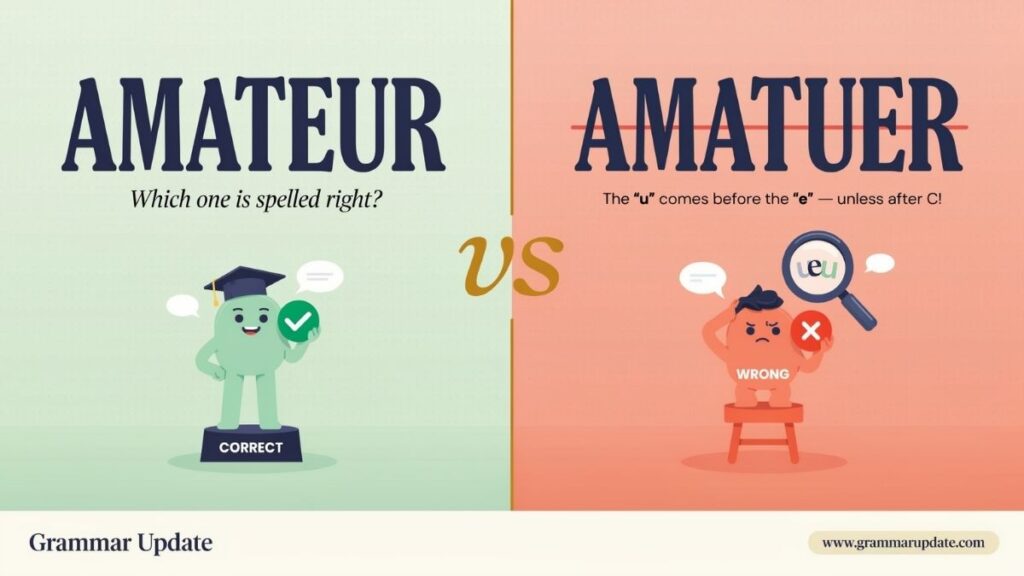
The difference couldn’t be simpler.
| Amateur | Amatuer |
|---|---|
| Correct English spelling | Incorrect spelling |
| Found in dictionaries | Not recognized |
| Accepted in academic writing | Considered a spelling mistake |
| Used worldwide | Should be avoided |
The confusion comes entirely from letter order.
Many writers accidentally reverse the “eu” combination and type “ue” instead.
That tiny switch creates a word that doesn’t exist.
Learn the difference between often confused words
In-Person vs In Person What’s the Difference?
Why Do People Misspell Amateur as Amatuer?
English spelling isn’t always logical. Some words seem determined to test your memory, and amateur is one of them.
Several factors contribute to this mistake.
The Letters Look Reversed
The most common reason is simple letter transposition.
Instead of writing:
amateur
people type:
amatuer
Because the pronunciation sounds similar, many writers don’t notice the mistake immediately.
French Origin of Amateur
The French origin of amateur also explains why the spelling feels unusual.
The English word comes from the French word amateur, which itself developed from the Latin word amator, meaning “lover.”
Originally, the word described someone who loved an activity.
Over time, English adopted both the spelling and the meaning.
Since English borrowed the word rather than creating it, the letter order stayed the same.
That unusual “eur” ending often surprises English learners.
Understanding the amateur etymology makes the spelling easier to remember.
Pronunciation Doesn’t Match Every Letter
Many English words contain silent or lightly pronounced letters.
The pronunciation of amateur doesn’t strongly emphasize every letter, so writers often spell the word based on what they hear.
This creates one of the most common English spelling mistakes.
It’s similar to words like:
- restaurant
- business
- separate
- definitely
People often spell these words according to pronunciation instead of their actual spelling.
Typing Too Quickly
Fast typing causes another problem.
When your fingers move quickly across the keyboard, it’s easy to reverse neighboring letters.
This is especially true for words containing uncommon letter combinations.
Learn the difference between often confused words
Take Effect vs Take Affect Which one Is Correct?
How to Pronounce Amateur
Many learners ask about amateur pronunciation because British and American English pronounce the word slightly differently.
The pronunciation remains correct in both accents.
Amateur Pronunciation US
In American English pronunciation, amateur is commonly pronounced as:
AM-uh-chur
Some speakers soften the final syllable slightly, depending on regional accent.
Amateur Pronunciation UK
In British English, the pronunciation is usually closer to:
AM-uh-tuh
The final syllable sounds lighter than it does in many American accents.
Although the pronunciation varies slightly, the spelling never changes.
Whether you’re learning amateur pronunciation US or amateur pronunciation UK, remember that the written form remains exactly the same.
This consistency also answers searches such as:
- amateur pronunciation
- amateur pronunciation in English
- amateur pronunciation guide
- how to pronounce amateur correctly
- pronunciation of amateur in American English
- pronunciation of amateur in British English
The spelling is always amateur.
The pronunciation changes slightly depending on the speaker’s accent, not the spelling.
Does Amateur Have Different Spellings in the US and UK?
No.
Unlike words such as:
| American English | British English |
|---|---|
| Color | Colour |
| Favorite | Favourite |
| Center | Centre |
The amateur spelling UK is identical to American English.
There is no British version that changes the letters.
If you’re searching for amateur spelling UK, you’ll find the same spelling used throughout the United Kingdom, the United States, Canada, Australia, and other English-speaking countries.
The correct spelling of amateur never changes.
How to Remember the Correct Spelling
Many people struggle because they focus only on pronunciation.
Instead, try remembering the letter pattern.
Think of the ending as:
eur
Never:
uer
A simple memory trick is this:
“Experts Use Experience Regularly.”
The first letters form E-U-R, which matches the ending of amateur.
Another trick is to remember that the word ends similarly to chauffeur, another word borrowed from French.
The spelling pattern becomes much easier once you’ve seen it several times.
If you’ve ever wondered why people spell amateur as amature or amatuer, the answer usually comes down to unfamiliar letter combinations rather than difficult grammar.
Learning the pattern once can save years of second-guessing.
How to Use Amateur Correctly
Knowing the spelling is only part of the lesson. You should also know how to use the word naturally in everyday writing.
The word works as both a noun and an adjective, making it flexible in conversations, academic writing, journalism, and professional communication.
Learn the difference between often confused words
Rosin vs Resin Difference and Which is Correct?
How to Use Amateur in a Sentence
Once you know the correct spelling, the next step is learning how to use the word naturally. The word “amateur” fits comfortably into everyday conversations, academic writing, news articles, and professional discussions.
Remember that it can act as both a noun and an adjective.
Amateur as a Noun
As a noun, “amateur” refers to a person who participates in an activity for enjoyment rather than as a career.
Examples:
- She is an amateur photographer who enjoys capturing wildlife.
- Every professional athlete was once an amateur.
- The competition welcomed amateurs from across the country.
- He started as an amateur before opening his own photography business.
- Many talented amateurs eventually become professionals.
These are excellent amateur noun examples because the word identifies a person.
Amateur as an Adjective
As an adjective, “amateur” describes an activity, event, or organization connected with nonprofessionals.
Examples:
- They joined an amateur theater group.
- The city hosts an amateur golf championship every year.
- She entered an amateur writing competition.
- He belongs to an amateur astronomy club.
- The museum displayed artwork from amateur artists.
These amateur adjective examples show how the word describes another noun instead of naming a person.
Understanding the difference between the noun and adjective forms will improve your amateur English grammar and make your writing more accurate.
Learn the difference between confusing word pairs
Waving vs Waiving Which is correct and Difference?
Amateur in a Sentence
Looking at real examples is one of the fastest ways to understand word usage. Here are several amateur sentence examples across different situations.
Everyday Conversation
- My brother is an amateur cook, but everyone loves his recipes.
- She’s still an amateur, yet her paintings look professional.
- I’m just an amateur gardener, so I’m still learning.
Education
- The science fair encouraged amateur inventors to present their projects.
- Several amateur researchers contributed valuable ideas.
Sports
- He won multiple amateur competitions before turning professional.
- Amateur sports often focus on skill development and teamwork.
- She remained an amateur athlete throughout college.
Photography
- Every amateur photographer develops a unique style with practice.
- An amateur camera can still produce amazing pictures in skilled hands.
Music
- The concert featured both professional performers and amateur musicians.
- Every amateur musician improves with consistent practice.
Writing
- The magazine accepted submissions from amateur writers.
- Many famous authors published their first stories as amateurs.
These amateur used in a sentence examples demonstrate that the word fits naturally into many different contexts.
Amateur Can Be Positive, Neutral, or Negative
Many people assume that “amateur” always means “unskilled.” That isn’t true.
The tone depends entirely on the context.
Neutral Meaning
Most of the time, amateur simply describes someone who participates for enjoyment rather than money.
Examples:
- She is an amateur photographer.
- He plays amateur tennis on weekends.
- They belong to an amateur orchestra.
Here, the word carries no judgment about skill.
Positive Meaning
Sometimes “amateur” highlights passion, dedication, and genuine enthusiasm.
Examples:
- The amateur artist created breathtaking landscapes.
- Several amateur astronomers discovered previously unknown comets.
- Amateur programmers have developed popular open-source software.
These examples show that enthusiasm and talent often matter more than a paycheck.
Negative Meaning
Occasionally, people use “amateur” to criticize poor quality or lack of experience.
Examples:
- The presentation looked amateur.
- Their editing seemed amateur compared to industry standards.
- The website appeared amateur and outdated.
Notice that these examples describe the quality of work rather than the person’s character.
If your goal is to criticize someone’s work, “amateurish” is often the better choice.
Learn the difference between confusing word pairs
Traveler vs Traveller Which Spelling Is Correct?
Amateur vs Amateurish
Although these words share the same root, they don’t mean the same thing.
| Amateur | Amateurish |
|---|---|
| Refers to a nonprofessional person or activity | Describes poor quality or lack of skill |
| Usually neutral | Usually negative |
| Can describe highly skilled people | Suggests work that lacks polish |
| Focuses on professional status | Focuses on quality |
Consider these examples.
Correct:
- She is an amateur photographer with incredible talent.
Correct:
- The brochure looked amateurish because of its poor design.
Incorrect:
- She is an amateurish photographer simply because she isn’t paid.
Someone can be an amateur while producing professional-quality work.
For example, many award-winning wildlife photographers began as amateurs. Their status had nothing to do with their ability.
This distinction helps explain the difference between amateur work meaning and amateurish work.
Amateur vs Professional
One of the most common comparisons involves amateur vs professional.
The biggest difference isn’t always skill.
Instead, it usually comes down to whether the person earns money from the activity.
| Amateur | Professional |
|---|---|
| Participates mainly for enjoyment | Works for payment |
| May have another primary career | Activity is their profession |
| Can be highly skilled | Expected to meet industry standards |
| Often volunteers time | Paid for expertise |
For example:
An amateur photographer may produce magazine-quality images while working full-time as a teacher.
A professional photographer earns a living by taking photographs.
The difference between amateur and professional is financial and occupational, not necessarily talent.
Amateur vs Expert
Another comparison that causes confusion is amateur vs expert.
These terms measure different things.
An amateur describes someone’s professional status.
An expert describes someone’s knowledge or ability.
That means someone can be:
- an amateur expert in birdwatching
- an amateur astronomer with decades of experience
- an amateur musician who performs at an advanced level
Likewise, a new employee may technically be a professional because they’re paid, even if they’re still gaining experience.
Learn the difference between confusing word pairs
Focussed vs Focused Which Spelling Is Correct?
Beginner vs Amateur vs Novice vs Hobbyist
People often treat these words as synonyms, but each has a distinct meaning.
| Word | Meaning | Main Focus |
|---|---|---|
| Amateur | Participates for enjoyment instead of money | Professional status |
| Beginner | Just starting to learn | Experience level |
| Novice | Has limited experience | Skill level |
| Hobbyist | Enjoys an activity during free time | Personal interest |
| Enthusiast | Has strong interest and passion | Dedication |
| Professional | Earns income from the activity | Occupation |
Understanding these differences improves your vocabulary and prevents awkward word choices.
Beginner Meaning
A beginner has recently started learning.
Example:
- She’s a beginner in watercolor painting.
Novice Meaning
A novice has some basic knowledge but still lacks experience.
Example:
- The novice chess player improved rapidly.
Enthusiast Meaning
An enthusiast has deep interest and passion.
Example:
- He’s a history enthusiast who visits museums every month.
Nonprofessional Meaning
A nonprofessional simply doesn’t earn money from the activity.
Many amateurs fall into this category.
Inexperienced Person
An inexperienced person lacks practice.
However, not every amateur is inexperienced.
This is one of the biggest misconceptions about the word.
Common Mistakes When Using Amateur
Even after learning the spelling, writers sometimes misuse the word.
Here are the mistakes to avoid.
Confusing Amateur with Amatuer
Incorrect:
- She is an amatuer photographer.
Correct:
- She is an amateur photographer.
This remains the most common amature spelling mistake.
Writing Amature Instead of Amateur
Many people also write:
- amature
This is another incorrect spelling.
If you’re wondering about amateur or amature, always choose “amateur.”
Amature is a misspelling just like amatuer.
Assuming Amateur Means Untalented
Being unpaid doesn’t mean someone lacks ability.
Many amateur artists, amateur musicians, and amateur athletes perform at remarkably high levels.
Skill comes from practice, not from receiving a paycheck.
Using Amateur as an Insult
Avoid using “amateur” carelessly to criticize someone.
Instead of saying:
- That’s amateur work.
Consider saying:
- The project needs more refinement.
This sounds more professional and focuses on the work rather than the person.
Other Common Misspellings of Amateur
Because of its unusual letter pattern, “amateur” appears in many incorrect forms.
Some of the most common include:
- Amature
- Amatuer
- Ameture
- Amatir
- Amatour
- Ammateur
None of these spellings are accepted in standard English.
The only correct English spelling is:
amateur
Learning common spelling mistakes like amateur helps improve both your writing and proofreading skills.
Related Forms of Amateur
Several words share the same root.
| Word | Meaning |
|---|---|
| Amateur | A nonprofessional participant |
| Amateurs | Plural form |
| Amateurish | Poorly done or lacking polish |
| Amateurism | Participation for enjoyment instead of financial gain |
Understanding these related words strengthens your English vocabulary and helps you recognize them in books, newspapers, and professional writing.
Common Phrases That Use Amateur
The word “amateur” appears in many everyday expressions. In each case, it refers to someone who participates because they enjoy the activity rather than because it is their profession.
Here are some of the most common phrases.
| Phrase | Meaning |
|---|---|
| Amateur athlete | A person who competes without earning a living from sports. |
| Amateur photographer | Someone who takes photographs as a hobby. |
| Amateur artist | A person who creates art for enjoyment. |
| Amateur musician | Someone who plays music without making it a career. |
| Amateur writer | A person who writes stories, poems, or articles for personal interest. |
| Amateur hobbyist | Someone who enjoys a hobby during free time. |
| Amateur competition | A contest limited to nonprofessional participants. |
| Amateur sports | Sports played by nonprofessionals. |
| Amateur status | Eligibility to compete as a nonprofessional. |
These phrases show that the word often describes enthusiasm rather than ability.
Amateur Radio Meaning Explained
One of the most searched phrases related to this topic is amateur radio.
Many people mistakenly search for “amature radio,” but the correct term is amateur radio.
Amateur radio is a worldwide hobby in which licensed individuals communicate using designated radio frequencies. Operators are often called “ham radio operators.”
Unlike commercial broadcasters, amateur radio operators communicate for education, experimentation, emergency communication, and recreation.
Some common activities include:
- Talking with operators around the world.
- Assisting during natural disasters when traditional communication systems fail.
- Learning about electronics and radio technology.
- Participating in community emergency response programs.
- Experimenting with antennas and signal transmission.
The word “amateur” in amateur radio does not mean unskilled. Instead, it means participants are not using radio for commercial profit.
Learn the difference between confusing word pairs
Thats vs That’s diffrance and Which Is Correct?
Why Amateur Radio Matters
Amateur radio has played an important role for more than a century.
During hurricanes, earthquakes, floods, and other emergencies, amateur radio operators have often provided communication when phone networks failed.
Many governments and emergency organizations continue to recognize amateur radio as an important backup communication system.
This is one reason the phrase remains widely used today.
Synonyms and Antonyms of Amateur
Learning related vocabulary improves your writing and helps you choose the most accurate word for each situation.
Amateur Synonym List
The best amateur synonym depends on context.
Common synonyms include:
- Hobbyist
- Enthusiast
- Nonprofessional
- Learner
- Beginner
- Novice
- Participant
- Recreational player
Each synonym has a slightly different meaning.
For example:
A hobbyist enjoys an activity during free time.
An enthusiast has strong interest and passion.
A novice emphasizes limited experience.
A beginner refers to someone who has recently started learning.
Although these words overlap, they are not always interchangeable.
Amateur Antonyms
Common antonyms include:
- Professional
- Expert
- Specialist
- Master
- Veteran
Again, remember that “professional” refers to payment, while “expert” refers to skill.
A professional may still be learning.
An amateur may already be highly skilled.
Learn the difference between tricky grammar more words
Wait vs Weight Difference and usage?
Real-World Examples of Amateur
Seeing the word in realistic situations helps reinforce its meaning.
Sports
Many Olympic athletes once competed as amateurs before pursuing professional careers.
Examples include:
- Amateur boxing
- Amateur wrestling
- Amateur golf
- Amateur cycling
These competitions focus on skill development, sportsmanship, and experience.
Photography
An amateur photographer may spend years improving composition, lighting, and editing.
Some eventually win international photography competitions despite never working professionally.
Art
An amateur artist often creates paintings, sculptures, or digital artwork simply because they enjoy the creative process.
Many local art exhibitions proudly feature amateur artists alongside experienced professionals.
Music
An amateur musician may perform in community bands, churches, local theaters, or family events.
Although they are unpaid, their performances can be remarkably polished.
Writing
An amateur writer might publish articles online, write novels, or maintain a personal blog before becoming a full-time author.
Many bestselling writers started exactly this way.
Learn the difference between tricky grammar more words
To Many vs Too Many Difference and Which is Correct?
Case Study One Letter Can Change Everything
Imagine two students submitting essays.
Student A writes:
“I am an amateur photographer.”
Student B writes:
“I am an amatuer photographer.”
Although both students mean the same thing, teachers, employers, and editors immediately notice the second spelling mistake.
A single misplaced letter can:
- Reduce credibility.
- Create a poor first impression.
- Suggest weak proofreading.
- Affect academic or professional writing quality.
This example shows why learning the correct spelling matters.
Common English Spelling Mistakes Similar to Amateur
“Amateur” isn’t the only word that confuses writers.
Here are several other commonly misspelled words.
| Correct | Incorrect |
|---|---|
| Separate | Seperate |
| Definitely | Definately |
| Accommodation | Accomodation |
| Necessary | Neccessary |
| Occasion | Ocassion |
| Receive | Recieve |
| Amateur | Amatuer |
| Amateur | Amature |
Many of these mistakes happen because English borrows words from Latin, French, Greek, and other languages.
Learning spelling patterns makes them much easier to remember.
Learn the difference between tricky grammar more words
Reinforce vs Reenforce Which Spelling Is Correct?
Tips for Learning Difficult English Spellings
If English spelling feels unpredictable, you’re not alone.
Try these techniques.
Learn Word Origins
Understanding the French word amateur helps explain its unusual ending.
Many English words preserve spellings from their original language.
Break Words into Parts
Instead of memorizing the whole word, focus on the ending.
amat + eur
Never:
amat + uer
Read Frequently
Regular reading naturally reinforces correct spelling.
The more often you see a correctly written word, the easier it becomes to remember.
Write It Repeatedly
Writing difficult words several times helps develop muscle memory.
Proofread Slowly
Most spelling mistakes happen because people read what they intended to write rather than what actually appears on the page.
Reading one sentence at a time helps catch errors.
Learn the difference between tricky grammar more words
What Kind of vs What Kinds of, Which One Should You Use?
Practice Session Amateur vs Amatuer
Choose the correct word to complete each sentence. Amateur vs Amatuer
- Sarah is an __________ photographer who loves taking nature pictures.
- Every professional athlete started as an __________ at some point.
- The correct spelling is __________, not “amatuer.”
- James joined an __________ soccer league for fun.
- My cousin is an __________ musician who performs at local events.
- The teacher corrected the word “__________” because it was spelled incorrectly.
- Emma won an __________ writing competition at her school.
- The dictionary recognizes __________ as the correct English word.
- An __________ artist may create beautiful paintings without selling them.
- The spelling “__________” is a common mistake made by English learners.
- Our town hosts an __________ golf championship every summer.
- Lisa is an __________ baker who enjoys making cakes for friends.
- Many people accidentally write “__________” instead of the correct spelling.
- The __________ photographer captured stunning wildlife images.
- He remained an __________ athlete throughout college.
- You should always write __________ in formal English.
- The coach encouraged every __________ player to practice regularly.
- “__________” is not found in standard English dictionaries.
- My brother is an __________ writer who hopes to publish a novel one day.
- The science fair welcomed __________ inventors from different schools.
- An __________ radio operator must follow licensing rules.
- Which word is correct: __________ or amatuer?
- The article explained why __________ is often misspelled.
- Even as an __________, she produced professional-quality artwork.
- Learning the correct spelling of __________ improves your English writing skills.
Answers
- Amateur
- Amateur
- Amateur
- Amateur
- Amateur
- Amatuer
- Amateur
- Amateur
- Amateur
- Amature
- Amateur
- Amateur
- Amatuer
- Amateur
- Amateur
- Amateur
- Amateur
- Amatuer
- Amateur
- Amateur
- Amateur
- Amateur
- Amateur
- Amateur
- Amateur
Here’s a trusted source for clear word meanings:
FAQs
What is an amateur synonym?
Common amateur synonyms include hobbyist, enthusiast, nonprofessional, novice, beginner, and recreational participant. The best synonym depends on the context. For example, “hobbyist” emphasizes personal interest, while “novice” highlights limited experience.
What is the difference between amateur and professional boxing?
The main difference is that amateur boxing focuses on skill development, safety, and scoring points, while professional boxing emphasizes longer bouts, entertainment, and prize money. Amateur boxers usually wear protective headgear in some competitions and fight fewer rounds, whereas professional boxers compete for rankings and financial rewards.
Amateur vs professional What’s the difference?
An amateur participates in an activity primarily for enjoyment or personal interest, while a professional earns money from that activity. An amateur can be highly skilled, and a professional isn’t always more talented. The distinction is based on occupation rather than ability.
How do you use amateur in a sentence?
Here are a few examples:
- She is an amateur photographer who enjoys taking wildlife pictures.
- The tournament welcomed amateur golfers from across the state.
- He started as an amateur before becoming a professional musician.
How do you pronounce “amatuer” in English?
The spelling “amatuer” is incorrect, so it has no official pronunciation. The correct word is “amateur.”
amateur (AM-uh-chur)
Is amateur an adjective?
Yes. Amateur can function as an adjective when it describes a noun.
Examples:
- amateur athlete
- amateur theater
- amateur competition
In these examples, “amateur” describes the type of athlete, theater, or competition.
What is amateur boxing?
Amateur boxing is a form of boxing in which athletes compete under rules designed to emphasize technique, sportsmanship, and safety rather than financial gain. Many Olympic and national boxing events follow amateur boxing rules.
What is the etymology of the word amateur?
The word “amateur” comes from the French word amateur, meaning “lover of something.” It ultimately traces back to the Latin word amator, which means “lover.” This origin explains why the word originally described someone who pursued an activity out of passion rather than profit.
Can an amateur be highly skilled?
Yes. An amateur can develop exceptional skills through years of practice. The word “amateur” describes someone who is not paid professionally, not someone who lacks talent or experience.
Is amateur always used for sports?
No. The word applies to many fields, including photography, writing, music, painting, astronomy, radio communication, and science. Anyone who participates for enjoyment rather than income may be called an amateur.
What is the opposite of amateur?
The most common opposite is “professional.” Other antonyms include expert or specialist when referring to a person’s skill or experience. However, “professional” and “expert” are not always interchangeable because one refers to occupation and the other to ability.
Why do people confuse amateur with amatuer?
Many writers accidentally reverse the letters “e” and “u” because the ending “eur” is uncommon in English. The French origin of the word also contributes to this frequent spelling mistake.
Is amateur a positive or negative word?
The word is usually neutral. It simply describes someone who does not earn money from an activity. Depending on the context, it can even have a positive meaning by highlighting passion, dedication, and enthusiasm. Only in certain situations is it used negatively to suggest a lack of polish or experience.
Conclusion
If you’ve ever stopped typing because you couldn’t remember whether it’s “Amateur” or “Amatuer,” you’re definitely not alone. It’s one of those words that seems simple until the letters decide to play hide-and-seek. Fortunately, the confusion is easy to clear up. The correct spelling is always “amateur.” The spelling “amatuer” is simply a common mistake caused by reversing the letters “e” and “u.”
A good way to remember it is to focus on the ending: “eur,” not “uer.” Once that pattern sticks, you’ll recognize the correct spelling every time. Better yet, you’ll write with more confidence in emails, school assignments, professional documents, and everyday conversations.
English spelling can be tricky, especially with words borrowed from other languages. Still, every mistake is an opportunity to improve your vocabulary and writing skills. Keep reading, keep practicing, and always take a moment to proofread. Before long, spelling “amateur” correctly will feel completely natural. The next time someone asks, “Is it Amateur vs Amatuer?” you’ll know the answer instantly and you can help clear up the confusion for them too.

Jhon AJS, the creative mind behind Grammar Update, is an experienced blogger passionate about simplifying English grammar. He focuses on explaining confusing word vs word differences, grammar rules, punctuation, and sentence structure in a clear and practical way. Through easy to understand guides and examples, Jhon helps readers improve their writing and communicate with confidence. With years of blogging experience, he continues to share helpful insights that make learning grammar simple, useful, and accessible for everyone.