You paid the bill, paid attention during the meeting, and paid your taxes on time, yet payed somehow still finds its way into your writing. The confusion surrounding payed vs paid has led to countless grammar mistakes in emails, essays, business documents, and social media posts. Many writers assume that pay follows the same pattern as played, stayed, and prayed, making payed seem perfectly reasonable. Unfortunately, English has other plans. Because pay is an irregular verb, its past tense becomes paid, not payed. This guide clears up the confusion, explains the most common mistakes, and shows exactly when to use each word so you can write with clarity, accuracy, and confidence.
Payed vs Paid The Short Answer
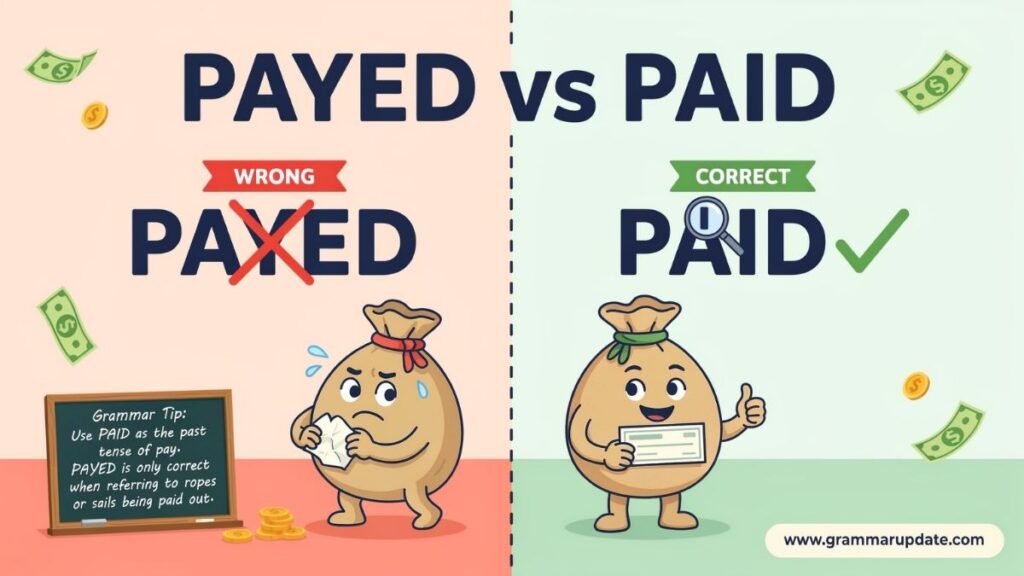
The rule is straightforward.
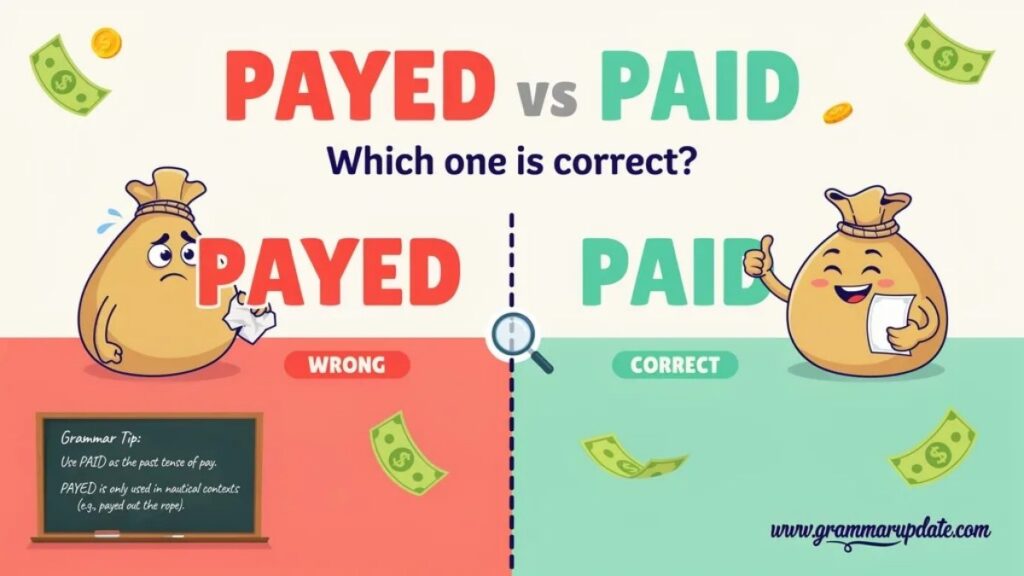
Use “paid” in almost every situation. Use “payed” only in specialized nautical contexts.
When discussing money, bills, salaries, attention, visits, or obligations, paid is always correct. When discussing ropes, ships, or waterproofing vessel seams, payed may be correct.
| Word | Meaning | Typical Usage |
|---|---|---|
| Paid | Past tense of pay | Everyday English |
| Payed | Maritime term | Sailing and nautical contexts |
Correct Examples
- I paid the bill yesterday.
- She paid attention during class.
- They paid the employees on Friday.
- He paid a visit to his parents.
- The sailors payed out the rope.
Incorrect Examples
- I payed the bill.
- She payed attention.
- They payed the workers.
- He payed his taxes.
For most writers, students, and professionals, paid is the only form they will ever need.
What Does “Paid” Mean?
The paid meaning refers to the past tense and past participle of the verb pay.
The verb pay has several meanings in English. It can describe financial transactions, compensation, attention, consequences, obligations, and visits. Because these meanings appear frequently in everyday communication, the word paid is one of the most commonly used irregular verbs in English.
Paid as the Past Tense of Pay
The past tense of pay is paid.
Examples:
- She paid the rent yesterday.
- We paid the invoice last week.
- He paid the contractor immediately.
- They paid their taxes on time.
Many grammar mistakes occur because writers expect pay to become payed. However, English contains numerous irregular verbs that change their spelling.
| Base Verb | Past Tense | Past Participle |
|---|---|---|
| Pay | Paid | Paid |
| Say | Said | Said |
| Sell | Sold | Sold |
| Tell | Told | Told |
This irregular pattern explains why paid is the correct past tense of pay.
Understand confusing English more words simply
It’s Called vs It Called Which Phrase Is Grammatically Correct?
Paid as a Past Participle
The word paid also functions as a past participle.
Examples:
- The account has been paid.
- The workers have been paid.
- The balance was paid in full.
- The debt had already been paid.
Past participles often appear with helping verbs such as:
- has
- have
- had
- was
- were
- been
Understanding this grammatical function improves both written and spoken English.
Common Uses of Paid in Everyday English
The word paid appears in many common expressions.
1 Financial Payment
- She paid the bill.
- They paid the rent.
- He paid the tuition fees.
- We paid the invoice.
2 Paid Someone
- The company paid its employees.
- The client paid the consultant.
- They paid the contractor.
3 Paid Attention
- The students paid attention.
- She paid close attention.
- Nobody paid attention to the warning.
4 Paid a Visit
- He paid a visit to his grandmother.
- The ambassador paid an official visit.
5 Paid the Price
- The company paid the price for poor decisions.
- He paid dearly for his mistake.
6 Paid in Full
- The account was paid in full.
- The balance has been paid in full.
These expressions demonstrate why paid dominates modern English usage.
Understand confusing English more words simply
Envolved vs Involved Which Is Correct?
What Does “Payed” Mean?
The payed meaning differs entirely from the standard verb pay.
The word belongs to maritime terminology and nautical vocabulary. Historically, sailors used payed in two specific situations.
Payed Out Rope
One meaning involves releasing rope or cable gradually.
Example:
The sailors payed out the anchor rope.
The phrase pay out rope means allowing rope to move under control. This usage still appears in sailing manuals and nautical instructions.
Understand confusing English more words simply
Propose vs Purpose Which Is Correct?
Waterproofing a Ship
The second meaning refers to covering seams with tar, pitch, or waterproof materials.
Example:
The crew payed the deck to prevent leaks.
This process helped protect wooden ships by sealing gaps between planks.
Related terms include:
- waterproof ship seams
- ship deck sealing
- maritime maintenance
- nautical repair
Outside these specialized meanings, the word rarely appears in modern English.
Is Payed a Word?
One of the most common grammar questions is:
Is payed a word?
The answer is yes.
However, this answer requires an important qualification.
Payed Is Correct When:
- discussing ships
- talking about ropes
- describing sailing techniques
- explaining maritime history
- discussing deck sealing
Payed Is Incorrect When:
- paying bills
- paying employees
- paying rent
- paying attention
- paying taxes
- paying someone
Many dictionaries include payed because it remains a legitimate nautical term. However, it is not the standard past tense of pay.
Gray vs Grey Which Spelling Is Correct and Difference?
Why Is Paid Spelled Differently?
English spelling rules contain many irregular verbs.
Examples include:
| Present | Past |
|---|---|
| say | said |
| make | made |
| sell | sold |
| tell | told |
| pay | paid |
These spellings developed over centuries as English evolved from older Germanic and French influences.
As a result, the verb pay adopted the irregular form paid.
This historical development explains why people frequently ask:
- Why is paid spelled paid?
- Is paid an irregular verb?
- Why is payed wrong?
The answer lies in the history of English rather than modern spelling rules.
Understand confusing English more words simply
Mobil vs Mobile Which Is Correct and Usage?
Difference Between Paid and Payed
The difference between paid and payed becomes clear once their meanings are separated.
| Feature | Paid | Payed |
|---|---|---|
| Past tense of pay | Yes | No |
| Paying money | Yes | No |
| Paying attention | Yes | No |
| Paying bills | Yes | No |
| Paying employees | Yes | No |
| Maritime terminology | No | Yes |
| Rope handling | No | Yes |
| Ship maintenance | No | Yes |
A simple rule can help:
Money uses paid. Ships use payed.
Why Writers Confuse Paid and Payed
The confusion between paid vs payed happens for several reasons.
Regular Verb Patterns
Most English verbs simply add -ed.
Examples:
- walk → walked
- jump → jumped
- clean → cleaned
Many writers therefore assume:
- pay → payed
This assumption feels logical, but English irregular verbs often break expected patterns.
Identical Pronunciation
Both words sound exactly the same.
Because speakers cannot hear the difference, spelling mistakes often appear in writing.
Social Media and Informal Writing
Errors spread quickly online. When people repeatedly see payed used incorrectly, they may assume it is acceptable.
English Language Learning
Many English learners apply regular grammar rules to irregular verbs. This explains why paid vs payed grammar remains a common topic in ESL education.
Understand confusing English more words simply
Rancor vs Rancour Difference and Which Spelling Is Correct?
Paid Attention or Payed Attention?
The correct phrase is:
Paid attention
Examples:
- She paid attention during class.
- The audience paid attention to the speaker.
- Drivers should pay attention to road signs.
The phrase payed attention is always incorrect because attention has nothing to do with ships or ropes.
| Expression | Correct |
|---|---|
| Paid attention | Yes |
| Payed attention | No |
Paid or Payed a Bill?
The correct expression is:
Paid a bill
Examples:
- I paid the electricity bill.
- She paid the invoice.
- They paid the rent.
Incorrect:
- I payed the bill.
- She payed the rent.
Whenever money changes hands, use paid.
When to Use Paid
Use paid when discussing:
- money
- salaries
- debts
- invoices
- bills
- attention
- visits
- consequences
Examples:
- He paid the fine.
- They paid the workers.
- She paid attention.
- We paid our taxes.
- The company paid compensation.
When to Use Payed
Use payed only when discussing:
- ropes
- cables
- sailing
- ship maintenance
- waterproofing seams
Examples:
- The sailors payed out the rope.
- The crew payed the deck.
- The seams were payed with tar.
These situations are extremely uncommon outside maritime writing.
A Simple Rule to Remember
If your sentence involves:
- money
- bills
- wages
- attention
- visits
Use paid.
If your sentence involves:
- ships
- ropes
- sailors
- deck sealing
Use payed.
For nearly every sentence in modern English, paid is the correct spelling.
Understand confusing English more words simply
Straight vs Strait Difference and Which Is Correct and Usage?
Payed vs Paid Examples
Examples often explain grammar rules better than definitions. Looking at real sentences helps you understand exactly where each spelling belongs. These payed vs paid examples show the difference between correct usage and common writing mistakes.
Correct Examples Using Paid
Because paid is the standard past tense and past participle of pay, it appears in countless everyday situations.
- She paid the rent before the deadline.
- We paid the invoice immediately.
- The company paid its employees on Friday.
- He paid for dinner.
- They paid the contractor in full.
- The students paid attention during the lecture.
- She paid a visit to her grandmother.
- The customer paid the balance yesterday.
- He paid the price for his mistake.
- The organization paid compensation to the victims.
Correct Examples Using Payed
The word payed appears only in maritime and nautical contexts.
- The sailors payed out the anchor rope slowly.
- The crew payed the seams with tar.
- The workers payed the deck to prevent leaks.
- The shipbuilders payed the wooden hull.
Outside these specialized meanings, the word rarely appears in modern English.
Incorrect Examples and Corrections
| Incorrect Sentence | Correct Sentence |
|---|---|
| I payed the bill. | I paid the bill. |
| She payed attention. | She paid attention. |
| They payed the workers. | They paid the workers. |
| He payed for dinner. | He paid for dinner. |
| We payed our taxes. | We paid our taxes. |
These examples demonstrate that paid belongs to standard English, while payed belongs to nautical language.
Understand confusing English more words simply
Authorization vs Authorisation Which is Correct?
Payed vs Paid Grammar Rules
Understanding the grammar behind these words removes nearly all confusion.
Verb Conjugation of Pay
The verb pay follows an irregular pattern.
| Verb Form | Example |
|---|---|
| Base Form | pay |
| Third Person Singular | pays |
| Present Participle | paying |
| Past Tense | paid |
| Past Participle | paid |
The past tense of pay is paid.
The past participle of pay is also paid.
Because the spelling changes, pay is classified as an irregular verb.
Why Payed Is Not the Standard Verb Form
Many English verbs simply add -ed to form the past tense.
Examples include:
- walk → walked
- clean → cleaned
- open → opened
- finish → finished
Following this pattern, many writers expect:
- pay → payed
English, however, contains hundreds of irregular verbs that do not follow standard spelling rules.
Examples include:
- say → said
- tell → told
- make → made
- sell → sold
- pay → paid
This irregular pattern explains why paid remains the correct spelling in ordinary English.
Understand confusing English more words simply
Rumor vs Rumour Difference and Usage
Paid vs Payed in American and British English
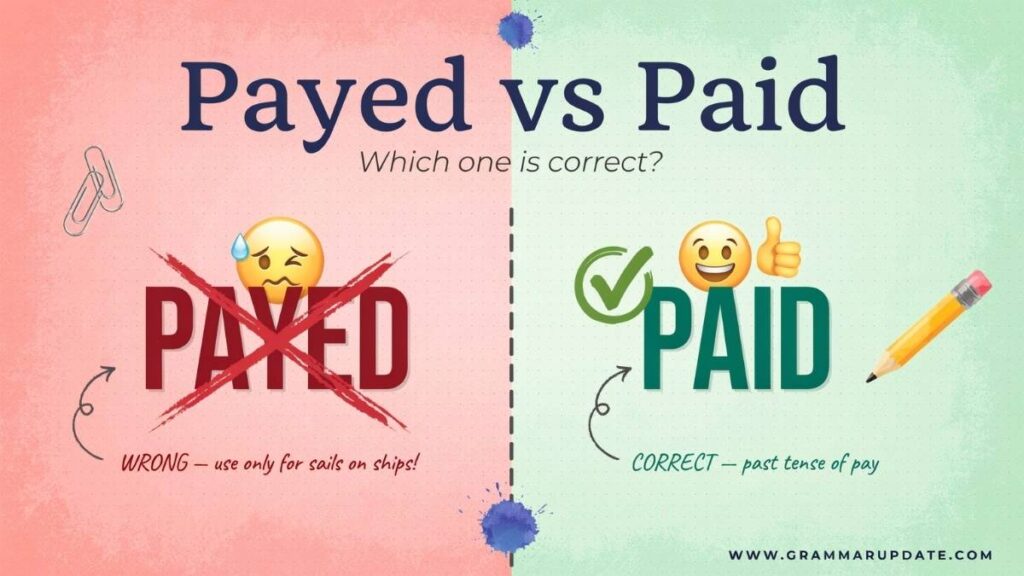
Some writers believe that one spelling belongs to American English while the other belongs to British English. This assumption is incorrect.
Both American and British English use paid.
American English
Examples:
- The customer paid the bill.
- The employee was paid yesterday.
British English
Examples:
- The tenant paid the rent.
- The company paid compensation.
| Region | Standard Spelling |
|---|---|
| United States | Paid |
| United Kingdom | Paid |
| Canada | Paid |
| Australia | Paid |
The spelling does not change between countries. The only accepted use of payed in either variety involves maritime terminology.
Learn the difference between tricky more English words
Receive vs Recieve Which is Correct and Usage?
Common Grammar Mistakes Involving Paid and Payed
The confusion between paid vs payed produces several recurring errors.
Payed Attention
Incorrect:
She payed attention during class.
Correct:
She paid attention during class.
Payed the Bill
Incorrect:
I payed the bill yesterday.
Correct:
I paid the bill yesterday.
Payed Someone
Incorrect:
The company payed its employees.
Correct:
The company paid its employees.
Payed a Visit
Incorrect:
He payed a visit to his grandparents.
Correct:
He paid a visit to his grandparents.
These mistakes appear frequently in emails, essays, social media posts, and online discussions.
Learn the difference between tricky more English words
Excited vs Exited learn the Difference and Usage
Why Do People Write Payed Instead of Paid?
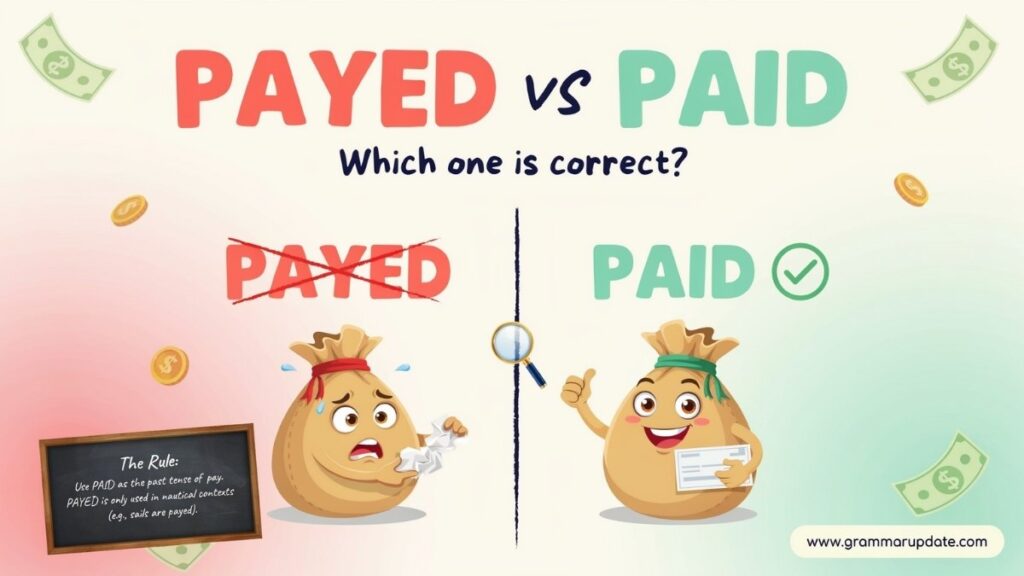
Several factors contribute to this common grammar mistake.
Regular Verb Patterns
English teaches writers to add -ed to form the past tense.
Examples:
- play → played
- stay → stayed
- work → worked
As a result, many people naturally assume:
- pay → payed
Identical Pronunciation
Both words sound exactly the same. Since the pronunciation never changes, writers often assume the spelling remains identical as well.
Informal Writing Habits
Social media, text messages, and casual online communication frequently contain spelling errors. Repeated exposure to incorrect forms can make them appear acceptable.
English Language Learning
Students learning English often apply regular grammar rules to irregular verbs. This explains why English grammar paid vs payed remains a popular search topic.
Practical Writing Example
Consider these two sentences:
The company payed its employees on Friday.
The company paid its employees on Friday.
Although readers understand both sentences, only the second one is grammatically correct.
In professional writing, small errors can affect credibility. Business reports, academic papers, resumes, and official documents should always use paid.
Learn the difference between tricky more English words
Quantify vs Qualify Differences and Correct Usage
Memory Tricks to Remember the Difference
Simple memory techniques can help you avoid this mistake permanently.
Money Uses Paid
Whenever money changes hands, use paid.
- paid the bill
- paid the rent
- paid the workers
- paid the invoice
Ships Use Payed
If the sentence involves:
- ropes
- ships
- decks
- sailing
- waterproofing
Use payed.
The One-Sentence Rule
If your sentence involves money, use paid. If it involves ships, use payed.
For most writers, this single rule is enough.
Payed vs Paid Comparison Table
| Situation | Correct Word |
|---|---|
| Paid attention | Paid |
| Paid a bill | Paid |
| Paid someone | Paid |
| Paid a visit | Paid |
| Paid in full | Paid |
| Paid taxes | Paid |
| Paid the rent | Paid |
| Payed out rope | Payed |
| Payed the deck | Payed |
| Waterproofed the ship | Payed |
This comparison summarizes the entire difference between paid and payed.
Practice Section Payed vs Paid
Choose the correct word (paid or payed) to complete each sentence.
- She ______ the electricity bill yesterday.
- The sailors ______ out the anchor rope slowly.
- We ______ close attention to the teacher.
- He ______ the restaurant bill before leaving.
- The crew ______ the deck to protect it from water.
- They ______ the workers at the end of the week.
- I ______ my taxes on time.
- The captain ______ out more rope during the storm.
- She ______ a visit to her grandparents.
- The company ______ its employees every Friday.
- He ______ off the loan last month.
- We ______ for the tickets online.
- The sailors ______ the seams with tar.
- She ______ me back yesterday.
- The customer ______ in full.
- They ______ attention to the warning signs.
- He ______ the contractor immediately.
- The crew ______ the wooden hull to prevent leaks.
- I finally got ______ after completing the project.
- She ______ him a compliment.
- The invoice must be ______ before Friday.
- The workers received their ______ wages.
- The shipbuilders ______ the deck carefully.
- We ______ the rent on the first day of the month.
- The students ______ close attention during the lecture.
Answers
- paid
- payed
- paid
- paid
- payed
- paid
- paid
- payed
- paid
- paid
- paid
- paid
- payed
- paid
- paid
- paid
- paid
- payed
- paid
- paid
- paid
- paid
- payed
- paid
- paid
Here’s a trusted source for clear word meanings:
FAQs
Why do people use payed?
Many writers use payed because English usually forms the past tense by adding -ed to a verb. Words such as played, stayed, and prayed follow this pattern, making payed seem logical. However, pay is an irregular verb, so its correct past tense is paid.
How do you use payed in a sentence?
The word payed is used only in nautical and maritime contexts.
Example:
The sailors payed out the anchor rope.
Outside sailing, ship maintenance, and rope handling, payed is generally incorrect.
Is it paid attention or payed attention?
The correct phrase is paid attention.
Example:
The students paid attention during the lecture.
Because this expression refers to focus or concentration, paid is always the correct choice.
Is it paid or payed back?
The correct phrase is paid back.
Examples:
- She paid back the loan.
- He paid me back yesterday.
The phrase payed back is incorrect in standard English.
Is payed correct or paid?
Both words exist, but they serve different purposes. Paid is correct for money, bills, wages, attention, and everyday communication. Payed is correct only in specialized maritime usage.
Is it “I got payed” or “I got paid”?
The correct expression is:
I got paid.
Example:
I got paid on Friday.
The phrase I got payed is a common grammar mistake.
Is it payed you or paid you?
The correct phrase is:
I paid you yesterday.
Whenever money, wages, or compensation are involved, paid is the correct spelling.
What is the meaning of payed?
The word payed refers to letting out rope gradually or sealing parts of a ship with tar or waterproof material. It is a technical maritime term rarely used outside sailing.
Is it paid or payed my bill?
The correct sentence is:
I paid my bill.
Because bills involve financial payment, paid is always correct.
Is it paid a visit or payed a visit?
The correct expression is:
She paid a visit to her grandparents.
The phrase paid a visit is an established English expression.
Is it paid or payed a compliment?
The correct phrase is:
He paid her a compliment.
When giving praise or admiration, the verb is always paid.
What does “paid” mean?
Paid is the past tense and past participle of the verb pay. It can mean giving money, settling a debt, receiving wages, giving attention, or making a visit.
Why is it paid and not payed?
The verb pay is irregular. Instead of following the normal -ed pattern, it changes to paid, just as say becomes said.
Is it paid off or payed off?
The correct expression is:
She paid off the loan.
The phrase paid off can also mean that hard work or effort produced positive results.
Is it draw or drew attention?
The correct past tense is:
The advertisement drew attention.
Draw is the present tense, while drew is the past tense.
Is it must be paid or payed?
The correct phrase is:
The invoice must be paid.
This sentence uses the past participle paid, which follows the helping verb be.
What does “to be paid” mean?
The phrase to be paid means to receive money, wages, salary, or compensation.
Example:
Employees expect to be paid on time.
Is it back paid or back payed?
The correct term is back pay.
Example:
The workers received back pay.
The spelling back payed is incorrect.
Is it cash paid or payed?
The correct expression is:
The invoice was cash paid.
Because the sentence refers to payment, paid is the correct word.
What does “I got paid” mean?
The phrase I got paid means that someone received money, wages, or compensation for work or services.
Example:
I got paid after completing the project.
What are common signs of being underpaid?
Some common signs include:
- Earning less than industry standards.
- Receiving additional responsibilities without higher pay.
- Discovering coworkers earn significantly more.
- Going years without a salary increase.
- Being paid below market rates for similar positions.
If you suspect you are underpaid, researching salary data and discussing compensation professionally may help address the issue.
Conclusion
The confusion surrounding payed vs paid has led to countless grammar mistakes in essays, emails, business documents, and everyday writing. Many people assume that payed must be correct because words such as played, stayed, and prayed follow the same spelling pattern. English, however, enjoys breaking its own rules, and the verb pay is one of those exceptions.
Fortunately, this confusion is much easier to solve than it appears. If your sentence involves money, bills, salaries, attention, visits, or ordinary communication, the correct word is always paid. The word payed belongs almost entirely to nautical language and appears only when discussing ropes, ships, or waterproofing vessel seams.
If you wrote “paid the bill,” “paid attention,” or “paid your employees,” your grammar is correct. If you accidentally typed “payed,” you are not alone. Thousands of writers make the same mistake because the spelling seems logical.
Remember this simple rule: people get paid, bills get paid, attention gets paid, and only ships get payed. Once you understand this distinction, the confusion disappears, the mistakes become easy to avoid, and choosing between paid vs payed becomes one of the simplest decisions in English grammar.

Jhon AJS, the creative mind behind Grammar Update, is an experienced blogger passionate about simplifying English grammar. He focuses on explaining confusing word vs word differences, grammar rules, punctuation, and sentence structure in a clear and practical way. Through easy to understand guides and examples, Jhon helps readers improve their writing and communicate with confidence. With years of blogging experience, he continues to share helpful insights that make learning grammar simple, useful, and accessible for everyone.