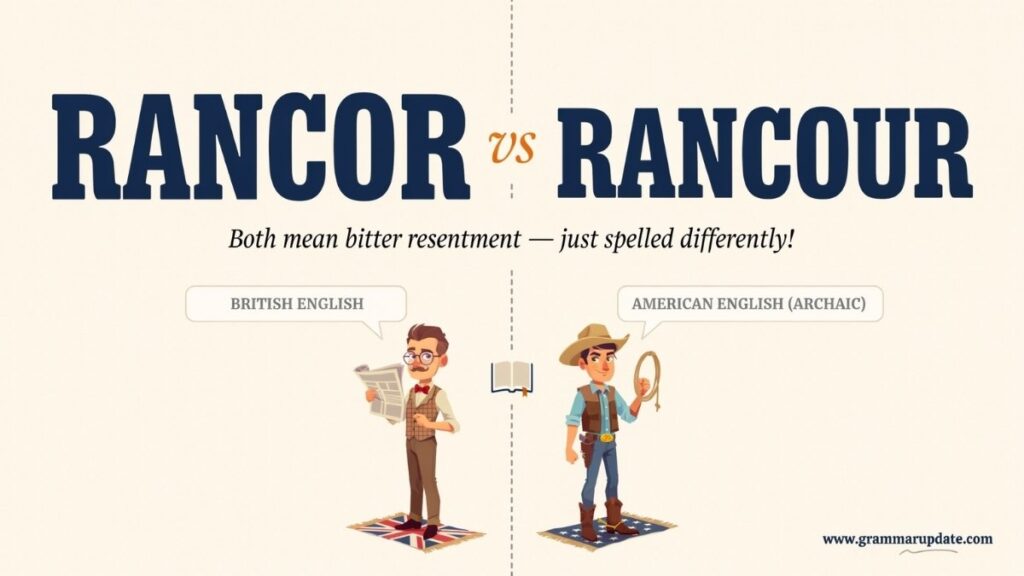
Have you ever stopped at Rancor vs Rancour and wondered whether you made a spelling mistake? The missing “u” can make even careful writers question their grammar, while spell checkers sometimes add even more confusion. Fortunately, this is not a grammar error but a difference between American and British English. Both words share the same meaning, pronunciation, and usage, yet their spellings vary by region. This article clears up the confusion, explains the spelling differences, and helps you avoid common writing mistakes. Whether you are a student, writer, editor, or English learner, this guide will show you exactly when to use rancor and rancour with confidence and accuracy.
Rancor vs Rancour at a Glance
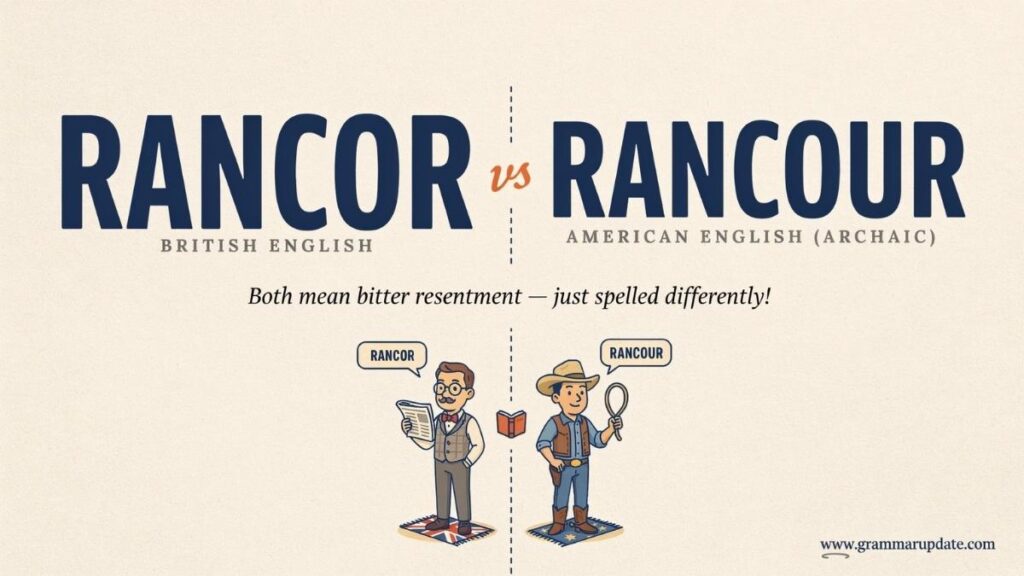
If you need a quick answer, here are the essential facts:
- Rancor is the preferred spelling in American English.
- Rancour is the preferred spelling in British English.
- Both words have the same meaning.
- Both words share the same pronunciation.
- Both spellings are correct.
- The difference is regional rather than grammatical.
| Feature | Rancor | Rancour |
|---|---|---|
| Meaning | Deep resentment | Deep resentment |
| Pronunciation | Same | Same |
| American English | Preferred | Rare |
| British English | Less common | Preferred |
| Canadian English | Less common | Common |
| Australian English | Rare | Common |
| New Zealand English | Rare | Common |
| Grammar | Correct | Correct |
What Does Rancor Mean?
The rancor meaning refers to deep bitterness, strong resentment, or long-lasting hostility toward another person or group.
Unlike temporary anger, rancor usually develops over time and often remains for months or years. People may experience rancor after betrayal, unfair treatment, broken relationships, or unresolved conflicts.
Common causes include:
- betrayal
- injustice
- personal conflicts
- family disputes
- workplace disagreements
- political tensions
Rancor Definition
The rancor definition is:
Deep-seated bitterness, resentment, or ill will.
The word describes emotions that continue long after the original disagreement has ended.
Examples:
- Years of political rancor divided the nation.
- The lawsuit created lasting rancor between the families.
- Personal rancor damaged their friendship.
Emotional Meaning of Rancor
Rancor represents more than ordinary anger. It combines several powerful emotions, including:
- bitterness
- resentment
- hostility
- animosity
- hatred
- ill will
Because of its emotional intensity, the word frequently appears in politics, psychology, literature, and social discussions.
Rancor in Modern English
Modern English commonly uses rancor when discussing:
- political conflicts
- family disagreements
- legal disputes
- workplace issues
- historical conflicts
- social tensions
Examples:
- The election campaign increased political rancor.
- Workplace conflicts created lingering rancor.
- The argument left years of rancor between them.
Fix common more word mistakes in English
Gray vs Grey Which Spelling Is Correct and Difference?
What Does Rancour Mean?
The rancour meaning is exactly the same as the meaning of rancor.
British English speakers use rancour to describe:
- bitterness
- resentment
- hostility
- emotional pain
- long-held anger
The spelling changes, but the meaning remains identical.
Rancour Definition
The rancour definition is:
A feeling of bitterness, resentment, or ill will.
Examples:
- The negotiations ended without rancour.
- Years of rancour affected the relationship.
- Political rancour divided the community.
Is Rancour Different From Rancor?
No.
Many people assume that rancor and rancour carry different meanings, but both words describe the same emotion.
| Word | Meaning |
|---|---|
| Rancor | Deep resentment and bitterness |
| Rancour | Deep resentment and bitterness |
The only difference is spelling preference.
Fix common more word mistakes in English
Propose vs Purpose Which Is Correct?
Rancor vs Rancour The Main Difference
The difference between rancor and rancour is entirely regional.
American English Rancor
American English prefers:
rancor
This spelling commonly appears in:
- American newspapers
- academic writing
- American dictionaries
- business writing
- journalism
Examples:
- political rancor
- personal rancor
- social rancor
British English Rancour
British English prefers:
rancour
This spelling commonly appears in:
- British newspapers
- UK publications
- educational materials
- British dictionaries
Examples:
- political rancour
- public rancour
- personal rancour
Fix common more word mistakes in English
Envolved vs Involved Which Is Correct?
British vs American Spelling Rancour
The spelling difference follows a familiar pattern in English.
| American English | British English |
|---|---|
| Color | Colour |
| Honor | Honour |
| Favor | Favour |
| Labor | Labour |
| Rancor | Rancour |
American English often removes the letter u, while British English preserves the traditional spelling.
Why Do Some Words End in -or and Others in -our?
British English retained many older spellings that contain -our, whereas American English simplified numerous words.
Examples include:
- honour → honor
- labour → labor
- favour → favor
- rancour → rancor
These spelling differences affect appearance but not meaning or pronunciation.
Fix common more word mistakes in English
It’s Called vs It Called Which Phrase Is Grammatically Correct?
Rancor vs Rancour Meaning Explained
Both words describe powerful negative emotions.
Lingering Hatred
Rancor often refers to hatred that continues over time.
Example:
The former business partners still felt rancor years later.
Deep Bitterness
People may develop bitterness after betrayal or disappointment.
Example:
His rancour grew after years of unfair treatment.
Lasting Resentment
Unlike temporary anger, rancor frequently remains for years.
Example:
The conflict created lasting rancor between the families.
Persistent Hostility
Rancor may lead to ongoing emotional conflict.
Example:
Political rancour divided the community.
Rancor and Rancour Pronunciation
One important fact is that both words sound almost identical.
Rancor Pronunciation
American pronunciation:
/ˈræŋ.kɚ/
Rancour Pronunciation
British pronunciation:
/ˈræŋ.kə/
Do They Sound Different?
No.
Although the spelling differs, the pronunciation remains nearly identical. Most listeners cannot determine which spelling a speaker intends.
Learn how to use confusing more words correctly
Neighbour vs Neighbor Which Spelling Is Correct?
Rancor Etymology and Word Origin
The word comes from the Latin term:
rancor
The original meaning included:
- bitterness
- resentment
- hostility
The word entered English through Old French and later developed two accepted spellings.
Historical Development
- American English adopted rancor.
- British English retained rancour.
Their shared origin explains why both spellings remain correct today.
Is Rancor a Noun?
Yes.
Both rancor and rancour function as nouns.
Examples:
- His rancor surprised everyone.
- Their rancour damaged the friendship.
- Political rancor increased during the election.
These words do not function as verbs.
Incorrect:
He rancored his opponent.
Correct:
He felt rancor toward his opponent.
Is Rancour an Emotion?
Yes.
Rancour describes a strong emotional state involving:
- resentment
- bitterness
- hostility
- animosity
- long-held anger
Unlike temporary frustration, rancour usually develops gradually and lasts for a significant period.
Rancor Meaning in Psychology
Psychologists often associate rancor with:
- unresolved resentment
- emotional hostility
- long-term anger
- interpersonal conflict
People who hold rancor may struggle with:
- forgiveness
- trust
- reconciliation
- emotional recovery
Persistent resentment can affect both relationships and emotional well-being.
Learn how to use confusing more words correctly
Tieing vs Tying Which Spelling Is Correct in English?
Rancour Meaning in Literature
Writers frequently use rancor and rancour to describe emotional conflict.
The word commonly appears in:
- historical fiction
- political writing
- family dramas
- revenge stories
- literary novels
Authors often use the term to express:
- bitterness
- hatred
- revenge
- unresolved emotions
Its emotional strength makes it particularly effective in literature.
Regional Usage Around the World
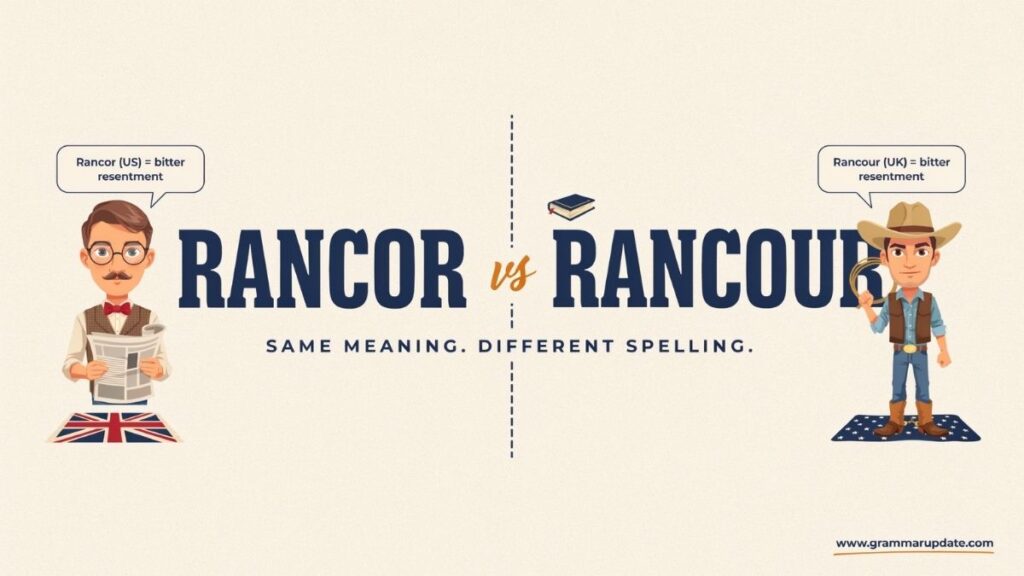
United States
Preferred spelling:
- rancor
United Kingdom
Preferred spelling:
- rancour
Canada
Canadian English generally prefers:
- rancour
Australia
Australian English commonly uses:
- rancour
New Zealand
New Zealand English usually prefers:
- rancour
Learn how to use confusing more words correctly
Unselect vs Deselect Which Term Is Correct?
Major Dictionaries Recognize Both Spellings
Several major dictionaries recognize both forms.
These include:
- Merriam-Webster Dictionary
- Cambridge Dictionary
- Oxford English Dictionary
| Dictionary | Preferred Form |
|---|---|
| Merriam-Webster | Rancor |
| Cambridge Dictionary | Rancour |
| Oxford English Dictionary | Both |
This confirms that both spellings are correct and widely accepted.
Key Facts About Rancor vs Rancour
- Both spellings are correct.
- Both words share the same meaning.
- Both words have nearly identical pronunciation.
- Rancor is standard in American English.
- Rancour is standard in British English.
- Both words describe deep resentment and bitterness.
- Major dictionaries recognize both spellings.
- The difference is regional rather than grammatical.
Which Spelling Should You Use?
For American Audiences
Use:
rancor
For British and Commonwealth Audiences
Use:
rancour
Writing Tip
Choose the spelling that matches your audience and remain consistent throughout your writing. Consistent spelling makes your work appear more professional, polished, and easier to read.
Learn how to use confusing more words correctly
Putting vs Puting Which Spelling Is Correct?
Rancor in a Sentence
Understanding rancor in a sentence helps writers and learners use the word naturally and accurately in both formal and informal writing.
Rancor in a Sentence (American English)
The political rancor continued long after the election ended.
The lawsuit created rancor between the two companies.
Despite their disagreement, they separated without rancor.
His rancor toward his former business partner never disappeared.
The debate ended with considerable rancor among the participants.
Rancour in a Sentence (British English)
The negotiations concluded without rancour.
There was no rancour between the former teammates.
Political rancour dominated the election campaign.
She spoke without any rancour despite the criticism.
Years of rancour damaged their relationship.
Learn the difference between tricky more English words
Heros vs Heroes Which Spelling Is Correct?
How to Use Rancor and Rancour Correctly
The meaning of both spellings remains exactly the same. The choice depends entirely on the variety of English you are using.
Use Rancor in American English
Writers using American English should choose rancor. This spelling appears in American newspapers, academic publications, business writing, and style guides throughout the United States.
Use Rancour in British English
Writers using British English should choose rancour. This spelling is also standard in Canada, Australia, and New Zealand.
Maintaining consistent spelling throughout your writing helps create a more professional and polished article.
Rancor Synonym and Rancour Synonym
Several words carry meanings similar to rancor and rancour.
| Synonym | Meaning |
|---|---|
| Resentment | Lingering anger |
| Bitterness | Deep emotional hurt |
| Hostility | Unfriendly feelings |
| Animosity | Strong dislike |
| Hatred | Extreme dislike |
| Ill will | Negative feelings |
| Malice | Desire to harm |
| Enmity | Long-term hostility |
| Grudge | Lasting resentment |
| Antagonism | Opposition or hostility |
These synonyms may vary slightly in strength, but they all describe negative emotions and strained relationships.
Example:
Years of resentment gradually developed into rancor.
Learn how to use confusing more words correctly
Realize vs Realise Which is Correct and Usage?
Antonyms of Rancor
Several words express the opposite meaning of rancor.
| Antonym | Meaning |
|---|---|
| Forgiveness | Letting go of resentment |
| Goodwill | Friendly feelings |
| Harmony | Peaceful relations |
| Friendship | Mutual affection |
| Kindness | Benevolent behavior |
| Compassion | Sympathy and understanding |
| Reconciliation | Restoring relationships |
| Peace | Absence of hostility |
Example:
Forgiveness replaced years of rancor.
Rancor vs Other Similar Words
Many English learners confuse rancor with other emotional terms. Although these words are related, they differ in intensity and duration.
| Word | Meaning | Duration |
|---|---|---|
| Anger | Temporary emotion | Short |
| Frustration | Mild annoyance | Short |
| Resentment | Lingering displeasure | Moderate |
| Bitterness | Deep disappointment | Long |
| Rancor | Lasting hostility | Very long |
| Hatred | Extreme dislike | Long |
Rancor generally refers to stronger and more persistent feelings than ordinary anger or frustration.
Rancor in Literature
Authors frequently use the word rancor or rancour to describe emotional conflict. The word commonly appears in historical fiction, political novels, family dramas, revenge stories, and literary works.
Writers use the term to express bitterness, hostility, resentment, and emotional wounds that continue for years.
Example:
Decades of rancor still separated the former friends.
Because the word carries strong emotional weight, it often appears during scenes involving conflict or unresolved tension.
Learn the difference between tricky more English words
Triple Vs Tripple Which Is the Correct One to Use?
Rancor in Politics
Political discussions frequently use the word to describe divisions between parties, leaders, or social groups.
Common expressions include:
- political rancor
- partisan rancor
- public rancor
- ideological rancor
Example:
Growing political rancor made compromise increasingly difficult.
News organizations regularly use the term when discussing heated political debates.
Rancor in Psychology
Psychologists often connect rancor with unresolved emotional conflicts. It may involve long-term resentment, hostility, or persistent anger.
People experiencing rancor may struggle with forgiveness, trust, reconciliation, and emotional recovery. Prolonged resentment can negatively affect both relationships and mental well-being.
Understanding these emotions may help individuals address conflicts before they develop into lasting bitterness.
Learn how to use confusing more words correctly
Enable vs Inable Difference and Correct Usage
Common Mistakes With Rancor and Rancour
One common mistake involves using the wrong regional spelling. American publications generally expect rancor, while British publications prefer rancour.
Another mistake occurs when writers assume one spelling is incorrect. Both spellings are fully accepted.
Some learners confuse rancor with temporary anger. Anger often disappears quickly, whereas rancor usually remains for a long time.
Another error involves treating the word as a verb.
Incorrect:
He rancored his opponent.
Correct:
He felt rancor toward his opponent.
Rancor vs Rancour Quick Comparison
| Feature | Rancor | Rancour |
|---|---|---|
| Meaning | Deep resentment | Deep resentment |
| Pronunciation | Same | Same |
| American English | Standard | Rare |
| British English | Rare | Standard |
| Canadian English | Less common | Common |
| Australian English | Rare | Common |
| New Zealand English | Rare | Common |
| Grammar | Correct | Correct |
How to Remember the Difference
A simple memory technique can help distinguish the spellings.
The ending -or appears in many American spellings such as color, honor, and favor. Therefore, rancor belongs to American English.
The ending -our appears in many British spellings such as colour, honour, and favour. Therefore, rancour belongs to British English.
Remembering this spelling pattern makes the distinction much easier.
Is Rancour Used in Canada?
Yes. Canadian English generally prefers rancour, although rancor occasionally appears because of American influence.
Is Rancour Used in Australia?
Yes. Australian English follows British spelling conventions, making rancour the standard spelling.
Is Rancour Used in New Zealand?
Yes. New Zealand English also follows British spelling rules and commonly uses rancour.
Is Rancor an American Spelling?
Yes. Rancor is the preferred spelling in American English and appears in dictionaries, newspapers, academic publications, and professional writing throughout the United States.
Is Rancour a British Word?
Not exactly. Rancour is not a different word. It is simply the British spelling of the same word.
Both spellings share the same meaning, pronunciation, and grammatical function.
Learn the difference between tricky more English words
Vinal vs Vinyl Which Is the Correct One to Use?
Why Are There Two Spellings?
The two spellings developed because British and American English evolved differently over time.
British English preserved many traditional -our spellings, while American English simplified numerous words by removing the letter u.
Examples include:
| American English | British English |
|---|---|
| Color | Colour |
| Honor | Honour |
| Favor | Favour |
| Labor | Labour |
| Rancor | Rancour |
This historical difference explains why both spellings remain correct today.
Fix common more word mistakes in English
Prooving vs Proving Difference
Practice Session Rancor vs Rancour
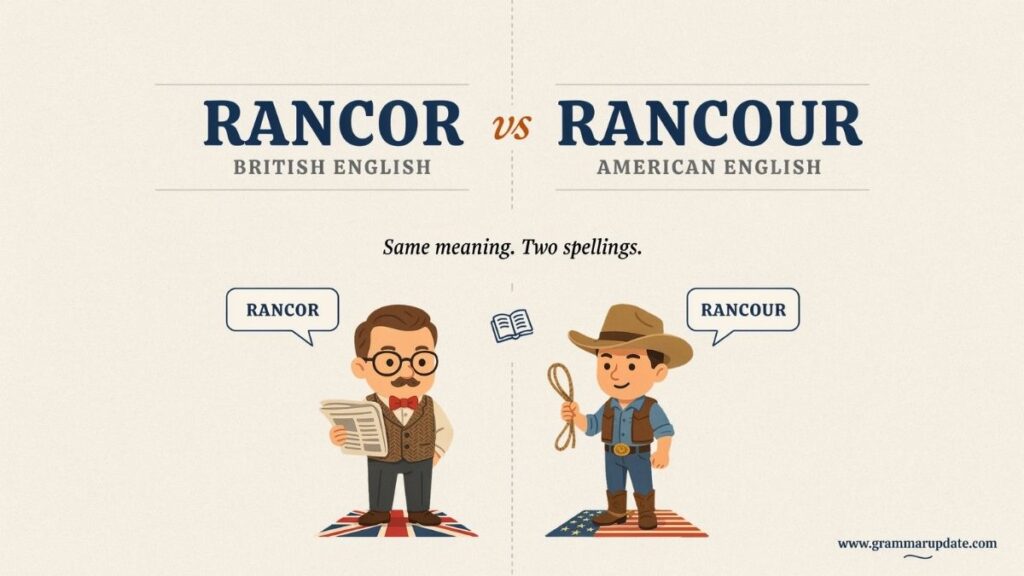
Test your understanding of Rancor vs Rancour by completing the sentences below. Choose the correct spelling based on the context and the variety of English being used.
Fill in the Blanks
- The American newspaper reported growing political ______ in Washington.
- The British journalist wrote about public ______ after the election.
- Years of personal ______ damaged their friendship.
- Despite the disagreement, they parted without ______.
- The court case created lasting ______ between the two families.
- Australian newspapers generally use the spelling ______.
- His ______ toward his former employer continued for years.
- The article explained the difference between ______ and ______.
- Canadian publications commonly prefer ______.
- The debate ended with considerable ______ among the participants.
- The senator spoke without bitterness or ______.
- Their business dispute produced deep ______.
- The American editor replaced ______ with rancor.
- Political ______ made cooperation difficult.
- The old rivals still felt ______ after many years.
- The negotiations concluded without any ______.
- British English generally prefers the spelling ______.
- The election campaign increased political ______.
- Emotional ______ prevented reconciliation.
- Both ______ and ______ are accepted spellings in English.
- The historian described centuries of ______ between the nations.
- The article used ______ because it was written for a UK audience.
- The dictionary recognized both ______ and ______.
- The conflict left deep ______ within the community.
- The professor explained that ______ and ______ have identical meanings.
Answers
- rancor
- rancour
- rancor / rancour
- rancor / rancour
- rancor / rancour
- rancour
- rancor / rancour
- rancor, rancour
- rancour
- rancor / rancour
- rancor / rancour
- rancor / rancour
- rancour
- rancor / rancour
- rancor / rancour
- rancour / rancor
- rancour
- rancor / rancour
- rancor / rancour
- rancor, rancour
- rancor / rancour
- rancour
- rancor, rancour
- rancor / rancour
- rancor, rancour
American or British English?
Write American English or British English beside each spelling.
| Word | Your Answer |
|---|---|
| Rancor | ______ |
| Rancour | ______ |
| Honor | ______ |
| Honour | ______ |
| Color | ______ |
| Colour | ______ |
| Favor | ______ |
| Favour | ______ |
Answers
- Rancor — American English
- Rancour — British English
- Honor — American English
- Honour — British English
- Color — American English
- Colour — British English
- Favor — American English
- Favour — British English
Correct the Sentence
Rewrite the following sentences using the spelling that matches the audience.
- The American article discussed political rancour.
- The British newspaper reported growing rancor.
- The Canadian magazine used rancor throughout the article.
- The US editor changed rancour to match American style.
- The Australian publication used rancor.
Suggested Answers
- The American article discussed political rancor.
- The British newspaper reported growing rancour.
- The Canadian magazine used rancour throughout the article.
- The US editor changed rancour to rancor.
- The Australian publication used rancour.
Quick Review
Complete the statements.
- Rancor is preferred in __________ English.
- Rancour is preferred in __________ English.
- Both spellings have the same __________.
- The difference is __________, not grammatical.
- Both words describe deep __________ and bitterness.
Answers
- American
- British
- meaning
- regional
- resentment
Here’s a trusted source for clear word meanings:
FAQs
Is it rancor or rancour?
Both rancor and rancour are correct spellings. Rancor is the standard form in American English, while rancour is preferred in British English, Canadian English, Australian English, and New Zealand English.
What is the difference between rancor and rancour?
There is no difference in meaning, pronunciation, or grammar. The only difference is regional spelling. American English uses rancor, whereas British English and most Commonwealth countries use rancour.
What does rancor mean?
Rancor means deep bitterness, long-lasting resentment, or intense hostility toward someone. It describes negative feelings that continue over a long period.
What does rancour actually mean?
Rancour means bitterness, resentment, or ill will. It has exactly the same meaning as rancor and differs only in spelling.
Is rancour or rancor correct?
Both spellings are correct. The appropriate choice depends on the variety of English you are using. Choose rancor for American audiences and rancour for British and Commonwealth audiences.
What is the opposite of rancor?
The opposite of rancor includes feelings such as forgiveness, goodwill, harmony, kindness, friendship, and reconciliation.
What is another word for rancour?
Common synonyms for rancour include:
- resentment
- bitterness
- hostility
- animosity
- ill will
- hatred
- enmity
- malice
Is rancor a noun?
Yes. Rancor is a noun that describes deep resentment, bitterness, or hostility.
Example:
Years of rancor damaged their relationship.
How do you use rancor in a sentence?
You can use rancor to describe lingering negative emotions.
Example:
The political debate ended with considerable rancor.
How do you use rancour in a sentence?
Rancour is used in the same way in British English.
Example:
The negotiations ended without rancour.
How do you pronounce rancor and rancour?
Both spellings share nearly the same pronunciation.
- American pronunciation: RAN-kər
- British pronunciation: RAN-kə
The pronunciation does not change significantly between the two spellings.
Is rancour used in British English?
Yes. Rancour is the standard spelling in British English and appears in British dictionaries, newspapers, books, and academic writing.
Is rancor used in American English?
Yes. Rancor is the preferred spelling in American English and is widely used in American publications and dictionaries.
Why are there two spellings of rancor?
The two spellings exist because American and British English developed different spelling conventions. British English retained the traditional -our ending, while American English simplified many words by using -or.
Which spelling should I use: rancor or rancour?
Use rancor when writing for American readers. Use rancour when writing for readers in the United Kingdom, Canada, Australia, or New Zealand.
Do rancor and rancour have the same meaning?
Yes. Both words describe deep resentment, bitterness, or long-lasting hostility. Their meanings, pronunciation, and grammatical functions are identical.
Is rancour used in Canada, Australia, and New Zealand?
Yes. These countries generally follow British spelling conventions, making rancour the preferred spelling.
Can rancor describe emotional resentment?
Yes. Rancor often refers to unresolved emotional resentment, bitterness, or hostility that continues over time.
Is rancor stronger than anger?
Yes. Anger is usually temporary, while rancor describes deep and long-lasting resentment that may continue for months or years.
Can rancor be used in formal writing?
Yes. Rancor and rancour frequently appear in journalism, academic writing, politics, literature, psychology, and professional communication.
Are rancor and rancour interchangeable?
Yes. They are interchangeable in meaning. The only consideration is choosing the spelling that matches your audience and using it consistently throughout your writing.
Fix common more word mistakes in English
Holliday vs Holiday Which Spelling Is Correct in English?
Conclusion
The confusion surrounding Rancor vs Rancour often causes writers to stop, question their spelling, and wonder whether the missing “u” has disappeared by mistake. Fortunately, this is one English disagreement that does not need to create any actual rancor. Both spellings are correct, both share the same meaning, and both describe deep resentment or bitterness. The only difference is regional usage.
Rancor is the preferred spelling in American English, while rancour is standard in British English and many Commonwealth countries. Understanding this distinction helps eliminate common spelling mistakes and improves writing accuracy.
So, the next time the letter “u” appears or decides to stay home there is no need for resentment. Choose the spelling that matches your audience, remain consistent throughout your writing, and let the only rancor be the word itself, not your spell checker.

Jhon AJS, the creative mind behind Grammar Update, is an experienced blogger passionate about simplifying English grammar. He focuses on explaining confusing word vs word differences, grammar rules, punctuation, and sentence structure in a clear and practical way. Through easy to understand guides and examples, Jhon helps readers improve their writing and communicate with confidence. With years of blogging experience, he continues to share helpful insights that make learning grammar simple, useful, and accessible for everyone.