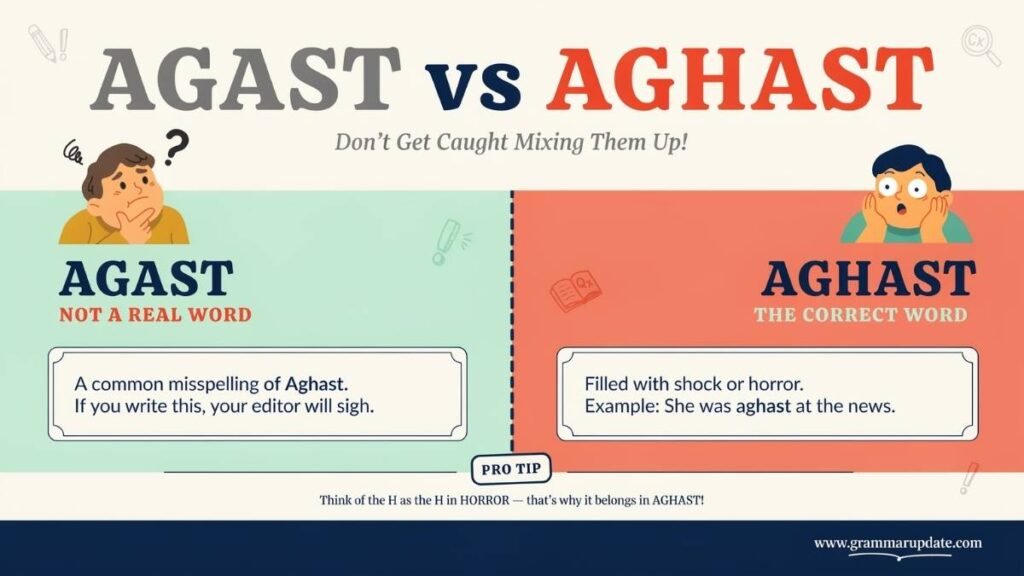
Have you ever written “agast” and then wondered if something looked a little off? You’re not alone. The confusion between agast vs aghast is easy to understand because both forms look and sound almost the same. But there’s a simple answer: aghast is the correct spelling in modern English. It means shocked, horrified, or deeply disturbed by something. Agast is an old form connected to the history of the word, but it isn’t the spelling you should normally use today. In this guide, you’ll learn the clear difference between agast vs aghast, their meanings, pronunciation, grammar, and examples so you can avoid this common spelling mistake.
Agast vs Aghast What’s the Difference?
The easiest way to understand agast vs aghast is to separate modern usage from historical usage.
Aghast is the standard modern spelling. It is an adjective used to describe someone who feels intense shock, horror, or alarm.
Agast is an older historical form related to the same word. You may encounter it when reading about historical English or the origin of aghast, but it isn’t the spelling you should normally use in modern writing.
| Word | Modern standard spelling? | Meaning | Modern use |
|---|---|---|---|
| aghast | Yes | Shocked, horrified, or stunned | Use this form |
| agast | No | Historical form associated with fear or terror | Avoid in ordinary modern writing |
For example:
Correct:
“She was aghast at the news.”
Incorrect in standard modern writing:
“She was agast at the news.”
The difference is only one letter, but that small h matters. English spelling often preserves letters that aren’t obvious from pronunciation, and aghast is a good example.
Learn the difference between confusing word pairs
Achieve vs Achive Difference Which Spelling Is Correct?
What Does Aghast Mean?
The aghast meaning is closely connected with strong shock, horror, and surprise.
In simple terms, if you are aghast, something has affected you so strongly that you’re shocked, horrified, or stunned by it.
For example:
“She was aghast at the sudden announcement.”
“He looked aghast when he saw the damage.”
“The parents were aghast at what had happened.”
“They stood aghast as the situation unfolded.”
Aghast usually describes a stronger reaction than ordinary surprise. If your friend tells you that they bought a different brand of cereal, you probably wouldn’t say you were aghast. That would make the breakfast aisle sound far more dramatic than it needs to be.
However, if someone receives shocking news or witnesses something disturbing, aghast can be an appropriate choice.
Learn the difference between confusing word pairs
Amateur vs Amatuer difference and Which one Is Correct?
Aghast Definition in Simple English
The aghast definition can be explained with a few simple words:
- shocked
- horrified
- stunned
- deeply alarmed
- filled with sudden distress
Aghast is an adjective. It commonly describes someone’s emotional state after they see, hear, or learn something disturbing or unexpected.
For example:
“She was aghast.”
“He looked aghast.”
“They stood aghast at the scene.”
Aghast commonly appears after verbs such as be, look, seem, stand, and remain.
The phrase “aghast at” is especially common:
“She was aghast at the decision.”
“He was aghast at what he had seen.”
“The public was aghast at the news.”
This pattern is worth remembering because it makes using the word much easier in everyday writing.
Is Agast a Word?
The question “is agast a word” needs a little historical context.
Agast is a real historical English form. It isn’t simply a meaningless spelling invented by modern writers. Older forms of English used agast in connection with fear, terror, and being frightened.
The word eventually developed into the modern form aghast.
Oxford traces aghast to late Middle English and identifies the obsolete verb agast or gast, meaning “frighten.” It also notes that the spelling with gh became established later
Etymonline also records agast as an older form associated with being terrified or suddenly filled with frightened amazement.
So the important distinction is simple:
Agast is historically attested, but aghast is the standard modern spelling.
That difference matters when you’re writing for a modern audience. If you’re preparing an essay, article, email, report, or school assignment, use aghast.
Learn the difference between confusing word pairs
Pretty vs Prety difference and Which Spelling Is Correct ?
Agast Meaning What Did It Mean Historically?
The historical agast meaning was connected with fear, terror, and frightened amazement.
Older English forms used related words to describe the act of frightening someone or the state of being terrified. Over time, the word’s form and spelling changed as English developed.
A simplified version of that development looks like this:
Old English → Middle English → Later English → Modern English
The word moved through older forms such as gæstan and agasten before the modern spelling aghast became established.
That history explains why you might see agast in discussions about historical English. It also explains why treating agast as a completely unrelated word would be misleading.
The modern writer, however, has a much simpler job: use aghast.
Why Is Aghast Spelled With an H?
If you’ve searched for “why is aghast spelled with an h,” the answer comes down to the history of English spelling.
The h wasn’t simply added because modern speakers needed help pronouncing the word. The spelling developed over time, and historical influences helped establish the gh form.
Oxford notes that the spelling with gh became general by about 1700. It also suggests that the spelling was probably influenced by the word ghost and compares the historical development with ghastly
Etymonline also explains the historical development of the gh spelling and connects the word with older forms related to frightening and terror.
The result is a word whose spelling contains a letter that isn’t obvious when you say it aloud.
That’s exactly why agast is such an easy spelling mistake.
You hear something close to “uh-gast,” so your brain may naturally produce “agast.” The standard spelling, however, is aghast.
Aghast Pronunciation How Do You Say It?
The standard aghast pronunciation is fairly simple once you know it.
In American English, it is commonly pronounced:
“uh-GAST”
The h does not have its own separate sound.
That creates the main spelling trap. You can pronounce the word correctly while still spelling it incorrectly.
Here’s the useful distinction:
Pronunciation: uh-GAST
Correct spelling: aghast
Common misspelling: agast
So when comparing agast vs aghast pronunciation, the two forms don’t give you a helpful audible difference. The spelling is what you need to remember.
Aghast in a Sentence
The phrase “aghast in a sentence” is one of the easiest ways to understand how the word actually works.
Here are some natural examples:
“She was aghast at the unexpected news.”
“He looked aghast when he saw the damage.”
“The workers were aghast at the sudden announcement.”
“The audience sat aghast as the details became clear.”
“Maria stood aghast, unable to believe what she had witnessed.”
Notice how the word describes a person’s reaction. It doesn’t simply mean “surprised.” It usually suggests a much stronger emotional response.
One of the most useful sentence patterns is:
be + aghast + at + something
For example:
“The employees were aghast at the decision.”
Another common pattern is:
look + aghast
For example:
“She looked aghast when she opened the letter.”
You can also use verbs such as seem, stand, and remain:
“He seemed aghast.”
“They stood aghast.”
“She remained aghast.”
Learning these patterns makes the word much easier to use naturally instead of simply memorizing its dictionary definition.
Learn the difference between confusing word pairs
Absorption vs Absorbsion difference and Which Is Correct?
Aghast Examples in Different Contexts
The best way to understand expressive adjectives is to see them in realistic situations.
In news writing:
“The community was aghast at the unexpected announcement.”
In a workplace:
“The staff were aghast when the company revealed the sudden changes.”
In a family situation:
“Her parents were aghast when they learned what had happened.”
In fiction:
“He stood aghast at the sight before him.”
In formal writing:
“Observers were aghast at the scale of the damage.”
In everyday conversation:
“I was aghast when I saw how much the repair cost.”
These aghast examples show that the word works across different types of writing. However, it usually carries a strong emotional tone, so it shouldn’t replace “surprised” in every situation.
For example:
“I was surprised by the price.”
This sounds natural.
“I was aghast at the price.”
This suggests the price was so shocking that it caused genuine disbelief or horror.
The second sentence is much more dramatic.
Learn the difference between confusing word pairs
Ether vs Either which is correct and Difference?
Agast vs Aghast Examples Correct and Incorrect
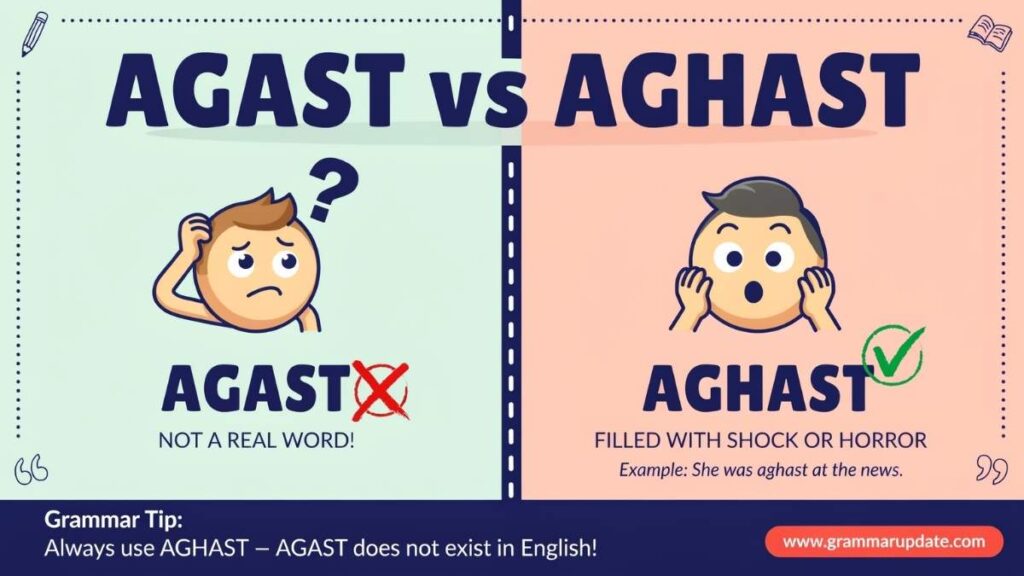
Looking at agast vs aghast examples side by side makes the difference easy to remember.
| Incorrect | Correct | Reason |
| She was agast at the news. | She was aghast at the news. | Aghast is the standard modern spelling. |
| He looked agast. | He looked aghast. | Use the modern form. |
| They stood agast at the scene. | They stood aghast at the scene. | Agast is not the usual modern spelling. |
| I was agast at the decision. | I was aghast at the decision. | The h belongs in the modern spelling. |
| She seemed agast when she heard it. | She seemed aghast when she heard it. | Aghast is the correct contemporary form. |
The mistake is easy to make because the pronunciation doesn’t clearly reveal the h.
That’s why this word belongs among the many commonly misspelled words that can cause trouble even for experienced writers.
Agast vs Aghast Grammar
When it comes to agast vs aghast grammar, the modern form is straightforward.
Aghast is an adjective.
It describes the emotional condition of a person.
Common structures include:
- be aghast
- look aghast
- seem aghast
- stand aghast
- remain aghast
- be aghast at something
Examples:
“The teacher was aghast at the student’s behavior.”
“He looked aghast after reading the message.”
“The witnesses stood aghast.”
“She remained aghast for several minutes.”
There is another useful grammar point to remember. Aghast normally appears after a linking verb rather than directly before a noun.
“She was aghast.”
This is natural.
“The woman looked aghast.”
This is natural.
“The aghast woman entered the room.”
This is much less natural in ordinary modern English.
Instead, you could write:
“The woman looked aghast as she entered the room.”
That construction sounds smoother and more natural.
Understanding this kind of usage is just as important as knowing the aghast spelling. Correct spelling gets the word right. Correct grammar makes the sentence work.
Learn the difference between confusing word pairs
In-Person vs In Person What’s the Difference?
Aghast vs Shocked Are They the Same?
Aghast and shocked are close in meaning, but they aren’t always interchangeable. Both words describe strong reactions, yet they carry slightly different emotional shades.
Shocked is the broader word. You can feel shocked by good news, bad news, an unexpected event, a surprising price, or something completely out of the ordinary.
Aghast usually carries a darker tone. It suggests that something has caused intense shock, horror, alarm, or distress.
| Word | Main meaning | Typical emotional tone |
|---|---|---|
| aghast | Shocked, horrified, or stunned | Strong and usually negative |
| shocked | Greatly surprised or disturbed | Broad |
| surprised | Unexpected reaction | Neutral |
| stunned | Overwhelmed by surprise | Strong |
| horrified | Filled with horror | Very strong |
Consider these examples:
“I was shocked to see my old teacher at the restaurant.”
This simply means the meeting was unexpected.
“I was aghast to see the condition of the building.”
This suggests that the condition was disturbing or horrifying.
The difference comes down to emotional intensity and context. If something merely catches you off guard, shocked may be enough. If it leaves you staring in disbelief because of its disturbing nature, aghast is more precise.
Learn the difference between confusing word pairs
Take Effect vs Take Affect Which one Is Correct?
Aghast vs Horrified What’s the Difference?
Aghast and horrified can describe very similar reactions. In fact, horrified is often listed as a synonym or closely related word for aghast.
Still, the two words aren’t identical.
Horrified places stronger emphasis on horror, fear, disgust, or revulsion. Aghast often combines shock with horror or stunned surprise.
Compare these sentences:
“She was horrified by the violence.”
This focuses strongly on the horror of what she witnessed.
“She was aghast at the news.”
This emphasizes her stunned and deeply disturbed reaction to what she learned.
The distinction isn’t always sharp. In many situations, either word can work. The best choice depends on which part of the emotion you want the reader to notice.
For example, if a person sees something frightening, horrified may be the stronger choice. If someone receives shocking information and is left speechless, aghast may fit better.
Aghast vs Astonished Shock or Surprise?
Astonished mainly describes extreme surprise. Aghast usually adds a darker emotional element.
For example:
“She was astonished by the magician’s performance.”
This sentence suggests amazement or extreme surprise. Nothing necessarily went wrong.
Now compare:
“She was aghast at the destruction.”
The second sentence clearly suggests shock, horror, or distress.
That distinction is useful when choosing expressive adjectives. Astonished can describe something impressive or unexpected. Aghast usually describes something disturbing, alarming, or deeply shocking.
You can think of the difference this way:
Astonished asks, “How could that happen?”
Aghast asks, “How could something this terrible happen?”
That isn’t a strict grammar rule, but it captures the difference in emotional tone.
Aghast vs Appalled Meaning and Usage
The question “aghast vs appalled” comes up often because both words describe strong negative reactions.
Aghast focuses mainly on shock, horror, or stunned disbelief. Appalled often adds a sense of disgust, disapproval, or moral outrage.
Consider these examples:
“The audience was aghast at the shocking revelation.”
The emphasis is on their stunned reaction.
“The audience was appalled by the cruel treatment.”
The emphasis shifts toward disgust and strong disapproval.
Both sentences describe serious emotional reactions, but the focus changes.
| Word | Main emphasis | Example |
| aghast | Shock and horror | She was aghast at the news. |
| appalled | Shock and disapproval | She was appalled by his behavior. |
| horrified | Horror or fear | She was horrified by the scene. |
| shocked | Strong surprise or disturbance | She was shocked by the announcement. |
Cambridge lists appalled, shocked, horrified, stunned, and astonished among words related to aghast. That overlap shows why context matters when selecting the best word.
Learn the difference between confusing word pairs
Rosin vs Resin Difference and Which is Correct?
Aghast Synonyms and Related Words
If you’re looking for an aghast synonym, you have several choices. However, each synonym carries a slightly different shade of meaning.
Common alternatives include:
- shocked
- horrified
- stunned
- astonished
- astounded
- appalled
- startled
- terrified
- horror-struck
These words shouldn’t be treated as perfect substitutes.
For example, startled usually describes a sudden reaction to something unexpected. It doesn’t necessarily involve horror.
Astonished emphasizes extreme surprise.
Appalled suggests strong disapproval or disgust.
Terrified focuses on fear.
Aghast sits somewhere around shock, horror, alarm, and stunned disbelief.
Choosing the right synonym therefore depends on the context.
Aghast Antonyms
An aghast antonym would describe someone who isn’t shocked, frightened, or emotionally disturbed.
Depending on the sentence, useful opposites can include:
- calm
- composed
- relaxed
- untroubled
- unsurprised
- confident
- unconcerned
For example:
“She remained calm despite the shocking news.”
“She was aghast at the announcement.”
These sentences create a clear contrast between emotional composure and intense shock.
Agast vs Aghast Synonym Are They Different?
The phrase “agast vs aghast synonym” can create the impression that these are two separate modern words with different meanings.
They aren’t.
The historical form agast and the modern word aghast are closely connected through the history of English. The difference is mainly one of historical form and modern spelling rather than two competing modern meanings.
If you need a synonym for the modern word, use words such as:
- shocked
- horrified
- stunned
- appalled
- astounded
- astonished
There is no need to search for a separate modern synonym for agast simply because you encountered the older spelling.
For contemporary English, the safest choice is still aghast.
Aghast Word Origin and Etymology
The history of aghast explains why the word looks unusual today.
The etymology of aghast reaches back to Middle English and earlier Germanic forms. Oxford identifies aghast as a late Middle English word connected with the obsolete verb agast vs gast, meaning “frighten.
Etymonline traces the word through Middle English agasten, meaning “to frighten,” and further back to Old English gæstan, “to terrify.” It also connects the history with words associated with ghosts and spirits.
A simplified development looks like this:
Old English: gæstan
Middle English: agasten
Historical form: agast
Later spelling: aghast
Modern English: aghast
English spelling didn’t become standardized overnight. Words changed as pronunciation, regional usage, scribal habits, printing, and spelling conventions developed.
That is why modern readers can encounter an older spelling that looks unfamiliar but still has a genuine place in English history.
The Ghost Connection in Aghast
The relationship between aghast and ghost is one of the more interesting details in the word’s history.
Etymonline connects the older forms of aghast with Old English words related to terrifying or frightening. Oxford also notes that the modern gh spelling was probably influenced by ghost and compares it with ghastly
This doesn’t mean that aghast simply means “ghost-like.” Modern English has its own established meaning.
Instead, the historical connection helps explain why the word contains gh even though the modern pronunciation doesn’t clearly pronounce those letters as a separate sound.
It also gives you a useful vocabulary connection:
ghost → ghastly → aghast
These words have historical relationships, although their modern meanings and grammar differ.
Why Does Aghast Have a Silent H?
The silent letter is one reason people search for “why is aghast spelled with gh.”
Modern English pronunciation doesn’t always reveal every letter in a word. Historical spelling can survive even after pronunciation changes.
In aghast, the h doesn’t produce a separate /h/ sound.
This creates a familiar problem for English learners.
You hear:
“uh-gast”
You may write:
“agast”
But standard modern English writes:
“aghast”
The lesson goes beyond this one word. English spelling and pronunciation don’t always match perfectly. That’s why building vocabulary through both reading and writing is important.
A grammar checker can catch a spelling error. It can’t always explain why the correct spelling looks different from the sound you hear.
Learn the difference between tricky grammar more words
Waving vs Waiving Which is correct and Difference?
British English vs American English Does the Spelling Change?
The answer is no.
Both American English and British English use the spelling aghast.
This isn’t a spelling difference like color and colour or center and centre.
The main difference you may notice is pronunciation.
| Feature | American English | British English |
| Spelling | aghast | aghast |
| Pronunciation | /əˈɡæst/ | /əˈɡɑːst/ |
| Meaning | Shocked or horrified | Shocked or horrified |
| Standard modern form | aghast | aghast |
So if you’re writing for an American audience, use aghast.
If you’re writing for a British audience, use aghast.
The spelling doesn’t need changing.
Is Aghast Formal or Informal?
Aghast is a standard English word that can appear in both formal and informal contexts.
However, it often sounds more dramatic or literary than simpler alternatives such as shocked or surprised.
Compare:
“I was shocked by the announcement.”
“I was aghast at the announcement.”
The first sentence sounds straightforward and conversational.
The second gives the reaction more emotional weight.
Aghast works particularly well in:
- journalism
- essays
- fiction
- formal descriptions
- speeches
- opinion writing
- serious conversation
It can also work in casual conversation when the situation genuinely calls for a strong reaction.
The important point is not to confuse “formal” with “old-fashioned.” Aghast is still a current English word. It simply has a stronger and more expressive tone than some everyday alternatives.
Can You Use Aghast at?
Yes. “Aghast at” is one of the most common and useful patterns.
Examples include:
“She was aghast at the decision.”
“He was aghast at what he saw.”
“The residents were aghast at the sudden change.”
“The employees were aghast at the announcement.”
If you’re unsure how to build a sentence with aghast, remembering “aghast at” gives you a reliable starting point.
For example:
Subject + be + aghast + at + noun
“She was aghast at the news.”
Subject + be + aghast + at + what-clause
“He was aghast at what had happened.”
These structures are natural and easy to adapt.
When Should You Use Aghast?
Use aghast when you want to describe a powerful reaction to something shocking, disturbing, frightening, or deeply unexpected.
It works especially well when someone:
- receives shocking news
- witnesses something disturbing
- discovers something alarming
- hears an unexpected revelation
- sees serious damage
- reacts strongly to cruel behavior
- learns about a serious mistake
For example:
“The residents were aghast when they discovered the extent of the damage.”
The word works because the situation involves more than simple surprise.
However, context still matters.
1.If someone tells you that their favorite restaurant is closed, you might be disappointed.
2.If someone tells you that the restaurant was destroyed in a fire, you might be shocked or horrified.
3.If the news leaves you stunned by the seriousness of what happened, aghast may be appropriate.
The stronger the emotional reaction, the more natural the word becomes.
When Should You Avoid Aghast?
Aghast is powerful, so using it for every minor inconvenience can make your writing sound exaggerated.
Consider this:
“I was aghast because my phone battery died.”
The sentence is grammatically possible, but it sounds overly dramatic unless you’re intentionally being humorous.
A more natural choice would be:
“I was annoyed because my phone battery died.”
Or:
“I was frustrated because my phone battery died.”
Now consider:
“I was aghast when I learned that the entire building had been destroyed.”
That sounds much more appropriate because the situation is genuinely serious.
This distinction is important for good English writing. Strong words should match strong situations.
Otherwise, the sentence loses its impact.
Aghast as an Adjective
Aghast is an adjective, and its grammar is fairly predictable.
It commonly follows linking verbs:
“She was aghast.”
“He seemed aghast.”
“They looked aghast.”
“The witnesses remained aghast.”
It also works after certain action verbs that describe appearance or posture:
“She stared at him, aghast.”
“He stood aghast at the scene.”
This gives writers several ways to avoid repeating the same sentence structure.
Instead of writing:
“She was aghast at the news.”
every time, you can write:
“She looked aghast when she heard the news.”
Or:
“She stood aghast after learning what had happened.”
Or:
“Aghast, she stared at the screen.”
That variation makes writing feel more natural and less repetitive.
Can Aghast Be Used Before a Noun?
In normal modern English, aghast generally appears after a verb rather than directly before a noun.
Natural:
“She looked aghast.”
“He was aghast.”
“The witnesses stood aghast.”
Less natural:
“The aghast man walked into the room.”
The last example isn’t impossible to understand, but it doesn’t sound like the usual modern construction.
A smoother version would be:
“The man walked into the room looking aghast.”
Or:
“The man looked aghast as he entered the room.”
This is a small but useful point for writers who want their English to sound natural rather than merely grammatical.
Learn the difference between tricky grammar more words
Acception vs Exception Difference and Usage?
Common Mistakes With Aghast
Knowing the definition isn’t enough. Writers can still make mistakes with spelling, grammar, prepositions, and word choice.
Writing Agast Instead of Aghast
Incorrect:
“She was agast at the news.”
Correct:
“She was aghast at the news.”
The missing h is the most common problem with this word.
Treating Aghast as a Verb
Incorrect:
“The news aghasted her.”
Aghast is an adjective, not a regular verb.
Better:
“The news left her aghast.”
Or:
“She was aghast at the news.”
Using Aghast for Ordinary Surprise
Incorrect or overly dramatic:
“I was aghast when my coffee order arrived five minutes late.”
Better:
“I was annoyed when my coffee order arrived late.”
Unless you’re deliberately using humor, aghast is too strong for most minor inconveniences.
Using the Wrong Preposition
Aghast commonly works with at:
“She was aghast at the decision.”
This is a useful pattern to memorize.
Assuming Aghast and Surprised Are Identical
They overlap, but aghast normally has a stronger negative emotional tone.
A person can be surprised by a birthday party.
A person can be aghast at a shocking revelation.
The context changes the word choice.
A Simple Rule to Remember Agast vs Aghast
If you’re trying to remember the correct spelling, keep the rule simple:
If you mean shocked, horrified, or stunned, write aghast.
The word contains the h:
A-G-H-A-S-T
Not:
A-G-A-S-T
A useful sentence to memorize is:
“She was aghast at the shocking news.”
Once you associate aghast with a strong emotional reaction, the spelling becomes easier to recall.
There’s no need to create an elaborate memory trick. The important thing is to connect the spelling with the meaning and use the word in a few natural sentences.
Learn the difference between tricky grammar more words
Connector vs Connecter Which Spelling Is Correct?
Agast vs Aghast Quick Comparison
| Feature | Agast | Aghast |
| Standard modern spelling | No | Yes |
| Historical form | Yes | Yes |
| Modern meaning | Historical form connected with fear | Shocked, horrified, or stunned |
| Part of speech | Historical form | Adjective |
| Common modern use | Not recommended | Common enough in standard English |
| Common construction | Not applicable in modern usage | aghast at |
| American English | Not the standard modern form | Yes |
| British English | Not the standard modern form | Yes |
| Example | Historical usage | “She was aghast at the news.” |
This comparison answers the main question quickly, but the historical distinction is worth remembering.
Agast isn’t simply a nonsense spelling. It belongs to the history of the word.
Aghast is the form modern readers expect.
Aghast in French
If you’re searching for “aghast in French,” the closest translation depends on the sentence and the emotional context.
The exact translation can change depending on whether the English sentence emphasizes shock, horror, alarm, or dismay.
For example:
“She was aghast at the news.”
A French translation needs to communicate more than simple surprise. It needs to capture the person’s strong emotional reaction.
This is a good example of why translation isn’t always word-for-word. A dictionary can give you useful equivalents, but the surrounding sentence determines which one sounds most natural.
Agast vs Aghast Meaning The Final Distinction
The agast vs aghast meaning becomes much easier once you separate historical English from modern English.
In modern English:
Aghast means shocked, horrified, or deeply disturbed.
Historically:
Agast was an older form associated with being frightened or terrified.
The two forms are connected. They aren’t best treated as two unrelated modern vocabulary choices.
This is why a dictionary or etymology source may mention agast even though a modern grammar checker will normally recommend aghast.
The historical form helps explain the modern word.
The modern form is the one you should use.
A Practical Case Study Choosing the Right Word
Imagine a company announces that an entire department will suddenly close.
A writer wants to describe the employees’ reaction.
The first draft says:
“The employees were agast at the announcement.”
The spelling is incorrect for standard modern English.
The corrected version is:
“The employees were aghast at the announcement.”
Now consider the choice of emotion.
“The employees were surprised at the announcement.”
This is grammatically correct, but it sounds relatively mild.
“The employees were shocked at the announcement.”
This sounds stronger and is perfectly natural.
“The employees were appalled at the announcement.”
This suggests strong disapproval or distress.
“The employees were aghast at the announcement.”
This emphasizes a stunned, deeply disturbed reaction.
All four sentences are possible, but they don’t communicate exactly the same feeling.
That is why strong writing isn’t simply about finding a dictionary synonym. It is about choosing the word that matches the situation.
How to Use Aghast Correctly
A simple approach works in most cases.
First, ask whether the person is reacting to something genuinely shocking, disturbing, or horrifying.
Next, check whether aghast fits the emotional intensity.
Then, use a natural grammatical structure such as:
- was aghast
- looked aghast
- seemed aghast
- stood aghast
- remained aghast
- was aghast at something
For example:
“She was aghast at what she discovered.”
“He looked aghast after reading the report.”
“They stood aghast at the scene.”
“The witnesses remained aghast for several minutes.”
1.If the reaction is mild, choose a simpler word.
2.If the reaction involves fear, consider horrified or frightened.
3.If it involves strong disapproval, appalled may be better.
4.If it is simply unexpected, surprised or astonished may work better.
The goal isn’t to use the most dramatic word available. The goal is to use the most accurate one.
Learn the difference between tricky grammar more words
Traveler vs Traveller Which Spelling Is Correct?
Practice Session Agast vs Aghast
Fill in each blank with the correct word or form. Choose between “Agast vs Aghast ” based on modern English usage and context.
- She was completely ________ when she heard the shocking news.
- The audience sat ________ as the disturbing story unfolded.
- He looked ________ after seeing the damage to his house.
- The parents were ________ at their son’s unexpected decision.
- I was ________ by the amount of money they had wasted.
- The workers stood ________ when they learned about the sudden closure.
- Maria was ________ at what she had witnessed.
- The reporter described the crowd as ________ after the announcement.
- He seemed ________ when he read the letter.
- The residents were ________ at the destruction caused by the storm.
- Which is the correct modern spelling: ________ or aghast?
- The word ________ means shocked, horrified, or deeply disturbed.
- She remained ________ after hearing the disturbing details.
- The students looked ________ when their teacher revealed the results.
- The historical form ________ is connected to the development of the modern word “aghast.”
- If you mean “deeply shocked,” the correct modern spelling is ________.
- The witnesses stood ________ at the unexpected scene.
- He was ________ at the news of the accident.
- Which spelling should you normally use in modern English: agast or ________?
- The manager was ________ when he discovered the serious mistake.
- She looked ________ after learning what had happened.
- The word “aghast” is commonly followed by the preposition ________.
- In modern English, ________ is an adjective meaning shocked or horrified.
- The h in ________ isn’t pronounced as a separate /h/ sound.
- If you’re writing a modern essay, use ________ rather than the historical form “agast.”
Answers
- aghast
- aghast
- aghast
- aghast
- aghast
- aghast
- aghast
- aghast
- aghast
- aghast
- agast
- aghast
- aghast
- aghast
- agast
- aghast
- aghast
- aghast
- aghast
- aghast
- aghast
- at
- aghast
- aghast
- aghast
Here’s a trusted source for clear word meanings:
FAQs
Is it aghast vs agast?
Aghast is the correct spelling in modern English. It means shocked, horrified, or deeply disturbed by something unexpected. Agast is a historical form connected to the development of aghast, but it isn’t the standard spelling used in modern writing.
Is “I am aghast” correct?
Yes. “I am aghast” is grammatically correct. It means “I am extremely shocked, horrified, or stunned.”
For example: “I am aghast at what happened.”
What does “aghast eyes” mean?
“Aghast eyes” describes eyes that show intense shock, fear, horror, or disbelief. The phrase is usually used descriptively rather than as a fixed expression.
For example: “She stared at him with aghast eyes after hearing the news.”
Is aghast a positive or negative word?
Aghast usually has a negative emotional meaning. It describes a strong reaction to something shocking, frightening, disturbing, or horrifying. It isn’t normally used for pleasant surprise.
What emotions are similar to aghast?
Emotions similar to aghast include shock, horror, alarm, disbelief, fear, distress, and astonishment. The closest choice depends on the situation because aghast combines elements of strong surprise and emotional disturbance.
What does “I’m aghast” mean?
“I’m aghast” means “I’m extremely shocked or horrified.” It tells the listener that something has caused a much stronger reaction than ordinary surprise.
What does “left aghast” mean?
“Left aghast” means that something caused a person to become extremely shocked, horrified, or stunned.
For example: “The unexpected announcement left everyone aghast.”
What is an example of an aghast reaction?
An aghast reaction might involve staring in disbelief, becoming speechless, or showing obvious shock after witnessing something disturbing.
For example: “The witnesses stood aghast when they saw the damage.”
Is aghast an Old English word?
Aghast has roots in older forms of English, but the modern word developed through Middle English. Its history is connected with older forms such as agast and agasten, which were associated with frightening or terrifying someone.
Is “agast” considered archaic?
Yes. Agast is generally treated as an obsolete or historical form in modern English. It can appear in historical texts or discussions of English word origins, but modern writers should normally use aghast.
Where does the word “agast” originate?
Agast comes from older forms of English associated with fear and terror. It is historically connected with the development of modern aghast and can be traced through Middle English forms related to frightening or terrifying.
Is agast a common word?
No. Agast isn’t a common modern English word. Most readers will expect aghast when the intended meaning is “shocked” or “horrified.”
Is there a word “agast”?
Agast is historically attested, so it isn’t simply a meaningless spelling. However, it isn’t the standard modern form of the word. In contemporary writing, aghast is the appropriate choice.
How do you use aghast in a sentence?
Aghast commonly describes someone’s reaction to something shocking or disturbing.
Examples include:
- “She was aghast at the news.”
- “He looked aghast when he saw the damage.”
- “The audience sat aghast as the story unfolded.”
What is the synonym of aghast?
Common synonyms for aghast include shocked, horrified, stunned, appalled, astonished, alarmed, and astounded. Each word has a slightly different emotional emphasis.
What is the noun form of aghast?
Aghast doesn’t have a direct noun form. Depending on the intended meaning, related nouns include shock, horror, alarm, astonishment, and disbelief.
Is it okay to use the word aghast in writing?
Yes. Aghast is a standard modern English adjective and is appropriate in formal, academic, journalistic, literary, and everyday writing when the context calls for a strong reaction.
What does “aghast” mean according to Oxford?
Oxford defines aghast as being filled with horror or surprise. It commonly describes someone who reacts strongly to something shocking or disturbing and is often used with “at.”
What does “aghast” mean in simple English?
Aghast simply means extremely shocked, horrified, or stunned by something. It describes a strong emotional reaction rather than ordinary surprise.
How is aghast different from shocked?
Shocked is a broader word that can describe many kinds of strong surprise. Aghast usually carries a stronger sense of horror, alarm, or distress.
For example, you can be shocked by unexpected good news, but aghast normally describes a disturbing or negative situation.
How is aghast different from appalled?
Aghast focuses on shock, horror, or stunned disbelief. Appalled often adds a sense of disgust, outrage, or strong disapproval.
For example: “She was aghast at the revelation” emphasizes shock, while “She was appalled by his behavior” emphasizes disapproval.
Can aghast describe fear?
Yes, but aghast usually describes more than simple fear. It can express a mixture of shock, horror, alarm, and stunned disbelief.
What does “stand aghast” mean?
“Stand aghast” means to remain standing while feeling extremely shocked, horrified, or stunned.
For example: “The crowd stood aghast as the building collapsed.”
Can aghast be used with “at”?
Yes. “Aghast at” is a very common grammatical construction.
For example: “The employees were aghast at the sudden decision.”
Does the h in aghast get pronounced?
No. The h doesn’t have a separate /h/ sound in the modern pronunciation of aghast. This is one reason people sometimes miss the h when spelling the word.
Is aghast the same in American and British English?
Yes, the spelling is the same in both varieties: aghast. The pronunciation can differ slightly between American and British English, but the meaning and spelling remain the same.
What is the easiest way to remember aghast?
Remember that the modern spelling contains the h:
A-G-H-A-S-T
A simple sentence can also help: “She was aghast at the shocking news.”
Can “agast” be used in modern writing?
It is best avoided in normal modern writing. Although agast has historical roots, readers today generally expect aghast. Using agast may look like a spelling mistake unless you’re discussing historical English.
What should you write: “agast meaning” or “aghast meaning”?
If you’re looking for the modern English word meaning shocked or horrified, the correct term is aghast meaning. Agast is relevant mainly when discussing the historical development of the word.
Conclusion
The confusion between agast vs aghast is easy to fix. In modern English, aghast is the correct spelling. It means very shocked, horrified, or deeply disturbed by something. Agast is an old form that you may find in historical English, but it isn’t the spelling you should use in everyday writing.
So, if something leaves you staring in shock, remember the h in aghast. For example, “She was aghast at the news.” That one little letter can save you from a very avoidable spelling mistake. Once you remember aghast, this confusing word doesn’t need to be quite so dramatic.

Jhon AJS, the creative mind behind Grammar Update, is an experienced blogger passionate about simplifying English grammar. He focuses on explaining confusing word vs word differences, grammar rules, punctuation, and sentence structure in a clear and practical way. Through easy to understand guides and examples, Jhon helps readers improve their writing and communicate with confidence. With years of blogging experience, he continues to share helpful insights that make learning grammar simple, useful, and accessible for everyone.