
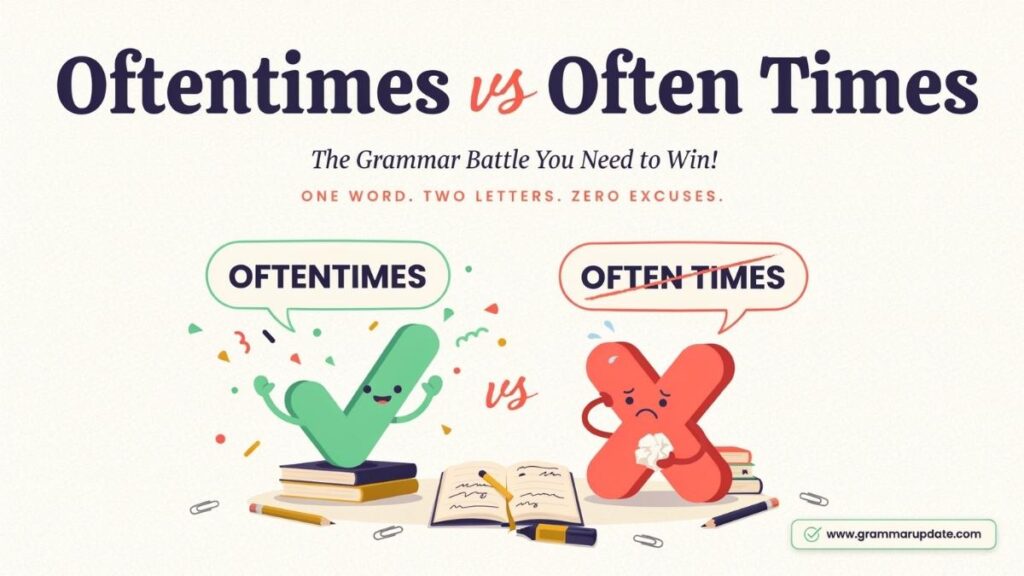
The oftentimes vs often times debate has confused writers for years, and it’s easy to understand why. After all, the only visible difference is a single space. That tiny gap has sparked countless grammar questions, proofreading headaches, and second guesses in emails, essays, and professional documents. Many people assume one form must be completely wrong, while others use both without knowing the difference. Fortunately, the rule is much simpler than it seems. This guide clears up the confusion, explains when each form is appropriate, and shares practical examples so you can avoid common grammar mistakes and write with confidence every time.
The Short Answer Oftentimes vs Often Times

If you’re looking for a quick answer, here’s the rule.
| Question | Answer |
|---|---|
| Oftentimes or often times which is correct? | Both are correct, but oftentimes is generally preferred. |
| Is oftentimes one word? | Yes. |
| Is often times correct? | Yes. It’s an accepted variant, although it’s less common in edited writing. |
| Which form should you use? | Oftentimes or simply often. |
For most readers, oftentimes is the better choice because it’s the spelling you’ll encounter most often in modern English. Even so, often times isn’t a grammar mistake. It has been used for centuries and still appears in books, magazines, and everyday writing. Many editors simply favor the one-word form because it creates a cleaner and more consistent style.
If your goal is clear, polished writing, choose oftentimes. If you prefer the simplest possible wording, often is usually an even stronger choice.
Fix common more word mistakes in English
Exercise vs Exorcise Differences and Correct Usage
What Does “Oftentimes” Mean?
Understanding the oftentimes meaning makes choosing the correct spelling much easier.
Oftentimes is an adverb of frequency that means:
- Frequently
- Regularly
- Many times
- On numerous occasions
- Repeatedly
It tells the reader that something happens more than once or occurs regularly.
For example:
- Oftentimes, the simplest solution is the best one.
- Success oftentimes comes from consistency.
- Small improvements oftentimes lead to big results.
Each sentence expresses repeated actions or events.
Oftentimes Definition
The oftentimes definition is straightforward.
Oftentimes means frequently, often, or many times.
As an adverb, it modifies a verb, adjective, or an entire sentence by describing how often something happens.
It belongs to the same family of frequency adverbs as:
- Often
- Frequently
- Usually
- Regularly
- Commonly
- Repeatedly
Among these words, often remains the most common choice in modern English, while oftentimes adds a slightly more conversational or literary tone.
Is Oftentimes a Real Word?
Yes.
A common question is:
Is oftentimes a real word?
Absolutely.
Oftentimes has been part of the English language for centuries and appears in major dictionaries. It’s accepted in both American English and British English, although it’s more common in North American writing than in British usage.
While it isn’t as widely used as often, it’s still considered standard English and is perfectly acceptable in both formal and informal writing.
Is Oftentimes One Word?
Yes.
If you’ve searched is oftentimes one word, the answer is simple.
Oftentimes is written as one word.
It’s considered a single-word adverb, similar to words such as:
- Sometimes
- Nowadays
- Meanwhile
- Nonetheless
Over time, English has merged many commonly used expressions into single words. Oftentimes follows the same pattern, making the one-word spelling the standard form in modern English.
When to Use Oftentimes
Knowing when to use oftentimes is easier than many people think.
Use oftentimes whenever you want to say that something happens frequently or regularly.
It’s appropriate in:
- Business writing
- Academic writing
- Professional emails
- Blog posts
- Speeches
- Everyday conversation
For example:
Oftentimes, experience is the best teacher.
Great ideas oftentimes begin with simple questions.
Teams oftentimes produce better results when they communicate effectively.
Because it functions as an adverb, oftentimes can appear at the beginning, middle, or end of a sentence.
Oftentimes in a Sentence
Here are several examples that show its correct usage.
Everyday Writing
- Oftentimes, I choose to walk instead of driving.
- We oftentimes forget how valuable patience can be.
- Children oftentimes learn by observing others.
Business Writing
- Successful companies oftentimes adapt quickly to change.
- Managers oftentimes encourage employees to share ideas.
- Customer feedback oftentimes reveals opportunities for improvement.
Academic Writing
- Researchers oftentimes compare multiple data sets before reaching conclusions.
- Historical events are oftentimes influenced by economic conditions.
- Scientific discoveries oftentimes lead to new areas of research.
Learn the difference between tricky more English words
Presant vs Present which is Correct Spelling and Usage?
What Does “Often Times” Mean?
The phrase often times is where most of the confusion begins.
Many writers assume it’s incorrect simply because oftentimes exists as a single word. In reality, that’s not entirely true.
Often Times Meaning
The often times meaning is essentially the same as oftentimes. Both express the idea of something happening frequently or many times.
For example:
- We often times overlook small details.
- People often times learn the most from failure.
Although these examples are grammatically acceptable, many editors would prefer oftentimes or simply often because those choices better match modern writing conventions.
Is Often Times Correct?
Yes.
Contrary to popular belief, often times is not automatically incorrect.
It has a long history in English and continues to appear in published books, newspapers, and online articles. However, oftentimes has become the preferred spelling in most edited writing because it’s treated as a single adverb.
If simplicity is your goal, often is an even better choice in many sentences.
Compare these examples:
- ✓ We oftentimes overlook simple solutions.
- ✓ We often times overlook simple solutions.
- ✓ We often overlook simple solutions.
All three sentences are grammatically correct, but the last is the clearest and most concise.
Learn the difference between tricky more English words
Coma vs Comma which is Difference?
Oftentimes vs. Often Times What’s the Difference?
Although only one space separates them, oftentimes and often times aren’t always treated the same way in modern writing.
| Oftentimes | Often Times |
|---|---|
| One word | Two words |
| Preferred spelling | Accepted variant |
| More common in edited writing | Less common in modern style |
| Functions as a single adverb | Often treated as a two-word variant of the same expression |
In everyday writing, both forms can communicate the same meaning. However, if you want your writing to look polished and consistent, oftentimes is usually the better choice.
A simple rule to remember is this:
Both forms are acceptable, but “oftentimes” is the spelling most editors recommend. If neither feels necessary, choose “often” for the clearest, most natural writing.
Fix common more word mistakes in English
Canon vs Cannon Difference and Usage
When Should You Use Oftentimes?
If you’re wondering when to use oftentimes, the answer is refreshingly simple.
Use oftentimes whenever you want to express that something happens frequently, regularly, or on many occasions. It functions as an adverb of frequency, making it a direct substitute for words such as often, frequently, and regularly.
Although often and oftentimes share essentially the same meaning, they don’t always create the same effect. Often is shorter, more direct, and more common in modern English. Oftentimes, on the other hand, adds a touch of emphasis and a slightly more conversational or literary rhythm.
Compare these examples:
Often, the simplest solution is the most effective.
Oftentimes, the simplest solution is the most effective.
Both sentences are correct. The difference isn’t grammatical it’s stylistic.
Using Oftentimes in Professional Writing
A common misconception is that oftentimes is too informal for business or academic writing.
That’s not true.
The word is fully accepted in professional writing, research papers, reports, and editorial content. However, many editors still prefer often because concise writing is generally easier to read.
For example:
- Successful teams oftentimes achieve better results through collaboration.
- Customer feedback oftentimes identifies opportunities for improvement.
- Careful planning oftentimes prevents costly mistakes.
Each sentence is grammatically correct. Still, replacing oftentimes with often would also be perfectly acceptable.
When editing your work, ask yourself a simple question:
Does “often” communicate the same idea just as clearly?
If the answer is yes, the shorter word is usually the stronger choice.
Using Oftentimes in Everyday English
Outside formal writing, oftentimes feels natural and conversational.
You’ll hear it in interviews, speeches, podcasts, and everyday conversations because it adds a little more emphasis than often without changing the meaning.
For example:
- Oftentimes, we create problems that don’t really exist.
- People oftentimes overlook the importance of consistency.
- Children oftentimes learn more by watching than by listening.
The word sounds slightly more expressive, which explains why many writers continue to use it despite the growing preference for often.
Learn how to use confusing more words correctly
Insite vs Insight difference and Common Mistakes
When Should You Use Often Times?
The question isn’t whether often times is correct it’s whether it’s the best choice.
The answer depends on your writing style.
Both oftentimes and often times have long histories in English, and both are recognized by major dictionaries. Even so, most editors today prefer the one-word spelling because it looks cleaner and reflects modern usage.
Why Does “Often Times” Still Appear?
English spelling hasn’t always been consistent.
Many words that are now written as one word originally appeared as two separate words. Over time, frequent use caused them to merge into single words.
The same pattern explains why oftentimes has become more common in edited writing, even though often times continues to appear in books, newspapers, and online publications.
Should You Use Often Times?
You certainly can.
For example:
We often times underestimate the value of patience.
The sentence is grammatically correct.
However, many editors would revise it as either:
We oftentimes underestimate the value of patience.
or
We often underestimate the value of patience.
Neither revision changes the meaning. They simply reflect the style most readers expect today.
If consistency and readability are your priorities, oftentimes is generally the better choice.
Learn the difference between tricky more English words
Copyright vs Copywrite Differences, Usage and Mistakes
Common Mistakes Writers Make
Although the rule is fairly straightforward, a few mistakes appear again and again.
Understanding them will help you write more confidently.
Assuming “Often Times” Is Wrong
One of the biggest misconceptions is that often times is incorrect English.
It isn’t.
The phrase has been used for centuries and remains an accepted variant of oftentimes. The real difference is one of preference rather than correctness.
If you’re writing professionally, oftentimes is usually the safer choice because it’s the form most editors expect.
Using Both Spellings in the Same Article
Consistency matters.
Switching between oftentimes and often times throughout the same document can make your writing look uneven.
Choose one spelling and use it consistently unless you’re discussing the difference between the two forms.
Using Oftentimes Too Frequently
Ironically, many writers use oftentimes too often.
Consider this example:
Managers oftentimes hold meetings that oftentimes last longer than expected.
Repeating the same adverb weakens the sentence.
A smoother revision would be:
Managers often hold meetings that last longer than expected.
Good writing isn’t about choosing the fanciest word. It’s about choosing the clearest one.
Forgetting That “Often” Is Usually Enough
Perhaps the easiest editing improvement is replacing oftentimes with often when no extra emphasis is needed.
Compare these versions:
Oftentimes, success comes from persistence.
Often, success comes from persistence.
Both are correct.
Most editors would choose the second because it’s shorter, cleaner, and easier to read.
Learn the difference between tricky more English words
Nitch vs Niche Difference and Which Is Correct?
Oftentimes vs Often
Many people searching for oftentimes vs often expect a grammar rule.
There isn’t one.
The difference is almost entirely stylistic.
Both words express the same basic idea: something happens frequently.
| Often | Oftentimes |
|---|---|
| More common | Less common |
| Shorter and more direct | Slightly more emphatic |
| Preferred in concise writing | Adds rhythm or emphasis |
| Ideal for most situations | Useful for stylistic variety |
Neither word is more correct than the other.
If your goal is simple, natural writing, choose often.
If the sentence flows better with oftentimes, use it confidently.
Learn the difference between tricky more English words
Clutz vs Klutz Which Spelling Is Correct in English?
Oftentimes vs. Sometimes vs. Frequently
Although these words all describe frequency, they don’t indicate the same level of repetition.
| Word | Meaning | Example |
|---|---|---|
| Sometimes | Occasionally | I sometimes work from home. |
| Often | Frequently | I often read before bed. |
| Oftentimes | Frequently; many times | Oftentimes, small habits produce big results. |
| Frequently | At regular or repeated intervals | The software is updated frequently. |
The key difference is that sometimes suggests occasional events, while often, oftentimes, and frequently describe actions that occur much more regularly.
If you’re unsure which word to choose, often remains the safest option because it’s clear, concise, and universally understood.
Learn how to use confusing more words correctly
Steer vs Stear Spelling Mistake and Usage
Real-World Examples of Oftentimes Vs Often Times
Seeing both forms in context makes the distinction much easier to understand.
Everyday Writing
- Oftentimes, we learn the most from our mistakes.
- I often forget where I left my keys.
- We often times underestimate how valuable patience can be.
Professional Writing
- Successful organizations oftentimes improve by listening to customer feedback.
- Employees often perform better when expectations are clearly defined.
- Leaders oftentimes achieve better results by encouraging collaboration.
Academic Writing
- Researchers oftentimes compare multiple studies before drawing conclusions.
- Historical evidence often challenges long-held assumptions.
- Scientific discoveries oftentimes create new questions rather than final answers.
Across all three contexts, you’ll notice the same pattern: often is the most common choice, oftentimes provides stylistic variation, and often times appears less frequently in modern edited prose.
Fix common more word mistakes in English
Manor vs Manner Which One Is Correct?
Synonyms for Oftentimes
Repeating the same word throughout an article can make your writing feel monotonous. Fortunately, English offers plenty of alternatives.
| Synonym | Best Used For |
|---|---|
| Often | Everyday writing |
| Frequently | Formal and academic writing |
| Regularly | Recurring habits |
| Repeatedly | Actions that happen again and again |
| Commonly | General observations |
| Usually | Typical situations |
| Habitually | Long-term routines |
| Routinely | Predictable actions |
| Many times | Informal emphasis |
| Time and again | Conversational or expressive writing |
Learn the difference between tricky more English words
Workday vs Work Day Which One Is Correct?
Practice Exercises Oftentimes Vs Often Times
Choose the correct word or phrase to complete each sentence.
Options: oftentimes, often times, often
Exercise
- ________, the simplest solution is the best one.
- We ________ forget that clear communication prevents misunderstandings.
- Small improvements ________ produce significant long-term results.
- Successful teams ________ perform better when everyone works toward the same goal.
- Researchers ________ compare multiple sources before drawing conclusions.
- ________, patience is more valuable than speed.
- Businesses ________ adapt quickly to changing market conditions.
- People ________ underestimate the importance of consistency.
- Teachers ________ encourage students to ask thoughtful questions.
- Experience ________ teaches lessons that no textbook can provide.
- Editors ________ recommend using often instead of oftentimes for a more concise style.
- Good habits ________ lead to lasting success.
- We ________ focus on problems instead of solutions.
- Careful planning ________ prevents costly mistakes.
- Leaders ________ earn respect by setting a positive example.
- During difficult ________, strong leadership becomes essential.
- There were many ________ when teamwork made all the difference.
- We visited our grandparents ________ throughout the summer.
- ________, the smallest changes have the greatest impact.
- Students ________ improve faster when they practice consistently.
- Writers ________ wonder whether oftentimes or often times is the correct spelling.
- The company ________ updates its policies to reflect industry changes.
- Scientists ________ revise their theories as new evidence becomes available.
- ________, simple writing is more effective than complicated writing.
- Professionals ________ proofread their work before submitting it.
Answer Key
- Oftentimes
- Often
- Oftentimes
- Often
- Often
- Oftentimes
- Often
- Often
- Often
- Oftentimes
- Often
- Oftentimes
- Often
- Oftentimes
- Often
- times
- times
- often
- Oftentimes
- Often
- Often
- Often
- Often
- Oftentimes
- Often
Here’s a trusted source for clear word meanings:
FAQs
Is oftentimes or often times correct?
Oftentimes is the correct and standard spelling. It is a single-word adverb meaning “frequently” or “many times.” Often times is generally considered a nonstandard split form and should be avoided in formal writing.
What is the difference between oftentimes and often times?
There is no difference in meaning. The difference is in spelling and usage. Oftentimes is the accepted word, while often times is usually treated as an incorrect or unnecessary two-word version.
Is oftentimes grammatically correct?
Yes. Oftentimes is grammatically correct and appears in major English dictionaries. It is perfectly acceptable in both spoken and written English.
Is oftentimes one word?
Yes. Oftentimes is always written as one word. Splitting it into often times is not recommended in edited or professional writing.
Should I use often or oftentimes?
Both are correct, but often is the more common choice. Use often for clear, concise writing, and choose oftentimes if you prefer a slightly more formal or literary style.
Is often times ever acceptable?
Although you may see often times in casual conversations or online posts, most grammar experts and style guides recommend using oftentimes or simply often instead.
What does oftentimes mean?
Oftentimes means frequently, regularly, or on many occasions. It has nearly the same meaning as often.
Is oftentimes more common in American or British English?
Oftentimes is more common in American English. British English generally favors often, although oftentimes is still understood.
Is oftentimes still used in modern English?
Yes. Oftentimes remains a valid and widely recognized word, especially in American English. However, often is more common in everyday writing.
Can I start a sentence with oftentimes?
Yes. Beginning a sentence with oftentimes is completely correct.
Example: Oftentimes, the simplest solution is the most effective.
Is oftentimes appropriate for academic writing?
Yes, it is grammatically acceptable. However, many academic style guides prefer often because it is shorter, more direct, and more common in scholarly writing.
What are some synonyms for oftentimes?
Common alternatives include:
- Often
- Frequently
- Regularly
- Repeatedly
- Commonly
- Many times
- Time and again
Does often mean all the time?
No. Often means something happens frequently, but not constantly. If something happens all the time, words like always or constantly are more accurate.
Is there any difference in meaning between often and oftentimes?
No significant difference exists. Both mean “frequently.” The main distinction is style: often is more common, while oftentimes has a slightly more formal or literary tone.
Which is better for professional writing: often or oftentimes?
For business, academic, and professional writing, often is generally the better choice because it is concise, modern, and preferred by most editors. Oftentimes is still correct but used less frequently.
Conclusion
The oftentimes vs. often times debate is a perfect example of how one small space can create a surprisingly big grammar question. Fortunately, the rule is much simpler than it first appears. While oftentimes and often times share the same meaning and are both recognized in English, oftentimes is generally the preferred spelling in modern edited writing. In many cases, the simple word often is an even better choice because it’s concise, natural, and easy to read.
The next time you find yourself wondering which form to use, don’t overthink it. If you want the standard spelling, choose oftentimes. If you come across often times, don’t assume it’s a mistake it has a long history and remains an accepted variant. And if often says exactly what you mean, let simplicity do the work.
Grammar has a funny way of turning tiny details into big debates. In this case, it’s just one little space. Now that you know the difference between oftentimes vs. often times, you can stop second-guessing your spelling and spend more time writing with clarity, confidence, and consistency.

Jhon AJS, the creative mind behind Grammar Update, is an experienced blogger passionate about simplifying English grammar. He focuses on explaining confusing word vs word differences, grammar rules, punctuation, and sentence structure in a clear and practical way. Through easy to understand guides and examples, Jhon helps readers improve their writing and communicate with confidence. With years of blogging experience, he continues to share helpful insights that make learning grammar simple, useful, and accessible for everyone.