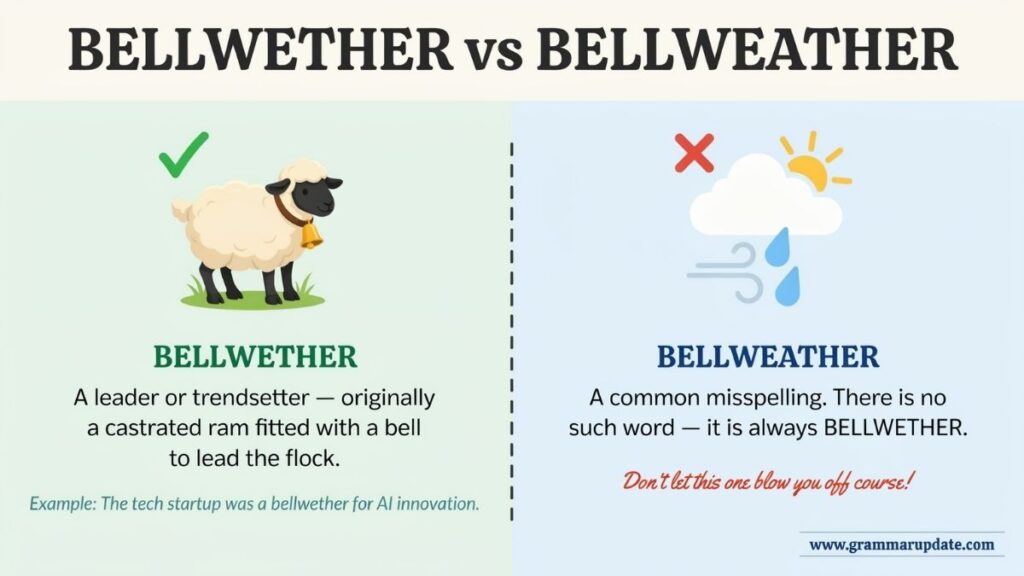
You ever written bellwether and then stopped to wonder, “Wait, is it bellweather?” You’re not alone. This spelling can easily cause confusion because bellwether looks like it should be connected to the word weather. But it isn’t. Bellwether is the correct spelling, while bellweather is a common mistake. The word comes from bell + wether, where wether means a male sheep. Today, bellwether means a person, place, company, or thing that leads or signals a wider trend. In this guide, you’ll learn the clear difference between bellwether vs bellweather, along with the meaning, origin, pronunciation, and correct usage.
Quick Answer Bellwether vs Bellweather
The correct spelling is bellwether.
Bellweather is a common misspelling.
| Word | Correct? | Meaning |
|---|---|---|
| bellwether | Yes | A leader or indicator of a broader trend |
| bellweather | No | A common misspelling of bellwether |
| bell weather | No | Not the standard spelling of the word |
| bell-wether | Generally no | Not the usual modern spelling |
So, if you’re asking, “Is it bellwether vs bellweather?” choose bellwether.
The correct spelling bellwether contains wether, not weather.
A simple way to remember it is:
bell + wether = bellwether
The word comes from a sheep, not from the weather.
Learn the difference between often confused words
Acreage vs Acrag difference and Which Spelling Is Correct?
Bellwether vs Bellweather Spelling at a Glance
The bellwether spelling can look strange because wether isn’t a word most people use every day. Weather, on the other hand, is extremely familiar. That familiarity often causes writers to add the extra “a.”
Here’s the key difference:
Bellwether = correct
Bellweather = incorrect
Wether = a male sheep
Weather = atmospheric conditions
Once you know what wether means, the spelling becomes much easier to remember.
What Does Bellwether Mean?
The bellwether meaning is a leader or an indicator of a broader trend.
A bellwether can refer to a person, group, place, company, stock, event, product, or other thing that helps show where a larger situation may be heading.
For example:
The company’s sales are a bellwether for the technology industry.
In this sentence, the company’s sales aren’t simply important. They provide information about the direction of the wider industry.
A bellwether may:
- Lead other people or organizations
- Influence a trend
- Reflect changing public opinion
- Indicate future developments
- Signal changes in a market
- Provide clues about an election
- Reflect changes in consumer behavior
- Serve as an early indicator of a larger movement
In simple terms, a bellwether is something you watch because it may tell you which way things are going.
Bellwether Definition and Meaning
The bellwether definition centers on two related ideas: leadership and indication.
The original meaning involved a sheep that led a flock while wearing a bell. The modern meaning is figurative. It describes something that leads, influences, or signals a broader trend.
The development looks like this:
Literal meaning:
A sheep wearing a bell and leading a flock.
↓
Leadership meaning:
A person or thing that leads others.
↓
Figurative meaning:
A person, place, group, company, event, or other indicator that signals a broader trend.
This progression explains why the bellwether word meaning changes slightly depending on the context.
For example:
- A fashion designer can be a bellwether for changing styles.
- A state can be a political bellwether.
- A company can be a bellwether for its industry.
- A stock can be a market bellwether.
- An election can become a bellwether for public opinion.
The central idea remains the same: something provides a useful signal about what may come next.
Learn the difference between often confused words
Lend vs Lent difference and which is Correct?
Bellwether vs Bellweather Meaning Why Are They Confused?
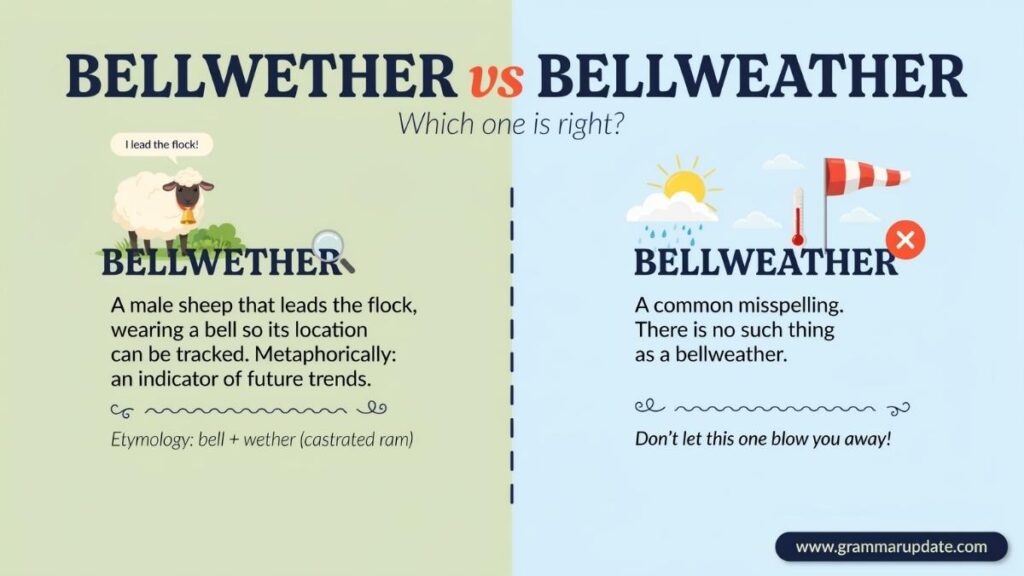
The bellwether vs bellweather meaning question often begins with a spelling mistake.
People see bellwether and connect the second half of the word with weather. That seems reasonable at first because a bellwether can indicate a trend, and the word indicator may remind people of forecasting.
But the connection is incorrect.
Bellwether and weather come from completely different sources.
| Word | Meaning | Connection to bellwether |
| wether | A male sheep | Direct connection |
| weather | Atmospheric conditions | No connection |
| whether | Used to express alternatives or uncertainty | No connection |
The correct word is bellwether, and the word contains wether.
So remember:
Bellwether comes from a sheep, not the sky.
Why Is Bellwether Spelled With an E?
The question “Why is bellwether spelled with an e?” has a historical answer.
The second part of the word comes from wether, an old term for a male sheep. The word bellwether developed from the idea of a bell-bearing sheep that led a flock.
The spelling therefore isn’t random.
It preserves part of the word’s history.
Think of the word as two pieces:
bell + wether = bellwether
Bell refers to the object attached to the animal.
Wether refers to the male sheep.
Bellwether originally referred to the bell-bearing sheep.
The modern figurative meaning developed from the animal’s role as a leader of the flock.
Bellwether Comes From Wether
Understanding wether makes the entire spelling question much easier.
A wether is a male sheep. In modern usage, the word generally refers to a castrated male sheep.
That gives us the original concept behind bellwether:
A sheep wearing a bell leads the flock.
The other sheep follow it.
The shepherd can identify the flock by listening for the bell.
That image eventually became a metaphor for people and things that lead or indicate broader trends.
The progression is simple:
sheep with a bell → flock leader → leader → trend indicator
That is why the word can describe everything from political states to companies and market indicators.
Bellwether Origin and Etymology
The bellwether etymology goes back to Middle English.
The word originally referred to a sheep that wore a bell and led a flock. Historical forms included combinations of words meaning bell and wether.
The word has been used in English for centuries. Its figurative meaning developed from the literal image of the lead sheep.
That history matters because it explains the spelling better than any simple memorization trick.
The word didn’t begin as a metaphor for prediction.
It began with an actual animal.
A shepherd needed to keep track of a flock. A sheep with a bell could help identify the group’s location and movement. Because the other sheep followed it, the animal became associated with leadership.
English later applied that idea to people and things.
A political region could lead the way in a voting trend.
A company could signal changes in an industry.
A stock could reflect broader market conditions.
The old sheep remained at the heart of the word even after the meaning became figurative.
Learn the difference between often confused words
Agast vs Aghast difference and Which one Is Correct?
What Does Wether Mean in Bellwether?
If you want to understand the correct spelling of bellwether, you need to understand wether.
Wether means a male sheep, especially a castrated male sheep.
That gives the word its historical connection to sheep.
The phrase “bellwether originally referred to a sheep” isn’t just a convenient spelling trick. It describes the word’s actual origin.
The original bellwether was essentially a lead sheep with a bell.
This is why:
- wether belongs in bellwether
- weather does not
- bellweather is a misspelling
- bellwether has no etymological connection to meteorological weather
Wether vs Weather
The wether vs weather distinction causes much of the spelling confusion.
Weather is the word you use for conditions in the atmosphere.
For example:
The weather is unusually cold today.
Wether is the sheep-related word.
For example:
The shepherd separated the wether from the younger sheep.
Whether is a completely different word used to introduce alternatives or uncertainty.
| Word | Meaning | Example |
| wether | Male sheep | The wether remained with the flock. |
| weather | Atmospheric conditions | The weather changed overnight. |
| whether | Expresses alternatives or uncertainty | I don’t know whether she will attend. |
Now look at the target word:
bellwether
It contains wether.
Not weather.
Not whether.
Bellwether Pronunciation
The bellwether pronunciation is approximately:
BEL-weth-er
The pronunciation can make the spelling harder because wether and weather sound very similar in many varieties of English.
That means you can’t always rely on pronunciation to remember which spelling is correct.
The safest approach is to remember the word’s origin.
Think:
bell + wether
Then say:
BEL-weth-er
The pronunciation and spelling become easier once you connect the word to the sheep-related meaning.
How Do You Spell Bellwether?
If you’re asking, “How do you spell bellwether?” use this formula:
bell + wether = bellwether
Then remember:
wether = male sheep
A useful mental picture is a sheep walking at the front of a flock with a bell around its neck.
That gives you the entire word.
Bell.
Sheep.
Leader.
Bellwether.
A short memory trick is:
A bellwether has a bell on a wether, not weather in the sky.
It may sound a little silly, but that’s exactly why it works.
Bellwether as a Noun
Bellwether is primarily a noun.
You can use it for a person, group, place, company, stock, event, or other thing that leads or indicates a trend.
Examples include:
The county is a bellwether for national elections.
The company has become a bellwether for the technology industry.
Her designs became a bellwether for changing fashion trends.
The stock is considered a bellwether for the sector.
The plural form is bellwethers.
For example:
Several companies have emerged as bellwethers for the industry.
Bellwether as an Adjective
Bellwether is primarily a noun rather than a standard adjective.
However, English often uses nouns before other nouns to modify them. That’s why you commonly see expressions such as:
- bellwether state
- bellwether county
- bellwether company
- bellwether stock
- bellwether industry
- bellwether election
In bellwether state, for example, bellwether functions as a noun modifier.
So it’s more accurate to describe bellwether as a noun that can function attributively rather than simply calling it an adjective.
Learn the difference between confusing word pairs
Achieve vs Achive Difference Which Spelling Is Correct?
Bellwether in Politics
Politics is one of the most common areas where you’ll encounter the word.
A political bellwether is a person, group, state, county, district, election, or voting pattern that is considered a useful indicator of broader political trends.
The word does not mean guaranteed predictor.
That’s an important distinction.
A bellwether is an indicator, not a crystal ball.
Political trends can change. Demographics shift. Voters change their priorities. A place that once reliably reflected national voting patterns may eventually stop doing so.
That means the term should be used carefully.
What Does Bellwether State Mean?
The bellwether state meaning refers to a state whose voting behavior has historically been viewed as an indicator of broader national political trends.
A bellwether state isn’t necessarily the same thing as a swing state.
A swing state is usually defined by how competitive an election is.
A bellwether state is defined by its perceived ability to reflect broader voting patterns.
The two can overlap, but they describe different ideas.
For example, a state may be highly competitive without accurately reflecting the national electorate. Another state may have a long history of voting in ways that resemble national results even if it isn’t the most competitive state in a particular election.
Bellwether Election Meaning
A bellwether election is an election whose result is watched as a possible indicator of a larger political trend.
It might involve:
- A state
- A county
- A congressional district
- A local race
- A primary
- A special election
- A specific group of voters
Political analysts may watch these results for clues about changes in public opinion.
However, a bellwether election isn’t guaranteed to predict the final national result.
The term describes its perceived usefulness as an indicator.
Bellwether County
A bellwether county is a county whose voting results are considered useful for understanding broader electoral trends.
For example, analysts may watch a county because its voters historically resemble voters in the surrounding region or the country as a whole.
A county may also become a bellwether because it contains a mix of demographic, economic, or political characteristics that make its voting behavior particularly informative.
But a county’s bellwether status isn’t permanent.
Political coalitions change.
Population patterns change.
Voting behavior changes.
A former bellwether can lose its predictive value.
Learn the difference between confusing word pairs
Amateur vs Amatuer difference and Which one Is Correct?
Bellwether in Business and Finance
The word also appears frequently in business and finance.
A bellwether company is a company whose performance may provide clues about broader industry conditions.
A bellwether stock is a stock that investors watch because its performance may indicate wider market or sector trends.
The idea is similar to politics.
Instead of watching one place to understand voters, analysts watch one company or stock to understand a market.
What Does Bellwether Company Mean?
A bellwether company is a business whose performance is considered a useful indicator of conditions in its industry or the wider economy.
For example:
The retailer’s declining sales became a bellwether for weaker consumer demand.
The retailer isn’t necessarily responsible for the entire economy.
Its results simply provide information that may help analysts understand broader consumer behavior.
A bellwether company may have:
- A large market presence
- Significant industry influence
- A broad customer base
- Exposure to major economic trends
- A history of reflecting industry conditions
- Enough scale to make its results useful as a signal
What Does Bellwether Stock Mean?
A bellwether stock is a stock that investors watch because its performance may provide clues about a broader market or industry.
For example:
Investors viewed the company’s earnings report as a bellwether for consumer spending.
The stock doesn’t have to be the best performer.
It doesn’t even have to be the largest stock.
Its importance comes from its ability to provide useful information about broader conditions.
Market Bellwether Meaning
The market bellwether meaning centers on the idea of an observable signal.
A market bellwether is a company, stock, commodity, index, or other market measure that investors watch for clues about broader market conditions.
An economic bellwether works in a similar way.
For example:
New housing construction can serve as an economic bellwether because construction activity affects employment, financing, materials, transportation, and consumer spending.
The key idea is simple:
Watch one signal to gain clues about a much larger movement.
Bellwether Does Not Mean Popular
One common mistake is treating bellwether as a sophisticated synonym for popular.
That’s incorrect.
A thing can be popular without being a bellwether.
A bellwether may also be influential without being especially popular.
Consider these differences:
| Word | Main idea |
| popular | Liked or favored by many people |
| trendsetter | Helps establish a new trend |
| leader | Leads others |
| influential | Has the power to affect others |
| bellwether | Indicates or leads a broader trend |
The words overlap, but they aren’t interchangeable in every situation.
A trendsetter actively establishes a trend.
A bellwether can serve as a signal that a trend is developing.
Bellwether Does Not Mean Any Example
Another mistake is using bellwether to mean “example.”
An example simply illustrates something.
A bellwether has a stronger role. It must provide some indication of leadership, direction, or a broader trend.
Compare these two sentences:
This bookstore is an example of a successful local business.
This bookstore has become a bellwether for changing reading habits in the neighborhood.
The first sentence simply describes an example.
The second describes an indicator.
That difference is important.
Learn the difference between confusing word pairs
Pretty vs Prety difference and Which Spelling Is Correct ?
Bellwether vs Weather Why the Sound Causes Trouble
The bellwether vs weather confusion is easy to understand.
Most people encounter weather regularly.
They talk about:
- Weather forecasts
- Bad weather
- Cold weather
- Warm weather
- Weather conditions
Far fewer people encounter wether.
Because weather is familiar, writers sometimes automatically insert it into bellwether.
That creates bellweather.
The problem is that the spelling changes the word’s historical structure.
Bellwether comes from bell + wether.
Weather has nothing to do with the word.
Whether vs Wether vs Weather
These three words can cause confusion because they sound similar.
Whether is used when discussing alternatives or uncertainty.
Wether refers to a male sheep.
Weather refers to atmospheric conditions.
Examples:
I don’t know whether they will arrive today.
The wether stayed near the flock.
The weather became colder overnight.
Now add the target word:
The county is a bellwether for the election.
The spelling is clear once you know the history.
Common Bellwether Spelling Mistakes
The most common spelling mistake is:
bellweather
Other incorrect or uncommon forms may include:
- bell weather
- bell-wether
- bellwhether
- bell wether
For modern standard English, use:
bellwether
This is especially important in professional writing, academic writing, journalism, business reports, and educational content.
A spelling checker may catch bellweather in some situations, but you shouldn’t depend entirely on software. The spelling is easier to remember when you understand where the word came from.
Learn the difference between confusing word pairs
Absorption vs Absorbsion difference and Which Is Correct?
Why Do People Spell Bellwether as Bellweather?
The reason is straightforward: weather is familiar, while wether isn’t.
When people spell an unfamiliar word from memory, they often replace an unfamiliar component with a familiar one.
Bellwether is a perfect example.
The word sounds almost as if it contains weather, and its modern meaning involves predicting or indicating trends. That combination makes bellweather feel logical.
But language doesn’t always follow what looks logical.
The history decides the spelling.
Bellwether comes from wether.
Bellwether Synonyms
The best bellwether synonym depends on the sentence.
Possible alternatives include:
- leader
- trendsetter
- pioneer
- pacesetter
- indicator
- guide
- forerunner
- precursor
- harbinger
- signal
- benchmark
These words aren’t exact replacements in every situation.
For example, leader emphasizes leadership.
Indicator emphasizes information.
Trendsetter emphasizes influence over a developing trend.
Harbinger emphasizes a sign that something is coming.
Bellwether can combine several of these ideas.
Bellwether Antonyms
There isn’t one perfect antonym for every use of bellwether.
Depending on the context, possible contrasts include:
- follower
- imitator
- laggard
- latecomer
A business that simply follows an established market trend might be described as a follower rather than a bellwether.
Likewise, a person who copies existing trends isn’t necessarily a trendsetting bellwether.
Learn the difference between confusing word pairs
Ether vs Either which is correct and Difference?
Bellwether in a Sentence
If you’re looking for a bellwether example, these sentences show how the word works in different contexts.
Political example
The county has long been considered a bellwether in presidential elections.
Here, the county’s voting pattern is considered an indicator of broader political behavior.
Business example
The retailer’s holiday sales became a bellwether for consumer spending.
The sales figures provide clues about wider consumer behavior.
Financial example
Investors watched the company’s earnings because its stock is a bellwether for the technology sector.
The stock is being used as an indicator of sector conditions.
Cultural example
The festival has become a bellwether for changing tastes in independent film.
The festival reflects a broader cultural movement.
Fashion example
Her designs became a bellwether for the industry’s move toward sustainable materials.
Her work signals a wider change in the industry.
These examples show why bellwether means more than simply important or popular.
Learn the difference between confusing word pairs
In-Person vs In Person What’s the Difference?
Bellwether Literal Meaning vs Figurative Meaning
The bellwether literal meaning comes from the original sheep-related use.
The bellwether figurative meaning describes leadership or trend indication.
| Meaning | Description |
| Literal | A sheep wearing a bell and leading a flock |
| Leadership | A person or thing that leads others |
| Trend indicator | Something that signals a broader development |
| Political | A place or group whose voting may indicate wider political trends |
| Business | A company or industry whose performance may indicate broader conditions |
| Financial | A stock or asset watched as a market indicator |
Modern English overwhelmingly uses the figurative meaning.
Bellwether Moment Meaning
A bellwether moment is an event that serves as a significant signal of a larger change.
For example:
The company’s decision became a bellwether moment for the industry.
The event matters because it may reveal where the broader industry is heading.
A bellwether moment can involve:
- Politics
- Business
- Technology
- Culture
- Consumer behavior
- Social change
The word works because the event acts as a signal.
Bellwether Town Meaning
A bellwether town is a town whose political, economic, social, or consumer behavior is considered representative of a broader trend.
For example:
The town has become a bellwether for changing housing preferences among younger buyers.
The town doesn’t need to predict every development.
Its importance comes from the belief that what happens there may appear elsewhere later.
Can Bellwether Be Used as a Noun?
Yes.
Bellwether is primarily a noun.
Examples include:
The county is a bellwether for national elections.
The company is a bellwether for the industry.
She became a bellwether of modern fashion.
The plural form is bellwethers.
For example:
Several technology companies have become bellwethers for the broader market.
Can Bellwether Be Used as an Adjective?
Bellwether is primarily a noun, but it can appear before another noun as a noun modifier.
This is why phrases such as bellwether state and bellwether company are common.
For example:
The state became a bellwether state.
The company is a bellwether company.
In these phrases, bellwether modifies the following noun.
Calling it simply an adjective isn’t the most precise grammatical description.
Is Bellwether One Word?
Yes.
Bellwether is written as one word in standard modern English.
Use:
bellwether
Avoid writing:
bell weather
when you mean the noun referring to a trend indicator.
The word has existed as a compound for centuries, so there is no need to split it into two words.
Is Bellwether Related to Weather?
No.
This is one of the most important points in the bellwether vs bellweather discussion.
Bellwether comes from bell + wether.
Wether refers to a male sheep.
Weather refers to atmospheric conditions.
The two words have different meanings and different histories.
So if you’re tempted to spell bellwether with weather because the word seems connected to prediction, stop and think about the sheep.
The sheep is the key.
Learn the difference between confusing word pairs
Lint vs Lent Difference Which one is correct?
A Simple Case Study How a Bellwether Works
Imagine a large retail company called Northstar Market.
Northstar notices that customers are buying fewer large appliances and more compact, energy-efficient products.
One company’s sales don’t automatically prove that the entire economy has changed.
However, if Northstar operates across a large market and its customer behavior has historically reflected broader consumer trends, analysts might treat the company as a bellwether.
Later, several other retailers report the same pattern.
Northstar’s earlier results now look more meaningful.
That’s how the concept works in practice.
A bellwether provides an early clue about a broader movement.
It doesn’t guarantee what will happen.
It simply gives observers a useful signal.
How to Remember Bellwether Spelling
The easiest way to remember the bellwether spelling is to forget the word weather.
Use this formula:
bell + wether = bellwether
Then remember:
wether = male sheep
Picture a sheep walking at the front of a flock with a bell around its neck.
That image connects the word’s spelling to its history.
The progression is:
bell → sheep → leader → indicator
Once you remember the sheep, the spelling becomes much harder to get wrong.
One-Line Memory Trick
A bellwether has a bell on a wether, not weather in the sky.
It’s short, accurate, and easy to remember.
Learn the difference between confusing word pairs
Choose vs Chose Difference which one is correct?
Bellwether vs Bellweather Final Comparison
| Feature | Bellwether | Bellweather |
| Standard spelling | Yes | No |
| Standard dictionary form | Yes | No |
| Contains wether | Yes | No |
| Connected to sheep | Yes | No |
| Connected to atmospheric weather | No | No |
| Means trend indicator | Yes | No |
| Used in politics | Yes | No |
| Used in business | Yes | No |
| Used for stocks | Yes | No |
| Common spelling mistake | No | Yes |
Learn the difference between confusing word pairs
Then vs Than difference which one is correct ?
Practice Session Bellwether vs Bellweather
Fill in each blank with the correct word or phrase. Bellwether vs Bellweather
- The correct spelling is __________, not bellweather.
- A __________ is a person, group, place, or thing that indicates a broader trend.
- The word bellwether comes from the words “bell” and __________.
- A __________ is a male sheep, especially a castrated male sheep.
- Bellwether has no connection to atmospheric __________.
- The most common misspelling of bellwether is __________.
- The original bellwether was a sheep wearing a __________.
- The sheep with the bell traditionally helped lead the __________.
- In politics, a state that indicates broader voting trends may be called a __________ state.
- A company whose performance indicates broader industry trends can be called a __________ company.
- A stock that provides clues about broader market conditions may be called a __________ stock.
- The approximate pronunciation of bellwether is __________.
- Bellwether is primarily used as a __________.
- The plural form of bellwether is __________.
- The words wether and weather have different __________ and meanings.
- The word __________ refers to atmospheric conditions such as rain, snow, and wind.
- The word __________ refers to a male sheep.
- A bellwether is an indicator, not a guaranteed __________ of the future.
- A political bellwether may provide clues about public __________.
- A market bellwether may provide clues about future market __________.
- The phrase “bellwether county” usually refers to a county whose voting patterns may indicate broader __________ trends.
- The phrase “bellwether company” refers to a company whose performance may indicate broader __________ conditions.
- To remember the spelling, think: bell + __________ = bellwether.
- The spelling “bellweather” is a common __________ of bellwether.
- In the sentence “The county is a bellwether for national elections,” bellwether means an __________ of a broader political trend.
Answers
- bellwether
- bellwether
- wether
- wether
- weather
- bellweather
- bell
- flock
- bellwether
- bellwether
- bellwether
- BEL-weth-er
- noun
- bellwethers
- origins
- weather
- wether
- predictor
- opinion
- trends
- political
- industry
- wether
- misspelling
- indicator
Here’s a trusted source for clear word meanings:
FAQs
Is bellweather a recognized spelling of bellwether?
No. Bellweather is generally a misspelling of bellwether. The standard spelling is bellwether.
Is bellwether written as one word?
Yes. Bellwether is normally written as one word in modern English.
What does the “wether” part of bellwether mean?
Wether refers to a male sheep, traditionally a castrated male sheep. It explains why bellwether contains wether instead of weather.
Is bellwether connected to the word weather?
No. Bellwether comes from bell and wether. Weather refers to atmospheric conditions and has a different meaning and origin.
Why do people mistakenly write bellweather?
People often substitute the familiar word weather for the less familiar word wether. The two words also sound similar, which makes the spelling mistake easy to make.
What is the easiest way to remember bellwether?
Remember the phrase “bell plus wether.” A bellwether originally referred to a sheep with a bell that led a flock.
Does bellwether always refer to a person?
No. Bellwether can describe a person, group, place, company, stock, event, or other thing that leads or indicates a broader trend.
Can a company be called a bellwether?
Yes. A company can be called a bellwether when its performance provides useful clues about the direction of an industry or market.
What is a bellwether stock?
A bellwether stock is a stock that investors watch because its performance may provide clues about broader market or industry conditions.
Can an election be described as a bellwether?
Yes. An election can be described as a bellwether when its result is viewed as an indicator of broader political trends.
What makes a state a political bellwether?
A state may be considered a political bellwether when its voting patterns have historically provided useful clues about wider national voting behavior.
Is a bellwether always accurate at predicting the future?
No. A bellwether is an indicator, not a guaranteed predictor. Political, economic, and social conditions can change and reduce its predictive value.
Can bellwether describe a trendsetter?
Yes, depending on the context. A bellwether can describe something that leads or signals a trend, although trendsetter emphasizes actively creating a trend.
What is the plural of bellwether?
The plural form is bellwethers.
Can bellwether describe something in fashion?
Yes. A designer, product, brand, or style can be called a bellwether when it signals or influences a broader change in fashion.
Is bellwether formal or informal English?
Bellwether is a standard English word that works well in formal, academic, journalistic, business, political, and general writing.
Can bellwether be used for economic trends?
Yes. An economic bellwether is something whose performance or behavior provides clues about broader economic conditions.
What is the difference between a bellwether and a benchmark?
A benchmark provides a standard for comparison, while a bellwether serves as a leader or indicator of a broader trend. A single thing can sometimes function as both, but the concepts aren’t identical.
Conclusion
The confusion between bellwether and bellweather is easy to understand, but the correct spelling is simple: bellwether. The word has nothing to do with weather. It comes from bell + wether, where wether means a male sheep. Historically, a bellwether was a sheep that wore a bell and led the flock.
Today, the meaning has moved beyond sheep. A bellwether can be a person, company, stock, state, election, or event that leads or signals a broader trend. It can help you see where politics, business, markets, or public opinion may be heading.
So, when you’re unsure whether to write Bellwether vs Bellweather, remember the sheep, not the forecast. Bellwether is the correct spelling. That extra “a” in bellweather? It doesn’t belong there.

Jhon AJS, the creative mind behind Grammar Update, is an experienced blogger passionate about simplifying English grammar. He focuses on explaining confusing word vs word differences, grammar rules, punctuation, and sentence structure in a clear and practical way. Through easy to understand guides and examples, Jhon helps readers improve their writing and communicate with confidence. With years of blogging experience, he continues to share helpful insights that make learning grammar simple, useful, and accessible for everyone.