Ever paused mid-sentence while writing Inclosed vs Enclosed and wondered if English is quietly messing with you? You’re not alone. That single extra letter has caused more confusion than most grammar rules combined, tripping up students, professionals, job seekers, and everyday writers for generations. Old letters often say inclosed, while modern emails confidently use enclosed, leaving many people stuck between what looks right and what actually is right. The confusion deepens when historical texts, dictionaries, and business writing don’t seem to agree at first glance. Thankfully, the truth is far simpler than it looks. This guide clears the Inclosed vs Enclosed confusion, breaks down the history, highlights common mistakes, and shows you exactly which spelling belongs in modern English.
Inclosed vs Enclosed The Short Answer
When people search for “is inclosed or enclosed correct”, they usually want a quick answer before digging deeper into grammar rules.
Here it is:
- Enclosed is the correct modern spelling.
- Inclosed is an archaic spelling variant.
- Modern dictionaries and grammar guides recommend using enclosed in virtually all situations.
Quick Comparison
| Word | Status | Modern Usage |
|---|---|---|
| Enclosed | Standard spelling | Yes |
| Inclosed | Obsolete spelling | Rare |
| Enclosed | Business writing | Recommended |
| Inclosed | Historical texts | Common |
| Enclosed | Academic writing | Yes |
| Inclosed | Professional communication | No |
If you are writing:
- Emails
- Cover letters
- Resumes
- Contracts
- Reports
- Business correspondence
- School assignments
The correct spelling enclosed should always be your choice.
What Does Enclosed Mean?
Before examining the spelling difference, it helps to understand the enclosed meaning itself.
The enclosed definition generally refers to something that is:
- Included with something else.
- Surrounded or sealed.
- Contained within boundaries.
- Covered or protected.
The meaning changes slightly depending on the context.
Enclosed Meaning in Letter Writing
One of the most common uses appears in formal correspondence.
When someone writes:
Please find enclosed the requested documents.
It means the documents accompany the letter.
The phrase enclosed with this letter indicates that additional materials are included inside the envelope or package.
Common examples include:
- Contracts
- Receipts
- Certificates
- Legal forms
- Application documents
- Invoices
This usage explains why the phrase business letter enclosed remains common in professional communication.
Enclosed Meaning in Email Communication
Digital communication has preserved many traditional letter-writing conventions.
Although emails contain attachments rather than physical papers, people still write:
- Please find the enclosed attachment.
- Kindly review the enclosed document.
- The enclosed files in email contain the updated proposal.
However, many modern style guides now prefer:
- I’ve attached the document.
- The file is attached.
- Please see the attached report.
Both approaches are acceptable, although “attached” often sounds more natural in email writing standards.
Physical Meaning of Enclosed
The word also describes something surrounded or protected by boundaries.
Examples include:
- An enclosed garden.
- An enclosed patio.
- An enclosed yard.
- An enclosed package.
The enclosed area meaning refers to a space surrounded by walls, fences, barriers, or other structures.
Enclosed Space Definition
The enclosed space definition typically describes an area with limited openings or restricted ventilation.
Examples include:
- Storage tanks
- Cargo holds
- Elevators
- Utility rooms
- Underground chambers
In workplace safety regulations, enclosed spaces often require special precautions because air circulation may be limited.
Is Inclosed a Word?
One of the most frequently searched questions is:
Is inclosed a word?
The answer is yes.
However, the answer requires an important qualification.
Inclosed Definition
The inclosed definition is virtually identical to the meaning of enclosed.
Historically, the word meant:
- Surrounded
- Included
- Shut in
- Contained within
For centuries, English writers used both spellings interchangeably.
Examples from older texts include:
The garden was inclosed by stone walls.
The letter was inclosed within the package.
The fields were inclosed by hedges.
Today, most dictionaries classify inclosed as:
- Archaic
- Obsolete
- Historical
- Rare
Therefore, if you need to spell inclosed, you should understand that the word belongs primarily to older forms of English.
Inclosed vs Enclosed Meaning
The inclosed vs enclosed meaning debate often creates confusion because both words express the same basic idea.
The real difference lies in usage, not definition.
| Feature | Enclosed | Inclosed |
|---|---|---|
| Meaning | Included or surrounded | Included or surrounded |
| Modern English spelling | Yes | No |
| Historical English usage | Yes | Yes |
| Professional writing | Common | Rare |
| Business communication | Standard | Avoid |
| Literary writing style | Occasionally | Historical |
Simply put:
The meanings are the same. The spelling changed over time.
This transition reflects the natural process of language evolution.
English has simplified many spellings over the centuries.
| Older Form | Modern Form |
|---|---|
| Musick | Music |
| Publick | Public |
| Shew | Show |
| Inclose | Enclose |
As spelling became standardized, enclose gradually replaced inclose.
Difference Between Inclosed vs Enclosed
The difference between enclosed and inclosed in English can be explained through three factors.
Time Period
Inclosed belongs primarily to earlier English.
Enclosed belongs to contemporary English.
Audience Expectations
Modern readers expect to see enclosed.
Using inclosed in a resume, business email, or report may appear outdated or incorrect.
Purpose of Writing
Professional writing terminology strongly favors enclosed.
This includes:
- Resume writing language
- Business communication
- Formal correspondence
- Academic writing
- Email writing standards
Because of these expectations, the correct word choice for modern communication is enclosed.
Why Did English Change from Inclosed to Enclosed?
English spelling has never been completely fixed.
Before dictionaries became widely available, writers often used multiple spellings for the same word.
Historical English Usage
Several centuries ago, writers commonly alternated between:
- Enclose
- Inclose
Both forms appeared in books, newspapers, letters, and official records.
Regional preferences often influenced spelling choices.
The Rise of Standardized English
During the eighteenth and nineteenth centuries, dictionaries and printing practices began to standardize spelling.
Publishers, schools, and educators increasingly favored enclose.
Over time:
- Enclose became standard.
- Inclose became uncommon.
- Inclosed gradually became obsolete.
Language Evolution and Spelling Change
English constantly changes.
Words evolve, spellings shift, and certain forms disappear altogether.
Examples include:
- To-day → Today
- Chuse → Choose
- Shewed → Showed
- Inclosed → Enclosed
This process explains why inclosed still appears in historical documents while modern English overwhelmingly prefers enclosed.
Fix common more word mistakes in English
Home Made vs Homemade Which Is Correct?
Is Inclosed an Old Spelling of Enclosed?
Yes.
The answer to “Is inclosed an old spelling of enclosed?” is unquestionably yes.
Linguists describe it as an archaic spelling variant.
That means:
- It was once accepted.
- It appeared in published works.
- It later fell out of common use.
Many traditional spelling forms have experienced similar changes.
You may still encounter inclosed meaning in historical documents when reading:
- Nineteenth-century letters
- Archived newspapers
- Legal records
- Family correspondence
- Historical manuscripts
- Literary collections
Outside these contexts, the word rarely appears.
Should I Use Inclosed or Enclosed?
Many writers ask:
Should I use inclosed or enclosed?
The answer is simple.
The Use enclosed in virtually every situation.
Use Enclosed For:
- Emails
- Cover letters
- Job applications
- Reports
- Business communication
- Academic writing
- Legal documents
- Professional correspondence
Use Inclosed Only For:
- Historical quotations
- Archival documents
- Literary imitation
- Discussions of language history
This guideline applies to nearly all forms of written communication.
Professional Writing Example
Incorrect:
Please find the contract inclosed.
Correct:
Please find the contract enclosed.
Resume Writing Language
If a job applicant writes:
My resume is inclosed.
Many employers may assume the writer made a spelling mistake.
Modern English strongly favors enclosed in all professional settings.
Learn how to use confusing more words correctly
Either vs Eather Which is Correct Spelling and Usage
How to Use Enclosed Correctly
Many people understand the meaning but remain unsure about how to use enclosed correctly.
Fortunately, the rules are straightforward.
Enclosed Documents Example
- The report is enclosed with this letter.
- The enclosed documents require your signature.
- The enclosed paperwork must be returned by Friday.
Attachment in Email Examples
- Please review the enclosed attachment.
- The enclosed files in email contain the revised budget.
- The enclosed document outlines the proposed changes.
Correspondence
Formal correspondence often uses traditional phrases.
Examples include:
- Please find enclosed the invoice.
- Enclosed is a copy of the agreement.
- An enclosed copy of the certificate is included.
These expressions remain common in business communication.
Letter Enclosure Examples
Typical enclosures include:
- Contracts
- Invoices
- Receipts
- Certificates
- Tax forms
- Resumes
- Application documents
Many formal letters include an enclosure notation at the bottom:
Enclosure: Resume
or
Enclosures: Contract, Invoice, Receipt
This convention helps readers identify additional materials.
Simple Rules to Remember
Keep these guidelines in mind:
- Use enclosed when something is included.
- Use enclosed when something is surrounded.
- Use enclosed in modern English writing.
- Avoid inclosed unless discussing historical materials.
- Choose enclosed in all professional communication.
Following these rules ensures clear, accurate, and professional writing.
Learn how to use confusing more words correctly
Party’s vs Parties Basic Difference
Examples of Enclosed in a Sentence
One of the easiest ways to understand how to use enclosed correctly is to see the word in real-world contexts. The meaning remains consistent, yet the usage changes depending on whether you are writing a business letter, sending an email, or describing a physical object.
Formal Writing Examples
The word enclosed frequently appears in formal correspondence, legal documents, and professional communication.
- Please find the signed contract enclosed with this letter.
- The certificate is enclosed with your application package.
- Enclosed is a copy of the agreement for your records.
- The enclosed paperwork must be returned by Friday.
- Please review the enclosed documents before signing.
These examples demonstrate why formal writing enclosed remains common in business and administrative communication.
Business Communication Examples
Modern business communication still relies on traditional wording in many situations.
- The enclosed invoice reflects the revised pricing.
- An enclosed copy of the purchase order has been included.
- The enclosed correspondence outlines the agreed terms.
- Please review the enclosed paperwork before the meeting.
In professional environments, clarity matters. The word enclosed immediately tells readers that additional materials accompany the message.
Email Examples
Although email has largely replaced printed letters, many organizations continue to use traditional language.
- Please review the enclosed attachment.
- The enclosed files in email contain the updated budget.
- Kindly examine the enclosed document before our discussion.
- The revised proposal is enclosed for your consideration.
However, modern email writing standards increasingly favor:
- I’ve attached the document.
- The report is attached.
- Please see the attached file.
Both styles remain acceptable depending on the level of formality.
Everyday Examples
Outside professional writing, enclosed describes spaces, objects, and areas surrounded by boundaries.
- The backyard is enclosed by a wooden fence.
- The playground is fully enclosed for safety.
- The package arrived enclosed in protective wrapping.
- The animals remained inside an enclosed area.
Historical Examples
The term inclosed appears primarily in older texts.
- The estate was inclosed by stone walls.
- The letter was inclosed within the parcel.
- The fields were inclosed by hedges.
These examples illustrate the distinction between historical English usage and usage in modern English.
Learn how to use confusing more words correctly
Stellar vs Steller Differences and Usage
Common Phrases That Use Enclosed
Certain expressions containing enclosed have remained remarkably stable for centuries. These phrases continue to appear in business communication, legal writing, and formal correspondence.
Please Find Enclosed
The phrase please find enclosed is one of the oldest examples of formal business language.
Example:
Please find enclosed the requested financial statements.
Although some modern style guides consider the expression somewhat formal, it remains widely accepted.
Enclosed With This Letter
This phrase indicates that additional materials accompany the correspondence.
Example:
The signed agreement is enclosed with this letter.
Enclosed Copy
An enclosed copy refers to a duplicate version of a document.
Examples:
- An enclosed copy of the invoice is provided.
- Please keep the enclosed copy for your records.
Enclosed Package
The phrase enclosed package describes a parcel or item that is fully covered or protected.
Enclosed Correspondence
Legal and administrative documents often reference enclosed correspondence, particularly when multiple documents accompany a letter.
Learn how to use confusing more words correctly
Speach vs Speech Which Spelling Is Correct in English?
What Does Enclosed Mean in a Letter?
The enclosed meaning in letter writing is straightforward.
It tells the reader that additional materials accompany the message.
For example:
Please find enclosed the requested application forms.
This statement means the forms are included inside the envelope.
Common letter enclosures include:
- Contracts
- Certificates
- Invoices
- Tax forms
- Receipts
- Legal documents
- Photographs
- Applications
Because of this usage, the term business letter enclosed remains common in formal correspondence.
Learn how to use confusing more words correctly
Honor vs Honour Which Spelling Is Correct?
Enclosed in an Envelope Meaning
The phrase enclosed in the envelope meaning refers to an item placed inside an envelope for delivery or protection.
Examples include:
- The photographs were enclosed in the envelope.
- The certificate was enclosed in an envelope for safekeeping.
- The documents remained enclosed in the envelope until delivery.
Inclosed or Enclosed in an Envelope
Many people ask whether to write inclosed or enclosed in an envelope.
Modern English clearly favors:
The documents were enclosed in the envelope.
Historical writing may contain:
The documents were inclosed in the envelope.
Outside historical materials, enclosed is always the preferred spelling.
Learn how to use confusing more words correctly
Eying vs Eyeing Which Spelling Is Correct?
What Is an Enclosed Trailer?
Search interest around inclosed or enclosed trailer often surprises writers because the term appears outside grammar discussions.
An enclosed trailer is a trailer with solid walls and a roof that protects cargo during transportation.
Common uses include:
- Transporting motorcycles
- Moving household furniture
- Carrying business equipment
- Storing construction tools
- Hauling commercial goods
Benefits of an Enclosed Trailer
| Benefit | Explanation |
|---|---|
| Weather protection | Shields cargo from rain and snow |
| Security | Reduces theft risk |
| Privacy | Keeps contents hidden |
| Safety | Protects equipment during transport |
| Storage | Functions as temporary storage space |
The modern term is always enclosed trailer. The phrase inclosed trailer rarely appears outside historical references.
Learn how to use confusing more words correctly
Labelling vs Labeling Which Spelling Is Correct and Use It?
American English vs British English
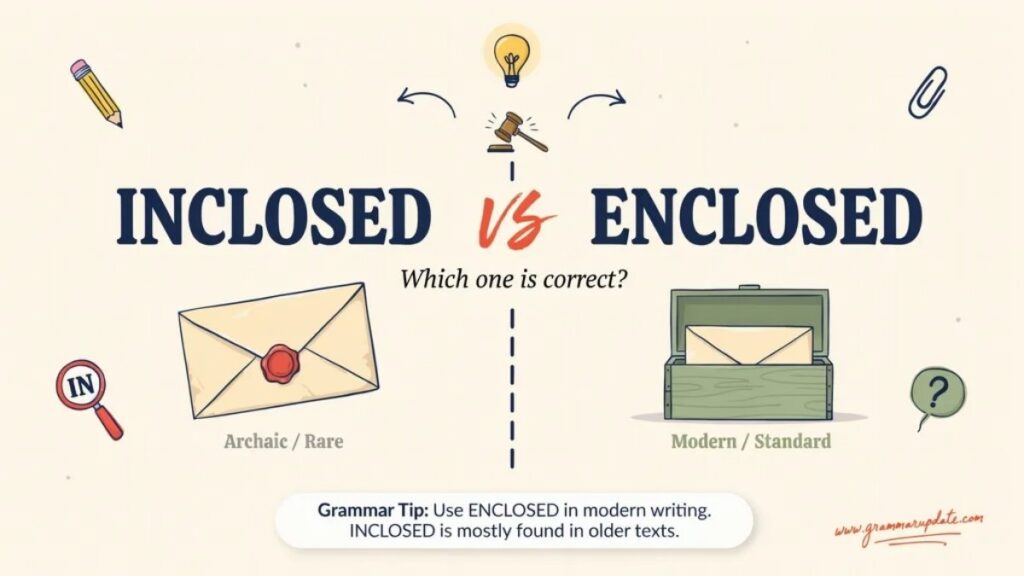
Some writers assume that inclosed belongs to British English while enclosed belongs to American English.
This belief is incorrect.
American English
American English universally uses enclosed.
Examples:
- Please find enclosed the report.
- The documents are enclosed.
- The package was enclosed.
British English
British English also uses enclosed.
Examples:
- Enclosed is a copy of the agreement.
- The requested documents are enclosed.
- Please see the enclosed information.
Therefore, enclosed is the modern spelling in both varieties of English.
Fix common more word mistakes in English
Instalments vs Installments Which Is Correct and Use It?
Common Mistakes People Make
Several misunderstandings continue to appear in modern writing.
Using Inclosed in Professional Writing
Many writers believe inclosed is simply an alternative spelling.
Incorrect:
Please find my resume inclosed.
Correct:
Please find my resume enclosed.
Assuming Inclosed Is British English
Both American and British English strongly favor enclosed.
Copying Historical Documents
Older letters frequently contain inclosed, causing some writers to believe the word remains standard.
Confusing Enclosed and Attached
In email communication, “attached” often sounds more natural.
Examples:
- I’ve attached the report.
- The file is attached.
However, “enclosed” remains acceptable in formal correspondence.
Quick Comparison Table
| Feature | Enclosed | Inclosed |
|---|---|---|
| Modern English spelling | Yes | No |
| Business communication | Yes | No |
| Email writing standards | Yes | No |
| Historical documents | Yes | Yes |
| Professional writing terminology | Yes | No |
| Contemporary English grammar | Yes | No |
| Literary writing style | Rare | Sometimes |
| Formal correspondence | Yes | Rare |
Why Is Enclosed the Correct Spelling?
Many writers ask:
Why is enclosed correct spelling?
The answer lies in the standardization of English.
Over several centuries:
- Dictionaries adopted enclosed.
- Schools taught enclosed.
- Publishers printed enclosed.
- Businesses used enclosed.
- Style guides recommended enclosed.
As a result, modern English spelling overwhelmingly favors enclosed.
The shift from inclosed to enclosed reflects the broader process of language evolution, where older spellings gradually disappear.
Fix common more word mistakes in English
Sneek vs Sneak Which Spelling Is Correct and Use It?
Case Study Business Communication
Consider these two cover letters.
Example One
Please find my resume inclosed.
Example Two
Please find my resume enclosed.
Most hiring managers would immediately recognize the second version as correct.
The first version may appear outdated or may even be mistaken for a spelling error.
This example demonstrates why correct word choice matters in professional communication.
Key Facts About Inclosed vs Enclosed
- Both words originally shared the same meaning.
- Inclosed is an archaic spelling variant.
- Enclosed is the accepted modern spelling.
- Both American and British English use enclosed.
- Professional writing favors enclosed.
- Historical documents often contain inclosed.
- Modern dictionaries classify inclosed as obsolete.
Fix common more word mistakes in English
Acception vs Exception Difference and Usage?
Practice Session Inclosed vs Enclosed
Fill in each blank with the correct word: inclosed or enclosed.
- Please find the report ______ with this letter.
- The documents were ______ in an envelope for safety.
- The old manuscript used the word ______ in several places.
- The certificate is ______ with your application.
- The garden is ______ by a wooden fence.
- Kindly review the ______ attachment before signing.
- The parcel was carefully ______ for delivery.
- Historical letters often used the term ______.
- Please see the ______ copy for details.
- The estate was ______ by stone walls.
- The email includes an ______ file for review.
- The letter was ______ with important instructions.
- The fields were ______ by hedges long ago.
- Modern writing always prefers ______.
- The package arrived fully ______ and intact.
- The agreement is ______ for your approval.
- The old document shows the word ______ repeatedly.
- The enclosed area was clearly marked as ______.
- Please find the ______ paperwork attached.
- The message included an ______ statement.
- The manuscript was ______ in protective covering.
- The enclosed trailer kept the goods ______ during transport.
- The report is ______ with this email.
- The historical record reads “the land was ______.”
- In business writing, ______ is the correct spelling.
Answers
- enclosed
- enclosed
- inclosed
- enclosed
- enclosed
- enclosed
- enclosed
- inclosed
- enclosed
- enclosed
- enclosed
- enclosed
- inclosed
- enclosed
- enclosed
- enclosed
- inclosed
- inclosed
- enclosed
- enclosed
- inclosed
- enclosed
- enclosed
- inclosed
- enclosed
Here’s a trusted source for clear word meanings:
FAQs
Is it inclosed vs enclosed shoes?
People use enclosed shoes in modern English. This term describes footwear that fully covers the foot, such as sneakers, loafers, boots, and formal shoes. The spelling “inclosed shoes” belongs to older writing and does not appear in modern usage.
What does “inclose” mean?
“Inclose” refers to an older verb form of enclose. It means to surround something, shut something in, or include items with a letter or package. Modern English replaced “inclose” with enclose, so you will rarely see it outside historical texts.
What is the difference between enclosed and closed?
“Closed” means something stops being open, like a closed door or a closed shop.
“Enclosed” means something sits inside something else or comes included with a document or package.
For example:
- A closed door blocks entry.
- An enclosed document comes with a letter or email.
Is it correct to say “enclosed is”?
Yes, you can use “enclosed is” in formal writing.
Example:
- Enclosed is the signed agreement for your review.
This structure works well in business communication and official correspondence.
Which is correct inclosed or enclosed?
Use enclosed in modern English. It works in emails, letters, academic writing, and business communication. The word inclosed appears only in historical writing and does not fit modern standards.
What are enclosed shoes?
Enclosed shoes cover the entire foot, including toes and heels. Common examples include:
- Sneakers
- Boots
- Loafers
- Dress shoes
Sandals and flip-flops do not count as enclosed shoes because they leave parts of the foot exposed.
What does “enclosed” mean?
“Enclosed” means something comes included with a message or sits inside a boundary.
You see it in:
- Business letters (enclosed document)
- Emails (enclosed attachment)
- Physical spaces (enclosed area)
Example:
- Please review the enclosed file before the meeting.
What does “amount inclosed” mean?
“Amount inclosed” comes from older English. It refers to money included with a letter or document. Modern writing replaces it with “amount enclosed.”
Example:
- The amount enclosed covers the full payment.
Is it correct to say “enclosed please find”?
Yes, you can use it, especially in formal writing. However, modern English prefers shorter and clearer alternatives.
Better options include:
- Please find the enclosed document.
- I’ve attached the file for your review.
- The document appears in the attachment.
Conclusion
The confusion around Inclosed vs Enclosed should feel less like a grammar puzzle and more like a simple choice between an outdated relic and a modern standard. The word inclosed still pops up in older documents like a polite visitor from another century, while enclosed has clearly taken its place in today’s writing.
If you ever hesitate again, you’re not alone this mix-up has tripped up plenty of writers. The easy rule is this: for anything modern, from emails to resumes, enclosed is always the correct choice. Inclosed belongs only in historical texts or when quoting older sources.
So the next time this question shows up, you’ll know exactly what to do. Choose the modern spelling, write with confidence, and let the old confusion stay where it belongs in the past.

Jhon AJS, the creative mind behind Grammar Update, is an experienced blogger passionate about simplifying English grammar. He focuses on explaining confusing word vs word differences, grammar rules, punctuation, and sentence structure in a clear and practical way. Through easy to understand guides and examples, Jhon helps readers improve their writing and communicate with confidence. With years of blogging experience, he continues to share helpful insights that make learning grammar simple, useful, and accessible for everyone.