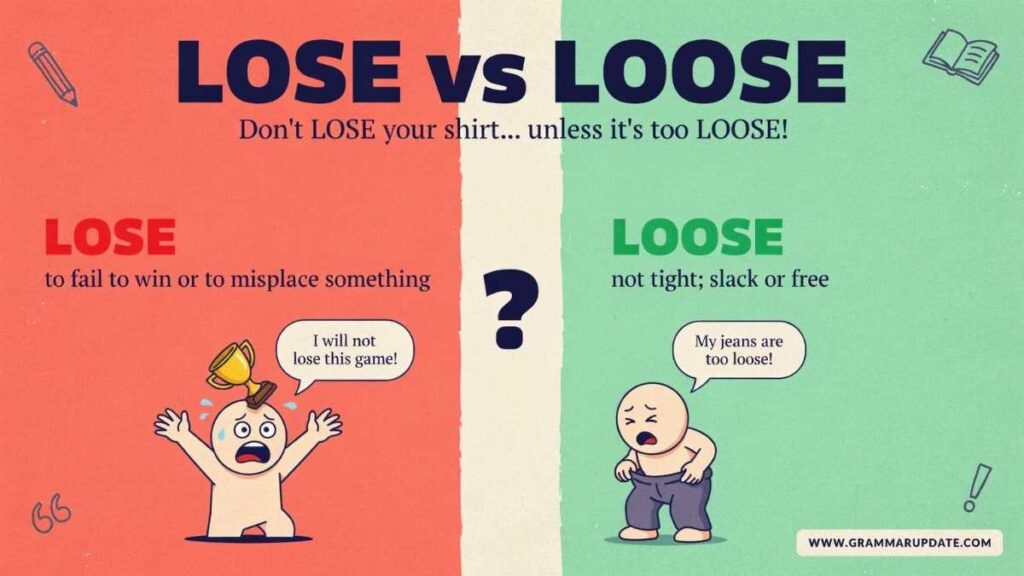
The difference between lose vs loose is easy to understand once you know what each word means. Although they look and sound similar, they are used in different situations. You use lose when you misplace something, fail to win, or no longer have something. You use loose when something is not tight, firmly attached, or securely held. For example, you can lose your keys, but your keys can also be loose in your bag. That extra “o” in loose can make the spelling confusing, but a simple memory trick can help. In this guide, you’ll learn the meanings, differences, examples, and common mistakes involving lose vs loose.
quick answer
| Word | Part of speech | Meaning | Example |
|---|---|---|---|
| Lose | Verb | To misplace something, fail to win, or no longer have something | I don’t want to lose my phone. |
| Loose | Usually an adjective | Not tight, firmly attached, or securely held | This shirt is too loose. |
Remember this basic distinction: you lose something, but something can be loose.
Learn the difference between confusing more English words
Fluorescent vs Flourescent difference and usage ?
What Does Lose Mean?
Lose is a verb. It describes an action or change in which you misplace something, fail to win, or no longer have something you once had.
You can use lose when you cannot find an item, when you do not win a competition, or when something decreases or disappears.
Lose Means to Misplace Something
When you lose an object, you cannot find it or do not know where it is.
Examples:
I always lose my keys when I am in a hurry.
Be careful not to lose your wallet at the airport.
She does not want to lose her phone again.
In each sentence, lose describes the act of misplacing something.
Lose Means to Fail to Win
Lose can also describe the opposite of winning a game, contest, election, or competition.
Examples:
Our team might lose the final match.
They worked hard but still lost the game.
If we do not practice, we could lose the competition.
Here, lose does not mean that someone misplaced an object. It means they did not win.
Lose Means to No Longer Have Something
You can also use lose when someone no longer has something they once possessed, such as time, money, confidence, or an opportunity.
Examples:
We cannot afford to lose any more time.
He lost money in the investment.
You may lose confidence if you keep criticizing yourself.
She does not want to lose the opportunity.
This use often refers to something abstract rather than a physical object.
Lose Can Describe a Reduction
Lose can describe a decrease in weight, speed, value, or another measurable amount.
Examples:
I want to lose a few pounds.
The car began to lose speed.
The company could lose money this quarter.
The plant may lose its leaves in winter.
In these examples, lose describes a reduction or a gradual disappearance.
Learn the difference between confusing more English words
Disappoint vs Disapoint difference and usage?
What Does Loose Mean?
Loose is usually an adjective. It describes something that is not tight, firmly fixed, securely attached, or held in place.
You might use loose to describe clothing, a screw, a tooth, a rope, or an object that can move freely.
Loose Means Not Tight
When clothing is loose, it does not fit closely against your body.
Examples:
These pants are too loose around the waist.
He prefers loose clothing during the summer.
I need a smaller size because this jacket feels loose.
Loose can describe something that has plenty of room or does not fit snugly.
Loose Means Not Firmly Attached
The Loose can also describe an object that is not securely fixed in place.
Examples:
The handle is loose, so be careful when you use the door.
A loose screw caused the chair to wobble.
The dog escaped through a loose section of the fence.
In these sentences, loose describes the condition of something that is not firmly secured.
Loose Means Free or Unrestrained
Loose may describe something that is not tied, confined, or controlled.
Examples:
The horse broke free and ran loose across the field.
Keep your hair loose if you want a relaxed style.
The children were allowed to run loose in the backyard.
This meaning often suggests freedom of movement.
Learn the difference between confusing more English words
Exhilarate vs Exhilirate difference and usage?
The Main Difference Between Lose vs Loose
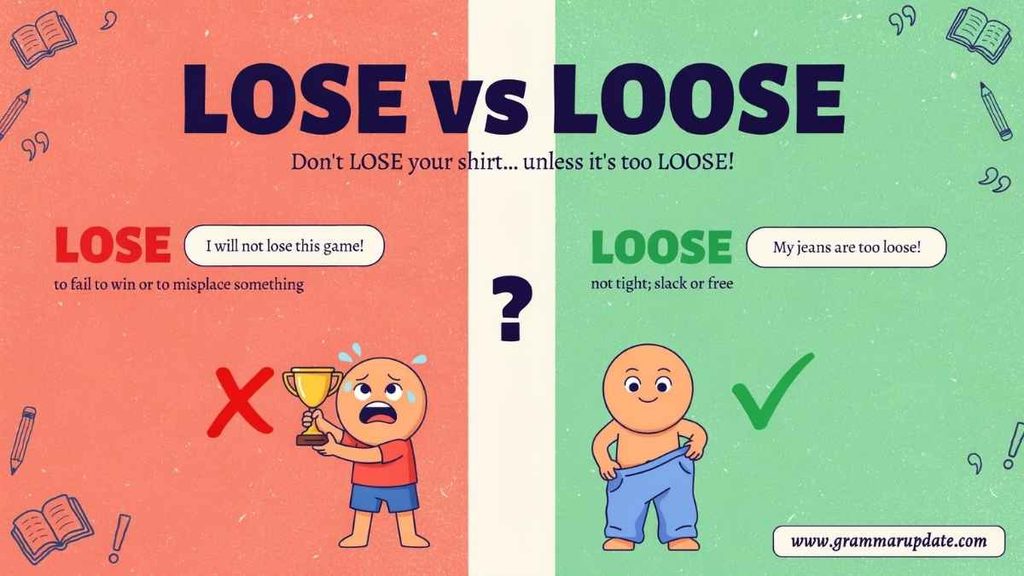
The most important difference between lose and loose is their meaning and grammatical role.
Lose is a verb that describes an action or change. Loose is generally an adjective that describes a condition.
Compare these sentences:
I might lose my bracelet.
My bracelet is loose.
In the first sentence, lose tells you what might happen to the bracelet. In the second, loose tells you that the bracelet does not fit tightly.
The words are not interchangeable. Replacing one with the other can make a sentence incorrect or change its meaning.
How to Pronounce Lose and Loose
Lose and loose have different vowel sounds, even though their spellings look similar.
Lose rhymes with “choose.” It has a voiced z sound at the end.
Loose rhymes with “moose.” It has an unvoiced s sound at the end.
Say the words slowly:
Lose: looze
Loose: loos
The pronunciation difference can help you remember which word belongs in your sentence. However, spelling and meaning are still the most reliable guides when you write.
Learn the difference between confusing word pairs
Caught vs Cauhgt difference and usage?
Why People Confuse Lose and Loose
People often confuse lose and loose because the words look almost identical. Both begin with “lo” and contain similar letters. The extra “o” in loose can make the spelling feel less predictable.
Their pronunciation also contributes to the confusion. Some speakers may not clearly distinguish the final sounds, especially when speaking quickly.
Another reason is that both words appear in everyday expressions. You might write about losing weight, losing a game, wearing loose pants, or having a loose screw. Because the words appear in similar contexts, it is easy to choose the wrong one while typing.
The solution is to focus on meaning rather than appearance. Ask yourself whether you need a verb that describes an action or an adjective that describes a condition.
An Easy Memory Trick for Lose vs Loose
Use the extra “o” in loose as a reminder that something has extra room.
Loose has two “o” letters, just like something loose may have extra space around it. For example, loose pants have extra room, and a loose screw has room to move.
Lose has only one “o.” Remember it as the action word: you can lose your keys, lose a game, or lose time.
Here is the quick reminder:
Lose = an action or change.
Loose = not tight or securely fixed.
If you can remember this distinction, you will avoid most lose vs loose spelling mistakes.
Learn the difference between confusing word pairs
Extreme vs Extreem difference and usage?
When to Use Lose
Use lose when you need a verb that describes misplacing something, failing to win, or no longer having something.
For example, use lose in sentences such as:
Do not lose your ticket.
I hate to lose a close game.
We cannot lose another hour.
She hopes to lose a little weight.
The business could lose customers if service gets worse.
You can also use different forms of the verb, depending on the tense.
| Form | Example |
|---|---|
| Lose | I do not want to lose my place. |
| Loses | He loses his patience when he is tired. |
| Lost | We lost the match yesterday. |
| Losing | She is losing interest in the project. |
Notice that lose changes form according to the sentence, but it remains a verb.
When to Use Loose
Use loose when you want to describe something that is not tight, firmly attached, or restrained.
For example:
The shirt is loose around the shoulders.
A loose button fell off my coat.
The dog was running loose in the park.
The rope became loose after the knot slipped.
The lid is loose, so tighten it before carrying the container.
In these examples, loose describes the state or condition of a person, animal, object, or item of clothing.
Can Loose Be a Verb?
Although loose usually functions as an adjective, it can also be used as a verb. As a verb, loose means to release, set free, or let something go.
Examples:
The archer loosed an arrow.
They loosed the horses into the pasture.
The guards loosed the prisoners.
This verb use is less common in everyday conversation than the adjective loose. Still, it is correct in the right context.
Do not confuse loose with lose just because both can appear as verbs. Their meanings remain different. Lose means to misplace, fail to win, or no longer have something. Loose as a verb means to release or set free.
Learn the difference between confusing word pairs
Exceed vs Excede difference and usages?
Lose vs Loose in Everyday Sentences
These paired examples show how the meaning changes depending on which word you use.
| Lose | Loose |
|---|---|
| I might lose my keys. | The keys are loose in my pocket. |
| She does not want to lose the race. | The runner wore a loose shirt. |
| We could lose power during the storm. | A loose wire caused the problem. |
| He hopes to lose some weight. | These pants are loose around the waist. |
| Do not lose your grip on the rope. | The rope became loose. |
| I do not want to lose this opportunity. | The dog was running loose outside. |
The examples make the distinction clear: lose describes an action or change, while loose describes a condition or, less commonly, the act of releasing something.
Learn the difference between confusing word pairs
Guarantee vs Guarentee difference and usage ?
Common Expressions With Lose
Lose appears in many familiar expressions. Learning them can help you recognize the word in context.
| Expression | Meaning | Example |
|---|---|---|
| Lose weight | Become lighter | She wants to lose weight gradually. |
| Lose your temper | Become angry | Try not to lose your temper during the meeting. |
| Lose track of time | Stop noticing how much time has passed | I lost track of time while reading. |
| Lose hope | Stop believing that something will happen | They refused to lose hope. |
| Lose your way | Become unable to find the correct route | We lost our way in the forest. |
| Lose interest | Stop feeling interested | He began to lose interest in the show. |
| Lose control | No longer be able to manage something | The driver started to lose control of the car. |
In each expression, lose functions as a verb.
Common Expressions With Loose
Loose also appears in several common phrases.
| Expression | Meaning | Example |
|---|---|---|
| Let loose | Allow someone or something to act freely | The children let loose on the playground. |
| Break loose | Escape from a restraint or restriction | The dog managed to break loose. |
| Hang loose | Stay relaxed or calm | Just hang loose while we wait. |
| Loose change | Coins or small amounts of money | I found some loose change in my bag. |
| On the loose | Free and not captured or confined | The escaped animal was still on the loose. |
| Loose ends | Unfinished details or tasks | We need to tie up a few loose ends. |
These expressions use loose in ways connected to freedom, lack of restraint, or something not firmly gathered or completed.
Learn the difference between confusing word pairs
Grateful vs Greatful difference and Usage?
Synonyms and Opposites of Lose and Loose
Synonyms can help you understand a word’s meaning, but they do not always work in every sentence. Choose a replacement that fits the context.
| Word | Possible synonyms | Common opposites |
|---|---|---|
| Lose | Misplace, forfeit, miss, squander | Find, win, keep, gain |
| Loose | Untight, slack, free, unsecured | Tight, secure, fastened, restrained |
For example, you might replace lose with misplace in “I might lose my keys.” However, misplace would not fit every use of lose. In “Our team could lose the game,” the word forfeit may work in some contexts, but it can suggest giving up or surrendering rather than simply failing to win.
Likewise, slack may replace loose when describing a rope, but it may not fit naturally when describing a relaxed style of clothing
Lose and Loose in Formal Writing
In formal writing, choosing between lose and loose depends on the meaning you want to express. Use lose when you are talking about something being misplaced, reduced, missed, or no longer possessed. For example, “The company could lose valuable customers” uses lose correctly. Use loose when you describe something that lacks tightness or firm attachment, as in “The report contained a loose connection between the two ideas.”
Learn the difference between confusing word pairs
Beginning vs Beggining difference and usage?
Lose and Loose in Everyday Conversations
Everyday speech contains plenty of situations where lose and loose can appear. You might say, “I don’t want to lose my phone,” when talking about misplacing it. On the other hand, “This jacket feels loose” describes clothing that does not fit tightly. Although the words sound similar, their meanings make them easy to separate once you pay attention to the context.
Common Word Combinations With Lose
Lose appears in many familiar expressions that are useful in everyday English. You can lose confidence, lose patience, lose control, lose interest, lose hope, or lose track of something. In each case, lose works as the verb because it describes something you no longer have, maintain, or keep. Learning these common combinations can make the correct spelling feel more natural.
Common Word Combinations With Loose
Loose also appears in several familiar expressions, especially when something is free, relaxed, or not firmly fixed. Common examples include loose clothing, loose soil, loose connections, loose threads, loose change, and loose papers. The word can also appear in the expression “on the loose,” which describes someone or something that has escaped or is not being controlled.
Learn the difference between tricky grammar more words
Hierarchy vs Heirarchy difference and usage?
Practice Session Lose vs Loose
Fill in each blank with the correct word: lose vs loose.
- I do not want to ______ my wallet at the airport.
- These shoes are too ______ for me.
- Our team cannot afford to ______ another game.
- The dog got ______ and ran into the street.
- She wants to ______ a few pounds before summer.
- Be careful not to ______ your house keys.
- The screw is ______ and needs to be tightened.
- I always ______ track of time when I am reading.
- He wore a ______ jacket because the weather was warm.
- We could ______ the opportunity if we wait too long.
- The rope became ______ after the knot came undone.
- Try not to ______ your temper during the argument.
- The company may ______ money this year.
- A ______ button fell off my shirt.
- They did not want to ______ the final match.
- The horse broke ______ and ran across the field.
- I would hate to ______ this valuable necklace.
- The lid is ______, so make sure you secure it.
- She began to ______ interest in the project.
- The children were allowed to run ______ in the backyard.
- We cannot ______ any more time waiting for him.
- His belt is too ______ around his waist.
- He was afraid he might ______ his job.
- The wire is ______ and should be fixed before someone gets hurt.
- If you are not careful, you could ______ your place in line.
Answers
- lose
- loose
- lose
- loose
- lose
- lose
- loose
- lose
- loose
- lose
- loose
- lose
- lose
- loose
- lose
- loose
- lose
- loose
- lose
- loose
- lose
- loose
- lose
- loose
- lose
Here’s a trusted source for clear word meanings:
FAQs
What is the easiest way to remember lose vs loose?
A simple memory trick is to connect the extra “o” in loose with extra space. Loose clothing has extra room, while a loose screw is not firmly secured. Lose has one “o” and refers to an action, such as losing your keys, a game, or an opportunity.
Is loose always an adjective?
No. Loose usually works as an adjective, but it can also function as a verb. As a verb, loose means to release or set something free. For example, “The rider loosed the horse from its restraints.” This verb form is less common in everyday English.
What is the past tense of lose?
The past tense of lose is lost. The three main forms are lose, lost, and lost. For example, “I lose my keys often,” “I lost my keys yesterday,” and “I have lost my keys.” The form “loosed” does not normally belong to the verb lose.
What is the difference between lost and loose?
Lost is a form of the verb lose and refers to something that was misplaced, no longer had, or was not won. Loose usually describes something that is not tight, firmly attached, or restrained. For example, “I lost my bracelet” means you cannot find it, while “My bracelet is loose” means it does not fit tightly.
Can lose and loose have the same pronunciation?
No. Lose and loose have slightly different final sounds. Lose ends with a voiced “z” sound, while loose ends with an unvoiced “s” sound. Lose sounds similar to “looz,” while loose sounds similar to “loos.”
What does loose mean when describing clothing?
When loose describes clothing, it means the clothing does not fit tightly against the body. It usually has extra room and allows more freedom of movement. For example, “She wore a loose sweater on a warm afternoon.”
What does lose mean in everyday English?
Lose has several common meanings. You can lose something by misplacing it, lose a game by failing to win, or lose something such as time, money, confidence, or an opportunity. For example, “Do not lose your ticket” uses lose to mean misplace.
Can lose describe something that you cannot find?
Yes. Lose is the correct word when you can no longer find something you previously had. For example, “I think I lost my glasses at the restaurant.” Here, lose describes the act of misplacing the glasses.
Can loose describe a person?
Yes, depending on the context. Loose can describe someone or something that is free from restraint or control. It also appears in the expression “on the loose,” which means free and not captured or confined.
What does “on the loose” mean?
“On the loose” means free from confinement, control, or capture. For example, “The escaped dog was still on the loose.” The expression uses loose because it describes freedom rather than the act of losing something.
What does “loose ends” mean?
“Loose ends” refers to unfinished details, tasks, or matters that still need attention. For example, “We have a few loose ends to take care of before the event.” The expression uses loose because the details remain unresolved or incomplete.
What does “loose change” mean?
“Loose change” refers to coins or small amounts of money that you carry separately rather than keep organized in a wallet, purse, or account. For example, “I found some loose change in the bottom of my bag.”
Is “lose sight of” the correct expression?
Yes. “Lose sight of” is a standard expression meaning that you can no longer see someone or something. It can also mean to stop focusing on an important idea, goal, or fact. For example, “Do not lose sight of your main goal.”
Is “lose touch” the correct phrase?
Yes. “Lose touch” means to stop communicating or staying in contact with someone regularly. For example, “We moved to different cities and eventually lost touch.” Lose is correct because the phrase describes the loss of contact.
Is “loose the door” correct English?
Usually, no. If you mean that a door is not firmly secured, you would normally describe it as loose. If you mean to make something less tight, the correct verb is loosen. For example, “The door handle is loose” or “Loosen the screw.”
What is the difference between loose and loosen?
Loose usually describes something that is not tight or securely attached. Loosen is a verb meaning to make something less tight or less firmly fixed. For example, “The knot is loose” describes its condition, while “Loosen the knot” tells someone to make it less tight.
Why is “loosing” usually incorrect?
Loosing is a real word, but it is not the present participle of lose. The correct form is losing. Loosing comes from the verb loose and means releasing or setting something free. For example, “He is losing his keys” is correct when you mean misplacing them.
What is the difference between losing and loosing?
Losing is the -ing form of lose and can mean misplacing something, failing to win, or no longer having something. Loosing is the -ing form of the less common verb loose, meaning releasing or setting something free. For example, “She is losing her patience” is different from “The archer is loosing an arrow.”
How can you quickly choose between lose and loose?
Start with the meaning of the sentence. Use lose when you mean misplace, fail to win, or no longer have something. Use loose when you mean not tight, not firmly attached, or free from restraint. Once you focus on meaning instead of spelling, the difference becomes much easier to remember.
Learn the difference between tricky grammar more words
Possession vs Posession difference and usage?
Conclusion
The difference between lose vs loose is simple once you connect each word with its meaning. Use lose when you misplace something, fail to win, or no longer have something. Use loose when something is not tight, firmly attached, or under control.
A quick memory trick can make the difference even easier. Loose has an extra “o,” so think of extra space, like loose clothes or a loose screw. Lose has one “o” and usually describes something you do, such as lose your keys, lose a game, or lose an opportunity.
Once you remember this small difference, you will have much less trouble choosing between lose and loose in your everyday writing.

Jhon AJS, the creative mind behind Grammar Update, is an experienced blogger passionate about simplifying English grammar. He focuses on explaining confusing word vs word differences, grammar rules, punctuation, and sentence structure in a clear and practical way. Through easy to understand guides and examples, Jhon helps readers improve their writing and communicate with confidence. With years of blogging experience, he continues to share helpful insights that make learning grammar simple, useful, and accessible for everyone.