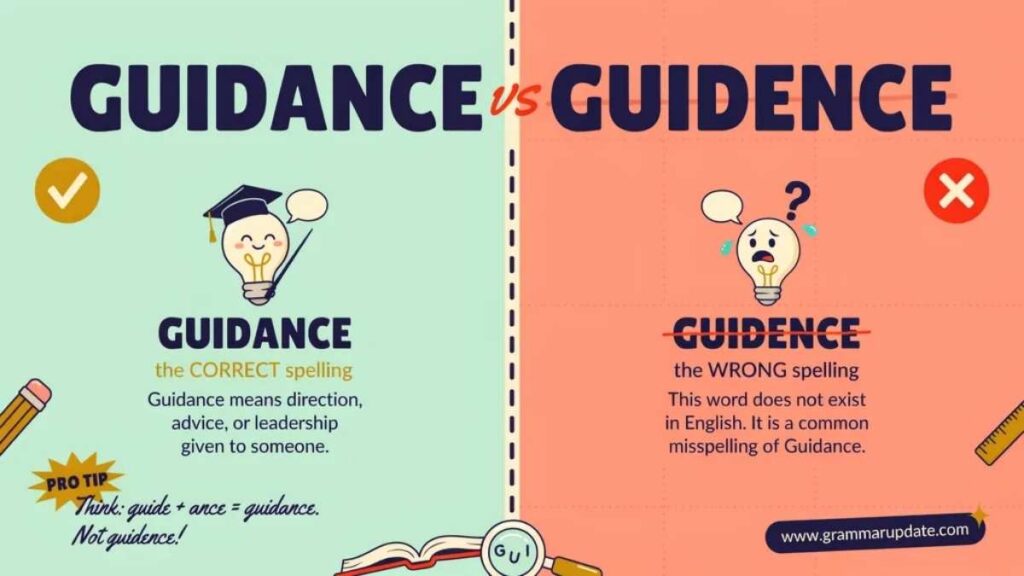
Guidance vs guidence is a common spelling mix up, but the correct choice is actually quite simple. Guidance is the correct spelling, while guidence is a misspelling. If you’re unsure whether to write guidance vs guidence, you’re not alone. This small spelling mistake often happens because the word sounds similar to other words ending in “-ence.” However, guidance ends in “-ance.” The word guidance means advice, direction, or support that helps someone make a decision or understand what to do. In this article, you’ll learn the correct spelling of guidance, its meaning, pronunciation, examples, and easy ways to remember it.
Quick Answer
Guidance is the correct spelling, while guidence is incorrect when you mean help, advice, or direction.
| Word | Correctness | Meaning |
|---|---|---|
| Guidance | Correct | Help, advice, direction, or support |
| Guidence | Incorrect for the intended meaning | A common misspelling of guidance |
Correct: The teacher gave me helpful guidance before the exam.
Incorrect: The teacher gave me helpful guidence before the exam.
If you’re wondering whether guidance vs guidence is correct, remember that the standard spelling contains an a, not an e. This spelling applies in both American and British English.
Learn the difference between confusing word pairs
Aluminum vs Aluminium difference and usage?
Guidance vs Guidence at a Glance
The difference between guidance vs guidence comes down to one letter. Although the incorrect form may look reasonable, it isn’t an accepted alternative spelling of the noun.
| Feature | Guidance | Guidence |
|---|---|---|
| Spelling | Standard English spelling | Misspelling |
| Part of speech | Noun | Incorrect form of the noun |
| Meaning | Help, direction, advice, or support | No standard meaning as a variant of guidance |
| Usage | Suitable for formal and informal writing | Should be corrected |
| Example | We need guidance from an experienced manager. | We need guidence from an experienced manager. |
The two spellings don’t describe different kinds of advice or different levels of support. They also aren’t regional spelling variations. Guidance is the correct form wherever standard English is used.
Learn the difference between confusing word pairs
Dilemma vs Dilema which one is correct ?
What Does Guidance Mean?
Guidance means help, advice, direction, or support that helps someone make a decision, solve a problem, or complete a task.
It can come from a person, an organization, written instructions, or a set of principles. Sometimes guidance involves clear directions. In other situations, it means helping someone understand their options without making the decision for them.
For example, a teacher might provide guidance on choosing a college course. A supervisor might offer guidance on completing a project. Similarly, a financial professional might explain the factors someone should consider before making a major purchase.
In each case, guidance helps a person move forward with a better understanding of the situation.
Guidance Meaning in Everyday English
The meaning of guidance depends on the context, but its central idea remains the same: help or direction that makes it easier to decide what to do.
A student may receive guidance about preparing for an examination. A new employee may seek guidance from an experienced coworker. A family might ask for guidance when facing an important decision. Meanwhile, a traveler may use a guidebook for guidance while exploring an unfamiliar city.
Guidance doesn’t always involve giving orders. It can include answering questions, explaining choices, sharing experience, or helping someone recognize possible consequences.
Guidance Definition and Practical Examples
The following examples show how guidance works in different situations.
| Context | Meaning | Example |
|---|---|---|
| Education | Help with learning or academic decisions | The counselor provided guidance about college applications. |
| Workplace | Support with responsibilities or professional development | My manager offered guidance on the new project. |
| Personal life | Advice or direction during a difficult situation | She sought guidance from a trusted friend. |
| Professional services | Information or recommendations from a qualified person | The company requested guidance on the new requirements. |
| Navigation | Direction that helps someone find a route | The system provides guidance during the journey. |
As these examples demonstrate, guidance can involve practical instructions, personal support, or professional recommendations. The surrounding sentence tells you which meaning applies.
Learn the difference between confusing word pairs
Definite vs Definitive difference and usage?
Why Guidence Is an Incorrect Spelling
Guidence may look convincing because English contains many words with similar endings. However, a familiar-looking spelling isn’t necessarily correct.
When you mean help, advice, or direction, the standard spelling is guidance. Replacing the a with an e creates a spelling error.
Is Guidence a Word?
Guidence isn’t the standard English spelling of the noun guidance. Therefore, you shouldn’t use it as a substitute in ordinary writing.
You may come across guidence in online posts, informal messages, search queries, or documents containing typos. However, seeing a spelling mistake repeatedly doesn’t make it an accepted alternative.
Incorrect: Please provide some guidence on this matter.
Correct: Please provide some guidance on this matter.
The corrected sentence uses the standard noun and expresses the intended meaning clearly.
Why Do People Spell Guidance as Guidence?
Several factors can lead writers to make this mistake.
First, English contains many nouns ending in -ance and -ence. These endings may sound similar in some words, making it difficult to choose the correct spelling by pronunciation alone.
Second, familiar words such as confidence, difference, and evidence may influence a writer to choose an e ending. However, spelling patterns don’t work identically across every English word.
Typing quickly can also contribute to the problem. When someone writes in a hurry, they may choose a familiar-looking form without checking it.
Finally, uncertainty about word formation can cause confusion. A writer may recognize guide but feel unsure about how to form the related noun.
The solution is straightforward: remember the established spelling and check a dictionary whenever you’re uncertain.
Learn the difference between confusing word pairs
Disappoint vs Disapoint difference and usage?
How to Remember the Correct Spelling of Guidance
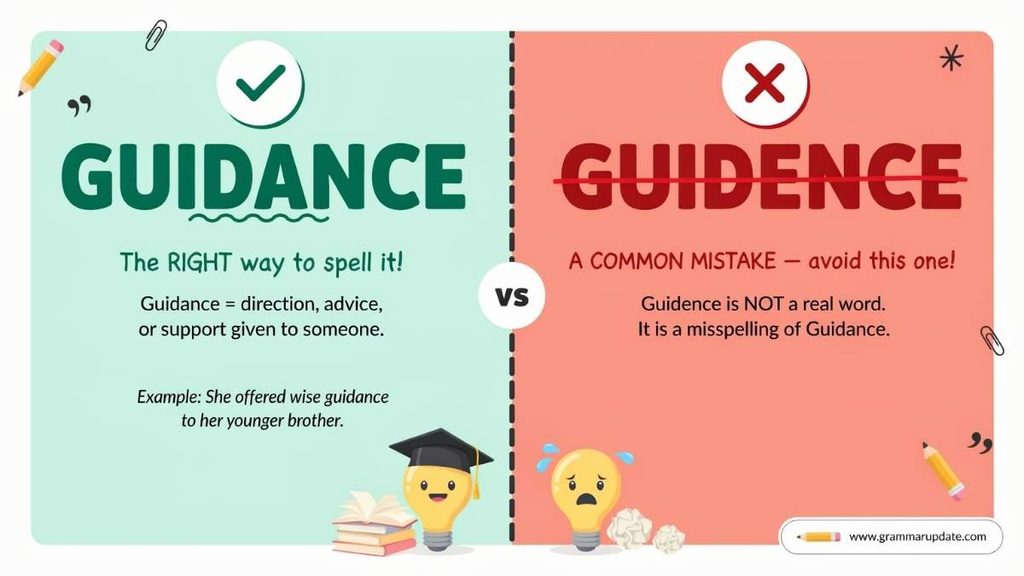
One useful way to remember the correct spelling is to connect guidance with the familiar word guide.
Both words begin with the same sequence of letters. Recognizing that relationship can help you recall the spelling more easily.
The Guide + ance Memory Trick
Think of the word this way:
Guide + ance = guidance
This is a spelling memory aid. It helps you remember the a in guidance rather than suggesting that every English noun follows the same word-formation pattern.
You can also connect guidance with advice and assistance. These words relate to the kind of help guidance provides, making the a a useful reminder.
A Quick Spelling Check
Before submitting your writing, ask yourself whether you’re referring to help, advice, or direction. If you are, check that you’ve written guidance with an a.
For example:
The mentor provided guidance throughout the training program.
Here, guidance refers to the support the mentor offered. The spelling is correct, and the noun fits naturally into the sentence.
Learn the difference between confusing word pairs
Exhilarate vs Exhilirate difference and usage?
Guidance Pronunciation and Spelling
Pronunciation and spelling are related, but they aren’t the same thing. Pronunciation tells you how a word sounds, while spelling tells you which letters to write.
In standard American English, guidance is commonly pronounced /ˈɡaɪ.dəns/. It has two syllables, with the stress on the first syllable.
The opening sound matches guide. However, the ending may not clearly tell you whether to write -ance or -ence. That uncertainty can contribute to the spelling mistake.
For this reason, relying on sound alone may not help you choose the correct form. Remember the established spelling: guidance.
Guidance as a Noun
Guidance is a noun. It names the help, advice, direction, or support that someone provides or receives.
It doesn’t normally function as a verb. When you want to describe the action of showing someone the way or helping them through a process, use guide instead.
Compare these examples:
The counselor offered guidance to the students.
The counselor guided the students through the application process.
In the first sentence, guidance names the help. In the second, guided describes the action.
How Guidance Works in a Sentence
Guidance can appear in different parts of a sentence.
As the object of a verb: We requested guidance from the instructor.
As the subject: Guidance from experienced professionals can help new employees.
After a preposition: She completed the assignment under the guidance of her supervisor.
Each example uses guidance as a noun. Its grammatical role changes depending on the sentence, but its spelling remains the same.
Learn the difference between confusing word pairs
Caught vs Cauhgt difference and usage?
Guidance in Different Contexts
The Guidance always involves help or direction, but its practical meaning can change according to the situation.
Guidance in Schools and Education
In education, guidance often refers to support that helps students make academic, personal, or career-related decisions.
Teachers may provide guidance on assignments, study methods, and classroom expectations. School counselors may help students consider courses, educational opportunities, or career paths.
For example:
The school counselor provided guidance on choosing subjects for the next academic year.
Guidance can also help students develop independent problem-solving skills. Instead of simply giving an answer, a teacher might ask questions, explain a concept, or demonstrate a method that helps the student understand what to do next.
Guidance in the Workplace
At work, guidance helps employees understand responsibilities, follow procedures, and develop professional skills.
A manager might explain how to complete a task. A mentor might share lessons from previous projects. A team leader might clarify expectations before a deadline.
For example, a new employee may receive guidance during onboarding. A supervisor might provide guidance on handling customer complaints. A team may also need clear guidance before starting the next phase of a project.
In these situations, guidance refers to workplace support rather than a physical guide or written manual.
Guidance in Personal Life
People often seek guidance when they face difficult choices or unfamiliar situations.
A trusted friend may offer a different perspective. A family member may share personal experience. A qualified counselor may help someone explore options relevant to their circumstances.
For example:
He sought guidance from his family before making the decision.
This sentence doesn’t suggest that his family made the decision for him. Instead, it explains that he asked for help while considering his options.
Guidance in Legal, Financial, and Professional Settings
In professional settings, guidance may involve explaining rules, procedures, options, or possible next steps.
For example:
The business requested guidance from a qualified adviser before changing its procedures.
When a matter involves legal rights, financial commitments, or other specialized concerns, it’s important to understand the kind of support being provided. General information isn’t necessarily the same as advice tailored to a person’s circumstances.
The word guidance describes the help being offered. It doesn’t automatically establish the provider’s qualifications or guarantee a particular result.
Learn the difference between confusing word pairs
Extreme vs Extreem difference and usage?
Guidance vs Advice
The Guidance and advice have related meanings, but they don’t always work in exactly the same way.
Guidance often suggests broader direction, support, or help over a period of time. Advice commonly refers to a recommendation about what someone should do.
| Feature | Guidance | Advice |
|---|---|---|
| Main meaning | Help, direction, or support | A recommendation or suggestion |
| Typical scope | May involve ongoing help | May focus on a particular decision |
| Common expressions | Seek guidance, provide guidance | Give advice, ask for advice |
| Example | The student received guidance throughout the semester. | The student received advice about which course to choose. |
The distinction isn’t absolute. Advice can be ongoing, and guidance can include specific recommendations.
For example, a career counselor might provide guidance over several meetings and offer advice about a particular job application. Both words can describe parts of the same conversation.
Guidance vs Guide
Although guidance and guide share a root, they have different grammatical roles.
Guide can function as a noun or a verb. As a noun, it can refer to a person or resource that shows someone the way. As a verb, it means to lead, direct, or help someone through a process.
Guidance is a noun that refers to the help or direction itself.
| Word | Part of speech | Example |
|---|---|---|
| Guide | Noun | The guide showed us around the museum. |
| Guide | Verb | The instructor will guide the trainees. |
| Guidance | Noun | The trainees received guidance from the instructor. |
A simple way to remember the difference is to think of a guide as someone or something that helps you, while guidance is the support or direction you receive.
Guidance vs Guidelines
Guidance and guidelines are closely related, especially in education and professional settings. However, they refer to different things.
Guidance means help, direction, or advice. Guidelines are principles, recommendations, or instructions that explain how to approach a task or situation.
For example, a manager might provide guidance on improving a report. The same manager might share guidelines for formatting it.
The first sentence focuses on help or direction. The second refers to specific recommendations about formatting.
A guideline is one recommended principle or instruction. Guidelines is its plural form.
Learn the difference between confusing more English words
Exceed vs Excede difference and usages?
Common Phrases With Guidance
Certain expressions appear frequently in everyday, academic, and professional writing. Learning them can make your word usage sound more natural.
| Phrase | Meaning | Example |
|---|---|---|
| Seek guidance | Ask for help or direction | You should seek guidance if the instructions aren’t clear. |
| Provide guidance | Give help or direction | The supervisor will provide guidance during training. |
| Offer guidance | Make help or advice available | Her mentor offered guidance throughout the project. |
| Under the guidance of | With someone’s direction or support | He learned the skill under the guidance of an expert. |
| Professional guidance | Help from someone in a professional role | They requested professional guidance before proceeding. |
| Expert guidance | Direction from someone with relevant expertise | The team benefited from expert guidance. |
| Career guidance | Help with career choices and development | Students attended a career guidance session. |
| Parental guidance | Direction or support from parents | Parental guidance can help children understand expectations. |
| Guidance and support | Help combined with encouragement or assistance | The organization provides guidance and support to its members. |
Each expression uses the correct spelling, guidance. Replacing it with guidence would introduce the same spelling error.
Learn the difference between confusing more English words
Grateful vs Greatful difference and Usage?
Common Grammar and Spelling Mistakes With Guidance
The most obvious mistake is writing guidence instead of guidance. However, writers can also misuse the word by treating it as a verb or making it plural unnecessarily.
Writing Guidence Instead of Guidance
This is the central issue in the guidance vs guidence spelling comparison.
Incorrect: The student asked for guidence before the examination.
Correct: The student asked for guidance before the examination.
The correction requires changing the e to an a. The intended meaning stays the same.
Using Guidance as a Verb
Because guidance describes direction, a writer might mistakenly use it to describe the act of directing someone.
Incorrect: The instructor will guidance the new employees.
Correct: The instructor will guide the new employees.
Use guide for the action and guidance for the help or direction provided.
Incorrectly Making Guidance Plural
In ordinary English, guidance is generally an uncountable noun. Writers don’t normally add s to make it plural when referring to help or advice.
Awkward in ordinary usage: The employee received several guidances from the manager.
More natural: The employee received several pieces of guidance from the manager.
You can count individual recommendations, suggestions, or instructions, but the noun guidance usually remains unchanged.
Using Guidence in Formal Writing
A spelling error can distract readers in a report, application, academic paper, or professional email.
Incorrect: We would appreciate your guidence regarding the proposed changes.
Correct: We would appreciate your guidance regarding the proposed changes.
The corrected sentence follows standard English spelling and maintains a professional tone.
Is Guidance Countable or Uncountable?
Guidance is generally an uncountable noun when it refers to help, direction, or advice.
You can write, “I need some guidance,” “She received a little guidance from her supervisor,” or “We appreciate your guidance and support.”
However, you wouldn’t normally say one guidance or three guidances to count separate pieces of help.
When you need to refer to individual items, use a suitable counting expression.
| Less natural or incorrect in ordinary usage | More natural expression |
|---|---|
| Three guidances | Three pieces of guidance |
| A guidance | A piece of guidance |
| Several guidances | Several recommendations |
| Two guidances from the teacher | Two suggestions from the teacher |
This grammar point is separate from the spelling issue. Even when you spell guidance correctly, you still need to use it in a grammatically natural way.
Correct and Incorrect Guidance Examples
Seeing the word in context makes the spelling rule easier to remember. These examples show how the correct form works in different situations.
Correct Examples
The teacher offered guidance to students who needed extra help.
I asked my manager for guidance before making the presentation.
Under her guidance, the team completed the project on time.
The school provides career guidance to graduating students.
We appreciate your guidance throughout the application process.
The new employees received guidance during their first week.
He sought guidance from an experienced professional.
Clear guidance can help people understand complicated instructions.
The organization offers guidance and support to its members.
She followed the guidebook for practical guidance during her trip.
Each sentence uses guidance as a noun referring to help, direction, advice, or support.
Incorrect Examples
| Incorrect sentence | Correct sentence |
|---|---|
| I need your guidence with this assignment. | I need your guidance with this assignment. |
| The teacher gave us guidence before the test. | The teacher gave us guidance before the test. |
| My supervisor will guidance me through the process. | My supervisor will guide me through the process. |
| She received three guidances from her mentor. | She received three pieces of guidance from her mentor. |
| We are grateful for your guidence and support. | We are grateful for your guidance and support. |
The first, second, and fifth examples contain the incorrect spelling. The third uses a noun where a verb should appear. The fourth uses an unnatural plural form.
Guidance in a Sentence More Everyday Examples
These sentence examples demonstrate how guidance fits into natural communication.
In School
My teacher gave me guidance on how to improve my writing.
The noun refers to the help the teacher provided.
At Work
The team needs guidance before moving forward with the project.
Here, guidance means direction or clarification about the next steps.
In Personal Communication
I asked my older brother for guidance because I wasn’t sure what to do.
The sentence describes seeking advice or support from someone trusted.
In Formal Writing
We respectfully request your guidance regarding the proposed changes.
This expression is suitable for a professional email or formal request.
In a Short Conversation
Thanks for your guidance. It really helped me understand the problem.
This example shows how the word works in informal communication.
Mini Case Study: Correcting a Workplace Email
Imagine an employee drafting this message:
Dear Ms. Carter, I would appreciate your guidence on preparing the quarterly report.
The meaning is clear, but the spelling needs correction.
The polished version reads:
Dear Ms. Carter, I would appreciate your guidance on preparing the quarterly report.
Only one letter changes, yet the corrected version follows standard English spelling and looks more professional.
The lesson is simple: proofreading even a short email can help you catch small errors before they reach the reader.
Synonyms for Guidance
Several words can replace guidance in suitable contexts. However, no synonym fits every sentence perfectly. Choose one that matches the kind of help you mean.
| Synonym | Meaning | Example |
|---|---|---|
| Advice | A recommendation about what to do | I asked my teacher for advice. |
| Direction | Instructions or help showing what path to take | The supervisor gave us direction. |
| Assistance | Help with a task or need | The student received assistance with the assignment. |
| Support | Help, encouragement, or backing | Her family provided support during the transition. |
| Counseling | Help involving discussion, advice, or professional support | The school offers career counseling. |
| Instruction | Information explaining how to do something | The trainer provided instruction on using the equipment. |
| Mentoring | Support and development provided by a mentor | The employee benefited from mentoring. |
| Recommendations | Suggestions about a suitable course of action | The adviser shared several recommendations. |
For example, instruction may fit better when someone explains a procedure, while support may be more suitable when the emphasis is on encouragement or continued help.
Learn the difference between confusing more English words
Beginning vs Beggining difference and usage?
Antonyms and Opposite Ideas of Guidance
There isn’t one perfect opposite for guidance in every context. The best contrasting word depends on what kind of help or direction is missing.
Misguidance means advice or direction that leads someone toward an incorrect understanding or action. Misdirection means direction that leads someone away from the intended path or objective. Confusion describes a state in which someone lacks clarity or understanding. Neglect means a failure to provide needed care, attention, or support.
For example, if someone receives misleading instructions, misguidance may describe the situation. If someone receives no help when they need it, lack of guidance is often the clearest expression.
These words describe different problems. They aren’t interchangeable antonyms in every sentence.
Word History and Origin of Guidance
The word guidance comes from guide, a word associated with leading, directing, or showing someone the way. Its development reflects the idea of helping a person move toward a destination, goal, or understanding.
The ending -ance appears in many English nouns that describe a state, process, or action. In guidance, it helps form a noun connected with guiding.
This relationship also explains why guide and guidance look similar but serve different grammatical purposes. Guide can refer to a person or thing that leads someone, or it can describe the act of leading. Guidance refers to the help, direction, or support someone receives.
The spelling guidance preserves the a in its established form. The alternative guidence doesn’t represent a separate standard spelling of this noun.
Learn the difference between confusing more English words
Hierarchy vs Heirarchy difference and usage?
Practice Session Guidance vs Guidence
Fill in each blank with the correct word: Guidance vs Guidence
- The teacher gave us useful ______ before the exam.
- I need some ______ on how to start this project.
- Her parents provided valuable ______ during her studies.
- The career counselor offered professional ______ to the students.
- Without proper ______, the task can become confusing.
- The manager gave me clear ______ about my new responsibilities.
- You should seek expert ______ before making an important decision.
- The website provides ______ for new users.
- His mentor offered helpful ______ throughout his career.
- We followed the instructions under the ______ of an experienced engineer.
- The student asked for ______ about choosing a college major.
- Good ______ can help you avoid common mistakes.
- The doctor provided ______ about maintaining a healthy lifestyle.
- The company offers financial ______ to new employees.
- She completed the training with the ______ of her supervisor.
- Parents often provide ______ when their children face difficult choices.
- The coach gave the team valuable ______ before the competition.
- I contacted an expert for ______ on the technical problem.
- The handbook contains useful ______ for employees.
- The counselor gave him practical ______ about his career options.
- With proper ______, you can improve your writing skills.
- The instructor provided step-by-step ______ during the lesson.
- We need professional ______ before changing the system.
- Her experience and ______ helped the team solve the problem.
- The program gives students academic ______ throughout the year.
Answers
- guidance
- guidance
- guidance
- guidance
- guidance
- guidance
- guidance
- guidance
- guidance
- guidance
- guidance
- guidance
- guidance
- guidance
- guidance
- guidance
- guidance
- guidance
- guidance
- guidance
- guidance
- guidance
- guidance
- guidance
- guidance
Here’s a trusted source for clear word meanings:
FAQs
Is it guidence vs guidance?
Guidance is the correct spelling. Guidence is a common misspelling. Use guidance when you mean advice, direction, or help with a decision.
What does guidance mean?
Guidance means advice, direction, or support that helps someone decide what to do or how to proceed. For example, “My teacher gave me guidance on the assignment.”
Is guidance spelled correctly?
Yes. Guidance is the correct spelling. It contains “-ance,” not “-ence”: G-U-I-D-A-N-C-E.
What does gaudance mean?
Gaudance is not a standard English word. It is usually a misspelling of guidance, which means advice, direction, or support.
What is the difference between guidance and guide?
Guidance is the advice or direction someone receives. A guide is a person, document, or resource that provides direction. For example, “The guide offered guidance during the tour.”
What is the plural form of guidance?
Guidance is generally an uncountable noun, so it does not usually have a plural form. Use “some guidance” or “pieces of guidance” rather than “guidances” in everyday writing.
What is a good sentence for guidance?
“The counselor provided helpful guidance as I considered my career options.” In this sentence, guidance means advice and support.
What is the opposite of guidance?
The opposite depends on the context. Misdirection can mean leading someone the wrong way, while a lack of guidance means not receiving the advice or support you need.
What is another word for lack of guidance?
You can say “absence of direction,” “insufficient support,” or “lack of advice.” Choose the phrase that best describes what is missing, whether it is instructions, expert advice, or personal support.
What are some synonyms for guidance?
Common synonyms include advice, direction, counsel, assistance, support, instruction, and help. The most suitable choice depends on the situation.
What is a stronger word for guidance?
Mentorship, expert counsel, or strategic direction may express a more specific kind of guidance. For example, mentorship often involves ongoing advice and support from someone with experience.
What is the meaning of guidance in one word?
Advice is a useful one-word meaning of guidance. Direction may be more suitable when the focus is on showing someone what to do or where to go.
What does “under your guidance” mean?
“Under your guidance” means with your advice, direction, or supervision. For example, “Under your guidance, I learned how to manage the project.”
What is another way to say “provide guidance”?
You can say “offer advice,” “give direction,” “provide support,” “share expertise,” or “mentor someone.” Choose the expression that fits the type of help you are offering.
What is an adjective for guidance?
Guidance is a noun. The adjective “guiding” appears in phrases such as “a guiding principle” and “a guiding influence.” “Guided” can describe someone or something receiving direction, as in “a guided activity.”
conclsion
The confusion between guidance vs guidence is easy to clear up once you remember one simple point: guidance is the correct spelling, while guidence is a misspelling. When you’re comparing Guidance vs guidence, remember that the correct word ends with “-ance,” not “-ence.” The word guidance contains “-ance” at the end, so there’s no extra “e” after the d. This small spelling detail can make a big difference in your writing.
You’ll use guidance when you mean advice, direction, help, or support from someone. For example, a teacher can give you guidance on an assignment, while a mentor can provide guidance throughout your career. If you’re still unsure about Guidance vs guidence, remember that the correct form is always guidance. Once you learn this simple spelling pattern, you won’t have to second-guess yourself every time you type it.
So, when you’re choosing between guidance vs guidence, let the correct spelling point you in the right direction: guidance is the word to use. If Guidance vs guidence appears in your writing, choose guidance confidently and leave guidence behind.

Jhon AJS, the creative mind behind Grammar Update, is an experienced blogger passionate about simplifying English grammar. He focuses on explaining confusing word vs word differences, grammar rules, punctuation, and sentence structure in a clear and practical way. Through easy to understand guides and examples, Jhon helps readers improve their writing and communicate with confidence. With years of blogging experience, he continues to share helpful insights that make learning grammar simple, useful, and accessible for everyone.