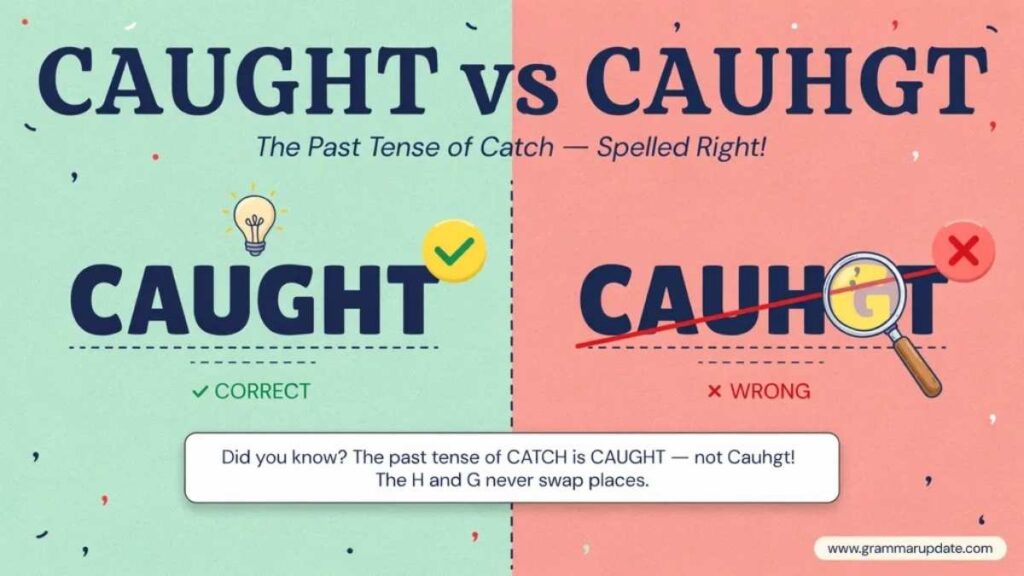
Caught vs cauhgt may look like a small spelling issue, but only one spelling is correct. Caught is the standard English spelling, while cauhgt is simply a common mistake caused by putting the letters in the wrong order. The confusion in caught vs cauhgt is understandable because caught does not sound exactly as it looks. However, once you remember the correct spelling, it becomes much easier to use. In this guide, you will learn what caught means, how to use it correctly, and why cauhgt is incorrect. With simple explanations and clear examples, you will quickly understand the difference and avoid this spelling mistake in your writing.
quick answer
Caught is the correct spelling. Cauhgt is incorrect and should not be used in standard English.
The difference comes down to the order of the letters. The correct spelling is c-a-u-g-h-t. In cauhgt, the letters are rearranged, which creates a spelling error rather than a different English word.
Here is the basic comparison:
| Spelling | Correct? | Meaning |
|---|---|---|
| Caught | Yes | Past tense and past participle of catch |
| Cauhgt | No | Misspelling of caught |
The simplest way to remember it is to focus on the sequence “aught” at the end of caught. Once that pattern becomes familiar, the incorrect spelling cauhgt becomes much easier to spot.
Learn the difference between confusing more English words
Exhilarate vs Exhilirate difference and usage?
What Does Caught Mean?
Caught is the past tense and past participle of catch. Its exact meaning depends on how you use it in a sentence.
The word can describe physically taking hold of something, stopping or finding someone, noticing an action, reaching transportation, becoming sick, or understanding something.
For example:
She caught the ball.
In this sentence, caught means that she successfully took hold of the ball.
Consider another example:
The police caught the thief.
Here, caught means that the police found and stopped the thief.
The word can also have a less literal meaning:
I caught a cold last week.
In this sentence, caught means became sick with a cold.
Caught can also describe successfully getting transportation:
We caught the last train home.
It can even mean noticing or discovering something:
She caught him looking at her phone.
As these examples show, the caught meaning changes slightly with the context, but the spelling always stays the same.
Caught as the Past Tense of Catch
Caught is the past tense of catch. Catch is an irregular verb, so you cannot form its past tense by simply adding -ed.
Regular verbs usually follow a predictable pattern. For example, walk becomes walked and clean becomes cleaned. Catch does not follow that pattern.
The three main forms are:
| Verb form | Word | Example |
|---|---|---|
| Base form | Catch | I catch the ball. |
| Past tense | Caught | I caught the ball. |
| Past participle | Caught | I have caught the ball. |
This gives you the pattern:
catch → caught → caught
Learning the three forms together is one of the easiest ways to remember the correct spelling and grammar.
Learn the difference between confusing more English words
Atheist Vs Athiest Which Spelling Is Correct?
What Is the Past Tense of Catch?
The past tense of catch is caught.
If you are asking, “What is the past tense of catch?” the answer is simply caught.
For example:
I catch the bus every morning.
I caught the bus yesterday.
The first sentence describes a regular action. The second describes something that already happened.
Here are a few more examples:
She caught the ball.
He caught the mistake before anyone noticed it.
We caught the train just in time.
The goalkeeper caught the ball.
In each sentence, caught describes an action that happened in the past.
What Is the Past Participle of Catch?
The past participle of catch is also caught.
That may seem confusing at first, but many irregular verbs have forms that work in different grammatical structures. With catch, the past tense and past participle are exactly the same.
For example:
She caught the ball.
She has caught the ball.
They caught the bus.
They have caught the bus.
In the first sentence of each pair, caught works as the simple past tense. In the second, caught works as the past participle after a helping verb such as has or have.
This is why the pattern catch caught caught is worth remembering.
Learn the difference between confusing more English words
Disappoint vs Disapoint difference and usage?
Catch Caught Caught The Three Forms
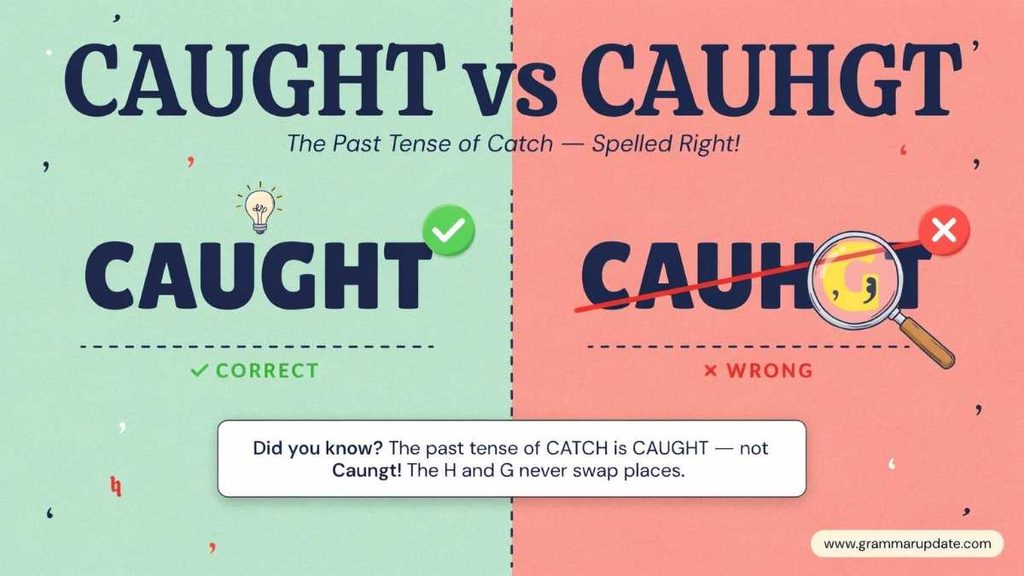
The verb catch has three main forms:
catch, caught, caught.
The first form is the base form. The second is the past tense. The third is the past participle.
For example:
1.I catch the bus every day.
2.I caught the bus yesterday.
3.I have caught the bus several times this week.
The word caught looks exactly the same in the past tense and past participle. The surrounding sentence tells you which grammatical role it has.
This pattern also answers common questions about catch verb forms, catch conjugation, and the correct form of catch.
Why Is Caught Not Cauhgt?
The main reason people write cauhgt is that caught has an unusual letter sequence.
The correct spelling is:
caught
The incorrect version is:
cauhgt
The problem is the order of the letters. In caught, the g comes before the h. In cauhgt, those letters appear in the wrong order.
Pronunciation does not always make this easier. English spelling often contains combinations that do not sound exactly the way they look. Caught is a good example.
For that reason, trying to spell the word entirely by sound can lead to mistakes. It is better to remember the written pattern.
Learn the difference between confusing more English words
Believe Vs Belive Which one Is Correct?
Why Do People Misspell Caught?
Several things can make caught easy to misspell.
First, the word does not look exactly like the way it sounds. That can make it difficult to reconstruct the spelling from pronunciation alone.
Second, the letters g and h can easily be placed in the wrong order when typing quickly.
Third, the spelling pattern is less predictable than the patterns in many common English words.
For example, someone may know that catch becomes caught but still type cauhgt without noticing the mistake. A quick proofread usually catches it.
The best solution is simple: memorize caught as a complete word rather than trying to build it letter by letter.
Caught vs Cauhgt Grammar
From a grammar perspective, caught is the correct form. Cauhgt is not a different grammatical form of catch.
Catch is an irregular verb. Its standard forms are catch, caught, and caught.
The base form appears in the present tense:
I catch the bus every morning.
The past tense appears when the action happened in the past:
I caught the bus yesterday.
The past participle appears with helping verbs:
I have caught the bus every day this week.
The important point is that cauhgt does not belong anywhere in this pattern.
The correct form of catch is always based on the context, but when you need the past tense or past participle, the answer is caught.
Learn the difference between confusing word pairs
Definite vs Definitive difference and usage?
When Should You Use Caught?
Use caught when you are talking about an action involving catch that happened in the past or when the sentence requires the past participle.
For example:
She caught the ball.
He caught the thief.
We caught the train.
I caught a cold.
The camera caught the entire incident.
They have caught the mistake.
The exact meaning changes with the sentence, but the grammatical form remains caught.
Common Uses of Caught
Caught appears in many everyday situations, which makes it an important word in English vocabulary.
You can catch an object:
She caught the ball.
You can catch a person:
The police caught the suspect.
You can catch transportation:
We caught the early train.
You can catch an illness:
He caught a cold.
You can catch someone’s attention:
The bright advertisement caught my attention.
You can catch someone doing something:
She caught him reading her messages.
You can catch a mistake:
The editor caught the error before publication.
You can also catch what someone says:
Sorry, I did not catch that.
These different uses show why caught is such a common word in both spoken English and written English.
Caught vs Catch
Caught and catch are forms of the same verb, but they do not work in exactly the same situations.
Catch is the base form. Caught is the past tense and past participle.
Compare these sentences:
I catch the bus every morning.
I caught the bus yesterday.
The first sentence describes a regular present action. The second describes a completed action in the past.
Another comparison makes the difference even clearer:
She catches the ball easily.
She caught the ball easily.
Catches describes a present or regular action. Caught describes an action that already happened.
Understanding this difference will help you use the correct form without relying on guesswork.
Learn the difference between confusing word pairs
Conscious vs Conscience Difference and which is correct?
Caught Pronunciation and Spelling
Caught can be tricky because pronunciation does not provide a perfect guide to its spelling.
The pronunciation of caught can also vary somewhat between regional accents. American English and British English speakers may pronounce the vowel differently depending on their accent.
However, the standard spelling remains the same:
caught
This is an important lesson in English spelling. A word may sound different from what you expect while still having one standard written form.
Instead of trying to spell caught from its sound, remember the written pattern c-a-u-g-h-t.
Common Mistakes With Caught
One of the most common mistakes is writing cauhgt instead of caught.
For example:
She cauhgt the ball.
The correct sentence is:
She caught the ball.
Another mistake is using catch when the sentence clearly describes a completed past action.
For example:
Yesterday, I catch the bus.
The correct version is:
Yesterday, I caught the bus.
A third mistake involves treating catch like a regular verb and adding -ed.
He catched the ball.
The correct form is:
He caught the ball.
These mistakes come from different sources, but the solution is the same: remember that catch is an irregular verb.
Learn the difference between confusing word pairs
Category vs Catagory Which one Is Correct?
How to Remember the Correct Spelling of Caught
A simple memory trick can make the spelling much easier.
Remember the ending:
aught
The correct word is:
caught
You can also connect the spelling to other familiar words such as taught and bought. These words have similar letter patterns even though their meanings and pronunciations differ.
Another useful method is to memorize the complete verb pattern:
catch → caught → caught
Do not think of caught as catch plus an ending. Treat caught as its own spelling.
That small change in how you remember the word can prevent the common cauhgt mistake.
Caught in Common Expressions
The Caught appears in several common English expressions.
Caught red-handed means someone was discovered while doing something wrong.
The student was caught red-handed cheating on the test.
Caught off guard means someone was surprised or unprepared.
The unexpected question caught me off guard.
Caught by surprise means something happened unexpectedly.
The sudden announcement caught everyone by surprise.
Caught in the act means someone was discovered while doing something.
The camera caught him in the act.
Caught up in something can mean becoming deeply involved in an event or situation.
She got caught up in the excitement.
These expressions are common in everyday English, so recognizing caught in different contexts can improve both reading and speaking skills.
Learn the difference between confusing word pairs
Daiquiri Vs Dacquiri Which one Is Correct?
Caught Sentence Examples
The following caught sentence examples show how the word works in different situations.
| Sentence | Meaning |
|---|---|
| She caught the ball. | She took hold of the ball. |
| He caught the thief. | He found and stopped the thief. |
| We caught the bus. | We successfully boarded the bus. |
| I caught a cold. | I became sick. |
| The headline caught my attention. | The headline attracted my attention. |
| Mom caught me eating cookies. | Mom discovered me doing something. |
| The editor caught the mistake. | The editor noticed the error. |
| I caught what you said. | I heard or understood you. |
These examples also show why the definition of caught depends on context.
Caught vs Cauhgt A Simple Comparison
| Feature | Caught | Cauhgt |
|---|---|---|
| Standard spelling | Yes | No |
| English word | Yes | No in standard modern English |
| Related verb | Catch | Catch |
| Past tense | Yes | No |
| Past participle | Yes | No |
| Correct usage | Yes | No |
| Example | She caught the ball. | She cauhgt the ball. |
The choice is straightforward. Use caught.
Learn the difference between confusing word pairs
Controversy vs Contraversy which one is correct?
Is Cauhgt a Word?
Cauhgt is not a standard English word. It is a misspelling of caught.
If you see cauhgt in a text, the writer most likely intended to write caught.
For example:
Incorrect: He cauhgt the ball.
Correct: He caught the ball.
The spelling error does not create a new meaning. It simply changes the letters in the correct word.
Is Caught the Correct Spelling?
Yes. Caught is the correct spelling.
It is the standard past tense and past participle of catch in modern English.
If you are writing an email, school assignment, article, report, or social media post, use caught.
The incorrect form cauhgt should be corrected.
Learn the difference between basic English word mistakes
Becoming vs Becomeing Which one Is Correct?
Practice Session Caught vs Cauhgt
Fill in each blank with the correct word: Caught vs Cauhgt.
- The police ______ the thief near the station.
- She ______ the ball with one hand.
- I ______ a cold after walking in the rain.
- He was ______ cheating during the exam.
- The goalkeeper ______ the ball just before it crossed the line.
- We ______ the last bus home.
- The fisherman ______ a large fish this morning.
- I ______ him looking through my bag.
- She ______ her dress on the door handle.
- The teacher ______ the student using his phone in class.
- He ______ the flu from his younger brother.
- They ______ a glimpse of the famous actor.
- The dog ______ the ball in its mouth.
- I ______ myself thinking about the problem again.
- The firefighters ______ the escaping animal.
- She ______ the keys before they fell to the ground.
- We ______ the train just in time.
- He ______ his finger in the door.
- The camera ______ the entire incident.
- The child ______ the butterfly carefully.
- She ______ a mistake in the report.
- The security guard ______ the intruder on camera.
- I ______ sight of my friend in the crowd.
- He ______ the ball while playing soccer.
- The students were ______ talking during the test.
Answers
- caught
- caught
- caught
- caught
- caught
- caught
- caught
- caught
- caught
- caught
- caught
- caught
- caught
- caught
- caught
- caught
- caught
- caught
- caught
- caught
- caught
- caught
- caught
- caught
- caught
Here’s a trusted source for clear word meanings:
FAQs
What is the correct spelling, caught vs cauhgt?
Caught is the correct spelling. Cauhgt is a misspelling and should not be used in standard English.
Is cauhgt a word in English?
No. Cauhgt is not a standard English word. It is simply a spelling error for caught.
Why is cauhgt an easy spelling mistake to make?
The spelling of caught can be tricky because the letters do not match its pronunciation very closely. When writing quickly, it is easy to put the letters in the wrong order.
How can I remember how to spell caught?
Focus on the letter pattern c-a-u-g-h-t. Remembering the “augh” sequence can make the correct spelling easier to recognize and write.
Can I use cauhgt in formal writing?
No. Cauhgt should be corrected to caught in formal writing, school assignments, professional documents, and other standard English contexts.
What does caught mean?
Caught is the past tense and past participle of catch. It can mean grabbed, stopped, trapped, noticed, or reached something in time, depending on the sentence.
What are the verb forms of catch?
The main forms are catch, caught, and caught. Catch is the base form, while caught is used for both the past tense and past participle.
Is caught the past tense of catch?
Yes. Caught is the simple past tense of catch. For example, “She caught the ball” describes an action that happened in the past.
Is caught also a past participle?
Yes. Caught works as both the simple past tense and past participle of catch. For example, “He has caught the bus” uses caught as a past participle.
Can caught describe a person?
Yes. Caught can describe someone who has been stopped, trapped, or discovered doing something. For example, “The student was caught cheating.”
Can caught have different meanings?
Yes. Its meaning changes with the context. You can catch a ball, catch a bus, catch a cold, catch someone’s attention, or catch someone making a mistake.
What is a simple sentence with caught?
“She caught the ball before it reached the ground” is a simple example of how caught is used in a sentence.
Is caught used in American English?
Yes. Caught is standard in American English and is also widely used in British English. The spelling does not change between these varieties.
Can caught follow a helping verb?
Yes. Caught can follow helping verbs such as has, have, and had. For example, “She has caught the train” uses caught correctly as a past participle.
Why does caught contain “gh”?
The spelling of caught comes from its historical development in English. The “gh” remains part of the standard spelling even though it does not represent a separate sound in modern pronunciation.
Learn the difference between basic English word mistakes
Acquire Vs Aquire Which one Is Correct?
conclusion
The confusion between caught vs cauhgt is actually simple to clear up. Caught vs cauhgt has one clear winner: caught is the correct spelling, while cauhgt is a common spelling mistake. Caught is the past tense and past participle of catch, so you use it when talking about something that happened in the past or has already happened. If you ever hesitate with caught vs cauhgt, remember the correct letter order: c-a-u-g-h-t. Once you get used to it, caught becomes easy to recognize, write, and use correctly. Cauhgt, on the other hand, can safely stay out of your sentences.

Jhon AJS, the creative mind behind Grammar Update, is an experienced blogger passionate about simplifying English grammar. He focuses on explaining confusing word vs word differences, grammar rules, punctuation, and sentence structure in a clear and practical way. Through easy to understand guides and examples, Jhon helps readers improve their writing and communicate with confidence. With years of blogging experience, he continues to share helpful insights that make learning grammar simple, useful, and accessible for everyone.