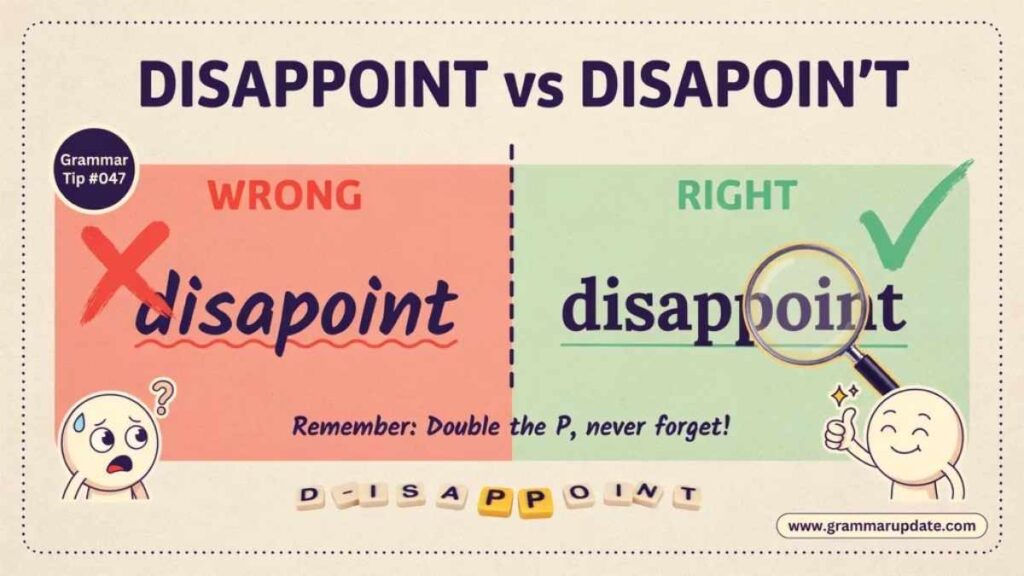
English spelling can be tricky, even when the difference is just one tiny letter. The confusion around disappoint vs disapoint is a perfect example. Both spellings look similar, but only disappoint is correct. Disapoint is a common spelling mistake, while dissapoint is another incorrect version you may see. The good news is that this confusion is easy to clear up. Disappoint has one s and two p’s, and remembering that small detail can save you from a common error. In this guide, we’ll explain the meaning, pronunciation, spelling, and correct use of disappoint so you can use the word with confidence in everyday English.
Quick Answer
If you’re wondering whether to write disapoint or disappoint, choose disappoint. It is the correct spelling in standard English.
| Word | Correct? | Meaning | Example |
|---|---|---|---|
| disappoint | Yes | To fail to meet someone’s expectations or hopes | I don’t want to disappoint my parents. |
| disapoint | No | A misspelling of disappoint | Please don’t disapoint me. |
| dissapoint | No | A misspelling of disappoint | I don’t want to dissapoint you. |
The correct spelling is disappoint.
It contains one s and two p’s:
d-i-s-a-p-p-o-i-n-t
A useful way to remember it is dis + appoint = disappoint.
The word appoint already contains two p’s. When you add dis- to the beginning, those two p’s remain.
Learn the difference between confusing more English words
Unpure vs Impure Which one Is Correct?
Disappoint vs Dissapoint Which Spelling Is Correct?
The comparison between disappoint vs dissapoint creates a slightly different spelling problem.
Disappoint is correct.
Dissapoint is incorrect.
The extra s in dissapoint probably comes from the way some writers expect words beginning with dis- to develop. However, standard English doesn’t spell this word with diss-.
For example, these three forms are easy to compare:
Disappoint is correct.
Disapoint is incorrect.
Dissapoint is incorrect.
If you’re searching for dissapoint or disappoint, there isn’t a difference in meaning to learn. Only disappoint is the standard English word.
Is Disappoint Correct?
Yes, disappoint is correct.
If you’ve searched is disappoint correct, the answer is definitely yes. Disappoint is a standard English verb that appears in everyday conversations, professional writing, academic work, news articles, books, and many other types of English.
For example:
The team’s poor performance disappointed its fans.
Here, disappointed is the past-tense form of disappoint.
Another example is:
I don’t want to disappoint my family.
In this sentence, disappoint functions as the main verb.
What Does Disappoint Mean?
The disappoint meaning is closely connected to expectations.
To disappoint someone means to fail to give that person something they expected, hoped for, or wanted. In simple terms, it means to let someone down or fail to meet expectations.
A clear disappoint definition is to cause someone to feel unhappy because something didn’t happen as expected or hoped.
For example:
The canceled concert disappointed thousands of fans.
The fans expected the concert to happen. When the event was canceled, their expectations were not met. That situation caused disappointment.
The word can also describe ordinary situations that aren’t especially serious.
For example:
The restaurant’s food disappointed us.
I don’t want to disappoint my teacher.
The final episode disappointed many viewers.
She felt that she had disappointed her family.
In each example, something fails to match an expectation.
Disappoint Meaning in English
If you’re looking for disappoint meaning in English, think about three related ideas: failing to meet expectations, letting someone down, and causing disappointment.
For example:
The late delivery disappointed me.
The speaker expected the package to arrive on time. When it arrived late, the result didn’t match that expectation.
The feeling doesn’t always have to be dramatic. Disappoint can describe a small frustration, a missed opportunity, or a major emotional letdown. Context determines how strong the feeling is.
Learn the difference between confusing more English words
Envisage vs Envision difference and usage?
Disappoint as a Verb
Disappoint is a verb because it describes an action or result that causes someone to feel let down.
It commonly takes an object when you say that one person or thing disappoints another person.
For example:
The decision disappointed the employees.
In this sentence, the decision is the subject, disappointed is the verb, and the employees are the object.
The verb also appears frequently with pronouns.
Don’t disappoint me.
I don’t want to disappoint you.
She never wants to disappoint her parents.
These structures are common in everyday English, which is why phrases such as disappoint me and disappoint you appear so often.
Disappoint You Meaning
The disappoint you meaning is to let you down or fail to meet your expectations.
For example:
I promise I won’t disappoint you.
The speaker means that they won’t let the other person down.
The phrase can sound serious or casual depending on the situation. A parent might say it seriously to a child, while two friends might use it jokingly when choosing a movie or restaurant.
Disappoint Me Meaning
The disappoint me meaning follows the same basic idea.
For example:
Please don’t disappoint me.
This means please don’t let me down or fail to meet my expectations.
Again, the situation determines the emotional weight of the expression.
Learn the difference between confusing more English words
Acquaintance Vs Acquaintence Which one Is Correct?
Disappoint Spelling Why Does It Have Two P’s?
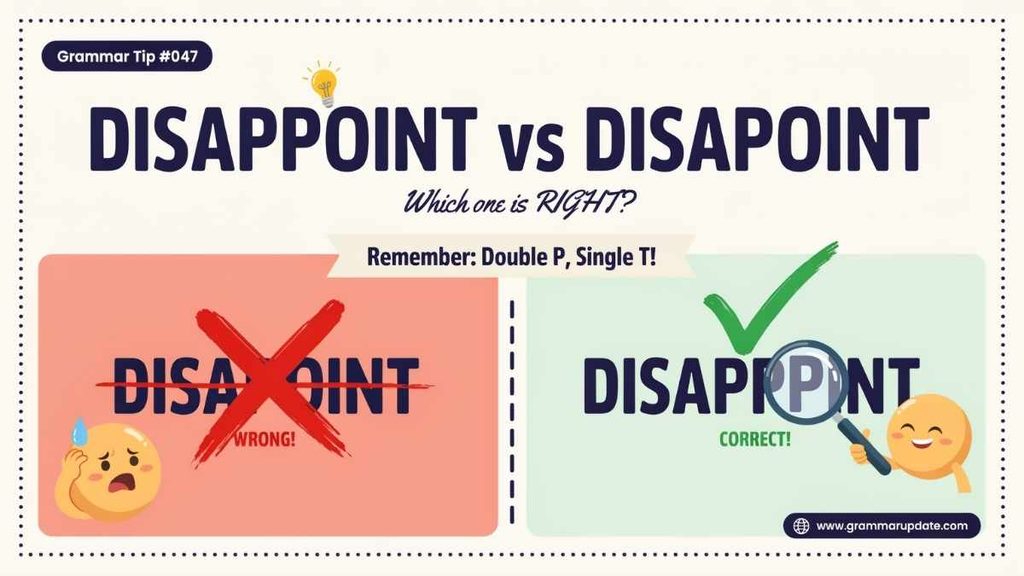
The easiest clue for remembering the disappoint spelling is the word appoint.
Look at the word:
appoint
Now add dis-:
disappoint
This gives you the useful pattern:
dis + appoint = disappoint
The connection with appoint makes the double p much easier to remember.
The misspelling disapoint happens when writers leave out one of those p’s. The error is understandable because the pronunciation doesn’t strongly highlight the two letters.
However, the spelling remains disappoint.
A simple way to remember it is to think of appoint whenever you’re unsure.
How to Spell Disappoint Correctly
If you’re searching for how do you spell disappoint, the answer is:
D-I-S-A-P-P-O-I-N-T
The word begins with dis, contains appoint, and ends with oint.
The most important part to remember is the double p.
Disappoint is correct.
Disapoint is incorrect.
Dissapoint is incorrect.
If you’re asking how do you spell disappoint correctly, think of the word as two parts: dis + appoint.
That small trick is usually enough to prevent the most common spelling error.
Disappoint Correct Spelling and Common Misspellings
The disappoint correct spelling becomes easier to recognize when you compare it with the forms that commonly appear by mistake.
| Spelling | Status | Explanation |
|---|---|---|
| disappoint | Correct | Standard English spelling |
| disapoint | Incorrect | One p is missing |
| dissapoint | Incorrect | An extra s appears and the spelling of appoint is altered |
| disappointed | Correct | Past-tense and past-participle form |
| disappointing | Correct | Present participle and adjective |
| disappointment | Correct | Noun form |
There is no standard disapoint correct spelling because disapoint itself is not a separate English word.
The same applies to dissapoint correct spelling. Dissapoint is simply another misspelling of disappoint.
Learn the difference between commonly mixed-up more words
Acceptable Vs Aceptable Which one Is Correct?
Why Do People Write Disapoint?
The misspelling of disappoint usually comes from a combination of pronunciation, memory, and fast typing.
When people hear the word spoken naturally, the two p’s aren’t pronounced as two clearly separated sounds. Someone may therefore remember the general sound without remembering the exact spelling.
Typing quickly can make the problem worse. When a familiar word contains double letters, it’s easy to skip one without noticing.
English also contains many words with confusing double-letter patterns. Words such as accommodation, necessary, committee, and opportunity can cause similar problems.
The important thing is to recognize the pattern instead of trying to spell the word entirely from its sound.
For disappoint, the most useful pattern is appoint.
Disappoint Pronunciation
The standard disappoint pronunciation in US English is approximately /ˌdɪsəˈpɔɪnt/.
The word has three syllables, with the main stress on the final syllable.
Pronunciation explains part of the spelling confusion. Although the written word contains two p’s, you don’t hear two separate, strongly emphasized p sounds.
That makes it possible to know exactly how to say the word while still hesitating over how to write it.
This is an important difference between pronunciation and spelling. Pronunciation tells you how a word sounds. Spelling tells you how that word appears in writing.
For disappoint, remembering the visual connection with appoint is more useful than trying to spell the word entirely by sound.
Learn the difference between commonly mixed-up more words
Acknowledge Vs Acknowlege Which one Is Correct?
Common Forms of Disappoint
The disappoint word has several related forms that appear frequently in English.
| Form | Use | Example |
|---|---|---|
| disappoint | Base verb | I don’t want to disappoint you. |
| disappoints | Present-tense verb | The result disappoints many people. |
| disappointed | Past tense or adjective | The fans were disappointed. |
| disappointing | Present participle or adjective | The result was disappointing. |
| disappointment | Noun | The loss was a major disappointment. |
Learning these forms together can make English grammar and spelling easier.
For example:
I don’t want to disappoint my family.
The decision disappoints many employees.
The announcement disappointed the students.
The students were disappointed.
The announcement was disappointing.
The announcement was a disappointment.
Although all these words come from the same word family, each one has a different grammatical role.
Disappoint vs Disappointed
The difference between disappoint and disappointed is important because they don’t perform the same job in a sentence.
Disappoint is a verb.
For example:
The news disappointed me.
The news caused the feeling.
Disappointed can describe someone’s emotional state.
For example:
I was disappointed by the news.
The first sentence focuses on what caused the reaction. The second focuses on the person experiencing the reaction.
A useful pattern is:
Something disappoints you.
You feel disappointed.
For example:
The test result disappointed Sarah.
Sarah was disappointed by the test result.
This distinction becomes especially useful when you’re writing about emotions.
Learn the difference between commonly mixed-up more words
Believe Vs Belive Which one Is Correct?
Disappointing vs Disappointed
The Disappointing and disappointed are closely related, but they describe different things.
Disappointing usually describes something that causes disappointment.
For example:
The movie was disappointing.
Disappointed usually describes the person who experiences the feeling.
For example:
I was disappointed by the movie.
The difference is small but important.
The movie causes the feeling, so it is disappointing.
The person experiences the feeling, so the person is disappointed.
Another example makes the distinction even clearer:
The restaurant was disappointing.
We were disappointed with the restaurant.
This pattern appears constantly in everyday English.
Disappointment vs Disappoint
The difference between disappointment vs disappoint is mainly grammatical.
Disappoint is a verb.
Disappointment is a noun.
For example:
The result disappointed me.
Here, disappointed is the verb.
The result was a disappointment.
Here, disappointment is a noun.
You can also use the noun when talking about an event or experience.
Losing the final match was a huge disappointment.
His failure to keep the promise caused disappointment.
The meaning stays connected to unmet expectations, but the grammatical function changes.
Disappoint Synonym and Meaning
A disappoint synonym can help you understand the word more clearly.
Depending on the context, possible disappoint synonyms include let down, frustrate, discourage, dishearten, displease, and upset.
These words aren’t always perfect replacements.
For example:
The canceled trip disappointed me.
You could say:
The canceled trip upset me.
However, upset can suggest a stronger or somewhat different emotional response.
Likewise:
She disappointed her parents.
You could say:
She let her parents down.
The second version sounds more conversational, while disappoint is often more neutral.
The best synonym depends on the exact emotion and context.
Disappoint in a Sentence
If you’re looking for a disappoint sentence or a disappoint example sentence, the following examples show how the verb works naturally.
I don’t want to disappoint my team.
The poor performance disappointed the coach.
She promised that she wouldn’t disappoint her parents.
The final result disappointed everyone who expected a close competition.
Don’t disappoint yourself by giving up too early.
The product disappointed customers because it didn’t perform as advertised.
His decision disappointed several members of the group.
The ending of the story disappointed me.
Each example shows the basic idea of failing to meet expectations or letting someone down.
Learn the difference between commonly mixed-up more words
Atheist Vs Athiest Which Spelling Is Correct?
How to Use Disappoint in a Sentence
To use disappoint in a sentence, place it where a verb describing an unmet expectation makes sense.
One common structure is:
Subject + disappoint + object.
For example:
The decision disappointed the workers.
Another common structure is:
Subject + don’t or doesn’t + want to disappoint + object.
For example:
I don’t want to disappoint my friends.
You can also use the past form when talking about something that already happened.
The announcement disappointed many students.
Once you understand the basic meaning, the word is straightforward to use.
Disappoint vs Disapoint in Everyday Writing
The difference between disappoint vs disapoint matters because spelling mistakes can affect the overall impression of your writing.
Imagine a business sending this message to a customer:
We don’t want to disapoint you.
The reader will probably understand the meaning, but the spelling mistake makes the sentence look less polished.
Now compare it with:
We don’t want to disappoint you.
The second version looks professional and complete.
The same principle applies to school assignments, workplace emails, resumes, reports, applications, and other formal writing.
A single typo doesn’t automatically make writing poor. However, repeated spelling mistakes can distract readers and reduce confidence in the message.
Correct spelling helps your ideas receive attention instead of making the reader pause over an avoidable error.
Learn the difference between confusing word pairs
Acquire Vs Aquire Which one Is Correct?
A Simple Example of Why Correct Spelling Matters
Imagine a student writing about an exam result.
The first version says:
I was disappointed because I expected a higher grade.
The second version says:
I was disapointed because I expected a higher grade.
The meaning is clear in both sentences. However, the second sentence contains a spelling mistake.
Now imagine that sentence in a college application or formal assignment. The error becomes more noticeable because readers expect careful writing in those situations.
This is why learning correct English isn’t only about memorizing words for a spelling test. Correct spelling helps your writing look polished, reliable, and easier to read.
Common Spelling Mistakes With Disappoint
One of the most common spelling mistakes is leaving out the second p.
The incorrect form is disapoint.
The correct form is disappoint.
Another mistake is adding an extra s.
The incorrect form is dissapoint.
The correct form is disappoint.
Writers can also confuse disappointed with disappointing.
For example:
I was disappointing about the result.
This sentence is incorrect because the person experiences the feeling.
A better sentence is:
I was disappointed about the result.
You can use disappointing when describing something that causes the feeling:
The result was disappointing.
Another common problem involves disappointment and disappoint.
The sentence:
The result was a disappoint.
is incorrect.
The noun form is disappointment:
The result was a disappointment.
Understanding the word family makes these mistakes much easier to avoid.
Disappoint and the Prefix Dis-
The prefix dis- appears in many English words, including disagree, dislike, disconnect, distrust, and disapprove.
Disappoint also begins with dis-.
For spelling purposes, however, the most useful connection isn’t simply the prefix. It’s the relationship between disappoint and appoint.
Think of the word this way:
dis + appoint = disappoint
The word appoint already contains two p’s. Those letters remain when dis- is added.
This gives you a practical spelling rule for this particular word.
When you’re unsure whether to write disapoint or disappoint, look for appoint inside the word.
Learn the difference between confusing word pairs
Definite vs Definitive difference and usage?
How to Remember the Correct Spelling of Disappoint
If you’re trying to remember how to spell disappoint, don’t depend entirely on pronunciation.
Instead, remember the word appoint.
Appoint has two p’s.
Disappoint contains appoint.
Therefore, disappoint also has two p’s.
A simple memory sentence is:
Don’t disappoint. Remember the two p’s.
You can also write the word correctly several times when you’re learning it. Repeated exposure helps turn an unfamiliar spelling into a familiar visual pattern.
Once you’ve seen disappoint correctly often enough, the misspelled versions begin to look strange.
That’s one of the most useful ways to learn commonly misspelled words. You don’t need a complicated rule for every word. Sometimes you simply need to recognize the correct form until it becomes automatic.
Learn the difference between confusing word pairs
Dilemma vs Dilema which one is correct ?
Practice Session Disappoint vs Disapoint
Choose the correct word or form to complete each sentence. Disappoint vs Disapoint
- I hope I don’t ______ you with my decision.
- The team did not want to ______ its loyal fans.
- She was ______ by the poor results.
- The movie was ______ because the ending felt rushed.
- His failure to arrive on time caused great ______.
- Please don’t ______ me by forgetting the meeting.
- We were ______ when the event was canceled.
- The restaurant’s service may ______ customers who expect quick meals.
- He promised he wouldn’t ______ his parents.
- The spelling ______ is correct, while “disapoint” is incorrect.
- I don’t want to ______ my teacher with an incomplete assignment.
- The final score was ______ for the home team.
- She felt ______ after hearing the bad news.
- The delay could ______ passengers waiting at the station.
- His performance failed to meet our ______.
- The correct spelling is ______, not “dissapoint.”
- I would hate to ______ you after you worked so hard.
- The poor quality of the product was very ______.
- They were deeply ______ by the team’s performance.
- The unexpected cancellation caused considerable ______.
- Don’t let one small mistake ______ you.
- The word “disappoint” is commonly used as a ______.
- The correct spelling has one “s” and two ______.
- She didn’t want to ______ her family by giving up.
- If you fail to meet someone’s expectations, you may ______ them.
Answers
- disappoint
- disappoint
- disappointed
- disappointing
- disappointment
- disappoint
- disappointed
- disappoint
- disappoint
- disappoint
- disappoint
- disappointing
- disappointed
- disappoint
- expectations
- disappoint
- disappoint
- disappointing
- disappointed
- disappointment
- disappoint
- verb
- p’s
- disappoint
- disappoint
Here’s a trusted source for clear word meanings:
FAQs
Why is “disapoint” incorrect?
“Disapoint” is a misspelling of “disappoint.” The correct spelling is “disappoint,” with one s and two p’s. Although the incorrect version may look natural at first glance, it isn’t accepted in standard English.
Why is “disappoint” spelled with two p’s?
The spelling of “disappoint” includes two p’s because of the “appoint” part of the word. A useful way to remember it is to think of “dis + appoint,” which makes the double p easier to remember.
Is “dissapoint” also an incorrect spelling?
Yes. “Dissapoint” is another common misspelling. It has an extra s, while the correct form is “disappoint,” spelled d-i-s-a-p-p-o-i-n-t.
How many p’s are in “disappoint”?
There are two p’s in “disappoint.” The correct spelling is d-i-s-a-p-p-o-i-n-t. Remembering the double p can help you avoid the common mistake “disapoint.”
How many s’s are in “disappoint”?
“Disappoint” has only one s. This is why “dissapoint” is incorrect. The correct spelling is “disappoint,” with one s followed by two p’s.
Is “disappoint” a verb?
Yes, “disappoint” is a verb. It means to fail to meet someone’s expectations or hopes. For example, “The poor result disappointed the students.”
Can “disappoint” be used in a sentence?
Yes. For example, “I hope the new movie doesn’t disappoint its fans.” Here, “disappoint” describes the failure to meet the fans’ expectations.
What is the past tense of “disappoint”?
The past tense is “disappointed.” For example, “The decision disappointed everyone.” The word can also describe a person’s feelings, as in “She felt disappointed.”
What is the -ing form of “disappoint”?
The -ing form is “disappointing.” It describes something that causes disappointment. For example, “The final result was disappointing.”
What is the noun form of “disappoint”?
The noun form is “disappointment.” It refers to the feeling or experience that occurs when something fails to meet your hopes or expectations. For example, “The cancellation was a major disappointment.”
What is the difference between “disappoint” and “disappointment”?
“Disappoint” is a verb, while “disappointment” is a noun. For example, “The decision may disappoint you” uses the verb, while “The decision was a disappointment” uses the noun.
What is the difference between “disappointed” and “disappointing”?
“Disappointed” describes how someone feels, while “disappointing” describes something that causes that feeling. For example, “I was disappointed because the experience was disappointing.”
Can “disappoint” describe someone’s actions?
Yes. You can use “disappoint” when someone’s actions fail to meet another person’s expectations. For example, “His decision disappointed his parents.”
What does “disappoint yourself” mean?
“Disappoint yourself” means to feel that your own actions or results did not meet your personal expectations. For example, “I disappointed myself by not finishing the project.”
What does “disappoint me” mean?
“Disappoint me” means to fail to meet my expectations, hopes, or wishes. For example, “I know you won’t disappoint me” expresses confidence that someone will meet those expectations.
What does “disappoint you” mean?
“Disappoint you” means to fail to meet your expectations or hopes. For example, “I don’t want to disappoint you” means the speaker does not want to let you down.
Can “disappoint” be used in professional writing?
Yes. “Disappoint” is a standard English verb and works well in professional and formal writing. Its meaning remains the same: failing to meet someone’s expectations or hopes.
How can you remember the spelling of “disappoint”?
The easiest trick is to remember the double p: disappoint. You can also connect it mentally with “appoint” to remind yourself that the two p’s belong in the middle of the word.
Which spelling is correct: “disappoint,” “disapoint,” or “dissapoint”?
“Disappoint” is the only correct spelling in standard English. “Disapoint” has one p too few, while “dissapoint” has an extra s. The correct form has one s and two p’s.
Learn the difference between confusing word pairs
Becoming vs Becomeing Which one Is Correct?
Conclusion
The confusion between disappoint vs disapoint is actually simple to clear up. Disappoint is the correct spelling, while disapoint and dissapoint are common spelling mistakes. Just remember that disappoint has one s and two p’s.
The word disappoint is a verb that means to fail to meet someone’s hopes or expectations. Its related forms include disappointed, disappointing, and disappointment. Once you remember the double p, the spelling becomes much easier. So, the next time you need this word, choose disappoint and leave disapoint behind. One small spelling trick can save you from a surprisingly common mistake.

Jhon AJS, the creative mind behind Grammar Update, is an experienced blogger passionate about simplifying English grammar. He focuses on explaining confusing word vs word differences, grammar rules, punctuation, and sentence structure in a clear and practical way. Through easy to understand guides and examples, Jhon helps readers improve their writing and communicate with confidence. With years of blogging experience, he continues to share helpful insights that make learning grammar simple, useful, and accessible for everyone.