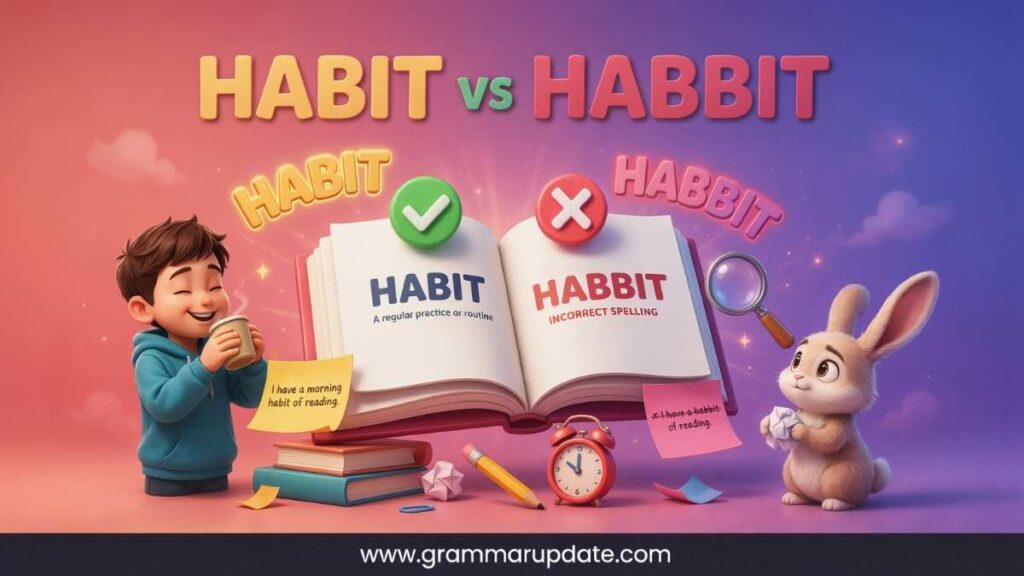
English spelling can turn a simple word into a tiny guessing game. Habit vs habbit is a good example. That extra b may look harmless, but it changes a correct spelling into a common mistake. So, which one should you use? Habit is the correct spelling, while habbit is incorrect. Habit refers to something you do regularly, often without thinking about it. You might have a good habit, a bad habit, or a habit of checking your phone too often. In this guide, you’ll learn the meaning, pronunciation, spelling, and usage of habit, along with simple ways to remember why it has only one b and avoid this mistake.
Quick answer
If you’re unsure about habit vs habbit, the answer is simple: habit is correct, while habbit is a misspelling.
| Word | Correct? | Meaning | Example |
|---|---|---|---|
| Habit | Yes | A regular or repeated behavior | Reading is a good habit. |
| Habbit | No | Common misspelling of habit | “Habbit” is incorrect. |
Remember: write habit with one b. The extra b in habbit doesn’t belong there.
Fix common more word mistakes in English
Foodie vs Foody Which One Is Correct?
Habit vs Habbit The Difference Explained
Habit is the correct spelling. Habbit is incorrect.
The difference comes down to one letter. Habit contains one b, while habbit contains two. Standard English dictionaries, including Oxford and Cambridge, recognize habit as the established spelling. They define it mainly as a repeated or regular behavior and also record other meanings of the word.
| Word | Correct spelling | Meaning |
|---|---|---|
| Habit | Yes | A repeated behavior, regular practice, or usual way of acting |
| Habbit | No | A common misspelling of habit |
For example, this sentence is correct:
Reading before bed is a healthy habit.
This sentence contains the common spelling mistake:
Reading before bed is a healthy habbit.
The meaning remains easy to understand in the second sentence, but the spelling is not standard.
Therefore, when you are deciding between habit vs habbit, choose habit.
The correct spelling is:
Habit
The incorrect form is:
Habbit
The plural follows the same pattern. One habit becomes several habits, not several habbits.
Why Do People Confuse Habit vs Habbit?
The spelling confusion usually comes from the fact that English uses both single and double consonants in many familiar words. Because of that, habbit can look strangely believable even though it is incorrect.
Consider words such as rabbit, hobby, and address. Each contains a doubled consonant. When you encounter a word such as habit, your brain may automatically expect another b.
However, English spelling does not work by simply doubling a consonant whenever a word contains a similar sound. Each word has its established spelling.
Pronunciation can add another layer of confusion. Habit is pronounced with a clear b sound, but hearing a consonant does not tell you whether the written word needs one letter or two.
That is why spelling and pronunciation should not always be treated as identical systems.
The correct form is h-a-b-i-t.
There is no second b.
Learn the difference between basic English word mistakes
Fascinating vs Facinating difference and usage?
What Does Habit Mean?
The most common habit meaning is a regular behavior or action that someone performs repeatedly. Oxford defines habit as something a person does often and almost without thinking, particularly when the behavior can be difficult to stop. Cambridge similarly describes it as something done often and regularly, sometimes without the person realizing it.
In simple English, a habit is a repeated behavior that becomes part of your usual routine.
For example, someone might have a habit of reading for twenty minutes before going to sleep. Another person might have a habit of checking email as soon as they begin work.
The behavior itself does not have to be good or bad. The word simply describes a pattern that happens regularly.
This is why you can talk about good habits, bad habits, healthy habits, nervous habits, eating habits, study habits, sleeping habits, and work habits.
For example:
She developed a habit of walking after dinner.
He has a habit of checking his phone during conversations.
Reading every morning became part of her daily routine.
In each sentence, habit describes something that happens repeatedly.
Habit Meaning in English
The habit meaning in English becomes clearer when you look at the idea of repetition.
A single action is not necessarily a habit. If you drink coffee once, that action alone does not establish a habit. If you drink coffee every morning and the behavior becomes part of your routine, you can describe it as a habit.
That distinction matters.
A habit often develops through repetition. Eventually, the action may feel natural or automatic. Cambridge gives examples involving getting into a habit, getting out of a habit, and picking up habits from other people.
For example:
He got into the habit of exercising before breakfast.
She got out of the habit of reading every night.
Children can pick up habits from the people around them.
Thus, the habit definition in English involves more than simply doing something. The idea of regularity plays an important role.
Learn the difference between basic English word mistakes
Concede vs Conceed difference and usage?
Good Habits and Bad Habits
Habits can have positive or negative effects.
Good habits are repeated behaviors that generally support a useful goal. Reading regularly, exercising, arriving on time, organizing your work, and preparing for the next day can all become good habits.
For example:
Getting up early became a useful habit.
She has developed the habit of reviewing her notes after class.
However, habits can also be unwanted. Procrastination, excessive phone checking, nail biting, and staying up too late can become bad habits when they repeat often enough.
For example:
Staying up until midnight became a bad habit.
He is trying to break his habit of checking social media during work.
The word habit itself does not tell you whether the behavior is good or bad. The surrounding words provide that information.
Is Habbit a Word?
If you are wondering is habbit a word, the answer is no when you mean the standard English word for a repeated behavior.
Habbit is a common misspelling of habit. It does not function as a standard alternative spelling.
That distinction is important because some unusual-looking English words are perfectly legitimate. A strange-looking word is not automatically an error. In this case, however, major learner dictionaries give habit as the standard form. Oxford and Cambridge both provide dictionary entries for habit.
So the answers are simple.
Is habit a word? Yes.
Is habbit a word? Not as the standard spelling of this word.
Is habbit the correct spelling? No.
Is habit the correct spelling? Yes.
Why Is Habit Spelled With One B?
The question why is habit spelled with one b does not have a useful answer based on a simple modern spelling rule. English contains many words whose spellings reflect their historical development rather than a single predictable pattern.
Oxford traces habit through Middle English and Old French to the Latin word habitus, which meant condition or appearance. The English word originally had a clothing-related sense and later developed meanings connected with physical or mental character and repeated behavior.
Today, the spelling is simply established as habit.
That means it is better to remember the correct form than to invent a rule that suggests every similar word should follow the same pattern.
Think of it this way:
Habit has one b.
Habbit adds an unnecessary second b.
The extra letter does not change the pronunciation or create another standard English word.
Learn the difference between basic English word mistakes
Aluminum vs Aluminium difference and usage?
Habit With One B or Habbit With Two B?
This is one of the easiest ways to settle the spelling confusion.
Habit has one b.
Habbit has two b’s.
Only the first form is correct.
| Spelling | Number of b’s | Standard English? |
|---|---|---|
| Habit | 1 | Yes |
| Habbit | 2 | No |
The same pattern continues in related forms.
1.Habit becomes habitual.
2.Habit becomes habitually.
3.Habit becomes habituated.
4.Habit becomes habituation.
The single b remains throughout these related words. Oxford lists habitual and related forms within the same word family.
Therefore, remembering the word family can make habit spelling easier.
Habit vs Habbit Examples
The clearest way to understand habit vs habbit examples is to compare the incorrect form with the corrected version.
| Incorrect | Correct |
|---|---|
| She has a bad habbit. | She has a bad habit. |
| Reading is a useful habbit. | Reading is a useful habit. |
| He developed a strange habbit. | He developed a strange habit. |
| Good habbits take time to develop. | Good habits take time to develop. |
| She wants to break this habbit. | She wants to break this habit. |
The pattern never changes. Whenever the intended word means a repeated behavior or regular practice, use habit.
Here are some natural examples of habit usage:
Reading before bed is part of my daily habit.
He has a habit of arriving early.
She developed the habit of taking notes during meetings.
Exercise became a regular habit after several months.
Checking the door twice became a nervous habit.
The examples also show why habit works naturally with words such as daily, regular, healthy, bad, nervous, and unusual.
Habit Pronunciation
The habit pronunciation is another area where spelling questions sometimes arise.
Cambridge gives the US and UK pronunciation as /ˈhæb.ɪt/. The word has two syllables, with the stress on the first syllable.
The pronunciation can be represented as:
hab-it
The first syllable contains the b sound. However, that does not mean the spelling requires two b’s.
This is a useful reminder that English pronunciation cannot always tell you exactly how many letters belong in a word.
For example, speakers hear a single b sound in habit. The standard spelling represents that sound with one b.
Therefore, habit pronunciation supports the correct pronunciation, but spelling still needs to be learned as its established written form.
Learn the difference between basic English word mistakes
Guidance vs Guidence difference and usage ?
Habit vs Habbit Correct Spelling in American English
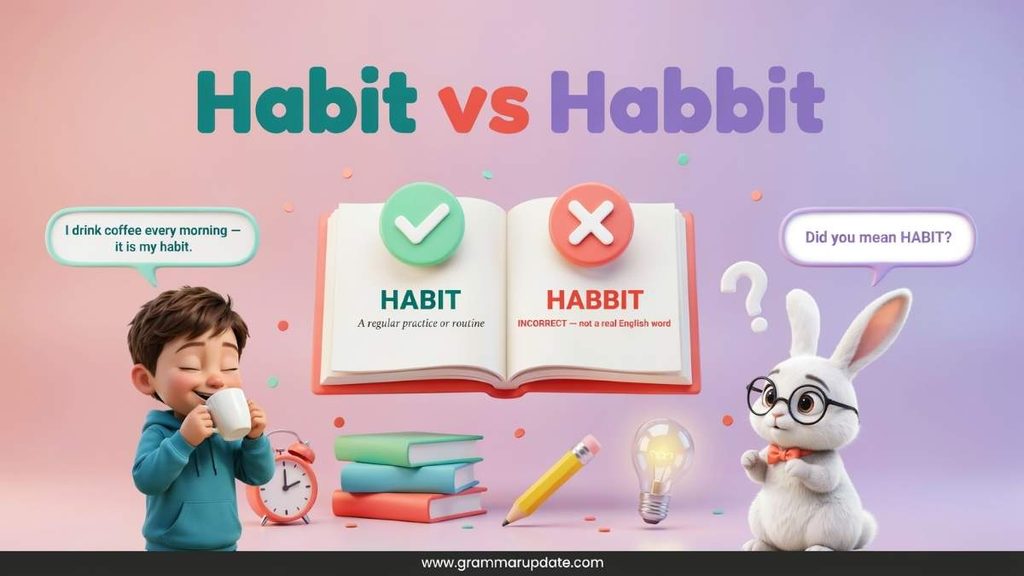
If you are writing in American English, the correct form is habit.
British English also uses habit.
Unlike words such as color and colour, this is not a regional spelling difference. American English does not use habbit as an alternative form.
| English variety | Correct spelling |
|---|---|
| American English | habit |
| British English | habit |
| Standard English | habit |
So, if you are writing an American English article, email, essay, resume, or school assignment, use habit.
Habit Plural Form
The habit plural is habits.
The change is straightforward:
habit → habits
There is no extra b.
For example:
She has several healthy habits.
His daily habits have changed.
Good habits often take time to develop.
The incorrect plural is habbits.
This mistake usually appears because someone has already added the unnecessary second b to the singular form. Once the spelling is corrected, the plural becomes simple.
One habit.
Two habits.
Several habits.
The plural of habit therefore follows the ordinary pattern of adding s to the singular noun.
My Habit Meaning
The phrase my habit refers to a repeated behavior or routine associated with the speaker.
For example:
My habit is to read before bed.
Here, the speaker is describing a regular personal routine.
You can also use the phrase in a sentence such as:
Checking my email first thing in the morning is my habit.
More naturally, a speaker might say:
I have a habit of checking my email first thing in the morning.
The second version is especially common because English frequently uses the structure have a habit of followed by a verb ending in -ing.
For example:
I have a habit of drinking tea after dinner.
She has a habit of interrupting people.
He has a habit of leaving things until the last minute.
This structure is useful because it clearly connects the word habit with a repeated action.
Learn the difference between basic English word mistakes
Fluorescent vs Flourescent difference and usage ?
Common Phrases With Habit
Habit appears in several established English expressions. Learning these phrases can improve both vocabulary and natural English word usage.
Break a Habit
To break a habit means to stop a repeated behavior.
For example:
She is trying to break the habit of staying up too late.
Build a Habit
To build a habit means to establish a repeated behavior through regular practice.
For example:
He wants to build a habit of exercising every morning.
Develop a Habit
Develop a habit emphasizes the gradual process of making something part of your routine.
For example:
Children can develop a habit of reading when they regularly spend time with books.
Get Into the Habit Of
To get into the habit of doing something means to start doing it regularly.
For example:
Try to get into the habit of reviewing your schedule each morning.
Get Out of the Habit Of
This expression describes losing a previous routine.
For example:
After the holidays, she got out of the habit of exercising.
Force of Habit
Force of habit describes an action performed automatically because someone has done it repeatedly for a long time. Oxford gives this expression as an established idiom.
For example:
By force of habit, he reached for his phone even though he had nothing to check.
Make a Habit Of
To make a habit of something means to do it regularly, often with an implication that the behavior may not be desirable.
For example:
Do not make a habit of leaving important tasks until the last minute.
Kick the Habit
Kick the habit is an informal expression meaning to stop an unwanted repeated behavior. Dictionaries commonly use it in contexts involving smoking and other persistent habits.
For example:
He decided to kick the habit of smoking.
Learn the difference between often confused words
Lose vs Loose difference and usage?
Habit Has Another Meaning
The word habit is not limited to behavior.
Oxford and Cambridge also list habit as a noun referring to a distinctive piece of clothing worn by a monk or nun.
For example:
The monk wore a traditional habit.
In this context, habit has nothing to do with a daily routine. The surrounding sentence tells you which meaning applies.
This second meaning also helps explain why the word has an interesting history. Oxford traces it back through French to Latin habitus, with earlier meanings connected to condition, appearance, dress, or attire.
Over time, the word developed additional meanings related to a person’s usual behavior and character.
Habit vs Habitat
Habit and habitat look similar, but their meanings are completely different.
A habit is a repeated behavior or regular practice.
A habitat is the natural environment where an organism lives.
For example:
Reading every evening is a habit.
A forest can provide habitat for many animals.
The extra letters in habitat matter. Habitat is not another spelling of habit.
This distinction becomes especially important in biology and environmental writing because replacing one word with the other can completely change the meaning of a sentence.
Habit vs Hobby
Habit and hobby can overlap, but they do not mean the same thing.
A habit is a repeated behavior or routine.
A hobby is an activity someone usually pursues for enjoyment during free time.
For example:
Photography is her hobby.
Taking photographs every Sunday is her habit.
The same activity can sometimes function as both. Someone might enjoy gardening as a hobby and also develop a habit of watering plants every morning.
Therefore, the key difference lies in what the word emphasizes. Hobby focuses on an enjoyable activity, while habit focuses on repetition and regular behavior.
Learn the difference between often confused words
Principal vs Principle Difference and usage ?
Common Spelling Mistakes Related to Habit
The most common spelling mistakes involve adding the unnecessary second b.
Habbit is incorrect.
Habbits is also incorrect.
The correct forms are habit and habits.
Another useful point concerns related words. Writers sometimes assume that if habit has one b, a related word might suddenly need two. That does not happen in the common word family.
Habitual uses one b.
Habitually uses one b.
Habituated uses one b.
Habituation uses one b.
Consequently, learning the word family gives you several opportunities to reinforce the correct spelling.
Why the Habbit Misspelling Looks So Convincing
There is a reason this particular typo can fool the eye.
When you read quickly, the difference between habit vs habbit is only one letter. The two forms also share the same beginning and ending. Because English contains many familiar words with double consonants, the incorrect version does not look completely strange.
However, visual familiarity can be misleading.
A spelling that looks familiar is not necessarily a standard spelling.
This is especially true when a typo appears repeatedly online. Once you see the same error many times, your brain may begin to treat it as familiar vocabulary.
That does not turn the typo into a correct English word.
For habit, the reliable form remains the same:
h-a-b-i-t.
How to Remember the Correct Spelling of Habit
The simplest memory trick is also the most useful:
One habit, one b.
There is no need to memorize a complicated English spelling rule.
You can also connect habit with habitual. Both words begin with the same basic spelling pattern.
Habit.
Habitual.
Habitually.
The repeated visual pattern makes the single b easier to remember.
Another useful approach is to separate the word mentally:
hab + it
This makes the extra b stand out as something that does not belong.
The key is consistency. Each time the word appears in your writing, use habit with one b.
Learn the difference between often confused words
Your vs You’re Difference and which is correct ?
When the Habbit Spelling Can Cause Problems
A spelling error rarely changes the meaning of a sentence when the surrounding context is clear. However, that does not make the mistake harmless in every setting.
1.In academic writing, repeated spelling errors can distract from the argument and make proofreading weaknesses more visible.
2.In professional communication, a typo can interrupt an otherwise polished email, report, or presentation.
3.In job applications, basic spelling errors can distract readers from the qualifications and experience being presented.
Online, consistent spelling improves readability and gives readers a smoother experience.
The point is not that one typo destroys good writing. It does not. Instead, careful spelling removes unnecessary distractions.
A Simple Habit Spelling Check
When you finish writing, look specifically for habit and its plural.
If you see habbit, change it to habit.
If you see habbits, change it to habits.
Then check related forms such as habitual and habitually.
This small proofreading step can catch one of the easiest spelling mistakes to overlook because the incorrect form looks familiar.
Learn the difference between often confused words
Breached VS Breeched difference and Which Is Correct?
practice session Habit vs Habbit
Complete each sentence with the correct word or form: Habit vs Habbit
- Brushing your teeth twice a day is a healthy ______.
- The correct spelling is ______, not “habbit.”
- It takes time to develop a good ______.
- He has a ______ of checking his phone before bed.
- She is trying to break her bad ______.
- Reading every night became a regular ______ for him.
- “Habbit” is a common spelling ______ of “habit.”
- You should get into the ______ of drinking enough water.
- He does it out of ______, not because he really wants to.
- The plural form of “habit” is ______.
- Exercise can become an important daily ______.
- Which spelling is correct: “habit” or “habbit”? ______
- She has a ______ of arriving early for work.
- It’s difficult to change a long-standing ______.
- He wants to make a ______ of reading before sleeping.
- The word “habit” is pronounced with a short ______ sound at the beginning.
- “Habbit” should not be used in standard English because it is a ______.
- The phrase “force of ______” describes something you do because you are used to doing it.
- Good study ______ can help students perform better.
- He finally kicked the ______ of biting his nails.
- “Habit” is a ______ that describes a repeated or regular behavior.
- If you have several routines, you can call them your daily ______.
- She is trying to get out of the ______ of staying up late.
- Always check the spelling of ______ before using it in formal writing.
- The correct word in the sentence “Walking every morning is a healthy ______” is ______.
Answers
- habit
- habit
- habit
- habit
- habit
- habit
- mistake
- habit
- habit
- habits
- habit
- habit
- habit
- habit
- habit
- a
- misspelling
- habit
- habits
- habit
- noun
- habits
- habit
- habit
- habit
Here’s a trusted source for clear word meanings:
FAQs
What is the correct spelling between Habit vs Habbit ?
The correct spelling is “habit,” with one b. “Habbit,” with two b’s, is a common misspelling and should not be used in standard English.
Why is habit spelled with one b?
“Habit” has one b because that is its established standard English spelling. Adding a second b creates the incorrect form “habbit.” The word is pronounced /ˈhæb.ɪt/ in both American and British English.
Is habbit a real English word?
No. “Habbit” is not the standard spelling of the English word “habit.” If you mean a repeated action or regular behavior, use “habit.”
What does habit mean in English?
“Habit” is a noun that refers to something you do regularly, often without consciously thinking about it. For example, checking your phone before bed can become a habit.
How do you pronounce habit?
“Habit” is pronounced /ˈhæb.ɪt/. The first syllable sounds like “hab,” followed by a short “it” sound. American and British English use the same pronunciation.
Does habit have one b or two?
The word “habit” has one b: h-a-b-i-t. The spelling “habbit” incorrectly doubles the b.
Is habit the same in American and British English?
Yes. “Habit” has the same spelling in American and British English. The word refers to a regular or repeated behavior in both varieties of English.
Is habit a noun or a verb?
“Habit” is primarily used as a noun. It names a repeated action, regular behavior, or established way of doing something. For example, “Reading before bed is a good habit.”
What is the plural of habit?
The plural of “habit” is “habits.” For example, “Good habits can make daily tasks easier.”
What is the adjective form of habit?
The common adjective form is “habitual.” It describes something that is usual, repeated, or done because it has become a habit. For example, “He is a habitual latecomer.”
What is the adverb form related to habit?
The related adverb is “habitually.” It means doing something in a usual or repeated way. For example, “She habitually checks her messages in the morning.”
What does “out of habit” mean?
“Out of habit” means doing something because you are accustomed to doing it. You may perform the action automatically without making a deliberate decision each time.
What does “force of habit” mean?
“Force of habit” means doing something automatically because you have become used to doing it in a particular way. For example, you might check the time even when you already know what time it is.
What does “get into the habit of” mean?
“Get into the habit of” means to become accustomed to doing something regularly. For example, “She got into the habit of reading every evening.”
What does “make a habit of” mean?
“Make a habit of” means to start doing something regularly until it becomes a normal part of your routine. For example, “Make a habit of reviewing your work before submitting it.”
Can habit refer to clothing?
Yes. “Habit” has another dictionary meaning. It can refer to a long piece of clothing traditionally worn by a monk or nun.
Can habit mean usual behavior?
Yes. “Habit” can refer to a person’s usual behavior or regular way of doing things. In this sense, it can describe actions performed regularly because they have become familiar.
What is the difference between habit and habitual?
“Habit” is a noun, while “habitual” is an adjective. A habit is a repeated behavior, whereas habitual describes something that is usual or repeated. For example, “Reading is a habit” and “She is a habitual reader.”
Why do people mistakenly spell habit as habbit?
“Habbit” can look convincing because English has many words that use double consonants. However, “habit” does not follow that spelling pattern. Remembering the single b can help you avoid this common typo.
What are common phrases that use habit?
Common expressions include “good habit,” “bad habit,” “break a habit,” “get into the habit,” “get out of the habit,” “out of habit,” and “force of habit.” These phrases describe repeated behavior or actions that have become familiar.
Learn the difference between often confused words
Disastrous vs Disasterous difference and usage ?
Conclusion
The confusion between habit vs habbit is easy to clear up: habit is the correct spelling, while habbit is a common misspelling. If you’re talking about something you do regularly or almost automatically, the word you need is habit.
The easiest way to remember it is simple: habit has only one b. You can have a good habit, break a bad habit, or do something out of habit. The word also appears in useful expressions such as “force of habit” and “get into the habit of.”
So, when that extra b tries to sneak into your sentence, send it packing. Write habit, not habbit. One small letter makes the difference, and now you have a simple way to get the spelling right every time.

Jhon AJS, the creative mind behind Grammar Update, is an experienced blogger passionate about simplifying English grammar. He focuses on explaining confusing word vs word differences, grammar rules, punctuation, and sentence structure in a clear and practical way. Through easy to understand guides and examples, Jhon helps readers improve their writing and communicate with confidence. With years of blogging experience, he continues to share helpful insights that make learning grammar simple, useful, and accessible for everyone.