The aluminum vs aluminium debate makes a simple spelling difference seem more complicated than it really is. Is one spelling wrong, or did English simply give the same metal two names? The answer is much simpler: both spellings are correct. “Aluminum” is the standard form in American English, while “aluminium” is preferred in British English and several other varieties. Both words refer to the same chemical element, so you are not choosing between two different metals. In this article, you will learn why these spellings differ, where each one is used, and which form to choose for your audience, without letting one extra letter create unnecessary confusion.
quick answer
The aluminum vs aluminium spelling difference is easy to recognize once you compare the two forms. Aluminum ends in um, while aluminium ends in ium. Their meaning remains the same.
| Feature | Aluminum | Aluminium |
|---|---|---|
| Standard regional usage | American English | British English |
| Ending | um | ium |
| Meaning | The metallic element Al | The same metallic element |
| Chemical symbol | Al | Al |
| Atomic number | 13 | 13 |
| Typical pronunciation | Four syllables in standard US pronunciation | Five syllables in standard UK pronunciation |
| Common product terms | Aluminum foil, aluminum cans | Aluminium foil, aluminium cans |
This comparison shows that the main distinction involves spelling and pronunciation rather than meaning or chemical identity.
Learn the difference between confusing more English words
Changeable vs Changable Which one Is Correct?
Aluminum vs Aluminium Which Spelling Is Correct?
Both aluminum and aluminium are correct spellings. The form you should use depends on the variety of English you are writing.
American English uses aluminum. You will commonly see this spelling in American dictionaries, school materials, newspapers, product descriptions, and technical documents. For example, an American manufacturer might advertise an aluminum frame or an aluminum can.
British English uses aluminium. This spelling is standard in the United Kingdom and is also common in Australia and several other English-speaking regions. A British company would generally describe the same product as an aluminium frame or an aluminium can.
The difference is similar to other regional spelling variations, such as color and colour or center and centre. One form may be preferred in a particular country, but that preference does not automatically make the alternative incorrect everywhere.
If you are writing for readers in the United States, choose aluminum. If your audience expects British English, choose aluminium. When a publisher, teacher, or organization provides a spelling convention, follow that guidance.
What Is the Difference Between Aluminum and Aluminium?
The aluminum vs aluminium difference is primarily a matter of language convention. Both words identify the same metallic element, and neither spelling describes a separate substance.
Aluminum is the preferred form in American English. Aluminium is the preferred form in British English and many other varieties. The additional letters in the British spelling do not indicate a different grade, purity, or chemical structure.
For example, an American might say, “The company makes lightweight aluminum panels.” A British speaker might say, “The company makes lightweight aluminium panels.” Both sentences describe the same type of material.
The distinction also applies to compound expressions. Writers use aluminum alloy in American English and aluminium alloy in British English. The regional spelling changes, but the basic meaning stays the same.
It is useful to remember that aluminum and aluminium name the element, while terms such as alumina and alum refer to different substances. Alumina is aluminum oxide, and alum refers to a group of compounds. These related words should not be treated as interchangeable names for the metal.
Learn the difference between confusing more English words
Concede vs Conceed difference and usage?
Aluminum Meaning and Aluminium Meaning
The aluminum meaning and aluminium meaning are identical. Both words refer to a chemical element with the symbol Al and atomic number 13.
Aluminum is a silvery, lightweight metallic element. It is widely used because it has a relatively low density, resists corrosion under many conditions, and conducts heat and electricity. Manufacturers also combine it with other elements to create alloys suited to different purposes.
You will encounter aluminum and aluminium in many everyday settings. Kitchen foil, beverage cans, window frames, vehicle components, aircraft structures, and construction materials are familiar examples. The exact composition of a product may vary, particularly when it contains an alloy, but the regional spelling does not tell you anything about that composition.
In short, aluminum definition and aluminium definition describe the same element. If you understand one form, you understand the other.
Why Does American English Use Aluminum?
The American spelling aluminum has a history that stretches back to the early 19th century. It did not begin as a modern attempt to shorten the British spelling. Instead, it developed through the naming choices made when scientists were studying the element.
British chemist Sir Humphry Davy proposed the name alumium in 1808. He later used aluminum in his 1812 book Elements of Chemical Philosophy. Other scientists favored aluminium, partly because the ending ium matched the pattern found in the names of several other metallic elements.
Both forms appeared during the 19th century. Over time, aluminum became increasingly common in the United States, while aluminium gained a stronger foothold in Britain and much of the international scientific community.
Noah Webster’s 1828 American dictionary is often mentioned in discussions of American spelling. It listed aluminum, helping establish the form in American reference works. However, the spelling did not become dominant overnight. The two forms continued to compete in American usage during the 19th century.
The American Chemical Society adopted aluminum as its preferred spelling in 1925. That decision reinforced the form already becoming familiar in the United States. Today, aluminum is the standard spelling in American English, including most general and technical writing.
Learn the difference between confusing more English words
Fascinating vs Facinating difference and usage?
Why Does British English Use Aluminium?
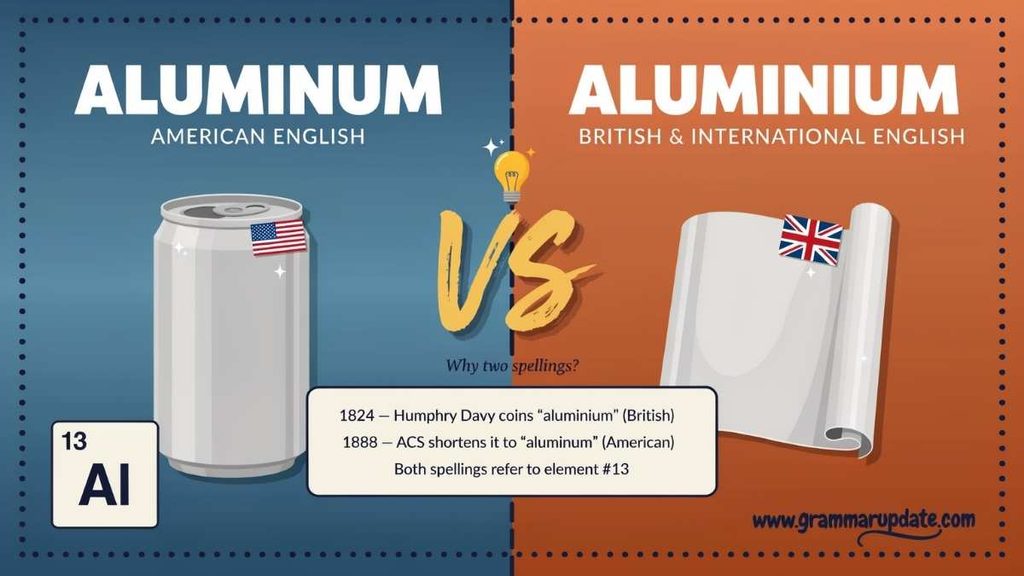
British English uses aluminium because the longer form became established through scientific naming conventions and general usage. Many chemists preferred the ending ium because it resembled the endings of element names such as sodium, potassium, and magnesium.
Although Davy used aluminum, the form aluminium gained support among other scientists. It eventually became the conventional spelling in Britain and remained common in many other English-speaking regions.
The British spelling is not a correction of an inherently wrong American word. Both forms have historical roots, and each became standard in different language communities.
Today, aluminium is the expected form in most British English writing. You will see it in educational materials, technical documents, news articles, and product descriptions. For a British audience, writing aluminium foil or aluminium alloy will generally look more natural than using the American spelling.
Learn the difference between confusing word pairs
Extreme vs Extreem difference and usage?
Aluminum vs Aluminium in the US, UK, Canada, and Australia
English spelling conventions vary across countries, and this word is a useful example. The United States and Canada commonly use aluminum, while the United Kingdom and Australia generally use aluminium.
In the United States, aluminum is the established spelling in everyday writing and technical communication. American readers will usually expect that form in articles, school assignments, product listings, and business documents.
In the United Kingdom, aluminium is the standard spelling. It is also commonly used in Australia and New Zealand, where British spelling traditions have had a strong influence.
Canadian English commonly uses aluminum as well, although Canadian spelling can reflect both British and American influences. For formal or specialized writing, check the dictionary or style guide recommended by the organization you are writing for.
The practical rule is to match the spelling to the audience rather than assuming that one version applies to every English-speaking country.
Learn the difference between confusing word pairs
Embarrass vs Embarass difference and usage?
Is Aluminum or Aluminium Correct in American English?
Aluminum is the standard American English spelling. If you are writing an article, essay, email, or product description for a US audience, aluminum is normally the appropriate choice.
For example, an American writer would generally write, “The building uses aluminum panels to reduce weight.” The same sentence in British English would normally use aluminium.
The British spelling is still a valid English form. It simply does not match the usual American spelling convention. An American editor may change aluminium to aluminum to maintain consistency with US English, just as a British editor may make the opposite change.
If a quotation, official title, or organization name uses a particular spelling, preserve it when accuracy requires you to do so. Otherwise, use the standard spelling for your intended audience.
How Do You Pronounce Aluminum and Aluminium?
The two spellings are also associated with different standard pronunciations. In general American English, aluminum is pronounced with four syllables. In standard British English, aluminium is usually pronounced with five.
The difference can be noticeable when speakers from the two regions say the words aloud. The additional syllable in aluminium helps distinguish the British form from the American one.
Pronunciation can vary by accent, so not every speaker will sound exactly the same. Still, recognizing the usual syllable pattern can help you understand the difference when listening to American and British English.
If you are learning either variety, use a dictionary recording that matches your target accent. Listening to the word in a complete sentence can also help you hear how its stress and rhythm work in natural speech.
Learn the difference between confusing word pairs
Acknowledge Vs Acknowlege Which one Is Correct?
Aluminum vs Aluminium in Chemistry and the Periodic Table
Despite their different spellings, aluminum and aluminium refer to the same chemical element. Its chemical symbol is Al, and its atomic number is 13. These scientific identifiers remain unchanged regardless of the English spelling.
The atomic number tells you how many protons an atom of the element contains. The symbol Al is the internationally recognized chemical abbreviation used in formulas, tables, and scientific communication.
Aluminum is a lightweight metal with useful properties, including good thermal and electrical conductivity. It also forms a protective oxide layer when exposed to air, which helps it resist corrosion under many ordinary conditions. Manufacturers use pure aluminum in some applications and combine it with other elements to produce alloys with different properties.
The International Union of Pure and Applied Chemistry, commonly known as IUPAC, uses aluminium as its standard name while recognizing aluminum as an acceptable variant. This scientific preference does not mean that American English must use aluminium in everyday writing. Regional spelling conventions still apply, and authors should follow the requirements of their publications or institutions.
Aluminum or Aluminium for Academic and Professional Writing
When writing an academic paper, technical report, or professional document, choose the spelling required by the relevant style guide. A US university assignment may expect American English, while a British publication may require British English. Scientific journals can also specify their own terminology rules.
For an English paper, follow your instructor’s directions. If the assignment requires American English, use aluminum. And If it requires British English, use aluminium. If no variety is specified, choose one convention and apply it consistently.
The same principle applies to business writing. A company preparing product information for American customers will usually use aluminum, while a company targeting British customers will normally use aluminium. Consistency makes the document easier to read and prevents unnecessary editing.
Learn the difference between confusing word pairs
Dilemma vs Dilema which one is correct ?
Common Mistakes With Aluminum and Aluminium
One common mistake is treating the unfamiliar spelling as incorrect. An American reader may be used to aluminum and assume that aluminium contains an extra letter by mistake. A British reader may have the opposite reaction. In reality, both forms are established spellings.
Another mistake is switching between the two forms without a clear reason. A document that uses aluminum in one section and aluminium in another may look inconsistent, especially when it targets one specific audience. Choose the appropriate regional form and keep it throughout the text.
Writers should also avoid assuming that the spelling reveals the material’s composition. Aluminum and aluminium do not refer to different metals, and neither form tells you whether a product is made from pure aluminum or an alloy.
Finally, do not confuse the element’s name with related terms. Alumina, for example, refers to aluminum oxide. It is related to the element but is not another spelling of aluminum or aluminium.
Aluminum vs Aluminium Everyday Examples
The difference becomes especially clear when you compare sentences written in American and British English. The spelling changes, but the meaning remains the same.
| American English | British English |
|---|---|
| The pan has an aluminum handle. | The pan has an aluminium handle. |
| We recycled the aluminum cans. | We recycled the aluminium cans. |
| The building has aluminum window frames. | The building has aluminium window frames. |
| The engineer selected an aluminum alloy. | The engineer selected an aluminium alloy. |
| Aluminum foil helps cover the food. | Aluminium foil helps cover the food. |
Consider a company that sells kitchen products in both the United States and the United Kingdom. Its American product page might describe a lightweight aluminum tray, while its British page might call the same item a lightweight aluminium tray. The product does not change; the spelling simply matches the intended audience.
This approach is useful for websites, catalogs, and other material prepared for international readers. Localize the spelling when appropriate, but keep the product details and technical facts accurate.
Learn the difference between confusing word pairs
Definite vs Definitive difference and usage?
Aluminum and Aluminium in Everyday Products
You can see this metal in many everyday products, including beverage cans, kitchen foil, window frames, cookware, and aircraft parts. In American English, these products are usually described with “aluminum,” while British English uses “aluminium.” The spelling changes with the variety of English, but the material itself remains the same.
For example, an American might write, “The can is made of aluminum,” while a British writer would write, “The can is made of aluminium.” Neither sentence is incorrect. The important thing is to follow the spelling convention of your audience and remain consistent throughout your writing.
Consistency Matters in Professional Writing
Choosing between aluminum and aluminium becomes especially important when you are writing for a specific audience. If your article follows US English, use “aluminum” throughout the text. If you are writing in British English, use “aluminium.”
Mixing the two forms is not a serious grammar mistake, but it can make your writing look inconsistent. Think of it like using two different spellings of the same person’s name in one document. The meaning remains clear, but consistent usage looks cleaner and more professional.
Learn the difference between confusing word pairs
Disappoint vs Disapoint difference and usage?
Aluminum vs Aluminium in Global English
English has developed different spelling conventions in different parts of the world, and aluminum versus aluminium is a good example. American English generally favors “aluminum,” while British English, Australian English, and many other varieties commonly use “aluminium.”
Aluminum and Aluminium in Formal Documents
The spelling you choose can depend on the style of the document and the audience reading it. American companies, schools, and publications generally use “aluminum,” while British organizations commonly use “aluminium.” The same pattern appears in technical reports, product descriptions, academic papers, and educational materials.
If a document follows a particular style guide, use the spelling that guide recommends. Otherwise, match the variety of English used throughout the document. There is no need to worry that one form will suddenly become incorrect. The metal stays exactly the same; only the spelling changes.
Learn the difference between commonly misused words
Exhilarate vs Exhilirate difference and usage?
practice session Aluminum vs Aluminium
Complete each sentence with the correct word: aluminum vs aluminium. Pay attention to the region, spelling convention, and context.
1. In American English, the standard spelling is __________.
2. In British English, the preferred spelling is __________.
3. Both aluminum and aluminium refer to the same chemical __________.
4. The chemical symbol for aluminum is __________.
5. Aluminum has the atomic number __________.
6. The United States generally uses the spelling __________ in everyday writing.
7. The United Kingdom generally uses the spelling __________ in everyday writing.
8. A British newspaper would usually write __________ foil.
9. An American manufacturer would typically advertise __________ cans.
10. The spelling __________ is common in Australia.
11. The spelling __________ is standard in American dictionaries.
12. A student writing for a British school assignment should generally use __________.
13. A student writing for an American school assignment should generally use __________.
14. The lightweight metal used to make many beverage cans is __________.
15. The spelling __________ contains an extra “i” before the final “um.”
16. Sir Humphry Davy played an important role in the naming history of __________.
17. The American spelling is shorter by one syllable in many common pronunciations: __________.
18. A British engineer might refer to an __________ ladder.
19. An American homeowner might install __________ siding on a house.
20. The word __________ is generally preferred in British scientific writing.
21. The word __________ is generally preferred in American scientific writing.
22. The symbol Al represents the element called aluminum or __________.
23. If you are following US English style, write “The frame is made of __________.”
24. If you are following UK English style, write “The frame is made of __________.”
25. The main difference between aluminum and aluminium is regional spelling, not the identity of the __________.
Answers
- aluminum
- aluminium
- element
- Al
- 13
- aluminum
- aluminium
- aluminium
- aluminum
- aluminium
- aluminum
- aluminium
- aluminum
- aluminum
- aluminium
- aluminum
- aluminum
- aluminium
- aluminum
- aluminium
- aluminum
- aluminium
- aluminum
- aluminium
- element
Here’s a trusted source for clear word meanings:
FAQs
Why do Americans spell it “aluminum” instead of “aluminium”?
Americans use “aluminum” because that spelling became established in American English. Both words refer to the same chemical element, but “aluminum” is the standard form in the United States.
Why did America drop the “i” in aluminium?
The shorter spelling gained popularity in the United States during the 19th century. It appeared in Noah Webster’s 1828 dictionary and eventually became the accepted American spelling.
Which spelling came first: aluminum or aluminium?
The naming history began with chemist Sir Humphry Davy, who proposed different forms of the name. “Aluminum” appeared before “aluminium” became the preferred spelling in Britain and many other countries.
How do you pronounce “aluminium” correctly?
In British English, “aluminium” is commonly pronounced with five syllables, with the main stress on “min.” Pronunciation varies slightly by accent, but the British form has an extra syllable compared with the usual American pronunciation of “aluminum.”
What is aluminum called in England?
In England, the metal is called “aluminium.” This is the standard British English spelling used in everyday writing, education, and many technical contexts.
What does China call aluminum?
In Chinese, aluminum is called 铝, written as “lǚ” in Mandarin Pinyin. It refers to the same chemical element represented by the symbol Al.
Why is it called tin foil if it is made of aluminum?
The expression “tin foil” comes from the time when manufacturers made foil from tin. Aluminum later replaced tin for this purpose, but the older name remained in everyday speech.
Was aluminum ever rarer than gold?
Yes. During the 19th century, extracting aluminum was difficult and expensive, which made it a highly valuable metal. As production methods improved, aluminum became much more affordable and widely available.
Where does the United States get most of its aluminum from?
The United States gets aluminum through domestic production, recycling, and imports. Canada has been a major supplier of imported primary aluminum, although supply sources and import patterns can change over time.
What was the old name for aluminum?
One early name proposed by Sir Humphry Davy was “alumium.” He later used “aluminum,” while “aluminium” emerged as another form that became standard in Britain and many other countries.
What do British people call aluminum foil?
British people generally call it “aluminium foil.” The spelling follows British English conventions, but the product is the same as American aluminum foil.
How do Australians spell aluminum?
Australians generally spell the word “aluminium,” following the form used in British English and many other varieties of English outside North America.
Is aluminum magnetic?
Aluminum is not ferromagnetic like iron, nickel, or cobalt. An ordinary magnet will not attract it in the familiar way it attracts iron, although aluminum can interact weakly with magnetic fields.
Is aluminum foil the same as tin foil?
Today, “aluminum foil” and “tin foil” usually refer to the same kitchen product. Modern household foil is generally made from aluminum, even when people casually call it tin foil.
Why is aluminum used to make foil?
Aluminum is lightweight, flexible, and easy to roll into very thin sheets. It also helps protect food from light, air, and moisture, making it useful for wrapping and storing many foods.
What is the difference between aluminum and aluminium in scientific writing?
Both spellings refer to the element with the chemical symbol Al and atomic number 13. American scientific writing generally uses “aluminum,” while British and many international contexts use “aluminium.” Follow the spelling convention required by your institution, publisher, or style guide.
Learn the difference between commonly misused words
Caught vs Cauhgt difference and usage?
Conclusion
The difference between aluminum vs aluminium is simple: both words name the same metal, but the spelling depends on where you are. American English uses “aluminum,” while British English and Australian English generally use “aluminium.” So, neither spelling is wrong, and there’s no need to let one extra “i” cause a grammar meltdown. Just choose the form that suits your audience and use it consistently. Whether you’re wrapping a sandwich in aluminum foil or writing about the element in a school assignment, you can be confident that you’re using the right word for your variety of English.

Jhon AJS, the creative mind behind Grammar Update, is an experienced blogger passionate about simplifying English grammar. He focuses on explaining confusing word vs word differences, grammar rules, punctuation, and sentence structure in a clear and practical way. Through easy to understand guides and examples, Jhon helps readers improve their writing and communicate with confidence. With years of blogging experience, he continues to share helpful insights that make learning grammar simple, useful, and accessible for everyone.