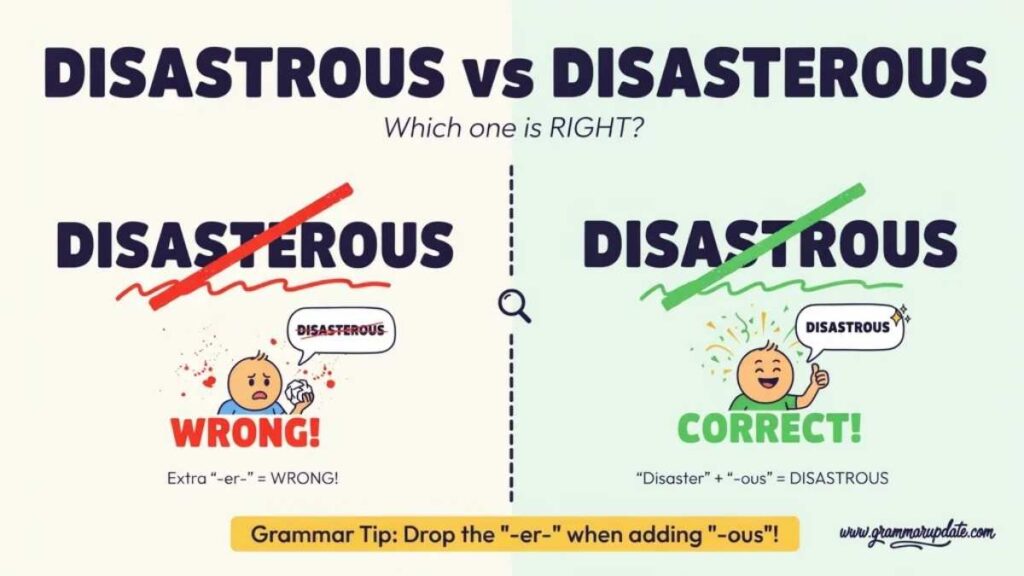
English spelling can be tricky, especially when a word looks like it should keep every letter from its root. The confusion between disastrous vs disasterous is a good example. Only one spelling is correct: disastrous. It means extremely bad, harmful, or unsuccessful. Disasterous is a common misspelling, even though it may look natural because of the word disaster. That extra “e” simply does not belong. In this guide, you’ll learn why disastrous is correct, what it means, how to use it in everyday sentences, and how it differs from related words. By the end, this spelling mistake should be easy to avoid.
quick answer
The easiest way to clear up the confusion is to compare the two spellings side by side. Only one is accepted in standard English.
| Word | Correct? | Meaning | Word Type |
|---|---|---|---|
| Disastrous | Yes | Extremely bad or harmful | Adjective |
| Disasterous | No | Common misspelling | — |
In short, always use “disastrous” when describing something that causes very bad results. The extra “e” in “disasterous” is unnecessary.
Fix common more word mistakes in English
Breached VS Breeched difference and Which Is Correct?
Is It Disastrous vs Disasterous?
The correct spelling is disastrous.
Disasterous is an incorrect spelling that often appears because writers naturally connect the adjective with the noun disaster. Since disaster contains an e, it is tempting to write disasterous when adding an adjective ending. English spelling, however, does not always work by simply attaching a suffix to every letter of the original word.
The correct relationship is disaster to disastrous, not disaster to disasterous.
The difference becomes easy to see when the two forms appear side by side.
| Form | Status | Part of speech | Meaning |
|---|---|---|---|
| disastrous | Correct | Adjective | Extremely bad, harmful, unsuccessful, or damaging |
| disasterous | Incorrect | Not the standard adjective form | Common misspelling of disastrous |
For example, you can write, “The decision had disastrous consequences.” You should not write, “The decision had disasterous consequences.”
This answers the common search question, is it disastrous vs disasterous, without much mystery. Disastrous is the standard English form.
Learn the difference between confusing more English words
Embarrass vs Embarass difference and usage?
Disastrous Correct Spelling and Meaning
The disastrous meaning centers on serious negative effects. Cambridge defines disastrous as extremely bad or unsuccessful and also describes it as something that causes great harm, damage, or suffering. Oxford similarly defines it as very bad, harmful, or unsuccessful.
In simple terms, something disastrous produces a result that is far worse than an ordinary problem.
For example, a minor delay is inconvenient. A disastrous delay could cause a project to collapse, a flight connection to be missed, or a major operation to fail.
The word can describe physical damage, financial loss, failed plans, poor decisions, unsuccessful attempts, or other serious negative outcomes.
Consider these examples:
The storm caused disastrous damage to the coastal area.
The company made a disastrous investment decision.
Their first attempt to repair the machine was disastrous.
The team suffered a disastrous loss in the final minutes.
The new strategy produced disastrous results.
In each case, disastrous acts as an adjective. It tells the reader that the noun that follows it has extremely bad or harmful qualities or consequences.
The Disastrous Definition in Simple English
A useful disastrous definition is “extremely bad, harmful, damaging, or unsuccessful.”
That definition covers both literal and figurative uses.
A disastrous event may involve serious physical destruction. A disastrous decision may simply produce terrible consequences. Likewise, a disastrous performance can describe an attempt that went very badly even when nobody suffered physical harm.
Cambridge specifically notes that disastrous can describe something that is a complete failure. That broader use explains why the word appears in everyday contexts as well as serious discussions.
Learn the difference between confusing more English words
Exceed vs Excede difference and usages?
Is Disasterous a Word?
If you are asking is disasterous a word, it is important to separate what people write from what standard English recognizes.
Disasterous is a common misspelling of disastrous. It is not the standard adjective form used in dictionaries for the meaning associated with disaster.
Therefore, if you search for disasterous meaning or disasterous definition, you are almost certainly looking for the meaning of disastrous.
The confusion makes sense. The noun disaster contains the sequence disaster, so adding ous appears to produce disasterous. However, the established English adjective is disastrous.
This is one of those spelling problems where logic alone can send you in the wrong direction.
The correct form is:
disaster → disastrous
The incorrect form is:
disaster → disasterous
Once you remember that relationship, the spelling becomes much easier.
Why Is “Disasterous” Incorrect?
The main source of this spelling confusion is the noun disaster.
When people try to form the adjective themselves, they may think that disaster simply needs the suffix ous added to it. That gives disasterous.
However, disastrous is an established English word with its own spelling history. Oxford traces the word to the late sixteenth century, with the word coming through French désastreux and Italian disastroso from disastro, meaning disaster.
That history also helps explain why treating the modern word as a simple mechanical combination of disaster and ous can be misleading.
In other words, the correct spelling should be learned as a complete word:
disastrous
Rather than trying to construct it every time, connect it directly with its meaning and word family.
Why Is Disastrous Spelled Without E?
If you are wondering why is disastrous spelled without e, focus on the standard adjective form rather than the spelling of the noun.
Disaster contains an e.
Disastrous does not.
That distinction is the key.
The correct spelling is d-i-s-a-s-t-r-o-u-s.
There is no e between the t and r.
The incorrect spelling disasterous inserts an extra e after the t. That letter belongs to the spelling of disaster, but it does not appear in disastrous.
This is also why the phrase is disastrous, not disasterous.
Learn the difference between confusing more English words
Grateful vs Greatful difference and Usage?
Disastrous Spelling and Word Formation
The word family becomes much clearer when you compare the main forms.
| Word | Part of speech | Example |
|---|---|---|
| disaster | Noun | The event was a disaster. |
| disastrous | Adjective | The event had disastrous consequences. |
| disastrously | Adverb | The plan failed disastrously. |
The noun disaster names an event, situation, or outcome involving great harm, damage, suffering, or serious difficulty. Cambridge also notes that disaster can describe a complete failure in a less literal sense.
The adjective disastrous describes something extremely bad, harmful, or unsuccessful.
The adverb disastrously explains how something happens or develops.
For example:
1.The launch was a disaster.
2.The launch was disastrous for the company.
3.The launch ended disastrously.
These sentences share the same basic idea, but each word performs a different grammatical job.
That distinction matters in English grammar because related words can belong to different parts of speech.
Disastrous in Example Sentences
Context is one of the easiest ways to understand word usage. Once you see disastrous in several situations, its meaning becomes much more natural.
The company made a disastrous decision that resulted in major financial losses.
The storm had disastrous effects on local farms.
Their attempt to fix the electrical system without professional help was disastrous.
The team made a disastrous start to the season.
The new software update produced disastrous results for some users.
A disastrous mistake during the experiment ruined the entire test.
The drought could have disastrous consequences for agricultural production.
His first attempt at repairing the old engine was disastrous.
The examples show that disastrous does not have to describe a literal disaster.
That point is important.
You can use disastrous for an actual destructive event, such as a major storm. You can also use it figuratively for a decision, attempt, performance, plan, or result that goes extremely badly.
Oxford gives examples involving a disastrous harvest, fire, result, and start to a season. Cambridge likewise uses the word for mistakes, attempts, effects, consequences, and unsuccessful situations.
How to Use Disastrous in a Sentence
The easiest way to use disastrous is as an adjective that modifies a noun.
For example:
The company experienced a disastrous year.
Here, disastrous describes year.
You can also use the adjective after a linking verb.
The decision was disastrous.
In this sentence, disastrous describes the decision.
Another common structure places disastrous before words such as consequences, results, effects, outcome, mistake, and decision.
These combinations are especially useful in formal and professional English.
Common natural phrases include disastrous consequences, disastrous results, disastrous effects, disastrous outcome, disastrous decision, disastrous mistake, disastrous failure, disastrous event, and disastrous situation.
These phrases also make useful vocabulary patterns for anyone improving English writing.
Learn the difference between confusing more English words
Beginning vs Beggining difference and usage?
Disastrous vs Disasterous Meaning
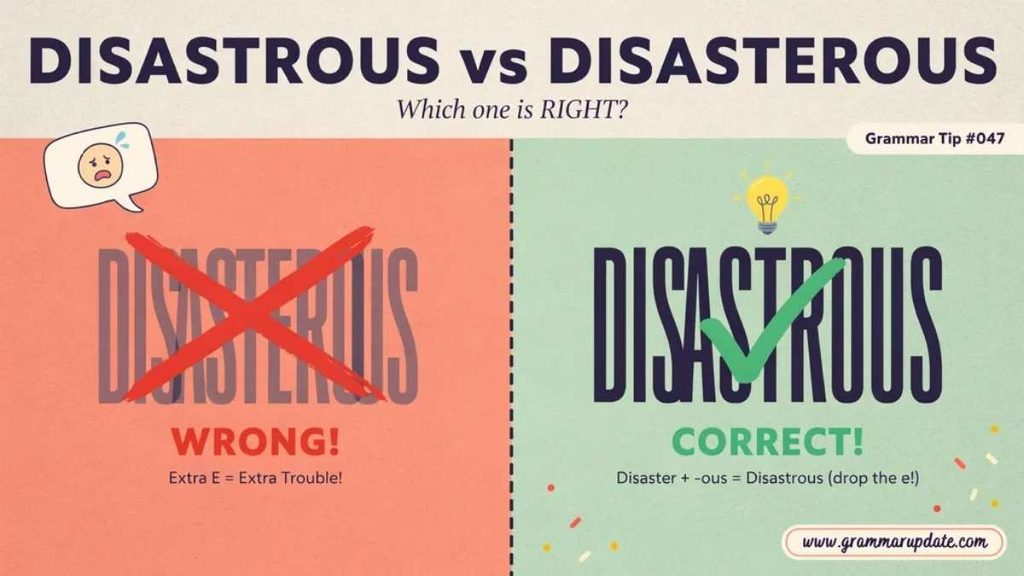
There is no genuine difference in meaning between disastrous vs disasterous because they are not two standard English words with separate definitions.
Instead, the comparison involves one correct word and one incorrect spelling.
| Search or question | Correct answer |
|---|---|
| disastrous meaning | Extremely bad, harmful, damaging, or unsuccessful |
| disasterous meaning | A misspelling of disastrous |
| disastrous definition | Something very bad, harmful, or unsuccessful |
| disasterous definition | Not the standard dictionary form |
| disastrous correct spelling | Disastrous |
| disasterous correct spelling | Disasterous is incorrect |
| correct spelling of disastrous | Disastrous |
Therefore, if someone asks, “What is the difference between disastrous vs disasterous?” the answer is mainly about spelling rather than meaning.
The correct form is disastrous.
Common Spelling Mistakes With Disastrous
The most common spelling mistake is adding the e from disaster.
A writer may type:
The project was disasterous.
The correct sentence is:
The project was disastrous.
Another error occurs when writers remember the noun but forget that the adjective has a different spelling pattern.
The noun is disaster.
The adjective is disastrous.
The adverb is disastrously.
Keeping these three forms together can prevent several related errors.
For example:
1.The event was a disaster.
2.The event had disastrous consequences.
3.The event ended disastrously.
The forms look related because they are related. However, they do not use exactly the same spelling.
Learn the difference between confusing word pairs
Hierarchy vs Heirarchy difference and usage?
Disastrous vs Disasterous Pronunciation
Pronunciation can add another layer to the spelling confusion.
In American English, Cambridge gives the pronunciation of disastrous as /dɪˈzæs.trəs/. Oxford gives the American pronunciation as /dɪˈzæstrəs/.
The word has three syllables in ordinary pronunciation, with the main stress on the middle syllable.
Because the pronunciation does not clearly announce every letter in the written word, trying to spell disastrous entirely by sound can lead to the incorrect disasterous.
That is a common problem in English. Pronunciation and spelling often work together, but they do not always match letter for letter.
For this reason, connect the sound with the visual spelling:
disastrous
Once the spelling becomes familiar, the extra e starts to look just as out of place as it actually is.
Disastrous Synonyms
A disastrous synonym should match the context. Words such as catastrophic, devastating, calamitous, ruinous, destructive, and terrible can overlap with disastrous, but each has its own shade of meaning.
Catastrophic usually emphasizes extremely serious consequences.
Devastating emphasizes severe damage, destruction, or suffering.
Ruinous often focuses on something that causes serious financial or personal damage.
Destructive emphasizes the ability to cause damage or destruction.
Terrible is broader and more conversational.
For example, these sentences are similar but not identical:
1.The company suffered a disastrous financial loss.
2.The company suffered a devastating financial loss.
3.The company suffered a ruinous financial loss.
All three can work, but the emphasis changes slightly.
Cambridge lists fatal among the synonyms associated with disastrous and also provides related vocabulary such as unsuccessful and failed. Oxford lists catastrophic and devastating as synonyms.
Disastrous Synonyms by Context
| Situation | Useful alternative |
|---|---|
| Severe physical damage | devastating |
| Extremely serious consequences | catastrophic |
| Financial destruction | ruinous |
| Physical destruction | destructive |
| Very bad result | terrible |
| Serious misfortune | calamitous |
| Major failure | catastrophic or unsuccessful |
Therefore, do not replace disastrous with a synonym simply because a thesaurus lists it. First consider the exact meaning and tone you need.
Disastrous Antonyms
The opposite of disastrous depends on the situation.
1.For a plan, successful may work best.
2.For an effect, beneficial may be more appropriate.
3.For an outcome, positive or favorable may fit.
4.For a situation, fortunate can sometimes provide the intended contrast.
For example:
The first strategy produced disastrous results, while the revised strategy produced successful results.
The policy had disastrous effects on the business, while the new approach had beneficial effects.
The original outcome was disastrous, but the final outcome was favorable.
This shows why there is not always one perfect disastrous antonym.
Learn the difference between confusing word pairs
Possession vs Posession difference and usage?
How to Remember the Correct Spelling
If you regularly forget how to spell disastrous, use the connection between the noun and adjective.
Remember:
disaster → disastrous
Do not add the entire spelling of disaster before adding ous.
A simple memory sentence is:
A disaster can have disastrous consequences.
This sentence makes the spelling difference visible. The noun keeps its e, while the adjective does not.
Another useful approach is to remember that disastrous ends with trous:
disas + trous
The incorrect version adds an extra e:
disas + terous
That extra e is the spelling trap.
How Do You Spell Disastrous?
If you are searching for how do you spell disastrous, the answer is:
disastrous
The letters are:
D-I-S-A-S-T-R-O-U-S
The incorrect spelling is:
D-I-S-A-S-T-E-R-O-U-S
The second version contains an unnecessary e.
This also answers the related question, how to spell disasterous. If you mean the adjective associated with disaster, spell it disastrous.
Is Disastrous a Word?
Yes. Is disastrous a word is a straightforward question with a straightforward answer: disastrous is a standard English adjective.
Major English dictionaries recognize it and provide definitions, pronunciation information, examples, and related forms. Cambridge identifies it as an adjective meaning extremely bad or unsuccessful, while Oxford defines it as very bad, harmful, or unsuccessful.
The word has a long history in English. Oxford traces disastrous to the late sixteenth century and connects it through French and Italian to the word for disaster.
So there is no reason to hesitate when using disastrous in formal writing.
The spelling is standard.
The adjective is standard.
The meaning is well established.
How to Use Disastrous Correctly
Correct spelling is only half the job. Good writing also requires accurate word usage.
Use disastrous when something is extremely bad, harmful, unsuccessful, or damaging.
For instance:
The company made a disastrous decision.
This sentence works because the decision produced severe negative consequences.
However, calling every small inconvenience disastrous can sound exaggerated.
If your flight arrives ten minutes late, disastrous would usually be too strong unless you are using humor or exaggeration. If the delay causes you to miss an important international connection and lose a major business opportunity, disastrous may be reasonable.
The word therefore carries more weight than ordinary adjectives such as bad, disappointing, inconvenient, or unsuccessful.
That difference helps make your writing more precise.
Learn the difference between confusing word pairs
Guarantee vs Guarentee difference and usage ?
Disastrous vs Disasterous in Formal Writing
Correct spelling becomes especially important in professional and academic writing.
A spelling mistake in an informal message may pass unnoticed. In a report, article, application, assignment, or business document, however, the same mistake can make the writing look less polished.
Consider these examples.
Incorrect:
The company experienced disasterous financial results.
Correct:
The company experienced disastrous financial results.
Incorrect:
The decision could have disasterous consequences.
Correct:
The decision could have disastrous consequences.
Incorrect:
It was a disasterous mistake.
Correct:
It was a disastrous mistake.
The correction is simple, but it makes the writing conform to standard English spelling.
Learn the difference between confusing word pairs
Dumbbell vs Dumbell difference and usage?
The Difference Between Disaster and Disastrous
The noun and adjective are closely connected, yet they perform different jobs.
Disaster refers to an event, situation, or outcome that causes great harm, damage, suffering, or serious difficulty. Cambridge also notes that disaster can describe something that is a complete failure.
Disastrous describes something that is extremely bad, harmful, damaging, or unsuccessful.
Compare these sentences:
The flood was a disaster.
The flood had disastrous consequences.
The first sentence names the event.
The second describes the consequences.
That simple distinction can help you decide whether you need the noun disaster or the adjective disastrous.
Disastrous and Disastrously
The word disastrously is the adverb form.
It describes an action or situation that develops in a disastrous way.
For example:
The project failed disastrously.
The negotiations ended disastrously.
The company performed disastrously during the final quarter.
Cambridge defines disastrously as happening in a way that is disastrous and gives examples involving plans, relationships, projects, and business performance.
The difference is easy to see:
The project was disastrous.
The project failed disastrously.
In the first sentence, disastrous describes the project.
In the second, disastrously describes how the project failed.
Learn the difference between confusing word pairs
Airplane vs Aeroplane difference and usage?
Practice Session Disastrous vs Disasterous
Fill in each blank with the correct form: disastrous vs disasterous.
- The company suffered a __________ financial loss after the failed investment.
- The storm had __________ effects on several coastal communities.
- Their attempt to repair the machine without proper tools was __________.
- The manager made a __________ decision that caused serious problems.
- The project produced __________ results after several major errors.
- The spelling “disasterous” is a common __________ of “disastrous.”
- The team had a __________ start to the championship.
- The accident could have __________ consequences for the entire operation.
- His first attempt at preparing the complicated recipe was __________.
- The new strategy turned out to be __________ for the business.
- The flood caused __________ damage to nearby farmland.
- Missing the deadline had __________ consequences for the company.
- The plan looked promising at first but ended in a __________ failure.
- The incorrect spelling “disasterous” should be replaced with __________.
- The unexpected software error created a __________ situation for the engineers.
- The decision to ignore the safety warning proved __________.
- The campaign experienced a __________ decline in public support after the mistake.
- A __________ mistake during the experiment forced the researchers to start again.
- The restaurant’s opening night was __________ because of several serious problems.
- The company avoided what could have been a __________ financial crisis.
- The hurricane left __________ destruction in its path.
- The project manager admitted that the original plan had been __________.
- The incorrect spelling “disasterous” is not the standard form. The correct spelling is __________.
- Their failure to prepare for the sudden change had __________ results.
- If you are unsure whether to write “disastrous” or “disasterous,” always choose __________.
Answers
- disastrous
- disastrous
- disastrous
- disastrous
- disastrous
- misspelling
- disastrous
- disastrous
- disastrous
- disastrous
- disastrous
- disastrous
- disastrous
- disastrous
- disastrous
- disastrous
- disastrous
- disastrous
- disastrous
- disastrous
- disastrous
- disastrous
- disastrous
- disastrous
- disastrous
Here’s a trusted source for clear word meanings:
FAQs
Can “disastrous” describe a person?
Usually, no. “Disastrous” describes something that causes very bad results, such as an action, decision, event, or situation. For example, you can say, “The decision had disastrous consequences.”
Can “disastrous” describe a decision?
Yes. “Disastrous decision” is a natural phrase for a decision that leads to extremely bad results. For example, “The company made a disastrous decision.”
Is “disastrous” an adjective or a noun?
“Disastrous” is an adjective. It describes a noun, as in “a disastrous mistake,” “disastrous results,” or “a disastrous event.”
What is the noun related to “disastrous”?
The related noun is “disaster.” For example, “The project became a disaster” uses the noun, while “The project had a disastrous outcome” uses the adjective.
What is the adverb form of “disastrous”?
The adverb form is “disastrously.” For example, “The plan failed disastrously.”
Can “disastrous” describe a small mistake?
Yes, but it usually suggests that the mistake produced serious consequences. If the mistake was minor, words such as “unfortunate,” “problematic,” or “incorrect” may be more suitable.
What words commonly come before “disastrous”?
Common phrases include “disastrous consequences,” “disastrous results,” “disastrous effects,” “disastrous decision,” “disastrous mistake,” “disastrous outcome,” and “disastrous failure.”
Can “disastrous” be used in academic writing?
Yes. “Disastrous” can be used in academic writing when the evidence supports a strong description of severe negative results. For a more neutral tone, words such as “harmful,” “negative,” or “adverse” may work better.
Why is “disastrous” spelled without the extra “e”?
The standard spelling is “disastrous,” not “disasterous.” Although the word comes from “disaster,” its adjective form does not retain the extra “e.” This spelling is one reason “disasterous” is a common spelling mistake.
Is “disastrous” related to “disaster”?
Yes. “Disaster” is the related noun, while “disastrous” is the adjective. For example, “The storm was a disaster” uses the noun, while “The storm caused disastrous damage” uses the adjective.
Can “disastrous” and “catastrophic” always be used interchangeably?
Not always. Both words describe extremely serious negative effects, but “catastrophic” often emphasizes exceptionally severe or devastating consequences. The better choice depends on the context.
What is the plural form of “disastrous”?
“Disastrous” does not have a separate plural form because adjectives do not normally change for singular or plural nouns in English. You can say “a disastrous event” and “disastrous events.”
Can “disastrous” describe a financial situation?
Yes. For example, “The company experienced disastrous financial losses.” The word can describe severe financial problems, decisions, results, or consequences.
Can “disastrous” describe an outcome?
Yes. “Disastrous outcome” is a standard phrase for an outcome that produces extremely bad results. For example, “The experiment had a disastrous outcome.”
What is the difference between “disastrous” and “disastrously”?
“Disastrous” is an adjective, while “disastrously” is an adverb. You can write “a disastrous result,” but you would write “the plan failed disastrously.”
Does “disastrous” always refer to a real disaster?
No. “Disastrous” can also describe situations that are not literal disasters. For example, “The interview was disastrous” means that the interview went extremely badly.
What is the correct spelling in American English?
The standard American English spelling is “disastrous.” “Disasterous” is a misspelling rather than an alternative American spelling.
Can “disastrous” describe a failed plan?
Yes. You can say, “The plan was disastrous” or “The plan had disastrous consequences.” The adjective emphasizes how seriously the plan failed or how harmful its results were.
What is the easiest way to remember the spelling of “disastrous”?
Connect the word to “disaster” and remember the correct form as “disastrous.” A useful reminder is: “A disaster can have disastrous consequences.” This helps you avoid adding the unnecessary “e” in “disasterous.”
Learn the difference between confusing word pairs
Foreign vs Foriegn difference and usage?
Conclusion
The difference between disastrous vs disasterous is simple once you remember one thing: disastrous is the correct spelling. Disasterous is a common misspelling, even though that extra “e” can look tempting because of the word disaster.
Use disastrous when you mean something extremely bad, harmful, or unsuccessful. For example, you can describe a disastrous decision, disastrous results, or disastrous consequences. The related word forms are also easy to remember: disaster is the noun, disastrous is the adjective, and disastrously is the adverb.
So, when you are unsure, skip the extra “e” and choose disastrous. That small spelling check can save you from turning a simple writing mistake into a disastrous one.

Jhon AJS, the creative mind behind Grammar Update, is an experienced blogger passionate about simplifying English grammar. He focuses on explaining confusing word vs word differences, grammar rules, punctuation, and sentence structure in a clear and practical way. Through easy to understand guides and examples, Jhon helps readers improve their writing and communicate with confidence. With years of blogging experience, he continues to share helpful insights that make learning grammar simple, useful, and accessible for everyone.