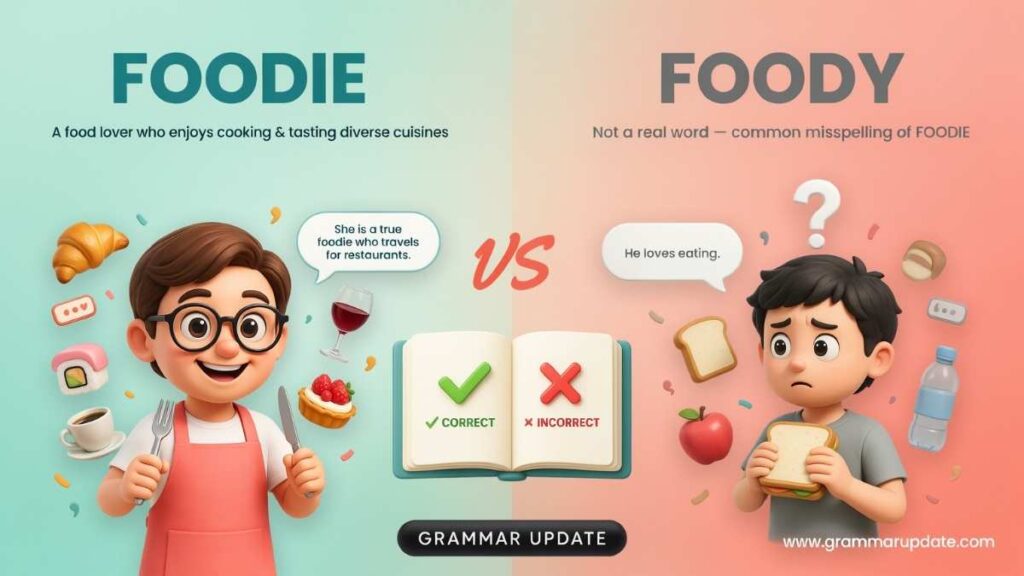
Foodie vs foody can be confusing because both spellings look perfectly reasonable at first glance. If you are writing about someone who loves good food, you might wonder which word belongs in your sentence. Foodie is the more familiar and commonly used form for a person who enjoys exploring dishes, restaurants, cuisines, and cooking. Foody is also recognized, but it is less common in everyday English. That small spelling difference can make you hesitate, especially when you want your writing to look polished. The good news is that the confusion is easy to clear up. Let’s look at both forms and see when each one makes sense.
Quick answer
If you are unsure about foodie vs foody, this table clears up the main difference at a glance. Both forms are recognized, but they differ in familiarity and everyday usage.
| Feature | Foodie | Foody |
|---|---|---|
| Meaning | A person who loves and takes a strong interest in food | A person interested in food |
| Spelling | More familiar | Less common |
| Word type | Noun and adjective | Noun and adjective |
| Common usage | Widely used | Less frequently used |
| Best general choice | Yes | Alternative form |
In short, both foodie and foody can be correct. However, foodie is the more familiar choice for general English writing.
Fix common more word mistakes in English
Drier vs Dryer Which one Is Correct?
Foodie vs Foody The Simple Answer
When people search for foodie vs foody which is correct, they often expect one spelling to be right and the other to be wrong. The actual situation is more nuanced.
Foodie is the widely recognized spelling for a person who has an enthusiastic interest in food. Foody is also an established spelling, although it appears less often in everyday writing.
| Word | Main meaning | Typical use | General familiarity |
|---|---|---|---|
| Foodie | A person strongly interested in food | Noun and adjective | Very familiar |
| Foody | Another spelling of foodie | Noun and adjective | Less familiar |
| Food lover | Someone who loves food | Noun phrase | Very familiar |
| Food enthusiast | Someone with a strong interest in food | Noun phrase | Neutral and polished |
Therefore, if the question is is foodie vs foody correct, the answer is that both have dictionary support. However, foodie is generally the more recognizable choice.
What Does Foodie Mean?
The foodie meaning is simple: a foodie is a person who loves food and takes a particular interest in different types of food.
Cambridge defines foodie as a person who loves food and is very interested in different kinds of food. Collins describes foodies as people who enjoy cooking and eating different kinds of food. Oxford gives a similar definition, describing a foodie as someone very interested in cooking and eating different kinds of food.
In other words, a foodie does more than simply eat when hungry. Food becomes an interest, hobby, or source of curiosity.
Someone might spend a Saturday looking for a new restaurant, then spend Sunday testing a homemade pasta recipe. Another person might plan vacations around local dishes and traditional markets. Both could naturally be described as foodies.
Foodie Definition and Meaning
The foodie definition can be summarized as follows:
Foodie is a noun for a person who has a strong and enthusiastic interest in food, especially eating, cooking, restaurants, or different cuisines.
The word does not mean that someone eats unusually large amounts of food. That is an important distinction.
A person can have a small appetite and still be a passionate foodie. The defining idea is interest rather than quantity.
For example, someone who studies regional cooking methods, searches for unusual ingredients, and enjoys trying unfamiliar dishes may be a foodie even if they eat small portions.
Foodie as a Noun
The most familiar foodie word usage is as a noun.
Consider these sentences:
Maria is a foodie who loves exploring local restaurants.
My brother became a foodie after learning how to cook.
The restaurant has become popular with local foodies.
She calls herself a foodie because she enjoys trying dishes from different cultures.
In each sentence, foodie identifies a person.
The plural form is foodies. This is an important spelling detail because foodys is not the standard plural form.
| Singular | Plural |
|---|---|
| foodie | foodies |
| a foodie | several foodies |
| one foodie | many foodies |
Collins specifically lists foodies as the plural form.
Foodie as an Adjective
Although foodie is commonly introduced as a noun, it can also work as an adjective.
Cambridge lists an adjective use meaning suitable for or relating to people who love food and are very interested in different types of food.
For example:
The city has become a popular foodie destination.
The restaurant is part of the local foodie scene.
The festival attracts a large foodie crowd.
The neighborhood has developed a lively foodie culture.
Here, foodie describes something associated with people who are enthusiastic about food.
That means the idea that foodie can only be a noun is too limited. Its modern usage is broader.
Learn the difference between confusing word pairs
Patient vs Patience which one is correct ?
What Does Foody Mean?
The foody meaning is closely connected to foodie because dictionaries treat the two forms as variants.
Cambridge defines foody as another spelling of foodie and identifies it as both a noun and an adjective. Oxford lists foody as an informal noun and gives foodie as its alternative form.
So, if you see foody in English writing, you should not automatically assume that the writer made a spelling error.
Foody Definition
A practical foody definition is:
Foody is an alternative spelling of foodie for a person interested in cooking and eating different kinds of food. It can also appear as an adjective for something associated with people who have a strong interest in food.
Oxford specifically records foody as an informal noun for someone very interested in cooking and eating different kinds of food.
Foody as a Noun
As a noun, foody can refer to a person who has a strong interest in food.
For example:
I am a foody who enjoys experimenting with new recipes.
She describes herself as a foody.
The word is understandable in these sentences, and dictionary evidence supports this use. However, many readers are more accustomed to foodie.
That difference in familiarity matters when you are choosing vocabulary for a broad audience.
Foody as an Adjective
Foody can also appear as an adjective.
Cambridge gives adjective usage for both foodie and foody. It describes this use as relating to or suitable for people who love food and are particularly interested in different types of food.
For example:
The city has a lively foody culture.
The area has become popular with foody travelers.
They enjoy exploring the foody side of the city.
These sentences are possible, but foodie may sound more natural to many readers.
Learn the difference between confusing word pairs
Minuscule vs Miniscule which one is correct ?
Foodie vs Foody What Is the Difference?
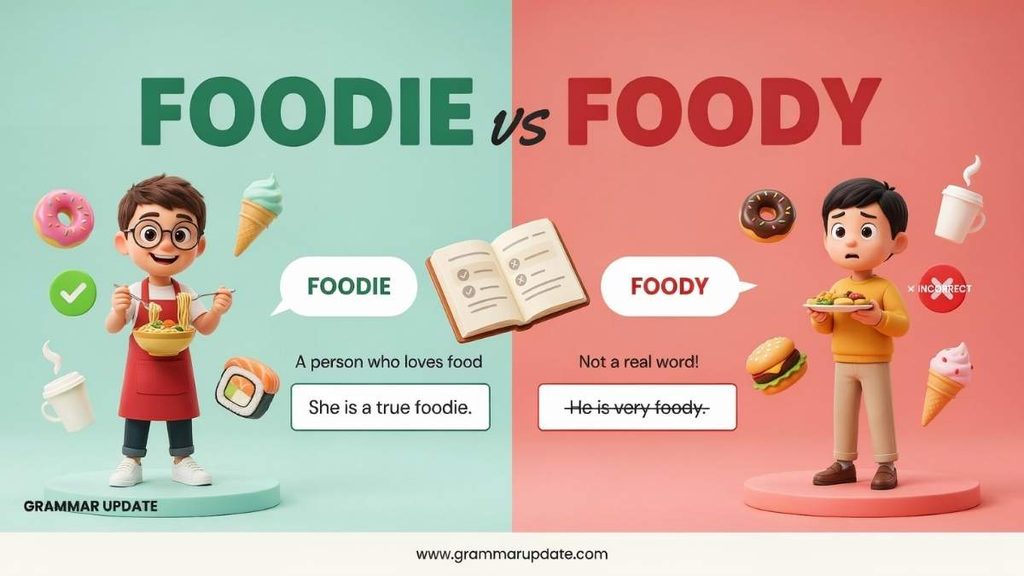
The main foodie vs foody difference is not a simple correct-versus-incorrect spelling rule.
Both forms are recognized.
Instead, the difference is mainly about familiarity, frequency, and word choice.
Cambridge lists foody as another spelling of foodie. Collins also gives foody as a variant. Oxford lists foody as an informal noun and identifies foodie as the alternative form.
This means that calling foody an outright misspelling would create more confusion rather than clear it up.
| Point of comparison | Foodie | Foody |
|---|---|---|
| Dictionary status | Established word | Established variant |
| Meaning | Person interested in food | Same basic meaning |
| Noun use | Yes | Yes |
| Adjective use | Yes | Yes |
| Plural noun | foodies | foodies |
| Familiarity | Higher | Lower |
| General writing choice | Usually preferred | Less common alternative |
Therefore, the difference between foodie and foody is largely one of common usage and reader familiarity.
Learn the difference between confusing word pairs
Fascinating vs Facinating difference and usage?
Is Foodie the Correct Spelling?
Yes. Foodie is a correct and established English word.
In fact, it is the form most readers will recognize immediately when you describe someone who is enthusiastic about food.
Collins lists foodie as a noun and gives foody as another form. Cambridge also lists foodie as the main entry and identifies foody as an alternative spelling.
If you are writing an article, restaurant description, travel guide, social media caption, or general piece of American English, foodie is usually the clearest choice.
For example:
She is a foodie who loves discovering hidden restaurants.
That sentence feels natural because the word matches common English usage.
Foodie Spelling and Word Formation
The foodie spelling comes from food plus the informal ending -ie. Collins identifies the word origin as food + -ie and notes that the formation may have been influenced partly by junkie.
That history helps explain why the word is spelled foodie rather than simply foody.
English contains many informal nouns ending in -ie. Consequently, foodie fits a broader pattern of word formation rather than simply following the spelling of its base word.
This is also why someone who sees food + y might reasonably wonder whether foody should be the natural form. It looks logical. Nevertheless, English spelling does not always work that neatly.
Learn the difference between confusing word pairs
Concede vs Conceed difference and usage?
Can Foody Be Used in English?
Yes. Foody can be used in English, and major dictionaries support it.
Cambridge calls it another spelling of foodie. Oxford lists it as an informal noun, while Collins records it as a variant.
Therefore, the statement “foody is always wrong” is not accurate.
At the same time, dictionary recognition does not mean that both forms are equally common in every situation.
Think of it this way: two roads may lead to the same destination, but one may be much more familiar to most drivers. The same principle can apply to vocabulary.
Foodie is the familiar road.
Foody is the less familiar alternative.
Is Foody a Correct Word?
Yes. It has dictionary support.
Is Foody Grammatically Correct?
Yes, when it is used according to its documented noun or adjective meaning.
Is Foody the Most Common Choice?
Not necessarily. Foodie is generally the more familiar form for readers.
That distinction is the key to understanding the foodie vs foody spelling question.
Learn the difference between confusing word pairs
Aluminum vs Aluminium difference and usage?
Foodie vs Foody Examples
Examples make the difference easier to see because they show how the words behave in real sentences.
Foodie Example
She is a foodie who loves trying new cuisines.
Here, foodie is a noun referring to a person.
Another Foodie Example
My friend became a foodie after taking a professional cooking course.
Again, the word identifies someone with a strong interest in food.
Foodie in a Sentence
The city is a perfect destination for any foodie who enjoys international cuisine.
In this example, foodie refers to someone who actively enjoys exploring food.
Foody Example
I am a foody, and I love cooking for myself.
Cambridge uses a similar example to demonstrate the alternative spelling.
Foody in a Sentence
His enthusiasm for everything foody is easy to notice.
This type of adjective use is also supported by Cambridge’s dictionary entry.
The important point is that foody can work. However, foodie is likely to feel more familiar to a wider group of readers.
Learn the difference between confusing more English words
Guidance vs Guidence difference and usage ?
Foodie vs Foody Usage in American English
American English commonly uses foodie to describe someone who is especially interested in food.
Collins identifies an American English use of foodie as an informal term for a person keenly interested in food, especially eating or cooking. It also records foodie as a British English noun with foody as an alternative.
That does not mean foody belongs only to British English. Cambridge and Oxford recognize foody as an English variant without presenting it as an exclusively British form.
Therefore, it would be misleading to create a strict rule such as “American English uses foodie while British English uses foody.”
The reality is more flexible.
Both forms exist, while foodie is generally the more familiar choice.
Foodie vs Foody Compared With Food Lover
Sometimes the easiest way to understand foodie is to compare it with related expressions.
Food lover is straightforward. It simply describes someone who loves food.
Food enthusiast sounds slightly more polished and neutral.
Foodie is more informal and often suggests active curiosity about food, cooking, restaurants, or cuisines.
Gourmet can carry a more specialized meaning. It may refer to someone interested in sophisticated or high-quality food, or to food itself when describing quality or preparation.
Connoisseur suggests deeper knowledge or refined judgment.
| Expression | Main idea | Typical tone |
|---|---|---|
| Foodie | Strong interest in food and food experiences | Informal |
| Food lover | Someone who loves food | Simple and broad |
| Food enthusiast | Someone strongly interested in food | Neutral |
| Gourmet | Interest in sophisticated or high-quality food | More specialized |
| Connoisseur | Knowledgeable and discerning about something | Formal |
So, foodie does not always mean gourmet.
For example, someone may proudly call themselves a foodie because they enjoy street food, home cooking, or regional dishes. They do not need to focus on expensive restaurants or fine dining.
Learn the difference between confusing more English words
Fluorescent vs Flourescent difference and usage ?
Common Confusion About Foodie and Foody
One common mistake is assuming that the spelling must be foody simply because the base word is food.
At first glance, food + y seems perfectly reasonable. However, established English vocabulary does not always follow the most obvious spelling pattern.
Another mistake is assuming that foodie means someone who eats a lot. It does not. The word focuses on interest and enthusiasm.
Someone might have a modest appetite while knowing an impressive amount about cooking techniques, ingredients, restaurants, or international cuisine.
There is also confusion about whether a foodie must be a chef. That is not the case either.
A chef works professionally with food. A foodie simply has a strong personal interest in it.
The distinction is important because professional skill and personal enthusiasm are not the same thing.
Foodie and Foody Plural Forms
The plural form often causes another spelling problem.
The correct plural of foodie is foodies.
For example:
The restaurant has become popular with foodies.
The festival attracted foodies from across the city.
Many foodies enjoy trying dishes they have never tasted before.
The form foodys is incorrect in standard usage.
Collins explicitly gives foodies as the plural form of foodie.
The same plural pattern applies to the variant spelling when it is used as a noun. Collins lists the British noun form with the plural ending -ies.
Learn the difference between confusing more English words
Lose vs Loose difference and usage?
Foodie Usage in Everyday Writing
Foodie appears naturally in many modern contexts.
You may see it in restaurant reviews, travel articles, food blogs, social media posts, event descriptions, and casual conversations.
For example:
The coastal town has become a foodie destination.
The restaurant is popular with local foodies.
She follows several foodie accounts online.
The festival brings together foodies, chefs, and local producers.
The city has a growing foodie scene.
These expressions work because foodie has developed into a familiar part of modern food terminology.
The word also works well in informal conversation because it is short, friendly, and immediately understandable.
Foody Usage in Everyday Writing
Foody appears less often, but it can still be meaningful.
For example:
The neighborhood has a strong foody culture.
She considers herself a foody.
The guide explores the city’s foody side.
These examples can be understood without difficulty. Nevertheless, some readers may instinctively expect foodie.
That is the practical issue with the foody word. Its existence is not the problem. Its lower familiarity is what can make the spelling look unusual.
Learn the difference between confusing more English words
Principal vs Principle Difference and usage ?
practice session Foodie vs Foody
Complete each sentence with the correct word or form: foodie, foody, foodies, or another appropriate word based on context.
- Sarah is a real ______ who loves trying new restaurants.
- The city has become a popular destination for ______ from around the country.
- My brother is a ______ because he enjoys cooking and exploring new cuisines.
- The restaurant attracts many local ______ every weekend.
- If you mean a person who has a strong interest in food, ______ is the more familiar spelling.
- Cambridge recognizes ______ as another spelling of foodie.
- She considers herself a ______ because she loves experimenting with different recipes.
- The festival attracted hundreds of ______ interested in local cuisine.
- A person who loves exploring food and restaurants can be called a ______.
- The plural form of foodie is ______.
- She is a ______ who plans her vacations around local food.
- The word ______ is more familiar to most readers than foody.
- He became a ______ after developing an interest in international cooking.
- Many ______ enjoy discovering small restaurants that serve traditional dishes.
- The city has a lively ______ culture.
- The word foody can function as both a noun and an ______.
- Someone who loves food but does not cook professionally can still be a ______.
- The restaurant guide was written for local ______.
- If you want the most widely recognized spelling, choose ______.
- The sentence “She is a ______ who loves Italian cuisine” uses the word as a noun.
- The sentence “The city is a popular ______ destination” uses foodie as an adjective.
- Someone who is interested in food, cooking, and different cuisines can be described as a food ______.
- The spelling ______ is recognized as an alternative form of foodie.
- A person does not need to be a professional chef to be a ______.
- When writing for a broad audience, ______ is usually the clearest choice for a person who loves food.
Answers
- foodie
- foodies
- foodie
- foodies
- foodie
- foody
- foodie
- foodies
- foodie
- foodies
- foodie
- foodie
- foodie
- foodies
- foodie
- adjective
- foodie
- foodies
- foodie
- foodie
- foodie
- enthusiast
- foody
- foodie
- foodie
Here’s a trusted source for clear word meanings:
FAQs
Is foodie vs foody the correct spelling?
Both foodie and foody are recognized English spellings. However, foodie is the more familiar choice in everyday English. It commonly refers to someone who has a strong interest in food, cooking, restaurants, or different cuisines.
What does foodie mean?
Foodie describes a person who has a strong interest in food. A foodie may enjoy trying new dishes, visiting different restaurants, exploring cuisines, or experimenting with recipes. The person does not need to be a professional chef.
Is foody a real word?
Yes, foody is a real English word. Dictionaries recognize it as a variant of foodie. However, it is less familiar to many readers, so foodie is usually the clearer choice in general writing.
What does foody mean?
Foody refers to someone who is particularly interested in food. It can also describe something connected with food, depending on the sentence. Although the word is valid, foodie is more common in everyday use.
What is the difference between foodie and foody?
Foodie and foody have essentially the same basic meaning when they describe a person interested in food. The main difference is usage. Foodie is much more familiar to most English speakers, while foody is an alternative form that appears less often.
What do you call a person who loves food?
You can call a person who loves food a foodie. The term usually suggests more than simply enjoying meals. A foodie often takes an active interest in discovering new dishes, cuisines, restaurants, ingredients, or cooking techniques.
What makes someone a foodie?
A person can be called a foodie when food becomes a genuine interest or hobby. For example, they may enjoy exploring new restaurants, learning about different cuisines, trying unfamiliar dishes, or experimenting with recipes at home.
Can foodie be used as an adjective?
Yes, foodie can be used as an adjective in some contexts. For example, “The city has a lively foodie culture.” It is also commonly used as a noun, as in “She is a dedicated foodie.”
What is the plural of foodie?
The plural form of foodie is foodies. For example, “The food festival attracted thousands of foodies.” The spelling foodys is not the standard plural form.
Can you use foodie in a sentence?
Yes. For example, “James is a foodie who loves trying dishes from different cultures.” In this sentence, foodie is a noun that describes someone with a strong interest in food.
Is foodie an informal word?
Yes, foodie is generally an informal and conversational term. It works well in everyday conversations, blogs, social media posts, restaurant reviews, and other casual contexts. More formal writing may use terms such as food enthusiast or food connoisseur when appropriate.
Is foody another spelling of foodie?
Yes, foody is recognized as another spelling of foodie. However, foodie is the more familiar form. Therefore, if you are writing for a broad audience, foodie will usually make your meaning clearer immediately.
What is another word for foodie?
Depending on the context, you can use food lover, food enthusiast, gourmet, or food connoisseur. These terms are related, but they are not always interchangeable. For example, connoisseur can suggest specialized knowledge, while food lover is a broader and simpler expression.
How do you use foodie correctly?
Use foodie to describe someone who has a strong interest in food, cooking, restaurants, or different cuisines. For example, “My sister is a foodie who loves exploring local restaurants.” The word normally describes a person rather than a particular dish.
Is foodie spelled correctly?
Yes, foodie is spelled correctly. It is the more familiar spelling for a person who has a strong interest in food. If you are choosing between foodie and foody for general writing, foodie will usually be the more recognizable option.
Is foody or foodie better for everyday writing?
Foodie is generally the better choice for everyday writing because it is more familiar to readers. Foody is also a recognized form, but it may look unusual to people who are accustomed to seeing foodie. When clarity matters, foodie is the straightforward choice.
Learn the difference between confusing more English words
Your vs You’re Difference and which is correct ?
Conclusion
Foodie vs foody may look like a tiny spelling battle, but those two little letters can still make you pause mid-sentence. The good news is that the confusion is easy to clear up. Both foodie and foody are recognized English forms, and both can describe someone with a strong interest in food. However, foodie is the more familiar choice in everyday writing.
So, if you are writing about someone who loves exploring restaurants, trying new dishes, or talking about food with almost heroic enthusiasm, foodie is the safe pick. Remember the simple rule: when in doubt, choose foodie. Your sentence will be clear, your spelling will stay on the right track, and your reader can get back to the important business of thinking about dinner.

Jhon AJS, the creative mind behind Grammar Update, is an experienced blogger passionate about simplifying English grammar. He focuses on explaining confusing word vs word differences, grammar rules, punctuation, and sentence structure in a clear and practical way. Through easy to understand guides and examples, Jhon helps readers improve their writing and communicate with confidence. With years of blogging experience, he continues to share helpful insights that make learning grammar simple, useful, and accessible for everyone.