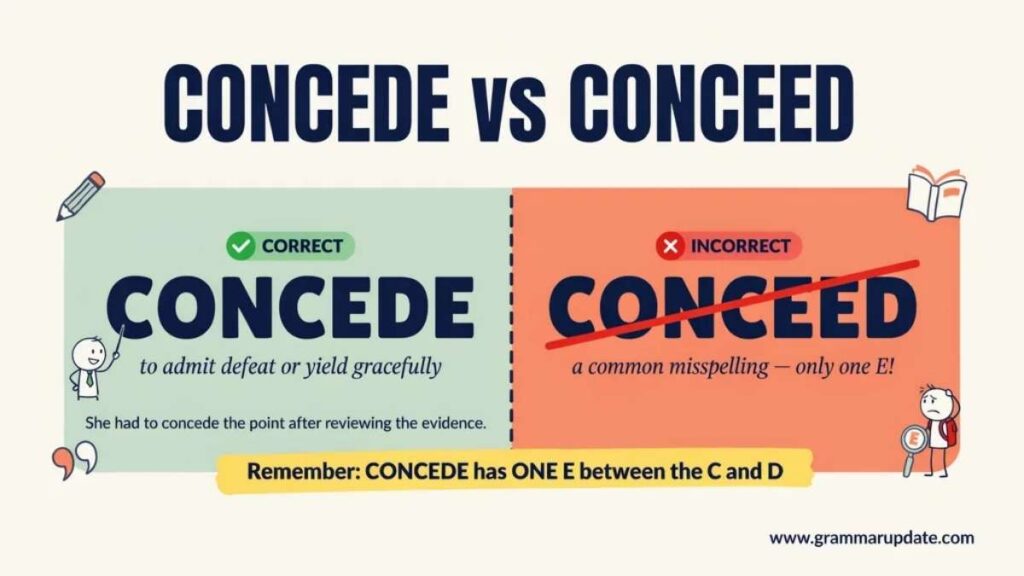
Concede vs conceed look almost identical, but only one is correct. That extra “e” in conceed may seem harmless, yet it turns the word into a spelling mistake. The correct word is concede. It can mean admitting that something is true, accepting someone’s point, giving something up, or accepting defeat. The meaning depends on the situation, but the spelling remains the same. In this guide, you will learn the difference between concede vs conceed, understand what concede means, and see how to use it correctly in everyday writing. By the end, this small spelling confusion should be easy to clear up.
quick answer
| Word | Correct spelling? | Meaning | Example |
|---|---|---|---|
| concede | Yes | Admit, acknowledge, yield, or accept defeat | I concede that you are right. |
| conceed | No | Incorrect spelling of concede | Do not write conceed. |
| conceded | Yes | Past tense and past participle of concede | She conceded that she was wrong. |
| conceding | Yes | Present participle of concede | He is conceding the point. |
| conceited | Yes | Having an excessively high opinion of yourself | He is too conceited to listen. |
So, when choosing between concede vs conceed, always use concede.
The word appears in several important contexts. You can concede a point in an argument, concede defeat in a competition, concede a goal in football, or concede some authority during a negotiation. Although these uses look different, they share the basic idea of admitting, allowing, or giving way.
Learn the difference between confusing word pairs
Colleague vs Colleage which one is correct ?
What Does Concede Mean?
What does concede mean? In simple terms, concede means to admit that something is true, accept that you have lost, or allow something to another person or side.
The word often suggests that the person did not necessarily want to accept the situation. Someone may concede a point because the evidence is convincing. A team may concede defeat because the result is no longer realistically in doubt. A company may concede some authority during negotiations because reaching an agreement requires compromise.
The Cambridge Dictionary defines concede as admitting, often unwillingly, that something is true. It also defines the word as allowing someone to have something and accepting that you have lost a competition. The Oxford Advanced Learner’s Dictionary gives similar meanings and notes that the word can involve admitting that something is true or logical, giving something away, or admitting defeat.
This gives us three useful meanings.
First, concede can mean to admit something is true.
For example:
“I concede that your explanation makes sense.”
Second, it can mean to accept defeat.
For example:
“The team conceded defeat after the final round.”
Third, it can mean to give or allow something.
For example:
“The company conceded some authority to its regional office.”
The surrounding words usually make the intended meaning obvious.
Concede Definition
A clear concede definition is: to admit that something is true or correct, to accept that you have lost, or to give or allow something, often reluctantly.
The word is a verb, so it describes an action rather than a person or quality.
Consider these examples:
“She conceded that the report contained an error.”
“The player conceded defeat.”
“The company conceded some control to its partner.”
Each sentence uses concede differently. In the first sentence, the person admits a fact. And In the second, the player accepts a loss. In the third, the company gives up part of its control.
This is why simply memorizing one short definition can be limiting. The word changes slightly with context, but its central idea remains connected to acceptance or yielding.
Learn the difference between confusing word pairs
Fascinating vs Facinating difference and usage?
What Does Concede Mean in English?
If you are looking for the general concede meaning in English, think of the word as a formal way of saying “admit,” “acknowledge,” “accept,” or “give way,” depending on the situation.
It is especially common in discussions where one person or side has resisted something before finally accepting it.
For example:
“After reviewing the evidence, he conceded that the criticism was fair.”
The sentence does not necessarily mean that he happily agreed. Instead, it suggests that the evidence made it difficult for him to continue rejecting the point.
That subtle difference is useful. Admit can work in ordinary conversation, while concede often sounds more deliberate or formal.
Compare these sentences:
“I admit that I made a mistake.”
“I concede that your argument is stronger.”
Both are correct, but they do not have exactly the same tone.
The first sounds natural in everyday conversation. The second fits more naturally into a debate, formal discussion, negotiation, or written argument.
What Does Concede Mean in Football?
The phrase concede meaning in football is particularly common because sports writers frequently use the word when describing goals and points.
In football, to concede a goal means to allow the opposing team to score.
For example:
“The home team conceded a goal just before halftime.”
This means that the opposing team scored against the home team.
The word does not necessarily mean that the defenders deliberately allowed the goal. It simply describes the event from the perspective of the team that allowed the score.
The Cambridge Dictionary specifically defines concede a goal or point as failing to stop an opposing team or person from winning a point or game.
You might therefore read sentences such as:
“The goalkeeper conceded two goals.”
“The defense conceded a late goal.”
“The team has conceded only three goals this season.”
In each example, concede refers to the score given to the opponent.
What Does Concede a Goal Mean?
What does concede a goal mean? It means that a team allows the opposing team to score.
Suppose Team A is playing Team B. Team B scores in the 80th minute. From Team A’s perspective, Team A has conceded a goal.
You could say:
“Team A conceded a goal in the final ten minutes.”
You could also say:
“Team A conceded three goals during the match.”
The word is therefore closely connected with football, soccer, goals, defense, opponents, matches, and scores.
Concede Meaning in Sports
The concede meaning in sports extends beyond football.
Depending on the sport, a player or team can concede a point, goal, game, or sometimes an entire contest. The basic idea remains the same: the opposing side has gained something that the player or team failed to prevent or has accepted.
For example:
“The player conceded the final point.”
“The team conceded two goals.”
“The champion refused to concede defeat.”
Sports commentators often use concede because it communicates more than simply “lost.” It can describe a specific point or goal as well as the broader acceptance of defeat.
Learn the difference between confusing word pairs
Changeable vs Changable Which one Is Correct?
What Does Concede Defeat Mean?
What does concede defeat mean? It means to accept that you have lost.
Someone who concedes defeat stops claiming that they can still win or acknowledges that the other side has prevailed.
For example:
“After losing the final round, the player conceded defeat.”
Here, the player accepts the result.
The phrase can appear in sports, elections, arguments, competitions, and other situations involving opposing sides.
The Cambridge Dictionary gives “concede defeat” as admitting that you have lost a fight, argument, game, or similar contest.
Concede defeat does not always mean physically surrendering. A person can concede defeat simply by acknowledging the result.
That distinction matters because concede and surrender overlap in some situations but are not always interchangeable.
What Does Conceded Defeat Mean?
What does conceded defeat mean? It means that someone accepted a loss in the past.
Conceded is the past tense and past participle of concede.
For example:
“She conceded defeat after the final results were announced.”
“The team conceded defeat after falling too far behind.”
“He finally conceded defeat in the debate.”
The meaning is straightforward: the person or team accepted that the other side had won.
You can also use concede without the word defeat when the context already makes the result clear.
For example:
“After the final round, he conceded.”
In this sentence, the reader understands that he accepted the loss.
Concede vs Conceited
The Concede vs conceited is a different spelling and meaning issue from concede vs conceed.
Concede is a verb.
Conceited is an adjective.
Concede means to admit, acknowledge, yield, or accept defeat. Conceited means having an excessively high opinion of yourself.
Compare these sentences:
“She conceded that her opponent had made a stronger argument.”
“She was too conceited to admit that her opponent had made a stronger argument.”
The first sentence describes an action. The second describes a personality trait.
This is the easiest way to remember the difference.
Concede means accepting something.
Conceited describes excessive self-pride.
Concede vs Conceited Meaning
The concede vs conceited meaning can be reduced to two simple ideas.
Concede means to admit, acknowledge, allow, or accept defeat.
Conceited means overly proud or too pleased with yourself.
For example:
“I concede that you were right.”
“He is conceited and rarely accepts criticism.”
The words may look similar at first glance, but they belong to different grammatical categories and perform different jobs in a sentence.
Learn the difference between confusing word pairs
Acknowledge Vs Acknowlege Which one Is Correct?
Conceded vs Conceited
The difference becomes slightly trickier when comparing conceded vs conceited.
Conceded is the past form of concede.
Conceited is an adjective.
For example:
“She conceded that the evidence was convincing.”
“She sounded conceited during the discussion.”
The first sentence says that she admitted something. The second says that she appeared overly proud of herself.
This means conceded or conceited is not really a spelling choice. You need to choose the word based on the meaning you want.
Consider another pair:
“The team conceded two goals.”
“The player seemed conceited after scoring two goals.”
The first sentence describes what happened during the match. The second describes the player’s attitude.
What Is the Difference Between Conceded and Conceited?
The difference between conceded and conceited is both grammatical and semantic.
Conceded is a verb form. It tells you that someone admitted, accepted, or allowed something.
Conceited is an adjective. It describes someone who thinks very highly of themselves.
If you can replace the word with “admitted” or “accepted,” conceded may be correct.
If you are describing someone as overly proud, conceited is the correct word.
Learn the difference between confusing more English words
Dilemma vs Dilema which one is correct ?
Why Is Conceed Incorrect?
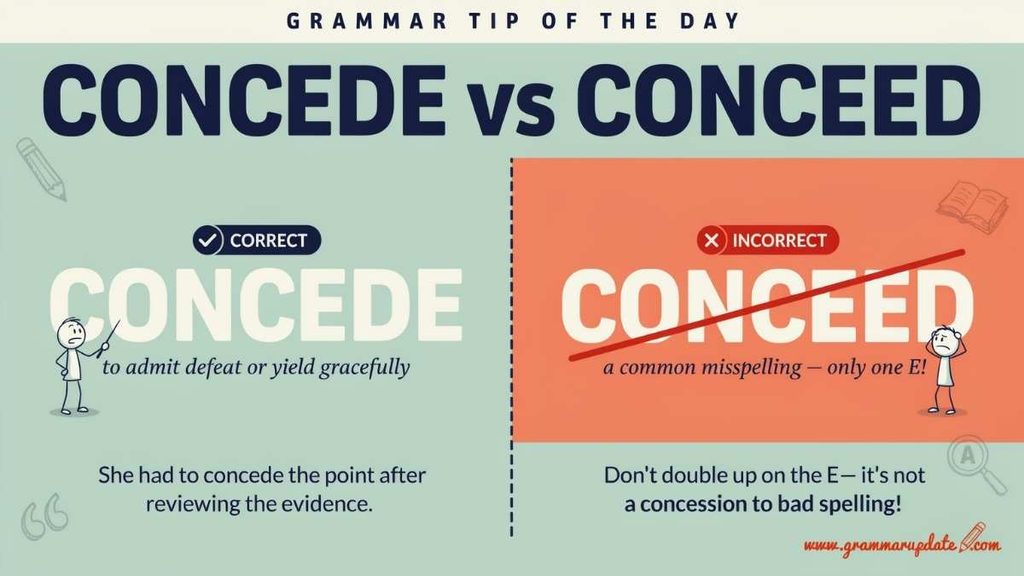
Conceed is incorrect because the standard English spelling is concede.
The mistake is understandable. English contains several common words ending in “-ceed,” including proceed, exceed, and succeed. That can make conceed look convincing.
However, spelling patterns do not always transfer from one word to another.
The correct spelling is:
concede
The incorrect spelling is:
conceed
The extra e in conceed does not belong there.
The same issue appears in the past tense. The correct form is conceded, not conceeded.
This gives you a useful spelling family:
concede
concedes
conceded
conceding
concession
The Oxford dictionary lists the standard forms as concede, concedes, conceded, and conceding.
How to Spell Concede
If you are wondering how to spell concede, remember the base form as concede.
It contains one e after the c and one final e:
c-o-n-c-e-d-e
The easiest mistake to avoid is adding another e before the final d.
Incorrect: conceed
Correct: concede
A quick memory trick is to connect the spelling with the related word concession. Both belong to the same word family.
Concede becomes conceded in the past tense:
concede → conceded
It becomes conceding in the present participle:
concede → conceding
The final e drops before the “-ing” ending, which is a familiar spelling pattern in English.
How to Spell Conceded
The correct spelling is conceded.
Incorrect:
“The team conceeded three goals.”
Correct:
“The team conceded three goals.”
When you add the past-tense ending to concede, you do not keep two e’s before the d.
The correct form is:
concede → conceded
Not:
concede → conceeded
This is an important distinction because conceeded can look plausible at a quick glance. Once you know that the correct form is conceded, however, the error becomes much easier to spot.
Concede vs Conceded
The Concede vs conceded is mainly a question of verb form.
Concede is the base form.
“I concede that your argument is reasonable.”
Conceded is the past tense.
“I conceded that your argument was reasonable.”
Conceded is also the past participle.
“She has conceded that the plan needs revision.”
The meaning stays closely related. The grammatical form changes according to the sentence.
The same pattern appears in sports.
1.“The team may concede a goal.”
2.“The team conceded a goal.”
3.“The team has conceded a goal.”
The first uses the base form. The second uses the past tense. The third uses the past participle.
Conceding and Its Meaning
Conceding is the present participle of concede. Cambridge identifies conceding as the present participle of concede.
For example:
“He is conceding the point.”
“She is conceding that the criticism is fair.”
“The team is conceding too many goals.”
The spelling is conceding, not conceeding.
This is another reason learning the entire word family helps. Instead of memorizing isolated spellings, you can recognize how the forms connect:
concede
conceded
conceding
concession
Learn the difference between confusing more English words
Definite vs Definitive difference and usage?
Concede Meaning in an Argument
The concede meaning in an argument is to admit that another person has made a valid point or that a particular fact is true.
For example:
“I concede that your calculation is correct.”
This does not necessarily mean the speaker agrees with the entire argument. The speaker may accept one specific point while continuing to disagree with the larger conclusion.
That is an important distinction.
Imagine two people discussing whether a new plan will save money. One person proves that the plan will reduce expenses. The other might say:
“I concede that the plan will save money, but I still have concerns about the schedule.”
The speaker has conceded one point without abandoning the entire position.
Oxford describes this use of concede as admitting that something is true or logical, often after initially resisting it.
What Does It Mean to Concede a Point?
To concede a point means to admit that another person’s particular point is correct or reasonable.
For example:
“I concede your point about the cost.”
This means the speaker accepts that the other person has made a valid observation.
You can still disagree with the overall argument.
That is why concede is useful in debates and discussions. It allows a speaker to recognize a valid point without automatically accepting every conclusion connected to it.
What Does It Mean to Concede an Argument?
To concede an argument generally means to accept that the other side has won or established its position.
This is stronger than conceding a single point.
Compare:
“I concede that point.”
This accepts one specific claim.
“I concede the argument.”
This suggests broader acceptance that the other side has prevailed.
Can Concede Mean Admit?
Yes. Can concede mean admit? In many situations, it can.
For example:
“She conceded that she had made an error.”
This is close in meaning to:
“She admitted that she had made an error.”
However, the two words can have slightly different tones.
Oxford explains that concede is often used when someone accepts something unwillingly, especially when accepting a fact or logical point. Admit has a wider everyday use and can refer to acknowledging a mistake, fault, or unpleasant truth.
That means concede is often a good choice when the person has resisted the point before accepting it.
For example:
“After seeing the evidence, he conceded that she was right.”
The sentence suggests a change from resistance to acceptance.
Concede vs Admit
Concede and admit overlap, but they are not identical in every situation.
Admit is common in everyday English.
Concede often sounds more formal and is especially useful when discussing an argument, competition, negotiation, or opposing position.
For example:
“I admit that I forgot the appointment.”
This sounds natural in everyday conversation.
“I concede that your argument is stronger.”
This sounds more natural in a formal discussion.
The distinction is not absolute. Both words can mean acknowledging something as true. The surrounding context determines which one sounds more natural.
Learn the difference between confusing more English words
Disappoint vs Disapoint difference and usage?
Can Concede Mean Surrender?
Can concede mean surrender? Sometimes, but the two words are not exact substitutes.
Surrender usually suggests giving up resistance, control, or an attempt to win. Concede can describe accepting defeat or yielding something without suggesting complete surrender.
For example:
“The team conceded defeat.”
This means the team accepted that it had lost.
“The soldiers surrendered.”
This carries a much stronger sense of giving up resistance.
Similarly, a company might concede some authority without surrendering all control.
“The company conceded some power to the board.”
This means it gave the board more authority. It does not necessarily mean that the company completely gave up control.
Concede Synonyms
The best concede synonym depends on the meaning of the sentence.
1.When concede means admit or acknowledge, useful alternatives include admit, acknowledge, recognize, accept, and agree.
2.When it means give something to another person or side, grant, allow, yield, and give way may work.
3.When it means accept defeat, yield, surrender, give in, and accept defeat may be suitable in particular contexts.
These words should not be treated as interchangeable in every sentence.
For example:
“I concede that you are right.”
can often become:
“I admit that you are right.”
But:
“The goalkeeper conceded a goal.”
cannot naturally become:
“The goalkeeper admitted a goal.”
The meaning of the word changes with the context, so the synonym must match the intended sense.
Learn the difference between confusing more English words
Exhilarate vs Exhilirate difference and usage?
Concession The Noun Related to Concede
The noun form related to concede is concession.
A concession can be something a person or organization gives or allows during a disagreement or negotiation.
For example:
“Both sides made concessions during the negotiations.”
Each side gave up something to reach an agreement.
Oxford defines concession as something that someone allows or gives, often to end an argument or make a situation easier. It also uses concession for the act of giving something or allowing it.
The word also appears in the expression concession speech. In this context, it refers to a speech in which someone acknowledges that they have lost an election or another contest.
So the relationship is easy to see:
concede → concession
concede defeat → concession speech
How to Use Concede
If you want to know how to use concede correctly, look at the structure around the verb.
Use concede that when admitting that something is true.
“She conceded that the report contained an error.”
Use concede a point when accepting a particular part of an argument.
“He conceded the point after reviewing the evidence.”
Use concede defeat when accepting a loss.
“The player conceded defeat after the final round.”
Use concede a goal when describing an opposing team scoring.
“The defense conceded a goal in the final minute.”
Use concede something to someone when describing something being given or allowed.
“The company conceded some authority to its regional office.”
These patterns cover many of the situations in which you are likely to encounter the word.
Concede in a Sentence
If you are looking for a clear concede in a sentence example, consider these:
“I concede that your explanation is more convincing.”
“She conceded the point after checking the figures.”
“The team conceded a goal in the final minute.”
“He refused to concede defeat.”
“The company conceded some control to its new partner.”
“She finally conceded that the criticism was fair.”
Each sentence shows a slightly different use.
The first and sixth examples involve admitting something is true. The second involves accepting a particular argument. The third relates to sports. The fourth involves accepting defeat. The fifth describes giving or allowing control.
Conceded in a Sentence
For a conceded in a sentence example, look at how the past tense works:
“He conceded that his original estimate was incorrect.”
“The team conceded two goals in the second half.”
“She conceded defeat after the final results were announced.”
“The manager conceded the point during the meeting.”
“The company conceded some authority to the new department.”
In each example, conceded describes something that happened in the past or forms part of a perfect construction.
Learn the difference between confusing more English words
Caught vs Cauhgt difference and usage?
Common Mistakes With Concede
One common mistake is writing conceed instead of concede.
For example:
Incorrect: “He will conceed that the plan failed.”
Correct: “He will concede that the plan failed.”
Another common mistake is writing conceeded instead of conceded.
Incorrect: “The team conceeded three goals.”
Correct: “The team conceded three goals.”
A third mistake is confusing conceded with conceited.
Incorrect:
“He conceited that his opponent was right.”
Correct:
“He conceded that his opponent was right.”
The confusion disappears once you remember that conceited is an adjective, while conceded is a verb form.
Another mistake is assuming that words with similar endings must follow the same spelling pattern. Words such as exceed, proceed, and succeed do not make conceed correct.
English has plenty of spelling patterns, but it also has plenty of exceptions. The dictionary spelling is the safest guide.
Is Concede a Verb?
Yes. Concede is a verb.
It can be followed by a that-clause:
“She conceded that the plan had failed.”
It can take an object:
“He conceded the point.”
It can be used with defeat:
“They conceded defeat.”
It can also appear in sports expressions:
“The team conceded a goal.”
These structures are all standard uses of the verb. Oxford lists patterns such as concede that, concede something, concede something to somebody, and concede defeat.
Is Conceded a Word?
Yes, conceded is a correct English word.
It is the past simple and past participle of concede.
For example:
“She conceded that she was wrong.”
Past tense.
“She has conceded that the proposal needs changes.”
Past participle.
The incorrect spelling is conceeded.
Learn the difference between confusing more English words
Extreme vs Extreem difference and usage?
Is Conceited the Same as Conceded?
No. Conceited and conceded are completely different words.
Conceded is the past form of concede and means admitted, acknowledged, accepted, or yielded.
Conceited is an adjective that describes someone who has an overly high opinion of themselves.
Compare:
“He conceded that his opponent was better.”
“He was conceited and believed he was better than everyone else.”
The first sentence describes an action. The second describes an attitude.
That simple distinction solves most of the confusion surrounding conceded vs conceited.
Learn the difference between confusing more English words
Exceed vs Excede difference and usages?
Practice Session Concede vs Conceed
Fill in each blank with the correct word. Choose from Concede vs Conceed , conceding, concession, or conceited.
- I had to ______ that my brother was right about the answer.
- The team ______ two goals during the second half.
- After reviewing the evidence, she ______ that her original claim was incorrect.
- He was too ______ to admit that he had made a mistake.
- The player refused to ______ defeat even after falling far behind.
- The goalkeeper ______ a goal in the final minute of the match.
- During the debate, Sarah decided to ______ the point rather than continue arguing.
- The company made a major ______ during the negotiations.
- The manager is ______ that the current plan needs some changes.
- He finally ______ that his opponent had presented stronger evidence.
- A good debater can ______ a valid point without accepting the entire argument.
- The team is ______ too many goals this season.
- She was so ______ that she never listened to anyone else’s advice.
- The coach refused to ______ that the opposing team had played better.
- After a long discussion, both sides made a ______ to reach an agreement.
- The defender ______ a goal shortly before halftime.
- He eventually ______ that the criticism was justified.
- The politician refused to ______ defeat until all the results had been announced.
- You should ______ that the other person has a valid argument when the evidence supports it.
- The company ______ some control to its new business partner.
- The player is ______ the match after suffering a serious disadvantage.
- She ______ that her first explanation was not completely accurate.
- The team cannot afford to ______ another goal.
- His ______ attitude made it difficult for him to accept criticism.
- After checking the facts, the writer decided to ______ that the earlier statement was wrong.
Answers
- concede
- conceded
- conceded
- conceited
- concede
- conceded
- concede
- concession
- conceding
- conceded
- concede
- conceding
- conceited
- concede
- concession
- conceded
- conceded
- concede
- concede
- conceded
- conceding
- conceded
- concede
- conceited
- concede
Here’s a trusted source for clear word meanings:
FAQs
Is “conceed” a correct word?
No. “Conceed” is a misspelling of “concede.” The correct spelling is concede, with one “e” before the final “d.” For example: “She had to concede that he was right.”
Why is “conceed” incorrect?
“Conceed” is incorrect because the standard spelling is concede. The confusion often comes from other English words that contain “-ceed,” but concede does not have a double “e” before the final “d.”
How do you spell “concede” correctly?
The correct spelling is c-o-n-c-e-d-e: concede. Its related forms include concedes, conceded, and conceding.
Is “conceded” the past tense of “concede”?
Yes. Conceded is both the simple past tense and past participle of concede. For example: “The player conceded that the referee had made the right decision.”
What does “conceded” mean in a sentence?
“Conceded” means admitted, acknowledged, accepted, or gave way, depending on the context. For example: “He conceded that his opponent had a stronger argument.”
Can “concede” describe an opinion?
Yes. You can use concede when you accept that another person has made a valid point or when you admit that something is true. For example: “I concede that your explanation is more convincing.”
Can you concede a point without agreeing with everything?
Yes. Conceding a point does not mean accepting an entire argument. You can admit that one part of someone’s argument is correct while still disagreeing with their overall conclusion.
Can “concede” be used without “defeat”?
Yes. Concede has several meanings and does not always relate to defeat. You can concede a point, concede that something is true, concede an argument, or concede a goal in sports.
What does “concede a point” mean?
“Concede a point” means to admit that someone has made a valid or correct point. It is commonly used in arguments, debates, and discussions. For example: “I concede your point, but I still disagree with your conclusion.”
What does “concede an argument” mean?
“Concede an argument” means acknowledging that the other side has a valid or stronger position. It usually means giving up your position on that specific issue.
What does “concede power” mean?
“Concede power” means giving another person or group some authority or control. The phrase is usually used in formal contexts involving leadership, organizations, negotiations, or authority.
Does “concede” always mean that you lost?
No. Concede does not always mean losing. It can mean admitting that someone is right, accepting a fact, granting something, allowing something, or accepting defeat.
Is “concede” the same as “admit”?
Concede and admit can have similar meanings when they refer to accepting that something is true. However, concede often suggests that someone is acknowledging a point after initially resisting it or taking a different position.
What is the difference between “concede” and “yield”?
Concede can mean acknowledging a fact or accepting another person’s point. Yield usually emphasizes giving way, surrendering control, or allowing someone else to proceed. The two words overlap in some contexts but are not always interchangeable.
What is the difference between “concede” and “surrender”?
Concede can mean acknowledging a point, granting something, or accepting defeat. Surrender usually suggests completely giving up resistance, control, or possession. Because of this difference, the words do not work in every situation.
Can “concede” mean “allow”?
Yes. In certain contexts, concede means to allow or grant something. In sports, for example, a team can concede a goal, meaning the opposing team scores against it.
What does “do not concede” mean?
“Do not concede” means do not admit, accept, grant, or give way, depending on the context. In a competition, it can mean refusing to accept defeat or refusing to give the other side an advantage.
What does “I will concede” mean?
“I will concede” means “I will admit or accept this point.” It often appears when someone acknowledges that another person is correct about a particular issue.
Is “concede” a regular verb?
Yes. Concede is a regular verb. Its main forms are concede, concedes, conceded, and conceding.
What are the main forms of “concede”?
The main forms are concede, concedes, conceded, and conceding. For example: “They concede the point,” “She concedes the point,” “They conceded the point,” and “They are conceding the point.”
What is the past participle of “concede”?
The past participle of concede is conceded. It can be used with helping verbs such as has, have, and had. For example: “The team has conceded three goals.”
What is the present participle of “concede”?
The present participle of concede is conceding. For example: “The team is conceding too many goals this season.”
What does “concede to someone” mean?
“Concede to someone” generally means giving way to that person or accepting their position, request, or authority. The exact meaning depends on the context in which the phrase appears.
What is the difference between “concede” and “grant”?
Concede can mean acknowledging a point or accepting something, sometimes reluctantly. Grant usually means giving or allowing something. For example, you can concede that someone is correct, but you can grant someone permission.
What does “concede that” mean?
“Concede that” introduces something a person accepts as true or valid. For example: “She conceded that the original plan had several problems.”
Conclusion
The difference between concede vs conceed is simple: concede is correct, and conceed is a spelling mistake. If you are writing an email, essay, report, or article, always choose concede.
The word concede can mean admit that something is true, accept that someone has a valid point, give something up, or accept defeat. The meaning depends on the situation. For example, you can concede a point in an argument, concede a goal in soccer, or concede defeat after losing a competition.
Just remember: concede has one “e” before the final “d.” Once you remember that, there is no reason to let conceed sneak into your writing. When in doubt, stick with concede.

Jhon AJS, the creative mind behind Grammar Update, is an experienced blogger passionate about simplifying English grammar. He focuses on explaining confusing word vs word differences, grammar rules, punctuation, and sentence structure in a clear and practical way. Through easy to understand guides and examples, Jhon helps readers improve their writing and communicate with confidence. With years of blogging experience, he continues to share helpful insights that make learning grammar simple, useful, and accessible for everyone.