
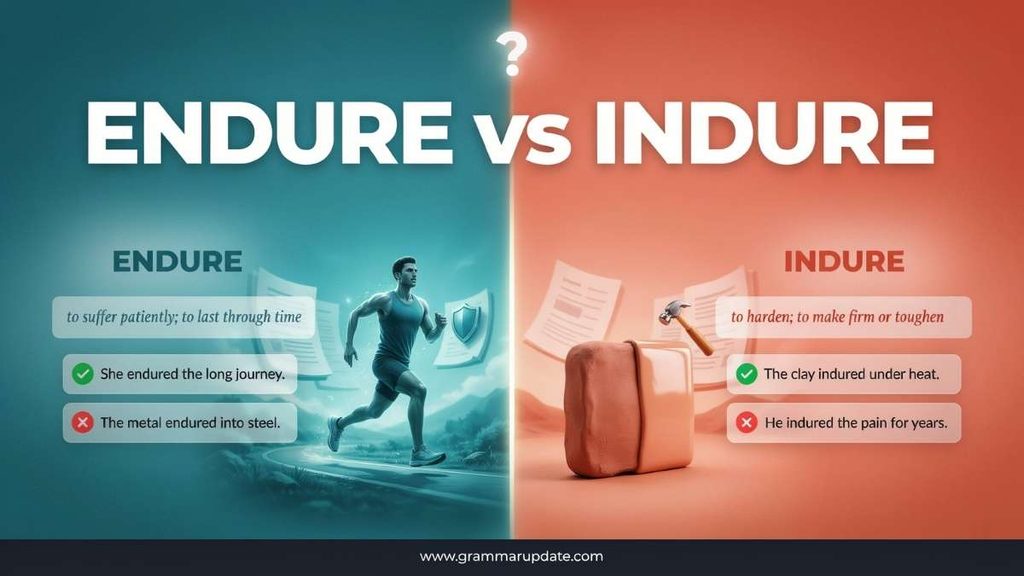
The endure vs indure confusion is easy to make, but the answer is simple once you know the difference. Both spellings look possible, especially when you hear the word and try to write it from memory. However, endure is the correct spelling in modern English, while indure is an old form that may appear in historical writing. So, if you’re writing an email, essay, article, or everyday message, endure is the safer choice. In this guide, you’ll learn what both forms mean, why they are confused, and how to use endure correctly. By the end, the spelling choice should feel effortless.
Quick answer
If you’re wondering whether to write endure vs indure, this quick table gives you the answer at a glance.
| Word | Status | Meaning | Example |
|---|---|---|---|
| Endure | Correct | To tolerate, withstand, or last | She had to endure the pain. |
| Indure | Obsolete | Historical form of endure | The old text uses indure. |
For modern English, choose endure. Indure may appear in historical writing, but it isn’t the standard spelling today.
Fix common more word mistakes in English
Habit vs Habbit Which Spelling Is Correct ?
Endure vs Indure Which Word Should You Use?
If you are wondering whether to write endure vs indure, choose endure in modern English.
Endure is the standard spelling. Indure is an obsolete historical spelling that you may encounter in older sources.
Consider these two sentences:
She had to endure months of uncertainty.
She had to indure months of uncertainty.
The first sentence uses the standard modern form. The second contains an obsolete form that would normally be treated as a spelling mistake in contemporary writing.
The word endure has several closely related meanings. You can endure pain, hardship, pressure, criticism, or an uncomfortable situation. You can also say that a tradition, friendship, idea, or influence endures when it continues to exist over time. Dictionary.com lists both meanings, including the senses of withstanding something and continuing to exist.
So, if you are searching for the correct spelling endure, the answer is simple: endure.
Endure vs Indure at a Glance
| Feature | Endure | Indure |
|---|---|---|
| Modern standard English | Yes | No |
| Main status | Standard verb | Obsolete historical form |
| Meaning today | Tolerate, withstand, or last | Historical form related to endure |
| Common in current writing | Yes | No |
| Historical use | Yes | Yes |
| Recommended for modern writing | Endure | Avoid |
| Example | They endured the hardship. | Mainly found in older texts |
This is not a spelling difference like color and colour, where both forms remain standard in different varieties of English. Instead, endure is the established modern form, while indure belongs mainly to historical usage.
Learn the difference between confusing word pairs
Habit vs Habbit Which Spelling Is Correct ?
What Does Endure Mean?
The endure definition centers on the ideas of tolerating, withstanding, bearing, and lasting.
As a transitive verb, endure can mean to experience something difficult without giving up or yielding. You might endure pain, hardship, pressure, discomfort, criticism, or a long period of uncertainty.
For example:
The hikers endured heavy rain throughout the journey.
Here, endure means withstand or bear. The hikers experienced unpleasant conditions and continued despite them.
The word also has an intransitive use. In that sense, something can endure when it continues to exist or remains over time.
For example:
The tradition has endured for generations.
Here, endure does not mean suffer. Instead, it means continue or last.
That second meaning is easy to overlook. Endure is not automatically connected with suffering. Something pleasant or valuable can endure as well. A friendship can endure. A tradition can endure. An artistic work can endure. An idea can endure.
Dictionary.com gives both the transitive sense of holding out against something and the intransitive sense of continuing to exist or last.
Endure Meaning “To Tolerate or Withstand”
The most familiar endure meaning involves difficulty.
When you endure something, you experience it and continue through it. The word often carries a sense of patience, strength, or resistance.
For example:
She endured the pain without complaining.
The workers endured difficult conditions during the project.
He could not endure the constant noise.
They endured years of financial pressure.
In each sentence, endure describes something unpleasant or demanding. Depending on the context, useful synonyms include tolerate, bear, withstand, suffer, and undergo.
There is a subtle difference between these words, however. Endure often suggests that the difficult experience continues for some time. It therefore works especially well when the sentence involves persistence through hardship.
Endure Meaning “To Last”
Endure can also mean continue to exist, survive, or remain.
For example:
Their friendship endured despite the distance.
The old custom has endured for centuries.
Her influence continues to endure.
The building has endured for more than a hundred years.
This meaning connects endure with words such as last, persist, survive, and remain.
Therefore, the word does not always describe a person suffering. Sometimes it describes something that successfully continues through time.
Learn the difference between confusing word pairs
Foodie vs Foody Which One Is Correct?
What Does Indure Mean?
The indure definition needs historical context because indure does not function as a normal modern alternative to endure.
Indure is documented as an obsolete spelling or form associated with endure. Its existence is therefore genuine, but its modern status is very different from that of endure.
That distinction matters when answering the question, “What does indure mean?”
In historical usage, indure could carry the sense associated with endure. In contemporary English, however, writers normally use endure instead.
The historical connection is not surprising. The modern word endure developed through Middle English enduren and Anglo-French or Old French endurer, ultimately tracing back to Latin indurare. The Latin root was associated with becoming hard or making something lasting.
So, indure is not simply a random misspelling that appeared yesterday. It has a documented linguistic history. Nevertheless, that does not make it the correct spelling for modern writing.
Is Indure a Word?
The question “is indure a word” deserves a more careful answer than a simple yes or no.
Historically, yes. Indure is recorded as an obsolete form connected with endure.
In modern standard English, however, no. You should not normally use indure as a replacement for endure.
This is an important distinction in English vocabulary. A word or spelling can exist in historical records without remaining part of everyday contemporary English.
English contains many obsolete spellings that readers may encounter in old books, manuscripts, dictionaries, and historical documents. Their presence tells us something about earlier English. It does not automatically make them appropriate for a modern email, essay, article, or report.
Therefore, if your question is “is indure a correct word for modern English?”, the practical answer is no. Use endure.
Learn the difference between confusing word pairs
Drier vs Dryer Which one Is Correct?
Why Do People Confuse Endure and Indure?
The confusion becomes easier to understand when you look at pronunciation and word history.
Endure begins with an unstressed syllable, and dictionary sources give pronunciations such as /ɛnˈdʊər/ and /ɛnˈdjʊər/ in American English. British pronunciation differs somewhat, but the written form remains endure.
Because the first syllable is not strongly stressed, the opening vowel may not stand out clearly in ordinary speech. As a result, someone who hears the word without seeing it written may wonder whether the first letter should be e or i.
There is another reason for the confusion. English contains many familiar words beginning with in-, including include, inform, insist, inspire, and inspect. The spelling indure therefore looks believable at first glance.
However, familiarity does not make a spelling correct.
The historical story makes the confusion even more interesting. The Latin source of endure was indurare, so the i in the older form is not completely mysterious. Over the development of English, spelling changed and eventually settled into the modern form endure.
Endure vs Indure The Historical Difference
The difference between endure vs indure is partly a story about how English spelling developed.
Endure was recorded in English as early as the late 13th or early 14th century. Its history leads through Middle English and French forms to Latin indurare. The Latin word itself was connected with hardness and lasting.
That history helps explain why the spelling indure appears in historical material.
Modern English eventually settled on endure as the standard form. Consequently, today’s writers do not normally have a choice between two equally accepted spellings.
This is why calling indure simply an “incorrect spelling” can be slightly misleading when discussing historical texts. It can be incorrect in a modern sentence, yet historically authentic in an older document.
Context matters.
Is Indure the Correct Spelling?
For modern writing, no.
If you are asking, “What is the correct spelling endure vs indure?” the answer is endure.
For example:
The community endured several difficult years.
That sentence uses standard modern English.
Writing:
The community indured several difficult years.
would create an incorrect modern spelling.
However, suppose a historian is reproducing an old document exactly as it appeared. If the original document contains indure, preserving that spelling may be appropriate because the purpose is historical accuracy.
That situation is very different from choosing indure in an original sentence written today.
The practical rule is simple: use endure for contemporary English and preserve indure only when the historical context specifically requires it.
Learn the difference between confusing word pairs
Aluminum vs Aluminium difference and usage?
Endure vs Indure Meaning and Usage
The endure vs indure meaning becomes much clearer once modern and historical usage are separated.
Endure has an active role in contemporary English. It functions naturally in everyday speech, academic writing, journalism, literature, and professional communication.
Indure does not have that same modern role. Instead, it mainly belongs to historical or obsolete usage.
This difference affects more than spelling. It affects how readers perceive the sentence.
Consider:
The company endured years of uncertainty.
The company indured years of uncertainty.
The first sentence sounds natural and current. The second looks like a spelling mistake unless the surrounding text clearly establishes a historical context.
That is why modern writers should not treat the two forms as interchangeable.
How to Use Endure in a Sentence
If you want to use endure in a sentence, start by identifying whether you mean “withstand” or “last.”
When the meaning is withstand, endure normally takes a difficult experience, condition, or thing as its object.
For example:
The athletes endured intense training.
The family endured a difficult period.
The plants must endure extreme heat.
She could not endure the constant interruptions.
When the meaning is last or continue, endure can stand on its own or work with a phrase describing duration.
For example:
The tradition endured for centuries.
Their friendship endured despite the distance.
The memory has endured through generations.
The two meanings are related because both involve continuing through something. One focuses on surviving an experience, while the other focuses on continuing to exist.
Learn the difference between confusing more English words
Guidance vs Guidence difference and usage ?
Endure Examples in Everyday English
The best way to understand endure is to see how its meaning changes with context.
The hikers endured heavy rain during the final stage of the journey.
This sentence focuses on tolerating unpleasant conditions.
The athlete endured months of demanding training.
Here, the emphasis falls on persistence through difficulty.
The old bridge endured decades of harsh weather.
In this case, endure means withstand.
Their friendship endured despite years of separation.
Here, endure means continued or survived.
The tradition has endured for generations.
This use means remained in existence.
Her work has endured long after her death.
Here, endure refers to lasting influence or continued recognition.
These examples show why context matters. A good dictionary definition gives you the basic meaning, but surrounding words tell you which shade of meaning the sentence requires.
Forms of Endure
The modern word family is straightforward.
| Form | Word | Example |
|---|---|---|
| Base verb | endure | They endure difficult conditions. |
| Third-person singular | endures | The tradition endures. |
| Past tense | endured | She endured the hardship. |
| Past participle | endured | They have endured many challenges. |
| Present participle | enduring | The memory remains enduring. |
| Noun | endurance | The race requires endurance. |
Dictionary sources list endure, endures, endured, and enduring as its main inflected forms.
The related noun endurance refers to the ability to withstand something difficult or continue despite strain. It can describe physical stamina as well as mental or emotional strength.
For example:
The marathon requires tremendous endurance.
The runners must endure fatigue during the race.
The first sentence needs a noun. The second needs a verb.
Learn the difference between confusing more English words
Fluorescent vs Flourescent difference and usage ?
Endure vs Endurance vs Enduring
These related forms can cause confusion when writers focus too heavily on spelling instead of grammar.
Endure is a verb.
Endurance is a noun.
Enduring can function as a present participle or adjective.
Compare these sentences:
They had to endure the difficult journey.
Their endurance impressed everyone.
Their friendship has remained enduring.
Each word belongs to the same family, but each performs a different grammatical job.
Enduring can also mean lasting or permanent when used as an adjective. Dictionary.com gives examples of enduring as something lasting or permanent.
Therefore, if you need the action, use endure. If you need the quality or ability, use endurance.
Endure vs Indure in Different Contexts
Endure works naturally in several kinds of situations.
Physical discomfort is one common context. Someone can endure pain, cold, heat, exhaustion, or demanding physical conditions.
Emotional difficulty is another. A person may endure grief, disappointment, stress, uncertainty, or hardship.
The word also works for long periods. Someone can endure years of difficulty, while an institution can endure decades of change.
Finally, endure can describe continued existence. Traditions, friendships, ideas, customs, and works of art can endure when they survive the passage of time.
That range gives endure much greater usefulness in modern English than indure.
Common Endure Spelling Mistakes
The most common mistake is replacing the first e with i.
Incorrect:
She had to indure the pain.
Correct:
She had to endure the pain.
Another mistake is carrying the incorrect spelling into related forms.
The modern forms are:
endured
enduring
endurance
endurable
They are not normally formed with indure.
This is useful because remembering the whole word family makes the spelling easier. If you know endurance begins with end-, it becomes easier to remember that endure does too.
A spelling mistake often happens because the writer remembers the sound but not the written form. In that situation, connecting the word with its related forms can provide a stronger memory cue.
Learn the difference between confusing more English words
Lose vs Loose difference and usage?
Endure vs Ensure A Different Confusion
Endure is also sometimes confused with ensure because the words share several letters.
Their meanings, however, are completely different.
| Word | Meaning | Example |
|---|---|---|
| Endure | Tolerate, withstand, or last | We had to endure the delay. |
| Ensure | Make certain | Please ensure the door is locked. |
If something is difficult and you have to bear it, endure fits.
If you need to make certain that something happens, ensure fits.
For example:
The hikers had to endure the storm.
The guide checked the weather to ensure everyone’s safety.
The difference becomes obvious once you focus on meaning instead of spelling.
Endure Synonyms and Their Differences
An endure synonym depends on the particular meaning.
When endure means tolerate or withstand, you might use bear, tolerate, suffer, withstand, or undergo.
When endure means continue to exist, you might use last, survive, persist, remain, or continue.
These words overlap, but they are not perfect substitutes in every sentence.
For example, “The tradition persisted” works naturally because persist emphasizes continuation. “The tradition suffered” would change the meaning completely.
Likewise, “She endured the pain” and “She tolerated the pain” are close in meaning, but endure often gives a stronger sense of continuing through difficulty.
That is why a dictionary list of synonyms should be treated as a starting point rather than a promise that every word can replace another word in every sentence.
Learn the difference between confusing more English words
Principal vs Principle Difference and usage ?
What About an Indure Synonym?
Searching for an indure synonym can create another layer of confusion because indure is not a normal modern alternative to endure.
If you encounter indure in an older source and its meaning corresponds to endure, the modern replacement will usually be endure.
Depending on the sentence, you may also choose tolerate, bear, withstand, survive, persist, last, remain, or continue.
The correct synonym depends on the intended meaning.
How to Spell Endure
If you are wondering how to spell endure, remember the five letters at the center of the word:
E-N-D-U-R-E
The first two letters are e-n.
A useful way to remember the endure spelling is to connect it with endurance and enduring.
Endure.
Endurance.
Enduring.
Endured.
The shared beginning gives you a reliable spelling pattern.
How to Spell Indure
The historical form indure is spelled I-N-D-U-R-E.
However, knowing how to spell indure does not mean that you should use it in modern writing.
If you are writing a new sentence today, the correct spelling is endure.
If you are studying historical English or reproducing an original historical text, indure may appear because the source used that form.
That is the key distinction between spelling something correctly as a historical quotation and choosing the appropriate spelling for contemporary English.
Learn the difference between confusing more English words
Your vs You’re Difference and which is correct ?
Is Indure an Obsolete Word?
It is more precise to describe indure as an obsolete spelling or historical form associated with endure.
The word obsolete matters here because it tells readers that the form has historical documentation but does not belong to ordinary modern usage.
This is different from saying that the form never existed.
English has changed considerably over the centuries. Spellings have shifted, pronunciations have changed, and some words have disappeared from everyday use. Historical dictionaries and texts preserve evidence of those changes.
Therefore, if you find indure in an old source, there is no need to assume the writer simply made a careless spelling mistake. The form has a documented history.
However, when writing contemporary English, modern usage takes priority.
Can Indure Be Used in English?
Yes, but only in a limited historical sense.
You may encounter indure when reading older material, examining historical spelling, discussing etymology, or reproducing an original document.
In ordinary modern English, however, it should not replace endure.
For example, a modern article should say:
The tradition endured for centuries.
A historical transcription may preserve the exact wording and spelling of its original source, even if that source uses an obsolete form.
The difference is not about whether a writer knows the “right” spelling. It is about the purpose of the writing.
A Simple Way to Remember the Correct Spelling
There is an easy rule to keep in mind:
If you mean tolerate, withstand, survive, or last, use endure.
Then connect it with endurance.
Endure and endurance belong to the same modern word family. Both begin with end-.
That connection is more useful than trying to memorize a complicated spelling trick.
If you see indure in an old book, remember that you are looking at historical language. If you are writing a fresh sentence, use endure.
Learn the difference between confusing more English words
Breached VS Breeched difference and Which Is Correct?
Practice Session Endure vs Indure
Now it’s time to put the difference between endure vs indure into practice. Choose the correct word for each sentence.
- She had to ________ several months of physical therapy after the injury.
- The old bridge was strong enough to ________ heavy winds and rain.
- He learned to ________ the pain without complaining.
- Their friendship continued to ________ despite years of separation.
- The workers had to ________ difficult conditions during the winter.
- Can this material ________ extreme temperatures?
- She managed to ________ the long and difficult journey.
- The team had to ________ several setbacks before reaching its goal.
- Good-quality equipment should ________ regular use for many years.
- He could not ________ the constant noise any longer.
- The patient had to ________ a lengthy recovery period.
- Their determination helped them ________ through a difficult time.
- The building was designed to ________ strong earthquakes.
- She had enough patience to ________ the uncomfortable situation.
- The tradition has continued to ________ for generations.
- Which spelling is correct in modern English: ________ or indure?
- If you want to describe the ability to withstand hardship, the verb you need is ________.
- The sentence “They had to ________ severe hardship” uses the standard modern spelling.
- He managed to ________ the pressure and finish the project.
- The word ________ may appear in historical texts, but it is not the usual modern spelling.
- Can you ________ another few hours of work?
- Plants in this region must ________ long periods of drought.
- She had to ________ many difficulties before achieving her goal.
- The correct spelling for the verb meaning “to suffer or withstand something difficult” is ________.
- If you are writing in contemporary standard English, use ________ rather than indure.
Answers
- endure
- endure
- endure
- endure
- endure
- endure
- endure
- endure
- endure
- endure
- endure
- endure
- endure
- endure
- endure
- endure
- endure
- endure
- endure
- indure
- endure
- endure
- endure
- endure
- endure
Here’s a trusted source for clear word meanings:
FAQs About Endure vs Indure
When should you use endure instead of indure?
Use endure in modern English when you mean to tolerate, withstand, suffer through, or continue to exist. Indure is not the standard spelling used in contemporary English, so endure is the correct choice for everyday writing.
Why is indure sometimes confused with endure?
The two forms look and sound similar, which can make indure seem like a reasonable spelling. However, modern English uses endure. The confusion becomes easier to understand when you consider that endure ultimately comes from the Latin indūrāre, meaning “to harden” or “make lasting.”
Can indure appear in historical English?
Yes. Indure may appear in older or historical writing, but it should not be treated as the normal modern spelling of the verb. Therefore, encountering indure in an old text does not mean you should use it in contemporary English.
Is indure an acceptable spelling in modern English?
No. For modern standard English, use endure. If you are writing an essay, email, article, or other contemporary text, endure is the appropriate spelling.
Can endure mean tolerate?
Yes. Endure can mean to tolerate or bear something unpleasant, painful, or difficult. For example, “She had to endure the intense heat” means she had to tolerate the difficult conditions.
Can endure also mean last?
Yes. Endure can describe something that continues to exist or remains over time. For example, “Their friendship endured for decades” means their friendship continued for a long period.
Does endure always describe something unpleasant?
No. When you endure something, the experience is usually difficult or unpleasant. However, when something endures, the meaning can simply be that it lasts or continues. A tradition, reputation, idea, or relationship can endure without suggesting suffering.
What is the past tense of endure?
The past tense of endure is endured. The same form also works as the past participle. For example, “They endured many hardships” uses endured as the past-tense verb.
What is the present participle of endure?
The present participle is enduring. It can function as part of a verb phrase or as an adjective. For example, “She is enduring a difficult period” uses it as part of a verb phrase, while “an enduring friendship” uses it as an adjective.
What is the difference between endure and endurance?
Endure is a verb, while endurance is a noun. Endure describes the action of tolerating, withstanding, or continuing, whereas endurance refers to the ability or strength to keep going despite difficulty, stress, or fatigue.
What does enduring mean when describing a person or thing?
Enduring can mean lasting for a long time or continuing to exist. It can also describe someone who patiently withstands difficulty. For example, “Her enduring patience helped the team through the crisis.”
Can endure describe emotional hardship?
Yes. Endure can describe someone experiencing emotional pain, grief, stress, disappointment, or another difficult situation. The verb emphasizes the ability to continue through the experience rather than giving up.
Can endure describe physical objects?
Yes. Objects and materials can endure pressure, heat, wear, or other forces. For example, “The structure was built to endure harsh weather.” In this context, endure means to withstand or remain in good condition despite an external force.
Can endure be used without an object?
Yes. Endure can work as an intransitive verb when it means to continue to exist or last. For example, “The tradition endured” means the tradition continued to exist.
What is the difference between enduring and endured?
Enduring usually refers to an ongoing action or describes something that lasts, while endured refers to an action that has already happened. For example, “They are enduring difficult conditions” describes an ongoing experience, whereas “They endured difficult conditions” describes a completed experience.
What is the word family of endure?
Common forms related to endure include endures, endured, enduring, endurance, endurable, and endurer. These forms express related ideas involving lasting, tolerating, or withstanding something.
Can endure describe something positive?
Yes. The word itself does not always carry a negative meaning. For example, “Their enduring friendship lasted for decades” uses enduring in a positive sense. However, when you endure something, the context usually involves difficulty, discomfort, or hardship.
What is a simple sentence using endure?
A simple example is, “She had to endure the long journey.” Here, endure means to experience and tolerate something difficult.
What is a simple way to remember endure?
Remember that the modern spelling is endure with an “e” at the beginning. When you mean “tolerate,” “withstand,” or “last,” choose endure rather than indure.
Is endure used in both American and British English?
Yes. Endure is a standard English verb in both American and British English. The pronunciation can vary slightly between varieties, but the spelling remains endure.
What does the root of endure tell us about its meaning?
The history of endure helps explain its connection with lasting and withstanding difficulty. Dictionary.com traces it through Middle English and Old French to the Latin indūrāre, meaning “to harden” or “make lasting.” The Latin root is related to dūrus, meaning “hard.”
Is endurable related to endure?
Yes. Endurable is formed from endure with the suffix “-able.” It means capable of being endured, tolerated, or borne. For example, “The discomfort was endurable” means the discomfort could be tolerated.
What does endurer mean?
Endurer is a noun derived from endure. It refers to a person who endures or withstands hardship, difficulty, or suffering. Although the word exists, it is much less common than the verb endure.
Conclusion
The confusion between endure vs indure is easy to clear up. Endure is the correct spelling in modern English. You use it when you mean to tolerate something difficult, withstand a challenge, or continue to exist over time. Indure is an old spelling that you may find in historical texts, but it isn’t the standard choice today. So, if you’re writing an email, article, essay, or everyday message, stick with endure. When in doubt, remember the simple rule: difficult things may test you, but they don’t have to test your spelling too. Choose endure and keep your writing clear.

Jhon AJS, the creative mind behind Grammar Update, is an experienced blogger passionate about simplifying English grammar. He focuses on explaining confusing word vs word differences, grammar rules, punctuation, and sentence structure in a clear and practical way. Through easy to understand guides and examples, Jhon helps readers improve their writing and communicate with confidence. With years of blogging experience, he continues to share helpful insights that make learning grammar simple, useful, and accessible for everyone.