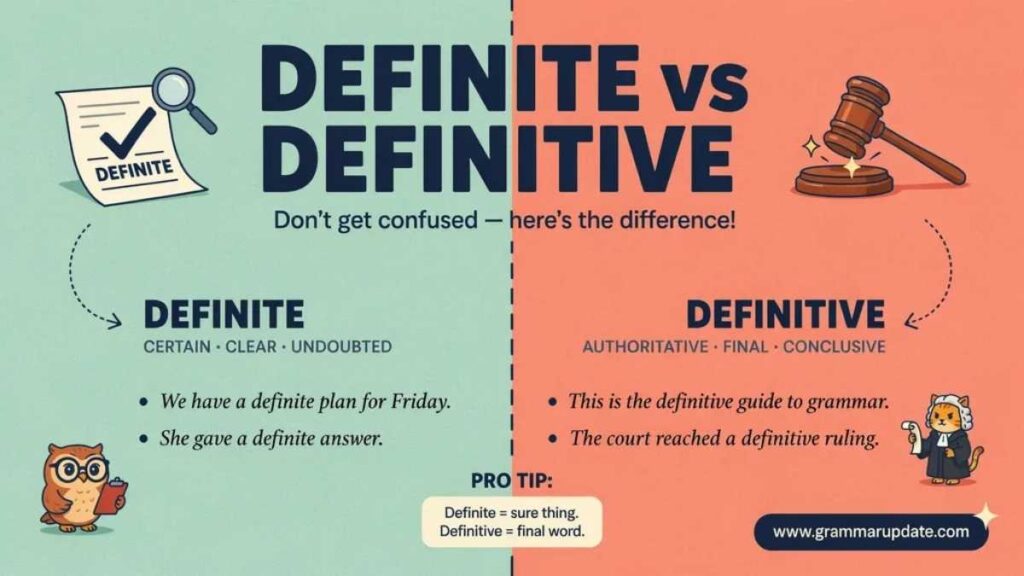
The difference between definite vs definitive is easy to miss because these two words look and sound so similar. They even share a common meaning, which makes the confusion understandable. Still, they aren’t interchangeable. Definite usually means clear, certain, or specific, while definitive means final, authoritative, or conclusive. Using one in place of the other can change the meaning of your sentence or make your wording sound awkward. The good news is that the difference isn’t difficult to learn. Once you know what each word emphasizes, choosing the right one becomes much easier. Let’s clear up the confusion and make these tricky words simple to use.
quick answer
| Definite | Definitive |
|---|---|
| Means clear, certain, or specific | Means final, authoritative, or conclusive |
| Focuses on certainty | Focuses on finality |
| Example: a definite date | Example: a definitive answer |
| Synonyms: certain, clear, specific | Synonyms: final, conclusive, authoritative |
Learn the difference between confusing more English words
Dilemma vs Dilema which one is correct ?
What Does Definite Mean?
The definite meaning centers on something that is clear, certain, specific, or fixed. When you describe something as definite, you’re saying that it isn’t vague or uncertain.
Definite is an adjective. It can describe a person, thing, plan, answer, date, decision, change, or situation that has a clear or certain quality.
For example, you might say, “We need a definite date for the meeting.” In this sentence, definite means that you need a specific date rather than a general idea such as “sometime next week.”
You could also say, “She gave me a definite answer.” Here, definite means that her answer was clear and certain rather than hesitant or unclear.
The word can take on a slightly different shade of meaning depending on the context. However, the basic idea stays the same: something is clear enough to identify, understand, or accept with certainty.
Definite Definition
A simple definite definition is clear, certain, fixed, specific, or clearly established.
The definite definition becomes easier to understand when you see how the word works in different situations. A definite date is a date that has been settled. And A definite answer is an answer that isn’t vague. A definite change is a change that is clearly noticeable.
Consider these examples:
“We have a definite plan for the weekend.”
“The company has set a definite deadline.”
“There was a definite improvement in his writing.”
“She gave a definite answer to the question.”
In each example, definite tells you that something is clear, certain, or settled.
Definite Meaning With Examples
The definite meaning in English can change slightly according to the context.
1.When you say, “The meeting has a definite time,” you mean that the time has been fixed.
2.When you say, “There is a definite difference between the two products,” you mean that the difference is clear and noticeable.
3.When you say, “He showed definite interest in the job,” you mean that his interest was clear enough to recognize.
4.When you say, “We need a definite answer,” you mean that you need a clear and certain response.
These examples show why context matters. Definite doesn’t always mean exactly the same thing, but it consistently points toward clarity, certainty, or specificity.
Learn the difference between confusing more English words
Controversy vs Contraversy which one is correct?
What Does Definitive Mean?
The definitive meaning focuses more on finality, authority, or conclusiveness.
Definitive is also an adjective. However, it often describes something that settles an issue or represents the final and most authoritative version of something.
For example, consider the sentence, “The investigation provided a definitive answer.” This doesn’t simply mean that the investigators found an answer. It suggests that their findings settled the question.
You might also hear someone describe a book as “the definitive guide” to a subject. In that case, definitive suggests that the book is considered especially complete, authoritative, or reliable.
Other examples include:
“The study found definitive evidence.”
“The court issued a definitive ruling.”
“The final report offered a definitive explanation.”
“The publisher released the definitive version of the book.”
The word carries more weight than definite in many of these contexts because it suggests that something has reached a final or authoritative point.
Definitive Definition
A simple definitive definition is final, conclusive, authoritative, or serving as the ultimate resolution of something.
The definitive definition becomes clearer when you compare it with definite.
Suppose a company has chosen a date for a meeting. You could call it a definite date because the date is fixed.
Now suppose the company’s leadership officially announces that date as the final date and says there will be no further changes. Calling it the definitive date emphasizes its final and authoritative status.
That is the central difference between definite and definitive.
Definitive Meaning With Examples
The definitive meaning in English often appears in situations involving evidence, conclusions, decisions, rulings, explanations, and authoritative sources.
For example:
“The research did not provide a definitive answer.”
This means the research failed to settle the question completely.
“The court issued a definitive ruling.”
This means the ruling carries final or authoritative force.
“This is the definitive guide to the subject.”
This suggests that the guide is considered the most complete or authoritative resource available.
“The test produced a definitive result.”
This means the result provides a conclusive answer rather than merely pointing toward one.
Learn the difference between confusing more English words
Becoming vs Becomeing Which one Is Correct?
Definite vs Definitive Key Difference
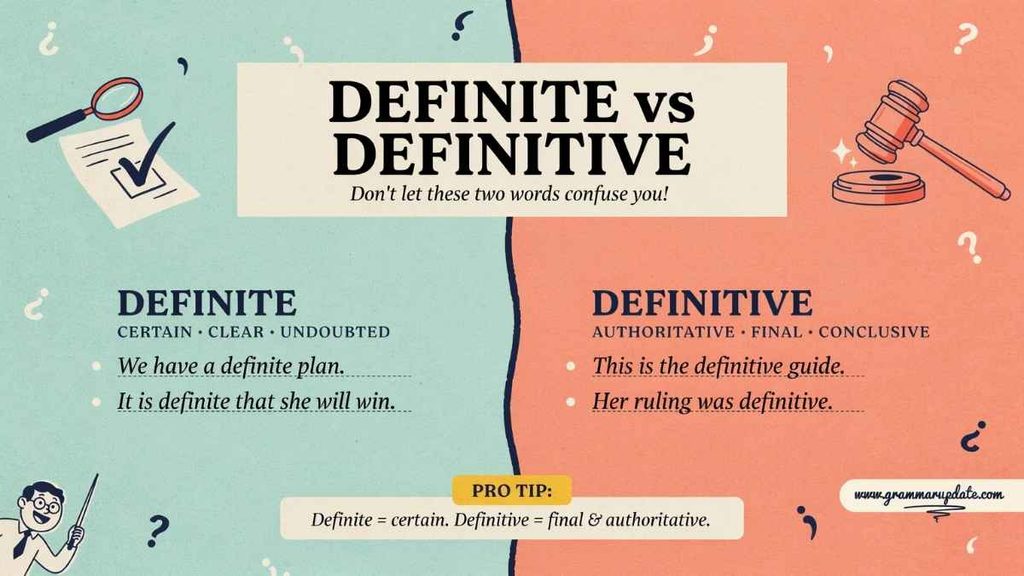
The easiest way to understand definite vs definitive is to focus on two ideas: certainty and finality.
Definite usually means clear, certain, specific, or fixed.
Definitive usually means final, conclusive, authoritative, or ultimate.
| Word | Main idea | Typical meaning | Example |
|---|---|---|---|
| Definite | Certainty and clarity | Clear, certain, specific, or fixed | We need a definite date. |
| Definitive | Finality and authority | Final, conclusive, or authoritative | The report gave a definitive answer. |
This comparison explains the basic definite vs definitive meaning. The words can overlap, but they don’t always communicate the same idea.
Certainty vs Finality
A useful way to remember the difference is to connect definite with certainty and definitive with finality.
When something is definite, you know what it is or you can identify it clearly.
When something is definitive, it usually settles an issue or carries enough authority to serve as the final word.
For example, “We have a definite plan” means the plan is clear and settled.
“This is the definitive plan” suggests that this is the final or authoritative version of the plan.
That distinction can seem small, but it becomes important in professional and academic writing where word choice needs to be precise.
Clear vs Conclusive
Another useful comparison is clear versus conclusive.
A definite statement can make something clear. A definitive statement can settle the matter.
Likewise, definite evidence can clearly point toward a conclusion, while definitive evidence suggests evidence strong enough to establish a conclusion with authority.
This is why definitive often appears in discussions about scientific research, legal decisions, official reports, and established facts.
Definite vs Definitive Examples
Looking at definite vs definitive examples side by side makes the distinction easier to recognize.
| Definite | Definitive |
|---|---|
| We need a definite date. | We need a definitive decision. |
| She gave a definite answer. | The report gave a definitive answer. |
| He showed definite interest. | The research provided definitive evidence. |
| They made definite plans. | The court issued a definitive ruling. |
| There was a definite change. | The investigation reached a definitive conclusion. |
| We saw a definite improvement. | The test produced a definitive result. |
The first column mainly focuses on clarity, certainty, or specificity. The second column emphasizes finality, authority, or conclusiveness.
Learn the difference between commonly mixed-up more words
Acquire Vs Aquire Which one Is Correct?
Definite Answer vs Definitive Answer
Should you say definite answer or definitive answer? Both expressions are correct, but they communicate slightly different ideas.
A definite answer is a clear or certain answer.
For example:
“She gave me a definite answer about the meeting.”
This sentence tells you that she answered clearly instead of leaving you guessing.
A definitive answer suggests that the answer settles the question.
For example:
“The investigation finally provided a definitive answer.”
This sentence suggests that the investigation resolved the matter.
The difference becomes particularly clear when you imagine a difficult question. Someone might give you a definite answer because they’re confident about it. However, a definitive answer usually comes from information, evidence, or authority that makes the answer conclusive.
So, when deciding between a definite answer or definitive answer, ask yourself what you want to emphasize. If you mean clear or certain, choose definite. If you mean final or conclusive, choose definitive.
Definite Decision vs Definitive Decision
Is a decision definite or definitive? Again, both words can work.
A definite decision is a decision that has clearly been made.
For example:
“The manager made a definite decision to postpone the meeting.”
The sentence tells you that the manager has decided rather than leaving the matter open.
A definitive decision places more emphasis on finality.
“The board made a definitive decision about the company’s future.”
Here, definitive suggests that the board has made the final or authoritative decision.
This distinction between definite decision vs definitive decision is useful in business writing. A decision can be definite because someone has made it. It can be definitive when that decision settles the matter.
Definite Statement vs Definitive Statement
A definite statement is clear and direct.
For example:
“She made a definite statement about the company’s plans.”
The statement wasn’t vague or uncertain.
A definitive statement has a stronger sense of authority.
For example:
“The official report made a definitive statement about the cause of the problem.”
Here, definitive suggests that the report represents an authoritative position.
The difference between a definite statement vs definitive statement becomes especially useful in formal writing. If you’re simply describing a clear statement, definite may be enough. If the statement carries official authority or settles a disputed point, definitive may be the better choice.
Learn the difference between commonly mixed-up more words
Acquaintance Vs Acquaintence Which one Is Correct?
Definite Evidence vs Definitive Evidence
The distinction becomes even more important when discussing evidence.
Definite evidence can refer to evidence that clearly establishes or strongly indicates something.
For example:
“The researchers found definite evidence of improvement.”
The evidence clearly showed that an improvement had occurred.
Definitive evidence carries a stronger meaning. It suggests evidence that settles the question or establishes something conclusively.
For example:
“The researchers found definitive evidence supporting the theory.”
This wording suggests that the evidence is strong and conclusive.
However, definitive is a word that should be used carefully. Evidence can be strong without being conclusive. If reasonable questions remain, calling something definitive may overstate what the evidence actually proves.
Definite Result vs Definitive Result
A definite result is a clear or certain outcome.
For example:
“The experiment produced a definite result.”
This means the outcome was clear.
A definitive result suggests that the outcome settles the matter.
For example:
“The second test produced a definitive result.”
The second sentence gives the reader a stronger sense that the testing has resolved the question.
The same distinction appears throughout scientific and technical writing. Definite focuses on certainty, while definitive adds the idea of finality.
Definite Conclusion vs Definitive Conclusion
A definite conclusion is a conclusion that has been clearly reached.
For example:
“The committee reached a definite conclusion after reviewing the records.”
The committee made its determination clearly.
A definitive conclusion goes further.
“The investigation reached a definitive conclusion about the cause of the accident.”
Here, definitive suggests that the conclusion settles the issue.
This distinction matters in research writing because a conclusion can be clear without necessarily being final. New evidence may change an existing interpretation. Therefore, writers should use definitive only when the context genuinely supports that stronger claim.
Learn the difference between commonly mixed-up more words
Atheist Vs Athiest Which Spelling Is Correct?
Definite Solution vs Definitive Solution
A definite solution is a solution that has been clearly identified or established.
For example:
“The engineer found a definite solution to the immediate problem.”
The engineer knows what solution to use.
A definitive solution suggests a complete or final resolution.
For example:
“The new system could provide a definitive solution to the problem.”
Here, definitive implies that the solution would fully resolve the issue rather than simply improve the situation.
This is another clear example of the difference between definite and definitive. One emphasizes certainty. The other emphasizes completeness or finality.
When to Use Definite
Use definite when you want to emphasize certainty, clarity, specificity, or something that has been fixed.
The word works naturally with dates, plans, answers, details, changes, decisions, and expectations.
For example:
“We need a definite date before we book the hotel.”
“She gave a definite answer.”
“The company has definite plans to expand.”
“There has been a definite improvement in sales.”
“He showed definite signs of concern.”
A simple test can help you choose the word. If you could replace definite with clear, certain, specific, or fixed without changing the basic meaning, definite is probably the right choice.
When to Use Definitive
Use definitive when you want to emphasize finality, authority, conclusiveness, or an ultimate resolution.
The word commonly appears with answers, evidence, decisions, statements, rulings, guides, versions, and conclusions.
For example:
“The researchers are still looking for definitive proof.”
“This book is considered a definitive guide to the subject.”
“The ruling provided a definitive answer to the legal dispute.”
“The final report offered a definitive explanation.”
“No definitive conclusion has emerged from the investigation.”
A helpful test is to ask whether you mean final, conclusive, authoritative, or ultimate. If that is the idea, definitive will often fit better.
Learn the difference between confusing word pairs
Believe Vs Belive Which one Is Correct?
Definite vs Definitive in Grammar
The definite vs definitive grammar distinction is straightforward once you separate grammar from meaning.
Both words usually function as adjectives. They modify nouns, but they give those nouns different qualities.
A definite adjective describes something clear, certain, specific, or fixed.
For example:
1.“a definite plan”
2.“a definite answer”
3.“a definite date”
4.“a definite change”
5.“a definite possibility”
A definitive adjective emphasizes finality, authority, or conclusiveness.
For example:
1.“a definitive answer”
2.“a definitive guide”
3.“a definitive ruling”
“definitive evidence”
“a definitive version”
The grammatical role is similar, but the semantic difference changes what each sentence communicates.
Definite Article in Grammar
Definite also has an important grammatical meaning.
In English grammar, the definite article is “the.”
For example:
“I saw a dog near the gate.”
“The dog followed me home.”
In the first sentence, the speaker introduces a dog without identifying a particular dog to the listener. In the second sentence, the speaker uses the definite article because the listener now knows which dog the speaker means.
This idea is called definite reference.
A definite noun phrase refers to a particular person, thing, group, or idea that the listener or reader can identify from the context.
For example:
“The teacher entered the classroom.”
The phrase “the teacher” identifies a particular teacher in the relevant context.
This grammatical use of definite has nothing to do with definitive. You say “the definite article,” not “the definitive article.”
Learn the difference between confusing word pairs
Acceptable Vs Aceptable Which one Is Correct?
Definite and Definitive A Deeper Meaning Difference
The best way to understand definite and definitive is to think about what each word tells your reader.
Definite tells your reader that something is clear or certain.
Definitive suggests that something is final, conclusive, or authoritative.
Imagine a project manager discussing a launch date.
“The launch date is definite.”
This means the date has been fixed.
Now imagine the manager says:
“This is the definitive launch date.”
The second statement suggests that the date is the final official choice.
The difference isn’t about grammar. It’s about the meaning you want to communicate.
Is Definitive Stronger Than Definite?
Definitive can sound stronger than definite because it often adds the idea of finality or authority. However, definitive isn’t simply a stronger version of definite.
Consider these two sentences:
“We have a definite plan.”
“We have a definitive plan.”
The first sentence says the plan is clear and settled.
The second can suggest that the plan is the final or authoritative version.
Neither sentence is automatically better. The correct choice depends on the meaning you want.
Definite vs Definitive Pronunciation
The Definite and definitive also differ in pronunciation.
Definite is commonly pronounced with three syllables, while definitive has four. Both words receive stress near the beginning, but definitive has an additional syllable toward the end.
When practicing definite vs definitive pronunciation, focus on hearing the difference in syllable count. English spelling doesn’t always tell you exactly how a word will sound, so listening and repetition can help.
The pronunciation difference also explains why these words may feel slightly different when spoken, even though they share the same root.
Definite Synonym vs Definitive Synonym
The best definite synonym depends on the context.
Words such as clear, certain, specific, fixed, exact, settled, and decided can often replace definite.
For example:
“We need a definite date.”
You could say:
“We need a fixed date.”
Or:
“We need a specific date.”
A definitive synonym usually emphasizes finality or authority. Common alternatives include final, conclusive, authoritative, decisive, ultimate, and complete.
For example:
“The report gave a definitive answer.”
You could write:
“The report gave a conclusive answer.”
However, synonyms aren’t interchangeable in every sentence. Each word carries its own shade of meaning, so context should always guide your choice.
Learn the difference between confusing word pairs
In Process vs In Progress Difference and usage?
Definite vs Definitive Synonyms
| Definite | Definitive |
|---|---|
| Clear | Conclusive |
| Certain | Final |
| Specific | Authoritative |
| Fixed | Decisive |
| Exact | Ultimate |
| Settled | Complete |
This comparison shows the main vocabulary distinction. Definite synonym choices usually relate to certainty and clarity. Definitive synonym choices usually relate to finality, authority, and conclusiveness.
Common Mistakes With Definite and Definitive
Because the two words look so similar, writers sometimes treat them as interchangeable. That can make a sentence sound less precise.
One common mistake involves using definitive when the writer only means certain.
For example:
“The meeting has a definitive date.”
If you simply mean that the date has been fixed, “definite date” usually expresses the idea more naturally.
Another mistake involves using definite when the intended meaning is conclusive.
For example:
“The investigation provided definitive evidence.”
Here, definitive works because the writer wants to emphasize that the evidence is conclusive.
However, if the evidence merely points toward a conclusion, calling it definitive may exaggerate its strength.
The safest approach is simple. Ask whether you mean clear and certain or final and conclusive.
Learn the difference between confusing word pairs
Unpure vs Impure Which one Is Correct?
Definite vs Definitive in Different Contexts
The difference becomes easier to recognize when you see the words in real-world situations.
Academic Writing
Academic writing often uses definitive when discussing evidence, conclusions, interpretations, and authoritative findings.
For example:
“The study did not provide a definitive explanation.”
Definite can describe clear patterns or findings.
“For the researchers, the data showed a definite pattern.”
The first sentence focuses on finality. The second focuses on clarity.
Business Writing
In business communication, definite often works well with schedules, plans, and commitments.
“We need a definite delivery date.”
Definitive can describe official decisions or authoritative statements.
“The board issued a definitive statement about the company’s plans.”
Legal Writing
Legal writing frequently uses definitive when discussing rulings, interpretations, and authoritative decisions.
“The ruling provided a definitive interpretation of the law.”
Definite can describe clearly established details.
“The agreement contains a definite payment schedule.”
Everyday English
In everyday conversation, definite is generally more natural when you want to express certainty.
For example:
“Are you coming tomorrow?”
“Yes, that’s definite.”
Definitive sounds more formal and often appears in professional, academic, technical, or official contexts.
Learn the difference between confusing word pairs
Envisage vs Envision difference and usage?
Practice Session Definite vs Definitive
Fill in each blank with either Definite vs Definitive.
- We need a ______ answer before we can move forward.
- The doctor gave a ______ diagnosis after reviewing all the test results.
- She made a ______ decision to accept the job offer.
- The report provides ______ evidence that the system needs improvement.
- Do you have a ______ plan for the weekend?
- The court’s ruling gave a ______ answer to the legal question.
- There is a ______ difference between the two products.
- Scientists have not yet found a ______ solution to the problem.
- His explanation was clear and ______.
- The manager gave us a ______ date for the meeting.
- The new study offers a ______ explanation for the unusual results.
- We need a ______ conclusion before publishing the report.
- She was ______ that she had locked the door.
- The investigation produced ______ proof of the company’s involvement.
- They haven’t reached a ______ agreement yet.
- The book is considered the ______ guide to the subject.
- He gave me a ______ answer when I asked whether he would attend.
- The experiment produced a ______ result that supported the theory.
- We need a ______ statement about what happened.
- The evidence was strong enough to provide a ______ conclusion.
- I have a ______ idea of what I want to study in college.
- The expert gave a ______ explanation based on years of research.
- The instructions don’t give a ______ time for completing the task.
- The judge’s ruling was ______ and settled the matter completely.
- She gave a ______ response, so there was no doubt about her position.
Answers
- definite
- definitive
- definite
- definitive
- definite
- definitive
- definite
- definitive
- definite
- definite
- definitive
- definitive
- definite
- definitive
- definite
- definitive
- definite
- definitive
- definite
- definitive
- definite
- definitive
- definite
- definitive
- definite
Here’s a trusted source for clear word meanings:
FAQs
Can definite and definitive be used interchangeably?
No. Definite means clear, certain, or specific, while definitive describes something that provides a final, authoritative, or conclusive answer. The right choice depends on whether you mean certainty or finality.
Which word is stronger, definite or definitive?
Definitive generally carries a stronger sense of finality. Something definite can be clear and certain, while something definitive usually settles an issue or leaves little room for further discussion.
Can you say “definitive plans”?
You can, but “definite plans” usually sounds more natural when you mean plans that have been clearly decided or arranged. “Definitive” works better when you want to emphasize that something is final.
What does a definite date mean?
A definite date is a specific date that has been clearly decided or established. For example, “We haven’t chosen a definite date for the event yet.”
What does a definitive date mean?
A definitive date is the final or authoritative date for an event or situation. The word “definitive” puts more emphasis on finality than simple certainty.
Is “definite proof” correct?
Yes. “Definite proof” can describe proof that clearly establishes something. However, “definitive proof” usually suggests evidence strong enough to settle the matter completely.
Is “definitive evidence” correct?
Yes. Definitive evidence provides strong, conclusive support for a claim. It can help settle a question when ordinary evidence may leave some uncertainty.
Can definite describe a person?
Yes. When definite describes a person, it can suggest that the person speaks or acts in a clear, firm, or decisive way. The exact meaning depends on the sentence.
Can definitive describe a person?
It can, but this use is less common. Definitive usually describes things such as answers, statements, decisions, explanations, or sources rather than people.
What is the easiest way to remember definite vs definitive?
A simple way to remember the difference is to connect definite with certainty and definitive with finality. If something is clear or certain, use “definite.” If it settles an issue or provides an authoritative conclusion, “definitive” often fits better.
Why does definitive have an extra “iv”?
Definitive and definite belong to the same word family, but they developed into different adjective forms. The “-ive” ending in “definitive” helps create an adjective associated with something final, authoritative, or conclusive.
Can definite describe an answer?
Yes. A definite answer is a clear and certain answer. It shows that someone has given a specific response rather than leaving the matter uncertain.
Can definitive describe an answer?
Yes. A definitive answer goes a step further. It provides a final or conclusive response that settles the question.
What is the difference between a definite decision and a definitive decision?
A definite decision is one that has been clearly made. A definitive decision emphasizes that the decision is final and settles the matter.
What is the difference between a definite statement and a definitive statement?
A definite statement is clear, specific, and certain. A definitive statement carries the additional sense of authority or finality and may settle an issue.
What is the difference between definite evidence and definitive evidence?
Definite evidence gives clear support for something. Definitive evidence provides conclusive support that can settle the question or establish the facts with strong authority.
What is the difference between a definite result and a definitive result?
A definite result is a clear or certain outcome. A definitive result emphasizes that the outcome provides a final answer or settles the matter.
What is the difference between a definite solution and a definitive solution?
A definite solution is a clearly identified way to solve a problem. A definitive solution suggests a final or conclusive answer that fully resolves the problem.
Is “definitive guide” a common expression?
Yes. A definitive guide usually refers to a thorough and authoritative resource that aims to give reliable and comprehensive information about a particular subject.
Does definitive always mean final?
Not always in a strict sense, but finality is an important part of its meaning. Definitive commonly suggests that something is authoritative, conclusive, or accepted as the final answer.
Conclusion
The difference between definite vs definitive is simple once you know what each word emphasizes. Definite means clear, certain, or specific. Definitive means final, authoritative, or conclusive. In other words, something definite gives you certainty, while something definitive usually settles the matter.
When you’re talking about clear plans, dates, choices, or facts, definite is often the right word. When something provides a final answer, settles a question, or serves as the strongest authority on a subject, definitive fits better.
Keep that small difference in mind, and these two similar-looking words become much easier to use correctly. No more second guessing at the keyboard.

Jhon AJS, the creative mind behind Grammar Update, is an experienced blogger passionate about simplifying English grammar. He focuses on explaining confusing word vs word differences, grammar rules, punctuation, and sentence structure in a clear and practical way. Through easy to understand guides and examples, Jhon helps readers improve their writing and communicate with confidence. With years of blogging experience, he continues to share helpful insights that make learning grammar simple, useful, and accessible for everyone.