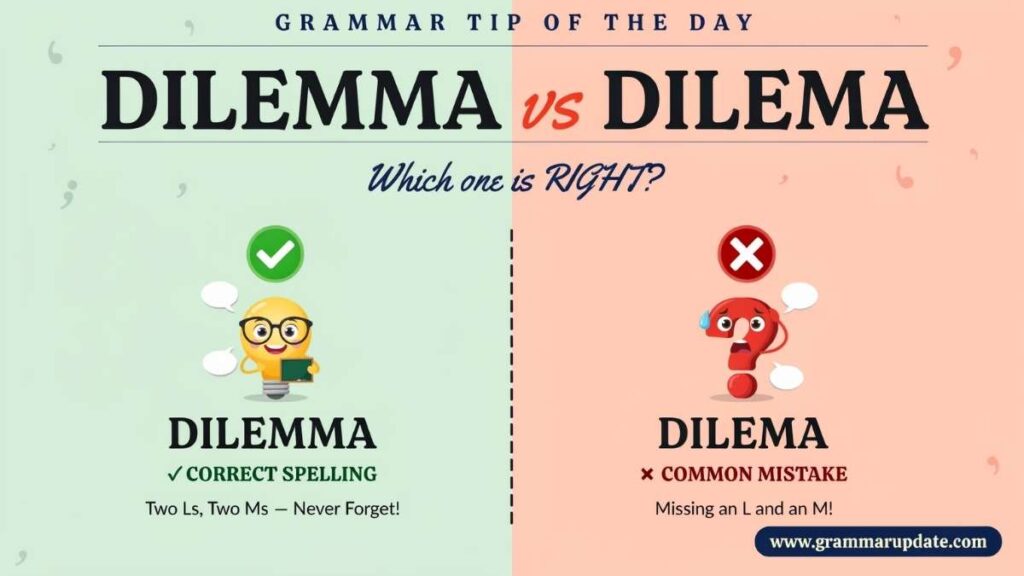
The difference between dilemma vs dilema is simple once you know which spelling is correct. Dilemma is the correct word, while dilema is a common spelling mistake. The extra m may seem like a small detail, but it can make your writing look less polished. Dilemma means a difficult choice or situation where you have to choose between competing options. Luckily, there’s no need to turn the spelling itself into another dilemma. In this guide, you’ll learn the correct spelling, meaning, pronunciation, and usage of dilemma. You’ll also see why people often misspell it and how to remember the correct form with ease.
Quick Answer
If you’re wondering, “Is it dilemma vs dilema?”, the correct answer is dilemma.
Dilemma is the standard spelling in English. Dilema is a misspelling and doesn’t represent a different version of the word.
The same applies to dilemna. If you’re asking, “Is it dilemma or dilemna?”, choose dilemma.
The correct spelling is:
D-I-L-E-M-M-A
The key detail is the double m in the middle.
| Spelling | Correct? | Meaning |
|---|---|---|
| dilemma | Yes | A difficult choice or situation |
| dilema | No | Common misspelling |
| dilemna | No | Common misspelling |
So, if you’re checking the dilemma correct spelling, remember one simple rule: dilemma has two m’s and no n.
Learn the difference between confusing more English words
In Process vs In Progress Difference and usage?
What Is a Dilemma?
A dilemma is a difficult situation that requires you to make a choice between competing alternatives.
For example, imagine that you receive two job offers. One offers an excellent salary but requires you to move far away from your family. The other keeps you close to home but pays much less.
You have a difficult decision to make. Neither option is perfect. That situation can be called a dilemma.
In simple English, a dilemma involves a choice where each option has something good and something undesirable.
This is why a dilemma is more than an ordinary problem. A problem simply needs a solution. A dilemma usually forces you to decide which difficult option you can live with.
Dilemma Definition
A simple dilemma definition is a difficult situation in which a person must choose between competing alternatives.
The word is a noun. You can use it to describe a difficult choice in personal life, work, education, relationships, business, medicine, or ethics.
For example:
She faced a difficult dilemma.
The company was dealing with a serious dilemma.
He couldn’t decide which option to choose because both created problems.
The committee faced an ethical dilemma.
The plural form is dilemmas.
For example:
The managers faced several difficult dilemmas during the project.
The important idea behind the dilemma word meaning is choice. If there is no meaningful choice involved, the word may not be the best fit.
Learn the difference between confusing more English words
Atheist Vs Athiest Which Spelling Is Correct?
Dilemma vs Dilema What Is the Difference?
The difference between dilemma vs dilema is spelling, not meaning.
Dilemma is correct. Dilema is incorrect.
There isn’t a separate definition for dilema in standard English. If someone writes dilema when they mean the difficult-choice noun, they’re simply making a spelling error.
| Feature | Dilemma | Dilema |
|---|---|---|
| Standard English spelling | Correct | Incorrect |
| Meaning | Difficult choice or situation | No separate standard meaning |
| Part of speech | Noun | Not the standard form |
| Double m | Yes | No |
| Recommended in formal writing | Yes | No |
Therefore, the dilema vs dilemma comparison doesn’t involve two words with different meanings. It involves the correct spelling and a common misspelling.
If you’re writing an essay, email, report, application, or professional document, always use dilemma.
Learn the difference between confusing more English words
Unpure vs Impure Which one Is Correct?
Dilemma vs Dilemna Which Spelling Is Correct?
The comparison dilemma vs dilemna creates another common spelling question.
Dilemma is the correct spelling. Dilemna is incorrect.
The word does not contain an n in the middle. It contains two m’s.
Correct:
dilemma
Incorrect:
dilemna
The incorrect form may seem reasonable because English pronunciation doesn’t always make spelling obvious. Someone who hears the word without seeing it written might guess the letters incorrectly.
However, there is no standard English spelling called dilemna.
This means that the dilemna spelling should be treated as a misspelling rather than a regional or alternative form.
Why Is Dilemma Commonly Misspelled?
The dilemma spelling can be difficult because English spelling doesn’t always follow pronunciation perfectly.
When people hear a word, they often try to reproduce the sounds they recognize. That approach works with many simple words, but it can cause trouble with words that have less predictable spellings.
Dilemma is one of those words.
Some writers leave out the second m and write dilema. Others insert an n and write dilemna. Both mistakes can happen when someone remembers the pronunciation but not the exact spelling.
Another reason is familiarity. When you see an incorrect spelling several times, your brain can start to recognize it as familiar. That doesn’t make it correct, though.
The easiest way to avoid the mistake is to remember the middle of the word:
dilemma = double m
Once you remember that pattern, the spelling becomes much easier.
How to Spell Dilemma
If you’re asking how to spell dilemma, the answer is:
D-I-L-E-M-M-A
If you’re asking how do you spell dilemma correctly, focus on the two m’s.
A useful way to remember the spelling is to think of the word as:
di + lemma
The historical form of the word helps explain why the double m appears. Dilemma comes from the Greek word dilēmma, which was formed from elements meaning “two” and “premise” or “proposition.”
You don’t need to memorize its Greek history to spell the word correctly. A simple memory trick is enough:
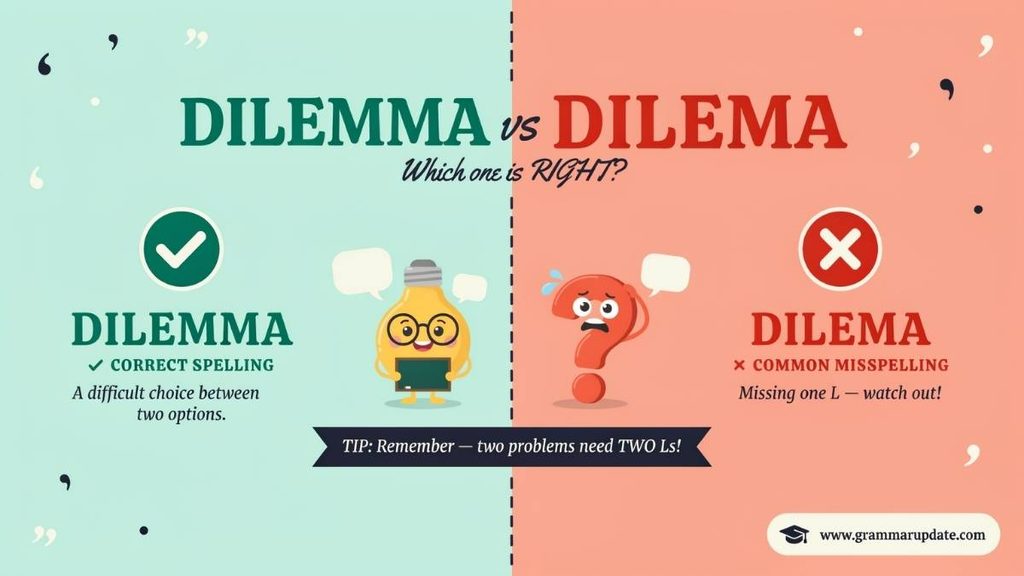
Dilemma has two m’s.
That small reminder can prevent one of the most common spelling errors associated with the word.
Dilemma Pronunciation
The dilemma pronunciation can vary slightly depending on the variety of English being spoken.
In American English, the word can be pronounced with the first syllable sounding like “di” or with a pronunciation closer to “dye.” British English also has pronunciation variation.
The word generally has three syllables, with the main stress on the middle syllable.
The spelling and pronunciation don’t mean that you should add an n to the word. There is no silent n in dilemma because there is no n in the correct spelling.
If you’re wondering how to pronounce dilemma correctly, focus on saying the word naturally rather than trying to pronounce every written letter separately.
Learn the difference between confusing more English words
Acknowledge Vs Acknowlege Which one Is Correct?
Dilemma Spelling in American and British English
One useful fact settles the question of dilemma UK spelling versus dilemma US spelling: both use dilemma.
American English uses dilemma.
British English uses dilemma.
The spelling doesn’t change between these two varieties.
| English variety | Correct spelling |
|---|---|
| American English | dilemma |
| British English | dilemma |
| Canadian English | dilemma |
| Australian English | dilemma |
Pronunciation may differ slightly between regions, but the written form remains the same.
So, if you’re wondering whether dilemma UK vs US spelling produces two different forms, it doesn’t.
Dilema isn’t the British version, and dilemna isn’t the American version. Both are simply incorrect spellings when used to mean the English word dilemma.
Learn the difference between tricky grammar more words
Believe Vs Belive Which one Is Correct?
Dilemma Meaning in English
The dilemma meaning centers on a difficult choice.
A typical dilemma involves competing alternatives. You may have two difficult choices, several possible options, or conflicting alternatives. What makes the situation a dilemma is that the decision isn’t easy.
For example, imagine that a student has an important examination the next morning. At the same time, a close friend needs help with an urgent problem.
Studying may improve the student’s result. Helping the friend may be more important personally. Either choice could have consequences.
That is a personal dilemma.
A professional dilemma works in much the same way. A manager might have to choose between reducing costs and keeping employees. Both choices can have consequences, so the decision becomes difficult.
The circumstances change, but the basic idea remains the same: a dilemma involves a difficult choice.
Dilemma Examples
Looking at dilemma examples can make the meaning much easier to understand.
A personal dilemma might look like this:
She faced a dilemma over whether to move to another city for a better job or stay close to her family.
A professional dilemma might be:
The manager faced a dilemma about whether to promote an experienced employee or a newer employee with stronger recent results.
An ethical dilemma could be:
The journalist faced an ethical dilemma over whether publishing the information would benefit the public or unfairly harm someone’s privacy.
A moral dilemma might be:
He faced a moral dilemma because telling the truth could seriously hurt someone he cared about.
An everyday dilemma could be:
I had a dilemma: should I buy the laptop I want or save the money for my vacation?
Each example involves a meaningful decision. That’s what separates a dilemma from an ordinary inconvenience.
Dilemma in a Sentence
A dilemma sentence usually describes someone facing a difficult decision.
The word commonly appears with expressions such as “face a dilemma,” “be in a dilemma,” “a dilemma about,” and “a dilemma over.”
For example:
She faced a dilemma over whether to accept the promotion.
He was in a dilemma about which university to attend.
The decision created an ethical dilemma for the committee.
The company faced a difficult dilemma over how to reduce costs.
These patterns are useful because they show how native English speakers commonly use the word.
Instead of trying to force the word into an unusual sentence, use it when the situation genuinely involves a difficult choice.
Learn the difference between tricky grammar more words
Changeable vs Changable Which one Is Correct?
Is Dilemma Always About Two Choices?
The historical meaning of dilemma is closely connected to two alternatives.
The word comes from Greek dilēmma. It was formed from di-, meaning “two,” and lemma, meaning a premise or proposition.
That history explains why people often describe a dilemma as a choice between two difficult options.
Modern English, however, uses the word more broadly.
A dilemma can involve more than two alternatives when the central issue is still a difficult decision involving competing choices.
For example:
The committee faced a dilemma over how to distribute its limited budget among several important projects.
That situation may involve several possible decisions rather than exactly two.
The traditional idea of two alternatives remains useful for understanding the word’s origin, but everyday English doesn’t always restrict dilemma to exactly two options.
Dilemma vs Problem
A dilemma and a problem are related, but they aren’t the same thing.
A problem is something that needs to be solved. A dilemma involves a difficult choice.
Consider a broken computer.
If the computer won’t turn on, you have a problem.
Now imagine that repairing it will cost $900, while replacing it will cost $1,500. You also have important files on the old machine.
Now you have a choice between competing alternatives. That decision can become a dilemma.
| Problem | Dilemma |
|---|---|
| Something needs a solution | A difficult choice needs to be made |
| May have one clear solution | Often involves competing options |
| Can be technical or practical | Often involves conflicting consequences |
| Example: a broken computer | Example: repair it or replace it |
A simple way to remember the difference is this:
A problem asks, “How can this be fixed?”
A dilemma asks, “Which difficult option should I choose?”
Learn the difference between tricky grammar more words
Acquire Vs Aquire Which one Is Correct?
Dilemma vs Predicament
Predicament and dilemma can sometimes describe similar situations, but they don’t emphasize exactly the same thing.
A predicament is a difficult or unpleasant situation. A dilemma places more attention on the choice involved.
For example:
She was in a predicament after losing her passport.
This sentence focuses on the difficult situation.
Now consider:
She faced a dilemma over whether to cancel the trip or continue without her passport.
This sentence focuses on the decision.
The two words can overlap, but context determines which one sounds more natural.
When the main issue is being stuck in a difficult situation, predicament may work better. When the main issue is choosing between difficult alternatives, dilemma is usually the clearer choice.
Dilemma vs Quandary
Quandary is another word that can overlap with dilemma.
A quandary describes a state of uncertainty about what to do.
For example:
She was in a quandary about which job offer to accept.
You could also say:
She faced a dilemma about which job offer to accept.
Both sentences work.
The difference is subtle. Dilemma often highlights the competing choices, while quandary can place more emphasis on uncertainty and indecision.
Neither word should automatically replace the other. Choose the one that best matches the situation you’re describing.
Learn the difference between tricky grammar more words
Colleague vs Colleage which one is correct ?
Moral Dilemma and Ethical Dilemma
The expressions moral dilemma and ethical dilemma are common in English.
A moral dilemma occurs when someone has to make a difficult choice involving questions of right and wrong.
For example:
He faced a moral dilemma when telling the truth could seriously hurt his friend.
An ethical dilemma is similar, especially when the decision involves professional or broader principles.
For example:
The doctor faced an ethical dilemma involving the patient’s wishes and the possible consequences of the decision.
Ethical dilemmas can appear in medicine, journalism, law, business, technology, education, and public policy.
The word dilemma therefore has practical uses far beyond ordinary conversation.
Is Dilemma a Noun?
Yes. Dilemma is a noun.
It names a difficult choice or situation.
For example:
The dilemma troubled her for several days.
In this sentence, dilemma functions as a noun.
The plural form is dilemmas.
For example:
The managers faced several difficult dilemmas during the project.
The plural is straightforward. Add s to make dilemmas.
| Number | Form | Example |
|---|---|---|
| Singular | dilemma | She faced a dilemma. |
| Plural | dilemmas | They faced several dilemmas. |
You don’t need a special plural ending for ordinary modern English.
Common Phrases With Dilemma
Dilemma appears in several common phrases and sentence patterns.
One common expression is “face a dilemma.”
For example:
We face a dilemma over whether to expand the business.
Another is “be in a dilemma.”
For example:
She was in a dilemma about accepting the position.
You can also use “moral dilemma” and “ethical dilemma.”
For example:
The story presents a serious moral dilemma.
The researchers discussed an ethical dilemma.
Other natural patterns include “dilemma about something” and “dilemma over something.”
For example:
He had a dilemma about whether to move abroad.
The board faced a dilemma over the proposed changes.
Learning these common patterns can make your English sound more natural.
Learn the difference between confusing more English words
Envisage vs Envision difference and usage?
Common Dilemma Spelling Mistakes
The two most common mistakes discussed in this article are dilema and dilemna.
Here is the correction:
| Incorrect spelling | Correct spelling |
|---|---|
| dilema | dilemma |
| dilemna | dilemma |
The first mistake removes one of the m’s.
The second mistake replaces the correct double m with an incorrect n.
Neither spelling represents a standard variation of dilemma.
Forgetting the Second M
Incorrect:
She faced a dilema.
Correct:
She faced a dilemma.
This is the main mistake in the dilema vs dilemma comparison.
The easiest way to avoid it is to remember that dilemma contains two m’s.
Adding an N
Incorrect:
He was caught in a dilemna.
Correct:
He was caught in a dilemma.
The letter n doesn’t belong in the standard spelling.
Learn the difference between confusing more English words
Acquaintance Vs Acquaintence Which one Is Correct?
practice session Dilemma vs Dilema
Choose the correct word or form to complete each sentence. Dilemma vs Dilema
- She faced a difficult ________ when she had to choose between two job offers.
- The student was in a ________ about whether to study abroad or stay close to home.
- The correct spelling is ________, not “dilema.”
- He found himself in a serious moral ________.
- Choosing between honesty and protecting his friend put him in a difficult ________.
- The company faced a ________ over whether to reduce costs or keep all its employees.
- Which spelling is correct: ________ or dilema?
- The teacher explained that “dilema” is a common spelling ________.
- She had a tough ________ to make before the deadline.
- The manager faced an ethical ________ when deciding how to handle the situation.
- He was caught in a ________ between accepting the promotion and spending more time with his family.
- Remember that ________ contains two m’s.
- The word “dilemma” describes a difficult ________ between alternatives.
- She was in a ________ because both choices seemed equally important.
- The correct form is ________, not “dilemna.”
- His personal ________ made it difficult for him to decide what to do.
- The politician faced a difficult ________ over the proposed policy.
- If you are unsure how to spell the word, remember: di-le-mma, ________.
- The child faced a simple ________: tell the truth or keep the secret.
- A moral ________ involves a difficult choice about what is right or wrong.
- She couldn’t decide which option to choose, so she remained in a ________.
- “Dilema” is not the standard English spelling of ________.
- The word ________ can describe a situation involving conflicting choices.
- He faced the ________ of choosing between his career and his family.
- If you write “dilemna,” replace it with the correct spelling, ________.
Answers
- dilemma
- dilemma
- dilemma
- dilemma
- dilemma
- dilemma
- dilemma
- mistake
- dilemma
- dilemma
- dilemma
- dilemma
- choice
- dilemma
- dilemma
- dilemma
- dilemma
- dilemma
- dilemma
- dilemma
- dilemma
- dilemma
- dilemma
- dilemma
- dilemma
Here’s a trusted source for clear word meanings:
FAQs
Is “dilema” the correct spelling?
No. “Dilema” is a common misspelling of “dilemma.” The correct spelling has two m’s: dilemma.
Is “dilemna” spelled correctly?
No. “Dilemna” is another common misspelling of “dilemma.” The correct spelling is dilemma, with two m’s and no n.
Why do people spell “dilemma” as “dilemna”?
The spelling can be confusing because the word’s pronunciation doesn’t clearly reveal every letter. Some people also insert an n because similar English words contain an n in comparable positions. However, the standard spelling is dilemma.
How do you spell “dilemma” correctly?
The correct spelling is dilemma. Remember the double m in the middle: d-i-l-e-m-m-a. Writing it this way can help you avoid the common spelling “dilema.”
Does “dilemma” have two m’s?
Yes. Dilemma is spelled with two consecutive m’s. It contains no n, so both “dilema” and “dilemna” are incorrect spellings.
What does “dilemma” mean?
A dilemma is a difficult situation in which you must choose between two or more alternatives. The available choices often have competing advantages, disadvantages, or consequences.
Is a dilemma always about two choices?
Not always. The word originally referred to two alternatives, but modern English can use dilemma more broadly for a difficult situation involving several conflicting choices.
Can I say “I am in a dilemma”?
Yes. “I am in a dilemma” is a natural and grammatically correct expression. It means that you’re facing a difficult choice and aren’t sure which option to choose.
What is a simple example of a dilemma?
Choosing between keeping a well-paid job you dislike and accepting a lower-paying job you enjoy can create a dilemma. Both options have important benefits and drawbacks.
Is “dilemma” a noun?
Yes. Dilemma is a noun. It names a difficult choice or situation, as in “She faced a difficult dilemma.”
What is the plural of “dilemma”?
The standard plural form is dilemmas. For example, you can say, “The students discussed several moral dilemmas.”
What is the difference between a dilemma and a problem?
A problem is a difficulty that needs to be solved, while a dilemma involves a difficult choice between competing alternatives. A dilemma can be a problem, but not every problem creates a dilemma.
How is a dilemma different from a predicament?
A dilemma focuses on a difficult choice between alternatives. A predicament refers more broadly to a difficult or unpleasant situation that can be hard to escape or resolve. The two words can overlap, but their meanings aren’t identical.
What is a moral dilemma?
A moral dilemma is a situation in which you must choose between conflicting moral principles, duties, or values. Each available choice may have an ethical consequence.
What is an ethical dilemma?
An ethical dilemma occurs when a person or organization faces competing ethical responsibilities or principles. The challenge comes from having no option that seems completely right.
What are some common expressions with “dilemma”?
Common expressions include “face a dilemma,” “be in a dilemma,” “moral dilemma,” “ethical dilemma,” “difficult dilemma,” and “dilemma over something.”
Is “dilemma” spelled differently in American and British English?
No. Dilemma has the same spelling in American and British English. The word doesn’t change to “dilema” or another form in either variety.
Where does the word “dilemma” come from?
Dilemma comes from Greek and entered English through Latin. Its original meaning referred to a proposition involving two alternatives. Over time, the word developed its modern sense of a difficult choice or situation.
What are some synonyms for “dilemma”?
Depending on the context, synonyms for dilemma include predicament, quandary, difficult choice, difficult decision, and challenging situation. The best alternative depends on the specific situation.
Is “dilemma” appropriate for formal writing?
Yes. Dilemma works well in both everyday and formal English. You can use it in conversations, academic writing, professional communication, and discussions of moral or ethical issues.
Learn the difference between confusing more English words
Acceptable Vs Aceptable Which one Is Correct?
Conclusion
The confusion between dilemma vs dilema is actually easy to clear up. Dilemma is the correct spelling, while dilema vs dilemna are common spelling mistakes. When you see dilemma vs dilema, remember that dilemma has two m’s and no n. The word refers to a difficult choice or situation where you have to decide between competing options. Once you remember the double m, the dilemma spelling becomes much easier to get right. Whether you’re talking about a personal dilemma, a moral dilemma, or a tough decision at work, using the correct spelling makes your writing clear and professional. So, when in doubt, choose dilemma and leave dilema behind.

Jhon AJS, the creative mind behind Grammar Update, is an experienced blogger passionate about simplifying English grammar. He focuses on explaining confusing word vs word differences, grammar rules, punctuation, and sentence structure in a clear and practical way. Through easy to understand guides and examples, Jhon helps readers improve their writing and communicate with confidence. With years of blogging experience, he continues to share helpful insights that make learning grammar simple, useful, and accessible for everyone.