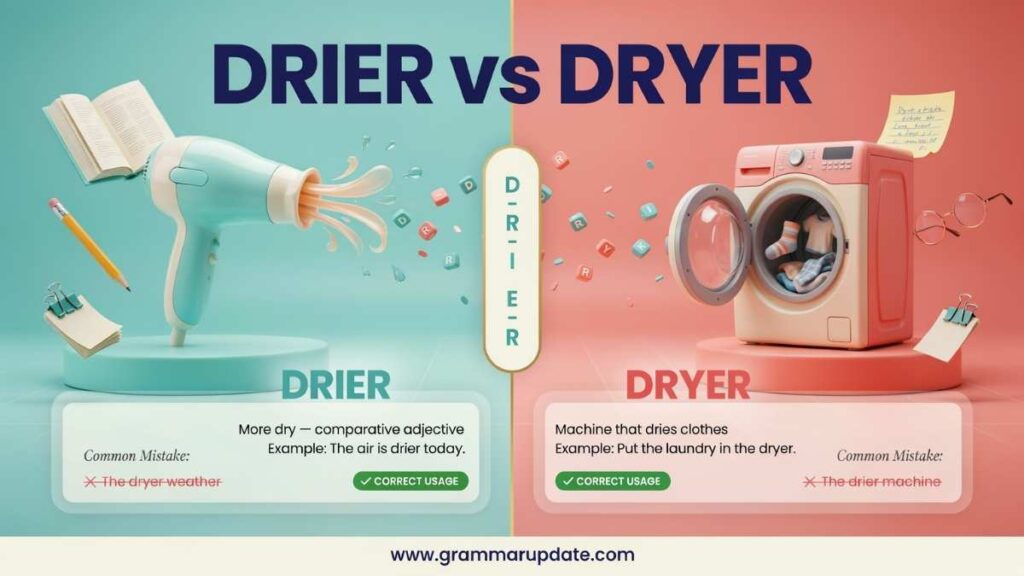
English can make simple spelling choices surprisingly tricky, and drier vs dryer is a good example. Both words are correct, but they have different common uses. Drier is the comparative form of dry, so you use it when something has less moisture or is more dry than something else. Dryer usually means a machine or device that dries something. For example, you might say “drier weather” when the air contains less moisture, but “clothes dryer” when talking about the machine. The difference is small, but the meaning matters. Once you know what each word means, choosing between drier and dryer becomes much easier.
Quick answer
If you’re unsure whether to use drier vs dryer, this quick table makes the difference clear:
| Word | Meaning | Example |
|---|---|---|
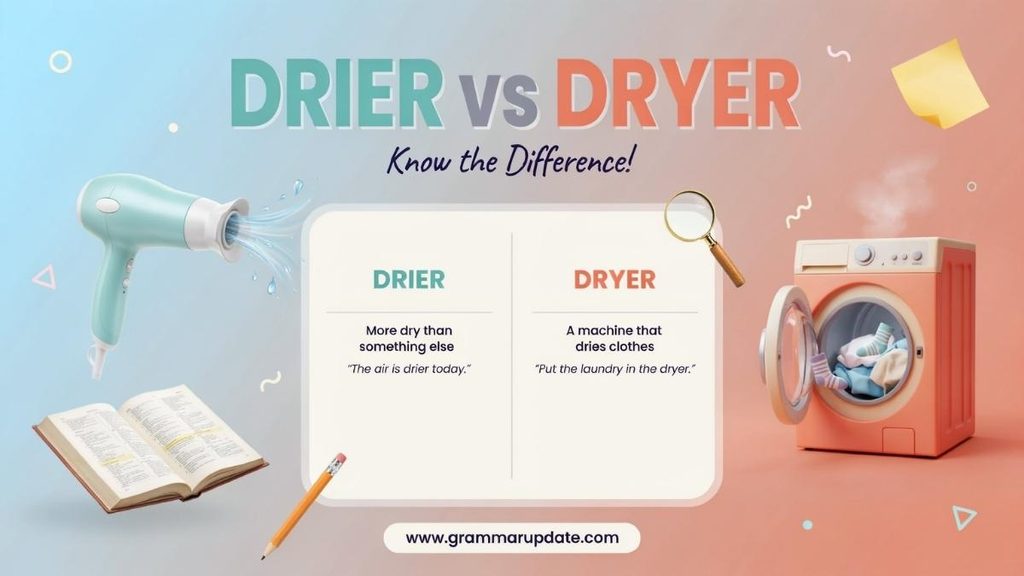
| Drier | More dry; having less moisture | The air is drier today. |
| Dryer | A machine or device that dries something | The clothes are in the dryer. |
The easiest rule is simple: use drier for comparing dryness and dryer for a machine or drying device. Both words are correct, but the meaning tells you which one to choose.
Fix common more word mistakes in English
Patient vs Patience which one is correct ?
Drier vs Dryer What’s the Difference?
The simplest way to understand drier vs dryer is to look at what the word is doing in the sentence.
Drier is normally the comparative form of the adjective dry. It means something has less moisture than something else, or that conditions have become less wet.
Dry → drier → driest
For example:
The desert air is drier than the coastal air.
The soil is drier after several weeks without rain.
This room feels drier than the one downstairs.
In each example, drier compares one condition with another.
Dryer, on the other hand, is usually a noun. It refers to a machine or device used to dry something. You might use it for clothes, hair, hands, food, grain, or other materials.
For example:
Put the wet clothes in the dryer.
She used a hair dryer after taking a shower.
The restaurant installed a hand dryer.
Therefore, the main difference between drier and dryer is grammatical as well as semantic. Drier normally describes a condition. Dryer normally names something that performs the drying.
| Word | Usual role | Main meaning | Example |
|---|---|---|---|
| drier | Comparative adjective | More dry or less moist | The air is drier today. |
| dryer | Noun | A machine or device that dries something | Put the clothes in the dryer. |
| drier | Noun in some usage | Another spelling of dryer | The drier stopped working. |
This distinction solves most cases of drier vs dryer confusion.
What Does Drier Mean?
Drier is the comparative form of dry. It tells you that something has less moisture, less water, or less humidity than something else.
The word does not usually describe a machine. Instead, it describes a change or comparison.
For example:
Today is drier than yesterday.
The western side of the valley is drier.
My skin feels drier in winter.
The second sentence compares the western side with another area. The third compares the current condition of the skin with a previous or normal condition.
Because drier is a comparative adjective, it commonly appears with than.
The soil is drier than it was last week.
The air is drier than usual.
This towel is drier than that one.
However, you do not always need the word than. The comparison can be understood from the context.
The climate becomes drier as you move inland.
Here, the sentence describes a gradual change. The meaning is still comparative even though than does not appear.
Drier Definition and Meaning
The basic drier definition is “more dry” or “having less moisture.” In grammar, it is the comparative form of dry.
The word can describe many things, including air, weather, soil, skin, clothes, food, climate, and other materials.
For example:
The region has a drier climate.
The northern fields are drier.
Winter makes my hands drier.
The paper becomes drier in warm air.
The important point is that drier describes a condition. It does not automatically refer to a drying machine.
That distinction becomes especially useful when you are choosing between drier air and air dryer.
Learn the difference between often confused words
Embarrass vs Embarass difference and usage?
What Does Dryer Mean?
Dryer is usually a noun that refers to a machine or device used to make something dry.
A dryer removes moisture from an object or material. Depending on the context, it might use heated air, moving air, spinning, or another drying process.
Common examples include clothes dryer, hair dryer, hand dryer, grain dryer, and tumble dryer.
For example:
The clothes are still wet, so leave them in the dryer.
He bought a new hair dryer.
The public restroom has an automatic hand dryer.
The word dryer follows a familiar English pattern. The suffix -er can create a noun for a person or thing that performs an action. In this case, something that dries can be called a dryer.
That is why dryer works naturally as the name of a machine.
Dryer Definition and Meaning
The dryer definition is generally a machine or device that dries something.
For example, a clothes dryer removes moisture from wet clothing. A hair dryer removes moisture from wet hair. A hand dryer dries wet hands.
The word can also appear in technical or industrial contexts.
A grain dryer, for example, is equipment used to reduce moisture in harvested grain. In manufacturing, different types of drying equipment can remove moisture from materials during production.
Therefore, dryer is not limited to laundry.
Learn the difference between often confused words
Fascinating vs Facinating difference and usage?
Drier vs Dryer Which Word Should You Use?
Both drier and dryer are correct words. The correct choice depends on what you mean.
If you are comparing levels of dryness, use drier.
If you are naming a machine or device that dries something, use dryer in most everyday American English contexts.
Consider these examples:
The air is drier today.
The dryer is running.
The first sentence needs an adjective because it describes the air. The second sentence needs a noun because it names a machine.
This is why asking only “Is drier correct?” or “Is dryer correct?” does not completely solve the problem. Both words are legitimate. The real question is what you are trying to say.
There is also an important dictionary detail. Drier can be used as a noun meaning a machine that dries something. Major English dictionaries recognize drier as an alternative spelling of dryer in this sense. However, dryer is the more familiar choice in many everyday American English contexts.
So, if you are writing about a machine, dryer is generally the clearest choice.
Drier Than or Dryer Than?
When you are making a comparison, drier than is the standard choice.
For example:
This room is drier than the kitchen.
The climate here is drier than it was last year.
The towel is drier than the other one.
The reason is simple. Drier is the comparative form of dry.
Dry → drier
Just as:
Easy → easier
Busy → busier
Happy → happier
Dry follows a similar spelling pattern.
The phrase dryer than usually does not work when you mean “more dry.” In that situation, drier than is the natural grammatical choice.
Compare these sentences:
Correct: The air is drier than yesterday.
Incorrect for the intended meaning: The air is dryer than yesterday.
However, dryer can appear before another noun because it is a noun.
For example:
The dryer is louder than the washer.
Here, dryer is not a comparative adjective. It is the name of a machine, and louder provides the comparison.
This small distinction makes the difference much easier to understand.
Drier Weather or Dryer Weather?
When you are talking about weather conditions, drier weather is normally the correct expression.
Drier weather means weather with less moisture, less rain, or generally less wetness than another period.
For example:
We are expecting drier weather next week.
The southern region usually has drier weather during summer.
The farmers welcomed the drier weather after several rainy days.
The word dryer does not normally belong in this expression because weather is not a machine.
Therefore:
Drier weather = weather that is less wet or has less rain or moisture.
Dryer weather = generally not the standard choice when you mean less wet weather.
The same principle applies to drier climate.
A drier climate has less moisture or precipitation compared with a wetter climate.
For example:
The western region has a drier climate.
Plants in drier climates often need different adaptations.
As the elevation changes, the area may become cooler and drier.
The exact meaning of dry can vary with context. Weather can be dry because there is little rain, while air can be dry because it contains relatively little moisture.
Learn the difference between often confused words
Breached VS Breeched difference and Which Is Correct?
Drier Air or Dryer Air?
Drier air is the normal expression when you mean air with less moisture.
For example:
Cold indoor heating can make the air drier.
The desert has much drier air than the humid coast.
The room feels drier during the winter.
Here, drier describes the moisture level of the air.
However, air dryer can mean a machine or system that dries air.
For example:
The factory uses an air dryer to remove moisture from compressed air.
The technician replaced the air dryer.
This creates a useful distinction:
Drier air = air containing less moisture.
Air dryer = a device or system that removes moisture from air.
The position of the words changes the meaning.
Hair Dryer or Hair Drier?
Hair dryer is the more familiar everyday spelling, especially in American English.
For example:
I need a new hair dryer.
She used a hair dryer to dry her hair.
He keeps his hair dryer in the bathroom.
Hair drier is also recognized as an alternative spelling because drier can function as a noun meaning a drying device. Nevertheless, hair dryer is generally the clearer choice for ordinary writing.
The important thing is to separate the adjective drier from the noun use.
Her hair is drier today.
In this sentence, drier describes her hair.
She bought a new hair dryer.
In this sentence, dryer names the machine.
The meaning changes even though the pronunciation is essentially the same.
Clothes Dryer or Clothes Drier?
Clothes dryer is the usual choice in American English.
For example:
The clothes are still in the dryer.
Our clothes dryer stopped working.
The new dryer uses less electricity.
Clothes drier can also be found because drier has a noun meaning related to a drying machine. However, clothes dryer is generally more familiar and immediately clear to most readers.
In British English, tumble dryer is also a very common term for a machine that dries clothes.
Therefore, the safest everyday choice is clothes dryer in American English, while tumble dryer is especially common in British English.
Learn the difference between often confused words
Concede vs Conceed difference and usage?
Dry, Drier, and Driest
The relationship among dry, drier, and driest is straightforward once you see the pattern.
Dry is the basic adjective.
Drier is the comparative form.
Driest is the superlative form.
| Form | Meaning | Example |
|---|---|---|
| dry | Having little or no moisture | The towel is dry. |
| drier | Having less moisture than another thing | This towel is drier. |
| driest | Having the least moisture among several things | This is the driest towel. |
The spelling can look unusual because dry changes its final y to i before the comparative and superlative endings.
dry → drier → driest
You can compare this with:
happy → happier → happiest
easy → easier → easiest
busy → busier → busiest
So, if you are wondering whether the comparative should be more dry or drier, drier is usually the natural choice.
More Dry or Drier?
Drier is the standard comparative form of dry.
For example:
The air is drier today.
This soil is drier than the soil near the river.
The second room feels drier.
More dry is possible in certain contexts, particularly when a writer wants to emphasize the phrase or avoid ambiguity, but ordinary English generally prefers drier when comparing degrees of dryness.
For everyday grammar, remember:
dry → drier → driest
This simple pattern will usually give you the correct form.
Can Drier Be a Noun?
Yes. This is one of the reasons the drier vs dryer confusion exists in the first place.
Dictionaries recognize drier as a noun meaning a machine that dries something. In that sense, drier is an alternative spelling of dryer.
For example:
The drier is not working.
She put the clothes in the drier.
However, dryer is usually the more recognizable spelling when you are naming a machine, particularly in American English.
As a result, using dryer for machines can make your writing easier for readers to understand immediately.
At the same time, it would be inaccurate to say that drier is never a noun. It is a recognized noun, and dictionaries document that use.
Learn the difference between often confused words
Aluminum vs Aluminium difference and usage?
Why Is a Drying Machine Called a Dryer?
The word dryer comes from the verb dry combined with the suffix -er.
English frequently uses -er to create nouns connected with an action. A person or thing that performs an action can receive this ending.
For example:
A runner runs.
A teacher teaches.
A cleaner cleans.
A dryer dries.
The same basic idea applies to the drying machine. A dryer is something that dries.
The noun has a long history in English, and modern dictionaries trace dryer to the verb dry with the -er ending. The spelling drier is also established as an alternative noun form.
Therefore, dryer is not simply an arbitrary spelling. It follows a familiar word-building pattern.
Learn the difference between often confused words
Your vs You’re Difference and which is correct ?
Drier vs Dryer in American English
American English commonly uses dryer for machines and drier for the comparative adjective.
For example:
The weather is drier this week.
The clothes are in the dryer.
She bought a new hair dryer.
This distinction is especially useful for everyday writing because dryer is the form most readers expect when you are talking about a household appliance.
However, American dictionaries also recognize drier as a noun for a drying machine. Therefore, the alternative form is not automatically a spelling error.
The safest approach is to consider meaning first and audience second.
If you mean “more dry,” choose drier.
If you mean the machine, dryer is generally the clearest American English choice.
Dryer or Drier in the UK?
British English also recognizes both forms.
Drier can mean the comparative form of dry:
The weather is drier in the south.
Drier can also function as a noun meaning a drying machine.
Dryer is also used as a noun for a machine that dries something. In British English, you will also frequently encounter compounds such as tumble dryer.
For example:
The clothes are in the tumble dryer.
She bought a new hairdryer.
Therefore, the basic grammatical distinction remains the same in British English. The biggest difference is often the preferred vocabulary for particular machines rather than a completely different spelling rule.
Learn the difference between confusing more English words
Guidance vs Guidence difference and usage ?
Common Drier vs Dryer Mistakes
Many mistakes happen because the two words sound alike. When you hear the sentence, you cannot see whether the speaker means drier vs dryer. Writing removes that ambiguity, so you need to use context.
A common mistake is using dryer when you mean “more dry.”
Incorrect: The desert air is dryer than the coastal air.
Better: The desert air is drier than the coastal air.
Another common mistake is using drier when you are clearly naming a household appliance.
Less familiar: Put the clothes in the drier.
Clearer: Put the clothes in the dryer.
Neither confusion comes from pronunciation. Instead, it comes from mixing up grammatical roles.
When you are comparing conditions, think drier.
When you are naming a drying machine, think dryer.
Learn the difference between confusing more English words
Fluorescent vs Flourescent difference and usage ?
Drier vs Dryer A Simple Memory Trick
A useful memory trick is to connect the i in drier with the idea of comparison.
Dry becomes drier when you compare dryness.
Dry → drier → driest
Then connect dryer with a device.
A dryer is something that dries.
For example:
The weather is drier.
The dryer is running.
The first sentence describes a condition. The second names a machine.
This trick is simple, but it works because it focuses on meaning instead of memorizing two isolated spellings.
Drier vs Dryer Examples in Sentences
The best way to understand drier and dryer is to see them working in real sentences.
The air is drier today than it was yesterday.
This sentence uses drier because it compares moisture levels.
The clothes are still in the dryer.
This sentence uses dryer because it names a machine.
The desert has drier air than the rainforest.
Again, drier describes air with less moisture.
She used a hair dryer before leaving the house.
Here, dryer names the device.
The soil became drier after a month without rain.
Drier describes the changing condition of the soil.
The new dryer can handle a large load of clothes.
Dryer is a noun referring to an appliance.
The northern part of the country has a drier climate.
Drier describes a climate with less moisture or precipitation.
The technician repaired the air dryer.
Air dryer names equipment used to remove moisture from air.
The towel is drier now.
Drier compares its current condition with an earlier condition.
The dryer made a strange noise during the cycle.
Dryer names the machine.
These examples show why context matters more than the spelling alone.
Learn the difference between confusing more English words
Lose vs Loose difference and usage?
practice session Drier vs Dryer
Choose the correct word: drier vs dryer.
- The desert has ______ air than the coastal region.
- Please put the wet clothes in the ______.
- The weather became ______ after several weeks without rain.
- She bought a new hair ______ last week.
- This room feels ______ than the one upstairs.
- The clothes are still inside the ______.
- The northern region has a ______ climate.
- The technician repaired the air ______.
- My skin becomes ______ during the winter.
- This towel is ______ than the other one.
- He used a hair ______ to dry his hair.
- The soil is becoming ______ because there has been little rain.
- We expect ______ weather next week.
- The clothes ______ stopped working yesterday.
- The air feels ______ today.
- This part of the country has a ______ climate than the coast.
- The restaurant installed a hand ______ in the bathroom.
- The ground is much ______ after several sunny days.
- I need to buy a new clothes ______.
- The mountain air is ______ than the air near the sea.
- The farmer uses a grain ______ to remove moisture from the grain.
- The room became ______ after the heating system was turned on.
- Her hair was still wet, so she used the hair ______ again.
- This towel is ______ than the one I used earlier.
- The forecast says we will have ______ weather tomorrow.
Answers
- drier
- dryer
- drier
- dryer
- drier
- dryer
- drier
- dryer
- drier
- drier
- dryer
- drier
- drier
- dryer
- drier
- drier
- dryer
- drier
- dryer
- drier
- dryer
- drier
- dryer
- drier
- drier
Here’s a trusted source for clear word meanings:
FAQs
What is the difference between drier and dryer?
Drier is usually the comparative form of dry and means “more dry” or “less moist.” Dryer is usually a noun for a machine or device that dries something. For example, “The air is drier today,” but “The clothes are in the dryer.”
Which is correct, drier vs dryer?
Both are correct, but they are normally used in different ways. Use drier when you are comparing dryness or moisture levels. Use dryer when you are referring to a machine or device that removes moisture.
Is drier the comparative form of dry?
Yes. Drier is the comparative form of dry, while driest is the superlative form. The complete pattern is dry, drier, driest.
Is drier a word?
Yes, drier is a standard English word. It is most commonly used as the comparative form of dry. Dictionaries also recognize drier as a noun meaning a machine or device that dries something.
Is dryer a word?
Yes. Dryer is a standard English noun that usually refers to a machine or device used to dry something. Common examples include clothes dryer, hair dryer, and hand dryer.
When should you use drier instead of dryer?
Use drier when you mean that something has become more dry or contains less moisture than something else. For example, “The soil is drier after several days without rain.”
When should you use dryer instead of drier?
Use dryer when you are naming a machine or device that dries something. For example, “The clothes are in the dryer.”
Is it drier than or dryer than?
Drier than is the standard choice when you mean “more dry.” For example, “This region is drier than the coast.” Dryer than usually does not fit this meaning because dryer normally functions as a noun.
Is it drier weather or dryer weather?
Drier weather is the usual expression when you mean weather with less rain or moisture. For example, “The forecast predicts drier weather next week.”
Is it drier air or dryer air?
Drier air is the natural choice when you mean air that contains less moisture. For example, “The desert has drier air than the coastal region.”
Is it air drier or air dryer?
Both expressions can be correct, but they have different meanings. Drier air means air with less moisture, while an air dryer is a device or system that removes moisture from air.
Is it a hair dryer or hair drier?
Hair dryer is the more familiar spelling for the device, especially in American English. Hair drier is also recognized as an alternative noun spelling because drier can refer to a drying device.
Is it tumble drier or tumble dryer?
Both spellings are used. Tumble dryer is especially common in British English, while tumble drier is also recognized. The choice can depend on regional usage and writing style.
Can drier be used as a noun?
Yes. Drier can function as a noun meaning a machine or device that dries something. However, dryer is often the more familiar noun spelling in everyday American English.
Why is dryer spelled with “y” instead of “i”?
Dryer is formed from the word dry with the suffix -er and commonly functions as a noun for something that dries. Drier is the established comparative form of the adjective dry. Although the words look similar, their usual grammatical functions help distinguish them.
How do you spell the comparative form of dry?
The correct comparative spelling is drier. The three forms are dry, drier, and driest.
Is “more dry” correct, or should you use “drier”?
Drier is normally the preferred comparative form of dry. For example, “The climate is drier here.” More dry can appear in some contexts, but drier is the natural choice for an ordinary comparison.
What does drier mean?
Drier means “more dry” or “having less moisture” compared with something else. For example, “The desert has drier air than the coast.”
What does dryer mean?
Dryer usually means a machine or device that removes moisture. It can refer to equipment used for drying clothes, hair, hands, air, grain, or other materials.
How can you remember the difference between drier and dryer?
Think of drier as part of the sequence dry, drier, driest. Then think of a dryer as something that dries. In simple terms, drier usually describes dryness, while dryer usually names a drying device.
Is drier used in American English?
Yes. American English uses drier as the comparative form of dry. Dryer is commonly used for drying machines, although drier is also recognized as an alternative noun spelling.
Is drier used in British English?
Yes. British English uses drier as the comparative form of dry and also recognizes drier as a noun for a drying device. Dryer is also used, particularly in expressions such as tumble dryer.
How do you use drier in a sentence?
Use drier when comparing the dryness or moisture level of something. For example, “The air is drier today,” or “The western region has a drier climate.”
How do you use dryer in a sentence?
Use dryer when referring to a machine or device that dries something. For example, “The dryer is running,” or “She bought a new hair dryer.”
Why are drier and dryer commonly confused?
Drier and dryer are easy to confuse because they look and sound very similar. However, their usual roles are different. Drier normally describes a greater degree of dryness, while dryer usually refers to something that performs the drying.
Learn the difference between confusing more English words
Principal vs Principle Difference and usage ?
Conclusion
Drier vs dryer can be confusing because the two words look and sound almost the same. However, their meanings are usually different. Drier is the comparative form of dry, so you use it when something has less moisture or is more dry than something else. Dryer usually refers to a machine or device that dries something.
For example, you can say, “The air is drier today,” but “The clothes are in the dryer.” The easiest way to remember the difference is simple: dry, drier, driest describes levels of dryness, while a dryer is something that does the drying. Once you connect each word with its purpose, this common spelling confusion becomes much easier to avoid.

Jhon AJS, the creative mind behind Grammar Update, is an experienced blogger passionate about simplifying English grammar. He focuses on explaining confusing word vs word differences, grammar rules, punctuation, and sentence structure in a clear and practical way. Through easy to understand guides and examples, Jhon helps readers improve their writing and communicate with confidence. With years of blogging experience, he continues to share helpful insights that make learning grammar simple, useful, and accessible for everyone.