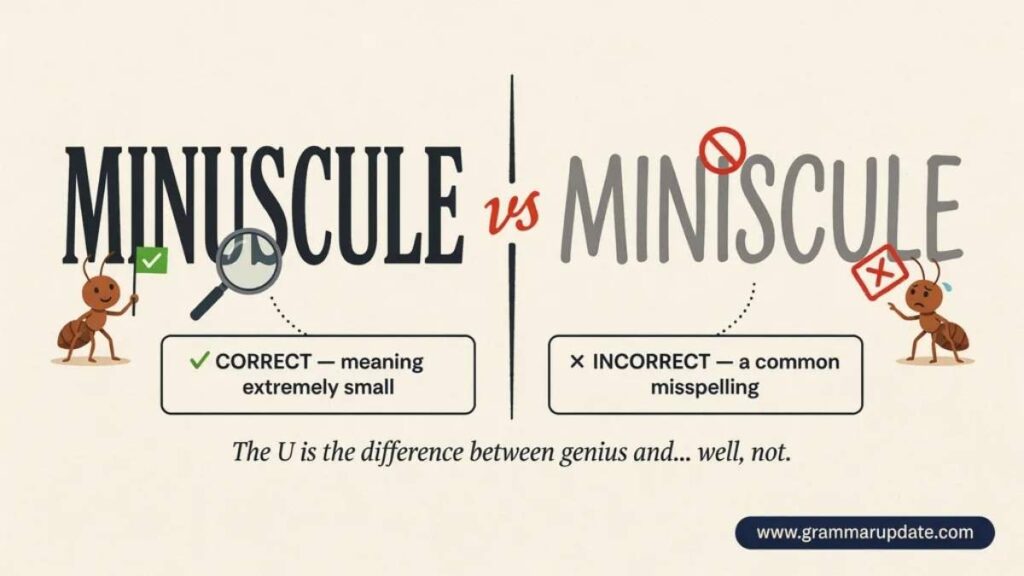
English spelling can turn one tiny letter into a surprisingly big headache. The minuscule vs miniscule confusion is a good example. Both spellings look almost the same, so it is easy to mix them up when you are writing quickly. However, minuscule is the standard spelling for something extremely small. Miniscule is also seen in English, but many dictionaries treat it as a misspelling, while some recognize it as a variant. In this guide, you’ll learn the correct spelling, meaning, pronunciation, origin, and everyday usage of minuscule. By the end, you’ll know exactly which spelling to use and why that little “u” matters.
Quick Answer
Minuscule vs miniscule look almost identical, but their spelling and usage are not exactly the same. This quick table makes the difference easy to remember.
| Word | Meaning | Usage |
|---|---|---|
| Minuscule | Extremely small | Standard spelling |
| Miniscule | Extremely small | Common variant or misspelling |
For formal and professional writing, minuscule is the safest choice. Remember the “u” in minuscule, and this tiny spelling problem becomes much easier to avoid.
Fix common more word mistakes in English
Sightseeing vs Siteseeing Which One Is Correct?
Minuscule vs Miniscule The Correct Spelling
The correct spelling minuscule contains a u after min. The spelling miniscule replaces that u with an i.
The main difference between minuscule vs miniscule is therefore spelling rather than meaning. When people write miniscule, they generally intend to use the adjective minuscule, which means extremely small.
Consider this sentence:
The difference between the two measurements was minuscule.
Here, minuscule means extremely small.
The spelling is easy to remember once you focus on the middle of the word:
minu-scule
Not:
mini-scule
Major dictionaries treat the two forms somewhat differently. Oxford lists minuscule as an adjective meaning extremely small and traces the word to French and ultimately Latin. Cambridge lists miniscule as an alternative in its American Dictionary, while its Learner Dictionary identifies it as a common incorrect spelling. That variation explains why you may encounter both forms when searching English dictionaries.
For practical writing, however, minuscule is the better choice.
Minuscule vs Miniscule at a Glance
| Feature | Minuscule | Miniscule |
|---|---|---|
| Meaning | Extremely small | Usually intended to mean extremely small |
| Spelling | Standard form | Common variant or misspelling |
| Part of speech | Adjective; also a specialized noun | Usually used as an adjective |
| Formal writing | Preferred | Usually avoid |
| Academic writing | Preferred | Better replaced with minuscule |
| American English | Standard | Also appears as a variant |
| British English | Standard | Commonly treated as a misspelling |
| Main difference | Contains u | Contains i |
The easiest conclusion is simple: when you mean extremely small, use minuscule.
What Does Minuscule Mean?
The minuscule meaning is extremely small.
You can use minuscule when something has a very small physical size. For example, a minuscule insect may be difficult to see because of its tiny body. Likewise, a minuscule crack in a piece of glass may be present even though you can barely notice it.
However, the word does not apply only to physical objects.
You can also use minuscule for quantities, differences, effects, chances, changes, and other abstract ideas. For example, a company might report a minuscule increase in sales. A scientist might observe a minuscule difference between two measurements. Similarly, someone might have only a minuscule chance of finding a particular object.
The word therefore has a wider range than simply tiny.
A useful minuscule definition is:
Minuscule means extremely small in size, amount, degree, or significance, depending on the context.
For example:
The amount of dust was minuscule.
The change in temperature was minuscule.
She noticed a minuscule crack in the screen.
The difference between the two results was minuscule.
In each sentence, the word highlights something very small.
Learn the difference between confusing more English words
Bass vs Base Differences and usage ?
What Does Miniscule Mean?
The miniscule meaning is generally intended to be the same as the meaning of minuscule: extremely small.
However, the spelling deserves attention.
Miniscule appears in actual English writing, so it would be inaccurate to pretend that nobody uses the form. In fact, some dictionary resources record it as a variant. At the same time, other resources classify it as a common spelling error.
That difference in dictionary treatment can create confusion.
For a reader who simply wants to know what the word means, miniscule will usually be understood as meaning extremely small. Nevertheless, writers who want the standard spelling should use minuscule.
Therefore, the practical miniscule definition is not really a separate definition. Instead, it points back to the meaning associated with minuscule.
Is Miniscule a Correct Spelling?
The answer requires a little context.
If you ask whether miniscule appears in English, the answer is yes. People use it, and some dictionaries record it. However, if you are asking for the standard spelling to use in careful writing, minuscule is the better answer.
Cambridge provides an interesting example of this dictionary variation. Its American Dictionary lists miniscule as an alternative spelling, while its Learner Dictionary describes miniscule as a common spelling of minuscule that is not correct.
Therefore, saying that miniscule never appears in English would be too broad. Likewise, treating miniscule as equally preferred in every context would also be misleading.
For formal writing, the safest rule remains:
Use minuscule.
This choice avoids unnecessary spelling questions and follows the conventional form recognized by major English dictionaries.
Learn the difference between confusing more English words
Equipment vs Equiptment difference and usage ?
Why Do People Spell It Miniscule?
The spelling miniscule looks surprisingly natural.
One major reason is the familiar English element mini. English uses mini in many words that relate to small size, including miniature, minibus, minivan, miniskirt, and miniseries.
As a result, miniscule can look as though it contains mini plus another word element. The spelling seems logical at first glance.
Unfortunately, English spelling does not always follow the pattern that looks most obvious.
Minuscule does not simply come from the modern English word mini. Its history goes back through French to Latin. The historical form helps explain why the word contains u rather than i.
Pronunciation can add another layer of confusion. When people hear the word, the difference between the written u and i does not stand out clearly enough to guarantee the correct spelling.
Therefore, a writer may know exactly what the word means yet still type miniscule.
The Word Origin of Minuscule
The word origin provides one of the best clues to its spelling.
Minuscule comes through French from Latin minuscula. The Latin term referred to something smaller and was especially connected with smaller forms of letters.
The Latin connection also relates to minus, meaning less or smaller.
Over time, the word developed into the English adjective minuscule, which now commonly means extremely small.
This history matters because it explains why the modern spelling does not follow the familiar mini pattern.
Instead of thinking:
mini + scule
think:
minus + cule
That is not a modern spelling rule. It is simply a useful memory aid.
The historical development also explains why minuscule has a specialized meaning connected with writing and typography, which is often overlooked in basic spelling comparisons.
Minuscule Spelling How to Remember It
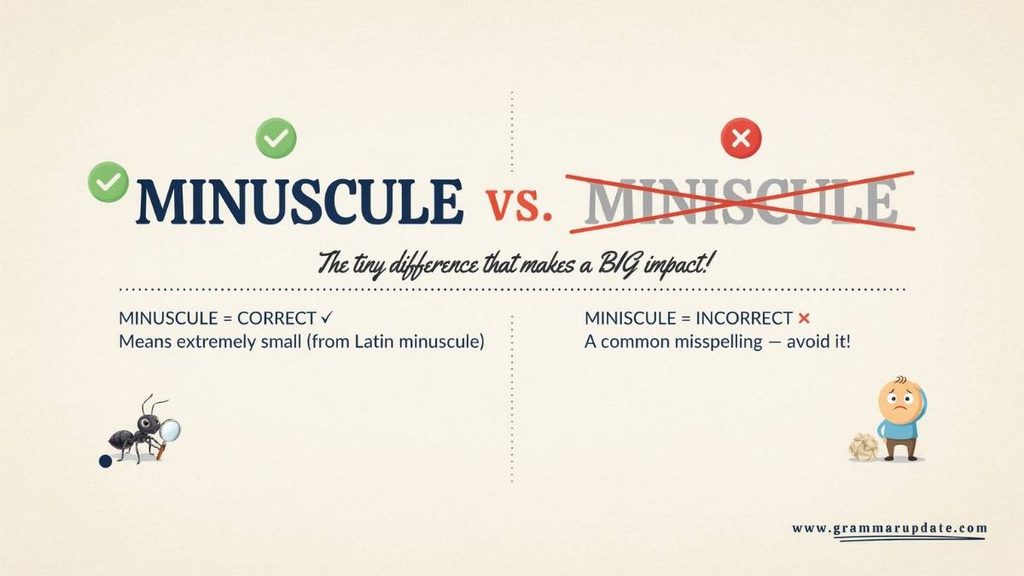
If the minuscule spelling keeps slipping away, focus on the middle.
The correct spelling is:
M-I-N-U-S-C-U-L-E
The important sequence is:
MINU-SCULE
A simple memory trick is:
Minuscule starts like minus.
The connection is useful because minus suggests less or smaller, which fits the modern meaning of minuscule.
Therefore, when you wonder how do you spell minuscule, remember:
MINUS + CULE = MINUSCULE
This small trick can prevent the most common spelling mistake.
Minuscule Part of Speech
The most common part of speech for minuscule is adjective.
An adjective describes a noun, so you can use minuscule before a noun in many different situations.
For example:
A minuscule insect landed on the table.
She noticed a minuscule change in the results.
The device contains a minuscule component.
The company reported a minuscule increase in revenue.
The word can describe physical objects as well as abstract concepts.
Minuscule also has a specialized noun use in discussions of handwriting, manuscripts, and typography. That meaning developed from the historical association between smaller letter forms and minuscule writing.
In ordinary conversation, however, you will usually encounter minuscule as an adjective.
Minuscule in a Sentence
If you are searching for minuscule in a sentence, the best examples show its flexibility.
For physical size:
The insect was so minuscule that it was difficult to see.
For quantity:
Only a minuscule amount of paint remained.
For difference:
There was a minuscule difference between the two measurements.
For effect:
The adjustment had a minuscule effect on the final result.
For probability:
There was a minuscule chance of recovering the lost file.
For change:
The new setting produced only a minuscule improvement.
These examples show that minuscule does not have to describe something that you can physically measure with a ruler. Instead, it can emphasize that something is extremely small in degree or amount.
Miniscule in a Sentence
The phrase miniscule in a sentence usually appears when someone wants to demonstrate the variant spelling.
For example:
The spelling miniscule is often confused with the standard form minuscule.
Another example is:
Although miniscule appears in some English usage, minuscule is the safer spelling for formal writing.
If you want to use the word itself to describe something, however, choose minuscule:
The company made a minuscule adjustment to the schedule.
That sentence follows the standard spelling.
Learn the difference between confusing more English words
Dumbbell vs Dumbell difference and usage?
Minuscule vs Miniscule Spelling Difference
The minuscule vs miniscule spelling difference is tiny, but it is easy to remember once you identify the exact letters involved.
Minuscule:
M I N U S C U L E
Miniscule:
M I N I S C U L E
Only one letter changes in the middle. However, that single letter determines whether you are using the conventional spelling or the commonly encountered variant.
This is one reason spelling errors can survive even when a writer understands the word perfectly. The mistake does not necessarily come from misunderstanding the meaning. Instead, it comes from reconstructing the spelling from memory.
That is especially common with words whose pronunciation does not clearly reveal their spelling.
Minuscule vs Miniature
Minuscule vs miniature can confuse readers because both words can describe something small.
However, they are not interchangeable in every context.
Minuscule means extremely small.
Miniature usually means something that is small in scale, often because it represents a larger object.
Consider a model train.
A miniature train is a smaller representation of a full-sized train. It was designed at a reduced scale.
A minuscule train would simply emphasize that the train itself is extremely small.
Therefore:
The museum displayed a miniature model of the train.
The model contained minuscule wheels.
The first sentence emphasizes the reduced model. The second emphasizes the extremely small wheels.
The distinction may seem small at first. However, choosing the more precise word makes writing much clearer.
Minuscule vs Minute
Minuscule vs minute is another useful comparison.
Minute has several meanings in English. As a noun, it refers to a unit of time. As an adjective, it can mean extremely small.
For example:
The scientist detected minute particles in the sample.
Here, minute means extremely small.
Now consider:
The scientist waited one minute.
Here, minute refers to time.
Minuscule does not have this particular ambiguity. When you describe something as minuscule, readers generally understand that you mean extremely small.
Therefore, both words can describe something very small, but context makes minute more flexible and sometimes more confusing.
Learn the difference between confusing more English words
Airplane vs Aeroplane difference and usage?
Minuscule vs Microscopic
Minuscule and microscopic can overlap, but they do not always carry the same meaning.
Minuscule broadly means extremely small.
Microscopic can also mean extremely small, but it can suggest a scale associated with a microscope or microscopic examination.
For example:
The print was minuscule.
This simply tells you that the print was extremely small.
The scientist examined microscopic organisms.
This sentence suggests organisms at a scale associated with microscopy.
Therefore, microscopic can be more specific in scientific contexts.
A minuscule object does not necessarily require a microscope to see.
Minuscule vs Tiny
Tiny is one of the most direct synonyms for minuscule.
For example:
The room was tiny.
The room was minuscule.
Both sentences describe something very small.
However, the tone differs slightly.
Tiny is extremely common in everyday English. Minuscule can sound somewhat more formal, emphatic, or precise.
If you are talking casually, tiny may feel more natural.
If you are explaining a very small difference in a report, minuscule may fit better.
For example:
There was a tiny scratch on the table.
There was a minuscule difference between the two results.
Both words work well, but the second sentence illustrates a context where minuscule sounds particularly natural.
Learn the difference between confusing word pairs
Foreign vs Foriegn difference and usage?
Minuscule vs Insignificant
Minuscule and insignificant sometimes overlap, but they focus on different ideas.
Minuscule emphasizes small size, amount, or degree.
Insignificant emphasizes a lack of importance.
Consider:
The error was minuscule.
This tells you the error was extremely small.
The error was insignificant.
This tells you the error was not important enough to matter.
An error can therefore be minuscule without being insignificant.
For example, a tiny error in a critical scientific calculation could have major consequences. In that case, the error might be minuscule in size but significant in effect.
That distinction is especially useful in academic and professional writing.
Minuscule vs Negligible
Minuscule and negligible are close in some contexts, especially when you describe quantities or effects.
However, negligible carries a stronger idea of practical unimportance.
Compare these sentences:
The difference was minuscule.
The difference was negligible.
The first sentence focuses on the size of the difference.
The second sentence suggests that the difference is so small that it has little practical importance.
This distinction matters in technical writing.
For example, a laboratory report might describe a minuscule variation in measurements. A business report might call that variation negligible if it has no meaningful effect on the final result.
Therefore, minuscule and negligible can overlap, but they should not automatically replace one another.
Minuscule Synonyms
A good minuscule synonym depends on context.
Tiny works well in everyday conversation.
Minute can describe something extremely small, although it also has a time-related meaning.
Microscopic works especially well when the context involves extremely small physical dimensions or scientific observation.
Miniature works when something is a small-scale version of another object.
Diminutive can describe something small and often carries a more formal or literary tone.
Infinitesimal emphasizes an extremely small amount or difference.
Negligible works when the small size also means little practical effect.
Insignificant works when the focus is importance rather than physical size.
The important point is that synonyms do not always have identical meanings. A thesaurus can show related words, but context determines which one actually belongs in your sentence.
Minuscule Pronunciation
The common pronunciation of minuscule is represented as:
/ˈmɪn.ə.skjuːl/
The pronunciation helps explain why the spelling causes trouble. When you hear minuscule, the middle vowel does not provide a strong visual clue about whether the written word contains u or i.
That means pronunciation alone cannot reliably guide the spelling.
For that reason, it helps to memorize the written pattern:
minu-scule
Rather than trying to spell the word entirely from sound, connect its spelling with the familiar memory cue minus.
Learn the difference between confusing word pairs
Embarrass vs Embarass difference and usage?
Minuscule vs Miniscule Pronunciation
The minuscule vs miniscule pronunciation question can become confusing because the spelling variant may be pronounced in the same or a very similar way.
However, pronunciation does not settle the spelling issue.
English contains many words whose written forms cannot be predicted perfectly from their sounds. Minuscule is one of them.
Therefore, even if you pronounce the word correctly, you can still spell it incorrectly.
The safest approach is to learn the conventional spelling separately:
Minuscule.
Minuscule in American English
In American English, minuscule is the standard form you can confidently use in formal writing.
At the same time, American dictionaries may acknowledge miniscule as a variant. This is why searches for miniscule or minuscule US spelling can produce mixed results.
Dictionary treatment and preferred editorial usage are not always identical.
A word can appear in a dictionary while still being less desirable in careful writing.
Therefore, if you are writing American English and want the most conventional form, choose minuscule.
This applies to professional communication, academic writing, website content, reports, essays, and other edited material.
Minuscule in British English
Minuscule is also the standard spelling in British English.
Oxford lists minuscule as the adjective meaning extremely small. The word works naturally in both British and American English.
The main difference appears in how some dictionary resources treat miniscule as a variant.
Therefore, the practical rule remains the same across the two major varieties of English:
Use minuscule when you want the standard spelling.
Learn the difference between confusing word pairs
Fascinating vs Facinating difference and usage?
Common Minuscule Spelling Mistakes
The most important spelling mistake is miniscule.
For example:
The difference was miniscule.
The preferred form is:
The difference was minuscule.
The same correction applies regardless of the context.
You might be describing a minuscule amount, a minuscule error, a minuscule change, or a minuscule object. The spelling remains the same.
The problem becomes easier to avoid once you remember that the word contains minu rather than mini.
How to Use Minuscule Correctly
Minuscule works naturally when you want to emphasize very small size or amount.
You can use it with physical nouns:
a minuscule insect
a minuscule hole
a minuscule component
You can also use it with quantities:
a minuscule amount
a minuscule quantity
a minuscule portion
It also works with abstract nouns:
a minuscule difference
a minuscule effect
a minuscule chance
a minuscule improvement
This flexibility makes minuscule a useful adjective when you want something stronger than simply small.
Learn the difference between confusing word pairs
Concede vs Conceed difference and usage?
Minuscule vs Miniscule Examples
| Less Preferred Form | Standard Form |
|---|---|
| The error was miniscule. | The error was minuscule. |
| She noticed a miniscule difference. | She noticed a minuscule difference. |
| Only a miniscule amount remained. | Only a minuscule amount remained. |
| The insect was miniscule. | The insect was minuscule. |
| The change was miniscule. | The change was minuscule. |
These examples reveal the central point. The intended meaning does not change. The spelling does.
A Practical Example Choosing the Right Word
Imagine that two laboratory measurements differ by only a tiny amount.
You could write:
The measurements showed a minuscule difference.
That sentence clearly emphasizes the very small size of the difference.
You could also write:
The measurements showed a negligible difference.
Now the focus shifts slightly. The writer suggests that the difference is so small that it has little practical importance.
If you write:
The measurements showed a minute difference.
That can also work because minute can mean extremely small.
However, miniature would not be a natural choice:
The measurements showed a miniature difference.
That sounds awkward because miniature generally refers to a small-scale version of something.
This example shows why word choice matters. Several words can describe smallness, but each carries its own shade of meaning.
When to Use Minuscule
Minuscule works particularly well when you want to emphasize that something is remarkably small.
In formal writing, it can describe a very small difference, amount, effect, or change.
For example:
The new method produced a minuscule improvement in efficiency.
In academic writing, it can describe small differences between observations:
The researchers observed a minuscule variation between the samples.
In everyday English, it can describe physical objects:
The apartment had a minuscule kitchen.
Therefore, the word is not restricted to one type of writing.
When Another Word Is Better
Although minuscule is useful, it is not always the most precise choice.
Use miniature when you mean a smaller version or model of something.
Use microscopic when you mean extremely small in a scientific or microscopy-related context.
Use negligible when the small amount has little practical effect.
Use insignificant when the main point concerns importance rather than size.
Use tiny when you want a simple, natural everyday word.
Use infinitesimal when you want to emphasize an extraordinarily small amount or difference.
Choosing the right synonym can make a sentence more precise without making it more complicated.
Learn the difference between confusing word pairs
Aluminum vs Aluminium difference and usage?
Minuscule Meaning and Examples in English
The minuscule meaning in English is centered on extreme smallness.
It can refer to something:
small in size
very little in amount
tiny in degree
extremely small in effect
very limited in probability
The surrounding noun usually makes the exact sense clear.
For example, a minuscule object is extremely small physically. A minuscule amount is very little. A minuscule chance is a very low probability. A minuscule effect is an effect that is extremely small.
Therefore, context gives the word its precise shade of meaning.
Miniscule Meaning and Examples in English
The miniscule meaning in English generally points readers toward the same concept: extremely small.
However, the spelling remains the main issue.
If you are writing a sentence for publication, use:
The difference was minuscule.
Rather than:
The difference was miniscule.
The second form may be understood immediately, but the first avoids the spelling problem.
Learn the difference between confusing word pairs
Guidance vs Guidence difference and usage ?
practice session Minuscule vs Miniscule
Choose the correct word, minuscule vs miniscule, to complete each sentence.
- The difference between the two measurements was __________.
- Only a __________ amount of water remained in the container.
- The scientist noticed a __________ change in the test results.
- The insect was so __________ that it was difficult to see.
- The company reported a __________ increase in its expenses.
- She found a __________ crack in the glass.
- There was only a __________ chance of finding the missing document.
- The device contains several __________ components.
- The error was __________ and did not affect the final result.
- A __________ amount of dust had collected on the surface.
- The artist added a __________ detail to the painting.
- The improvement in performance was __________.
- The difference between the two colors was __________.
- The laboratory detected a __________ variation between the samples.
- He made a __________ adjustment to the settings.
- The amount of sugar needed for the recipe was __________.
- The company experienced a __________ decline in sales.
- A __________ hole appeared in the fabric.
- The chances of success seemed __________.
- The researcher observed a __________ difference between the two groups.
- The machine requires only a __________ quantity of oil.
- The child noticed a __________ mark on the table.
- The financial impact of the change was __________.
- The two results showed a __________ difference.
- The engineer identified a __________ fault in the system.
Answers
- minuscule
- minuscule
- minuscule
- minuscule
- minuscule
- minuscule
- minuscule
- minuscule
- minuscule
- minuscule
- minuscule
- minuscule
- minuscule
- minuscule
- minuscule
- minuscule
- minuscule
- minuscule
- minuscule
- minuscule
- minuscule
- minuscule
- minuscule
- minuscule
- minuscule
Here’s a trusted source for clear word meanings:
FAQs
Is minuscule vs miniscule the correct spelling?
Minuscule is the standard spelling and the safest choice for formal, academic, professional, and edited English. Miniscule appears in real English usage and some dictionaries recognize it as a variant. However, other dictionaries treat it as a common misspelling.
What is the difference between minuscule vs miniscule?
The main difference is spelling. Minuscule contains a u in the middle, while miniscule contains an i. Both forms generally refer to something extremely small, but minuscule is the preferred standard spelling.
Is miniscule a misspelling of minuscule?
Miniscule is commonly considered a misspelling of minuscule, although some dictionaries list it as a variant. If you want to avoid confusion in formal writing, use minuscule.
What does minuscule mean?
Minuscule means extremely small. It can describe the physical size of an object as well as a very small amount, difference, effect, change, or chance.
Can minuscule describe an amount?
Yes. Minuscule can describe a very small quantity or amount. For example, “Only a minuscule amount of paint remained” means that only a very small amount was left.
Can minuscule describe an abstract idea?
Yes. Minuscule can describe abstract things such as a difference, effect, improvement, risk, or chance. For example, “The change had a minuscule effect on the final results.”
Is minuscule stronger than small?
Generally, yes. Small simply indicates limited size or amount, while minuscule emphasizes that something is extremely small.
Why is minuscule spelled with a u?
Minuscule developed through French from the Latin word minuscula. Its history is connected with Latin minus, meaning less or smaller. Therefore, its spelling does not come from the modern English word mini.
Does minuscule come from the word mini?
No. Although minuscule looks similar to words beginning with mini, it does not come from the English word mini. Its origin goes back through French to Latin minuscula.
How can I remember the spelling of minuscule?
A simple memory trick is to connect minuscule with minus. Think of the beginning as minus followed by cule. This can help you remember the u that is often missing in the spelling miniscule.
Is minuscule an adjective?
Yes. Minuscule is most commonly used as an adjective. It describes something that is extremely small in size, amount, degree, or effect.
Can minuscule be used as a noun?
Yes. Minuscule also has a specialized noun meaning related to lowercase writing and historical forms of lettering. However, the adjective meaning is much more common in everyday English.
Is minuscule used in American English?
Yes. Minuscule is a standard spelling in American English. Some American dictionary resources also record miniscule as an alternative spelling, but minuscule remains the safer choice for formal writing.
Is minuscule used in British English?
Yes. Minuscule is also standard in British English. The spelling remains the same in both American and British English.
What is the difference between minuscule and miniature?
Minuscule means extremely small, while miniature usually refers to something made smaller than the original or a small-scale representation. For example, a miniature car is a small model of a full-sized car.
What is the difference between minuscule and microscopic?
Minuscule means extremely small in a broad sense. Microscopic can also describe something extremely small, but it often suggests a size that relates to microscopic observation or requires a microscope to examine closely.
What is the difference between minuscule and negligible?
Minuscule emphasizes extremely small size or amount. Negligible suggests that something is so small that it has little practical importance or effect. Therefore, the words can overlap, but they are not always interchangeable.
What is the difference between minuscule and minute?
Both minuscule and minute can mean extremely small. However, minute also has a common meaning related to time. Minuscule, when used as an adjective, specifically emphasizes extreme smallness.
Can minuscule mean very little?
Yes. When minuscule describes an amount or quantity, it can mean very little. For example, “The experiment required a minuscule amount of material.”
What are some synonyms for minuscule?
Common synonyms include tiny, very small, minute, microscopic, infinitesimal, and diminutive. In certain contexts, negligible or insignificant may also work when the focus is on limited importance or effect.
What is the opposite of minuscule?
Depending on the context, possible opposites include large, huge, enormous, substantial, considerable, and significant. The best choice depends on whether you are discussing size, amount, degree, or importance.
How do you use minuscule in a sentence?
You can use minuscule to describe something extremely small. For example: “The researcher found a minuscule difference between the two samples.”
Why do people spell minuscule as miniscule?
The spelling miniscule looks natural because English has many words beginning with mini that relate to smallness. Also, pronunciation does not clearly reveal the u in minuscule. As a result, writers often spell the word according to the pattern that looks familiar.
Conclusion
The minuscule vs miniscule confusion may seem tiny, but that missing letter can easily cause a spelling mistake. Minuscule is the standard spelling when you mean extremely small, while miniscule is a common variant that some dictionaries recognize and others treat as a misspelling. So, if you want the safest choice for formal writing, use minuscule. A simple way to remember it is to keep the u in minuscule. Once you know the correct spelling, this little grammar trouble becomes much easier to handle. The word may describe something very small, but its spelling does not have to create a big problem.

Jhon AJS, the creative mind behind Grammar Update, is an experienced blogger passionate about simplifying English grammar. He focuses on explaining confusing word vs word differences, grammar rules, punctuation, and sentence structure in a clear and practical way. Through easy to understand guides and examples, Jhon helps readers improve their writing and communicate with confidence. With years of blogging experience, he continues to share helpful insights that make learning grammar simple, useful, and accessible for everyone.