If in line vs inline has ever made you stop and question your grammar, you are definitely not alone. This small difference looks harmless, but it creates real confusion in writing because both forms sound exactly the same. That is where most mistakes start. Writers often guess instead of applying grammar rules, which leads to incorrect usage in emails, reports, websites, and technical content. One form belongs to everyday English when people queue, align, or stay consistent with something. The other belongs to technical language, coding, and digital systems where content sits directly inside structure. This guide clears that confusion, fixes common errors, and helps you use both forms correctly with confidence and clarity.
In Line or Inline Which One Is Correct?
Both forms are correct, but they serve different purposes.
Use in line when referring to order, alignment, agreement, consistency, or a queue of people. Use inline when referring to technical language, embedded formatting, programming functions, editing tools, or specialized systems.
Some publications still use in-line with a hyphen in technical contexts. However, modern US English usually prefers inline as one word.
| Form | Primary Use | Example |
|---|---|---|
| in line | order, agreement, queue | Costs stayed in line with budget |
| inline | technical or integrated use | Use inline styling for the button |
| in-line | older hyphenated modifier | in-line inspection unit |
- Both versions are correct when used in the right setting. Example: Staff stood in line while engineers fixed an inline error.
- Meaning depends on context, not pronunciation. Example: “In line with policy” differs from “inline function.”
What Does “In Line” Mean?
The phrase in line meaning usually refers to something arranged properly, consistent with standards, or placed in correct order.
This phrase often appears in everyday speech and professional writing because it works in physical and figurative situations. It may describe people waiting in a queue, financial results matching forecasts, or behavior following policy.
Examples include:
People waiting in line at a bank.
Spending in line with approved budgets.
Actions in line with company standards.
| Context | Meaning | Example |
|---|---|---|
| Queue | waiting in order | We stood in line for tickets |
| Business | matching targets | Sales stayed in line with plan |
| Policy | following standards | Staff acted in line with rules |
- “In line” often means aligned or consistent. Example: Prices remained in line with market trends.
- It also describes orderly position. Example: Students walked in line to class.
In Line With Meaning in Business
The phrase in line with meaning in business is widely used because it communicates precision and control.
It usually means that results matched expectations, actions followed policy, or spending stayed within limits. Executives, analysts, and managers use it frequently in reports, presentations, and earnings calls.
Examples:
Revenue came in line with forecasts.
Hiring remained in line with long-term strategy.
Costs stayed in line with approved budgets.
| Phrase | Professional Meaning |
|---|---|
| in line with expectations | matched forecast |
| in line with policy | followed rules |
| in line with strategy | aligned with goals |
- Businesses use this phrase to show stability. Example: Performance remained in line with guidance.
- It adds professional clarity to reports. Example: Expenses stayed in line with budget controls.
What Does “Inline” Mean?
The term inline meaning usually belongs to technical, digital, engineering, and product-related contexts.
It often describes something placed directly inside another structure instead of separately. In many cases, it suggests integration, convenience, or immediate placement.
You may see the word in programming, editing software, production systems, and sports equipment.
Examples include:
inline CSS
inline comments
inline editing
inline skates
inline inspection systems
| Context | Meaning | Example |
|---|---|---|
| Programming | embedded in code | inline CSS |
| Editing | changes inside view | inline editing |
| Manufacturing | checks during workflow | inline testing |
| Sports | wheels in one row | inline skates |
- “Inline” often means directly integrated. Example: The app supports inline replies.
- It is common in technical communication. Example: Developers added inline styles for testing.
Inline Meaning in Programming
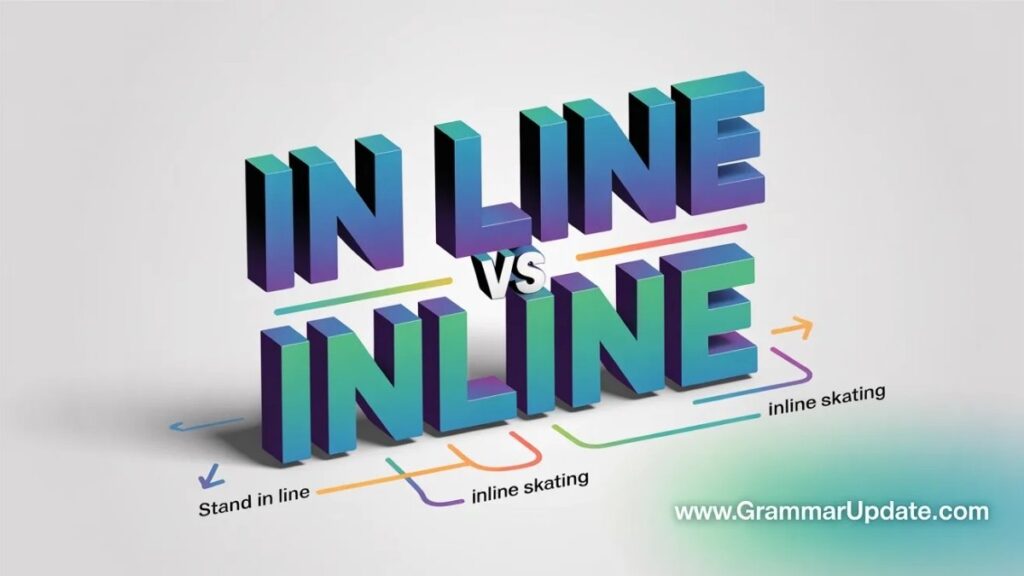
One of the most searched topics is inline meaning in programming because developers encounter the term often.
In coding, “inline” usually refers to content placed directly where it is used rather than stored in a separate file or location.
Inline CSS Meaning
Inline CSS places style instructions inside an HTML tag.
<p style="color:blue;">Example Text</p>
Meaning
Some languages use inline functions to improve efficiency for small repeated operations.
| Term | Meaning |
|---|---|
| inline CSS | styling inside HTML element |
| inline comment | comment beside code |
| inline function | compact embedded function |
- Inline code offers convenience for quick edits. Example: A designer used inline CSS during testing.
- Large projects usually limit inline code. Example: Teams moved styles to external files later.
In Line vs Inline Grammar Rules
The topic in line vs inline grammar becomes easy once you know the structure.
“In line” remains an open phrase used in standard English. “Inline” functions as a closed compound word used in specialized language.
English often evolves in this way. Separate words gradually combine after repeated use in a specific field.
| Form | Grammar Role |
|---|---|
| in line | phrase |
| inline | compound noun/adjective |
- Use two words for everyday meanings. Example: Her actions stayed in line with policy.
- Use one word for technical terms. Example: The software allows inline editing.
Learn the difference between words people mix up
Icycle vs Icicle Differences and Correct Usage
In Line or Inline With Expectations?
A common professional question asks whether to write in line or inline with expectations.
The correct phrase is in line with expectations.
This wording means results matched predictions, plans, or guidance. It appears often in finance, operations, and management communication.
Incorrect: inline with expectations
Correct: in line with expectations
| Phrase | Correct? |
|---|---|
| in line with expectations | Yes |
| inline with expectations | No |
- Use “in line with” for business comparisons. Example: Earnings came in line with expectations.
- Avoid “inline” in this phrase. Example: Analysts corrected the wording to in line with guidance.
Learn the difference between words people mix up
Present vs Presant Differences and Correct Usage
In Line vs Inline in a Sentence
Context always decides the correct spelling.
Examples:
We waited in line for coffee.
The website uses inline alerts.
Costs stayed in line with budget.
The editor supports inline comments.
| Sentence Purpose | Correct Form |
|---|---|
| waiting or order | in line |
| embedded technical feature | inline |
- Human movement usually uses “in line.” Example: Guests stood in line outside the theater.
- Digital placement usually uses “inline.” Example: The platform shows inline notifications.
Learn the difference between everyday English mistakes
Half Day vs Half-Day Which is correct and Usage
Difference Between In Line and Inline
The difference between in line and inline is the difference between general language and specialized terminology.
“In line” refers to order, consistency, queues, or agreement. “Inline” refers to embedded placement, integrated tools, or technical systems.
| Term | Core Meaning |
|---|---|
| in line | aligned, orderly, consistent |
| inline | embedded, internal, in-text |
- “In line” fits everyday and business writing. Example: Goals remained in line with strategy.
- “Inline” fits digital and technical writing. Example: Designers used inline elements in web design.
Inline vs Block Elements
In web development, many beginners learn inline vs block elements early.
Inline elements stay within surrounding text. Block elements begin on a new line and usually take more width.
| Type | Behavior |
|---|---|
| Inline | remains within text flow |
| Block | starts new line |
Examples:
<span> often behaves inline.<div> often behaves as block.
- Inline elements support text-level styling. Example: A span highlights one word inline.
- Block elements organize layout. Example: A div separates page sections clearly.
Learn the difference between everyday English mistakes
Stigmatism vs Astigmatism Difference and Usage
In Line or Inline Synonym Guide
Strong writing benefits from variety. Synonyms help reduce repetition.
| Original Term | Useful Alternatives |
|---|---|
| in line | aligned, consistent, orderly, in agreement |
| inline | embedded, integrated, internal, in-text |
- Synonyms improve flow and tone. Example: Use aligned with instead of repeating “in line with.”
- Choose replacements carefully. Example: “Embedded” often works instead of inline in technical text.
Learn the difference between basic English word mistakes
Breakroom vs Break Room Which Spelling Is Correct?
Common Mistakes Writers Make
Because the words sound identical, writers often choose the wrong version.
They may write “inline with expectations” in reports or “in line CSS” in coding notes. These mistakes appear small, yet they reduce credibility.
| Mistake | Correct Version |
|---|---|
| inline with expectations | in line with expectations |
| in line CSS | inline CSS |
| inline for queue meaning | in line |
- Business phrases usually require “in line.” Example: Sales stayed in line with forecasts.
- Technical phrases usually require “inline.” Example: The guide explained inline HTML styles.
Learn the difference between basic English word mistakes
Noteable vs Notable Correct Spelling and Usage
Quick Memory Rule
Use in line when discussing people, order, standards, agreement, or forecasts.
Use inline when discussing code, comments, formatting, tools, or integrated systems.
| Situation | Correct Choice |
|---|---|
| waiting at checkout | in line |
| spending matches budget | in line |
| style inside HTML tag | inline |
| comment beside content | inline |
- Human order usually signals “in line.” Example: We stood in line for lunch.
- Technical insertion usually signals “inline.” Example: The app supports inline replies.
Learn the difference between basic English word mistakes
Unkept vs Unkempt Difference and Usage
Practice Session In Line vs Inline
This section will help you test your understanding of in line vs inline with simple, real-world practice. Try answering first, then check the correct usage below.
Fill in the blanks
- We stood ___ for tickets for two hours.
- The website uses ___ CSS for styling buttons.
- Prices are ___ with market expectations.
- The editor allows ___ comments inside text.
- Students walked ___ to the assembly hall.
Answers:
- in line
- inline
- in line
- inline
- in line
Multiple Choice
- Which is correct for waiting?
A) inline
B) in line
C) in-line system
- Which is used in coding or web design?
A) inline
B) in line
C) in queue
- Which sentence is correct?
A) We are inline with expectations
B) We are in line with expectations
- What does “inline” usually mean?
A) waiting in order
B) embedded or inside content
C) standing in queue
- Which is correct grammar usage?
A) inline for waiting at store
B) in line for waiting at store
Correct the Mistake
Rewrite the sentences correctly:
- We are inline for coffee.
- The report is inline with company policy.
- Add in line CSS to the page.
Correct Answers:
- We are in line for coffee.
- The report is in line with company policy.
- Add inline CSS to the page.
Thinking
Choose the correct form in real situations:
- Waiting at a supermarket → __________
- Writing HTML styling → __________
- Business report alignment → __________
- Editing text inside a document → __________
Answers:
- in line
- inline
- in line
- inline
Here’s a trusted source for clear word meanings:
FAQs
Is it in line or in line or inline?
Use in line for queues, order, or agreement. Use inline for technical or digital contexts.
Do New Yorkers say in line or on line?
Many New Yorkers traditionally say on line instead of in line when waiting.
Is it waiting in line or inline?
The correct phrase is waiting in line.
Is “inline” two words?
No. Inline is usually written as one word.
What does “inline” mean?
It usually means placed directly within text, code, or a system.
Does “inline” mean straight?
Not usually. It more often means integrated or within a line, not physically straight.
Why do people say online instead of inline?
Because online is a separate word meaning connected to the internet, not the same as inline.
Are you on line or inline?
Use on line in some regional dialects for waiting. Use inline for technical meaning.
What do people stand in line for?
People stand in line for tickets, coffee, stores, events, and services.
What is another way to say “in line”?
You can say queued, aligned, in order, or consistent with, depending on context.
Where to use inline?
Use inline in programming, web design, editing tools, and technical writing.
What is the history of “in line” skates?
Inline skates became popular in the 1980s as modern roller skates with wheels arranged in one straight row.
Conclusion
The confusion between in line vs inline may look small, but it has tripped up emails, reports, blog posts, and more innocent writers than anyone can count. The good news is that this grammar puzzle is easier to solve than finding the office printer when you are late.
Use in line when talking about order, alignment, queues, or something that matches expectations. Use inline when discussing code, formatting, comments, or technical content placed directly inside something else.
Once you remember that people stand in line while developers write inline, the mistake usually disappears. Clear writing does not need magic tricks. It just needs the right word in the right place, and now you have both fully under control.

Jhon AJS, the creative mind behind Grammar Update, is an experienced blogger passionate about simplifying English grammar. He focuses on explaining confusing word vs word differences, grammar rules, punctuation, and sentence structure in a clear and practical way. Through easy to understand guides and examples, Jhon helps readers improve their writing and communicate with confidence. With years of blogging experience, he continues to share helpful insights that make learning grammar simple, useful, and accessible for everyone.