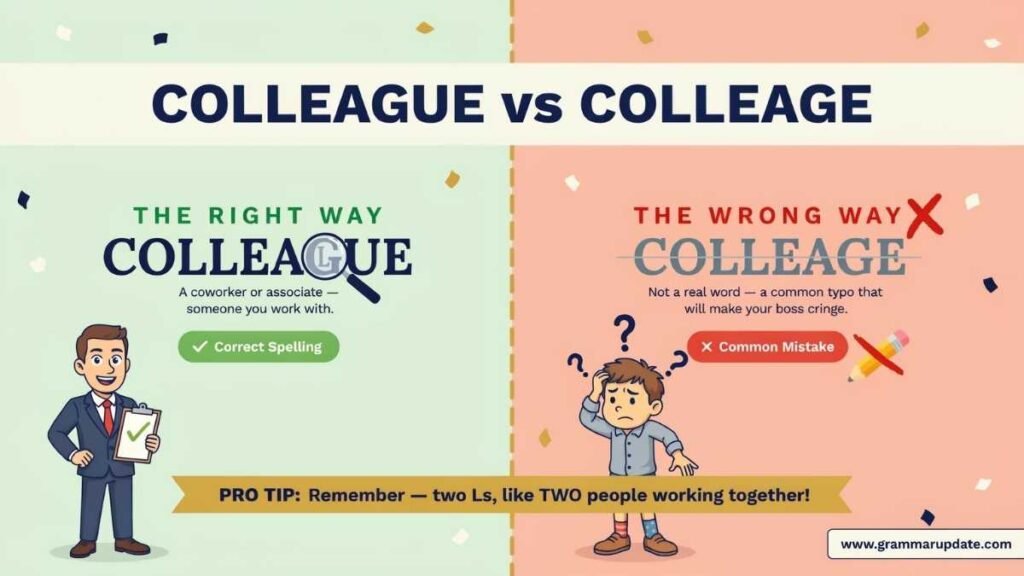
The difference between colleague vs colleage is easier to understand than the spelling might suggest. Colleague is the correct spelling, while colleage is a common spelling mistake. The tricky part is remembering the letters in the middle, especially when the word doesn’t sound exactly as it looks. Luckily, you only need to remember one correct form: colleague. Whether you’re writing an email, talking about your coworkers, or preparing a professional report, using the right spelling keeps your writing clear and polished. Once you learn the correct spelling and see a few simple examples, colleague becomes much easier to remember and use with confidence.
quick answer
Colleague is the correct spelling.
Colleage is incorrect in standard English. It is not an alternative American or British spelling. Instead, it is a common misspelling of colleague.
| Word | Correct? | Meaning |
|---|---|---|
| colleague | Yes | A person you work with or someone in the same profession |
| colleage | No | A misspelling of colleague |
| collaegue | No | A misspelling of colleague |
So, if you are asking, “What is the correct spelling: colleague vs colleage?” the answer is colleague.
The same applies to colleague vs collaegue. Neither colleage nor collaegue should replace the standard spelling.
The Correct Spelling of Colleague
The correct spelling is:
c-o-l-l-e-a-g-u-e
One useful way to remember the word is to notice the ending:
col + league = colleague
The ending league can act as a helpful visual reminder. Once you recognize that pattern, the spelling becomes much easier to recall.
Learn the difference between confusing more English words
Bougie vs Boujee which one is correct?
Colleague vs Colleage The Key Difference
The main difference between colleague vs colleage is simple: colleague is a real English word, while colleage is an incorrect spelling.
Colleague is a noun that refers to someone who works with you or someone who belongs to the same profession or field.
For example:
Maria is my colleague at the marketing company.
The spelling would be incorrect if you wrote:
Maria is my colleage at the marketing company.
The second sentence contains a spelling error. The intended word is clearly colleague.
This distinction matters when you are writing professional emails, resumes, reports, applications, academic assignments, or other formal documents.
What Does Colleague Mean?
The colleague meaning is a person you work with or someone who belongs to the same profession or professional field.
The word often describes someone who works at the same company, school, hospital, office, or organization. However, its meaning can be slightly broader than simply “someone who works in the same building.”
For example, two doctors who work at different hospitals may still refer to each other as colleagues because they belong to the same profession.
Likewise, two professors at different universities may describe each other as colleagues because they work in the same academic field.
Colleague Definition
A simple colleague definition is:
A colleague is a person you work with or someone who belongs to the same profession or professional field.
The word usually describes a professional relationship rather than a personal relationship.
For example:
My colleague helped me prepare the presentation.
The word colleague tells us that the person has a professional connection with the speaker.
Learn the difference between confusing more English words
Existence vs Existance which one is correct?
What Is the Work Colleague Meaning?
The phrase work colleague means someone you work with, usually at the same workplace or organization.
For example:
My work colleague helped me solve the problem.
The phrase work colleague is understandable and natural, although the word colleague already suggests a professional connection.
In many situations, you can simply say colleague.
For example:
I spoke with my colleague this morning.
This sentence already makes the workplace relationship clear.
Professional Colleague Meaning
The professional colleague meaning can extend beyond people who share the same employer.
A professional colleague may be someone who works in the same profession, industry, or specialized field.
For example, a journalist may describe another journalist from a different news organization as a colleague. Similarly, a researcher may call another researcher a colleague even when they work at different institutions.
The important idea is the professional connection.
Is a Colleague Someone You Work With?
Usually, yes.
If someone works with you at the same company or organization, you can generally call that person your colleague.
However, colleague can have a wider meaning. It can also refer to someone in the same profession or field even when you do not share an employer.
For example, two teachers working at different schools can still be professional colleagues.
This makes colleague slightly broader than the simple idea of “person who works beside you.”
Learn the difference between confusing more English words
Digraph vs Diphthong What’s the Difference?
Why Is Colleague Spelled This Way?
The spelling of colleague can look strange because English does not always spell words exactly as they sound.
The word has a long history. English adopted colleague through French collègue, which ultimately comes from Latin collega. Its spelling reflects this history rather than following a simple sound-by-sound pattern.
The ending can also cause confusion because colleague contains league.
This gives you a useful memory connection:
col + league = colleague
That is not a rule for forming English words. It is simply a convenient way to remember the spelling.
If you know how to spell league, connecting it with col can make colleague easier to remember.
How to Spell Colleague
If you are wondering how to spell colleague, the correct form is:
colleague
The letters are:
c-o-l-l-e-a-g-u-e
Pay particular attention to the middle of the word. The correct sequence is e-a-g-u-e.
Common mistakes often rearrange these letters or leave one out.
Colleague Spelling Breakdown
| Part | Spelling |
|---|---|
| Beginning | col |
| Ending pattern | league |
| Complete word | colleague |
A useful memory sentence is:
Your colleague is in your professional league.
This gives you a simple visual connection between colleague and league.
Colleague Pronunciation
Colleague pronunciation can seem confusing because the spelling contains more letters than you might expect from the sound.
In American English, colleague is commonly pronounced with two syllables, with the stress on the first syllable.
A learner-friendly pronunciation is:
KAH-leeg
The ending sounds similar to league.
If you are looking for colleague pronunciation audio, listening to a reliable dictionary recording can help you connect the written form with the spoken form.
Colleague Pronunciation American
The common American pronunciation of colleague is represented in IPA as /ˈkɑːliːɡ/, although the exact vowel quality can vary among speakers and regions.
The word normally has two syllables, and the first syllable receives the main stress.
The important thing is not to pronounce every written letter separately. The ending forms a single smooth syllable.
Colleague Pronunciation British
The common British pronunciation is represented as /ˈkɒliːɡ/.
The main difference between the common American and British pronunciations is the vowel in the first syllable. The overall word remains recognizable and has the same basic two-syllable structure.
So, colleague pronunciation American and colleague pronunciation British may sound slightly different because of accent, but the spelling remains colleague in both varieties of English.
How Do You Pronounce Colleague?
If you are asking, “How do you pronounce colleague?” focus on the two-syllable structure and the stress on the first syllable.
The final part sounds like league. Remembering that connection can help with both pronunciation and spelling.
Learn the difference between confusing more English words
Yea vs Yeah Which Word Is Correct?
Colleague vs College
College and colleague look similar, so it is easy to see why learners sometimes confuse them.
However, they have completely different meanings.
| Word | Meaning | Example |
|---|---|---|
| colleague | A person you work with or someone in the same profession | My colleague sent the report. |
| college | An educational institution or, in some contexts, a division or professional body | She attends college in Boston. |
The difference becomes especially clear in a sentence such as:
My colleague works at a local college.
Here, colleague refers to a person. College refers to an educational institution.
College vs Colleague Pronunciation
The College and colleague are also pronounced differently.
Both commonly contain two syllables, but their endings are different. College ends with a sound similar to “j,” while colleague ends with a sound similar to the final sound in league.
Because the words look alike, it helps to focus on meaning as well as pronunciation.
College refers to an institution or organization.
Colleague refers to a person.
Colleague vs Coworker What Is the Difference?
The colleague vs coworker difference is fairly small in everyday American English.
Both words can describe someone you work with. In many workplace situations, you can use either one without changing the basic meaning.
For example:
I spoke with my colleague about the project.
I spoke with my coworker about the project.
Both sentences sound natural.
However, colleague can have a slightly broader professional meaning. It can refer to someone in the same profession or field even when you do not work for the same employer.
Coworker usually focuses more directly on people who work together.
| Term | Main idea |
|---|---|
| colleague | A person you work with or someone in the same profession |
| coworker | A person who works with you, especially at the same workplace |
| workmate | Someone you work with |
| peer | Someone at a similar level or professional standing |
Colleague vs Coworker Difference in Context
Consider two accountants.
One accountant works at the same company as you. That person is your coworker and can also be your colleague.
Another accountant works for a completely different company but belongs to the same professional association. That person may still be your professional colleague, even though they aren’t your coworker.
This explains why colleague can sometimes have a wider meaning than coworker.
Coworker vs Colleague Meaning
The coworker vs colleague meaning overlaps in many everyday situations.
Coworker usually highlights the shared workplace.
Colleague often highlights the professional relationship.
Still, native speakers don’t always make a strict distinction. In ordinary conversation, the two words can often be used interchangeably.
Learn the difference between confusing more English words
Holistic vs Wholistic Which one Is Correct?
Is Every Coworker a Colleague?
In most workplace situations, a coworker can also be called a colleague.
However, the word colleague can extend beyond the shared workplace.
For example, two scientists working at different universities may be colleagues because they work in the same professional field.
The easiest way to think about it is this:
A coworker is generally someone who works with you.
A colleague can be someone who works with you or someone who shares your profession or professional field.
Context determines which word feels more natural.
Colleague vs Friend
Colleague and friend describe different types of relationships.
A colleague is connected to you through work, profession, or a professional field.
A friend is connected to you through a personal relationship.
One person can be both.
For example:
James is my colleague at the design company.
This sentence tells us about the professional relationship.
James is my friend.
This sentence tells us about the personal relationship.
You can also combine the two:
James is my colleague and a close friend.
Can a Colleague Be a Friend?
Yes, a colleague can be a friend.
People often become friends after spending time together at work. However, calling someone your colleague does not automatically mean that you are friends.
The phrase colleague friend meaning becomes clearer when you separate the two ideas.
Colleague describes the professional connection.
Friend describes the personal connection.
Therefore, someone can be your colleague without being your friend. Likewise, a friend isn’t automatically your colleague.
Colleague vs Peer
Peer usually refers to someone who has a similar position, level, status, or professional standing.
Colleague focuses more on a professional connection.
For example, a senior manager and a junior employee can be colleagues because they work in the same organization. They may not be peers because their positions and responsibilities are different.
On the other hand, two doctors working at different hospitals may be professional peers and colleagues because they belong to the same field.
The distinction is simple:
Colleague emphasizes professional connection.
Peer emphasizes comparable status or position.
Workmate vs Colleague
The Workmate and colleague can have similar meanings because both can describe someone you work with.
Workmate is especially common in British and Australian English. Colleague is widely used in both American and British English.
In professional writing, colleague is often the more natural choice.
For example:
I discussed the project with my colleague.
This works well in business, academic, and professional settings.
Learn the difference between confusing word pairs
Covenant vs Contract What’s the Difference?
Professional Associate Meaning
The phrase professional associate meaning refers to someone connected to you through professional activities or business.
Associate can sometimes mean something similar to colleague, but the two words are not always interchangeable.
A business associate could be a client, consultant, supplier, partner, or other professional contact.
For example:
I met several business associates at the conference.
That doesn’t necessarily mean those people work alongside the speaker.
Colleague is more directly connected with working together or belonging to the same profession.
Colleague Synonyms
Depending on the context, possible colleague synonyms include coworker, workmate, associate, peer, fellow employee, fellow worker, fellow professional, and professional associate.
These words have overlapping meanings, but each carries its own emphasis.
Coworker usually points to a shared workplace.
Peer often suggests similar professional status.
Associate can describe a broader professional connection.
Workmate focuses directly on someone you work with.
Because of these differences, replacing colleague with a synonym isn’t always a perfect one-for-one change.
Colleague Antonym
There isn’t one exact colleague antonym that works in every situation.
The appropriate opposite depends on the context.
For example, if colleague means someone inside a professional group, an outsider could provide a contrast. If it means a fellow employee, a nonemployee could provide a more specific contrast.
English doesn’t have one universal word that serves as the exact opposite of colleague.
Learn the difference between confusing word pairs
Solicited vs Unsolicited Differences and Usage
Colleague Plural What Is the Plural of Colleague?
The colleague plural is colleagues.
The singular form is:
colleague
The plural form is:
colleagues
You simply add s to the singular noun.
| Singular | Plural |
|---|---|
| colleague | colleagues |
Examples:
My colleague works in accounting.
My colleagues work in accounting.
She spoke with one colleague.
She spoke with several colleagues.
Colleagues Meaning
Colleagues means two or more people who work together or belong to the same profession or professional field.
For example:
The researchers shared their findings with their colleagues.
Here, colleagues refers to other people working in the same professional or academic area.
My Colleagues Meaning
The phrase my colleagues means the people who have a professional connection with you.
It can refer to people at your workplace, members of your professional team, or fellow professionals in your field.
For example:
I’m meeting my colleagues after work.
The exact group depends on the situation. In an office, it may mean fellow employees. In an academic setting, it may mean fellow professors or researchers.
Learn the difference between confusing word pairs
Envisage vs Envision difference and usage?
How to Use Colleague in a Sentence
Knowing how to use colleague in a sentence is easy once you remember that it is a noun.
Here are some natural examples:
My colleague helped me finish the report.
I spoke with a colleague about the new project.
Several colleagues attended the meeting.
Her colleagues congratulated her on the promotion.
He has worked with the same colleagues for years.
A colleague recommended the software.
The professor discussed the study with her colleagues.
My colleague and I are preparing the presentation.
Colleague Examples in Different Contexts
Workplace:
My colleague will handle the client meeting.
Education:
The teacher discussed the lesson plan with her colleagues.
Professional field:
The researcher presented the findings to colleagues from several universities.
Team setting:
I asked my colleague to review the document.
These examples show that colleague isn’t limited to a traditional office. The word can describe professional relationships across many fields.
Common Spelling Mistakes for Colleague
Colleague is sometimes written incorrectly in several ways.
| Incorrect spelling | Correct spelling |
|---|---|
| colleage | colleague |
| collaegue | colleague |
| collegue | colleague |
| coleague | colleague |
| colleegue | colleague |
| colleaguee | colleague |
The most common forms discussed here are colleage and collaegue.
Both are incorrect.
Common Misspelling of Colleague
The common misspelling of colleague often comes from rearranging the letters in the middle of the word.
For example, someone may write colleage because the spelling seems closer to the way the word sounds.
Another person may write collaegue because the letters ae appear in the wrong order.
These errors don’t change the intended meaning, but they do create a spelling error.
Learn the difference between confusing word pairs
Kaftan vs Caftan Difference and Which one Is Correct?
Colleague vs Colleage in Professional Writing
A spelling mistake colleague can be easy to overlook in a casual message. Professional writing is different.
Imagine writing:
I discussed the proposal with my colleage.
The reader will almost certainly understand the sentence. However, the incorrect spelling can make the message look rushed or poorly checked.
Now compare it with:
I discussed the proposal with my colleague.
The second version is clean and standard.
This matters in resumes, cover letters, business emails, reports, applications, presentations, and academic writing. Small spelling details contribute to the overall impression of your writing.
Why Do People Misspell Colleague?
People misspell colleague for several practical reasons.
The word contains an unusual combination of letters.
Its pronunciation doesn’t clearly reveal the complete spelling.
The ending resembles league, which can be helpful once you notice it but confusing if you don’t.
The words college and colleague also look similar, which can add to the confusion.
The easiest solution is to remember the correct visual pattern rather than trying to spell the word entirely from its pronunciation.
Think:
col + league = colleague
Then remember:
colleague → colleagues
That gives you both the singular and plural forms.
Is Colleague a Noun or a Verb?
Colleague is a noun.
It names a person who works with you or belongs to the same professional field.
For example:
My colleague called this morning.
In this sentence, colleague identifies the person who called.
Colleague isn’t normally used as a standard English verb.
Instead, English uses verbs such as work, collaborate, cooperate, coordinate, and communicate.
For example:
My colleague and I collaborated on the project.
Colleague names the people. Collaborated describes what they did.
Is Colleague a Formal Word?
Colleague works in both everyday and formal English.
You can use it in workplace conversations, emails, academic writing, business reports, resumes, and professional discussions.
For example:
I spoke with my colleague about the report.
This sentence sounds natural in ordinary conversation and professional writing.
Compared with coworker, colleague can sometimes sound slightly more professional. However, it isn’t an excessively formal word.
When Should You Use Colleague?
Use colleague when you want to describe someone connected to you through work or a profession.
The word works naturally when talking about a person who:
Works at the same company as you.
Works in the same department.
Belongs to your professional team.
Works in the same profession.
Works in the same field.
Belongs to the same professional organization.
Has a professional relationship with you.
For example:
I asked a colleague to review the report.
This tells the reader that the person has a professional connection with the speaker.
Learn the difference between confusing word pairs
In Process vs In Progress Difference and usage?
Colleague vs Coworker vs Friend
These three words can describe different parts of a relationship.
| Relationship | Suitable term | Main idea |
|---|---|---|
| Someone you work with | coworker | Shared workplace |
| Someone connected to you professionally | colleague | Professional relationship |
| Someone in a similar professional position | peer | Comparable status |
| Someone you know personally | friend | Personal relationship |
| Someone who is both professionally and personally connected | colleague and friend | Both relationships |
There is no need to force one word into every situation.
1.If the professional connection matters, colleague may be the best choice.
2.If the shared workplace matters, coworker may be more specific.
3.If the personal relationship matters, friend is the clearer word.
Correct and Incorrect Examples
Correct Examples
My colleague sent me the updated file.
I discussed the issue with my colleague.
Several colleagues attended the conference.
She has become a close friend as well as a colleague.
His colleagues praised his work.
Incorrect Examples
My colleage sent me the updated file.
I discussed the issue with my collaegue.
Several colleage attended the conference.
The correction is straightforward. Use colleague for one person and colleagues for more than one.
A Simple Way to Remember Colleague
When you forget how to spell colleague, think about the word league.
Col + league = colleague
Then add s when you need the plural:
colleague → colleagues
This simple visual connection can make the spelling much easier to remember.
You can also use a short memory sentence:
Your colleague is in your professional league.
The sentence isn’t a spelling rule. It’s simply a way to connect the difficult part of the word with a familiar word.
Learn the difference between confusing word pairs
Unpure vs Impure Which one Is Correct?
Practice session colleague vs colleage
Choose the correct word: colleague vs colleage.
- My ______ helped me finish the report before the deadline.
- Sarah is a trusted ______ at our company.
- I asked my ______ for advice about the new project.
- He introduced me to his ______ from the marketing department.
- Every ______ received an email about the meeting.
- My ______ and I often work on the same projects.
- She has been my ______ for more than five years.
- I invited one of my ______ to the company event.
- A good ______ can make the workplace more enjoyable.
- His ______ gave him useful feedback on his presentation.
- We discussed the problem with our ______ during lunch.
- Several ______ attended the professional training session.
- My new ______ showed me how to use the software.
- She works closely with her ______ in the finance department.
- I have a friendly relationship with most of my ______.
- The manager praised every ______ for their hard work.
- One of my ______ is moving to another department.
- He asked a senior ______ for guidance.
- Our ______ helped us solve the technical problem.
- She introduced her new ______ to the rest of the team.
- A professional ______ should communicate clearly with others.
- I spoke with my ______ about tomorrow’s presentation.
- The company organized a lunch for all its ______.
- My ______ and I share the same office.
- He thanked his ______ for helping him complete the task.
Answers
- colleague
- colleague
- colleague
- colleague
- colleague
- colleagues
- colleague
- colleagues
- colleague
- colleague
- colleague
- colleagues
- colleague
- colleagues
- colleagues
- colleague
- colleagues
- colleague
- colleague
- colleague
- colleague
- colleague
- colleagues
- colleague
- colleague
Here’s a trusted source for clear word meanings:
FAQs
Is “colleage” the correct spelling of “colleague”?
No. “Colleage” is a common spelling mistake. The correct spelling is “colleague.” Use “colleague” when referring to someone you work with or someone in the same professional field.
Why do people spell “colleague” as “colleage”?
The spelling can be confusing because “colleague” isn’t pronounced exactly as it looks. The ending “-league” may also cause people to leave out the “u” when spelling the word.
How do you pronounce “colleague”?
“Colleague” is generally pronounced like “KOL-eeg” in American English. It has two syllables, with the stress on the first syllable.
What does “colleague” mean in simple English?
A colleague is someone you work with or someone who belongs to the same profession or professional field. For example, a teacher may call another teacher a colleague.
Can someone at another company be your colleague?
Yes. A colleague doesn’t always have to work for the same company. People in the same profession or field can also be colleagues, even when they work for different organizations.
Is “colleague” singular or plural?
“Colleague” is the singular form. “Colleagues” is the plural form. For example, you can say, “My colleague helped me,” or “My colleagues helped me.”
Why does “colleague” have two Ls?
“Colleague” has two Ls as part of its standard spelling. The safest way to spell it is to remember the complete word rather than relying only on its pronunciation.
What is an easy way to remember the spelling of “colleague”?
A useful spelling trick is to remember the ending “-league.” You can think of the word as “col” + “league” when memorizing its spelling. This is simply a memory aid, not a literal explanation of the word’s origin.
What is the difference between “colleague” and “workmate”?
Both words can refer to someone you work with. “Colleague” sounds more professional and is widely used in formal English, while “workmate” is more casual and often refers to someone you work alongside.
Can people in the same profession be colleagues?
Yes. People can be colleagues because they share a profession or professional field. For example, two doctors can be colleagues even if they work at different hospitals.
Is “colleague” a formal word?
Yes. “Colleague” is a standard professional word. You can use it in workplace conversations, emails, reports, academic writing, and other formal situations.
What part of speech is “colleague”?
“Colleague” is a noun. It refers to a person who works with you or shares a professional connection with you.
What is the possessive form of “colleague”?
The singular possessive form is “colleague’s,” as in “My colleague’s office.” The plural possessive form is “colleagues’,” as in “My colleagues’ offices.”
Can you use “colleague” for someone you rarely work with?
Yes. You don’t need to work closely with someone every day to call that person a colleague. A shared workplace, profession, or professional connection can make the term appropriate.
How do you use “colleague” in a sentence?
You can use “colleague” to describe someone connected to you through work. For example, “My colleague helped me prepare the presentation.”
Is “colleague” the same as “associate”?
Not exactly. “Associate” has several meanings and can describe a professional or business connection. “Colleague” more specifically refers to someone connected to you through work or a shared profession.
Can a colleague be someone you are not friends with?
Yes. A colleague and a friend are not necessarily the same thing. A colleague is connected to you professionally, while a friend has a personal relationship with you.
Is “colleague” commonly used in American English?
Yes. “Colleague” is common in American English, especially in professional and workplace settings. “Coworker” is also widely used, particularly for someone who works at the same organization.
What is the simplest difference between “colleague” and “coworker”?
A coworker usually works at the same organization as you, while “colleague” can have a broader professional meaning and may refer to someone in the same profession or field.
Conclusion
The difference between colleague vs colleage is simple once you know the correct spelling. In fact, colleague vs colleage becomes much easier to understand when you remember that colleague is the correct word for someone you work with or someone in the same professional field. Colleage is a common spelling mistake and should be avoided in standard English.
The spelling can be tricky because colleague doesn’t sound exactly the way it looks. However, remembering the “-league” ending can help you get it right. When you see colleague vs colleage in your writing, remember that colleague is the correct choice. Understanding colleague vs colleage can help you avoid this common spelling mistake. So, whether you’re writing an email, report, or everyday message, use colleague with confidence. Once you remember the difference between colleague vs colleage, this little spelling mix-up won’t cause trouble again.

Jhon AJS, the creative mind behind Grammar Update, is an experienced blogger passionate about simplifying English grammar. He focuses on explaining confusing word vs word differences, grammar rules, punctuation, and sentence structure in a clear and practical way. Through easy to understand guides and examples, Jhon helps readers improve their writing and communicate with confidence. With years of blogging experience, he continues to share helpful insights that make learning grammar simple, useful, and accessible for everyone.