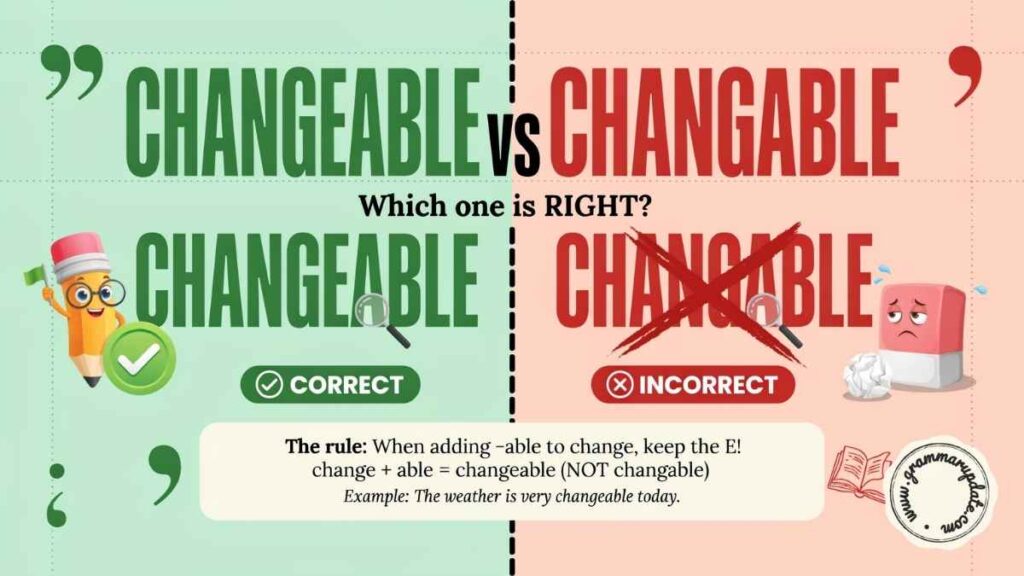
The difference between changeable vs changable is easy to understand once you spot one small letter. Changeable is the correct spelling, while changable is a common mistake. The confusion usually comes from the final e in change, which is easy to miss because you don’t hear it clearly. But that little e still needs to stay. Changeable can describe something that can be changed, such as plans or schedules, or something that often varies, such as weather or moods. So, if you’re unsure which spelling to use, remember change + able = changeable. One tiny letter makes all the difference, and now the confusion is clear.
Quick Answer
If you are asking, “Is it changeable or changable?” the correct answer is changeable.
Changeable is a standard English adjective. Changable is an incorrect spelling and does not have a separate meaning.
For example:
The meeting time is changeable if everyone agrees.
In this sentence, changeable means that the meeting time can be changed.
You can also use the word when something tends to vary:
Spring weather can be very changeable.
Here, changeable means that the weather can change frequently.
The important thing to remember is that changeable and changable are not two different words with different meanings. Changeable is the correct spelling, while changable is a spelling mistake.
Learn the difference between confusing more English words
Yea vs Yeah Which Word Is Correct?
Changeable vs Changable the Difference?
The main difference between changeable vs changable is spelling.
Changeable is the correct form used in standard English. Changable is a misspelling that usually occurs when someone leaves out the e from the word change before adding -able.
The correct formation is:
change + able = changeable
The incorrect form looks like this:
chang + able = changable
That missing e is the whole problem.
Changeable can describe something that can be altered, such as a schedule or setting. It can also describe something that tends to vary, such as weather or someone’s mood.
For example:
The website has changeable settings.
The weather is changeable in the mountains.
In both cases, the spelling remains changeable.
Why Is Changeable Spelled With an E?
One of the most common questions about this word is why is changeable spelled with an e.
The answer becomes easier when you look at the base word. The base word is change, and the adjective is formed by adding -able.
Change + able gives us changeable.
The final e remains part of the standard spelling. Although the e is not pronounced as a separate sound, it still appears in the written word.
This is one reason English spelling can sometimes be confusing. A letter does not always disappear simply because you cannot hear it clearly.
The word change already has an established spelling, and changeable keeps that connection.
Why Is the E Kept in Changeable?
If you are wondering why is the e kept in changeable, the simplest answer is that changeable is the established standard form of the word.
It is tempting to write changable because the pronunciation does not make the e obvious. However, spelling does not always follow pronunciation letter by letter.
You can make the spelling easier to remember by looking at the word family:
change
changed
changing
changeable
changeability
These words are related to the same root, although English spelling changes slightly when different suffixes are added.
The important point is that the standard spelling is changeable, not changable.
Changeable Meaning and Definition
The changeable meaning is fairly simple. Changeable describes something that can be changed or something that is likely to change.
The changeable definition can therefore be understood in two closely related ways.
First, something may be changeable because a person can alter it.
For example:
The appointment time is changeable.
The settings are changeable.
The design is changeable.
In each example, someone can make a change.
Second, something can be changeable because it tends to vary.
For example:
The weather is changeable.
Her mood is changeable.
Market conditions are changeable.
Here, the word describes something that does not always remain the same.
The context tells you which meaning applies.
Learn the difference between confusing more English words
Holistic vs Wholistic Which one Is Correct?
Changeable Grammar What Part of Speech Is It?
The changeable grammar is straightforward because changeable is an adjective.
An adjective describes a person, place, thing, condition, or idea.
For example:
We need a changeable schedule.
Changeable describes the schedule.
You can also use the adjective after a linking verb:
The schedule is changeable.
The weather seems changeable.
Her plans remain changeable.
Changeable can appear before a noun or after a linking verb. Its job remains the same: it describes something that can change or tends to change.
Changeable as an Adjective
The changeable adjective can describe many different things.
You might talk about changeable weather, changeable plans, changeable settings, changeable conditions, or a changeable mood.
For example:
The company has a changeable schedule.
The region experiences changeable weather.
The application includes changeable settings.
His mood can be quite changeable.
The word does not automatically carry a negative meaning. Its tone depends on the situation.
Describing weather as changeable is usually neutral. Describing someone’s behavior as changeable can sound more critical if you mean that the person frequently changes their mind or behavior.
Related Forms of Change
Understanding the related forms of change can make the changeable word easier to remember.
Change can work as both a verb and a noun.
As a verb, it means to make something different:
We need to change the schedule.
As a noun, it can refer to an alteration:
The company announced a change to the policy.
Changeable is an adjective:
The schedule is changeable.
Changeability is a noun:
The changeability of the weather makes planning difficult.
These words belong to the same word family, but each one has a different grammatical role.
Learn the difference between confusing more English words
Covenant vs Contract What’s the Difference?
Changeable Pronunciation and the Soft G Sound
The pronunciation of changeable can also help explain why people sometimes spell it incorrectly.
The word contains the same change spelling found in the base word change. The g has a soft sound in this pattern.
The same general soft g sound appears in words such as age, gentle, giant, and change.
English also has words where g has a hard sound, such as game, garden, and go.
The important thing to remember is that the pronunciation of changeable does not give you a separate spoken sound for the final e. That can make the spelling easy to miss when you are writing quickly.
Still, the written form remains changeable.
Does Changeable Have a Silent E?
Yes. Changeable contains a final e that is not pronounced as a separate vowel sound.
However, silent does not mean unnecessary.
English uses silent letters in many words, and they can remain important to spelling and word recognition.
In this case, the final e stays in changeable.
So if you are learning the spelling of changeable, do not remove the e simply because you cannot hear it clearly.
Changeable vs Changable Key Differences
| Feature | Changeable | Changable |
|---|---|---|
| Spelling | Correct | Incorrect |
| Part of speech | Adjective | Not standard |
| Meaning | Able or likely to change | No standard meaning |
| Base word | Change | Not applicable |
| Standard English | Yes | No |
| American English | Yes | No |
| British English | Yes | No |
The difference is not about meaning, grammar, or regional English. Changeable is the standard spelling in both American and British English.
Learn the difference between confusing more English words
Kaftan vs Caftan Difference and Which one Is Correct?
Common Mistakes With the Changable Spelling
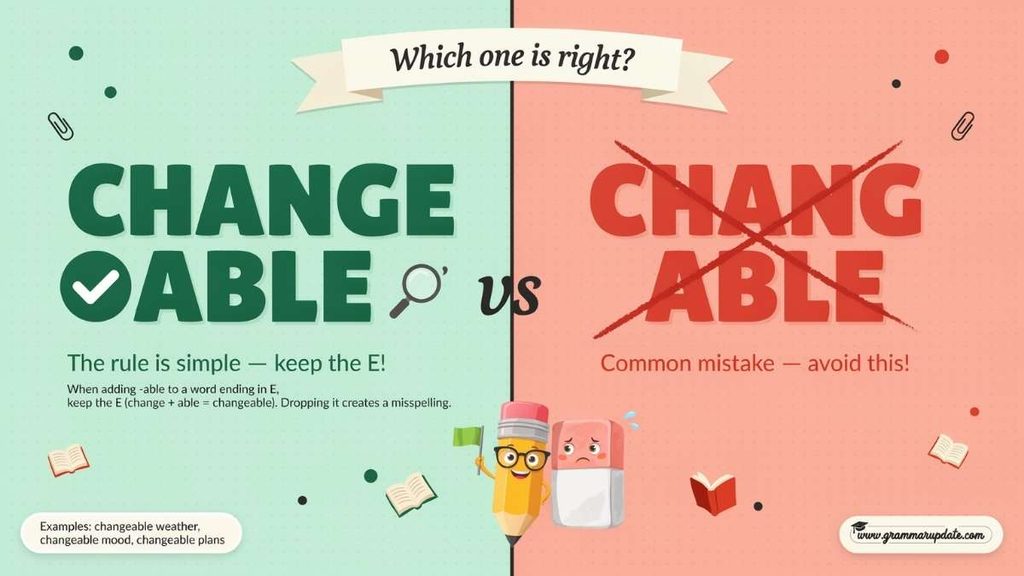
The changable spelling mistake usually happens because the word looks as though the e should disappear.
Someone may think:
change + able = changable
But the standard spelling is:
change + able = changeable
The easiest solution is to remember the base word before adding the suffix.
Start with change.
Then add able.
The result is changeable.
Dropping the Final E
The most common mistake is dropping the final e from change.
That creates changable, which is incorrect.
The final e may be silent, but it still belongs in the written form.
Spelling by Sound
Another common problem comes from spelling the word exactly as it sounds.
English spelling and pronunciation do not always match perfectly. Some letters are written even when they are not clearly heard.
That is why relying only on pronunciation can lead to mistakes.
If you know the base word change, the spelling becomes much easier.
Typing Too Quickly
Sometimes changable is simply a typing mistake.
Because the final e is not strongly noticeable in pronunciation, it can be easy to leave it out while typing.
A quick proofreading check can catch the error.
If you see changable, stop and ask whether the word comes from change.
If it does, write changeable.
Learn the difference between confusing word pairs
In Process vs In Progress Difference and usage?
How to Remember the Correct Spelling of Changeable
A simple memory trick is to keep the complete base word in your mind.
Change + able = changeable.
Do not start with chang.
Start with change.
Then add able.
You can also connect the spelling to other forms of the word:
change
changed
changing
changeable
Keeping the word family together makes the spelling easier to recognize.
Another useful reminder is that the e may be silent, but it is still part of the spelling.
Changeable in a Sentence
Learning changeable in a sentence is one of the easiest ways to understand how the word works.
Here are some natural examples:
The meeting schedule is changeable.
The weather can be extremely changeable during spring.
The app allows users to create changeable settings.
Our travel plans are still changeable.
The road conditions are changeable throughout the winter.
Her opinions can be quite changeable.
The company offers a changeable payment schedule.
These examples show that changeable can describe something that someone can modify or something that naturally varies.
Changeable Examples in Everyday English
Changeable appears in many everyday situations.
For example, you might describe plans as changeable when they are not final:
Our weekend plans are changeable because we are waiting for the weather forecast.
You might describe settings as changeable when users can modify them:
The brightness and notification settings are changeable.
You might describe weather as changeable when conditions shift frequently:
The weather has been very changeable this week.
You might describe someone’s mood as changeable when it shifts often:
His mood can be changeable when he is under pressure.
The meaning becomes clear from the noun that changeable describes.
Changeable Person Meaning
What does it mean when someone describes a person as changeable?
A changeable person may frequently change their opinions, moods, plans, preferences, or behavior.
For example:
She can be changeable about her weekend plans.
This means she may decide on one plan and then change her mind later.
The word does not always sound negative.
In a neutral context, it may simply mean that someone adapts easily or changes their preferences.
In a more critical context, it can suggest that someone is inconsistent or difficult to predict.
For example:
His changeable mood made it difficult to know how he would react.
Here, changeable suggests that his mood can shift quickly.
Learn the difference between confusing word pairs
Bougie vs Boujee which one is correct?
Changeable Synonyms
There are several changeable synonyms, but they do not all mean exactly the same thing.
Alterable describes something that can be changed.
Modifiable also means something can be changed or adjusted.
Adjustable usually suggests that something can be fine-tuned.
Variable emphasizes variation rather than the ability to make a change.
Flexible often suggests that something can adapt easily.
Unstable suggests that something lacks steadiness or consistency.
Inconsistent suggests that something does not remain the same in behavior, quality, or results.
For example, an adjustable chair can be moved into a different position. A changeable schedule can be altered. A variable temperature can rise and fall.
These words overlap, but context determines which one sounds most natural.
Changeable vs Variable
Changeable and variable can sometimes describe similar situations, but they are not always interchangeable.
Variable often focuses on something that varies.
For example:
The temperature is variable throughout the day.
Changeable can focus either on the possibility of change or on frequent variation:
The schedule is changeable.
The weather is changeable.
If something can be altered by a person, changeable often works particularly well.
If something naturally varies, variable may be more precise.
Changeable vs Flexible
Flexible often has a more positive tone.
For example:
We offer flexible working hours.
This suggests that the schedule can adapt to people’s needs.
Changeable is more neutral:
The working schedule is changeable.
This simply means the schedule can change.
Flexible often highlights adaptability. Changeable highlights the possibility or tendency to change.
Changeable vs Adjustable
Adjustable usually refers to something that can be moved, altered, or fine-tuned to suit a particular need.
For example:
The chair has an adjustable height.
Changeable has a broader meaning:
The schedule is changeable.
You would not normally replace adjustable with changeable when describing a physical feature designed for precise adjustment.
Learn the difference between confusing word pairs
Unpure vs Impure Which one Is Correct?
Common Phrases With Changeable
1.Changeable appears naturally in several common phrases.
2.Changeable weather refers to weather that can shift between different conditions.
3.Changeable conditions describes circumstances that may vary over time.
4.Changeable plans refers to plans that aren’t fixed.
5.Changeable settings refers to settings that users can modify.
6.Changeable schedules describe schedules that may be adjusted.
For example:
The mountain region is known for changeable weather.
Our plans are changeable until we receive the final confirmation.
The software provides several changeable settings.
These phrases show how naturally the adjective works in everyday English.
Is Changable a Word?
If you are asking, “Is changable a word?” the safest answer is no when you mean the standard adjective meaning capable or likely to change.
Changable is generally treated as a misspelling of changeable.
You may see it online because spelling mistakes appear frequently in informal writing. However, seeing a spelling mistake does not make it an accepted alternative.
For professional, academic, and formal writing, use changeable.
Is Changable an Incorrect Spelling?
Yes. Changable is an incorrect spelling of changeable.
The error usually comes from removing the final e from change.
Incorrect:
The schedule is changable.
Correct:
The schedule is changeable.
The meaning stays the same in the writer’s mind, but only the second spelling follows standard English usage.
Why Isn’t Changeable Spelled Changable?
The short answer is that the standard word is changeable.
The spelling preserves the final e from change.
Although English has many situations where a final e disappears before a suffix, that does not mean it should disappear in every word.
For example, change becomes changing, but the spelling of changeable retains the e.
This is why it is better to learn the established spelling of individual words rather than assume that one suffix always produces exactly the same spelling change.
Learn the difference between confusing word pairs
Envisage vs Envision difference and usage?
What Happens When You Add -Able to Change?
When you add the suffix -able to change, the standard result is changeable.
The suffix -able often forms adjectives that describe something capable of an action or condition.
For example:
read becomes readable.
predict becomes predictable.
accept becomes acceptable.
change becomes changeable.
However, English word formation has many spelling patterns and exceptions. You cannot always apply one rule mechanically to every word.
For changeable, the correct form is simply changeable.
Changeable and English Spelling Rules
English spelling rules can help, but they don’t always provide a perfect formula.
One common pattern involves a final e disappearing before certain suffixes.
For example:
make becomes making.
hope becomes hoping.
write becomes writing.
However, that does not mean the final e must disappear whenever a suffix is added.
Changeable is a good example.
The final e remains:
change becomes changeable.
This is why the so-called silent e rule should not be treated as an automatic rule for every suffix.
Word formation depends on the particular word and suffix involved.
Learn the difference between commonly mixed-up more words
Colleague vs Colleage which one is correct ?
American English and British English
The spelling changeable is used in both American English and British English.
There is no standard American form called changable.
There is also no British spelling difference that makes changable acceptable.
| English Variety | Standard Spelling |
|---|---|
| American English | Changeable |
| British English | Changeable |
| Canadian English | Changeable |
| Australian English | Changeable |
This makes the spelling choice easy.
Whether you are writing for an American audience or a British audience, use changeable.
Changeable Dictionary Definition
The basic dictionary meaning of changeable centers on the idea of change.
It can describe something that is capable of being altered or something that tends to vary.
For example, a changeable design can be modified.
A changeable mood can shift.
Changeable weather can move between different conditions.
A changeable schedule can be adjusted.
The word therefore works with both physical and abstract things.
Facts About Changeable
Changeable is an adjective.
It comes from the word change combined with the suffix -able.
The correct spelling is changeable.
Changable is a common misspelling.
The final e in changeable is not pronounced as a separate vowel sound.
The word can describe something that can be altered.
It can also describe something that tends to vary.
The spelling is the same in standard American and British English.
The word can describe plans, settings, weather, conditions, moods, opinions, behavior, and many other things.
A Simple Example to Understand Changeable
Imagine that a restaurant has a reservation system.
The restaurant allows customers to move their reservation from 6:00 p.m. to 7:00 p.m. The reservation time is therefore changeable.
Now imagine that the weather outside keeps moving between sunshine, rain, and strong wind. The weather is also changeable.
The same word works in both situations, but the reason is slightly different.
The reservation is changeable because someone can alter it.
The weather is changeable because it tends to vary.
That distinction makes the changeable meaning much easier to understand.
Learn the difference between commonly mixed-up more words
Acquaintance Vs Acquaintence Which one Is Correct?
Practice session Changeable vs Changable
- The weather is very __________ this time of year.
- Our travel plans are still __________.
- The meeting schedule is __________ if everyone agrees.
- The settings on this application are __________.
- His mood can be quite __________ throughout the day.
- The road conditions are __________ during winter.
- The appointment time is __________.
- The company’s policies are not always __________.
- The mountain weather can be extremely __________.
- The design is __________, so you can modify it later.
- Her plans are __________ because she has not made a final decision.
- The temperature has been unusually __________ this week.
- The software includes several __________ options.
- The deadline is __________ if the team needs more time.
- The situation remains __________ because new information may appear.
- The color of the background is __________ in the settings.
- The patient’s condition can be __________ from day to day.
- The schedule is __________ depending on staff availability.
- The market can be highly __________ during uncertain periods.
- The room has __________ lighting settings.
- Our weekend plans are __________ because of the weather.
- The rules are not __________ without approval.
- Spring weather is often __________.
- The company’s plans remain __________ until the final meeting.
- The incorrect spelling “changable” should always be replaced with __________.
Answers
- changeable
- changeable
- changeable
- changeable
- changeable
- changeable
- changeable
- changeable
- changeable
- changeable
- changeable
- changeable
- changeable
- changeable
- changeable
- changeable
- changeable
- changeable
- changeable
- changeable
- changeable
- changeable
- changeable
- changeable
- changeable
Here’s a trusted source for clear word meanings:
FAQs
Why is changeable sometimes misspelled as changable?
Changeable is sometimes misspelled as changable because the final e in change is not clearly heard in pronunciation. However, the correct spelling keeps the e: changeable.
Does changeable contain a silent e?
Yes. The final e in changeable is silent, but it remains part of the correct spelling. Removing it creates the incorrect form changable.
How is the word changeable formed?
Changeable comes from the word change and the suffix -able. The correct spelling is changeable, with the e retained before -able.
Can you use changeable to describe weather?
Yes. Changeable can describe weather that frequently shifts from one condition to another. For example, “The weather has been changeable all week.”
Can changeable describe plans?
Yes. Changeable can describe plans that are not fixed and may be altered later. For example, “Our travel plans are still changeable.”
Is changeable an adjective or a verb?
Changeable is an adjective. It describes something that can be altered or something that tends to change. The related verb is change.
Can you describe a schedule as changeable?
Yes. A schedule can be described as changeable when it may be adjusted or revised. For example, “The work schedule is changeable depending on staff availability.”
Is changeable spelled the same way in American and British English?
Yes. Changeable is the standard spelling in both American and British English. Neither variety uses changable as the standard spelling.
What is an easy way to remember the spelling of changeable?
Remember the word as change + able. Keeping the complete base word change in mind makes it easier to remember the e in changeable.
Can changeable describe conditions?
Yes. Changeable can describe conditions that vary over time. For example, “Drivers should prepare for changeable road conditions.”
Can changeable have a negative meaning?
Sometimes. When you use changeable to describe a person’s mood, behavior, or opinions, it can suggest inconsistency. In other contexts, such as weather or plans, it is usually neutral.
What is the noun form of changeable?
The noun form is changeability. It refers to the quality or tendency of being changeable.
What is the related verb for changeable?
The related verb is change. Changeable describes something that can change or tends to change.
Can you use changeable for a person’s mood?
Yes. Changeable can describe a mood that shifts frequently. For example, “Her changeable mood made it difficult to predict her reaction.”
Why is changable considered incorrect?
Changable is considered incorrect because it leaves out the final e from the standard spelling changeable. In standard English, changeable is the correct form.
Is the final e in changeable pronounced?
No. The final e is silent rather than pronounced as a separate sound. Even so, it must remain in the written form changeable.
Can changeable mean something is likely to change?
Yes. Changeable can describe something that tends to vary or is likely to change. This meaning often applies to weather, moods, conditions, and circumstances.
Can changeable mean something can be altered?
Yes. Changeable can mean that something is capable of being changed or modified. For example, “The settings are changeable.”
Is changable a standard English word?
No. Changable is not the standard spelling of the adjective. It is a common misspelling of changeable.
What is the most common spelling error in changeable?
The most common error is dropping the final e and writing changable. Remembering the base word change helps you avoid this mistake.
Learn the difference between commonly mixed-up more words
Acceptable Vs Aceptable Which one Is Correct?
Conclusion
The difference between changeable vs changable is simple once you remember one small letter. Changeable is the correct spelling, while changable is a common misspelling. The easiest way to remember it is to keep the e in the original word change before adding -able.
Changeable can describe things that can be altered, such as plans, schedules, and settings. It can also describe things that often vary, such as weather, moods, and conditions. So, when you’re unsure, think of it as change + able = changeable. That little e may be quiet, but it definitely belongs there!

Jhon AJS, the creative mind behind Grammar Update, is an experienced blogger passionate about simplifying English grammar. He focuses on explaining confusing word vs word differences, grammar rules, punctuation, and sentence structure in a clear and practical way. Through easy to understand guides and examples, Jhon helps readers improve their writing and communicate with confidence. With years of blogging experience, he continues to share helpful insights that make learning grammar simple, useful, and accessible for everyone.