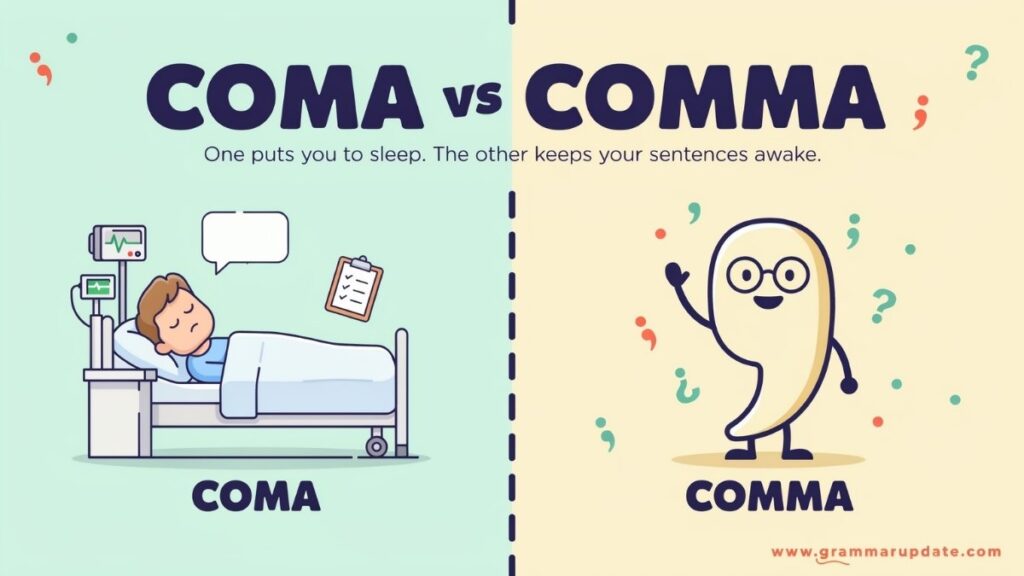
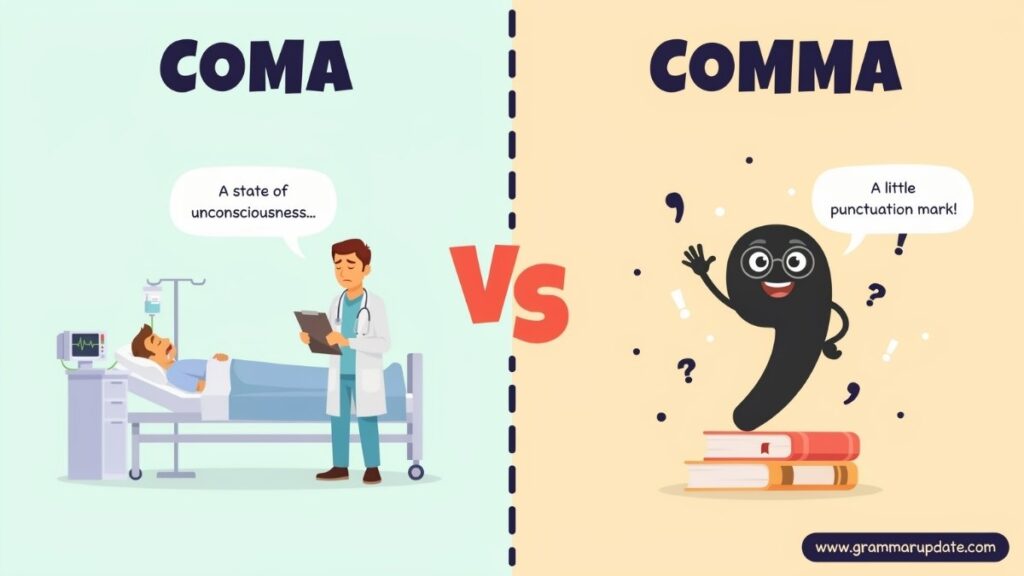
Have you ever written coma when you actually meant comma? You are not alone. The confusion between Coma vs Comma is a very common English mistake because the words look and sound similar. Still, their meanings are completely different. A comma is a punctuation mark used in writing to separate ideas and make sentences clear. A coma is a serious medical condition where a person is unconscious and cannot respond. Mixing them can lead to confusing or even funny sentences. This article clears up that confusion, explains both meanings in simple language, and gives easy examples so you can use each word correctly and write with confidence.
Coma vs Comma Which Word Is Correct?
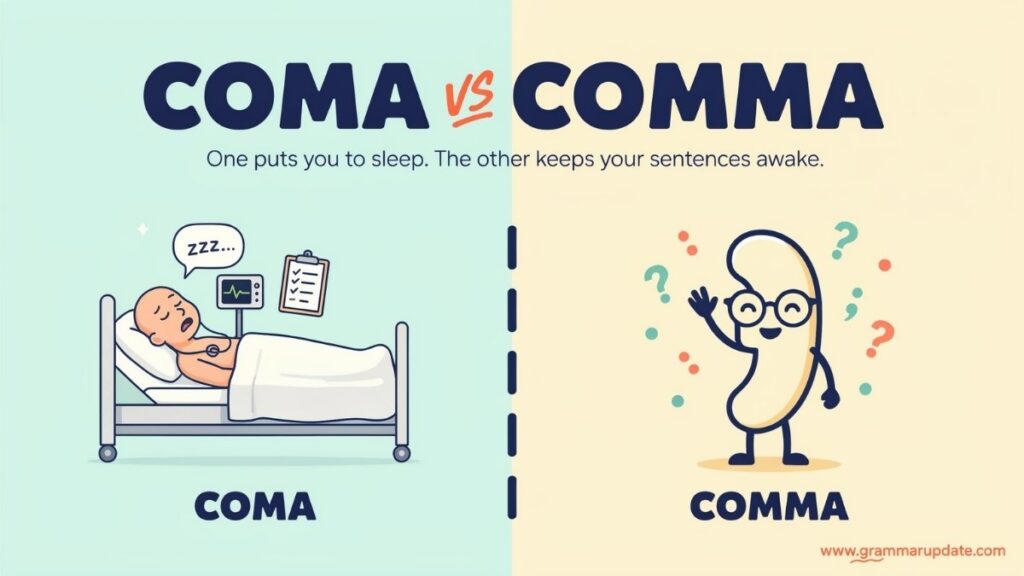
Both coma and comma are legitimate English words. The correct choice depends entirely on the context.
| Word | Meaning | Field |
|---|---|---|
| Comma | A punctuation mark | Grammar |
| Coma | A state of unconsciousness | Medicine |
If you are discussing punctuation, writing, or sentence structure, the correct word is comma. If you are discussing health, brain injuries, or emergency medicine, the correct word is coma.
Because the spellings differ by only one letter, many writers accidentally use the wrong word, especially when typing quickly.
Real Examples
- The editor inserted a comma to improve sentence clarity.
- The patient remained in a coma after the accident.
These examples clearly illustrate why understanding comma vs coma is important. One missing letter creates an entirely different meaning.
Quick Rule
- Comma = punctuation and writing.
- Coma = medicine and health.
This simple rule solves most spelling mistakes immediately.
Learn the difference between tricky more English words
Presant vs Present which is Correct Spelling and Usage?
What Does Comma Mean?
The comma meaning refers to one of the most important punctuation marks in English.
A comma separates words, phrases, clauses, and ideas within a sentence. It acts as a guide for readers by indicating pauses and helping organize information.
Without commas, sentences often become confusing, awkward, or misleading.
Comma Definition
A comma is:
A punctuation mark used to separate parts of a sentence and improve readability.
The symbol itself is:
,
Although small, the comma performs a powerful role in communication.
Why Commas Matter
Commas help readers:
- Understand sentence structure.
- Distinguish separate ideas.
Poor comma usage can create confusion or even change meaning.
Real Examples
- I bought apples, oranges, grapes, and bananas.
- After the meeting, the team discussed the results.
In the first example, commas separate items in a list. In the second example, the comma separates an introductory phrase from the main clause.
What Does Coma Mean?
The coma definition belongs entirely to medicine.
A coma is a prolonged state of unconsciousness in which a person cannot respond to external stimuli. Individuals in a coma cannot be awakened normally and often require intensive medical care.
Medical Coma Meaning
Doctors consider a coma a serious medical emergency because it affects brain activity and consciousness.
Common causes include:
- Traumatic brain injuries.
- Severe illnesses or lack of oxygen.
Real Examples
- The patient entered a coma following the car accident.
- Doctors closely monitored the coma in the intensive care unit.
Unlike commas, comas have absolutely no connection to grammar, punctuation, or writing.
Learn the difference between tricky more English words
Propose vs Purpose Which Is Correct?
Comma vs Coma Pronunciation
Pronunciation contributes significantly to the confusion between these words.
| Word | IPA | Pronunciation |
|---|---|---|
| Comma | /ˈkɑːmə/ | KOM-uh |
| Coma | /ˈkoʊmə/ | KOH-muh |
Although they sound similar, the first vowel sound differs.
Comma Pronunciation
The first syllable uses a shorter sound:
KOM-uh
Coma Pronunciation
The first syllable uses a longer “o” sound:
KOH-muh
Real Examples
- The teacher demonstrated the pronunciation of “comma.”
- The physician explained the patient’s coma.
Listening carefully to the first syllable often helps eliminate pronunciation mistakes.
Learn the difference between tricky more English words
Gray vs Grey Which Spelling Is Correct and Difference?
Why People Confuse Coma and Comma
The confusion between coma or comma occurs for several reasons.
First, the words look nearly identical. Second, their pronunciations are somewhat similar. Third, many people encounter both words during education, although in entirely different subjects.
Similar Spelling
Only one letter separates the words:
- comma
- coma
A simple typing mistake can remove the second “m.”
Pronunciation Similarities
English learners may hear:
- KOM-uh
- KOH-muh
Rapid speech often makes these sounds difficult to distinguish.
Real Examples
Incorrect:
Please insert a coma after the sentence.
Correct:
Please insert a comma after the sentence.
Incorrect:
The patient suffered a comma.
Correct:
The patient suffered a coma.
One letter completely changes the meaning.
Is Coma a Grammar Term?
Many people search online for coma meaning in grammar, but the answer is straightforward.
Coma is not a grammar term.
Only comma belongs to English punctuation.
There is no punctuation mark called a coma.
Real Examples
- The teacher explained comma rules to the class.
- The editor corrected several comma errors.
You would never write:
The teacher explained coma rules.
That sentence is incorrect because a coma belongs to medicine, not grammar.
Fix common more word mistakes in English
Rancor vs Rancour Difference and Which Spelling Is Correct?
How to Use a Comma Correctly
Commas improve sentence clarity and help readers understand relationships between ideas.
Several important grammar rules govern comma usage.
Commas in Lists
Commas separate items within a series.
Real Examples
- We bought bread, milk, eggs, and cheese.
- The conference included writers, editors, and teachers.
Introductory Phrases
Commas often follow introductory words or phrases.
Real Examples
- Before leaving, she locked the door.
- After dinner, we took a walk.
These commas create natural pauses and improve readability.
Learn the difference between tricky more English words
Really vs Realy, Which Is Correct? and Proper Usage
The Oxford Comma
The Oxford comma appears before the final item in a list.
With the Oxford comma:
We invited teachers, doctors, and engineers.
Without the Oxford comma:
We invited teachers, doctors and engineers.
Both styles are accepted, although many editors prefer the Oxford comma because it reduces ambiguity.
Real Examples
- The menu includes soup, salad, and pasta.
- The committee consists of managers, analysts, and consultants.
Consistency matters more than the style itself.
Fix common more word mistakes in English
Mobil vs Mobile Which Is Correct and Usage?
Common Comma Mistakes
Improper comma usage remains one of the most common writing errors.
Missing Commas
Incorrect:
After work we went home.
Correct:
After work, we went home.
Comma Splices
Incorrect:
I was tired, I went to bed.
Correct:
I was tired, so I went to bed.
These errors frequently appear in emails, essays, and business writing.
Real Examples
- Because it was raining, we stayed indoors.
- The meeting ended, and everyone left.
Proper punctuation improves both clarity and professionalism.
Fix common more word mistakes in English
Straight vs Strait Difference and Which Is Correct and Usage?
Real Sentence Corrections Coma vs Comma
Examining incorrect and corrected sentences helps reinforce the distinction.
Incorrect:
Add a coma after the introductory phrase.
Correct:
Add a comma after the introductory phrase.
Incorrect:
He remained in a comma after the accident.
Correct:
He remained in a coma after the accident.
Real Examples
- The editor removed an unnecessary comma.
- The doctors treated the patient’s coma.
These examples demonstrate why careful proofreading matters.
Comma vs Coma Examples
Comparing both words side by side makes the difference easier to remember.
Comma Examples
- Please place a comma before “but.”
- The sentence needs another comma.
Coma Examples
- The patient remained in a coma.
- Doctors treated the coma as a medical emergency.
One word belongs in a classroom. The other belongs in a hospital.
Fix common more word mistakes in English
Payed vs Paid Difference and Which One is Correct?
Comma in Academic and Professional Writing
Commas play an essential role in academic, business, and professional communication.
Incorrect punctuation can affect readability, credibility, and meaning.
Academic papers, research articles, legal documents, and business reports all rely on proper comma usage.
Real Examples
- After reviewing the evidence, the researchers published their findings.
- The report, which was submitted yesterday, received approval.
Professional writing demands precision, and commas contribute significantly to that precision.
British vs American English
Both American and British English use the same spellings:
- comma
- coma
The meanings remain identical in every English-speaking country.
Differences usually involve punctuation preferences rather than spelling.
Real Examples
American English:
We bought apples, oranges, and bananas.
British English:
We bought apples, oranges and bananas.
Regardless of style, the word remains comma, never coma.
Fix common more word mistakes in English
Loosing vs Losing Common English Mistake
Easy Memory Tricks
Memory techniques can help eliminate confusion.
- Comma has two m’s because it manages many parts of a sentence.
- Coma has one m because it refers to one medical condition.
Another simple reminder is:
Editors use commas. Doctors treat comas.
Real Examples
Think:
The editor added a comma.
Think:
The doctor treated a coma.
These associations make the spelling easier to remember.
Fix common more word mistakes in English
Fliers vs Flyers Which Spelling Is Correct and Usage?
Quick Comparison Table
| Feature | Comma | Coma |
|---|---|---|
| Meaning | Punctuation mark | Medical condition |
| Field | Grammar | Medicine |
| Spelling | Two m’s | One m |
| Used in writing | Yes | No |
| Used in hospitals | No | Yes |
| Related to punctuation | Yes | No |
| Related to healthcare | No | Yes |
| Improves sentences | Yes | No |
| Requires medical treatment | No | Yes |
Practice Section coma vs comma
Complete each sentence by choosing the correct word: coma vs comma.
- Please add a __________ after the introductory phrase.
- The patient remained in a __________ for several days.
- Use a __________ to separate items in a list.
- The accident left him in a __________.
- The teacher explained how to use a __________ correctly.
- Doctors monitored the patient’s __________ closely.
- Do not forget the __________ before the word “but.”
- The severe brain injury caused a __________.
- A __________ helps make sentences clearer.
- The hospital treated the patient who was in a __________.
- The editor inserted a __________ to improve the sentence.
- The patient woke up from the __________ after two weeks.
- Place a __________ after the introductory word.
- The doctors discussed the cause of the __________.
- Without the __________, the sentence sounds confusing.
- The nurse cared for the patient in a __________.
- Writers use a __________ to separate clauses.
- The accident caused the victim to fall into a __________.
- Every list in the sentence needs a __________.
- The medical team treated the patient in a __________.
- The teacher corrected several __________ mistakes in the essay.
- The patient remained in a __________ during treatment.
- Add a __________ after the date in the sentence.
- The doctor explained the seriousness of the __________.
- A __________ is an important punctuation mark in English.
Answer Key
- comma
- coma
- comma
- coma
- comma
- coma
- comma
- coma
- comma
- coma
- comma
- coma
- comma
- coma
- comma
- coma
- comma
- coma
- comma
- coma
- comma
- coma
- comma
- coma
- comma
Here’s a trusted source for clear word meanings:
FAQs
Is it comas or commas?
Both words are correct, but they have different meanings. Commas is the plural form of comma, which refers to punctuation marks used in writing. Comas is the plural form of coma, which refers to medical conditions involving unconsciousness.
How do I type a comma?
A comma is typed using the (,) key on a keyboard. It usually appears next to the M key on standard keyboards and is one of the most commonly used punctuation marks in English writing.
What is the difference between a comma and a semicolon?
A comma creates a short pause within a sentence and separates words, phrases, or clauses. A semicolon joins two closely related independent clauses and creates a stronger break than a comma.
Do you capitalize the word after a comma?
No, the word after a comma is generally not capitalized. Capital letters are only used if the following word is a proper noun, the pronoun I, or another word that normally requires capitalization.
What are the four main types of commas?
The four common types of commas are the list comma, introductory comma, coordinating comma, and nonessential clause comma. Each type serves a different purpose and helps make writing clearer and easier to read.
What is a comma symbol?
A comma is the punctuation mark (,). It separates ideas, phrases, clauses, and items in a sentence to improve readability and meaning.
What is the difference between coma and comma?
A comma is a punctuation mark used in grammar and writing, while a coma is a serious medical condition involving prolonged unconsciousness. Although the words differ by only one letter, their meanings are completely unrelated.
What is a dot with a comma called?
A punctuation mark that combines a dot and a comma is called a semicolon (;). It connects closely related sentences and separates complex items in a list.
What are the seven basic comma rules?
The main comma rules include separating items in a list, joining independent clauses with conjunctions, following introductory phrases, setting off nonessential information, separating direct addresses, introducing quotations, and separating dates or locations.
What is the hardest punctuation mark to use?
Many writers consider the semicolon the most difficult punctuation mark because it requires a clear understanding of sentence structure and independent clauses.
What is the most common comma mistake?
The most common comma mistake is the comma splice, which happens when two complete sentences are joined with only a comma instead of proper punctuation or a conjunction.
Is a coma considered punctuation?
No, a coma is not a punctuation mark. A coma is a medical condition, while a comma is the punctuation mark used in writing.
Why is the Oxford comma so controversial?
The Oxford comma is controversial because some style guides require it while others do not. Writers often debate whether it improves clarity or adds unnecessary punctuation.
What is the three-comma rule?
There is no official grammar rule called the three-comma rule. Some people use the term to describe the use of commas when writing lists that contain three or more items.
What are the nine comma rules?
The nine comma rules generally include using commas in lists, with coordinating conjunctions, after introductory phrases, around nonessential information, with direct address, quotations, dates, locations, and contrasting expressions.
What is a comma in punctuation?
A comma is a punctuation mark that separates ideas, creates pauses, and improves sentence clarity. It is one of the most frequently used punctuation marks in English.
What are the 14 punctuation marks?
The fourteen common punctuation marks include the period, comma, question mark, exclamation mark, colon, semicolon, apostrophe, quotation marks, hyphen, dash, parentheses, brackets, ellipsis, and slash.
What is (‘) called?
The symbol (‘) is called an apostrophe. It is used to show possession and form contractions.
What is a double comma called?
English grammar does not recognize a punctuation mark called a double comma. Two commas together usually indicate a punctuation mistake.
What are the 12 punctuation marks?
The twelve commonly taught punctuation marks include the period, comma, question mark, exclamation mark, colon, semicolon, apostrophe, quotation marks, hyphen, dash, parentheses, and ellipsis.
What is the three dots punctuation called?
The three dots (…) are called an ellipsis. They indicate omitted words, unfinished thoughts, or pauses in writing.
What are the two types of coma?
The two main types are medically induced coma and naturally occurring coma caused by injury, illness, or brain damage. Both conditions require medical supervision.
Do you still use the restroom in a coma?
People in a coma cannot independently use the restroom because they are unconscious. Medical professionals provide all necessary care during treatment.
Why doesn’t Gen Z use punctuation?
Many younger people use less punctuation in text messages and social media because it creates a more casual and conversational style. However, punctuation remains essential in academic, business, and professional writing.
What is the controversial comma called?
The Oxford comma is often called the controversial comma because writers and style guides disagree about whether it should always be used.
What is an unnecessary comma called?
An unnecessary comma is often called a superfluous comma or a comma error. Using extra commas can interrupt sentence flow and make writing harder to read.
Fix common more word mistakes in English
Choosing vs Chosing, How to Spell Choosing Correctly
Conclusion
The confusion between Coma vs Comma comes down to just one missing letter, but that small difference creates two completely different meanings. A comma helps organize sentences and improve clarity, while a coma is a serious medical condition. Mixing them can lead to confusing, incorrect, and sometimes unintentionally funny sentences.
The good news is that this mistake is easy to avoid once you understand the difference. Remember that a comma belongs in writing and punctuation, while a coma belongs in medicine and healthcare. Whenever you write, take a moment to check your spelling and context. That simple habit will help you avoid common mistakes, communicate more clearly, and write with greater confidence and accuracy.

Jhon AJS, the creative mind behind Grammar Update, is an experienced blogger passionate about simplifying English grammar. He focuses on explaining confusing word vs word differences, grammar rules, punctuation, and sentence structure in a clear and practical way. Through easy to understand guides and examples, Jhon helps readers improve their writing and communicate with confidence. With years of blogging experience, he continues to share helpful insights that make learning grammar simple, useful, and accessible for everyone.