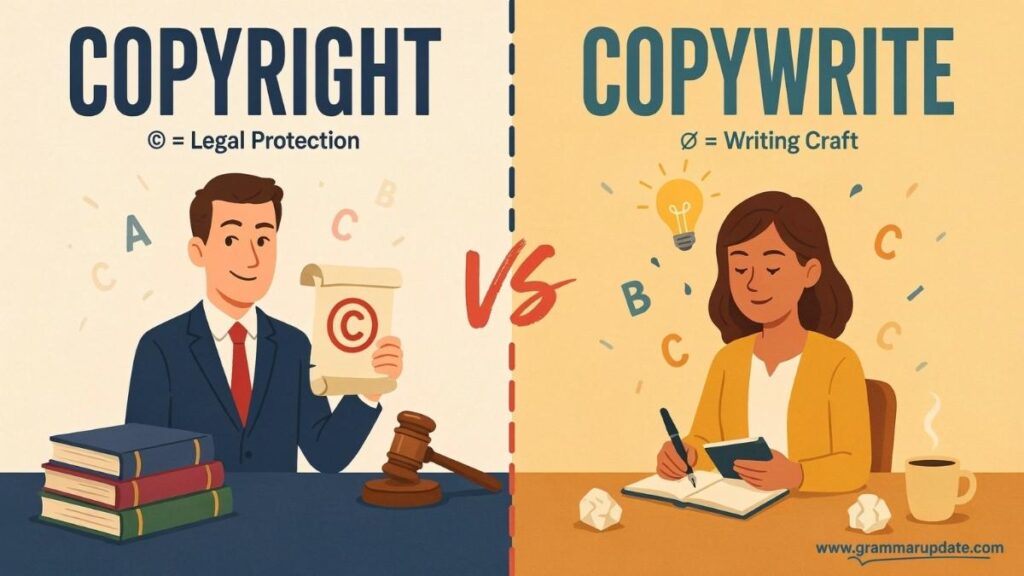
The confusion between Copyright vs Copywrite is surprisingly common. Students write it in assignments, business owners search for it online, and even experienced writers occasionally use the wrong spelling. Although the two words sound nearly identical, they have completely different meanings.
Copyright is the correct legal term that protects original creative works such as books, music, photographs, software, videos, and articles. Copywrite, however, is usually a spelling mistake caused by confusion with copywriting, which refers to writing content for advertising and marketing purposes.
The difference between copyright and copywrite helps writers, creators, students, and businesses avoid common mistakes, improve their writing accuracy, and use the correct term with confidence in both professional and everyday communication.
Copyright vs Copywrite Which Word Is Correct?
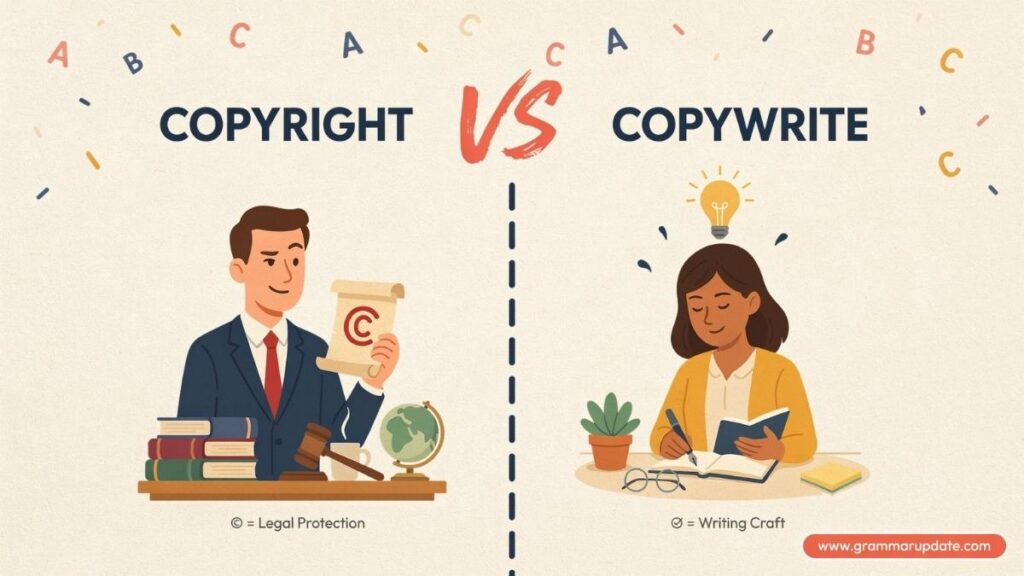
The answer is simple: copyright is the correct word.
Copywrite is generally considered a misspelling. Legal documents, dictionaries, educational institutions, and copyright laws all use the word copyright.
| Word | Correct Spelling | Meaning |
|---|---|---|
| Copyright | Yes | Legal protection for creative works |
| Copywrite | No | Common misspelling |
| Copywriting | Yes | Writing used in marketing and advertising |
If you are discussing ownership, intellectual property, or legal rights, the correct spelling is always copyright.
Real Examples
- The photographer owns the copyright to the image.
- The author registered the copyright for the novel.
Learn the difference between tricky more English words
Coma vs Comma which is Difference?
What Is Copyright?
Many people ask, What is copyright?
Copyright is a legal right that protects original works created by authors, artists, musicians, photographers, and content creators. It gives the creator exclusive rights to use, distribute, reproduce, and license the work.
Copyright Definition
Copyright is a form of intellectual property protection granted to creators of original works.
Protected works include:
- Books
- Articles
- Music
- Paintings
- Photographs
- Videos
- Software
- Websites
- Blog posts
The moment an original work is created and recorded in a tangible form, copyright protection generally begins automatically.
Copyright Meaning in Simple Words
The copyright meaning is straightforward.
If you create something original, you usually own the rights to it.
Copyright gives creators the ability to:
- Copy the work.
- Publish the work.
- Sell the work.
- License the work.
- Prevent unauthorized use.
It protects creative expression rather than ideas themselves.
Real Examples
- A songwriter owns the copyright to an original song.
- A blogger owns the copyright to an article.
Learn the difference between tricky more English words
Gray vs Grey Which Spelling Is Correct and Difference?
What Does Copywrite Mean?
The copywrite meaning causes confusion because many people see the word online.
In standard English, copywrite is not the correct spelling when discussing intellectual property.
Most people accidentally write copywrite when they mean:
- Copyright
- Copywriting
Because the words sound alike, the mistake is extremely common.
Real Examples
Incorrect:
The company filed a copywrite.
Correct:
The company filed a copyright.
Is Copywrite a Real Word?
One of the most searched questions is: Is copywrite a real word?
In standard English, the answer is generally no.
Major dictionaries recognize copyright as the legal term. The word copywrite usually appears as a misspelling or as part of a company or brand name.
Professional writers, legal experts, and publishers use copyright, not copywrite.
Learn the difference between tricky more English words
Rancor vs Rancour Difference and Which Spelling Is Correct?
Copyright vs Copywriting
Many people confuse Copyright vs Copywriting because both words begin with “copy.”
However, they describe entirely different concepts.
| Term | Meaning |
|---|---|
| Copyright | Legal protection for creative work |
| Copywriting | Writing that sells products or services |
What Is Copywriting?
Copywriting meaning refers to writing persuasive content designed to encourage readers to take action.
Professional copywriters create:
- Advertisements
- Sales pages
- Email campaigns
- Product descriptions
- Landing pages
- Marketing materials
Copywriting focuses on persuasion, while copyright focuses on legal ownership.
Real Examples
- A copywriter wrote the advertisement.
- The company owns the copyright to the advertisement.
Learn the difference between tricky more English words
Mobil vs Mobile Which Is Correct and Usage?
Difference Between Copyright and Copywrite
Understanding the difference between copyright and copywrite eliminates most confusion.
| Feature | Copyright | Copywrite |
|---|---|---|
| Correct spelling | Yes | No |
| Legal term | Yes | No |
| Found in dictionaries | Yes | Rarely |
| Protects creative works | Yes | No |
| Used in law | Yes | No |
Whenever you discuss ownership, legal rights, or intellectual property, copyright is always the correct choice.
Learn the difference between tricky more English words
Straight vs Strait Difference and Which Is Correct and Usage?
Why People Confuse Copyright and Copywrite
Several factors contribute to this mistake.
Similar Pronunciation
The words sound almost identical when spoken.
Confusion With Copywriting
Because copywriting is a legitimate profession, people often blend the two words.
Typing Errors
A single letter changes the spelling entirely.
Internet Searches
Millions of people search for Copyright or Copywrite every year, which reinforces the confusion.
Autocorrect Mistakes
Some spellcheck tools fail to recognize the intended meaning.
What Does Copyright Protect?
Copyright protects original creative works.
Protected materials include:
- Books
- Articles
- Music
- Paintings
- Films
- Photographs
- Software
- Videos
- Websites
- Digital content
Copyright protects the expression of an idea, not the idea itself.
Real Examples
Protected:
- A novel
- A song
- A photograph
Not protected:
- A business idea
- A movie concept
- A general theme
Learn the difference between tricky more English words
Payed vs Paid Difference and Which One is Correct?
What Copyright Does Not Protect
Copyright protection has limits.
The following generally cannot be copyrighted:
- Ideas
- Facts
- Titles
- Names
- Short phrases
- Slogans
- Discoveries
Other forms of intellectual property may apply.
- Trademarks protect brands.
- Patents protect inventions.
Who Owns Copyright?
The creator of the original work usually owns the copyright.
However, ownership may transfer through:
- Employment contracts
- Licensing agreements
- Sales agreements
- Work-for-hire arrangements
Real Examples
- A photographer owns their photographs.
- A company may own content created by employees.
Ownership depends on the agreement between the parties.
Learn how to use confusing more words correctly
Presant vs Present which is Correct Spelling and Usage?
Is Copyright Automatic?
Yes. In most countries, copyright protection begins automatically once the work is created and fixed in a tangible form.
This means:
- Writing an article creates copyright.
- Recording music creates copyright.
- Taking a photograph creates copyright.
Registration is often optional, although it provides additional legal benefits.
Copyright Registration
While copyright protection is automatic, registration offers several advantages.
Registration can provide:
- Legal evidence of ownership
- Public ownership records
- Easier enforcement
- Potential legal damages
Registration procedures vary depending on the country.
Copyright Symbol Meaning
The copyright symbol is:
©
This symbol indicates that a work is protected by copyright.
Common notices include:
© 2026 Company Name. All Rights Reserved.
Although the symbol is useful, protection often exists even without it.
Learn how to use confusing more words correctly
Affend vs Offend Which Spelling Is Correct in English?
How to Use the Copyright Symbol
The copyright symbol can appear on:
- Books
- Websites
- Videos
- Photographs
- Articles
- Software
The standard format is:
© Year Owner Name
Example:
© 2026 ABC Media. All Rights Reserved.
Copyright Infringement Explained
Copyright infringement occurs when someone uses protected material without permission.
Examples include:
- Copying articles
- Sharing pirated movies
- Using images without permission
- Republishing content
Copyright infringement may lead to legal action.
Real Examples
- Copying an entire blog post.
- Uploading copyrighted videos without permission.
Learn how to use confusing more words correctly
Sentence vs Sentance Which Spelling Is Correct?
Fair Use and Limited Exceptions
Fair use allows limited use of copyrighted material in certain situations.
These situations may include:
- Education
- Criticism
- Commentary
- News reporting
- Research
Fair use laws vary between countries and depend on specific circumstances.
Copyright vs Trademark vs Patent
Many people confuse these legal protections.
| Protection | Covers |
|---|---|
| Copyright | Creative works |
| Trademark | Brands and logos |
| Patent | Inventions |
Understanding these differences helps creators protect their work properly.
Copyright in Professional Writing
Businesses rely heavily on copyright protection.
Protected business materials include:
- Website content
- Marketing materials
- Reports
- Product descriptions
- Training manuals
Unauthorized copying can harm both businesses and creators.
Copyright in Academic Writing
Copyright also plays an important role in education.
Students and researchers must avoid:
- Plagiarism
- Unauthorized copying
- Improper citations
Respecting copyright supports ethical writing practices.
Learn how to use confusing more words correctly
Sence vs Sense Which Is Correct and Usage?
Can AI-Generated Content Be Copyrighted?
This question continues to evolve.
Many countries currently provide copyright protection only to works created by humans. Purely AI-generated content may not qualify for the same protection.
Because laws continue to change, creators should review local regulations regarding AI-generated works.
Common Mistakes People Make
Several mistakes appear repeatedly.
Using Copywrite Instead of Copyright
This remains the most common error.
Confusing Copyright With Copywriting
These terms describe completely different concepts.
Assuming Registration Is Required
Many people believe copyright does not exist without registration.
Misusing Copyright Symbols
Incorrect years and ownership information are common mistakes.
Real-World Examples
Correct:
- The author owns the copyright.
- The business hired a copywriter.
Incorrect:
- The author owns the copywrite.
- The company registered a copywrite.
These examples demonstrate why correct spelling matters.
Fix common more word mistakes in English
Preform vs Perform Confusion and Common Mistakes
British English vs American English
The spelling does not change between regions.
Both American English and British English use:
Copyright
The legal systems may differ, but the spelling remains the same.
What Dictionaries and Style Guides Say
Major dictionaries recognize copyright as the correct word.
Legal guides, academic institutions, and style manuals consistently use copyright.
The spelling copywrite is generally listed as an error or misspelling.
How to Remember Copyright vs Copywrite
A simple memory trick makes the difference easy to remember.
Copyright protects rights.
The word right appears inside copyright, reminding you that it involves legal rights.
Another helpful rule is:
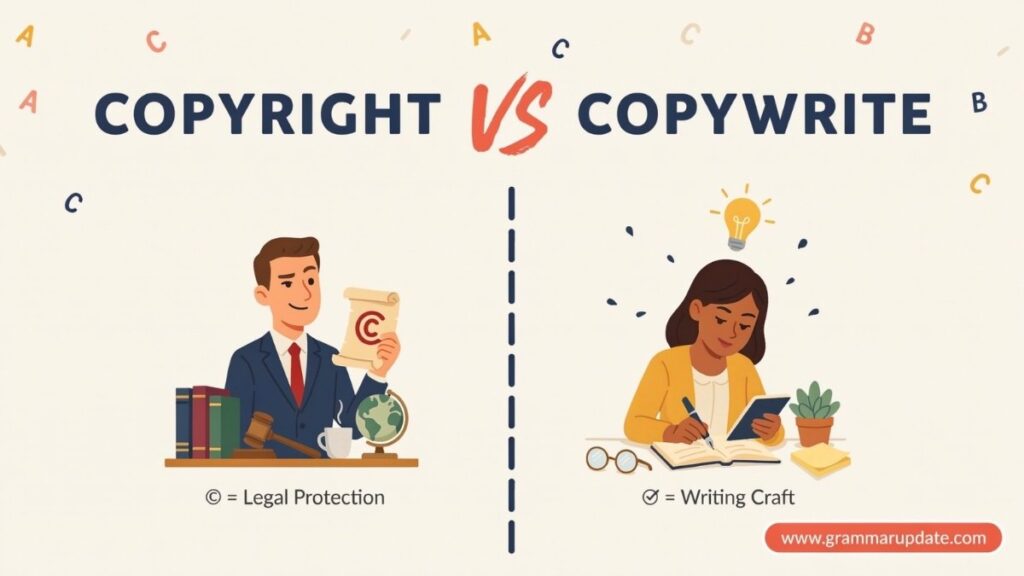
Copywriting sells. Copyright protects.
These simple reminders help eliminate confusion.
Fix common more word mistakes in English
Pentoxide vs Pentaoxide Scientific Overview
Copyright vs Copywrite at a Glance
| Feature | Copyright | Copywrite |
|---|---|---|
| Correct spelling | Yes | No |
| Legal term | Yes | No |
| Protects creative work | Yes | No |
| Used by lawyers | Yes | No |
| Dictionary word | Yes | Rarely |
| Professional usage | Yes | No |
Practice Session copyright vs copywrite
Choose the correct word: copyright vs copywrite.
- The author owns the __________ to her novel.
- The company added a __________ notice to its website.
- Original songs receive __________ protection under the law.
- The student accidentally wrote __________ in his assignment.
- The photographer registered the __________ for his images.
- Books, movies, and music are protected by __________ law.
- The artist holds the __________ to the painting.
- Most dictionaries recognize __________ as the correct spelling.
- The word __________ is generally considered a spelling mistake.
- The publisher purchased the __________ to the manuscript.
- The website displays a __________ symbol in the footer.
- Sharing copyrighted content without permission may violate __________ laws.
- The writer owns the __________ to the article.
- The legal agreement discussed __________ ownership.
- The company updated its __________ notice for the new year.
- Many people confuse __________ with copywriting.
- Creators automatically receive __________ protection for original work.
- The designer transferred the __________ to the client.
- Students should avoid using __________ in legal documents.
- The song remains protected by __________ law.
- The correct spelling is __________.
- The term __________ rarely appears in official legal documents.
- The filmmaker owns the __________ to the movie.
- Understanding __________ helps creators protect their work.
- In the debate “Copyright vs Copywrite,” the correct word is __________.
Answers
- copyright
- copyright
- copyright
- copywrite
- copyright
- copyright
- copyright
- copyright
- copywrite
- copyright
- copyright
- copyright
- copyright
- copyright
- copyright
- copyright
- copyright
- copyright
- copywrite
- copyright
- copyright
- copywrite
- copyright
- copyright
- copyright
Here’s a trusted source for clear word meanings:
FAQs
Is it copyright or copywrite?
Copyright is the correct spelling. It is the legal term used to protect original creative works such as books, music, photographs, videos, and software. Copywrite is generally considered a spelling mistake.
What is the difference between copyright and copywrite?
The difference is simple. Copyright is a legal right that protects original works, while copywrite is usually an incorrect spelling caused by confusion with copywriting.
Is copywrite a real word?
No. Copywrite is not recognized as the standard legal term in English. Major dictionaries, legal documents, and copyright laws use the word copyright.
What is copyright in simple words?
Copyright is a legal protection that gives creators exclusive rights to use, reproduce, distribute, and control their original work.
What does copyright protect?
Copyright protects original creative works, including books, articles, music, films, photographs, artwork, software, websites, and digital content.
What is copywriting?
Copywriting is the process of writing persuasive content for advertising, marketing, emails, sales pages, and promotional materials.
What is the difference between copyright and copywriting?
Copyright protects creative works through legal rights, while copywriting focuses on creating content that promotes products, services, or brands.
Who owns copyright?
The original creator usually owns the copyright. However, ownership may transfer through contracts, employment agreements, licensing deals, or work-for-hire arrangements.
Is copyright automatic?
Yes. In most countries, copyright protection begins automatically when an original work is created and recorded in a tangible form.
Do I need to register a copyright?
Registration is not always required because copyright protection is generally automatic. However, registration can provide stronger legal protection and evidence of ownership.
What is the copyright symbol?
The copyright symbol is ©. It indicates that a work is protected by copyright and identifies the owner of the material.
What is copyright infringement?
Copyright infringement occurs when someone uses, copies, distributes, or publishes copyrighted material without permission from the owner.
Can you copyright an idea?
No. Copyright protects the expression of an idea, not the idea itself. Ideas, concepts, and facts cannot receive copyright protection.
Can you copyright a name or logo?
No. Names, brand names, and logos are usually protected under trademark law rather than copyright law.
How long does copyright last?
Copyright duration varies by country, but many countries protect works for the creator’s lifetime plus several decades after their death.
Is copyright illegal?
No. Copyright is a legal system designed to protect creators and their original works from unauthorized use.
Why do people confuse copyright and copywrite?
People often confuse these words because they sound almost identical. The existence of copywriting also causes many writers to mistakenly use copywrite.
Can AI-generated content be copyrighted?
Copyright protection for AI-generated content depends on local laws. In many countries, human creativity is required for copyright ownership.
What is fair use in copyright law?
Fair use allows limited use of copyrighted material for purposes such as education, criticism, commentary, research, and news reporting.
How can I remember copyright vs copywrite?
An easy rule is: copyright protects rights, while copywriting writes words that sell. If the topic involves legal ownership, the correct word is always copyright.
Fix common more word mistakes in English
Commit vs Comit Correct Spelling and Usage
Conclusion
The confusion surrounding Copyright vs Copywrite is understandable because the two words sound nearly identical and often appear in online searches, articles, and everyday conversations. However, their meanings are entirely different, and using the wrong one can quickly turn a professional sentence into a noticeable mistake.
Copyright is the correct legal term that protects original creative works and grants creators exclusive rights over their content. Copywrite, on the other hand, is generally a spelling error that results from confusion with copywriting, the practice of writing advertising and marketing content.
A simple way to remember the difference is this: copyright protects rights, while copywriting writes words that sell. One belongs to the world of intellectual property, and the other belongs to marketing. Confusing the two is a bit like asking a lawyer to write a sales page or hiring a copywriter to handle legal documents.
By understanding the difference, writers, students, business owners, and content creators can avoid common mistakes, improve their writing accuracy, and communicate more confidently. The next time you see copywrite, you will immediately recognize the error and know that copyright is the only correct choice when discussing ownership, legal protection, and creative rights.

Jhon AJS, the creative mind behind Grammar Update, is an experienced blogger passionate about simplifying English grammar. He focuses on explaining confusing word vs word differences, grammar rules, punctuation, and sentence structure in a clear and practical way. Through easy to understand guides and examples, Jhon helps readers improve their writing and communicate with confidence. With years of blogging experience, he continues to share helpful insights that make learning grammar simple, useful, and accessible for everyone.