Bases vs basis can turn a simple sentence into a surprisingly tricky grammar question. The two words look almost identical, but they do not always mean the same thing. Basis usually means one foundation, reason, or supporting idea, while bases can mean several foundations, several physical bases, or even an action. That’s where the confusion starts. But there’s no need to overthink it. Once you understand how each word works, the difference becomes clear. This guide explains bases vs basis in simple English, shows how to use each word correctly, covers common mistakes, and gives practical examples to help you choose the right word with confidence.
Bases vs Basis The Quick Answer
The easiest way to understand basis vs bases is to start with grammatical number.
Basis is singular. It refers to one foundation, reason, principle, or underlying support.
Bases is the plural of basis when you mean more than one foundation, reason, or principle.
However, bases has two additional uses. It can be the plural of the noun base, or it can be a verb.
| Word | Grammatical function | Meaning | Example |
|---|---|---|---|
| basis | Singular noun | One foundation, reason, or principle | “Evidence provides the basis for the decision.” |
| bases | Plural noun | More than one basis | “Several bases support the theory.” |
| bases | Plural noun | More than one base | “The military operates several bases.” |
| bases | Verb | Uses something as a foundation | “The report bases its conclusion on data.” |
This is the key to bases vs basis grammar.
If you understand these four uses, most common mistakes disappear.
Learn the difference between commonly mixed-up more words
Sited vs Cited difference and Which One Is Correct?
What Is the Basis Meaning?
The basis meaning centers on the idea of a foundation or underlying support.
A basis can be the reason something happens, the principle behind an idea, the evidence supporting a conclusion, or the foundation on which something develops.
For example:
- “Trust is the basis of their relationship.”
- “The evidence provides a basis for the decision.”
- “The research has a strong scientific basis.”
- “There is no factual basis for the accusation.”
In each example, basis refers to something that supports or explains another thing.
The basis definition can therefore be summarized as a foundation, reason, principle, or underlying support.
Cambridge Dictionary defines basis in terms of the important facts, ideas, or principles from which something develops or is based. It also includes the meaning of a reason or method for doing something.
Basis as an Abstract Foundation
Basis often describes something abstract rather than something physical.
Consider this sentence:
“Evidence formed the basis of the investigation.”
Evidence isn’t a physical structure underneath the investigation. Instead, it provides the foundation that supports the investigation.
This use is common when discussing:
- arguments
- theories
- decisions
- relationships
- research
- policies
- claims
- agreements
- conclusions
- opinions
For example:
“Scientific evidence provides the basis for the treatment.”
Here, evidence supports the treatment decision.
Basis as an Underlying Reason
Basis can also mean the reason or justification for something.
Consider these examples:
- “There is no basis for the accusation.”
- “The court found a legal basis for the claim.”
- “The proposal has a reasonable basis.”
- “The decision was made on the basis of new evidence.”
In these sentences, basis is closely related to words such as reason, grounds, justification, and rationale.
Basis as a Method or Frequency
Basis also appears in expressions that describe how frequently something happens or how something is organized.
Examples include:
- “Employees are paid on a weekly basis.”
- “The system is reviewed on a daily basis.”
- “Applications are considered on an individual basis.”
- “The equipment should be inspected on a regular basis.”
In these expressions, basis refers to the method or schedule used for something.
Learn the difference between commonly mixed-up more words
Apprised vs Appraised difference and Which One Is Correct?
What Does Bases Mean?
The bases meaning depends on the context.
There are three main possibilities:
- Bases is the plural of basis.
- Bases is the plural of base.
- Bases is the third-person singular form of the verb base.
This is why bases can be one of the more confusing English word forms.
Bases as the Plural of Basis
When bases is the plural of basis, it means more than one foundation, principle, reason, or underlying support.
For example:
- “The theory rests on several bases.”
- “The argument has multiple bases.”
- “The conclusions were reached on different bases.”
In these sentences, bases refers to multiple conceptual foundations.
This answers the common question, “Is bases the plural of basis?”
Yes.
The plural of basis is bases.
The word changes from basis to bases rather than becoming basises.
Bases as the Plural of Base
Bases is also the plural of the separate noun base.
For example:
- “The country has several military bases.”
- “The baseball player reached all four bases.”
- “The building has several supporting bases.”
- “The company operates from regional bases.”
Here, bases does not mean multiple reasons or principles. It means more than one base.
A base can be a physical support, a location, a military installation, a mathematical component, a baseball position, or another type of foundation.
Bases as a Verb
Bases can also function as a verb.
It is the third-person singular present form of base.
For example:
- “The company bases its decisions on customer feedback.”
- “The researcher bases the conclusion on experimental results.”
- “The author bases the argument on historical evidence.”
In these sentences, bases means uses something as a foundation.
Compare these two sentences:
“The researcher found several bases for the theory.”
“The researcher bases the theory on several studies.”
The first uses bases as a plural noun. The second uses bases as a verb.
The spelling is identical, but the grammatical function is different.
Learn the difference between commonly mixed-up more words
Calendar vs Calender difference and Which Spelling Is Correct?
Basis vs Bases What Is the Difference?
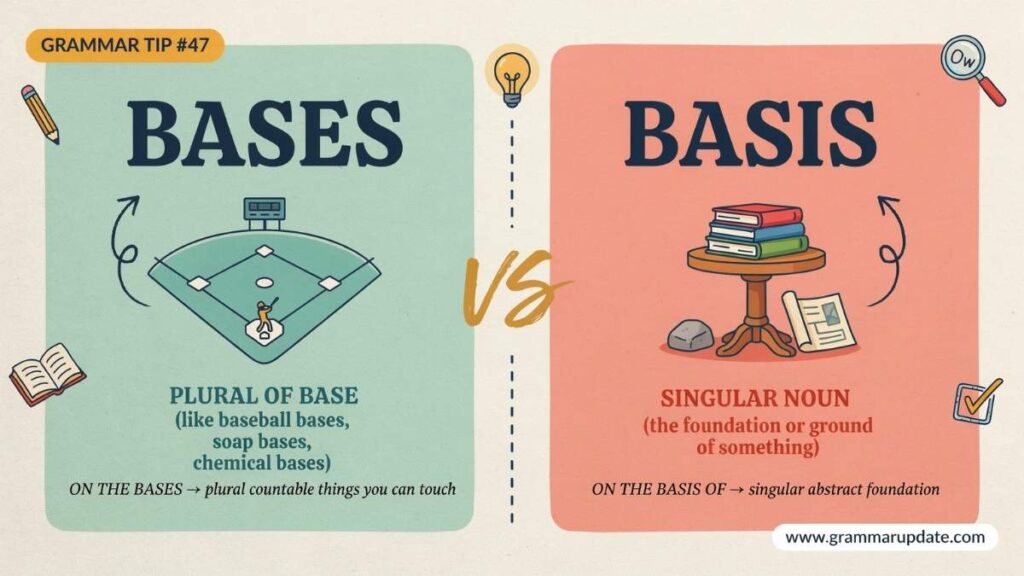
The difference between bases and basis mainly involves grammatical number and meaning.
Basis is a singular noun.
Bases can be a plural noun or a verb.
1.When bases is the plural of basis, it refers to multiple foundations or principles.
2.When bases is the plural of base, it refers to multiple physical, geographical, mathematical, or conceptual bases.
3.When bases is a verb, it means uses something as a foundation.
| Sentence | Correct? | Explanation |
| “Evidence is the basis of the argument.” | Yes | Basis refers to one foundation. |
| “Evidence is the bases of the argument.” | No | The sentence needs the singular noun basis. |
| “The theory has several bases.” | Yes | Bases means multiple foundations. |
| “The military has several bases.” | Yes | Bases is the plural of base. |
| “The researcher bases the conclusion on data.” | Yes | Bases is a verb. |
| “The researcher basis the conclusion on data.” | No | Basis is a noun, not this verb form. |
This is the core difference behind bases vs basis meaning.
Is Basis Singular or Plural?
Basis is singular.
If you’re asking, “Is basis singular or plural?” the answer is simple: basis is a singular noun.
Examples:
- “This basis is strong.”
- “The basis of the argument is clear.”
- “A scientific basis supports the claim.”
- “The decision has a reasonable basis.”
When you mean more than one, use bases.
Examples:
- “Several bases support the argument.”
- “The theory has multiple bases.”
- “The researchers identified different bases for comparison.”
So remember:
One basis.
Two or more bases.
What Is the Plural of Basis?
The answer to “What is the plural of basis?” is bases.
The plural of basis is an example of a noun that doesn’t simply take the usual -s ending.
| Singular form | Plural form |
| basis | bases |
| analysis | analyses |
| crisis | crises |
| thesis | theses |
| diagnosis | diagnoses |
Therefore, the standard plural form is bases, not basises.
For example:
Incorrect: “The researchers identified several basises.”
Correct: “The researchers identified several bases.”
The word bases may look unusual as the plural of basis, but it is the standard English form.
Why Is the Plural of Basis Bases?
Basis comes into English through Latin from Greek. Its plural follows a classical pattern in which the ending changes rather than simply adding an English plural ending.
You don’t need to study Greek or Latin to remember the grammar rule. Just remember the noun form:
basis → bases
This pattern also appears in several other English words:
analysis → analyses
crisis → crises
thesis → theses
diagnosis → diagnoses
This is why “basises” is not the standard plural form.
Learn the difference between commonly mixed-up more words
Strips vs Stripes Difference and which is correct?
Bases Plural Why It Can Be Confusing
The phrase bases plural becomes confusing because the same plural spelling comes from two different singular nouns.
Basis → bases
Base → bases
The meaning depends on context.
For example:
“Several bases support the theory.”
Here, bases is the plural of basis.
“The military operates several bases.”
Here, bases is the plural of base.
The spelling doesn’t tell you which meaning is intended. The surrounding words do.
This is where context clues become important.
Base vs Basis What’s the Difference?
The base vs basis meaning can overlap because both words can describe something that provides support.
However, they aren’t interchangeable.
Base commonly refers to a physical support, location, starting point, or main part.
Basis usually refers to an abstract foundation, reason, principle, or justification.
Compare:
“The lamp has a heavy base.”
“Evidence provides the basis for the conclusion.”
The lamp has a physical supporting structure. The conclusion has an abstract foundation.
What Does Base Mean?
The base meaning depends on the subject.
A base can refer to:
- The bottom or supporting part of an object
- A place where someone operates
- A military installation
- A baseball position
- A mathematical component
- A chemical substance
- A foundation or starting point
Examples:
- “The statue has a wide base.”
- “The company established a regional base in Texas.”
- “The soldiers returned to the base.”
- “The runner reached first base.”
- “The number system uses base ten.”
Because base has so many meanings, bases can also have many meanings.
Base vs Basis vs Bases
When comparing base vs basis vs bases, focus on the singular form first.
| Word | Function | Main meaning |
| base | Singular noun | One physical, geographical, conceptual, or structural base |
| basis | Singular noun | One abstract foundation, reason, or principle |
| bases | Plural noun | More than one basis |
| bases | Plural noun | More than one base |
| bases | Verb | Uses something as a foundation |
For example:
- “The building has a strong base.”
- “The evidence provides a strong basis for the decision.”
- “The theory has several bases.”
- “The military operates several bases.”
- “The company bases its strategy on research.”
This is the clearest way to understand the base and basis difference.
Basis vs Base Grammar
The basis vs base grammar distinction becomes easier when you ask whether you’re describing an abstract foundation or something that acts as a physical or operational base.
Use basis when you mean an underlying reason, principle, or justification.
Examples:
- “The policy has a strong basis in evidence.”
- “Trust is the basis of the partnership.”
- “The claim has no factual basis.”
- “The study provides a scientific basis for further research.”
Use base when you mean a physical structure, location, or other type of base.
Examples:
- “The table has a sturdy base.”
- “The company established a regional base.”
- “The military built a new base.”
- “The player returned to second base.”
The distinction isn’t absolute because base can have abstract meanings too. For example, you can talk about the “economic base” of a community.
Still, basis is much more closely associated with the idea of an underlying reason or foundation.
Learn the difference between confusing more English words
Bellwether vs Bellweather difference and usage?
Common Uses of Basis
Several expressions with basis appear frequently in everyday, academic, business, and professional English.
On the Basis of
“On the basis of” means using something as the reason, evidence, or foundation for a decision or conclusion.
Examples:
- “The application was approved on the basis of the submitted documents.”
- “The decision was made on the basis of new evidence.”
- “The claim was rejected on the basis of insufficient evidence.”
- “The court ruled on the basis of existing law.”
This phrase is especially common in formal writing.
Basis for
Use “basis for” when something provides support or justification for another thing.
Examples:
- “The evidence provides a basis for further research.”
- “There is no reasonable basis for the claim.”
- “The agreement created a basis for cooperation.”
- “The findings provide a factual basis for the recommendation.”
Basis of
Use “basis of” when referring to the underlying foundation of something.
Examples:
- “Trust is the basis of their relationship.”
- “Observation is the basis of the method.”
- “The data form the basis of the report.”
- “Communication is the basis of effective teamwork.”
The choice between “basis for” and “basis of” depends on the construction and relationship between the ideas.
On a Regular Basis
“On a regular basis” means regularly.
Example:
“The equipment should be inspected on a regular basis.”
The phrase is grammatically correct. However, “regularly” is often more concise:
“The equipment should be inspected regularly.”
Both versions are understandable and grammatically sound.
On a Daily Basis
“On a daily basis” means every day.
Examples:
- “The system records transactions on a daily basis.”
- “The staff reviews the information on a daily basis.”
Again, “daily” can often express the same idea more directly.
Learn the difference between confusing more English words
Acreage vs Acrag difference and Which Spelling Is Correct?
Common Uses of Bases
The common uses of bases depend on which meaning of bases is intended.
Multiple Foundations
When bases is the plural of basis, it can refer to several foundations or principles.
Examples:
- “The theory rests on several bases.”
- “The argument has multiple bases.”
- “The agreement was considered on different bases.”
Military Bases
When bases is the plural of base, it can refer to multiple military installations.
Examples:
- “The country operates several military bases.”
- “The aircraft were moved between bases.”
- “The soldiers returned to their bases.”
Baseball Bases
In baseball, bases are the four positions that runners must touch to score.
Examples:
- “The player reached first base.”
- “The runner stole two bases.”
- “The bases were loaded.”
- “The player touched all four bases.”
Mathematical Bases
Base also has mathematical meanings.
For example:
- “The number system uses base ten.”
- “The triangle has a long base.”
When referring to more than one base, the plural is bases.
Basis vs Bases Pronunciation
The bases vs basis pronunciation difference can cause confusion because the spellings look so similar.
The standard pronunciations are:
- basis: BAY-sis
- bases: BAY-seez
The pronunciation changes noticeably at the end.
| Word | Pronunciation | Simple guide |
| basis | /ˈbeɪ.sɪs/ | BAY-sis |
| bases | /ˈbeɪ.siːz/ | BAY-seez |
| base | /beɪs/ | BASE |
So if you’re asking how to pronounce basis, say “BAY-sis.”
If you’re asking how to pronounce bases when it is the plural of basis or base, say “BAY-seez.”
The pronunciation difference can help you distinguish the words when speaking.
Basis Pronunciation
The basis pronunciation is approximately:
BAY-sis
Example:
“The basis of the argument is clear.”
The second syllable sounds like “sis.”
Bases Pronunciation
The bases pronunciation is approximately:
BAY-seez
Example:
“Several bases support the theory.”
The second syllable sounds like “seez.”
This gives you an easy pronunciation shortcut:
base → BASE
basis → BAY-sis
bases → BAY-seez
Learn the difference between confusing more English words
Lend vs Lent difference and which is Correct?
Basis vs Bases Examples
Examples make confusing English words much easier to understand because they show how grammar works in real sentences.
Basis Example Sentences
- “The evidence provides the basis for the decision.”
- “Trust is the basis of their relationship.”
- “The report has a strong scientific basis.”
- “There is no factual basis for the accusation.”
- “The theory has a solid theoretical basis.”
- “The court examined the legal basis of the claim.”
- “The proposal has a reasonable basis.”
- “The payment is calculated on a monthly basis.”
These examples show the basis meaning in English as a foundation, reason, principle, justification, or method.
Bases Example Sentences
- “Several bases support the theory.”
- “The organization operates from several bases.”
- “The military has several bases in the region.”
- “The player reached all four bases.”
- “The researcher bases the conclusion on experimental evidence.”
These bases example sentences demonstrate the three main uses of bases.
Basis in a Sentence
If you’re wondering how to use basis in a sentence, ask whether you’re talking about one underlying foundation, reason, or principle.
Here are several correct examples:
“The evidence provides the basis for our conclusion.”
“The policy has a strong legal basis.”
“The decision was made on the basis of cost.”
“Trust forms the basis of their partnership.”
“The study provides a scientific basis for further research.”
Each sentence uses basis as a singular noun.
Bases in a Sentence
If you’re wondering how to use bases in a sentence, first determine what bases means.
If it means multiple foundations:
“The theory rests on several bases.”
If it means multiple physical locations:
“The organization operates from several bases.”
If it is a verb:
“The company bases its decisions on customer data.”
This is why you can’t decide between bases or basis without considering the sentence’s meaning.
A Simple Case Study One Spelling, Three Functions
Consider a researcher writing a report.
First, she writes:
“The researcher bases the conclusion on three independent studies.”
Here, bases is a verb. It means she uses the studies as the foundation for the conclusion.
Later, she writes:
“The conclusion has a strong scientific basis.”
Now basis is a singular noun. It refers to the underlying scientific foundation.
Finally, she writes:
“The conclusion rests on several theoretical bases.”
Here, bases is the plural of basis. It refers to several foundations.
The same group of words can therefore contain bases as a verb, basis as a singular noun, and bases as a plural noun.
The meaning comes from grammar and context.
Learn the difference between confusing word pairs
Agast vs Aghast difference and Which one Is Correct?
When to Use Bases vs Basis
If you’re unsure when to use bases vs basis, use this four-step check.
Use Basis for One Foundation
Use basis when you mean one underlying reason, principle, or foundation.
Example:
“This evidence provides the basis for the conclusion.”
Use Bases for Multiple Foundations
Use bases when you mean more than one basis.
Example:
“Several bases support the theory.”
Use Bases for Multiple Bases
Use bases when you mean more than one physical, geographical, mathematical, or conceptual base.
Example:
“The military operates several bases.”
Use Bases as a Verb
Use bases when the subject uses something as a foundation.
Example:
“The researcher bases the conclusion on evidence.”
This approach makes the basis or bases choice much easier.
Common Mistakes With Basis and Bases
The most common mistakes are easy to fix once you understand the noun forms.
Using Bases for a Singular Noun
Incorrect:
“This is the bases for the decision.”
Correct:
“This is the basis for the decision.”
The sentence refers to one foundation.
Using Basises as the Plural
Incorrect:
“The researchers identified several basises.”
Correct:
“The researchers identified several bases.”
The plural of basis is bases.
Confusing Basis With Base
Incorrect:
“The lamp has a heavy basis.”
Correct:
“The lamp has a heavy base.”
A physical supporting structure is normally called a base.
Using Basis as a Verb
Incorrect:
“The company basis its decision on sales data.”
Correct:
“The company bases its decision on sales data.”
Bases is the correct verb form.
Assuming Bases Always Means Multiple Reasons
Bases doesn’t always mean multiple reasons or foundations.
“The military has several bases.”
Here, bases refers to military installations.
“The theory has several bases.”
Here, bases refers to multiple foundations.
“The company bases its strategy on research.”
Here, bases is a verb.
The context changes the meaning.
Learn the difference between confusing word pairs
Achieve vs Achive Difference Which Spelling Is Correct?
Basis vs Bases in Academic Writing
Basis appears frequently in academic writing because researchers often discuss evidence, theories, principles, and arguments.
Common academic expressions include:
- scientific basis
- theoretical basis
- factual basis
- conceptual basis
- empirical basis
- research basis
- basis for an argument
- basis of a theory
- basis for a conclusion
Examples:
“The study provides a scientific basis for further investigation.”
“The argument has a strong theoretical basis.”
“The researchers found little factual basis for the claim.”
When several conceptual foundations are genuinely being discussed, bases can be correct:
“The theory developed from several intellectual bases.”
However, writers shouldn’t force bases into every sentence that contains multiple supporting ideas. Sometimes reasons, grounds, sources, foundations, or principles will communicate the meaning more naturally.
Good word usage is about precision, not complexity.
Basis vs Bases in Legal and Professional Writing
Basis is also common in legal, business, and professional English.
Some frequent expressions include:
- legal basis
- factual basis
- reasonable basis
- contractual basis
- statutory basis
- basis for a decision
- basis for a claim
- basis of an agreement
For example:
“The company had a reasonable basis for terminating the agreement.”
Here, basis means the justification supporting the company’s action.
Another example:
“The claim has no legal basis.”
This means the claim lacks an adequate legal foundation.
These uses show why the correct word matters in formal communication. A small grammatical mistake can make a sentence sound careless even when the intended meaning is obvious.
Basis vs Bases in Everyday English
You don’t need to work in academia or law to encounter these words.
Everyday examples include:
- “That’s the basis of my argument.”
- “We meet on a weekly basis.”
- “What is the basis for that opinion?”
- “The team has several bases around the region.”
- “She bases her decisions on experience.”
Basis often appears when someone explains why something exists, why a decision was made, or what supports an idea.
Bases is more common in everyday speech when it refers to physical locations, military installations, baseball positions, or other literal bases.
The plural meaning of basis is grammatically correct, but it appears less often in casual conversation.
Learn the difference between confusing word pairs
Amateur vs Amatuer difference and Which one Is Correct?
A Quick Trick to Remember Basis vs Bases
Use this simple memory rule:
One basis.
Several bases.
Then remember that bases has two other jobs:
Several bases can mean several physical or conceptual bases.
Someone bases something on evidence.
So the word bases can represent:
- the plural of basis
- the plural of base
- the verb bases
Meanwhile, basis is the singular noun.
Once that distinction clicks, the confusion largely disappears.
Basis vs Bases Quick Comparison
| Feature | Basis | Bases |
| Singular noun | Yes | No |
| Plural noun | No | Yes |
| Plural of basis | No | Yes |
| Plural of base | No | Yes |
| Verb | No | Yes |
| One foundation | Yes | No |
| Multiple foundations | No | Yes |
| Multiple physical bases | No | Yes |
| Pronunciation | BAY-sis | BAY-seez |
Learn the difference between confusing word pairs
Presant vs Present which is Correct Spelling and Usage?
Practice Session Basis vs Bases
Fill in each blank with the correct word: basis, bases, or base.
- Trust is the ______ of a strong relationship.
- The company ______ its decisions on customer feedback.
- The military operates several ______ in the region.
- The evidence provides a solid ______ for the argument.
- The player reached all four ______ during the game.
- The researchers identified several ______ for the theory.
- The statue has a wide ______ that keeps it stable.
- The decision was made on the ______ of new evidence.
- The organization ______ its policies on current research.
- There is no factual ______ for the accusation.
- The country has several military ______ around the world.
- The theory has a strong scientific ______.
- The runner touched all the ______ before scoring.
- The table has a sturdy ______.
- Several principles form the ______ of the new approach.
- The researcher ______ the conclusion on reliable data.
- The claim has no legal ______.
- The company operates from several regional ______.
- Communication is the ______ of an effective partnership.
- The report was prepared on the ______ of information collected during the investigation.
- The organization ______ its strategy on long-term economic trends.
- The building has a strong structural ______.
- Several theoretical ______ support the proposed explanation.
- The court found a reasonable ______ for the decision.
- The researchers ______ their conclusions on evidence from multiple studies.
Answers
- basis
- bases
- bases
- basis
- bases
- bases
- base
- basis
- bases
- basis
- bases
- basis
- bases
- base
- basis
- bases
- basis
- bases
- basis
- basis
- bases
- base
- bases
- basis
- base
Here’s a trusted source for clear word meanings:
FAQs
Is it “daily basis” or “daily bases”?
The correct expression is “on a daily basis.” Basis is singular because the phrase refers to one method or frequency. For example, “The system is checked on a daily basis.”
What is the difference between bases and basis?
Basis is a singular noun meaning a foundation, reason, principle, or underlying support. Bases can be the plural of basis, the plural of base, or a verb meaning “uses as a foundation.”
Is there a plural for basis?
Yes. The plural of basis is bases. For example, “The theory rests on several bases.”
What does basis mean in simple terms?
Basis means the foundation, reason, or main support for something. For example, “Evidence is the basis for the conclusion” means the evidence supports the conclusion.
When should you use basis instead of bases?
Use basis when you mean one foundation, reason, principle, or underlying support. Use bases when you mean more than one basis, more than one base, or when bases functions as a verb.
What does “bases” mean?
“Bases” has three main meanings. It can mean several foundations, several physical or conceptual bases, or the verb form in a sentence such as “She bases her decision on evidence.”
How do you use bases in a sentence?
Use bases as a plural noun or verb depending on the intended meaning. For example, “The military operates several bases” uses bases as a plural noun, while “She bases her decision on evidence” uses it as a verb.
Is it “monthly basis” or “monthly bases”?
The correct expression is “on a monthly basis.” For example, “The company reviews its accounts on a monthly basis.” Bases would not be correct in this expression.
How do you use bases as the plural of basis?
Use bases when you are referring to more than one foundation, principle, or underlying reason. For example, “The theory developed from several theoretical bases.”
What is the plural of base?
The plural of base is bases. For example, “The army operates several military bases.”
How do you refer to multiple bases?
The correct plural form is bases. For example, “The organization has several bases in different regions.”
Does base have more than one meaning?
Yes. Base can refer to a physical support, a place of operation, a military installation, a baseball position, a mathematical concept, or a chemical substance. Its exact meaning depends on context.
What is another word for basis?
Depending on the context, alternatives for basis include foundation, reason, grounds, principle, rationale, justification, support, or starting point. The best synonym depends on the sentence.
What does “basis for” mean?
“Basis for” refers to something that provides support, justification, or a reason for another thing. For example, “The evidence provides a basis for the conclusion.”
Is basis a noun?
Yes. Basis is a noun. It refers to a foundation, underlying reason, principle, justification, or method. It is normally used as a singular noun.
Is “bases” the plural form of “basis”?
Yes. Bases is the standard plural form of basis. However, bases is also the plural of base, so context determines which meaning applies.
Is it “cover my bases” or “cover my basis”?
The correct expression is “cover my bases.” It is an idiom meaning to take the necessary precautions or prepare for possible situations. For example, “I checked the documents twice to cover all my bases.”
What are five examples of bases?
Five examples include military bases, baseball bases, mathematical bases, physical bases, and multiple theoretical bases. The word can have different meanings depending on context.
How can bases be defined?
Bases can be defined as the plural of basis, the plural of base, or the third-person singular form of the verb base. Its meaning depends on how it functions in the sentence.
What are the three main uses of bases?
Bases has three main grammatical uses: the plural of basis, the plural of base, and the verb form of base. For example, “several bases,” “military bases,” and “she bases her argument on evidence.”
What is a common use of bases?
One common use of bases is as the plural of base, especially in expressions such as “military bases,” “baseball bases,” and “regional bases.” It can also refer to multiple foundations.
What does base mean?
Base can mean a physical supporting part, a place of operation, a military installation, a baseball position, a mathematical foundation, or a chemical substance. The context determines its meaning.
Is “on this basis” or “on these bases” correct?
Both can be correct, but they have different meanings. “On this basis” refers to one foundation or reason. “On these bases” refers to multiple foundations or reasons.
What does “on a monthly basis” mean?
“On a monthly basis” means once each month or according to a monthly schedule. For example, “The report is updated on a monthly basis.”
What does “basis” mean in “on this basis”?
In “on this basis,” basis means the reason, evidence, or foundation that supports a decision or conclusion.
Is “basis” singular or plural?
Basis is singular. Its plural form is bases. For example, “one basis” becomes “several bases.”
Is “bases” singular or plural?
Bases is plural when it functions as a noun. It can also function as a singular verb, as in “The company bases its decision on evidence.”
How do you pronounce basis?
Basis is pronounced approximately “BAY-sis.” Its standard US pronunciation is /ˈbeɪ.sɪs/.
How do you pronounce bases?
Bases is pronounced approximately “BAY-seez” when it is the plural of basis or base. The plural of basis is pronounced /ˈbeɪ.siːz/.
What is the difference between base and basis?
Base commonly refers to a physical support, location, or starting point, while basis usually refers to an abstract foundation, reason, principle, or justification. For example, a table has a base, while evidence provides a basis for an argument.
What are common examples of bases?
Common examples include military bases, baseball bases, regional bases of operation, physical bases, and multiple theoretical or conceptual bases.
What is another word for base?
Depending on the context, base can mean foundation, support, headquarters, headquarters location, bottom, starting point, or center of operations. The appropriate synonym depends on the intended meaning.
What is the opposite of basis?
There is no single exact opposite of basis in every context. Depending on the sentence, possible contrasts include conclusion, result, surface, or unsupported claim. The correct opposite depends on what basis means in that particular context.
What is a simple word for basis?
A simple word for basis is “foundation.” Other options include “reason,” “support,” or “ground,” depending on the context.
What is another way to say “on that basis”?
Depending on the context, you can say “for that reason,” “based on that,” “because of that,” or “using that as the foundation.”
What does basis mean in English?
In English, basis generally means the foundation, reason, principle, or support underlying something. It can also describe the method or frequency used for an activity, as in “on a daily basis.”
How do you use basis in a sentence?
Use basis as a singular noun when referring to one foundation, reason, principle, or method. For example, “The evidence provides a factual basis for the decision.”
What does “basis” mean in simple English?
Basis means the main reason or foundation behind something. If you ask, “What is the basis for this decision?” you are asking what reason or evidence supports it.
What is the difference between “basis” and “bases” in pronunciation?
Basis is pronounced “BAY-sis,” while bases, when it is the plural of basis or base, is pronounced “BAY-seez.” The final sound distinguishes the two words when spoken.
Conclusion
Bases vs basis can seem confusing at first. The words look almost the same, so it’s easy to mix them up. But once you understand what each word means, the difference is actually pretty simple.
Use basis when you are talking about one foundation, reason, principle, or supporting idea. Use bases when you’re talking about more than one basis or more than one base. Bases can also be a verb, as in “She bases her decision on reliable evidence.”
Here’s the easiest way to remember it: one basis, several bases. One base, several bases. That’s the basic rule.
For example, you might say, “Trust is the basis of their relationship,” but “The theory has several bases.” If you’re talking about military locations, you would say “military bases.” If you are describing an action, you might say, “The company bases its decision on customer feedback.”
So, when you are stuck between basis or bases, don’t guess. Look at what you’re trying to say. Are you talking about one foundation? Choose basis. Are you talking about several foundations, several bases, or using something as a foundation? Choose bases.
Once you know that little trick, bases vs basis stops being a grammar headache. The words may look like twins, but their jobs are different. Check the meaning, check the sentence, and you’ll have the right word every time.

Jhon AJS, the creative mind behind Grammar Update, is an experienced blogger passionate about simplifying English grammar. He focuses on explaining confusing word vs word differences, grammar rules, punctuation, and sentence structure in a clear and practical way. Through easy to understand guides and examples, Jhon helps readers improve their writing and communicate with confidence. With years of blogging experience, he continues to share helpful insights that make learning grammar simple, useful, and accessible for everyone.