Ever typed “mold” only to have your spell checker suggest “mould” and wondered which one is actually correct? You are not alone. This spelling difference confuses writers, students, homeowners, and professionals every day. The good news is that there’s no trick question. Both spellings are correct. The only difference is the type of English you’re using. In this guide, you’ll learn when to use mold vs mould, why the spellings differ, and how to choose the right one for your audience. With clear explanations, practical examples, and simple tips, you’ll clear up the confusion and write with confidence every time.
Is It Mold vs Mould?
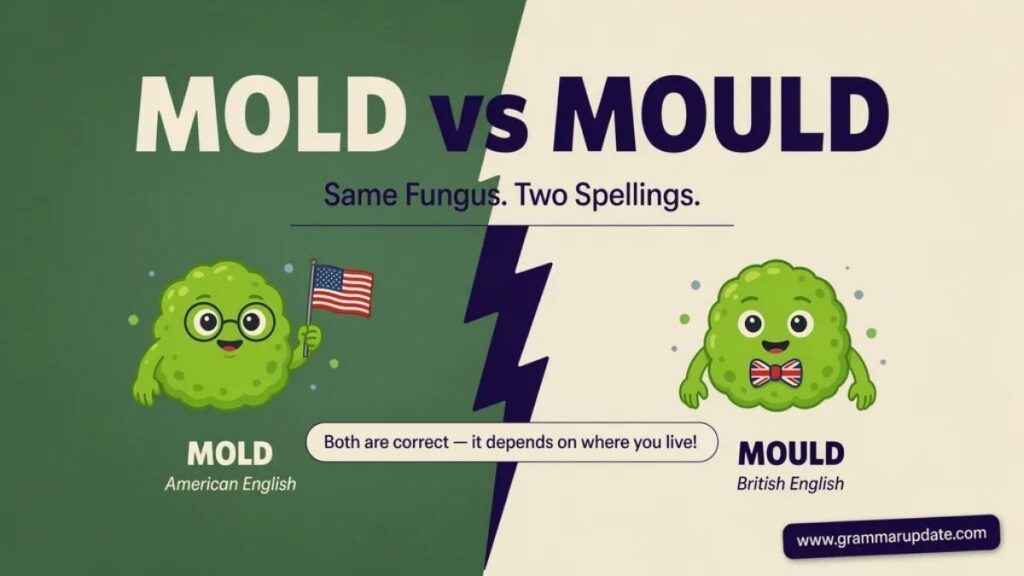
The simplest answer is that both spellings are correct.
If you’re writing for readers in the United States, use “mold.” If your audience is in the United Kingdom, Australia, New Zealand, or many other Commonwealth countries, use “mould.”
The meaning never changes. Only the spelling does.
| Feature | Mold | Mould |
|---|---|---|
| Preferred spelling | American English | British English |
| Meaning | Same | Same |
| Pronunciation | Same | Same |
| Correct spelling | Yes | Yes |
| Common in | United States | United Kingdom, Australia, New Zealand |
If you’re asking, “mold vs mould which is correct,” the answer depends entirely on your audience.
For example:
- The basement has mold on the walls. (US English)
- The basement has mould on the walls. (UK English)
Both sentences are equally correct.
Learn the difference between often confused words
Stopping vs Stoping Which Spelling Is Correct?
What Does Mold Mean?
The mold vs mould meaning changes depending on the context. Although many people immediately think of fungus, the word has several legitimate definitions.
In American English, “mold” commonly refers to:
- A fungus that grows in damp environments
- A hollow container used to shape materials
- A particular shape or form
- The act of shaping or influencing something
Because the word appears in many industries, understanding the context matters more than the spelling.
Mold as a Fungus
The most common meaning refers to microscopic fungi that grow where moisture is present.
Mold reproduces by releasing tiny spores into the air. These spores settle on damp surfaces and begin growing when conditions are favorable.
Common places where mold develops include:
- Bathrooms
- Kitchens
- Basements
- Attics
- Damp walls
- Ceiling corners
- Wet carpets
- Window frames
The phrase “mold vs mould fungus” often appears in health and home improvement articles because fungal growth can damage buildings and trigger allergies in sensitive individuals.
Examples:
- Mold spread across the bathroom ceiling after a plumbing leak.
- Bread left on the counter developed green mold.
- Moisture created the perfect environment for mold growth.
Mold as a Shape or Form
Another common definition has nothing to do with fungus.
A mold is a hollow object used to create another object with a specific shape.
Manufacturers, artists, bakers, and hobbyists all use molds every day.
Examples include:
- Chocolate mold
- Silicone mold
- Soap mold
- Resin mold
- Plaster mold
- Concrete mold
- Ceramic mold
Whether someone is producing chocolates or automotive parts, a mold provides the exact form needed for consistent results.
Mold as a Verb
The word also functions as a verb.
To mold something means to shape it physically or influence it over time.
Examples:
- The artist molded the clay into a beautiful sculpture.
- Great teachers help mold young minds.
- Experience can mold a person’s character.
This usage appears frequently in education, psychology, leadership, and personal development.
Learn the difference between often confused words
Defense vs Defence Which Spelling Is Correct?
What Does Mould Mean?
In British English, “mould” carries exactly the same meanings as “mold.”
Nothing changes except the spelling.
According to major dictionaries such as the Oxford English Dictionary and Cambridge Dictionary, “mould” refers to:
- Fungal growth
- A container used for shaping materials
- A distinctive form or pattern
- The act of shaping or influencing
If you’re writing for readers in the UK, Australia, or many Commonwealth countries, “mould” is the preferred spelling.
Mould as Fungus
British publications commonly describe damp buildings using the word “mould.”
Examples include:
- Black mould covered the bathroom ceiling.
- Damp walls encouraged mould growth.
- The landlord removed the mould after fixing the leak.
Whether written as mold vs mould, the organism remains the same fungus.
Mould as a Container
Manufacturing industries in the UK frequently use “mould” when discussing production.
Examples:
- Silicone mould
- Chocolate mould
- Resin mould
- Casting mould
- Concrete mould
Again, only the spelling changes.
Mould as a Verb
British English also uses “mould” as a verb.
Examples:
- Parents help mould their children’s values.
- Heat can mould plastic into complex shapes.
- The instructor moulded the students into confident speakers.
The pronunciation remains identical to the American spelling.
Learn the difference between often confused words
Trey vs Tray What’s the Difference?
Mold vs Mould What’s the Difference?
Many people search for the mold vs mould difference expecting two separate definitions.
There aren’t any.
The only real difference is regional spelling.
| Comparison | Mold | Mould |
|---|---|---|
| Meaning | Same | Same |
| Pronunciation | Same | Same |
| Grammar | Same | Same |
| Usage | American English | British English |
| Dictionaries | Merriam-Webster | Oxford, Cambridge, Collins |
If you’re comparing mold vs mould grammar, you’ll find no grammatical difference at all.
Both words can function as:
- A noun
- A verb
Both follow the same grammar rules.
Examples:
Noun:
- The mold spread quickly after the flood.
- The mould spread quickly after the flood.
Verb:
- The coach molded the team into champions.
- The coach moulded the team into champions.
The sentence structure never changes.
Learn the difference between often confused words
Disk vs Disc What’s the Difference and Which one Is Correct?
Mold vs Mould in American vs British English
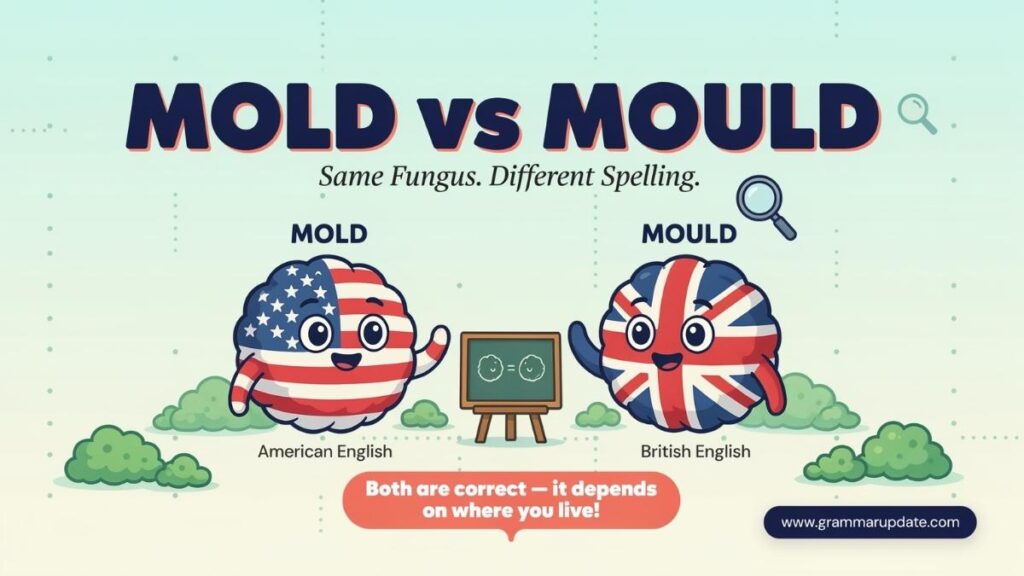
English spelling has evolved differently across regions over the past few centuries.
One of the most noticeable differences is the removal of certain silent letters in American English.
That’s why Americans write:
- Color
- Flavor
- Honor
- Neighbor
- Mold
Meanwhile, British English keeps the traditional spellings:
- Colour
- Flavour
- Honour
- Neighbour
- Mould
This explains why searches like “mold vs mould American English” and “mold vs mould British English” remain so popular.
American English
In the United States, “mold” appears in newspapers, scientific journals, government publications, textbooks, and everyday writing.
You’ll also find it in technical fields such as:
- Construction
- Manufacturing
- Food safety
- Medicine
- Biology
- Environmental science
Examples:
- Mold inspection
- Mold removal
- Mold spores
- Black mold
- Mold contamination
British English
British writers consistently prefer “mould.”
You’ll commonly see:
- Mould inspection
- Mould removal
- Black mould
- Food mould
- Bathroom mould
Government publications throughout the UK follow this spelling.
Canadian English
Canadian English is interesting because it combines elements of both American and British English.
When discussing mold vs mould Canada spelling, both versions appear. However, many Canadian publications lean toward “mould,” especially in formal writing, while American spelling appears frequently in technical and commercial contexts.
The key is consistency. Once you choose one spelling, use it throughout the document.
Australian English
Australian English follows British spelling conventions.
That means “mould” is the standard spelling in newspapers, schools, government publications, and professional writing.
If you’re researching mold or mould Australia spelling, you’ll usually encounter “mould.”
International Writing Tips
Choosing the correct spelling becomes much easier when you know your audience.
Use “mold” if you’re writing for:
- Readers in the United States
- American businesses
- US academic institutions
- American websites
Use “mould” if you’re writing for:
- Readers in the United Kingdom
- Australia
- New Zealand
- Most Commonwealth English audiences
For international brands, consistency matters more than the spelling itself.
Learn how to use confusing more words correctly
Feal vs Feel Which Spelling Is Correct?
Mold vs Mould Meaning in Different Contexts
One reason this word causes confusion is that it appears in many completely different fields.
The meaning changes according to the subject, even though the spelling rules stay the same.
Mold vs Mould Fungus
In biology, mold refers to fungi that grow in moist environments.
These organisms reproduce by releasing fungal spores into the air. Once the spores land on damp surfaces, they begin forming colonies.
Common household examples include:
- Bathroom mold
- Ceiling mold
- Wall mold
- Window mold
- Basement mold
Moisture, humidity, and poor ventilation greatly increase fungal growth.
Mold vs Mould Spores
Spores are microscopic reproductive particles that allow mold to spread.
Unlike seeds, spores are incredibly light. Air currents can carry them throughout homes and buildings.
Although spores are naturally present outdoors, excessive indoor moisture allows them to multiply rapidly.
People often search for “mold or mould spores” because understanding spores is essential for mold prevention and removal.
Mold vs Mould in Bathroom
Bathrooms provide ideal conditions for mold because they combine warmth, humidity, and frequent moisture.
Common locations include:
- Shower grout
- Ceiling corners
- Window frames
- Tile joints
- Around sinks
- Behind toilets
Proper ventilation and prompt drying of wet surfaces help reduce mold growth.
Mold vs Mould on Food
Not all molds are harmful, but many spoil food.
Common examples include:
- Bread mold
- Fruit mold
- Cheese mold
- Vegetable mold
Some cheeses intentionally use specific mold cultures during production, while mold growing unexpectedly on food usually signals spoilage.
Certain molds can produce toxins, making it safer to discard heavily affected food rather than simply removing the visible mold.
Learn how to use confusing more words correctly
Bright vs Brite Which Spelling Is Correct?
Mold vs Mould in Manufacturing
The phrase “mold or mould in manufacturing” refers to a tool or hollow form used to create products with a specific size and shape. Manufacturers rely on molds to produce thousands or even millions of identical parts with consistent quality.
Common manufacturing applications include:
- Injection molding
- Metal casting
- Plastic fabrication
- Concrete products
- Ceramic production
- Glass manufacturing
For example, injection molding creates everything from bottle caps to automotive components. Molten plastic flows into a precision-made mold, cools, and hardens before the finished part is removed.
Common Manufacturing Molds
| Industry | Example |
|---|---|
| Automotive | Plastic dashboards |
| Medical | Syringes and medical devices |
| Packaging | Plastic containers |
| Construction | Concrete blocks |
| Electronics | Device housings |
Whether someone writes “casting mold” or “casting mould” depends entirely on regional spelling.
Learn how to use confusing more words correctly
Kindergartner vs Kindergartener Which spelling Is Correct?
Mold vs Mould in Baking
Baking provides another everyday example of the word.
A baking mold gives food a specific shape before or during baking.
Popular examples include:
- Cake mold
- Bread mold
- Chocolate mold
- Cookie mold
- Muffin mold
Silicone has become one of the most popular mold materials because it is flexible, durable, and easy to clean.
If you search for “silicone mold or mould,” both spellings refer to the same kitchen tool.
Examples:
- Use a silicone mold for homemade chocolates.
- Pour the batter into a round cake mold.
- Freeze ice cubes in a silicone mold.
Understand confusing English more words simply
Investor vs Investee What’s the Difference and usage ?
Mold vs Mould in Cooking
Cooking uses molds for much more than cakes.
Many dishes depend on molds to create attractive presentations.
Examples include:
- Jelly molds
- Ice molds
- Butter molds
- Rice molds
- Dessert molds
Professional chefs often use decorative molds to create consistent portions and elegant food presentations.
Mold vs Mould in Construction
Construction professionals usually use the word when discussing concrete forms or moisture problems.
Examples include:
- Concrete mold
- Brick mold
- Decorative mold
- Bathroom mold
- Ceiling mold
The meaning depends on the context.
For example:
- Workers poured concrete into the mold.
- The inspector found mold behind the drywall.
One refers to construction equipment. The other refers to fungal growth.
Understand confusing English more words simply
Flatform vs Platform Difference which is correct?
Mold or Mould on Walls
One of the most common homeowner concerns involves mold growing on interior walls.
Typical causes include:
- Roof leaks
- Plumbing leaks
- High humidity
- Poor ventilation
- Flood damage
- Condensation
Signs of wall mold include:
- Black, green, or white spots
- Musty odors
- Peeling paint
- Damp drywall
- Discoloration
Addressing the moisture source is the first step toward preventing future mold growth.
Mold or Mould in Medicine
Medical professionals usually use “mold” in American publications and “mould” in British publications.
Medical discussions may involve:
- Mold allergies
- Respiratory irritation
- Fungal infections
- Indoor air quality
- Environmental health
Certain molds produce allergens that may trigger symptoms such as sneezing, coughing, watery eyes, or nasal congestion in sensitive individuals.
Not every mold is dangerous, but prolonged exposure to significant indoor mold growth should be investigated.
Understand confusing English more words simply
Insite vs Insight difference and Common Mistakes
Origin and History of Mold and Mould
The history of these spellings dates back hundreds of years.
The word originated from Old French and Germanic languages before becoming part of Middle English.
Originally, spellings varied widely because standardized dictionaries did not exist.
Later, spelling conventions became more consistent.
British English preserved the traditional spelling “mould.”
American English gradually adopted the simplified spelling “mold” during spelling reforms that favored shorter, more phonetic forms.
This explains why both spellings remain correct today.
Why Spell Checkers Suggest Different Spellings
Many writers wonder why their spelling checker changes “mould” to “mold” or vice versa.
The answer is simple.
Most spell-checking software follows your selected language settings.
Examples include:
- Microsoft Word
- Google Docs
- Grammarly
- Browser spell checkers
If your document uses US English, the software usually recommends “mold.”
If your document uses UK English, it usually recommends “mould.”
Changing your language preference changes the suggested spelling.
Understand confusing English more words simply
Preform vs Perform Confusion and Common Mistakes
Common Mistakes People Make
Although the word itself is simple, writers often make avoidable mistakes.
Mixing US and UK Spellings
One of the biggest mistakes is switching between spellings within the same document.
Incorrect example:
- Mold appeared on the walls, and the mould spread quickly.
Correct examples:
- Mold appeared on the walls, and the mold spread quickly.
- Mould appeared on the walls, and the mould spread quickly.
Choose one style and remain consistent.
Assuming One Spelling Is Wrong
Another common misconception is believing only one spelling is correct.
In reality, both spellings appear in major dictionaries.
The difference comes from regional spelling conventions rather than grammar.
Ignoring Your Audience
Always match your spelling to your readers.
An American audience expects “mold.”
A British audience expects “mould.”
Consistency improves readability and professionalism.
Confusing Mold With Molding
These words have different meanings.
“Molding” often refers to decorative trim around walls, ceilings, windows, or doors.
“Mold” usually refers to fungus, shaping tools, or the act of shaping something.
Context determines which word you need.
Understand confusing English more words simply
Really vs Realy, Which Is Correct? and Proper Usage
Similar American and British Spelling Differences
Many English words follow the same regional spelling pattern.
| American English | British English |
|---|---|
| Mold | Mould |
| Color | Colour |
| Flavor | Flavour |
| Honor | Honour |
| Neighbor | Neighbour |
| Favorite | Favourite |
| Gray | Grey |
| Theater | Theatre |
Learning these spelling differences helps writers produce content that matches their intended audience.
Mold or Mould Examples
Real-world examples make the spelling easier to remember.
Home Inspection
US English:
- The inspector found mold behind the bathroom tiles.
UK English:
- The inspector found mould behind the bathroom tiles.
Construction
- Workers poured concrete into the mold before it hardened.
- Engineers designed a custom mould for decorative stone panels.
Baking
- Pour the chocolate into the silicone mold.
- Remove the cake carefully from the baking mould.
Gardening
- Excess moisture encouraged mold to grow in the flowerpots.
- Poor drainage caused mould to develop around the roots.
School Writing
American students usually write “mold.”
British students usually write “mould.”
Neither spelling is more correct than the other.
Business Writing
International companies often create separate versions of documents for US and UK audiences to maintain consistent spelling.
Learn the difference between confusing more English words
Choosing vs Chosing, How to Spell Choosing Correctly
Mold or Mould in a Sentence
Here are several natural examples.
- Mold can spread quickly in damp environments.
- Mould often develops in poorly ventilated bathrooms.
- The baker filled the silicone mold with chocolate.
- Engineers designed a new casting mould for the factory.
- Good teachers help mold future leaders.
- Great experiences can mould a person’s character.
Tips for Choosing the Correct Spelling
Keep these simple guidelines in mind.
- Write “mold” for US audiences.
- Write “mould” for UK audiences.
- Stay consistent throughout the document.
- Match your organization’s style guide.
- Check your spell-check language settings before publishing.
- Remember that the meaning stays exactly the same.
Is Mold or Mould More Common?
Usage depends almost entirely on location.
In the United States, “mold” dominates books, websites, news articles, scientific journals, and educational materials.
In the United Kingdom, Australia, and New Zealand, “mould” remains the standard spelling.
Canadian English uses both forms, although “mould” appears more frequently in formal writing.
Online search results may vary because search engines personalize results based on your country and language settings.
Learn the difference between confusing more English words
Unaffected vs Uneffected Which Word to Use Correctly
Practice Session Mold vs Mould
Choose the correct word to complete each sentence: mold or mould.
- The bread developed __________ after being left out for a week.
- The baker poured the chocolate into a silicone __________.
- The bathroom ceiling had black __________ because of excess moisture.
- In American English, the preferred spelling is __________.
- In British English, the preferred spelling is __________.
- The artist used a plaster __________ to create identical sculptures.
- Too much humidity can cause __________ to grow on walls.
- The teacher helped __________ her students into confident speakers.
- Engineers designed a new casting __________ for the factory.
- A damp basement often encourages __________ growth.
- The cake came out of the baking __________ perfectly.
- The carpenter removed the damaged wall because of __________ contamination.
- The manager worked hard to __________ a strong and productive team.
- The bathroom fan helps prevent __________ from growing.
- Many factories use injection __________ to manufacture plastic products.
- The old cheese naturally developed __________ during aging.
- Moisture and poor ventilation are common causes of indoor __________.
- The sculptor filled the __________ with liquid resin.
- The inspector found __________ behind the wallpaper.
- Australian English generally prefers the spelling __________.
- American dictionaries usually list __________ as the standard spelling.
- The child used a sand __________ to build a castle.
- Fungal __________ spread through tiny airborne spores.
- Good mentors can __________ future leaders through guidance and experience.
- Whether you write “mold” or “mould,” the __________ remains the same.
Answers
- mold or mould
- mold or mould
- mold or mould
- mold
- mould
- mold or mould
- mold or mould
- mold / mould
- mold / mould
- mold / mould
- mold / mould
- mold / mould
- mold / mould
- mold / mould
- mold / mould
- mold / mould
- mold / mould
- mold / mould
- mold / mould
- mould
- mold
- mold / mould
- mold / mould
- mold / mould
- meaning
Here’s a trusted source for clear word meanings:
FAQs
Is it mold or mould when referring to a shape?
Both spellings are correct. Use “mold” in American English and “mould” in British English. They both describe a hollow form used to create an object with a specific shape.
How do you spell mold when talking about casting?
In the United States, the correct spelling is “casting mold.” In the United Kingdom and other countries that follow British English, the correct spelling is “casting mould.”
Is it mold or mould when talking about fungus?
Both are correct. “Mold” is the American English spelling, while “mould” is the British English spelling. Both refer to the same type of fungus.
Is it mold or mould when talking about food?
Use “food mold” in American English and “food mould” in British English. Both describe fungal growth that develops on spoiled food.
Is it black mold or black mould?
The spelling depends on your audience. American English uses “black mold,” while British English uses “black mould.”
Is it mold or mould in Canada?
Canadian English accepts both spellings. However, “mould” is more common in formal and traditional writing, while “mold” also appears in technical and commercial content.
How do British people spell mold?
British English spells the word as “mould.” This spelling appears in UK schools, newspapers, dictionaries, and government publications.
What does it mean to mold a person?
To mold a person means to influence their character, behavior, skills, or values over time through guidance, experience, or education.
Can mold be used as a verb?
Yes. As a verb, “mold” means to shape something physically or influence someone’s development. In British English, the verb is spelled “mould.”
What is a mold used for?
A mold is used to create objects with a specific shape. It is commonly used in baking, manufacturing, metal casting, resin crafts, concrete work, and ceramics.
What is the difference between mold and mildew?
Mold and mildew are both fungi, but they differ in appearance and growth. Mildew usually appears as a flat white or gray growth, while mold is often fuzzy and may be black, green, blue, or orange.
Is mold the same as bacteria?
No. Mold is a fungus, while bacteria are single-celled microorganisms. They belong to different biological groups and behave differently.
What is a synonym for mold?
Depending on the context, synonyms include form, shape, cast, pattern, framework, template, fungus, or mildew.
Is it “breaking the mold” or “breaking the mould”?
Both expressions are correct. Use “breaking the mold” in American English and “breaking the mould” in British English. The phrase means being unique or different from the usual pattern.
Does mold always refer to fungus?
No. Mold can refer to a fungus, a container used to shape materials, or the act of shaping or influencing someone. The intended meaning depends on the context.
Learn the difference between confusing more English words
Shinning vs Shining Correct Spelling and Usage
conclusion
No more second-guessing whether to write Mold vs Mould. Both spellings are correct. The only difference is the audience you’re writing for. Use “mold” in American English and “mould” in British English and most Commonwealth countries. Their meaning, pronunciation, and grammar are exactly the same, so you don’t need to memorize different definitions or rules. Simply choose the spelling that matches your readers and use it consistently throughout your writing. Once you understand this regional spelling difference, the confusion disappears. Whether you’re talking about fungus, a baking mold, a manufacturing mold, or shaping someone’s character, you’ll know which spelling fits your audience. In the end, great writing isn’t about adding or removing a single letter. It’s about being clear, consistent, and easy for your readers to understand.

Jhon AJS, the creative mind behind Grammar Update, is an experienced blogger passionate about simplifying English grammar. He focuses on explaining confusing word vs word differences, grammar rules, punctuation, and sentence structure in a clear and practical way. Through easy to understand guides and examples, Jhon helps readers improve their writing and communicate with confidence. With years of blogging experience, he continues to share helpful insights that make learning grammar simple, useful, and accessible for everyone.