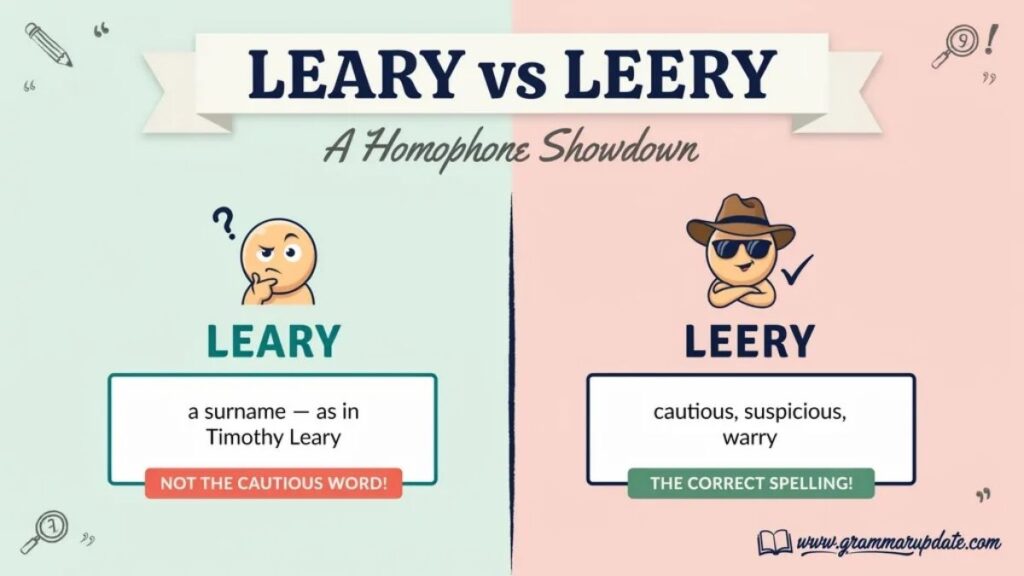
Have you ever paused while writing and asked yourself, “Is it Leary vs Leery?” It’s a common question because the two words sound alike, but they don’t mean the same thing. In the Leary vs Leery comparison, only “leery” is the correct word when you mean cautious or suspicious. “Leary” is usually a person’s last name, such as Timothy Leary. This simple mix-up can lead to spelling and grammar mistakes in everyday writing. In this guide, you’ll learn the correct spelling, meaning, pronunciation, and usage, along with easy examples and helpful tips to use the right word with confidence every time.
Quick Answer Is It Leary vs Leery?
The short answer is simple.
If you want to describe someone who feels cautious, suspicious, or hesitant, the correct word is “leery.”
“Leary” is usually not the correct spelling in this context. Instead, it is best known as a family name, such as Timothy Leary. Outside of proper names, using “Leary” instead of “leery” counts as a common spelling error.
Here’s the quick comparison.
| Question | Answer |
|---|---|
| Is it leary vs leery? | Leery is correct. |
| Leery correct spelling | Yes. |
| Is leary correct? | Not unless you are referring to a surname. |
| Is leary a word? | It exists mainly as a proper noun and family name. |
| Leery adjective | Yes. |
| Leary adjective | No. |
| How to spell leery | L-E-E-R-Y |
If your sentence talks about being careful, doubtful, or suspicious, always choose “leery.”
Examples:
Correct:
- I’m leery of online scams.
- She’s leery of strangers.
- Investors became leery of quick-rich schemes after the market crash.
Incorrect:
- I’m leary of online scams.
- She’s leary of strangers.
- We’re leary about giving out personal information.
These incorrect examples appear frequently online because many writers spell the word the way they think it sounds.
Why This Matters
Correct spelling affects more than grammar.
Using the proper spelling helps you:
- Communicate clearly.
- Build credibility in professional writing.
- Avoid grammar mistakes.
- Improve proofreading accuracy.
- Present polished academic work.
- Strengthen business communication.
A single spelling mistake may seem small. Still, readers often notice it immediately, especially when it involves frequently confused words.
Learn the difference between often confused words
Fistulogram vs Fistulagram which is correct and Difference ?
What Does Leery Mean?
Understanding the leery meaning makes it much easier to remember the correct spelling.
The English word “leery” describes someone who feels cautious because they believe something could be risky, dishonest, or unsafe. A person who is leery pays close attention before trusting someone or making a decision.
Many dictionaries define the word in similar ways.
According to the Merriam-Webster Dictionary, “leery” means suspicious or cautious because of realistic concerns.
The Cambridge Dictionary describes someone as leery when they are unwilling to trust something or someone completely.
The Oxford English Dictionary also defines the word as cautious or wary because of possible danger or deception.
Although each dictionary uses slightly different wording, they all point to the same idea.
1.Leery means cautious.
2.Leery means suspicious.
3.Leery means distrustful.
4.Leery means hesitant.
Leery Definition
The dictionary definition of leery can be summarized like this:
Leery
Adjective
Meaning:
Feeling cautious, suspicious, or unwilling to trust someone or something immediately.
This simple definition explains why the word appears so often in conversations about safety, business decisions, relationships, and financial risks.
Leery Pronunciation
Many spelling mistakes happen because people hear the word before they ever see it written.
The correct leery pronunciation in American English sounds like:
LEER-ee
It rhymes with “dreary.”
Thinking about that rhyme provides an easy memory trick.
Leery rhymes with dreary.
If you remember that “dreary” contains a double “e,” you’ll have an easier time remembering the proper spelling of leery.
Leery Is an Adjective
One common question is whether leery is an adjective.
Yes.
Leery functions as an adjective because it describes a person’s feelings or attitude.
Examples:
- The customer seemed leery before signing the contract.
- Parents are often leery of strangers.
- Travelers became leery after hearing about the scam.
- Many buyers remain leery of fake online stores.
Notice how the adjective describes someone’s state of mind rather than an action.
What Does Leery Express?
Although people often use several similar words interchangeably, each one has its own shade of meaning.
| Word | Typical Meaning |
|---|---|
| Leery | Suspicious because something may not be trustworthy. |
| Wary | Careful because danger may exist. |
| Cautious | Acting carefully to avoid mistakes. |
| Skeptical | Doubting whether something is true. |
| Distrustful | Unwilling to trust people or situations. |
| Hesitant | Slow to act because of uncertainty. |
Understanding these differences helps improve your English vocabulary and word choice.
Common Situations Where People Use Leery
The word appears naturally in many everyday situations.
Personal safety
People often become leery of strangers when walking alone at night.
Technology
Many internet users are leery of online scams after receiving fake emails or fraudulent text messages.
Business
Investors may become leery of companies that promise unrealistic profits.
Health
Patients sometimes feel leery before trying a new medical treatment.
Education
Students may be leery about using unreliable sources in research papers.
Travel
Tourists can become leery when approached by unofficial guides offering expensive services.
Each example shows that the person feels cautious because something raises concern.
Leery in Formal Writing
Many learners wonder whether leery belongs only in casual conversation.
The answer is no.
Leery appears regularly in newspapers, magazines, business reports, books, and professional articles. Although words like “cautious” or “wary” may sound slightly more formal in some contexts, “leery” remains a perfectly acceptable choice in standard English.
Examples:
- Economists remain leery of rapid inflation.
- Consumers are increasingly leery of misleading advertisements.
- Researchers became leery of conclusions based on limited evidence.
- Regulators remain leery of financial products that lack transparency.
Leery in Informal Writing
The word also sounds natural in everyday speech.
Examples:
- I’m leery of buying a used car without an inspection.
- She’s leery about answering unknown phone calls.
- We’re leery of deals that sound too good to be true.
- He’s leery of downloading apps from unfamiliar websites.
These examples sound conversational while following correct English usage.
Leery Examples in Sentences
Studying complete sentences helps reinforce correct usage.
Here are additional leery examples.
- The family became leery after reading negative reviews.
- Customers stayed leery of the company’s refund policy.
- She felt leery about sharing her password.
- Many people are leery of quick-rich schemes advertised online.
- Drivers remain leery during severe weather conditions.
- The teacher was leery of copied assignments.
- Travelers became leery after hearing reports of pickpockets.
- Buyers were leery of products with unusually low prices.
- He sounded leery when discussing the investment opportunity.
- They stayed leery until they verified the information.
Notice that “leery” almost always describes caution that comes from doubt, uncertainty, or previous experience.
Leery Synonym
If you want to vary your vocabulary, several words carry similar meanings.
Common leery synonym choices include:
- Wary
- Suspicious
- Skeptical
- Distrustful
- Cautious
- Guarded
- Doubtful
- Watchful
Each synonym fits slightly different situations.
For example, “wary” often emphasizes avoiding danger while “skeptical” focuses on doubting claims or evidence. “Leery” usually combines both ideas by suggesting caution because something feels questionable.
A Simple Way to Remember Leery
Many writers remember the spelling with this quick tip.
Think of the phrase:
“Be leery of scams.”
Now picture yourself carefully reading every email before clicking a link.
That cautious feeling captures the exact meaning of the word.
The phrase “be leery of” appears constantly in newspapers, online articles, and everyday conversation because it naturally describes sensible caution.
If you remember that one phrase, you’ll rarely confuse the spelling again.
Key Takeaways
Before moving on, remember these important facts.
- Leery is the correct English word.
- Leery is an adjective.
- Leery means cautious, suspicious, distrustful, or hesitant.
- Leery pronunciation rhymes with “dreary.”
- The phrase “be leery of” is common in both spoken and written English.
- Leery appears in American English and British English.
- Using “Leary” instead of “leery” is usually a common spelling mistake unless you are referring to a person’s surname.
Learn the difference between often confused words
Peice vs Piece Which Spelling Is Correct?
What Does Leary Mean?
Now that you understand the leery meaning, the next question naturally follows: what about “Leary”?
The answer is surprisingly simple.
In standard English, “Leary” is usually not a vocabulary word. Instead, it is a proper noun that most often appears as a surname. That’s why many dictionaries do not list a general leary definition as an adjective or common noun.
This distinction explains much of the leary vs leery confusion. People hear the pronunciation, assume the spelling starts with “Lea-,” and accidentally replace the correct word with a family name.
If you’re asking, “Leary vs leery correct?” the answer depends entirely on your context.
- Use “leery” when you mean cautious or suspicious.
- Use “Leary” only when referring to a person’s name.
Is Leary a Real Word?
One of the most common online searches is, “Is leary a real word?”
Yes, but not in the way many people think.
“Leary” exists as a proper noun. It is recognized as a surname rather than a standard English adjective. If you write, “I’m leary of that offer,” you’ve made a spelling mistake because the sentence requires the adjective “leery.”
Consider these examples.
Correct:
- I’m leery of online scams.
- She’s leery of strangers.
- Investors became leery after the company’s earnings report.
Incorrect:
- I’m leary of online scams.
- She’s leary of strangers.
- They became leary of the proposal.
The incorrect examples appear frequently online, which is why many people mistakenly believe “leary” is an accepted spelling.
Leary as a Surname
The most familiar use of “Leary” is as a family name.
Many people throughout history have carried the Leary surname, making it a legitimate proper noun. However, a surname should never replace the adjective “leery.”
Examples include:
- Timothy Leary
- Denis Leary
- Various families with the Leary family name throughout Ireland, the United States, Canada, Australia, and other English-speaking countries
Because surnames begin with a capital letter, you’ll usually see them written as “Leary” rather than “leary.”
Timothy Leary
One of the best-known people with this surname is Timothy Leary.
Timothy Leary was an American psychologist and writer who became widely known during the 1960s for his research and advocacy involving psychedelic substances. His surname has no connection to the adjective “leery,” even though the words sound similar.
This coincidence contributes to the confusion. Someone who recognizes the name “Timothy Leary” may accidentally assume that “leary” is also an acceptable spelling for the adjective.
It isn’t.
The proper noun and the adjective come from different linguistic backgrounds and serve completely different purposes.
Does Leary Mean Loud?
Another search phrase that appears online is “Leary as in loud.”
There is no standard English definition that uses “leary” to mean loud.
This misunderstanding likely comes from regional slang, misspellings, or confusion with entirely different words.
If you intend to describe someone who speaks loudly, words such as these are more accurate:
- Loud
- Noisy
- Boisterous
- Rowdy
- Vociferous
None of these meanings relate to “leery.”
Leary Meaning Slang
People also search for “leary meaning slang.”
In modern American English, “Leary” has no widely accepted slang meaning.
Occasionally, online discussions or local communities may use the spelling informally, but those uses are not recognized as standard English.
If you’re writing professionally, academically, or for publication, avoid treating “leary” as a slang substitute for “leery.”
Can Leary Mean Drunk?
Another common search asks, “Leary meaning drunk.”
The answer is no.
Standard dictionaries do not define “Leary” as meaning drunk or intoxicated.
Some regional dialects and historical slang have used words that resemble “leary,” but these uses are uncommon and are not part of modern standard English.
If you want to describe someone who has consumed too much alcohol, choose accurate words such as:
- Drunk
- Intoxicated
- Inebriated
- Tipsy
- Impaired
Using “leary” for this meaning would confuse most readers.
Leary Pronunciation
When discussing the Leary surname, the pronunciation is generally the same as the adjective “leery.”
Both are commonly pronounced:
LEER-ee
Because they sound alike, many people spell the adjective incorrectly after hearing it in conversation.
This is a classic example of homophone confusion. While the spellings are different, the pronunciation is nearly identical.
Why the Spelling Causes Confusion
English contains many words that sound alike but have different spellings and meanings.
These similarities create common spelling mistakes, especially when people rely on pronunciation instead of dictionary definitions.
Several factors make “leery” particularly vulnerable.
- The words sound almost identical.
- Many people know someone with the Leary surname.
- Spell checkers sometimes fail to catch the mistake if “Leary” is treated as a proper name.
- Writers often type quickly and don’t proofread carefully.
These factors explain why searches like “why do people spell leery as leary” remain popular.
Learn the difference between often confused words
Mold vs Mould Which Spelling Is Correct?
Leary vs Leery Side-by-Side Comparison
The easiest way to understand the leary vs leery difference is to compare them directly.
| Feature | Leery | Leary |
|---|---|---|
| Correct English word | Yes | Only as a proper noun |
| Part of speech | Adjective | Proper noun (surname) |
| Meaning | Cautious, suspicious, hesitant | Family name |
| Used in everyday writing | Frequently | Only when referring to a person |
| Found in dictionaries | Yes | Listed as a surname rather than an adjective |
| Common mistake | Rarely misspelled once learned | Frequently used incorrectly instead of “leery” |
The table highlights an important point.
If you’re discussing caution or suspicion, “leery” is always the proper spelling.
Leary vs Leery Meaning
Many readers search for “leary vs leery meaning.”
Here’s the simplest explanation.
Leery means cautious.
Leary is a surname.
That’s the entire difference.
The meanings do not overlap.
Leary vs Leery Grammar
From a grammar perspective, the distinction is straightforward.
“Leery” functions as an adjective because it describes a noun.
Examples:
- The customer seemed leery.
- They became leery of fake reviews.
- She remained leery throughout the negotiation.
“Leary” functions as a proper noun.
Examples:
- Timothy Leary wrote several influential books.
- Denis Leary is an actor and comedian.
- The Leary family has Irish roots.
Replacing one with the other creates a grammar mistake because they belong to different word classes.
Leary vs Leery Difference at a Glance
Remember these three facts.
- Leery is an adjective.
- Leary is a surname.
- They are never interchangeable.
Keeping these simple rules in mind will eliminate one of the most common spelling errors in English writing.
Learn how to use confusing more words correctly
Defense vs Defence Which Spelling Is Correct?
Why Do People Confuse Leary vs Leery?
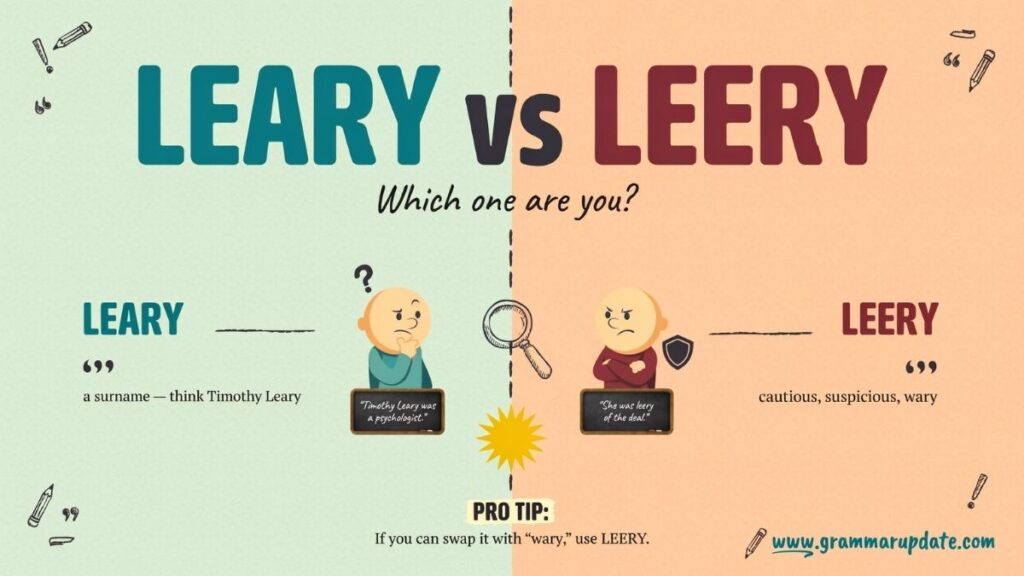
The confusion isn’t random. Several factors contribute to this common English mistake.
Similar Pronunciation
The biggest reason is pronunciation.
Both words are pronounced almost the same in everyday speech.
When people hear the word before reading it, they often guess the spelling.
Since “Leary” looks familiar as a surname, many assume it must be correct.
The Influence of Proper Names
Proper names shape our spelling habits more than we realize.
Names like Timothy Leary and Denis Leary appear in books, news articles, television, and online searches. Seeing these names repeatedly makes “Leary” feel familiar.
That familiarity leads people to use it where the adjective “leery” belongs.
Spell Check Doesn’t Always Help
Many writers depend on spelling checkers.
Unfortunately, spelling software isn’t perfect.
If your document treats “Leary” as a recognized surname, some spelling checkers won’t flag it as incorrect. The software sees a valid name rather than an incorrect adjective.
That’s why proofreading remains important even when using modern writing tools.
Search Engine Suggestions
Search engines also contribute to the confusion.
When thousands of users search for incorrect spellings like:
- Is it leary vs leery
- Leary meaning
- Leary spelling
those searches become common autocomplete suggestions.
Autocomplete reflects popular searches, not necessarily correct English usage.
Typing Habits
Fast typing leads to mistakes.
Many writers type words from memory instead of thinking about their spelling. Since “ea” appears in many English words, some naturally choose “Leary” without realizing the correct adjective uses “ee.”
English Spelling Isn’t Always Predictable
English spelling rules contain many exceptions.
Words with similar pronunciations often use different letter combinations.
Examples include:
| Correct Word | Common Misspelling |
|---|---|
| Definitely | Definately |
| Separate | Seperate |
| Accommodation | Accomodation |
| Embarrass | Embarass |
| Leery | Leary |
These examples remind us that pronunciation alone isn’t a reliable guide to spelling.
Proofreading Prevents Costly Errors
Whether you’re writing an email, school assignment, website article, or business proposal, careful proofreading helps catch spelling errors before someone else does.
A few extra seconds spent reviewing your work can improve:
- Professional credibility
- Reader confidence
- Communication clarity
- Academic performance
- Overall writing quality
When in doubt, check a trusted dictionary instead of relying on memory.
Learn how to use confusing more words correctly
Trey vs Tray What’s the Difference?
How to Use Leery Correctly
Now that you know the difference between the two words, the next step is learning when to use “leery” in everyday writing. Fortunately, the rule is simple.
Use “leery” whenever you want to describe someone who feels cautious, suspicious, hesitant, or unwilling to trust a person, situation, or idea immediately.
Whether you’re writing a business email, a research paper, a news article, or a casual text message, the meaning stays the same.
Think of “leery” as describing careful hesitation. The person isn’t necessarily afraid. Instead, they choose to be careful before making a decision.
When to Use Leery
Use “leery” in situations involving:
- Doubt
- Uncertainty
- Suspicion
- Risk
- Caution
- Lack of trust
These situations naturally fit the word because leery means cautious.
Examples include:
- Be leery of investment offers that promise guaranteed returns.
- Many shoppers are leery of fake online stores.
- Travelers should be leery of unofficial tour guides.
- Parents are often leery of strangers approaching their children.
- Employees became leery after hearing rumors about company layoffs.
In each example, the people aren’t acting out of panic. They’re simply choosing caution until they have more information.
Leery in Everyday Conversation
“Leery” appears regularly in spoken English.
You might hear someone say:
- I’m a little leery about buying that used car.
- She’s leery of giving out her phone number.
- We’re leery of signing the contract today.
- He’s leery about downloading unknown software.
- They’re leery of offers that sound too good to be true.
These examples sound natural because they reflect everyday situations where caution makes sense.
Leery in Professional Writing
The word also fits business communication.
Examples include:
- Investors remain leery of unstable markets.
- Consumers are increasingly leery of misleading advertisements.
- Executives are leery of making rapid changes without sufficient data.
- Financial analysts remain leery of unrealistic growth projections.
Professional publications often use “leery” because it communicates careful skepticism without sounding overly emotional.
Leery in Academic Writing
Academic writing values precision.
“Leery” works well when discussing attitudes toward research, evidence, or decision-making.
Examples include:
- Researchers remain leery of conclusions based on limited data.
- Historians are often leery of unsupported claims.
- Scientists became leery after identifying inconsistencies in the experiment.
- Reviewers remained leery until additional evidence became available.
Although words such as “skeptical” and “cautious” also fit these contexts, “leery” emphasizes careful distrust.
Leery in Formal Writing
Some learners wonder whether “leery” sounds too informal.
The answer is no.
Major newspapers, magazines, business journals, and respected publications regularly use the word.
Examples include:
- Investors are leery of rising inflation.
- Consumers remain leery of fraudulent websites.
- Officials are leery of approving the proposal without further review.
These examples demonstrate that “leery” belongs comfortably in formal English.
Leery in Informal Writing
The word sounds equally natural in casual conversation.
Examples include:
- I’m leery of that website.
- She’s leery about buying expensive shoes online.
- We’re leery of eating at restaurants with poor reviews.
- He’s always leery before trying a new app.
Whether you’re chatting with friends or writing an email, the word fits naturally.
Learn how to use confusing more words correctly
Disk vs Disc What’s the Difference and Which one Is Correct?
Leery in a Sentence
Seeing the word in different contexts helps reinforce proper usage.
Everyday Examples
- I’m leery of answering calls from unknown numbers.
- She’s leery about lending money to people she barely knows.
- They’re leery of making important decisions too quickly.
- He became leery after reading customer complaints.
- We’re leery of unrealistic promises.
Business Examples
- Investors grew leery after the company’s earnings declined.
- Customers remain leery of hidden subscription fees.
- The board became leery of expanding too quickly.
- Banks are often leery of high-risk borrowers.
- Employers are leery of resumes containing inaccurate information.
Academic Examples
- Students should be leery of unreliable online sources.
- The professor remained leery of unsupported conclusions.
- Researchers became leery after reviewing conflicting evidence.
- Editors are leery of articles without proper citations.
- Scholars remain leery of exaggerated historical claims.
Technology Examples
Technology creates many situations where caution is necessary.
Examples include:
- Be leery of emails requesting your password.
- Users should remain leery of fake software updates.
- Many people are leery of online scams.
- Consumers are increasingly leery of data privacy issues.
- Experts advise remaining leery of suspicious download links.
Financial Examples
Money often requires careful decision-making.
Examples include:
- Experienced investors are leery of quick-rich schemes.
- Customers became leery after receiving unexpected payment requests.
- Financial advisors remain leery of investments promising impossible returns.
- Buyers should be leery of extremely low prices.
- Consumers are leery of companies that hide extra fees.
Leery Adjective Examples
Since “leery” is an adjective, it modifies nouns.
Examples include:
- A leery customer
- A leery investor
- A leery traveler
- A leery shopper
- A leery employee
- A leery homeowner
Each phrase describes someone who feels cautious or suspicious.
Learn how to use confusing more words correctly
Feal vs Feel Which Spelling Is Correct?
Common Phrases That Use Leery
Some expressions appear so frequently that native English speakers recognize them instantly.
Learning these phrases helps improve both vocabulary and writing fluency.
Be Leery Of
This is the most common expression.
Examples:
- Be leery of fake job offers.
- Be leery of investment scams.
- Be leery of misleading advertisements.
- Be leery of strangers asking for personal information.
The phrase works in almost every situation involving caution.
Leery of Strangers
Parents often teach children to be leery of strangers.
Example:
Children should be leery of strangers who ask them to go somewhere without permission.
This phrase emphasizes personal safety rather than fear.
Leery of Scams
As online fraud continues to grow, this phrase appears frequently in news reports.
Examples:
- Consumers should remain leery of online scams.
- older people are often targeted by phone scams, making them understandably leery.
- Experts encourage everyone to stay leery of fake banking emails.
Leery of Quick-Rich Schemes
Financial writers commonly use this expression.
Example:
Experienced investors remain leery of quick-rich schemes because legitimate investments rarely guarantee enormous profits overnight.
Leery of Online Scams
Internet safety guides often include this advice.
Examples:
- Always be leery of online scams promising free prizes.
- Users should remain leery of fake customer support messages.
- Stay leery of links sent from unknown accounts.
These examples show how naturally “leery” fits modern English.
Learn how to use confusing more words correctly
Everywhere vs Every Where Which One Is Correct ?
Leery vs Wary What’s the Difference?
Many people assume these words mean exactly the same thing.
While they are close in meaning, they are not identical.
Understanding the difference between wary and leery improves your vocabulary and helps you choose the most accurate word.
Similarities
Both words describe caution.
Someone who is wary or leery avoids making quick decisions without thinking carefully.
Both words often appear in discussions about:
- Safety
- Business
- Relationships
- Online security
- Financial decisions
- Travel
Because of these similarities, dictionaries frequently list each word as a synonym for the other.
Key Differences
The difference lies in the reason behind the caution.
| Leery | Wary |
|---|---|
| Suggests suspicion or distrust. | Suggests careful attention to possible danger. |
| Often based on doubt or previous experience. | Often based on awareness of risk. |
| Frequently used when trust is uncertain. | Frequently used when avoiding harm. |
Although the distinction is subtle, it helps explain why both words continue to exist.
Examples of Leery
- She’s leery of sharing personal information online.
- Investors became leery after hearing about accounting problems.
- Customers remain leery of unrealistic product claims.
- Parents are leery of strangers approaching their children.
These examples focus on suspicion or distrust.
Examples of Wary
- Hikers should remain wary of slippery trails.
- Drivers should be wary during heavy rain.
- Travelers need to stay wary in unfamiliar neighborhoods.
- Campers remained wary of changing weather conditions.
These examples emphasize awareness of danger rather than distrust.
Leery vs Suspicious
People also compare “leery” with “suspicious.”
Although they overlap, there is a difference.
Someone who is suspicious often believes something is wrong.
Someone who is leery may simply choose caution without reaching that conclusion.
Example:
- She was suspicious that the email was fake.
- She was leery of clicking the link until she confirmed it was genuine.
The second sentence emphasizes careful behavior.
Leery vs Cautious
“Cautious” is broader than “leery.”
A cautious person tries to avoid mistakes in general.
A leery person usually feels cautious because something seems questionable.
Example:
- A cautious driver obeys traffic laws.
- A leery buyer questions unusually low prices.
The first describes a personality or habit.
The second describes a reaction to a specific situation.
Choosing the Right Word
The following guide makes word choice easier.
| Situation | Best Word |
|---|---|
| You don’t trust someone completely. | Leery |
| You notice potential danger. | Wary |
| You want to avoid mistakes. | Cautious |
| You doubt someone’s claim. | Skeptical |
| You believe someone may be dishonest. | Suspicious |
Choosing the most precise word makes your writing stronger and easier to understand.
Quick Review
Before moving to the next section, remember these important points.
- Use “leery” when describing someone who feels cautious, suspicious, hesitant, or distrustful.
- “Leery” works in everyday conversation, professional writing, and academic writing.
- The phrase “be leery of” is one of the most common expressions in English.
- “Leery of strangers” and “leery of online scams” are both correct and widely used.
- “Leery” and “wary” are close synonyms, but “leery” places greater emphasis on distrust or uncertainty.
- “Leery” remains the proper spelling in both American English and British English.
- If you’re unsure, remember this simple rule: use “leery” whenever you mean cautious or suspicious, and reserve “Leary” for a person’s surname, such as Timothy Leary.
Fix common more word mistakes in English
Bright vs Brite Which Spelling Is Correct?
Leery Synonyms and Antonyms
Building a strong vocabulary means knowing more than one word for the same idea. While “leery” has a clear meaning, several related words can express similar feelings. Each carries a slightly different tone, so choosing the right one makes your writing more precise.
The most common leery synonym depends on the situation. Sometimes you want to emphasize caution. Other times you want to highlight doubt or distrust.
Common Leery Synonyms
| Word | Meaning | Best Used When |
|---|---|---|
| Wary | Careful because danger may exist | Physical or emotional risks |
| Cautious | Taking care to avoid mistakes | General decision-making |
| Suspicious | Believing something may be dishonest | Possible deception |
| Skeptical | Doubting a claim or statement | Evaluating evidence |
| Distrustful | Unwilling to trust someone | Relationships or business |
| Guarded | Careful about revealing thoughts or feelings | Personal conversations |
| Doubtful | Unsure something is true | Opinions and beliefs |
| Watchful | Paying close attention | Monitoring possible danger |
| Hesitant | Slow to act because of uncertainty | Making decisions |
Although these words are similar, they are not always interchangeable.
For example:
- A cautious driver obeys traffic laws.
- A skeptical scientist questions weak evidence.
- A suspicious customer believes a seller may be dishonest.
- A leery shopper delays buying because the offer seems questionable.
Each sentence expresses caution, yet each adjective adds a slightly different meaning.
Which Synonym Should You Choose?
The table below makes choosing the right word easier.
| Situation | Best Word |
|---|---|
| You don’t completely trust someone | Leery |
| You’re avoiding danger | Wary |
| You’re making careful decisions | Cautious |
| You question whether something is true | Skeptical |
| You think someone may be dishonest | Suspicious |
| You avoid trusting people | Distrustful |
| You’re unsure about taking action | Hesitant |
Choosing the right adjective improves clarity and helps readers understand exactly what you mean.
Leery vs Wary
One of the most common searches is “leery vs wary.”
The two words overlap, but they are not identical.
Leery usually emphasizes suspicion or uncertainty.
Wary emphasizes awareness of possible danger.
Consider these examples.
Leery:
- Customers became leery of the company’s refund policy.
- She was leery of giving out personal information.
- Investors remained leery after reading the financial report.
Wary:
- Drivers should be wary of icy roads.
- Campers stayed wary of wild animals.
- Travelers remained wary during severe weather.
The first group focuses on trust.
The second focuses on safety.
Wary vs Leery
Sometimes both words fit the same sentence.
For example:
- The buyer was leery of the seller.
- The buyer was wary of the seller.
Both sentences are correct.
However, the first suggests distrust of the seller.
The second suggests caution because the situation might become risky.
This subtle difference explains why professional writers continue using both words.
Antonyms of Leery
Understanding opposite words also strengthens vocabulary.
Common antonyms include:
- Trusting
- Confident
- Certain
- Carefree
- Fearless
- Secure
- Relaxed
- Assured
Examples:
- She remained trusting despite the warnings.
- He felt confident about the investment.
- The customer appeared completely relaxed.
- They were certain the information was accurate.
These words communicate confidence instead of caution.
Expanding Your Vocabulary
Learning related vocabulary helps you write naturally.
Instead of repeating “leery” several times in one paragraph, you can choose another word when the meaning matches.
For example:
Original:
The customer was leery of the advertisement. She stayed leery during the sales presentation. Later, she remained leery before making a purchase.
Improved:
The customer was leery of the advertisement. She remained skeptical during the sales presentation and cautious before making a purchase.
The revised version sounds smoother because it avoids unnecessary repetition while preserving the intended meaning.
Fix common more word mistakes in English
Kindergartner vs Kindergartener Which spelling Is Correct?
Is Leary Ever Correct?
Many people assume “Leary” is always wrong.
That isn’t entirely true.
The spelling becomes correct when it refers to a person’s name.
Outside that context, however, “leery” remains the proper spelling whenever you mean cautious or suspicious.
Leary as a Family Name
The Leary surname has existed for centuries.
It originated in Ireland and continues to appear throughout English-speaking countries today.
You’ll find people with the Leary family name in:
- The United States
- Ireland
- Canada
- Australia
- New Zealand
- The United Kingdom
When used as a surname, “Leary” is always capitalized.
Examples:
- Mr. Leary attended the meeting.
- The Leary family moved to Boston.
- Sarah Leary accepted the award.
These examples are completely correct because “Leary” identifies a person rather than describing a feeling.
Timothy Leary
Perhaps the best-known individual with this surname is Timothy Leary.
Timothy Leary was an American psychologist, author, and public speaker. During the 1960s, he became widely recognized for his work involving psychedelic research and his influence on American counterculture.
Although millions of people recognize the name Timothy Leary, his surname has no connection to the adjective “leery.”
The similarity in pronunciation is purely coincidental.
Other Well-Known People Named Leary
Several public figures share the same surname.
Examples include:
- Denis Leary, an American actor, comedian, producer, and writer
- Various athletes, journalists, educators, and public officials with the Leary family name
Again, these examples involve proper names rather than vocabulary words.
Is Leary a Word?
Another popular question is:
“Is leary a word?”
The answer depends on what you mean.
If you’re asking whether it exists as a surname, yes.
If you’re asking whether it is the adjective meaning cautious, no.
For example:
Correct:
- Timothy Leary wrote several books.
- Denis Leary starred in numerous television programs.
Incorrect:
- I’m leary of online scams.
- She’s leary of strangers.
Whenever you mean cautious or suspicious, always choose “leery.”
Why Is Leary Incorrect?
People also search for “Why is leary incorrect?”
The explanation is simple.
Modern dictionaries recognize “leery” as the adjective.
They do not recognize “leary” as an alternative spelling of that adjective.
Because the pronunciation is nearly identical, many writers assume both spellings are acceptable.
They are not.
Is Leary a Misspelling?
In ordinary writing, yes.
If your sentence describes caution or suspicion, “leary” counts as a misspelling.
Examples:
Incorrect:
- I’m leary of fake websites.
- We’re leary of investment scams.
- She’s leary of strangers.
Correct:
- I’m leery of fake websites.
- We’re leery of investment scams.
- She’s leery of strangers.
Using the correct spelling demonstrates attention to detail and strengthens your writing.
Fix common more word mistakes in English
Enquiries vs Inquiries Which Spelling Is Correct?
The Origin and History of Leery
Understanding a word’s history often makes it easier to remember.
The adjective “leery” has appeared in English for hundreds of years.
Although language experts continue debating its exact development, most agree that the word entered English during the eighteenth century.
Its earliest uses described someone who was alert, cautious, or suspicious of possible deception.
Over time, that meaning became firmly established.
Today, the word still carries essentially the same idea.
Dictionary Definition of Leery
Leading dictionaries define the word in remarkably similar ways.
Merriam-Webster Dictionary defines “leery” as suspicious or wary.
Cambridge Dictionary explains that someone who is leery does not trust something completely because they believe problems may exist.
Oxford English Dictionary also connects the word with caution and distrust.
Although each definition uses different wording, all three emphasize careful suspicion.
How the Meaning Has Changed
The core meaning has remained surprisingly stable.
Earlier English often associated “leery” with clever observation or watchfulness.
Modern English focuses more directly on cautious distrust.
Even with this shift, the underlying idea remains consistent.
A leery person thinks carefully before trusting someone or something.
Why the Word Remains Popular
Modern life creates many situations where caution matters.
News articles frequently describe people as:
- Leery of online scams
- Leery of identity theft
- Leery of investment fraud
- Leery of misleading advertisements
- Leery of phishing emails
Because these situations occur daily, the adjective continues to appear in newspapers, business publications, government advice, and everyday conversation.
Fix common more word mistakes in English
Crain vs Crane difference Which one Is Correct?
Is Leery American or British English?
Another common question asks whether “leery” belongs only to American English.
The answer is no.
The word appears in both American English and British English.
Importantly, the spelling does not change.
Unlike words such as “color” and “colour” or “center” and “centre,” there are no competing spellings for “leery.”
Whether you’re writing for readers in New York, London, Sydney, or Toronto, the correct spelling remains exactly the same.
American English Spelling
In American English, “leery” is the standard spelling.
Examples:
- Americans are increasingly leery of phone scams.
- Investors remain leery of market volatility.
- Consumers have become leery of fake online reviews.
Every major American dictionary recognizes this spelling.
British English Spelling
British English uses the identical spelling.
Examples:
- Shoppers are becoming leery of fraudulent websites.
- Travelers remain leery of unofficial ticket sellers.
- Employers are leery of exaggerated job applications.
Unlike many other English words, no British alternative exists.
Correct English Usage
The following table summarizes standard English usage.
| Question | Correct Answer |
|---|---|
| Is leery a real word? | Yes |
| Is leery the correct spelling? | Yes |
| Is leary correct? | Only as a surname |
| Does British English spell it differently? | No |
| Does American English spell it differently? | No |
| Proper spelling of the adjective | Leery |
| Proper spelling of the surname | Leary |
English Vocabulary Tips
Remember these simple rules whenever you write.
- If the word means cautious or suspicious, spell it “leery.”
- If you’re writing someone’s last name, use “Leary.”
- When in doubt, check a trusted dictionary rather than relying on memory.
- Proofreading helps catch spelling errors before readers notice them.
Learn the difference between confusing more English words
Resale vs Resell What’s the Difference?
Common Mistakes to Avoid
Even experienced writers occasionally confuse “leery” and “Leary.” Fortunately, avoiding these errors is easy once you understand the difference.
Below are the most common grammar mistakes involving these two words and the correct way to fix them.
Using “Leary” Instead of “Leery”
This is by far the most common spelling error.
Incorrect:
- I’m leary of giving out my credit card information.
- She’s leary of strangers.
- We’re leary of online shopping websites.
Correct:
- I’m leery of giving out my credit card information.
- She’s leery of strangers.
- We’re leery of online shopping websites.
Whenever the word means cautious, suspicious, or hesitant, always use “leery.”
Assuming Both Spellings Are Accepted
Some English words have two accepted spellings depending on the country. Examples include “color” and “colour” or “center” and “centre.”
Many people assume “leary” and “leery” work the same way.
They do not.
There is only one correct spelling for the adjective.
| Meaning | Correct Spelling |
|---|---|
| Cautious or suspicious | Leery |
| Family name | Leary |
There is no American English spelling and British English spelling difference for this word.
Confusing Leery With Wary
These words are close in meaning, but they are not identical.
Incorrect understanding:
- Leery and wary always mean exactly the same thing.
Correct understanding:
- Both describe caution.
- Leery usually suggests distrust or suspicion.
- Wary usually emphasizes awareness of possible danger.
Understanding this distinction improves your vocabulary and helps you choose the most accurate word.
Thinking Spell Check Catches Everything
Many writers trust spelling software completely.
Unfortunately, spell checkers often recognize “Leary” because it is a valid surname.
As a result, this sentence might not receive a warning:
- I’m Leary of clicking unknown links.
Although the software recognizes “Leary” as a proper noun, the sentence is still incorrect.
Always proofread your writing instead of relying entirely on automated tools.
Capitalizing Leery
Another common error involves capitalization.
Incorrect:
- She felt Leery before signing the agreement.
Correct:
- She felt leery before signing the agreement.
Only capitalize “Leary” when it is part of a person’s name.
Using Leery as a Noun
Remember that “leery” is an adjective.
Incorrect:
- His leery surprised everyone.
Correct:
- His cautious attitude surprised everyone.
- He seemed leery during the interview.
Knowing the part of speech prevents grammar mistakes.
Quick Checklist Before Publishing
Ask yourself these questions before submitting your writing.
- Does the word describe caution or suspicion?
- If yes, did I spell it “leery”?
- Am I referring to a person’s surname?
- If yes, did I capitalize “Leary”?
- Did I proofread the sentence?
Answering these questions takes only a few seconds and can eliminate an embarrassing spelling mistake.
Learn the difference between confusing more English words
Allusion vs Illusion Difference and which is correct ?
Grammar Tips for Remembering the Correct Spelling
English contains thousands of frequently confused words, but “leery” becomes easy to remember with a few simple tricks.
Memory Trick One Think of “Dreary”
The easiest memory trick involves a familiar rhyme.
Leery rhymes with dreary.
Both words contain a double “e.”
If you remember one spelling, you’ll remember the other.
Memory Trick Two Remember the Meaning
Associate the word with caution.
Think about this sentence:
“Be leery of scams.”
People often repeat this phrase because it sounds natural and accurately describes careful behavior.
The more often you use the phrase, the easier the spelling becomes.
Memory Trick Three Separate the Surname
Think of “Leary” as someone’s last name.
Examples include:
- Timothy Leary
- Denis Leary
Whenever you see a capital “L,” remind yourself you’re probably looking at a person’s name rather than the adjective.
Memory Trick Four Read It Aloud
Reading your writing aloud often reveals mistakes your eyes overlook.
For example:
“I’m leary of that offer.”
Although the pronunciation sounds correct, seeing the spelling during proofreading makes the mistake easier to notice.
Memory Trick Five Verify With a Dictionary
Professional writers regularly verify spellings.
Reliable dictionary resources include:
- Merriam-Webster Dictionary
- Cambridge Dictionary
- Oxford English Dictionary
Checking a trusted dictionary takes less than a minute and ensures correct English usage.
Learn the difference between confusing more English words
Enflamed vs Inflamed Which One Is Correct?
Practice Session Leary vs Leery
Fill in the blanks by choosing the correct word: leary vs leery
- I’m ________ of clicking links from unknown email addresses.
- The children were taught to be ________ of strangers.
- Timothy ________ became a well-known psychologist in the 1960s.
- Many shoppers are ________ of online scams.
- The ________ family has Irish roots.
- Investors grew ________ after hearing the company’s financial report.
- Denis ________ is an American actor and comedian.
- You should be ________ of offers that sound too good to be true.
- The manager seemed ________ about approving the proposal.
- Ms. ________ welcomed everyone to the conference.
- Travelers became ________ after reading negative hotel reviews.
- Parents are naturally ________ of people they don’t know.
- The article discussed Timothy ________ and his research.
- Customers remained ________ of hidden subscription fees.
- Dr. ________ gave a lecture at the university.
- She was ________ of sharing her personal information online.
- The ________ surname is common in Ireland.
- Employees became ________ after hearing rumors about layoffs.
- Mr. ________ signed the official documents.
- Experienced buyers stay ________ of fake product reviews.
- The speaker quoted Timothy ________ during the presentation.
- We’re ________ of websites that ask for sensitive information immediately.
- Officer ________ spoke to the local community.
- Many consumers are ________ of unrealistic investment promises.
- Before entering your credit card details, be ________ of suspicious websites.
Answers
- leery
- leery
- Leary
- leery
- Leary
- leery
- Leary
- leery
- leery
- Leary
- leery
- leery
- Leary
- leery
- Leary
- leery
- Leary
- leery
- Leary
- leery
- Leary
- leery
- Leary
- leery
- leery
Here’s a trusted source for clear word meanings:
FAQs
Is it spelled leary vs leery?
The correct spelling is “leery” when you mean cautious, suspicious, or hesitant. “Leary” is generally a surname, such as Timothy Leary, and is not the correct adjective.
Is leery a valid Scrabble word?
Yes. “Leery” is a valid Scrabble word because it is a standard English adjective found in major dictionaries.
Is it weary vs wary or leery?
These are three different words with different meanings. “Weary” means tired, “wary” means careful or alert to danger, and “leery” means suspicious or cautious because of doubt or distrust.
What does leery mean?
Leery means cautious, suspicious, or hesitant to trust someone or something. It often describes a person who is careful because they think a situation may involve risk or deception.
Is there such a word as leery?
Yes. “Leery” is a real English word and has been part of the language for centuries. It is commonly used in both American English and British English.
Is leary an English word?
“Leary” exists as a proper noun, mainly as a surname. It is not the correct English adjective for someone who feels cautious or suspicious.
Is leary a Scrabble word?
No. “Leary” is not accepted as a standard Scrabble word because proper nouns are generally not allowed in Scrabble.
What is the word “OK” allowed in Scrabble?
Yes. “OK” is an accepted Scrabble word in modern official Scrabble dictionaries and can be played in tournament games that follow those word lists.
What is the two-letter Scrabble word with J?
The valid two-letter word containing the letter J is “JO.” It is accepted in modern official Scrabble dictionaries.
Why do Americans say weary instead of wary?
Most Americans do not intentionally replace “wary” with “weary.” The confusion usually happens because the two words sound similar in fast speech. “Weary” means tired, while “wary” means cautious.
What is a leery look?
A leery look is a facial expression that shows suspicion, doubt, or caution. It often suggests that someone does not fully trust a person or situation.
What’s another word for leery?
Common synonyms include wary, cautious, suspicious, skeptical, distrustful, guarded, and watchful. The best choice depends on the context.
Is it leery or leary?
Use “leery” when you mean cautious or suspicious. Use “Leary” only when referring to a person’s surname.
What is Leary in British slang?
“Leary” is not recognized as a standard British slang word. In most cases, people are referring either to the surname “Leary” or mistakenly spelling “leery.”
What does Leary drunk mean?
In modern standard English, “Leary” does not mean drunk. Some regional or historical slang may resemble the word, but this meaning is not recognized by standard dictionaries.
What is an antonym for leery?
Common antonyms include trusting, confident, carefree, certain, fearless, and assured.
Is leerys a Scrabble word?
No. “Leerys” is not a valid Scrabble word. The correct adjective is “leery,” and its comparative and superlative forms are typically expressed with “more leery” and “most leery.”
What is lery?
“Lery” is not a standard English word. It is usually a typographical error or a misspelling of “leery.”
Is leery a positive or negative word?
“Leery” is generally neutral. It describes a cautious or suspicious attitude and does not automatically carry a positive or negative meaning. Whether it is viewed positively depends on the situation.
How do you use leery in a sentence?
Example: “She was leery of sharing her personal information with an unfamiliar website.” Here, “leery” means cautious or suspicious.
What does Cambridge Dictionary say about leery?
Cambridge Dictionary defines “leery” as being unwilling to trust someone or something because you think problems may exist. It emphasizes caution and suspicion.
Is leary a real word?
Yes, but only as a surname or proper noun. It is not the correct spelling of the adjective “leery.”
What is the difference between leery and wary?
“Leery” suggests suspicion or distrust, while “wary” emphasizes carefulness because of possible danger. Both describe caution, but the reason behind the caution differs slightly.
Is leery an adjective?
Yes. “Leery” is an adjective that describes someone who feels cautious, suspicious, or hesitant.
How can I remember the correct spelling of leery?
A simple trick is to remember that “leery” rhymes with “dreary.” Both words contain a double “e,” making the correct spelling easier to recall.
Learn the difference between confusing more English words
What Kind of vs What Kinds of, Which One Should You Use?
Conclusion
The confusion between “leary” and “leery” is common because the two words sound almost identical. However, the meaning is completely different. In the debate of Leary vs Leery, only “leery” is correct when you mean cautious, suspicious, or hesitant. “Leary” is typically a surname, such as Timothy Leary. Understanding Leary vs Leery will help you avoid one of the most common spelling mistakes in English and improve your word choice.
Remember this simple rule: use “leery” when describing caution and use “Leary” only as a family name. Once you understand the Leary vs Leery difference, you’ll no longer wonder, “Is it leary or leery?” Learning Leary vs Leery also makes it easier to recognize the correct spelling in everyday writing, school assignments, and professional documents.
The next time you stop to think about Leary vs Leery, remember that meaning always comes first. If the word describes someone who feels cautious or suspicious, choose “leery.” Mastering Leary vs Leery will strengthen your grammar, improve your writing, and give you the confidence to choose the correct word every time.

Jhon AJS, the creative mind behind Grammar Update, is an experienced blogger passionate about simplifying English grammar. He focuses on explaining confusing word vs word differences, grammar rules, punctuation, and sentence structure in a clear and practical way. Through easy to understand guides and examples, Jhon helps readers improve their writing and communicate with confidence. With years of blogging experience, he continues to share helpful insights that make learning grammar simple, useful, and accessible for everyone.