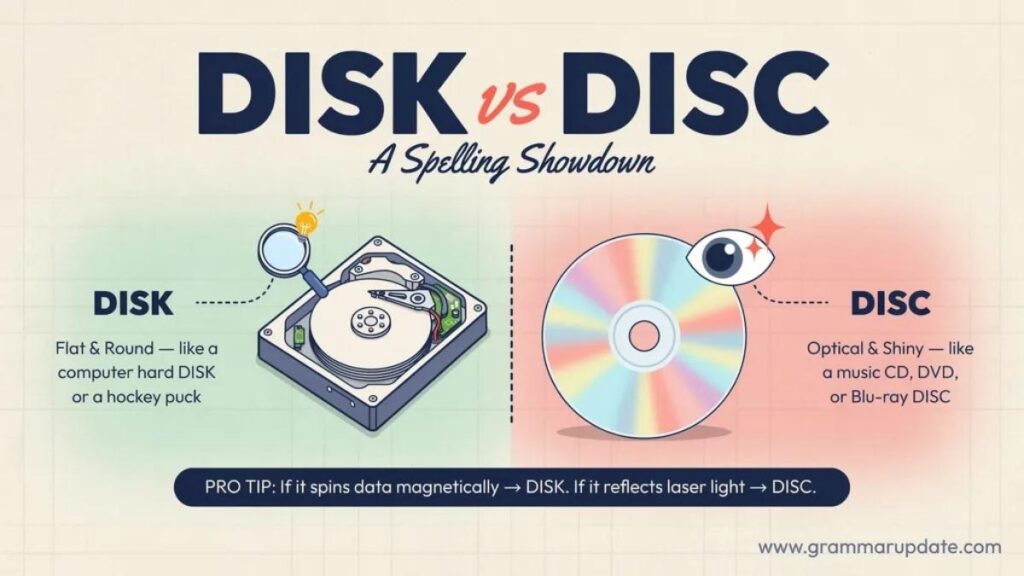
Have you ever typed “disk” and then stopped to wonder if it should be “disc” instead? You are not the only one. This small spelling difference confuses students, writers, professionals, and even native English speakers. The good news is that both words are correct they’re simply used in different situations. In this guide, you’ll learn the real difference between disk vs disc in a simple and practical way. From computers and CDs to spinal anatomy and astronomy, you’ll discover when each spelling is correct, why both exist, and how to remember the difference without second-guessing yourself again.
Quick Answer Disk or Disc?
The simplest rule is this:
- Use “disk” for most computer-related topics involving magnetic storage.
- Use “disc” for optical media, anatomy, sports equipment, and many scientific fields.
Although that rule works most of the time, there are several exceptions. Technology, medicine, engineering, and even brand names have shaped modern usage. That’s why understanding the meaning behind each spelling matters more than memorizing a single rule.
Quick Comparison
| Topic | Preferred Spelling |
|---|---|
| Hard disk drive | Disk |
| Floppy disk | Disk |
| Disk Management (Windows) | Disk |
| Compact Disc (CD) | Disc |
| DVD | Disc |
| Blu-ray | Disc |
| Intervertebral disc | Disc |
| Herniated disc | Disc |
| Disc brake | Disc |
| Flying disc | Disc |
| Accretion disk | Usually Disk |
| Galaxy disk | Usually Disk |
If you’re asking, “Is it disk or disc?” the answer depends entirely on what you’re describing.
Learn the difference between confusing more English words
Kindergartner vs Kindergartener Which spelling Is Correct?
What Do Disk and Disc Mean?
The disk vs disc meaning is almost identical because both words describe a flat, round object. Over time, different industries adopted different spellings for their own purposes. Today, each spelling has become standard within specific fields.
Although the pronunciation stays the same, the spelling often tells readers what subject you’re discussing before they read the rest of the sentence.
Disk Definition
A disk usually refers to a flat circular object, especially one related to computing or magnetic storage.
Common computer examples include:
- Hard disk drive (HDD)
- Floppy disk
- Disk partition
- Disk cleanup
- Disk utility
- Computer storage disk
- External hard drive
In computing, the word “disk” became popular because early storage devices relied on spinning magnetic disks that stored digital information.
Example sentences:
- My laptop uses a hard disk drive for data storage.
- The technician replaced the damaged disk.
- Windows reported a disk error during startup.
Disc Definition
A disc also means a flat circular object, but it commonly refers to optical media, body structures, sporting equipment, and mechanical parts.
Examples include:
- Compact Disc (CD)
- DVD
- Blu-ray Disc
- Intervertebral disc
- Disc brake
- Flying disc
- Disc golf equipment
Medical professionals almost always write “disc” when discussing the spine, while manufacturers of optical storage media also prefer this spelling.
Example sentences:
- The doctor diagnosed a herniated disc.
- The movie comes on Blu-ray Disc.
- She threw the flying disc across the park.
Why Both Spellings Exist
Many English words developed multiple spellings over hundreds of years. Disk and disc followed similar paths before becoming associated with different industries.
Instead of one spelling replacing the other, technology and science allowed both versions to survive.
Today, dictionaries recognize both spellings as correct. The key is choosing the version that matches your topic.
Learn the difference between confusing more English words
Feal vs Feel Which Spelling Is Correct?
Disk vs Disc Difference Explained
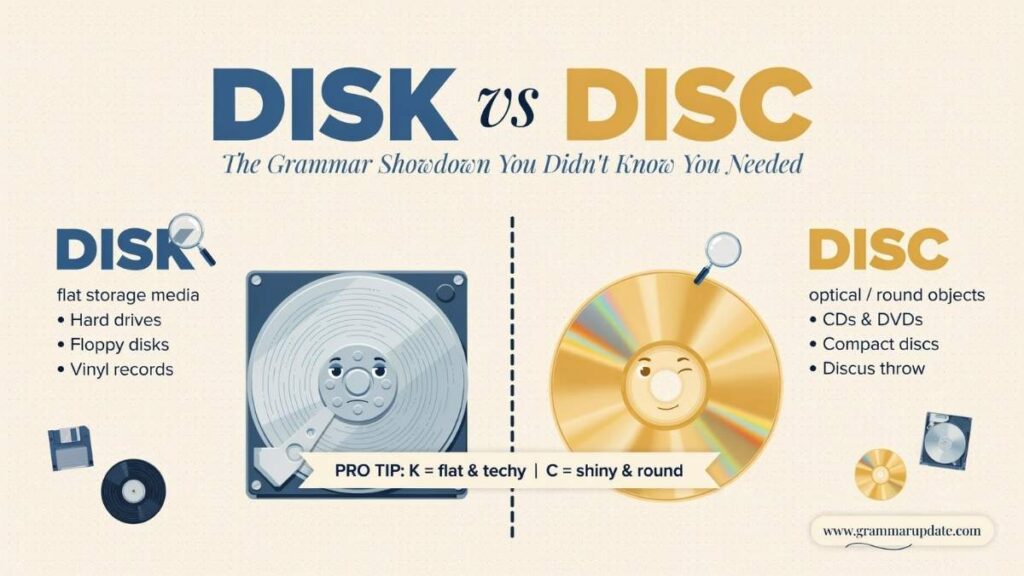
Understanding the disk vs disc difference becomes much easier when you focus on the field rather than the word itself.
Here’s the simplest way to remember it:
- Computers usually use disk.
- Medicine usually uses disc.
- Optical media uses disc.
- Astronomy often uses disk.
- Mechanical engineering commonly uses disc.
Let’s explore each one in more detail.
When to Use Disk
Use “disk” whenever you’re writing about traditional computer storage or magnetic storage devices.
You’ll frequently encounter disk in:
- Hard disk drive
- Floppy disk
- Disk partition
- Disk image
- Disk utility
- Disk encryption
- Disk formatting
- Disk management
- Computer storage disk
Microsoft Windows consistently uses the spelling “disk.”
Examples include:
- Disk Cleanup
- Disk Management
- Check Disk
- Virtual Hard Disk
Because these terms appear in millions of computers worldwide, “disk” has become deeply connected with computer hardware.
When to Use Disc
Use “disc” when discussing:
- Compact Disc technology
- Optical storage media
- DVD
- Blu-ray
- Spinal anatomy
- Orthopedic terminology
- Disc brake systems
- Flying sports equipment
Examples:
- The compact disc transformed the music industry.
- A slipped disc can cause severe back pain.
- Modern cars use ventilated disc brakes.
The spelling immediately tells readers you’re talking about something other than computer magnetic storage.
Learn the difference between confusing more English words
Everywhere vs Every Where Which One Is Correct ?
Disk vs Disc Comparison
The following table highlights the most common differences.
| Feature | Disk | Disc |
|---|---|---|
| Basic meaning | Flat circular object | Flat circular object |
| Pronunciation | Same | Same |
| Computer hardware | Yes | Rare |
| Magnetic storage | Yes | Rare |
| Optical storage | Rare | Yes |
| Medical terminology | Rare | Yes |
| Anatomy | Rare | Yes |
| Disc brakes | Rare | Yes |
| Frisbee and sports | Rare | Yes |
| Dictionaries | Accepted | Accepted |
The disk vs disc comparison shows that neither spelling is wrong. Each simply belongs to different industries.
Learn the difference between confusing more English words
Bright vs Brite Which Spelling Is Correct?
Disk vs Disc in Computing
One of the biggest reasons people search for the disk vs disc correct spelling is computer terminology.
Almost every operating system, software manual, and hardware manufacturer uses “disk” when referring to magnetic storage devices.
That choice dates back to the earliest days of computing.
Hard Disk Drives
A hard disk drive, often shortened to HDD, stores digital information on rotating magnetic platters.
Each platter spins thousands of times every minute while magnetic heads read and write information.
For decades, hard disk drives powered personal computers, business servers, and data centers around the world.
Examples include:
- Internal hard disk drive
- External hard drive
- Enterprise hard disk
- Backup disk
Although SSDs have become more common, millions of computers still rely on HDD technology.
This explains why “hard disk or hard disc” isn’t an equal choice. The accepted technical term is hard disk drive.
Solid-State Drives and Why “Disk” Still Appears
A solid-state drive contains no spinning disk at all.
Instead, it stores information using flash memory chips.
So why do computers still display words like:
- Disk usage
- Disk space
- Disk health
- Disk management
The answer is compatibility.
Operating systems kept the original terminology so users wouldn’t need to learn an entirely new vocabulary every time storage technology evolved.
As a result, “solid state disk spelling” continues to appear in software documentation even though SSDs don’t contain physical disks.
Floppy Disk vs Floppy Disc
One of the clearest examples of computer terminology is the floppy disk.
The floppy disk became one of the most recognizable storage devices of the 1980s and 1990s.
Its official name has always been “floppy disk.”
You’ll rarely see “floppy disc” outside informal writing or spelling mistakes.
Common examples include:
- 3.5-inch floppy disk
- 5.25-inch floppy disk
- Boot disk
- Recovery disk
These products relied on magnetic storage, which explains why the spelling follows computer conventions.
Disk Storage
The phrase “computer storage disk” covers several technologies.
Examples include:
- Hard disks
- Magnetic disks
- Virtual disks
- Backup disks
- Network disks
Each stores digital information in different ways, but all belong to the broader category of data storage.
Even cloud computing continues using familiar terms such as virtual disk because decades of technical writing established the spelling.
Disk Drive vs Disc Drive
Another common question is whether to write disk drive or disc drive.
The answer depends on the hardware.
A disk drive stores information on magnetic media.
Examples include:
- Hard disk drive
- Floppy disk drive
A disc drive reads optical media.
Examples include:
- CD drive
- DVD drive
- Blu-ray drive
Because optical drives read discs instead of magnetic disks, many manufacturers describe them as optical disc drives.
Understanding this distinction helps eliminate one of the most common disk vs disc grammar mistakes.
Learn the difference between confusing more English words
Investor vs Investee What’s the Difference and usage ?
Computer Disk vs Disc
The computer disk vs disc debate often confuses beginners because modern computers use both.
Consider this example.
A desktop computer may contain:
- One hard disk drive
- One SSD
- One Blu-ray disc drive
The operating system installs onto the hard disk or SSD, while movies and music are read from optical discs.
That means one computer legitimately uses both spellings.
| Device | Correct Spelling |
|---|---|
| Hard disk drive | Disk |
| Floppy disk | Disk |
| Virtual disk | Disk |
| Compact Disc | Disc |
| CD-ROM | Disc |
| DVD | Disc |
| Blu-ray | Disc |
| Optical disc | Disc |
Disk vs Disc in Medical Terms
Medical writing follows its own conventions, and one of the clearest examples is the preference for “disc.” If you’ve ever read an MRI report or visited an orthopedic specialist, you’ve almost certainly seen the word spelled with a “c.”
That isn’t a coincidence. Medical dictionaries, anatomy textbooks, and healthcare organizations overwhelmingly favor “disc” when referring to structures in the human body.
If you’re wondering, “Is it disk or disc in medical terms?” the standard answer is simple: use “disc.”
Disk vs Disc in Spine
One of the most searched questions is “disk vs disc in spine.”
The correct medical spelling is “spinal disc.”
The spine contains 23 intervertebral discs positioned between most vertebrae. These discs act as cushions that absorb shock, support movement, and help distribute body weight evenly.
Each spinal disc has two main parts:
- Annulus fibrosus: the tough outer ring
- Nucleus pulposus: the soft, gel-like center
Together, these structures allow your spine to bend, twist, and move without the bones grinding against one another.
Examples:
- The MRI showed a herniated disc.
- Age can reduce the flexibility of a spinal disc.
- Physical therapy often helps patients with disc injuries.
Although some people write “spinal disk,” that spelling is uncommon in professional healthcare writing.
Disc vs Disk in Medical Terms
Nearly every major medical reference uses “disc.”
You’ll commonly encounter terms such as:
- Intervertebral disc
- Cervical disc
- Lumbar disc
- Thoracic disc
- Herniated disc
- Degenerative disc disease
- Slipped disc
- Disc replacement surgery
Healthcare professionals use this spelling consistently because it has become the accepted medical terminology over many decades.
Herniated Disc
A herniated disc occurs when the soft center of an intervertebral disc pushes through a tear in its outer layer.
Common symptoms include:
- Back pain
- Neck pain
- Leg pain
- Numbness
- Tingling
- Muscle weakness
Treatment varies depending on severity and may include:
- Physical therapy
- Anti-inflammatory medication
- Exercise
- Epidural injections
- Surgery in severe cases
Intervertebral Disc Spelling
The phrase “intervertebral disc” is the accepted anatomical term worldwide.
Medical journals, anatomy textbooks, and orthopedic specialists almost always use this spelling.
If you’re writing medical content, “disc” is the safest and most professional choice.
Disc Brake vs Disk Brake
Another industry that strongly prefers “disc” is automotive engineering.
Modern vehicles use disc brakes because they provide reliable stopping power and better heat dissipation than older drum brakes.
A typical disc brake system includes:
- Brake rotor
- Brake caliper
- Brake pads
- Hydraulic system
When the driver presses the brake pedal, the caliper squeezes the brake pads against the rotating disc.
This friction slows the wheel and eventually stops the vehicle.
Although “disk brake” occasionally appears in casual writing, “disc brake” remains the standard term in automotive manuals, engineering documents, and manufacturer specifications.
Understand confusing English more words simply
Flatform vs Platform Difference which is correct?
Compact Disc vs Compact Disk
The compact disc changed digital media forever.
Introduced commercially in the early 1980s, the Compact Disc (CD) became the standard format for music, software, and data storage.
Its official name has always been “Compact Disc.”
Examples include:
- Compact Disc Digital Audio
- CD-ROM
- CD-R
- CD-RW
Because the product name includes “Disc,” writing “Compact Disk” is considered incorrect.
This answers another common question:
Why is it hard disk but compact disc?
The reason is simple.
Computer storage devices adopted “disk,” while optical media manufacturers officially chose “disc.”
Both spellings became industry standards.
CD Disk vs CD Disc
Many people ask whether “CD disk” or “CD disc” is correct.
Technically, neither phrase is ideal because CD already stands for Compact Disc.
Writing “CD disk” is incorrect.
Writing “CD disc” repeats the word “disc.”
Instead, write:
- CD
- Compact Disc
Example:
Correct:
- Save the files to a CD.
Also correct:
- Save the files to a Compact Disc.
DVD Disc or Disk
Like CDs, DVDs belong to the optical disc family.
DVD originally stood for Digital Versatile Disc.
Therefore, the preferred spelling is always “disc.”
Examples:
- DVD disc
- DVD player
- DVD drive
- DVD collection
You’ll rarely see reputable manufacturers use “DVD disk.”
Blu-ray Disc Spelling
Blu-ray follows the same convention.
The official product name is Blu-ray Disc.
Examples include:
- Blu-ray Disc player
- Blu-ray Disc movie
- Blu-ray Disc drive
The spelling never changes because it forms part of the official trademarked name.
Understand confusing English more words simply
Stopping vs Stoping Which Spelling Is Correct?
Optical Disc vs Optical Disk
Optical storage devices use lasers instead of magnetic surfaces.
Examples include:
- CD
- DVD
- Blu-ray
Because these devices belong to optical storage media, the preferred spelling is “optical disc.”
Characteristics of optical discs include:
- Laser-readable surface
- Circular plastic construction
- Digital data storage
- Long shelf life
- Portable format
The Magnetic storage and optical storage use different technologies, which helps explain why the spellings differ.
Magnetic Disk vs Disc
The Magnetic storage devices record information using magnetic fields.
Examples include:
- Hard disk drive
- Floppy disk
- Zip disk
- Magnetic disk storage
Optical storage devices use lasers.
Examples include:
- Compact Disc
- DVD
- Blu-ray Disc
The distinction has remained consistent throughout modern computing.
| Storage Technology | Preferred Spelling |
|---|---|
| Hard disk drive | Disk |
| Magnetic disk | Disk |
| Floppy disk | Disk |
| Compact Disc | Disc |
| DVD | Disc |
| Blu-ray Disc | Disc |
| Optical disc | Disc |
Understand confusing English more words simply
Focuses vs Focusses Which Spelling Is Correct?
Disk vs Disc in Agriculture
Agriculture is one area where both spellings appear.
Farm equipment manufacturers, regional publications, and agricultural suppliers sometimes prefer different versions.
As a result, both “disk harrow” and “disc harrow” can be found.
The same applies to “disk plow” and “disc plow.”
Regional usage often determines which spelling appears.
Disk Harrow vs Disc Harrow
A disc harrow is a tillage implement used to prepare soil before planting.
It consists of rows of large circular blades that:
- Break up soil
- Mix crop residue
- Control weeds
- Improve seedbed preparation
North American manufacturers often use “disk harrow,” while other companies and publications may prefer “disc harrow.”
Both describe the same agricultural equipment.
Disc Plow vs Disk Plow
A disc plow performs a similar function but uses larger rotating discs capable of cutting through rocky or heavy soil.
These machines work well in areas where traditional moldboard plows struggle.
Whether the manufacturer writes “disk plow” or “disc plow” usually depends on regional style rather than technical differences.
Disc or Disk for Frisbee
Another common search is “disc or disk for Frisbee.”
The accepted spelling is “disc.”
The reason is straightforward.
Flying sports have always adopted “disc.”
Examples include:
- Flying disc
- Disc golf
- Ultimate disc
- Disc sports
The term “flying disk” occasionally appears informally, but organized sports overwhelmingly use “disc.”
Disc Golf Disc Spelling
Disc golf manufacturers consistently use “disc.”
Professional players purchase:
- Distance discs
- Fairway discs
- Midrange discs
- Putter discs
Organizations governing the sport also use “disc” throughout their official rules.
Flying Disc or Flying Disk
The generic term is “flying disc.”
Frisbee is a well-known brand name, while “flying disc” describes the object itself.
Examples:
- Children played with a flying disc.
- She practices disc golf every weekend.
Disc Jockey Spelling
The entertainment industry provides another example.
The accepted spelling is “disc jockey.”
Although modern DJs rarely play vinyl records or CDs, the historical term has remained unchanged.
Today you’ll see:
- Disc jockey
- DJ
- Mobile disc jockey
- Radio disc jockey
Writing “disk jockey” is incorrect.
Antibiotic Disc or Disk
Microbiology laboratories use small paper discs containing antibiotics to determine whether bacteria respond to specific medications.
The procedure is known as the Kirby-Bauer disc diffusion test.
During testing:
- A bacterial culture grows on agar.
- Antibiotic discs are placed on the surface.
- Clear zones indicate bacterial sensitivity.
Medical laboratories generally write:
- Antibiotic disc
- Kirby-Bauer disc diffusion
Some scientific publications use “disk diffusion” because American English has influenced laboratory terminology. As a result, you’ll encounter both spellings in research papers.
Understanding the context is more important than memorizing a single rule.
Accretion Disk or Disc
Astronomy introduces another interesting exception.
Most astronomers prefer “accretion disk.”
An accretion disk forms when gas, dust, or other material spirals around a massive object such as:
- A black hole
- A neutron star
- A white dwarf
- A young star
Gravity pulls material inward while angular momentum causes it to rotate, creating a flattened disk.
This process plays a major role in:
- Galaxy formation
- Star formation
- Black hole growth
- Planetary system development
Although “accretion disc” appears in some publications, “accretion disk” is more common in modern astronomy literature, especially in North America.
Galaxy Disk vs Galaxy Disc
Astronomers also describe spiral galaxies as having a rotating disk.
The disk contains:
- Stars
- Gas
- Dust
- Spiral arms
You’ll frequently read terms such as:
- Galactic disk
- Thin disk
- Thick disk
The spelling aligns with broader astronomy terminology.
Scientific Disk or Disc
Scientific writing doesn’t always follow one universal rule.
Instead, each discipline has developed its own preferred spelling.
| Field | Preferred Spelling |
|---|---|
| Computing | Disk |
| Medicine | Disc |
| Anatomy | Disc |
| Microbiology | Usually Disc |
| Astronomy | Usually Disk |
| Automotive Engineering | Disc |
| Sports | Disc |
| Agriculture | Both |
Disk vs Disc in Medical Terms
Medical writing follows its own conventions, and one of the clearest examples is the preference for “disc.” If you’ve ever read an MRI report or visited an orthopedic specialist, you’ve almost certainly seen the word spelled with a “c.”
That isn’t a coincidence. Medical dictionaries, anatomy textbooks, and healthcare organizations overwhelmingly favor “disc” when referring to structures in the human body.
If you’re wondering, “Is it disk or disc in medical terms?” the standard answer is simple: use “disc.”
Disk vs Disc in Spine
One of the most searched questions is “disk vs disc in spine.”
The correct medical spelling is “spinal disc.”
The spine contains 23 intervertebral discs positioned between most vertebrae. These discs act as cushions that absorb shock, support movement, and help distribute body weight evenly.
Each spinal disc has two main parts:
- Annulus fibrosus: the tough outer ring
- Nucleus pulposus: the soft, gel-like center
Together, these structures allow your spine to bend, twist, and move without the bones grinding against one another.
Examples:
- The MRI showed a herniated disc.
- Age can reduce the flexibility of a spinal disc.
- Physical therapy often helps patients with disc injuries.
Although some people write “spinal disk,” that spelling is uncommon in professional healthcare writing.
Disc or Disk in Medical Terms
Nearly every major medical reference uses “disc.”
You’ll commonly encounter terms such as:
- Intervertebral disc
- Cervical disc
- Lumbar disc
- Thoracic disc
- Herniated disc
- Degenerative disc disease
- Slipped disc
- Disc replacement surgery
Healthcare professionals use this spelling consistently because it has become the accepted medical terminology over many decades.
Herniated Disc
A herniated disc occurs when the soft center of an intervertebral disc pushes through a tear in its outer layer.
Common symptoms include:
- Back pain
- Neck pain
- Leg pain
- Numbness
- Tingling
- Muscle weakness
Treatment varies depending on severity and may include:
- Physical therapy
- Anti-inflammatory medication
- Exercise
- Epidural injections
- Surgery in severe cases
Intervertebral Disc Spelling
The phrase “intervertebral disc” is the accepted anatomical term worldwide.
Medical journals, anatomy textbooks, and orthopedic specialists almost always use this spelling.
If you’re writing medical content, “disc” is the safest and most professional choice.
Understand confusing English more words simply
Anual vs Annual Which Spelling Is Correct?
Disc Brake vs Disk Brake
Another industry that strongly prefers “disc” is automotive engineering.
Modern vehicles use disc brakes because they provide reliable stopping power and better heat dissipation than older drum brakes.
A typical disc brake system includes:
- Brake rotor
- Brake caliper
- Brake pads
- Hydraulic system
When the driver presses the brake pedal, the caliper squeezes the brake pads against the rotating disc.
This friction slows the wheel and eventually stops the vehicle.
Although “disk brake” occasionally appears in casual writing, “disc brake” remains the standard term in automotive manuals, engineering documents, and manufacturer specifications.
Compact Disc vs Compact Disk
The compact disc changed digital media forever.
Introduced commercially in the early 1980s, the Compact Disc (CD) became the standard format for music, software, and data storage.
Its official name has always been “Compact Disc.”
Examples include:
- Compact Disc Digital Audio
- CD-ROM
- CD-R
- CD-RW
Because the product name includes “Disc,” writing “Compact Disk” is considered incorrect.
This answers another common question:
Why is it hard disk but compact disc?
The reason is simple.
Computer storage devices adopted “disk,” while optical media manufacturers officially chose “disc.”
Both spellings became industry standards.
CD Disk or CD Disc
Many people ask whether “CD disk” or “CD disc” is correct.
Technically, neither phrase is ideal because CD already stands for Compact Disc.
Writing “CD disk” is incorrect.
Writing “CD disc” repeats the word “disc.”
Instead, write:
- CD
- Compact Disc
Example:
Correct:
- Save the files to a CD.
Also correct:
- Save the files to a Compact Disc.
DVD Disc or Disk
Like CDs, DVDs belong to the optical disc family.
DVD originally stood for Digital Versatile Disc.
Therefore, the preferred spelling is always “disc.”
Examples:
- DVD disc
- DVD player
- DVD drive
- DVD collection
You’ll rarely see reputable manufacturers use “DVD disk.”
Blu-ray Disc Spelling
Blu-ray follows the same convention.
The official product name is Blu-ray Disc.
Examples include:
- Blu-ray Disc player
- Blu-ray Disc movie
- Blu-ray Disc drive
The spelling never changes because it forms part of the official trademarked name.
Optical Disc vs Optical Disk
Optical storage devices use lasers instead of magnetic surfaces.
Examples include:
- CD
- DVD
- Blu-ray
Because these devices belong to optical storage media, the preferred spelling is “optical disc.”
Characteristics of optical discs include:
- Laser-readable surface
- Circular plastic construction
- Digital data storage
- Long shelf life
- Portable format
Understand confusing English more words simply
Presentor vs Presenter Which Spelling Is Correct?
Magnetic Disk vs Disc
The Magnetic storage devices record information using magnetic fields.
Examples include:
- Hard disk drive
- Floppy disk
- Zip disk
- Magnetic disk storage
Optical storage devices use lasers.
Examples include:
- Compact Disc
- DVD
- Blu-ray Disc
The distinction has remained consistent throughout modern computing.
| Storage Technology | Preferred Spelling |
|---|---|
| Hard disk drive | Disk |
| Magnetic disk | Disk |
| Floppy disk | Disk |
| Compact Disc | Disc |
| DVD | Disc |
| Blu-ray Disc | Disc |
| Optical disc | Disc |
Disk vs Disc in Agriculture
Agriculture is one area where both spellings appear.
Farm equipment manufacturers, regional publications, and agricultural suppliers sometimes prefer different versions.
As a result, both “disk harrow” and “disc harrow” can be found.
The same applies to “disk plow” and “disc plow.”
Regional usage often determines which spelling appears.
Disk Harrow vs Disc Harrow
A disc harrow is a tillage implement used to prepare soil before planting.
It consists of rows of large circular blades that:
- Break up soil
- Mix crop residue
- Control weeds
- Improve seedbed preparation
North American manufacturers often use “disk harrow,” while other companies and publications may prefer “disc harrow.”
Both describe the same agricultural equipment.
Disc Plow vs Disk Plow
A disc plow performs a similar function but uses larger rotating discs capable of cutting through rocky or heavy soil.
These machines work well in areas where traditional moldboard plows struggle.
Whether the manufacturer writes “disk plow” or “disc plow” usually depends on regional style rather than technical differences.
Understand confusing English more words simply
Totaled vs Totalled Which Spelling Is Correct?
Disc or Disk for Frisbee
Another common search is “disc or disk for Frisbee.”
The accepted spelling is “disc.”
The reason is straightforward.
Flying sports have always adopted “disc.”
Examples include:
- Flying disc
- Disc golf
- Ultimate disc
- Disc sports
The term “flying disk” occasionally appears informally, but organized sports overwhelmingly use “disc.”
Disc Golf Disc Spelling
Disc golf manufacturers consistently use “disc.”
Professional players purchase:
- Distance discs
- Fairway discs
- Midrange discs
- Putter discs
Organizations governing the sport also use “disc” throughout their official rules.
Flying Disc or Flying Disk
The generic term is “flying disc.”
Frisbee is a well-known brand name, while “flying disc” describes the object itself.
Examples:
- Children played with a flying disc.
- She practices disc golf every weekend.
Disc Jockey Spelling
The entertainment industry provides another example.
The accepted spelling is “disc jockey.”
Although modern DJs rarely play vinyl records or CDs, the historical term has remained unchanged.
Today you’ll see:
- Disc jockey
- DJ
- Mobile disc jockey
- Radio disc jockey
Writing “disk jockey” is incorrect.
Antibiotic Disc or Disk
Microbiology laboratories use small paper discs containing antibiotics to determine whether bacteria respond to specific medications.
The procedure is known as the Kirby-Bauer disc diffusion test.
During testing:
- A bacterial culture grows on agar.
- Antibiotic discs are placed on the surface.
- Clear zones indicate bacterial sensitivity.
Medical laboratories generally write:
- Antibiotic disc
- Kirby-Bauer disc diffusion
Some scientific publications use “disk diffusion” because American English has influenced laboratory terminology. As a result, you’ll encounter both spellings in research papers.
Understanding the context is more important than memorizing a single rule.
Accretion Disk or Disc
Astronomy introduces another interesting exception.
Most astronomers prefer “accretion disk.”
An accretion disk forms when gas, dust, or other material spirals around a massive object such as:
- A black hole
- A neutron star
- A white dwarf
- A young star
Gravity pulls material inward while angular momentum causes it to rotate, creating a flattened disk.
This process plays a major role in:
- Galaxy formation
- Star formation
- Black hole growth
- Planetary system development
Although “accretion disc” appears in some publications, “accretion disk” is more common in modern astronomy literature, especially in North America.
Galaxy Disk vs Galaxy Disc
Astronomers also describe spiral galaxies as having a rotating disk.
The disk contains:
- Stars
- Gas
- Dust
- Spiral arms
You’ll frequently read terms such as:
- Galactic disk
- Thin disk
- Thick disk
The spelling aligns with broader astronomy terminology.
Fix common more word mistakes in English
Compair vs Compare Which Is Correct and usage?
Scientific Disk or Disc
Scientific writing doesn’t always follow one universal rule.
Instead, each discipline has developed its own preferred spelling.
| Field | Preferred Spelling |
|---|---|
| Computing | Disk |
| Medicine | Disc |
| Anatomy | Disc |
| Microbiology | Usually Disc |
| Astronomy | Usually Disk |
| Automotive Engineering | Disc |
| Sports | Disc |
| Agriculture | Both |
This explains why the same dictionary recognizes both spellings.
Different industries simply adopted different standards over time.
In Part 3, you’ll learn about the history and origin of both spellings, American English vs British English preferences, dictionary recommendations, brand names, common writing mistakes, memory tricks, practical usage tips, frequently asked questions, 25 practice questions with answers, and the final verdict on choosing the correct spelling.
Fix common more word mistakes in English
Busing vs Bussing Difference and Correct Usage
The History and Origin of Disk and Disc
The words “disk” and “disc” share the same ancient roots. Both come from the Latin word discus, which itself came from the Greek word diskos. In ancient Greece, a diskos was a heavy circular object used in athletic competitions, much like the modern discus throw.
As English evolved, writers adopted different spellings. For centuries, “disc” appeared more often in general writing. During the twentieth century, however, the computer industry began using “disk” for magnetic storage devices. That decision eventually became the worldwide standard for computing terminology.
Rather than replacing one another, the two spellings developed separate identities.
Today:
- Disk is closely associated with computing.
- Disc is closely associated with anatomy, optical media, sports, and engineering.
American English vs British English
Many people assume that the difference is simply American vs British spelling. While there is some truth to that idea, it isn’t the whole story.
Disk vs Disc US English
American English generally prefers “disk” for computer-related terms.
Examples include:
- Hard disk drive
- Floppy disk
- Disk utility
- Disk management
- Disk partition
However, American English still uses “disc” for several established terms.
Examples:
- Compact Disc
- Blu-ray Disc
- Disc brake
- Disc jockey
- Herniated disc
Even in the United States, the choice depends more on the industry than on grammar alone.
Disk vs Disc UK English
British English traditionally favored “disc” in many situations.
Examples include:
- Compact Disc
- Disc brake
- Intervertebral disc
Modern British computer documentation, however, frequently uses “disk” because software companies and hardware manufacturers adopted international terminology decades ago.
As a result, both spellings appear regularly in British publications.
Fix common more word mistakes in English
Flys vs Flies Correct Spelling and Common Mistakes
Why Dictionaries Accept Both Spellings
Major English dictionaries recognize both words as correct.
Their guidance focuses on context rather than declaring one spelling right and the other wrong.
Common dictionary observations include:
| Dictionary Guidance | Summary |
|---|---|
| Disk | Preferred for computer storage and magnetic media. |
| Disc | Preferred for anatomy, optical media, and many physical objects. |
| Both | Correct when used in the appropriate context. |
That consistency explains why professional writers rarely treat one spelling as an error.
Brand Names That Influence Spelling
Many famous products helped establish today’s spelling conventions.
Examples include:
| Product or Technology | Official Spelling |
|---|---|
| Hard Disk Drive (HDD) | Disk |
| Compact Disc | Disc |
| Blu-ray Disc | Disc |
| CD-ROM | Disc |
| Windows Disk Cleanup | Disk |
| Windows Disk Management | Disk |
| Google Persistent Disk | Disk |
| Apple Disk Utility | Disk |
Because these names are official product terms, changing the spelling would be incorrect.
For example:
Correct:
- Disk Utility
Incorrect:
- Disc Utility
Correct:
- Blu-ray Disc
Incorrect:
- Blu-ray Disk
Always follow the official product name.
Fix common more word mistakes in English
Treet vs Treat Spelling Confusion and Usage
Common Disk vs Disc Mistakes
Even experienced writers occasionally confuse the two spellings.
Fortunately, most mistakes are easy to avoid.
Using Disc for Hard Drives
Incorrect:
- My computer needs a new hard disc.
Correct:
- My computer needs a new hard disk.
Hard drives belong to magnetic storage, so “disk” is the accepted spelling.
Using Disk for CDs and DVDs
Incorrect:
- I bought a music disk.
Correct:
- I bought a music disc.
Optical storage media uses “disc.”
Mixing Spellings in One Article
One of the biggest writing mistakes is switching spellings without a reason.
For example:
Incorrect:
- The hard disk stores files on a compact disk.
Correct:
- The hard disk stores files, and you can back them up to a compact disc.
Each spelling should match the technology being discussed.
Ignoring Industry Standards
Medical writers should use:
- Intervertebral disc
- Herniated disc
- Degenerative disc disease
Computer writers should use:
- Hard disk drive
- Disk partition
- Disk space
Following industry standards makes your writing look more professional.
Disk vs Disc Examples
Real-world examples make the distinction much easier to remember.
| Sentence | Correct Word |
|---|---|
| My computer reports low disk space. | Disk |
| Install Windows on the new hard disk. | Disk |
| Copy the files from the floppy disk. | Disk |
| The doctor diagnosed a herniated disc. | Disc |
| The MRI showed damage to an intervertebral disc. | Disc |
| Insert the Blu-ray Disc into the player. | Disc |
| The mechanic replaced the front disc brakes. | Disc |
| Children enjoyed throwing the flying disc. | Disc |
| The telescope captured an accretion disk around the black hole. | Disk |
| The farmer repaired the disc harrow before planting. | Disc |
How to Remember Disk vs Disc
A simple memory trick can help you choose the correct spelling.
Think of the letter “K.”
“K” reminds many people of computers and keyboards.
If you’re writing about:
- Hard disks
- Disk drives
- Disk storage
- Disk partitions
Choose “disk.”
Now think of the letter “C.”
“C” can remind you of:
- Compact Disc
- CD
- Cervical disc
- Disc brake
Although memory tricks aren’t perfect, they help in everyday writing.
When Should You Use Disk?
Choose “disk” when writing about:
- Computer hardware
- Hard disk drives
- Magnetic storage
- Disk partitions
- Disk formatting
- Disk utilities
- Disk images
- Virtual disks
- External hard drives
- Computer storage systems
- Most astronomy topics
When Should You Use Disc?
Choose “disc” when writing about:
- Compact Disc technology
- DVDs
- Blu-ray
- Optical storage media
- Spinal anatomy
- Intervertebral discs
- Disc brakes
- Flying discs
- Disc golf
- Disc jockeys
- Most medical writing
Quick Usage Guide
| Topic | Correct Spelling |
|---|---|
| Hard disk drive | Disk |
| Floppy disk | Disk |
| Disk cleanup | Disk |
| Disk partition | Disk |
| SSD documentation | Disk |
| Compact Disc | Disc |
| CD-ROM | Disc |
| DVD | Disc |
| Blu-ray Disc | Disc |
| Optical disc | Disc |
| Spinal disc | Disc |
| Intervertebral disc | Disc |
| Herniated disc | Disc |
| Disc brake | Disc |
| Flying disc | Disc |
| Disc golf | Disc |
| Disc jockey | Disc |
| Accretion disk | Disk |
| Galaxy disk | Disk |
| Disk harrow or disc harrow | Both |
Practice Section disk vs disc
Fill in each blank with the correct word: disk vs disc
- The technician replaced the damaged hard ________ in the computer.
- The doctor explained that the patient had a herniated ________.
- Insert the Blu-ray ________ before starting the movie.
- Windows displayed a ________ read error during startup.
- The MRI revealed a damaged spinal ________.
- Save the backup files to the external hard ________.
- The mechanic replaced the worn front brake ________.
- Copy the documents from the floppy ________.
- She threw the flying ________ across the field.
- The astronomer studied an accretion ________ surrounding the black hole.
- Open ________ Management to create a new partition.
- The farmer used a ________ harrow to prepare the soil.
- The laboratory performed an antibiotic ________ diffusion test.
- The patient injured an intervertebral ________ while lifting heavy boxes.
- The software created a virtual ________ for testing.
- The DVD ________ would not load into the player.
- The computer reported low ________ space.
- The cyclist’s brake ________ needed replacement.
- The children enjoyed playing with a colorful flying ________.
- The technician installed a new hard ________ drive.
- The researcher observed the galaxy’s rotating ________.
- Store your music collection on a compact ________.
- The computer successfully formatted the system ________.
- Professional players choose the right ________ for every disc golf throw.
- The backup ________ contains all of last month’s important files.
Answers
- disk
- disc
- disc
- disk
- disc
- disk
- disc
- disk
- disc
- disk
- Disk
- disc (or disk, depending on regional agricultural usage)
- disc
- disc
- disk
- disc
- disk
- disc
- disc
- disk
- disk
- disc
- disk
- disc
- disk
Here’s a trusted source for clear word meanings:
FAQs
Is “disk” or “disc” the correct spelling?
Both spellings are correct, but they are used in different contexts. “Disk” is the standard spelling for computer storage devices like hard disks and floppy disks, while “disc” is preferred for optical media such as CDs and DVDs, medical anatomy, disc brakes, and flying discs.
Why is it called a hard disk but a Compact Disc?
The computer industry adopted “disk” for magnetic storage devices decades ago. Manufacturers of optical storage media officially named their products Compact Disc and later Blu-ray Disc. Those official product names established the spelling used today.
Is “disk” or “disc” used in computer terminology?
Computer terminology almost always uses “disk.” Examples include hard disk drive (HDD), disk partition, disk space, disk cleanup, disk management, and virtual disk. These terms have remained standard across operating systems and hardware manufacturers.
Why do doctors use “disc” instead of “disk”?
Medical professionals use “disc” because it is the accepted anatomical spelling. Terms such as intervertebral disc, spinal disc, herniated disc, and degenerative disc disease follow established medical terminology used in textbooks, research papers, and clinical practice.
Is “disk” or “disc” correct for CDs, DVDs, and Blu-ray?
The correct spelling is “disc.” CDs, DVDs, and Blu-ray are optical storage media that use lasers to read data. Their official names include the word “Disc,” making this the standard spelling.
Is there a pronunciation difference between “disk” and “disc”?
No. Both words are pronounced exactly the same. The only difference is their spelling and the context in which they are used.
Why do dictionaries include both “disk” and “disc”?
Modern dictionaries recognize both spellings because each has become standard in different industries. Rather than choosing one over the other, dictionaries recommend using the spelling that matches the subject you are discussing.
Which spelling is preferred in technical writing?
Technical writing follows industry conventions. Computer documentation uses “disk,” while medical, automotive, and optical media documentation generally uses “disc.” Following the accepted terminology improves clarity and professionalism.
Is “disk” or “disc” used in astronomy?
Most astronomy publications use “disk” for terms such as accretion disk, galactic disk, and protoplanetary disk. Although “disc” occasionally appears, “disk” is the more common spelling in modern astronomical literature.
Can I use “disk” and “disc” interchangeably?
Not usually. While both words share the same meaning, readers expect specific spellings in different fields. Using “hard disc” or “Compact Disk” may confuse readers because those spellings do not match the accepted terminology.
Why does Windows use the spelling “disk”?
Microsoft adopted “disk” for its operating systems because early computers stored data on magnetic disks. As a result, Windows includes features such as Disk Management, Disk Cleanup, and Check Disk, and those names have remained unchanged.
What is the easiest way to remember the difference between disk and disc?
Think about the topic. If you’re writing about computer storage or magnetic media, use “disk.” If you’re writing about CDs, DVDs, the spine, disc brakes, or flying sports equipment, use “disc.” Matching the spelling to the industry is the simplest way to avoid mistakes
Conclusion
Choosing between “Disk vs Disc ” is easier than it looks. Use “disk” for computers and magnetic storage, and use “disc” for CDs, DVDs, Blu-ray, the spine, disc brakes, and flying sports. The correct spelling depends on the context, not personal preference.
The next time you see the disk vs disc question, don’t overthink it. Just remember what you’re writing about and follow the standard spelling for that field. Once you know this simple rule, you’ll avoid common spelling mistakes and write with confidence every time.

Jhon AJS, the creative mind behind Grammar Update, is an experienced blogger passionate about simplifying English grammar. He focuses on explaining confusing word vs word differences, grammar rules, punctuation, and sentence structure in a clear and practical way. Through easy to understand guides and examples, Jhon helps readers improve their writing and communicate with confidence. With years of blogging experience, he continues to share helpful insights that make learning grammar simple, useful, and accessible for everyone.