Have you ever typed Peice vs Piece, stared at the screen, and wondered if your keyboard was playing tricks on you? You’re not alone. This tiny spelling mix-up confuses millions of English learners and native speakers because both words seem like they should be correct. Here’s the truth: only piece is the correct English spelling. Peice is simply a common typo caused by reversing the letters “i” and “e.” In this guide, you’ll clear up the confusion once and for all. You’ll learn the correct spelling of piece, its meaning, pronunciation, grammar, practical examples, and easy memory tricks that will help you write confidently every time.
Quick Answer Peice vs Piece
If you’re looking for the short answer, here it is.
| Word | Correct? | Meaning |
|---|---|---|
| Piece | Yes | A part, portion, object, or individual item |
| Peice | No | A misspelling of “piece” |
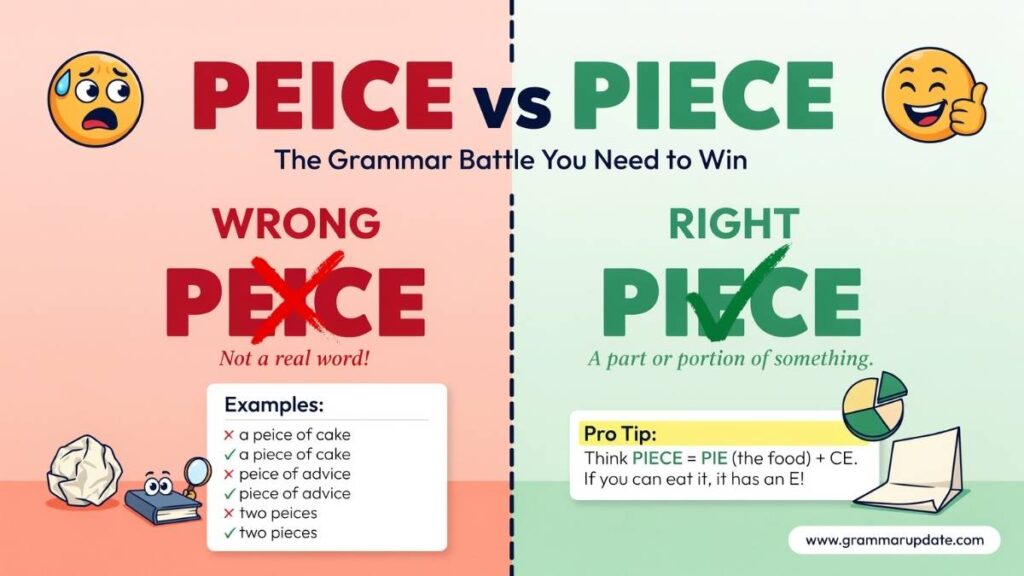
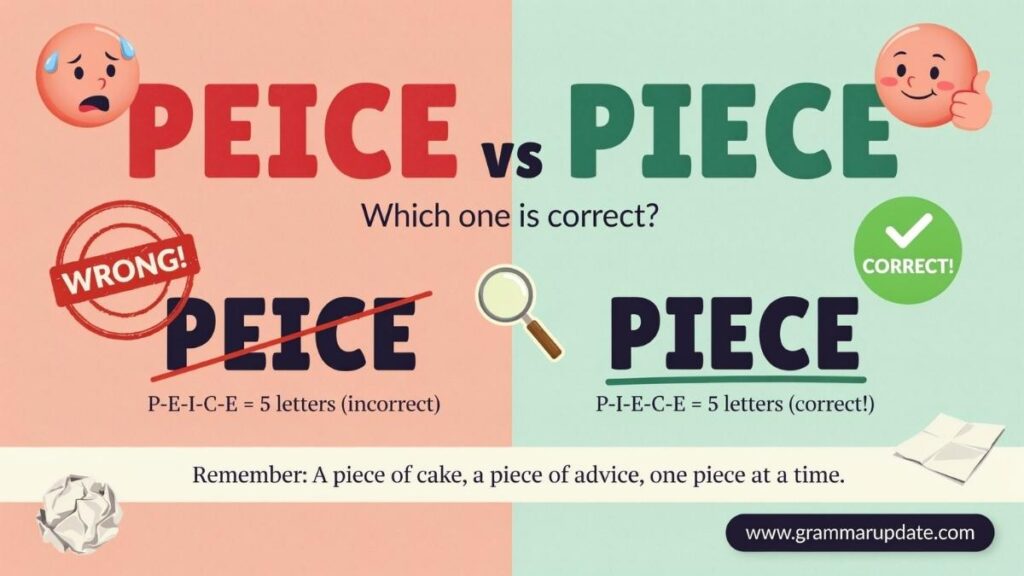
The correct English spelling is piece.
The spelling peice is simply a typo caused by reversing the letters “i” and “e.” No major English dictionary recognizes peice as a standard word.
Here’s a quick comparison.
| Question | Answer |
|---|---|
| Is peice a word? | No |
| Is piece the correct spelling? | Yes |
| How do you spell piece? | P-I-E-C-E |
| What does piece mean? | A part or portion of something |
Whenever you’re writing essays, emails, reports, blog posts, or social media content, always use piece.
Understand confusing English more words simply
Disk vs Disc What’s the Difference and Which one Is Correct?
Piece Meaning
Understanding the piece meaning makes it easier to remember the correct spelling.
The dictionary meaning of piece is a separate part of something larger or a single object that belongs to a group. Depending on the situation, the word has several related meanings.
Here are the most common definitions.
What Does Piece Mean?
Piece can refer to:
- A part of a whole
- An individual object
- A work of art or music
- A written composition
- A game token
- An item of clothing or furniture
- A serving of food
Because it has many meanings, piece appears in everyday conversations, books, newspapers, business writing, and academic English.
Here are a few examples.
- She ate a piece of chocolate after dinner.
- The puzzle is missing one piece.
- He wrote an opinion piece for the newspaper.
- They performed a beautiful piano piece.
- Please hand me that piece of paper.
Although the situations are different, the meaning stays connected. Each example refers to one individual part, object, or work.
Piece Definition in Different Contexts
The word changes slightly depending on how you use it.
| Context | Piece Definition | Example |
|---|---|---|
| Food | A serving or portion | A piece of pizza |
| Objects | One item | A piece of furniture |
| Writing | An article or composition | A news piece |
| Music | A musical work | A classical piece |
| Games | A movable object | A chess piece |
| Puzzles | One section | Puzzle piece |
Notice how versatile the word is. That’s one reason why piece appears so frequently in English vocabulary.
Piece Meaning in English
In English grammar, piece is most commonly used as a noun.
It names something rather than describing it or showing an action.
Examples include:
- a piece of cake
- a piece of advice
- a piece of evidence
- a broken piece
- a missing piece
- a puzzle piece
- a piece of work
Many English learners first encounter the word while studying countable and uncountable nouns because expressions like “piece of advice” and “piece of information” help count things that normally cannot be counted individually.
For example:
Incorrect:
I have three advices.
Correct:
I have three pieces of advice.
This is an important part of English grammar and one reason why understanding piece meaning improves your writing.
Understand confusing English more words simply
Mold vs Mould Which Spelling Is Correct?
Is “Peice” a Real Word?
One of the most searched questions online is, “Is peice a word?”
The answer is simple.
No.
Peice is not accepted in standard English.
You’ll never find it listed as a correct entry in respected dictionaries such as Merriam-Webster, the Oxford English Dictionary, or the Cambridge Dictionary.
Instead, dictionaries recognize only piece.
Whenever someone writes peice, they have accidentally switched the positions of “i” and “e.”
This makes peice a spelling mistake rather than an alternative spelling.
Why Is “Peice” Incorrect?
English contains many words where the letters “i” and “e” appear together.
Unfortunately, remembering which letter comes first isn’t always easy.
Since piece sounds exactly the same no matter how you imagine spelling it, many people naturally type peice by accident.
This happens because our brains often remember pronunciation more easily than letter order.
Common reasons include:
- Typing too quickly
- Misremembering spelling rules
- Relying on pronunciation
- Letter reversal while typing
- Lack of proofreading
Even experienced writers occasionally make this mistake before correcting it.
Why Spell Check Flags “Peice”
Modern spelling checker tools immediately recognize peice as an incorrect spelling.
Programs such as Microsoft Word, Google Docs, Grammarly, and browser spell checkers automatically suggest replacing peice with piece.
That’s because piece exists in every major English dictionary while peice does not.
If your spelling checker underlines peice with a red line, it’s doing exactly what it should.
However, spell check isn’t perfect.
If you accidentally type another real word instead of your intended word, the software may not catch the mistake.
That’s why proofreading remains an important writing habit.
Understand confusing English more words simply
Defense vs Defence Which Spelling Is Correct?
Why Do People Confuse Peice vs Piece?
If piece is the only correct spelling, why do so many people still write peice?
The answer lies in how English spelling developed over hundreds of years.
Unlike many languages with consistent spelling patterns, English borrowed words from Latin, French, German, Greek, and many other languages. As a result, spelling rules aren’t always predictable.
Let’s look at the biggest reasons behind this confusion.
The “I Before E” Confusion
Most people learned this rhyme in school:
“I before E except after C.”
While it helps with some words, it isn’t a perfect rule.
For example:
| Word | Correct Spelling |
|---|---|
| Believe | IE |
| Field | IE |
| Chief | IE |
| Piece | IE |
| Receive | EI |
| Ceiling | EI |
| Conceit | EI |
The problem is that English contains many exceptions.
Some words follow the rule.
Others don’t.
That’s why relying only on the rhyme often leads to grammar mistakes and common spelling mistakes.
Learning the correct spelling of piece through practice works much better than depending entirely on one rule.
Typing Habits and Letter Reversal
Typing introduces another challenge.
Since the letters “i” and “e” sit close together in many people’s mental spelling patterns, it’s easy to reverse them.
This type of mistake is called a peice typo.
It happens even when you know the correct spelling.
Professional editors often catch these errors during proofreading because our brains tend to read familiar words as if they were already correct.
Pronunciation Doesn’t Reveal the Spelling
Here’s another reason people struggle.
The pronunciation of piece gives almost no clue about its spelling.
Whether someone imagines writing piece or peice, both seem like they’d sound exactly the same.
English pronunciation doesn’t always match English spelling.
Consider these examples.
| Word | Pronunciation | Common Mistake |
|---|---|---|
| Piece | Same long “ee” sound | Peice |
| Peace | Same pronunciation | Piece |
| Receive | Long “ee” sound | Recieve |
| Believe | Long “ee” sound | Beleive |
This explains why pronunciation alone isn’t enough to master English spelling rules.
Learning the correct letter order is the key.
Understand confusing English more words simply
Trey vs Tray What’s the Difference?
How to Spell Piece Correctly Every Time
Fortunately, remembering the spelling isn’t difficult once you use a few simple techniques.
The “Piece of Pie” Memory Trick
One of the easiest tricks connects the word piece with pie.
Notice that both words begin with the letters “PI.”
Think of the phrase:
“A piece of pie.”
Since pie begins with “PI,” piece also begins with “PI.”
This simple mental picture helps many students remember the correct spelling instantly.
Remember the “IE” Pattern
Although the famous spelling rule has exceptions, piece follows the common “IE” pattern.
Break the word into smaller parts.
PIE + CE
Many people remember it this way because the first three letters spell pie.
That tiny connection often prevents the letters from getting reversed.
Practice Similar Words
The best long-term strategy is regular spelling practice.
Study groups of words that use the same letter pattern.
Examples include:
- piece
- field
- belief
- achieve
- chief
- relief
The more often you see these words, the more natural their spelling becomes.
Reading books, articles, and newspapers also strengthens your memory without requiring extra effort.
Instead of memorizing isolated spelling rules, you’ll begin recognizing correct English spelling automatically through repeated exposure.
Understand confusing English more words simply
Feal vs Feel Which Spelling Is Correct?
Piece Pronunciation
Many learners search for piece pronunciation because they want to say the word correctly as well as spell it correctly.
Here is the pronunciation:
piece (pees)
The word rhymes with words such as:
- peace
- niece
- fleece
- cease
Both American English and British English pronounce piece almost identically. The vowel sound is the long “ee” sound, making it easy to recognize in conversation.
Why Pronunciation Doesn’t Help with Spelling
Although piece pronunciation is straightforward, it doesn’t reveal the correct order of the letters.
This is why many learners write peice instead of piece. English contains many words where pronunciation alone cannot tell you how the word is spelled.
Learn the difference between often confused words
Everywhere vs Every Where Which One Is Correct ?
Piece Grammar and Usage
Understanding piece grammar helps you use the word naturally in both spoken and written English. Since piece appears in countless everyday expressions, learning its grammatical role can improve your writing almost immediately.
In most situations, piece functions as a noun. It names a thing, a portion, or an individual item. Depending on the sentence, it may refer to a physical object, an abstract concept, or even a creative work.
Is “Piece” a Noun?
Yes. Piece is primarily a noun.
It refers to one part of something larger or one individual item.
Examples include:
- I found a piece of glass on the floor.
- She bought a beautiful piece of jewelry.
- The detective discovered another piece of evidence.
- We finished the last piece of the puzzle.
- He shared an interesting piece of information.
Notice that piece often combines with the word “of.” This pattern appears throughout English vocabulary.
Common examples include:
- piece of advice
- piece of furniture
- piece of cake
- piece of paper
- piece of equipment
- piece of clothing
- piece of art
- piece of evidence
- piece of news
These combinations are so common that native speakers use them without thinking.
Can “Piece” Be Used as a Verb?
Yes, although it’s less common.
As a verb, piece means to put separate parts together.
Examples:
- The archaeologists pieced the ancient vase together.
- Detectives pieced together the events of the crime.
- She carefully pieced the quilt together.
In these examples, piece expresses the action of assembling or reconstructing something.
Common Grammar Mistakes
Many learners make similar grammar mistakes when using piece.
Incorrect:
- I have many furniture pieceses.
- She gave me an advice.
- I bought three equipments.
Correct:
- I have many furniture pieces.
- She gave me a piece of advice.
- I bought three pieces of equipment.
Words such as advice, information, furniture, equipment, and evidence are uncountable nouns. To count them correctly, English uses piece.
This is one reason why piece grammar is important for English language learning.
Piece as a Countable Noun
Unlike advice or information, piece itself is countable.
You can say:
- one piece
- two pieces
- several pieces
- many pieces
Examples:
- There are five pieces of pizza left.
- She collected several puzzle pieces.
- Two broken pieces were lying on the ground.
Learn the difference between often confused words
Bright vs Brite Which Spelling Is Correct?
Piece vs Peace
Among commonly confused words, piece vs peace causes more confusion than almost any other pair.
The reason is simple.
They sound exactly alike.
These words are homophones, meaning they share the same pronunciation but have different spellings and meanings.
Piece vs Peace Difference
Here’s an easy comparison.
| Word | Meaning | Example |
|---|---|---|
| Piece | A part, portion, object, or work | A piece of bread |
| Peace | Calmness or freedom from conflict | We hope for world peace. |
Although they sound identical, they are never interchangeable.
Examples:
Correct:
- Please give me a piece of paper.
- Everyone deserves peace of mind.
Incorrect:
- Please give me a peace of paper.
- Everyone deserves piece of mind.
The second sentence contains one of the most common English spelling errors.
Spell Peace of Mind Correctly
Many people accidentally write:
Piece of mind
This is incorrect.
The correct phrase is:
Peace of mind
Peace refers to mental calmness, not a physical object.
Examples:
- Finishing the project gave me peace of mind.
- Good insurance provides peace of mind.
- Knowing everyone arrived safely brought peace of mind.
Whenever you’re talking about calmness or emotional comfort, always use peace.
Piece vs Peace Grammar Guide
A quick memory trick helps separate these words.
| Word | Think About |
|---|---|
| Piece | Part of something |
| Peace | Calm and quiet |
If you’re describing an object, choose piece.
If you’re describing tranquility, choose peace.
Learn the difference between often confused words
Kindergartner vs Kindergartener Which spelling Is Correct?
Common Expressions Using “Piece”
English contains dozens of popular expressions that use piece. Learning these phrases expands your vocabulary and helps you sound more natural.
Piece of Cake
One of the best-known English idioms is piece of cake.
It doesn’t refer to dessert.
Instead, it means something is very easy.
Examples:
- The driving test was a piece of cake.
- Don’t worry about the homework. It’s a piece of cake.
- After enough practice, coding becomes a piece of cake.
If someone asks, “How do you spell piece of cake?” the answer is exactly the same as the noun piece.
Piece by Piece
This expression means gradually or one step at a time.
Examples:
- They rebuilt the house piece by piece.
- She learned English piece by piece.
- Success often comes piece by piece.
Piece of the Puzzle
This phrase describes one important part of a larger problem or solution.
Examples:
- The witness provided another piece of the puzzle.
- Market research became the missing piece.
- Every clue added another puzzle piece.
Piece of Advice
English speakers use this expression constantly.
Examples:
- Here’s one piece of advice.
- My grandfather gave me an important piece of advice.
- Always listen carefully before responding.
Notice that advice never becomes “advices.”
Piece of Evidence
Evidence is another uncountable noun.
Correct examples include:
- The police collected one piece of evidence.
- Each piece of evidence supported the case.
- Scientists examined every piece carefully.
Piece of Work
Depending on the situation, this phrase has two meanings.
It may describe:
- A creative work
- Someone behaving in an unusual or difficult way
Examples:
- That painting is a remarkable piece of work.
- He’s quite a piece of work sometimes.
Context determines the meaning.
Learn the difference between tricky grammar more words
Investor vs Investee What’s the Difference and usage ?
4 Piece Meaning
Many people search for 4 piece meaning because they see it in advertisements, menus, clothing stores, and product descriptions.
A 4-piece item simply contains four separate components.
Examples include:
Clothing
- Four-piece suit
- Four-piece winter outfit
- Four-piece accessory set
Furniture
- Four-piece bedroom set
- Four-piece patio collection
Food
- Four-piece chicken meal
- Four-piece nugget box
- Four-piece pastry assortment
Music
A four-piece band contains four musicians.
Examples:
- Guitar
- Bass
- Drums
- Vocalist
The exact meaning depends on what follows the number.
Learn the difference between tricky grammar more words
Visiter vs Visitor Difference Which One Is Correct?
How Do You Spell “Piece of Cake”?
This common question appears because people often confuse piece with peace.
The correct spelling is:
Piece of cake
Never write:
- Peace of cake
- Peice of cake
The idiom means something is very simple.
Example sentences:
- Fixing the bicycle was a piece of cake.
- Once you understand the rules, the game is a piece of cake.
- The interview turned out to be a piece of cake.
How to Spell Pieces
Many writers also wonder how to spell pieces.
The plural form is:
Pieces
Notice that only “s” is added.
Singular:
Piece
Plural:
Pieces
Examples:
- The vase broke into several pieces.
- We gathered all the puzzle pieces.
- The mechanic replaced the damaged pieces.
Piece Singular and Plural
| Form | Example |
|---|---|
| Piece | One piece of pizza |
| Pieces | Several pieces of pizza |
Remember that the spelling of piece never changes before adding the plural ending.
Learn the difference between tricky grammar more words
Allusion vs Illusion Difference and which is correct ?
Piece Synonym
Although piece is versatile, choosing a synonym sometimes improves variety in your writing.
Here’s a useful piece synonym list.
| Synonym | Best Used For |
|---|---|
| Part | Portion of something |
| Portion | Food or quantity |
| Fragment | Broken objects |
| Section | Books, reports, buildings |
| Segment | Divisions or categories |
| Component | Machines or systems |
| Element | Scientific or abstract ideas |
| Item | Individual object |
| Unit | Collections or groups |
| Portion | Measured amount |
Each synonym fits slightly different situations.
For example:
- A fragment of glass
- A section of the report
- A component of the engine
- A portion of cake
- An item on the list
Choosing the right synonym makes your writing more precise.
Piece Plural
The piece plural form is simple.
Singular:
Piece
Plural:
Pieces
Examples:
- One piece
- Two pieces
- Several pieces
- Hundreds of pieces
Remember that English simply adds “-s” because piece already ends with the silent letter “e.”
Learn the difference between tricky grammar more words
Advice vs Advise What’s the Difference?
Piece in Everyday Sentences
Reading examples is one of the fastest ways to improve English writing skills.
Here are correct sentence examples.
Correct Examples
- She picked up a broken piece of glass.
- Every puzzle piece matters.
- I’d like another piece of pie.
- He published an opinion piece yesterday.
- This artwork is my favorite piece.
- Please hand me a piece of paper.
- They replaced the missing piece.
- That’s an impressive musical piece.
- I found another piece of evidence.
- We solved the mystery piece by piece.
Incorrect Examples
Incorrect:
- I found one peice of paper.
Correct:
- I found one piece of paper.
Incorrect:
- Please give me a peace of cake.
Correct:
- Please give me a piece of cake.
Incorrect:
- She gave me an advice.
Correct:
- She gave me a piece of advice.
Studying correct examples helps eliminate common spelling mistakes and strengthens your understanding of correct English usage.
Piece vs Peice Comparison Table
| Feature | Piece | Peice |
|---|---|---|
| Correct English spelling | Yes | No |
| Found in dictionaries | Yes | No |
| Accepted in academic writing | Yes | No |
| Used in business writing | Yes | No |
| Recognized by grammar checkers | Yes | No |
| Appears in spell check dictionaries | Yes | No |
| Recommended for formal English | Yes | No |
Whenever you hesitate between piece or peice, remember this simple rule.
Piece is always correct.
Peice is always a spelling mistake.
Learn the difference between confusing more English words
Entwined vs Intertwined What’s the Difference and usage?
Words Commonly Misspelled Like Piece
The confusion between peice vs piece isn’t unique. English contains many words that people misspell because of unusual letter patterns or inconsistent spelling rules. Recognizing these patterns can improve your spelling and reduce errors in everyday writing.
Here are some of the most commonly misspelled words.
| Incorrect | Correct |
|---|---|
| Peice | Piece |
| Beleive | Believe |
| Recieve | Receive |
| Definately | Definitely |
| Seperate | Separate |
| Occured | Occurred |
| Untill | Until |
| Grammer | Grammar |
| Goverment | Government |
| Writting | Writing |
Notice that several of these words involve reversing the letters “i” and “e.” That’s one reason why common English spelling errors continue to appear, even among experienced writers.
Why These Mistakes Happen
Several factors contribute to spelling errors.
- English words come from many different languages.
- Pronunciation doesn’t always match spelling.
- Fast typing increases letter reversals.
- Similar-looking words confuse the eye.
- Many spelling rules have exceptions.
Instead of memorizing every rule, read regularly and proofread your work carefully. The more often you see correctly spelled words, the easier they become to remember.
Learn the difference between confusing more English words
That’s Mean vs that means Difference and which one is correct?
Origin and History of the Word Piece
Learning where a word comes from often makes it easier to remember its spelling.
The word piece entered English during the Middle English period. It came from the Old French word “piece,” which meant a part, portion, or fragment. That French word ultimately traces back to Vulgar Latin and the Latin word “pettia,” referring to a portion or section.
Over time, the spelling remained remarkably stable.
Unlike many English words that changed significantly through the centuries, piece kept nearly the same form. This explains why dictionaries continue to recognize only one standard spelling.
Today, piece appears in nearly every type of English writing, including:
- Newspapers
- Books
- Academic papers
- Business reports
- Legal documents
- Websites
- Blogs
- Emails
- Text messages
Because the word is so common, mastering its spelling has an immediate impact on your writing accuracy.
Why Correct Spelling Matters
Some people wonder whether a small spelling mistake really matters.
In casual conversations with friends, a typo may not cause serious problems. However, professional, academic, and public writing demand greater accuracy.
Correct spelling improves communication in several ways.
Builds Credibility
Readers naturally trust writing that looks polished.
Repeated spelling errors can distract readers from your message and make your work appear rushed.
Prevents Misunderstanding
Although peice is clearly intended to mean piece, repeated mistakes may slow readers down or create unnecessary confusion.
Clear writing allows readers to focus on your ideas rather than your spelling.
Improves Academic Performance
Teachers often deduct points for grammar mistakes and spelling mistakes.
Learning commonly misspelled words helps students earn stronger grades while developing better writing habits.
Creates a Professional Image
Whether you’re writing an email, resume, proposal, or business report, correct English spelling reflects attention to detail.
Employers, clients, and colleagues notice polished writing.
Supports Better SEO
If you publish online, spelling also affects search visibility.
Search engines understand that people often search for peice vs piece or piece or peice because they’re looking for the correct spelling. However, consistently misspelling important words throughout an article can reduce readability and lower user trust.
Well-written content keeps readers engaged, encourages longer visits, and improves the overall user experience.
Tips to Improve Your English Spelling
Improving your spelling doesn’t require memorizing thousands of words overnight. Small daily habits make a significant difference over time.
Here are practical techniques that work.
Read Every Day
Books, magazines, newspapers, and quality websites expose you to correct spelling naturally.
The more correctly spelled words you see, the easier they become to recognize.
Slow Down While Typing
Many spelling mistakes happen because fingers move faster than the brain.
Taking a few extra seconds often prevents simple letter reversals like peice.
Proofread Before Publishing
Never rely entirely on your first draft.
Read your writing slowly from beginning to end.
You’ll often notice mistakes that were invisible while typing.
Use a Spelling Checker
Modern spelling checker tools quickly identify many common errors.
They are useful, but they should support your knowledge rather than replace it.
Learn Word Families
Grouping similar words strengthens memory.
Examples include:
- Piece
- Pieces
- Pieced
- Piecing
- Masterpiece
Seeing related words together makes spelling patterns easier to remember.
Practice Difficult Words
Keep a personal spelling list.
Whenever you misspell a word, write the correct version several times and use it in a sentence.
This simple exercise reinforces long-term memory.
Learn the difference between confusing more English words
Receive vs Recieve Which is Correct and Usage?
Practice Session piece VS pieces
Choose the correct word to complete each sentence. In every blank, write either piece vs pieces.
- Please hand me a ______ of paper.
- The vase broke into several ______ after it fell.
- She ate one ______ of chocolate after lunch.
- We finally found the missing puzzle ______.
- He wrote an interesting opinion ______ for the newspaper.
- My grandmother gave me a valuable ______ of advice.
- The mechanic replaced the broken ______ in the engine.
- I need another ______ of cake, please.
- Every ______ of evidence helped solve the mystery.
- The children picked up the broken ______ of glass carefully.
- She bought a beautiful ______ of jewelry for her birthday.
- The artist finished a stunning ______ of artwork.
- They rebuilt the old fence ______ by ______.
- I found one missing ______ under the sofa.
- The museum displayed several ancient ______ from the Roman Empire.
- Please cut the sandwich into four equal ______.
- He learned the song one ______ at a time.
- This chess ______ belongs on the top shelf.
- The detective discovered another ______ of evidence.
- I need one more ______ before the puzzle is complete.
- She carefully collected all the broken ______ from the floor.
- That article is my favorite ______ in today’s magazine.
- The teacher asked each student to write one ______ of information about themselves.
- Every ______ of the machine must work properly for it to operate.
- The baker served each customer a fresh ______ of pie.
Answers
- piece
- pieces
- piece
- piece
- piece
- piece
- pieces
- piece
- piece
- pieces
- piece
- piece
- piece, piece
- piece
- pieces
- pieces
- piece
- piece
- piece
- piece
- pieces
- piece
- piece
- piece
- piece
Here’s a trusted source for clear word meanings:
FAQs
Is it spelled piece vs peice?
The correct spelling is piece. The spelling peice is a common typo caused by switching the letters “i” and “e.” Standard English dictionaries recognize only piece.
How do you spell piece like “piece of pie”?
Spell it as piece: P-I-E-C-E. The phrase “piece of pie” can also help you remember the correct letter order because both words begin with “PI.”
How do you spell peice?
If you’re trying to spell the correct word, the answer is piece. The spelling peice is incorrect.
What does “piece” mean?
Piece means a part, portion, section, object, or individual item. It can also refer to a work of art, music, or writing.
How do you spell piece like “piece of furniture”?
The correct spelling is piece. For example, “They bought a new piece of furniture.”
What is the slang meaning of “piece”?
In slang, piece can have different meanings depending on the context. It may refer to an attractive person, a firearm, or something valuable. Because slang varies by region and community, always consider the context before using it.
Is the saying “I said my peace” or “I said my piece”?
The correct expression is “I said my piece.” It means you have expressed your opinion and have nothing more to add.
How do you spell 10 pieces?
The correct spelling is 10 pieces. The plural of piece is pieces.
How do you spell piece like “piece of bread”?
Spell it as piece: P-I-E-C-E. Example: “She ate a piece of bread.”
How do you spell piece like “One Piece”?
Whether you’re referring to the common noun or the title One Piece, the word is always spelled piece.
Which is correct: 2 piece or 2 pieces?
Both are correct, depending on the context.
- Use 2-piece before a noun: a 2-piece suit.
- Use 2 pieces when referring to quantity: I bought 2 pieces of pizza.
How do you spell “piece of garbage”?
The correct spelling is piece. Example: “That is a piece of garbage.”
What does “2 piece” mean in slang?
In slang, “2-piece” often refers to a two-punch combination in a fight. The meaning depends on the context.
What does “you’re a piece” mean?
The phrase has different meanings depending on tone and context. It may be a compliment, an insult, or slang referring to someone’s appearance or behavior.
What is another meaning of piece?
Besides meaning a part of something, piece can also mean a musical composition, an article, a work of art, a chess piece, or a serving of food.
What can I say instead of “piece”?
Common synonyms include:
- Part
- Portion
- Fragment
- Section
- Segment
- Component
- Element
- Item
Can I say “my piece”?
Yes. The expression “say my piece” is correct and means to express your thoughts or opinions.
Is the saying “forever hold your peace vs piece”?
The correct phrase is “forever hold your peace.” Here, peace means silence or harmony, not a physical object.
Is it “piece of mind” or “peace of mind”?
The correct expression is peace of mind. It means a feeling of calm or freedom from worry.
How do you spell piece in the plural?
The plural form is pieces. Simply add “s” to the end of piece.
Do you say “slice of cake” or “piece of cake”?
Both are correct, but they have different meanings.
- Slice of cake refers to an actual slice.
- Piece of cake can refer to a portion of cake or the idiom meaning something is very easy.
Which is correct piece vs peice?
Piece is always the correct spelling. Peice is never correct in standard English.
Is peice ever a correct spelling?
No. Peice is not a recognized English word.
Is it “speak my peace” or “speak my piece”?
Both expressions exist, but they mean different things.
- Speak my piece means to express your opinion.
- Speak my peace is sometimes used informally, but “say my piece” is the traditional and widely accepted expression.
What is the plural form of piece?
The plural of piece is pieces.
Is peice a word?
No. Peice is a spelling mistake. The correct English word is piece.
What is a synonym for “piece by piece”?
Depending on the context, you could use:
- Gradually
- Step by step
- Bit by bit
- Little by little
- Incrementally
What is a fancy word for piece?
Some formal alternatives include:
- Component
- Segment
- Portion
- Fragment
- Element
- Section
- Constituent
How do I spell piece?
The correct spelling is P-I-E-C-E. Remember the phrase “a piece of pie” to help keep the letters in the right order.
Conclusion
If you’ve ever hesitated between peice vs piece, you’re certainly not alone. It’s one of the most common English spelling mistakes because the two spellings look similar. However, only piece is correct. The spelling peice is simply a letter reversal and isn’t recognized in standard English.
A simple way to remember the correct spelling is to think of the phrase “a piece of pie.” Since both words begin with “PI,” it’s much easier to keep the letters in the right order. Also, don’t confuse piece with peace. Piece refers to a part, portion, or item, while peace means calmness or freedom from conflict.
The next time you write the word, you’ll know exactly which spelling to choose. With a little practice, careful proofreading, and regular reading, using the correct spelling of piece will become second nature. Small improvements like this make your writing clearer, more professional, and more confident one piece at a time.

Jhon AJS, the creative mind behind Grammar Update, is an experienced blogger passionate about simplifying English grammar. He focuses on explaining confusing word vs word differences, grammar rules, punctuation, and sentence structure in a clear and practical way. Through easy to understand guides and examples, Jhon helps readers improve their writing and communicate with confidence. With years of blogging experience, he continues to share helpful insights that make learning grammar simple, useful, and accessible for everyone.