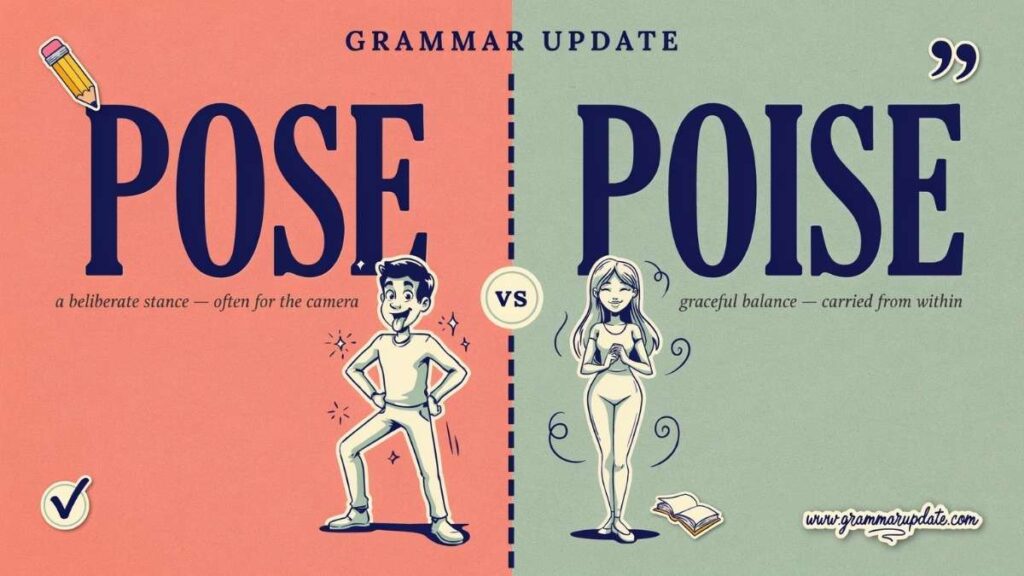
Have you ever paused while writing and wondered, “Is it pose vs poise?” You’re not alone. These two words look almost identical, but they have completely different meanings. The pose vs poise confusion is common because one small letter can change the entire message. Pose relates to actions like asking a question, creating a challenge, or standing for a photo. Poise describes confidence, calmness, and self-control. This guide clears up the difference between pose and poise with simple explanations, practical examples, and grammar tips to help you use the right word confidently every time.
Pose vs Poise Quick Answer
If you’re looking for a fast answer, here’s the key difference between pose and poise.
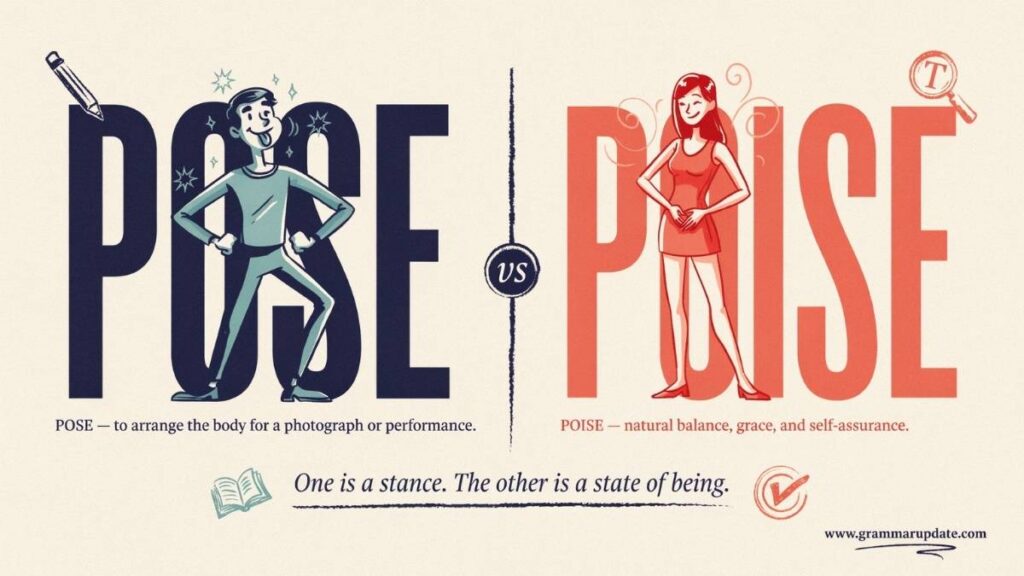
- Pose usually refers to placing yourself in a particular position, presenting something, pretending to be someone else, or creating a question, challenge, or problem.
- Poise refers to calm confidence, graceful behavior, balance, and emotional control, especially in difficult situations.
Here’s a simple comparison.
| Word | Primary Meaning | Example |
|---|---|---|
| Pose | To place, present, or position | She decided to pose for a photo. |
| Poise | Calm confidence and self-control | The speaker answered every question with poise. |
One of the biggest grammar mistakes people make is writing “poise a question.” That expression is incorrect.
The correct phrase is always “pose a question.”
Likewise, if you’re describing someone’s elegance, confidence under pressure, or self-possession, the correct word is poise.
Remember this simple rule:
- Pose is about action, position, or presenting something.
- Poise is about confidence, balance, and graceful behavior.
Understanding this simple distinction solves most pose vs poise confusion in everyday writing.
Learn the difference between confusing more English words
Leary vs Leery Which Is Correct and Difference?
Pose vs Poise Meaning
The easiest way to remember the difference between pose and poise is to understand what each word actually means. Although the words share similar letters and similar pronunciation, they belong to different parts of the English vocabulary and describe completely different ideas.
Let’s examine each word individually.
What Does Pose Mean?
The pose meaning depends on how it’s used in a sentence. It can function as both a verb and a noun.
As a verb, pose means to place yourself in a certain position, present something for consideration, pretend to be someone else, or create a challenge or question.
Common uses include:
- Pose a question
- Pose a problem
- Pose a challenge
- Pose for a picture
- Pose for a photo
- Pose as someone else
The dictionary meaning of pose generally includes these definitions:
- To assume or arrange a particular body posture.
- To present an issue or question.
- To pretend to be someone or something.
- To model for a photograph, painting, or artwork.
Here are several examples of pose in everyday English.
- The reporter decided to pose a difficult question during the interview.
- The family gathered to pose for a picture before dinner.
- The actor posed as a police officer during the movie.
- New technology can pose unexpected challenges for businesses.
- She smiled naturally instead of trying to strike a pose.
Notice that every example involves an action. Someone is presenting, pretending, positioning themselves, or creating a situation.
Pose Definition
The most common pose definition is:
“To place yourself or something in a particular position, present a question or problem, or pretend to be someone else.”
Because pose has multiple meanings, context tells readers exactly how it’s being used.
Pose as a Verb
You’ll encounter pose as a verb far more often than as a noun.
Examples include:
- Can you pose a question for the audience?
- Scientists continue to pose new theories.
- Those icy roads pose a serious danger.
- The children posed for a class photograph.
Each sentence demonstrates a different meaning while following the same basic grammar pattern.
Pose as a Noun
Pose also works as a noun.
In this form, it describes a particular body position or posture.
Examples include:
- The yoga instructor demonstrated a new pose.
- The dancer held the final pose for several seconds.
- Her confident pose impressed the photographer.
In photography, fashion, dance, and art, pose almost always refers to physical stance or body posture.
Posing Meaning
The word posing comes directly from the verb pose.
Depending on context, posing may mean:
- Standing in position for a photograph.
- Pretending to be someone.
- Presenting a question or challenge.
Examples include:
- Posing for graduation photos took nearly an hour.
- The suspect admitted to posing as a doctor.
- Posing difficult questions helps students think critically.
Posed Meaning
Posed is simply the past tense of pose.
Examples include:
- The journalist posed several thoughtful questions.
- They posed together after the ceremony.
- Rising costs posed serious problems for homeowners.
Each example shows how the word changes tense while keeping its meaning.
What Does Poise Mean?
Unlike pose, poise usually describes a person’s character rather than an action.
The poise meaning centers on calm composure, graceful behavior, emotional control, and confidence under pressure.
Someone with poise stays calm during stressful situations instead of becoming nervous or overwhelmed.
You’ll often hear people describe leaders, public speakers, athletes, and performers as having poise.
Examples include:
- She handled the interview with remarkable poise.
- Despite the criticism, he maintained his poise.
- The athlete displayed poise during the championship game.
- Good leaders show poise under pressure.
These examples highlight emotional strength rather than physical movement.
Poise Definition
A common poise definition is:
“The ability to remain calm, confident, balanced, and graceful, especially in difficult situations.”
Many dictionaries also define poise as balance and stability.
Although this older meaning still exists, modern English usually uses poise to describe confidence and composure.
Poise as a Noun
Most of the time, poise functions as a noun.
Examples include:
- Her poise impressed everyone in the room.
- Experience helped him develop greater poise.
- Calm composure often comes with practice.
Because poise is an abstract quality, it cannot usually be counted.
People don’t normally say “three poises.”
Instead, they speak about someone’s level of poise.
Poised Meaning
The adjective poised comes from poise.
It describes someone or something that is prepared, balanced, confident, or ready for success.
Examples include:
- The company is poised for growth next year.
- She looked poised before giving her presentation.
- The team appears poised for success.
- He remained poised throughout the debate.
Notice that poised often describes readiness as well as confidence.
Poise Meaning in English
Modern English commonly uses poise in situations involving:
- Public speaking
- Job interviews
- Leadership
- Business presentations
- Television appearances
- Competitive sports
- High-pressure decision-making
Someone who demonstrates poise in communication speaks clearly, thinks carefully, and stays calm regardless of pressure.
That explains why poise is frequently associated with elegance and confidence, emotional control, self-possession, and graceful behavior.
Learn the difference between confusing more English words
Peice vs Piece Which Spelling Is Correct?
Pose vs Poise Side-by-Side Comparison
Now that you understand each word individually, comparing them side by side makes the difference even clearer.
| Feature | Pose | Poise |
|---|---|---|
| Primary meaning | To position yourself, present something, or pretend | Calm confidence, balance, and graceful behavior |
| Part of speech | Verb and noun | Mostly a noun; also forms the adjective “poised” |
| Common usage | Pose a question, pose a challenge, pose for a photo | Maintain poise, show poise, speak with poise |
| Refers to | Actions, positions, or presenting ideas | Personal qualities and emotional control |
| Typical context | Photography, grammar, discussions, acting | Leadership, interviews, presentations, communication |
| Example | They posed for a family picture. | She answered every question with poise. |
Another simple way to remember the difference between pose and poise is this:
- If you’re talking about doing something, presenting something, or changing your physical stance, use pose.
- If you’re describing confidence, balance and stability, or graceful behavior, use poise.
Think about these two sentences.
- The photographer asked everyone to pose naturally.
- The CEO spoke with poise despite difficult questions.
The first sentence involves body posture.
The second describes confidence under pressure.
That single comparison explains most pose vs poise usage questions you’ll encounter in everyday English.
Mold vs Mould Which Spelling Is Correct?
Pose vs Poise Pronunciation
One reason people mix up pose and poise is that their spellings are similar. Their pronunciations are also close enough to cause confusion, especially during fast conversations. However, they don’t sound exactly the same.
Learning the correct pronunciation makes it easier to recognize each word in speech and use it confidently in your own writing.
Pose Pronunciation
pose (pohz)
The word pose has one syllable and rhymes with words like:
- Nose
- Rose
- Close
- Those
Examples:
- Please pose for the camera.
- The teacher asked each student to pose a thoughtful question.
- Heavy rain can pose a safety risk.
The long “o” sound makes the word smooth and easy to recognize.
Poise Pronunciation
Poise also has one syllable, but it rhymes with words like:
- Voice
- Choice
- Rejoice
Examples:
- She answered every question with poise.
- The athlete showed remarkable poise during the final seconds.
- Good leaders maintain poise under pressure.
Instead of the long “o” sound heard in pose, poise uses the “oi” sound.
Pose vs Poise Pronunciation
The pose vs poise pronunciation difference is small but important.
| Word | Pronunciation | Rhymes With |
|---|---|---|
| Pose | Pohz | Rose, nose, close |
| Poise | Poyz | Voice, choice, rejoice |
Many English learners hear these words quickly in conversation and assume they’re the same. That’s understandable. Still, listening carefully to the vowel sound makes identifying each word much easier.
A helpful memory trick is this:
- Pose has the long “o” sound.
- Poise has the “oi” sound.
Repeating each word aloud several times can help train your ear.
Pose vs Pause Pronunciation
Another common source of confusion is pose vs pause pronunciation.
Although pose and pause begin with the same letter, they are different words with different sounds and meanings.
| Word | Meaning | Pronunciation |
|---|---|---|
| Pose | To position, present, or pretend | Pohz |
| Pause | To stop briefly | Pawz |
Examples:
- The model will pose for the photographer.
- Please pause before answering the question.
Because pose and pause appear in similar contexts, especially when spoken quickly, some learners accidentally substitute one for the other. Paying attention to the vowel sound helps prevent this mistake.
How to Pronounce Pose and Poise Correctly
If you’re wondering how to pronounce pose and how to pronounce poise, follow these simple steps.
For pose:
- Stretch the long “o” sound.
- Finish with a soft “z” sound.
For poise:
- Begin with the “oi” sound heard in “choice.”
- End with the same soft “z” sound.
Practice reading these pairs aloud.
- Pose for a picture.
- Show poise during the interview.
- Pose a challenge.
- Maintain poise under pressure.
- Strike a pose.
- Speak with poise.
Repeating contrasting pairs helps improve pronunciation differences and strengthens your vocabulary practice.
Learn the difference between confusing more English words
Defense vs Defence Which Spelling Is Correct?
Pose vs Poise a Question?
One of the most searched grammar questions is whether you should write pose or poise a question.
The answer is simple.
The only correct expression is pose a question.
Writing poise a question is always incorrect because poise does not mean “to ask,” “to present,” or “to introduce.”
Why “Pose a Question” Is Correct
The verb pose means to present something for consideration.
When you pose a question, you present it for someone to answer.
This meaning has existed in English for centuries and appears in dictionaries, academic writing, journalism, and professional communication.
Examples:
- The professor posed an interesting question.
- The interviewer posed several difficult questions.
- Scientists continue to pose new questions about climate change.
- Every good teacher knows how to pose a question that encourages discussion.
In each sentence, pose means “to present.”
Why “Poise a Question” Is Incorrect
Poise refers to calm confidence, graceful behavior, and emotional control.
Since poise has nothing to do with presenting questions, the phrase poise a question is grammatically incorrect.
Incorrect:
- She poised a question during the meeting.
Correct:
- She posed a question during the meeting.
Replacing pose with poise changes the meaning completely and creates a grammar mistake.
Can You Pose a Question?
Yes. In fact, can you pose a question is one of the most common examples used in English grammar lessons.
Other common expressions include:
- Pose a problem.
- Pose a challenge.
- Pose a threat.
- Pose a risk.
- Pose a concern.
Each phrase uses pose to introduce or present something that requires attention.
Pose or Poise Which Is Correct?
The correct choice depends entirely on what you’re trying to say.
Use pose when talking about:
- Asking or presenting a question.
- Creating a problem.
- Presenting a challenge.
- Standing for a photograph.
- Pretending to be someone else.
Use poise when talking about:
- Calm composure.
- Emotional control.
- Graceful behavior.
- Confidence under pressure.
- Self-possession.
Here’s a quick comparison.
| If You Mean… | Correct Word |
|---|---|
| Present a question | Pose |
| Stand for a picture | Pose |
| Pretend to be someone | Pose |
| Calm confidence | Poise |
| Grace under pressure | Poise |
| Elegance and confidence | Poise |
This simple guide answers the question, “Should I use pose or poise?” in nearly every situation.
Learn the difference between confusing more English words
Trey vs Tray What’s the Difference?
How to Use Pose Correctly
Understanding how to use pose correctly helps eliminate one of the most common English grammar mistakes.
Pose is flexible because it functions as both a verb and a noun. In everyday English, the verb form appears much more frequently.
Pose as a Verb
Most people encounter pose as a verb.
It can mean to present, position, pretend, or create.
Here are its most common uses.
Pose a Question
This is the most common expression involving pose.
Examples:
- The student posed a thoughtful question.
- Reporters posed difficult questions after the announcement.
- Every researcher should pose clear questions before beginning a study.
Pose a Problem
When something creates difficulty, it poses a problem.
Examples:
- Rising temperatures pose a serious problem for farmers.
- Outdated software can pose security risks.
- Poor communication often poses problems for teams.
Pose a Challenge
You can also use pose when introducing a challenge or obstacle.
Examples:
- Learning a new language can pose a challenge.
- Heavy traffic posed unexpected challenges for commuters.
- Budget cuts may pose challenges next year.
Pose a Threat
This expression commonly appears in news articles and professional writing.
Examples:
- Floodwaters pose a threat to nearby communities.
- Fake websites pose a security threat.
- Distracted driving poses a danger to everyone on the road.
Pose for a Picture
In photography, pose means to arrange your body before a camera.
Examples:
- The family posed for a holiday picture.
- Everyone smiled and posed for a group photo.
- The graduates posed proudly with their diplomas.
Pose for a Photo
Although similar to “pose for a picture,” this phrase appears more often in modern conversation.
Examples:
- The actor stopped to pose for a photo with fans.
- Tourists lined up to pose for a photo near the monument.
- She preferred to pose naturally instead of forcing a smile.
Strike a Pose
Strike a pose means to quickly assume a particular body posture.
It’s common in fashion, entertainment, dance, and social media.
Examples:
- The models struck dramatic poses during the fashion show.
- The children laughed as they struck funny poses.
- He struck a confident pose before the photographer started shooting.
Pose Naturally
Professional photographers often encourage people to pose naturally rather than standing stiffly.
Examples:
- Relax your shoulders and pose naturally.
- Children usually pose naturally without much instruction.
- Natural expressions often produce the best photographs.
Pose as Someone
Pose can also mean pretending to be another person.
Examples:
- The criminal posed as a bank employee.
- The actor posed as a detective in the television series.
- Scammers sometimes pose as government officials.
This meaning often appears in crime reports and cybersecurity articles.
Pose Definition in Everyday English
Looking across all these examples, one idea connects every use of pose.
It involves presenting, positioning, pretending, or creating something.
Whether someone poses for a photo, poses a challenge, or poses as someone else, the word always describes an action.
Learn the difference between commonly mixed-up more words
Disk vs Disc What’s the Difference and Which one Is Correct?
How to Use Poise Correctly
Unlike pose, which usually describes an action, poise refers to a personal quality. It describes someone’s ability to remain calm, confident, and graceful, even in stressful situations. People with poise don’t panic easily. They stay focused, think clearly, and respond thoughtfully.
You’ll often see poise used when talking about leaders, athletes, public speakers, job candidates, and anyone who performs well under pressure.
Understanding the correct usage of poise makes the difference between pose and poise much easier to remember.
Poise as a Noun
In modern English, poise is almost always used as a noun. It represents an abstract quality rather than a physical action.
Someone can have poise, develop poise, or maintain poise, but they don’t usually “do” poise the way they “pose” for a picture.
Examples:
- The CEO handled the difficult meeting with poise.
- Her poise impressed everyone during the presentation.
- Experience often helps people develop greater poise.
- The athlete showed incredible poise in the final minutes of the game.
In every example, poise describes confidence and emotional control rather than movement.
Poise Definition
The most common poise definition is:
“The ability to remain calm, confident, and graceful, especially in challenging situations.”
Many dictionaries also define poise as balance or equilibrium. While that meaning still exists, everyday English usually focuses on calm composure and self-confidence.
What Does Poise Mean?
If you’re wondering, “What does poise mean?” think of someone who stays relaxed when everyone else is nervous.
A person with poise:
- Speaks confidently.
- Thinks before reacting.
- Handles criticism professionally.
- Remains calm during unexpected situations.
- Shows respect even under pressure.
These qualities make poise valuable in both personal and professional life.
Poise Meaning in English
The poise meaning in English extends beyond simple confidence. It combines several positive qualities that help people communicate effectively and make good decisions.
These qualities include:
- Calm composure
- Graceful behavior
- Emotional control
- Self-possession
- Balance and stability
- Confidence under pressure
- Elegance and confidence
Because of these characteristics, poise is often associated with successful leaders, teachers, judges, presenters, and customer service professionals.
Examples of Poise
Here are some examples of poise in everyday situations.
At work:
- The manager maintained poise while solving an unexpected problem.
- Her poise helped calm the entire team.
During public speaking:
- Even after forgetting one slide, he continued with remarkable poise.
- The speaker answered every audience question with poise.
In sports:
- The goalkeeper showed poise during the penalty shootout.
- Great athletes combine skill with poise under pressure.
At school:
- The student remained calm and answered confidently with poise.
- Her poise during the debate earned praise from the judges.
These examples show that poise isn’t limited to one profession or activity. It’s a quality that benefits people in every area of life.
Poise in Communication
Effective communication requires more than choosing the right words. It also requires confidence and self-control.
People with poise in communication:
- Listen carefully before responding.
- Speak clearly and respectfully.
- Maintain eye contact.
- Stay calm during disagreements.
- Express ideas confidently.
For example:
Instead of becoming defensive during a meeting, a manager with poise listens carefully, acknowledges different opinions, and responds professionally.
That calm approach often leads to better conversations and stronger relationships.
Poise in Public Speaking
Public speaking is one of the clearest examples of poise in action.
Many people feel nervous before standing in front of an audience. Speakers with poise manage those nerves without letting them affect their performance.
They often:
- Speak at a steady pace.
- Maintain confident body language.
- Recover smoothly from small mistakes.
- Stay composed during difficult questions.
Example:
Although the microphone stopped working briefly, the presenter maintained poise and continued once the issue was resolved.
Poise in Interviews
Job interviews can be stressful, making poise an important professional skill.
Interviewers often notice how candidates react when asked unexpected questions.
Someone with poise:
- Takes a moment to think.
- Gives organized answers.
- Remains polite.
- Doesn’t panic under pressure.
Example:
Despite being asked a difficult technical question, she answered with poise and confidence.
Maintain Poise
One of the most common expressions is maintain poise.
It means to remain calm and confident regardless of what’s happening around you.
Examples:
- Good leaders maintain poise during crises.
- Emergency responders maintain poise in dangerous situations.
- Experienced pilots maintain poise during unexpected weather conditions.
Maintaining poise doesn’t mean ignoring emotions. Instead, it means managing emotions effectively.
Poised Meaning
The adjective poised comes directly from the noun poise.
It describes someone or something that is ready, balanced, confident, or prepared for success.
Examples:
- The startup is poised for growth.
- The team is poised for success this season.
- She looked poised before beginning her speech.
- Investors believe the company is poised for expansion.
Notice that poised often suggests readiness as much as confidence.
Poised for Success
You’ll frequently see the phrase poised for success in business, education, and news articles.
It means someone or something is well prepared to achieve positive results.
Examples:
- After months of preparation, the company is poised for success.
- The student is poised for academic achievement.
- Strong leadership has the organization poised for long-term growth.
Poised for Growth
Businesses, markets, and industries often use the phrase poised for growth.
Examples:
- The renewable energy industry is poised for growth.
- The local economy appears poised for expansion.
- New technology has the company poised for future opportunities.
In these examples, poised suggests readiness rather than certainty.
Learn the difference between commonly mixed-up more words
Feal vs Feel Which Spelling Is Correct?
Pose vs Poise in Sentences
One of the best ways to master confusing English words is to compare them in real sentences.
The following pose vs poise sentence examples show how each word functions naturally in context.
Examples Using Pose
- The reporter decided to pose a difficult question.
- Rising temperatures pose serious environmental challenges.
- The tourists stopped to pose for a photo.
- She learned how to pose naturally during the photography session.
- The actor posed as a detective in the television series.
- New regulations may pose problems for small businesses.
- The yoga instructor demonstrated each pose carefully.
- Heavy snowfall can pose risks for drivers.
- The children happily posed for a picture.
- His comments posed an interesting challenge for the research team.
Examples Using Poise
- The judge handled the debate with remarkable poise.
- Her poise impressed every interviewer.
- The athlete maintained poise despite intense pressure.
- Good leaders inspire confidence through poise.
- He answered every question with calm composure and poise.
- Her graceful behavior reflected years of experience.
- The speaker showed confidence under pressure.
- Emotional control helped her remain poised throughout the discussion.
- The company appears poised for growth this year.
- She demonstrated elegance and confidence during the ceremony.
Learn the difference between commonly mixed-up more words
Everywhere vs Every Where Which One Is Correct ?
Common Expressions with Pose
Several everyday expressions use the word pose. Learning these phrases improves both your vocabulary and your writing.
| Expression | Meaning | Example |
|---|---|---|
| Pose a question | Present a question | The teacher posed a question to the class. |
| Pose a problem | Create difficulty | Rising costs pose a problem for many families. |
| Pose a challenge | Present an obstacle | Learning a new language can pose a challenge. |
| Pose a threat | Create danger | Cyberattacks pose a threat to businesses. |
| Pose a risk | Create potential harm | Wet roads pose a risk to drivers. |
| Pose for a photo | Stand for a photograph | Everyone posed for a photo after graduation. |
| Strike a pose | Assume a body position | The dancers struck a pose before the music began. |
| Pose as someone | Pretend to be another person | The scammer posed as a bank employee. |
These expressions appear frequently in newspapers, business reports, academic writing, and everyday conversation.
Common Expressions with Poise
Poise also appears in many common expressions, although they focus on confidence rather than action.
| Expression | Meaning | Example |
|---|---|---|
| Maintain poise | Stay calm | She maintained poise throughout the interview. |
| Show poise | Demonstrate confidence | The captain showed poise during the final minutes. |
| Speak with poise | Communicate confidently | He spoke with poise and clarity. |
| Act with poise | Behave gracefully | She acted with poise despite the criticism. |
| Display poise | Show emotional control | The young athlete displayed remarkable poise. |
| Poised for success | Ready to succeed | The business is poised for success. |
| Poised for growth | Ready to expand | The industry is poised for growth. |
Pose vs Poise Synonyms
Understanding synonyms can make the pose vs poise difference easier to remember. Although some words may appear similar, they don’t always work in the same situations. Choosing the wrong synonym can change the meaning of your sentence.
Pose Synonyms
The best synonym for pose depends on the context.
When pose means “to position your body,” common synonyms include:
| Synonym | Meaning | Example |
|---|---|---|
| Position | To place something in a certain way | She positioned herself near the window. |
| Place | To put something somewhere | He placed the object on the table. |
| Arrange | To organize or set up | The photographer arranged the group for the picture. |
| Stand | To place yourself upright | The students stood for the photograph. |
pose means “to present a question or problem,” synonyms include:
| Synonym | Meaning | Example |
|---|---|---|
| Present | To introduce an idea | The report presented several concerns. |
| Raise | To bring up a topic | She raised an important question. |
| Create | To cause something | The storm created serious problems. |
| Introduce | To bring something forward | The speaker introduced a new idea. |
When pose means “to pretend to be someone,” synonyms include:
| Synonym | Meaning | Example |
|---|---|---|
| Pretend | Act as if something is true | He pretended to be a doctor. |
| Impersonate | Copy another person’s identity | The criminal impersonated an official. |
| Fake | Create a false appearance | The website was designed to fake a real company. |
Poise Synonyms
Poise describes personal qualities, so its synonyms focus on confidence, balance, and emotional control.
| Synonym | Meaning | Example |
|---|---|---|
| Composure | Calmness during stress | She maintained her composure during the crisis. |
| Confidence | Belief in your abilities | His confidence helped him succeed. |
| Self-control | Ability to manage emotions | Good leaders need self-control. |
| Grace | Elegant and respectful behavior | She handled the situation with grace. |
| Balance | Stability and control | The dancer showed excellent balance. |
| Assurance | A feeling of certainty | He spoke with assurance during the meeting. |
The phrase pose vs poise synonym can be confusing because these words have completely different synonym groups.
Pose connects with action.
Poise connects with character.
That distinction helps you choose the right word quickly.
Learn the difference between confusing word pairs
Licence vs License Which Spelling Is Correct?
Why People Confuse Pose and Poise
The pose vs poise confusion happens because English contains many words that look and sound almost identical but have different meanings.
These are often called commonly confused words or near-homophones.
Pose and poise create confusion for several reasons.
Similar Spelling
Both words begin with “pos” and contain only four or five letters.
When someone writes quickly, the extra “i” in poise is easy to miss or add by mistake.
Examples:
Incorrect:
- She showed great pose during the interview.
Correct:
- She showed great poise during the interview.
The first sentence suggests a physical position, not confidence.
Similar Pronunciation
The pose pronunciation and poise pronunciation are close.
Both words end with a “z” sound, which makes them easy to mix up during conversation.
However:
- Pose sounds like “pohz.”
- Poise sounds like “poyz.”
The vowel sound changes the word completely.
Autocorrect Mistakes
Modern writing tools sometimes create additional confusion.
A writer may type “poise a question” when they mean “pose a question.” Spell-check programs may not always catch the mistake because both words are correctly spelled English words.
This is why understanding meaning matters more than relying only on technology.
Similar Contexts
Some situations involve both physical appearance and confidence, which can make the words feel connected.
For example:
“The speaker stood with perfect poise.”
This describes confidence.
“The speaker struck a pose.”
This describes body posture.
A person can have both pose and poise at the same time, but they describe different things.
Learn the difference between confusing word pairs
Planing vs Planning Difference and Correct Usage
How to Remember Pose vs Poise
Many learners ask, “How do I remember the difference between pose and poise?”
A simple memory trick can help.
Remember: Pose = Position
The word pose starts with “pos,” which can remind you of position.
Use pose when someone:
- Positions their body.
- Presents a question.
- Creates a problem.
- Pretends to be someone.
Examples:
- Pose for a photo.
- Pose a question.
- Pose a challenge.
Remember: Poise = Inner Confidence
Poise describes something inside a person.
Think:
Poise = Personal confidence.
Use poise when someone shows:
- Calm composure.
- Emotional control.
- Confidence under pressure.
- Graceful behavior.
Examples:
- She answered with poise.
- He maintained his poise.
- The athlete showed poise during the final match.
A Simple Comparison
| Situation | Correct Word |
|---|---|
| Standing for a photograph | Pose |
| Asking an important question | Pose |
| Creating a difficult situation | Pose |
| Staying calm during stress | Poise |
| Showing confidence in public | Poise |
| Acting professionally under pressure | Poise |
This pose vs poise easy explanation works because it connects each word with a clear idea.
Learn the difference between confusing word pairs
Imbed vs Embed Which Spelling Should You Use?
Pose vs Poise Grammar Rules
Understanding pose vs poise grammar helps you avoid common English mistakes.
Although both words are nouns, they behave differently in sentences.
Pose as a Verb
Pose frequently appears as a verb.
Common sentence patterns include:
Subject + pose + object
Examples:
- The journalist posed a question.
- The storm posed a threat.
- The photographer posed the model.
Subject + pose + for + noun
Examples:
- They posed for a picture.
- She posed for a photo.
Subject + pose + as + person/role
Examples:
- The criminal posed as a police officer.
- The actor posed as a scientist.
Pose as a Noun
As a noun, pose usually refers to a physical position.
Examples:
- The yoga pose requires flexibility.
- The dancer held the pose.
- The model changed her pose.
Poise as a Noun
Poise is usually an abstract noun.
Common patterns include:
Subject + have/show/maintain + poise
Examples:
- She showed poise during the interview.
- He maintained his poise.
- The player had incredible poise.
Because poise describes a quality, it often appears with verbs related to possession or demonstration.
Poised as an Adjective
Poised describes someone who appears confident, calm, or ready.
Examples:
- She looked poised before the presentation.
- The company is poised for growth.
- The team is poised for success.
Understanding these grammar patterns makes pose vs poise correct usage much easier.
Pose vs Poise in Writing
Good writing depends on choosing words that communicate your exact meaning. A small spelling difference can completely change your message.
Pose vs Poise in Academic Writing
Academic writing often uses pose when discussing questions, theories, and challenges.
Examples:
- Researchers pose questions about future developments.
- Climate change poses significant challenges.
- The study poses a new perspective.
Poise appears less often in academic writing but may describe behavior.
Examples:
- The researcher responded with poise during the presentation.
- Students can develop poise through public speaking practice.
Pose vs Poise in Professional Writing
Professional communication often uses both words.
Examples using pose:
- The new regulations pose challenges for businesses.
- The proposal poses several important questions.
Examples using poise:
- The manager handled the situation with poise.
- Strong leadership requires confidence and poise.
Choosing the correct word improves credibility and clarity.
Pose vs Poise Examples in Writing
Here are more pose vs poise examples to show the difference.
Incorrect:
- The manager showed great pose during the difficult meeting.
Correct:
- The manager showed great poise during the difficult meeting.
Why?
Because the sentence describes emotional control, not physical position.
Incorrect:
- The researcher poised an interesting question.
Correct:
- The researcher posed an interesting question.
Why?
Because the researcher presented a question.
Incorrect:
- The athlete struck a poise before the competition.
Correct:
- The athlete struck a pose before the competition.
Why?
Because the athlete created a physical stance.
Common Mistakes to Avoid
Writing “Poise a Question”
This is the most common mistake.
Always write:
- Pose a question.
Never write:
- Poise a question.
Using Pose for Confidence
Example:
Wrong:
- She handled the interview with pose.
Correct:
- She handled the interview with poise.
Confidence requires poise.
Using Poise for Body Position
Example:
Wrong:
- The photographer asked her to poise.
Correct:
- The photographer asked her to pose.
Physical positioning requires pose.
Confusing “Poised” and “Posed”
These two words look very similar.
Posed:
- The journalist posed a question.
- They posed for a photo.
Poised:
- She looked poised before the speech.
- The company is poised for growth.
The spelling difference changes the meaning.
Learn the difference between confusing word pairs
Bright vs Brite Which Spelling Is Correct?
Pose vs Poise Practice Session
Complete each sentence by filling in the blank with the correct word: pose, posed, posing, pose, poise, poised, or poises.
- The journalist decided to ______ an important question during the interview.
- The athlete showed incredible ______ during the final moments of the competition.
- The family gathered outside to ______ for a holiday photo.
- The new technology may ______ challenges for small businesses.
- Despite the pressure, she maintained her ______ during the presentation.
- The actor ______ as a doctor in the movie scene.
- The teacher ______ a difficult question to encourage discussion among students.
- The dancer held the final ______ perfectly before leaving the stage.
- Good leaders remain calm and show ______ during difficult situations.
- The company is ______ for significant growth in the coming years.
- The photographer asked everyone to ______ naturally instead of forcing a smile.
- Rising costs can ______ serious problems for many families.
- The speaker answered every question with confidence and ______.
- The criminal was caught after ______ as a government employee.
- The yoga instructor demonstrated a challenging ______ for beginners.
- The manager handled the unexpected crisis with great ______.
- Scientists often ______ questions that lead to new discoveries.
- The children enjoyed ______ for pictures at the birthday party.
- Her calm attitude and confidence showed excellent ______.
- The storm ______ a major threat to nearby communities.
- The company appears ______ to become a market leader.
- The model changed her ______ several times during the photo session.
- Public speakers need confidence, preparation, and ______ to connect with audiences.
- The reporter ______ several questions about the new policy.
- The student remained ______ while answering questions in front of the entire class.
Answers
- pose
- poise
- pose
- pose
- poise
- posed
- posed
- pose
- poise
- poised
- pose
- pose
- poise
- posing
- pose
- poise
- pose
- posing
- poise
- posed
- poised
- pose
- poise
- posed
- poised
Here’s a trusted source for clear word meanings:
FAQs
What is the difference between pose and poise?
Pose and poise are different words with different meanings. Pose usually refers to an action, such as positioning your body, presenting a question, creating a problem, or pretending to be someone else. Poise describes a personal quality, such as calm confidence, balance, and emotional control.
Example:
- She posed for a photo.
- She answered the interview questions with poise.
Is it poise or pose?
The correct word depends on the meaning you want to express.
Use pose when you mean:
- A physical position
- A question or problem
- A challenge or threat
- Pretending to be someone
Use poise when you mean:
- Confidence
- Calm behavior
- Grace under pressure
- Emotional balance
What is the simple meaning of pose?
The simple meaning of pose is to place, position, present, or pretend.
Examples:
- The model posed for a picture.
- The teacher posed an interesting question.
- The actor posed as a detective.
What does poise mean?
Poise means staying calm, confident, and controlled, especially during difficult situations. A person with poise handles pressure without losing focus or becoming overwhelmed.
Example:
- The speaker answered difficult questions with poise.
Does pose mean position?
Yes. Pose can mean a position, especially when referring to body posture. This meaning is common in photography, art, yoga, and performance.
Example:
- The dancer held a graceful pose on stage.
What is a poise position?
A poise position refers to a balanced and confident posture. While poise is not usually a specific physical position, it can describe the way someone carries themselves with confidence, stability, and elegance.
How can you tell if someone has poise?
You can often recognize poise through a person’s behavior. Someone with poise usually:
- Remains calm under pressure
- Communicates clearly
- Shows confidence without arrogance
- Listens before responding
- Handles criticism respectfully
- Maintains emotional control
What are some examples of poise?
Examples of poise include:
- A leader staying calm during a crisis
- A student confidently giving a speech
- An athlete remaining focused during an important game
- An employee handling criticism professionally
What are the signs of a poised person?
A poised person often shows:
- Self-confidence
- Good manners
- Calm communication
- Thoughtful responses
- Professional behavior
- Emotional stability
Poised people do not avoid challenges. They handle them with control and confidence.
What does pose mean in slang?
In slang, pose can sometimes refer to someone pretending, showing off, or creating a false appearance. The meaning depends on the context.
Example:
- He is only posing as an expert.
This suggests the person is pretending to have knowledge or skills they may not actually have.
What does “just a pose” mean?
“Just a pose” means something is only an appearance or act rather than something genuine.
Example:
- His confidence was just a pose.
This means the confidence may have been fake or temporary.
What does it mean to pose someone?
To pose someone usually means to arrange their body position for a photograph, artwork, or performance.
Example:
- The photographer posed the model near the window.
It can also mean presenting someone in a particular way.
What does it mean to let someone pose you?
To let someone pose you means allowing another person to position or arrange your body, usually for a photo, painting, or artistic purpose.
Example:
- The photographer posed her near the entrance for the portrait.
What is an example of pose?
Examples of pose include:
- The family posed for a wedding photo.
- The scientist posed an important question.
- The new rule poses a challenge for businesses.
- The actor posed as a journalist in the film.
What is another word for pose?
The best synonym for pose depends on the meaning.
1.For physical position:
- Position
- Place
- Arrange
2.For presenting something:
- Raise
- Present
- Introduce
3.For pretending:
- Pretend
- Impersonate
- Fake
What words are similar to pose?
Words similar to pose include:
- Position
- Present
- Raise
- Ask
- Suggest
- Create
- Pretend
- Model
However, each synonym has slightly different uses.
What is a better word for pose?
A better replacement for pose depends on your sentence.
Examples:
Instead of “pose a question,” you can say:
- Ask a question
- Raise a question
Instead of “pose for a photo,” you can say:
- Stand for a photo
- Model for a photo
What is another word for poise?
Synonyms for poise include:
- Composure
- Confidence
- Self-control
- Grace
- Balance
- Calmness
- Assurance
What are synonyms for poised?
Synonyms for poised include:
- Confident
- Calm
- Prepared
- Composed
- Ready
- Self-assured
Example:
- She looked poised before the presentation.
Similar:
- She looked confident before the presentation.
What is poise slang for?
Poise is not commonly used as slang. In casual speech, people may use it to describe someone who appears confident, stylish, or naturally in control.
Example:
- She has so much poise.
This usually means the person carries themselves with confidence.
What is poise in a woman?
Poise in a woman refers to confidence, grace, emotional control, and the ability to handle situations with maturity. It is not about appearance alone. It reflects how someone communicates, reacts, and treats others.
What makes a woman poised?
A poised woman often demonstrates:
- Confidence without arrogance
- Respectful communication
- Emotional awareness
- Good judgment
- Calmness during challenges
- Self-respect
Poise comes from personality, experience, and self-confidence.
How do you describe someone with poise?
You can describe someone with poise by saying they are:
- Calm under pressure
- Graceful
- Confident
- Composed
- Professional
- Self-assured
Example:
- She handled the difficult conversation with remarkable poise.
What are the synonyms of poise?
Common synonyms of poise include:
- Composure
- Confidence
- Balance
- Grace
- Control
- Assurance
Does pose mean suggest?
Yes, pose can sometimes mean suggest or present, especially when introducing an idea, question, or problem.
Example:
- The study poses a new theory.
This means the study presents or suggests a theory.
What is the antonym of pose?
The opposite of pose depends on the meaning.
1.For physical positioning:
- Relax
- Move naturally
2.For pretending:
- Be genuine
- Be authentic
3.For presenting a question:
- Answer
- Resolve
How do you use the word pose?
You can use pose in several ways:
As a verb:
- She posed a question.
- He posed for a photo.
- The issue poses a challenge.
As a noun:
- The model held a pose.
What does it mean to pose as someone?
To pose as someone means to pretend to be another person, usually by taking on their identity or role.
Examples:
- The scammer posed as a bank employee.
- The actor posed as a doctor in the movie.
Is it correct to say “nice pose”?
Yes. “Nice pose” is correct when talking about someone’s physical position, especially in photography, dance, yoga, or art.
Examples:
- Nice pose! That photo looks great.
- The dancer created a beautiful pose.
However, you would not use “nice pose” to describe someone’s confidence. In that situation, use “great poise.”
Example:
- She showed great poise during the interview.
Conclusion
Pose and poise may look like twins, but they have completely different meanings. The easiest way to remember the difference is this: pose is about action, while poise is about attitude.
You pose for a photo, pose a question, or pose a challenge. You show poise when you stay calm, confident, and graceful under pressure.
So, when you’re unsure whether to use pose or poise, look at the meaning. If it involves a position, action, or presentation, choose pose. If it describes confidence, balance, or emotional control, choose poise.
One small letter can create a big grammar mistake, but understanding the difference makes your writing clearer and more accurate. With this simple trick, pose vs poise confusion becomes easy to avoid.

Jhon AJS, the creative mind behind Grammar Update, is an experienced blogger passionate about simplifying English grammar. He focuses on explaining confusing word vs word differences, grammar rules, punctuation, and sentence structure in a clear and practical way. Through easy to understand guides and examples, Jhon helps readers improve their writing and communicate with confidence. With years of blogging experience, he continues to share helpful insights that make learning grammar simple, useful, and accessible for everyone.