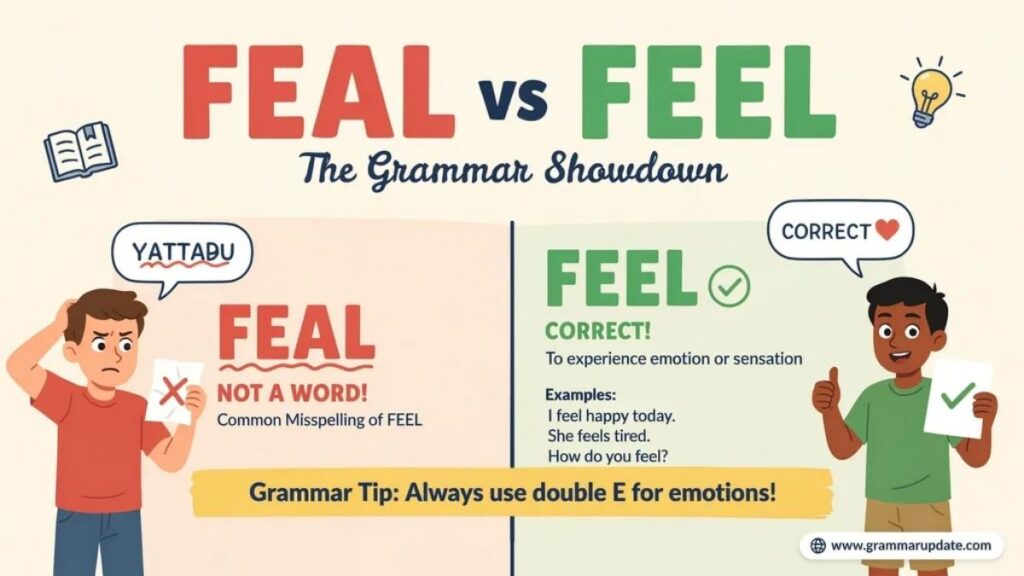
Have you ever looked at the words feal vs feel and wondered if they were both correct? You’re not the only one. Since both words sound exactly the same, it’s easy to mix them up. The good news is that the answer is simple. In modern English, feel is the correct spelling when you’re talking about emotions, opinions, physical sensations, or the sense of touch. Although feal is a real word, it is an old, obsolete term that means “loyal” or “faithful” and is rarely used today. This guide will clear up the confusion around feal vs feel with simple explanations, real-life examples, grammar tips, and easy memory tricks so you can choose the correct word every time.
Quick Answer Feal vs Feel?
If you’re wondering, “feel or feal which is correct,” the answer is simple.
| Word | Modern English | Everyday Writing | Dictionary Status |
|---|---|---|---|
| Feel | Yes | Correct | Common word |
| Feal | No | Usually incorrect | Obsolete historical word |
For everyday communication, always write feel.
Examples:
- I feel happy today.
- Do you feel better now?
- We feel confident about the results.
- Feel free to ask questions.
In contrast, feal rarely appears outside historical writings. Most modern dictionaries label it as an obsolete word or an archaic English word.
If your spell checker marks feal as incorrect, it is usually protecting you from a common typo rather than correcting a modern vocabulary choice.
Learn the difference between often confused words
Anual vs Annual Which Spelling Is Correct?
What Does Feel Mean?
Understanding feel meaning helps you avoid one of the most common spelling mistakes in English.
The word feel is primarily a verb. It describes experiencing emotions, sensing something through touch, noticing physical conditions, or expressing an opinion.
According to the Merriam-Webster Dictionary, Oxford English Dictionary, Cambridge Dictionary, and Collins Dictionary, feel has remained an essential part of Modern English for centuries.
Feel Definition
The basic feel definition is:
“To experience or become aware of something through touch, emotion, or perception.”
People use the word every day because it describes both physical sensation and emotional response.
For example:
- I feel cold.
- She feels excited.
- They feel nervous before interviews.
- We feel grateful for your support.
Each sentence describes an emotional feeling or a physical sensation.
Feel as a Verb
The feel verb has several meanings depending on context.
To Experience Emotions
One of the most common uses of feel is expressing emotions.
Examples:
- I feel happy after the good news.
- She feels anxious before exams.
- They feel proud of their achievements.
- We feel lucky to be here.
Here, feel expresses an emotional response rather than physical contact.
To Perceive Through Touch
Feel also means perceiving something using the sense of touch.
Examples:
- Feel the fabric before buying it.
- I felt the smooth surface.
- Can you feel the difference?
- He felt the temperature of the water.
This meaning relates directly to tactile sensation.
To Express an Opinion
Sometimes feel means “to believe” or “to think.”
Examples:
- I feel this plan will succeed.
- She feels that everyone deserves respect.
- They feel the project needs more time.
Although similar to think, feel often suggests a personal opinion influenced by emotion or experience.
To Notice Physical Conditions
Feel frequently describes physical conditions.
Examples:
- I feel sick.
- He feels tired.
- She feels stronger today.
- The room feels warm.
In each example, the speaker experiences a physical sensation.
Feel as a Noun
Although people mostly use feel as a verb, it can also function as a noun.
In this form, it describes texture, atmosphere, or general impression.
Examples:
- This jacket has a soft feel.
- The office has a friendly feel.
- The room has a relaxing feel.
Notice that the noun refers to an overall impression rather than an action.
Learn the difference between often confused words
Everywhere vs Every Where Which One Is Correct ?
What Does Feal Mean?
Many people search “feal meaning” after seeing the word online. Others wonder, “is feal a word?”
The answer surprises many English learners.
Yes, feal is a real word. However, it is no longer part of standard everyday English.
Is Feal a Real Word?
Yes.
Feal appears in respected historical dictionaries, but modern dictionaries label it as obsolete or archaic vocabulary.
An obsolete word once had regular use but gradually disappeared from everyday speech and writing.
Today, most people never encounter feal unless they study historical English, medieval literature, or language development.
This explains why many spell checkers highlight feal as a possible error.
Feal Definition
Historically, feal means:
- Loyal
- Faithful
- Trustworthy
The word often described a loyal follower, faithful servant, or someone devoted to another person.
For example:
- The knight remained feal to his king.
- Every feal servant protected the kingdom.
- The feal companion never betrayed his friend.
These examples sound unusual today because the word belongs to an earlier stage of English.
Feal Meaning in Old English and Middle English
Many people ask whether feal is an Old English word.
The answer is slightly more complicated.
The modern historical word developed through Middle English and Scots rather than existing as a common word in today’s English.
Over time, words like loyal and faithful replaced feal in ordinary communication.
Language constantly changes. Some words become popular while others slowly disappear.
Feal belongs to that second category.
Today, it survives mainly in:
- Historical novels
- Medieval documents
- Language research
- Old poetry
- Historical dictionaries
Outside these situations, modern writers almost always choose feel.
When Can You Correctly Use Feal?
Although uncommon, feal still has legitimate uses.
You may encounter it in:
Historical Literature
Authors writing about medieval Europe sometimes preserve authentic vocabulary.
Example:
“The feal knight defended the castle until sunrise.”
Scottish Historical Writing
Some older Scottish texts include feal because it remained in regional usage longer than in standard English.
Medieval Documents
Legal records, poems, and manuscripts occasionally include feal when describing loyalty.
Academic Research
Linguists and historians studying obsolete English words often discuss feal definition and historical usage.
Outside these contexts, replacing feel with feal creates a spelling mistake.
Learn the difference between often confused words
Bright vs Brite Which Spelling Is Correct?
Feal vs Feel What’s the Difference?
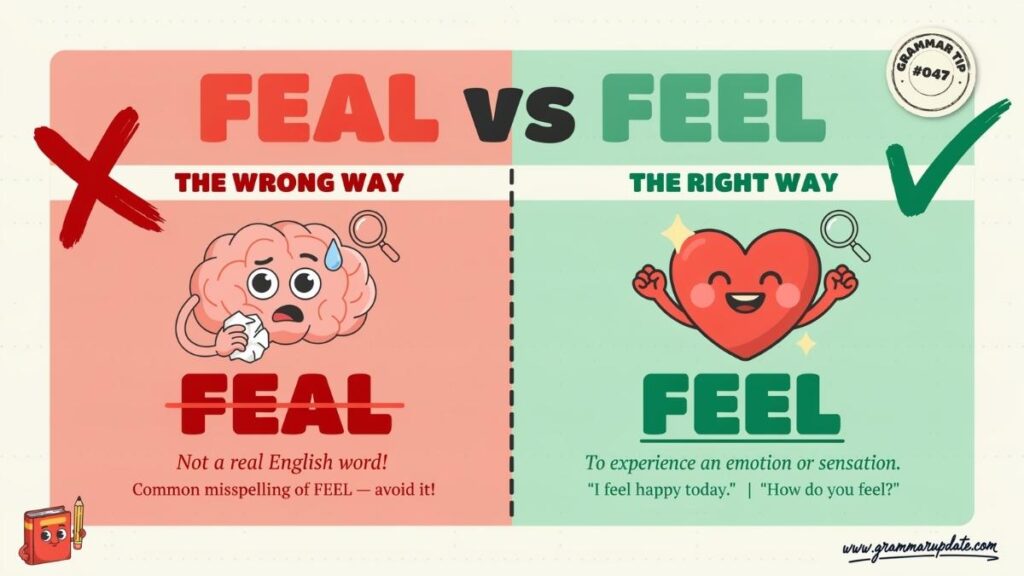
The difference between feal vs feel becomes much clearer when comparing them side by side.
| Feature | Feel | Feal |
|---|---|---|
| Modern English usage | Yes | Rare |
| Everyday writing | Correct | Usually incorrect |
| Meaning | Experience emotions, touch, opinion, physical sensation | Loyal, faithful |
| Part of speech | Mainly verb, sometimes noun | Adjective |
| Dictionary status | Standard English | Obsolete English word |
| Common in conversation | Yes | No |
| Used in schools | Yes | Rarely |
| Common spelling mistake | No | Yes |
The comparison shows that these words may sound identical, but they belong to very different parts of the English language.
If you’re writing emails, essays, business reports, blog posts, or social media updates, choose feel every time.
How to Pronounce Feel and Feal
Many spelling confusion problems happen because English contains numerous homophones.
These are words that sound alike but have different spellings or meanings.
Do Feal vs Feel Sound the Same?
Yes.
The feal vs feel sound is identical in standard English pronunciation.
They rhyme with:
- Deal
- Heal
- Meal
- Peel
- Real
- Seal
- Wheel
Because both words share the same pronunciation, many writers accidentally replace one with the other.
This explains why searches for feal pronunciation and feel pronunciation remain popular.
feel
Feal Pronunciation
Even though feal is obsolete, its pronunciation matches feel exactly.
That means:
- Feel pronunciation: /feel/
- Feal pronunciation: /feel/
No difference exists in normal speech.
Only the spelling and meaning change.
This makes feal vs feel pronunciation especially confusing for English learners who rely on sound rather than spelling .
Learn the difference between often confused words
Kindergartner vs Kindergartener Which spelling Is Correct?
Why People Misspell Feel as Feal
English spelling rarely follows simple pronunciation rules.
Many words sound alike while using completely different spellings.
That is exactly what happens here.
Sound-Based Spelling
People often write words exactly as they hear them.
Since both words sound identical, someone unfamiliar with the standard spelling may naturally write feal.
Typing Errors
Fast typing creates another source of mistakes.
The letters “ea” and “ee” appear in many English words.
Examples include:
- Read
- Lead
- Bread
- Great
- Clean
- Speak
Because English spelling rules contain many exceptions, writers sometimes choose the wrong vowel combination.
English Learners
Students learning English frequently search:
- Is feal correct English?
- Can you use feal instead of feel?
- What is the difference between feal vs feel?
These questions arise because pronunciation alone cannot always determine spelling.
Learning the correct English spelling requires exposure to reading and writing.
Autocorrect Doesn’t Always Catch Every Error
Although many spelling checkers recognize feal as unusual, some applications leave it unchanged because it exists as an obsolete dictionary entry.
Proofreading remains important.
Reading your work slowly often catches mistakes that software misses.
Learn the difference between confusing word pairs
Investor vs Investee What’s the Difference and usage ?
Feel vs Feal in Sentences
Examples make grammar easier to understand than definitions alone.
Correct Feel Usage
These feel examples show proper modern English usage.
Emotion
- I feel excited about tomorrow.
- She feels confident during presentations.
- They feel grateful for your help.
Physical Sensation
- I feel cold this morning.
- He feels pain in his shoulder.
- We feel the warmth of the sun.
Opinion
- I feel this solution will work.
- She feels everyone deserves another chance.
- They feel the meeting should continue.
Touch
- Feel the surface before painting it.
- Can you feel the vibration?
- He carefully felt the edge of the stone.
These feel sentence examples represent standard English grammar and appear in everyday communication.
Historical Feal Usage
The following feal in a sentence examples reflect historical usage rather than modern writing.
- The feal soldier remained loyal until the end.
- Every feal servant honored the king.
- The feal companion protected his master.
- She remained feal despite great hardship.
Although grammatically correct in historical contexts, these sentences sound old-fashioned today.
Modern writers almost always replace feal with loyal or faithful.
Learn the difference between confusing word pairs
Flatform vs Platform Difference which is correct?
Feeling vs Fealing
Another common spelling confusion involves feeling vs fealing.
The correct spelling is always feeling.
Feeling comes directly from the verb feel.
Examples include:
- I have a strange feeling.
- She’s feeling much better today.
- They’re feeling optimistic.
- That feeling never disappeared.
The spelling fealing is not accepted in standard English dictionaries.
It is simply a common misspelling of feel.
Whenever you add “-ing” to feel, keep the double “e.”
Correct:
- Feel
- Feeling
- Feelings
- Felt
Incorrect:
- Fealing
- Feelings
Learn the difference between confusing word pairs
Stopping vs Stoping Which Spelling Is Correct?
Feel Free or Feal Free
One of the most searched questions online is, “Should I write feel free or feal free?” The answer is simple.
The correct phrase is always feel free.
This expression appears in everyday conversations, emails, customer service messages, business communication, websites, and academic writing. It politely gives someone permission or encouragement to do something.
Examples:
- Feel free to ask any questions.
- Feel free to contact us anytime.
- Feel free to share your ideas.
- Feel free to call if you need help.
- Feel free to leave a comment below.
The phrase “feal free” is incorrect because feel is the correct spelling in Modern English.
If you accidentally write “feal free,” most readers will recognize it as a typo instead of a valid phrase.
Learn the difference between confusing word pairs
Focuses vs Focusses Which Spelling Is Correct?
Common Expressions That Use Feel
The word feel appears in hundreds of everyday expressions. Learning these phrases improves both your English vocabulary and your confidence when speaking or writing.
Here are some of the most common expressions.
| Expression | Meaning | Example |
|---|---|---|
| Feel free | Permission to do something | Feel free to ask questions. |
| Feel better | Recover from illness or sadness | I hope you feel better soon. |
| Feel good | Experience happiness or comfort | Exercise helps me feel good. |
| Feel bad | Experience sadness or guilt | She felt bad about the mistake. |
| Feel comfortable | Be relaxed or confident | Do you feel comfortable here? |
| Feel confident | Believe in yourself | He feels confident before interviews. |
| Feel welcome | Know that you are accepted | Guests should feel welcome. |
| Feel at home | Be relaxed in a new place | Please feel at home. |
| Feel proud | Experience pride | They feel proud of their achievements. |
| Feel sorry | Experience sympathy or regret | I feel sorry for the injured animal. |
These expressions appear regularly in books, newspapers, television programs, business writing, and daily conversations.
Learn the difference between confusing word pairs
Scoup vs Scoop Differences and Usage
Common Mistakes Related to Feel
Many spelling mistakes happen because English contains several words with similar sounds.
Below are some of the most common errors.
| Incorrect | Correct | Explanation |
|---|---|---|
| Feal | Feel | Modern English uses feel. |
| Fealing | Feeling | Add “-ing” without changing the base spelling. |
| Feeel | Feel | Extra letters create a spelling mistake. |
| Fell when meaning feel | Feel | Fell is the past tense of fall. |
| Fill instead of feel | Feel | Fill and feel have different meanings. |
These examples highlight why proofreading is so important.
A single misplaced letter can completely change the meaning of a sentence.
Feel Grammar
Understanding feel grammar makes your writing clearer and more natural.
The word feel is one of the most flexible verbs in English. It works in several grammatical patterns depending on the message you want to express.
Feel as a Linking Verb
Most often, feel functions as a linking verb.
Instead of showing an action, it connects the subject to a description.
Examples:
- I feel tired.
- She feels happy.
- They feel ready.
- The soup feels hot.
Notice that the adjective describes the subject rather than the verb itself.
Feel as an Action Verb
Sometimes feel describes the act of touching something.
Examples:
- Feel the fabric.
- Feel the wall.
- Feel your pulse.
- Feel the temperature.
Here, the verb expresses a physical action involving the sense of touch.
Feel Followed by a Clause
Feel also introduces opinions or beliefs.
Examples:
- I feel that honesty matters.
- We feel this plan will succeed.
- She feels everyone deserves respect.
- They feel the proposal needs revision.
In these examples, feel expresses an opinion rather than a physical sensation.
Learn the difference between confusing more English words
Check-in vs Check In Explained and Usage
Feel Verb Forms
Every English learner should know the principal forms of the verb.
| Verb Form | Word |
|---|---|
| Base Form | Feel |
| Third Person Singular | Feels |
| Present Participle | Feeling |
| Past Tense | Felt |
| Past Participle | Felt |
These forms appear in everyday English grammar.
Examples:
- I feel optimistic.
- She feels confident.
- We are feeling better.
- He felt nervous yesterday.
- They have felt welcome since arriving.
Notice that the past tense changes completely to felt.
It does not become “feeled.”
Feel Grammar Examples
Studying complete sentences helps reinforce correct grammar.
Present Tense
- I feel relaxed after work.
- She feels excited today.
- We feel grateful for your support.
Past Tense
- I felt nervous before the interview.
- He felt the cold wind.
- They felt relieved after the exam.
Present Perfect
- I have felt this way before.
- She has felt confident all week.
- We have felt welcomed by everyone.
Future Tense
- I will feel better tomorrow.
- They will feel proud of their success.
- You will feel more comfortable with practice.
These examples demonstrate proper grammatical accuracy across different tenses.
Learn the difference between confusing more English words
Skiid vs Skied Difference and Usage
Why Is Feel Spelled With Double E?
Many learners ask why feel spelling uses “ee” instead of “ea.”
The answer lies in the history of English.
English developed over many centuries through influences from Germanic languages, French, Latin, and other sources.
As pronunciation changed, many spellings remained unchanged.
The spelling feel became standardized hundreds of years ago and appears consistently in every major English dictionary.
Although “ea” represents the same sound in words like “meal” and “seal,” English spelling rules do not allow writers to replace “ee” with “ea” whenever they sound alike.
Each word keeps its own historical spelling.
That is why feel is correct and feal spelling is generally considered incorrect in modern writing.
Learn the difference between confusing more English words
Nonresponsive vs Unresponsive Differences and Usage
Memory Trick to Remember the Correct Spelling
Simple memory tricks help eliminate spelling confusion.
Think about this sentence:
“Feel has two eyes.”
The two letter “e”s look like two eyes.
You use your eyes to notice expressions and emotions, so remember that feel always contains two e’s.
Another helpful trick is to connect feel with words that share the same spelling pattern.
Examples include:
- Reel
- Heel
- Steel
- Wheel
- Green
The repeated “ee” pattern makes the correct spelling easier to remember.
If you find yourself writing feal, pause for a moment and picture the two eyes inside the word feel.
Understand confusing English more words simply
Accross vs Across, Which Is the Correct Spelling?
Is There Any Difference Between American and British English?
Some spelling differences exist between American and British English.
Examples include:
| American English | British English |
|---|---|
| Color | Colour |
| Favorite | Favourite |
| Organize | Organise |
| Theater | Theatre |
However, feel is not one of those differences.
Both American English and British English spell the word exactly the same way.
There is no British spelling called feal.
This means:
- American English: Feel
- British English: Feel
- Australian English: Feel
- Canadian English: Feel
No major English variety accepts feal as the modern spelling.
Dictionary Definitions
Major dictionaries agree on the modern usage of these words.
| Dictionary | Feel | Feal |
|---|---|---|
| Merriam-Webster Dictionary | Standard English verb and noun | Historical or obsolete entry |
| Oxford English Dictionary | Standard English | Historical usage |
| Cambridge Dictionary | Modern everyday word | Not used in standard modern English |
| Collins Dictionary | Common English vocabulary | Obsolete or archaic |
This consistency makes choosing the correct spelling easy.
If your goal is clear communication, every trusted language reference recommends feel.
Google Trends and Real-World Usage
Search behavior reveals an interesting pattern.
Millions of people search for terms like:
- feal meaning
- is feal a word
- feel or feal
- feeling vs fealing
- feel free or feal free
- feal pronunciation
- common spelling mistakes
Most of these searches come from people trying to confirm the correct spelling.
Meanwhile, feel appears billions of times across books, newspapers, websites, research papers, magazines, educational resources, and business documents.
The comparison clearly shows that feel dominates modern English usage while feal survives mainly in historical references.
Understand confusing English more words simply
Meating vs Meeting Difference and Usage
Quick Comparison Summary
| Question | Answer |
|---|---|
| Is feel the correct spelling? | Yes |
| Is feal a word? | Yes, but it is obsolete. |
| Can you use feal instead of feel? | No, not in modern English. |
| What does feel mean? | To experience emotions, touch, opinions, or physical sensations. |
| What does feal mean? | Loyal or faithful in historical English. |
| Do they sound the same? | Yes. They are homophones. |
| Which spelling should you use today? | Feel |
Real-World Case Study
Imagine two job applicants sending the same email.
Applicant One writes:
“Please feal free to contact me if you need additional information.”
Applicant Two writes:
“Please feel free to contact me if you need additional information.”
The second email creates a stronger first impression because it follows correct English spelling and grammar.
Although the hiring manager understands the intended meaning in both emails, consistent spelling demonstrates attention to detail and professionalism.
The same principle applies to school assignments, business reports, website content, resumes, and social media posts.
Small spelling errors can affect how readers perceive your writing.
Expert Insight
The Oxford English Dictionary describes language as something that evolves over time. Words regularly enter and leave common usage.
Feal serves as an excellent example of this process.
Centuries ago, writers commonly used it to describe someone who was loyal and faithful. As English developed, other words gradually replaced it. Today, feel remains part of everyday vocabulary while feal survives mainly in historical texts and specialized language research.
Understanding this evolution helps explain why some obsolete English words still appear in dictionaries even though modern writers rarely use them.
Key Takeaways
- Feel is the correct spelling in modern English.
- Feal is a real but obsolete word.
- Feel describes emotions, opinions, touch, and physical sensations.
- Feal historically meant loyal or faithful.
- Both words share the same pronunciation.
- Feeling is correct, while fealing is a spelling mistake.
- The correct phrase is always “feel free.”
- American English and British English both use feel.
- Trusted dictionaries recognize feel as the standard modern spelling.
- Careful proofreading helps eliminate common spelling mistakes before publishing your work.
Understand confusing English more words simply
Submission vs Submittion learn the Difference
Practice Session Feal vs Feel
Choose the correct word to complete each sentence: feel vs feal.
- I ______ much happier after talking with my friend.
- Please ______ free to ask questions during the presentation.
- They ______ excited about their vacation next week.
- Can you ______ the smooth surface of this table?
- She doesn’t ______ well today.
- We ______ confident that our team will win.
- The soup doesn’t ______ hot anymore.
- I ______ that honesty is always the best policy.
- Do you ______ nervous before public speaking?
- He could ______ the cold wind on his face.
- The old manuscript described a ______ knight who never betrayed his king.
- Every ______ servant remained loyal to the royal family.
- The historian explained that ______ once meant “faithful” or “loyal.”
- The ancient poem praised the ______ followers of the queen.
- Medieval writers often used the word ______ in historical texts.
- After a good night’s sleep, you’ll ______ refreshed.
- She could ______ the excitement in the crowded stadium.
- We all ______ proud of your success.
- I have a strange ______ that something good will happen today.
- Please don’t hesitate. ______ free to contact us anytime.
- The doctor asked if I could ______ any pain in my shoulder.
- They ______ grateful for everyone’s support.
- The old dictionary still includes the word ______ as an obsolete English term.
- I ______ much better after drinking some water.
- Writers should use ______ instead of ______ in modern English unless discussing historical language.
Answers
- feel
- feel
- feel
- feel
- feel
- feel
- feel
- feel
- feel
- feel
- feal
- feal
- feal
- feal
- feal
- feel
- feel
- feel
- feeling
- Feel
- feel
- feel
- feal
- feel
- feel, feal
Here’s a trusted source for clear word meanings:
uently Asked Questions
Is feal a real word in English?
Yes. Feal is a real English word, but it is obsolete. Historically, it meant “loyal,” “faithful,” or “trustworthy.” Today, it rarely appears outside historical literature, medieval texts, and dictionary entries. In modern English, you should almost always use feel instead.
Is it feel or feal?
The correct spelling for everyday English is feel. Use feel when talking about emotions, physical sensations, opinions, or the sense of touch. Feal is an archaic word and is not used in modern writing unless you’re discussing historical English.
What is the meaning of feel?
Feel means to experience an emotion, notice a physical sensation, touch something, or express an opinion. It is one of the most common verbs in English and appears in both spoken and written communication.
What is the meaning of feal?
Feal is an old English adjective that means loyal, faithful, or devoted. Although it still appears in historical dictionaries, it is no longer part of everyday English vocabulary.
How do you spell the word feel correctly?
The correct spelling is feel with a double “e.” This spelling is accepted in all major English dictionaries, including Merriam-Webster, Oxford, Cambridge, and Collins.
How do you pronounce feal?
Feal is pronounced exactly like feel. Both words rhyme with “deal,” “meal,” and “seal,” making them homophones even though they have different meanings.
What is the difference between feel and feal?
Feel is a modern English verb that describes emotions, opinions, touch, and physical sensations. Feal is an obsolete adjective meaning loyal or faithful. Although they sound the same, they belong to different periods of the English language and have different meanings.
Can feel be used as both a verb and a noun?
Yes. Feel is mainly used as a verb, but it can also be a noun. As a verb, it describes experiencing emotions or physical sensations. As a noun, it refers to texture, atmosphere, or the general impression of something.
What is the past tense and past participle of feel?
Both the past tense and past participle of feel are felt.
Examples:
- Yesterday, I felt tired.
- I have felt much better since resting.
What is the plural form of feel?
As a verb, feel does not have a plural form. When used as a noun, the plural is feels, although this form is uncommon and usually appears in informal contexts.
Is “I feel good” grammatically correct?
Yes. “I feel good” is grammatically correct and widely used in everyday English. It means you are healthy, happy, or in a positive emotional state.
What is the correct spelling: feeling or fealing?
Feeling is the correct spelling. The word fealing is a common misspelling and is not recognized in standard English.
Can you use feal in modern English?
Generally, no. Feal belongs to historical English and is considered obsolete. For modern communication, always use feel unless you’re quoting or discussing historical texts.
Is feal listed in the dictionary?
Yes. Major historical dictionaries include feal as an obsolete or archaic word. Modern learner’s dictionaries may omit it because it is no longer used in everyday English.
Is feal a valid Scrabble word?
Yes. Feal is accepted in many official Scrabble dictionaries because it is a recognized English word, even though it is obsolete in modern usage.
What is a homophone for feel?
Several words sound similar to feel, including:
- Feal
- Peel
- Reel
- Seal
- Heel
- Meal
- Deal
Among these, feal is the true homophone that often causes spelling confusion.
How do you use feel in a sentence?
Here are a few examples:
- I feel confident about the interview.
- We feel grateful for your support.
- She can feel the warmth of the sun.
- Do you feel ready for the exam?
How do you use feal in a sentence?
Because feal is a historical word, it mainly appears in older writing.
Examples:
- The feal knight remained loyal to his king.
- Every feal servant honored the crown.
These examples reflect historical English rather than modern usage.
What can I say instead of “feel”?
Depending on the context, you can replace feel with:
- Sense
- Experience
- Notice
- Believe
- Think
- Perceive
- Detect
- Observe
Choose the synonym that best matches your intended meaning.
Is feel an adjective or an adverb?
Neither. Feel is primarily a verb and can also function as a noun. It is not used as an adjective or an adverb in standard English.
Conclusion
Don’t let one small letter fool you. English has plenty of tricky spellings, and feal vs feel is one of them. The simple rule is this: use feel whenever you’re talking about emotions, opinions, physical sensations, or touch. Its the correct spelling in modern English. While feal is a real word, it is an old, obsolete term that means “loyal” or “faithful” and rarely appears outside historical writing. A quick way to remember it is this: if you’re writing “I feel happy,” “I feel tired,” or “feel free,” always choose feel with a double “e .”Now that you know the difference between feal vs feel, you can write with confidence and avoid this common spelling mistake every time.

Jhon AJS, the creative mind behind Grammar Update, is an experienced blogger passionate about simplifying English grammar. He focuses on explaining confusing word vs word differences, grammar rules, punctuation, and sentence structure in a clear and practical way. Through easy to understand guides and examples, Jhon helps readers improve their writing and communicate with confidence. With years of blogging experience, he continues to share helpful insights that make learning grammar simple, useful, and accessible for everyone.