Confused about their vs thier while writing emails, assignments, or social media captions? You are not alone. This small spelling mistake creates huge grammar confusion because both words look surprisingly believable at first glance. However, only “their” is correct in English grammar, while “thier” is simply a common spelling error that quietly damages writing quality and professionalism. The confusion becomes even worse when “their,” “there,” and “they’re” appear together and turn simple sentences into grammar chaos. This guide clearly explains the difference between their vs thier, removes spelling mistakes and confusion, improves grammar accuracy, and helps you use the correct word confidently in professional, academic, and everyday English writing without embarrassment again.
Quick Answer Their vs Thier?
The correct spelling is their.
The spelling “thier” is incorrect and should never appear in:
- academic writing
- professional communication
Example:
“Their department completed the project successfully.”
| Word | Correct or Incorrect | Accepted in Standard English |
|---|---|---|
| Their | Correct | Yes |
| Thier | Incorrect | No |
Most grammar-checking software immediately highlights “thier” because it does not exist in official English dictionaries or grammar references.
Fix common more word mistakes in English
Offered vs Offerred The Complete Guide to Correct Spelling
Their Meaning Explained Clearly
The word their is used to show:
- ownership
- possession
It describes something connected to, belonging to, or associated with people, groups, organizations, or individuals referred to as “they.”
Example:
“Their presentation impressed the entire audience.”
Their Meaning in Simple English
“Their” answers the question:
“Who does this belong to?”
| Sentence | Meaning |
|---|---|
| Their office moved downtown | The office belongs to them |
| Their children attend this school | The children are connected to them |
the Grammar Role of Their
In English grammar, “their” functions as a possessive determiner. Some grammar books also describe it as a possessive adjective because it modifies nouns by showing ownership.
“Their” appears before:
- nouns
- noun phrases
Example:
“Their strategy improved company performance.”
This grammar structure is extremely important because it helps writers recognize whether “their” is being used correctly.
Fix common more word mistakes in English
Cubical vs Cubicle Usage and Common Mistakes
Is “Thier” a Real English Word?
Many English learners search online asking:
“Is thier a word?”
The answer is simple:
No, “thier” is not a real English word.
The spelling exists only because people accidentally reverse:
- e
- i
Example:
“Many students incorrectly type thier during exams.”
The error appears frequently because the brain often processes familiar letter patterns visually instead of carefully analyzing spelling accuracy.
Why the Confusion Between Their vs Thier Happens
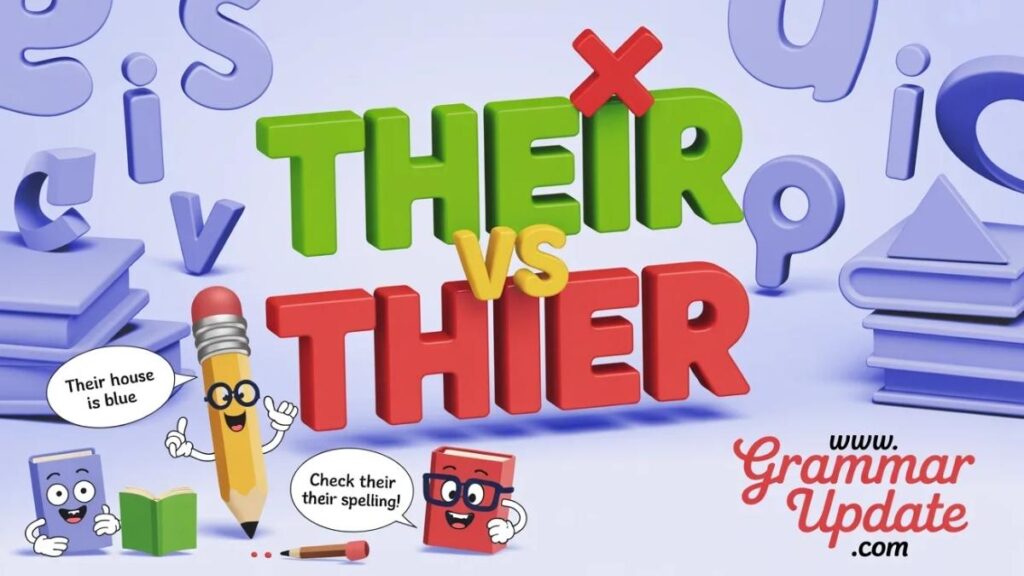
The confusion between thier or their happens because English spelling combines:
- irregular pronunciation
- inconsistent spelling rules
Several major factors contribute to this mistake.
Fix common more word mistakes in English
Tonite vs Tonight Difference and Which is Correct?
The “I Before E” Rule Creates Confusion
Many students learn the famous spelling rule:
“I before E except after C.”
Unfortunately, English contains many exceptions, including:
- their
- weird
- foreign
This creates confusion because learners naturally expect:
- ie
instead of:
- ei
Example:
“Their spelling confuses students who follow the ‘I before E’ rule strictly.”
Why the Rule Fails Sometimes
English developed from multiple language influences over centuries, including:
- Germanic languages
- French
- Latin
Because of this historical development, spelling patterns are not always consistent.
Learn how to use confusing more words correctly
Copys or Copies Which Is Correct?
Fast Typing Causes Letter Reversal
Modern digital communication has increased spelling mistakes dramatically because people type faster than they proofread.
This causes:
- letter reversal errors
- visual assumption mistakes
Example:
“Fast typing often turns their into thier accidentally.”
The mistake becomes difficult to notice because “thier” still looks visually believable to the brain during rapid reading.
Pronunciation Confuses Writers
The words:
- their
- there
- they’re
sound extremely similar in spoken English.
Because pronunciation overlaps heavily, many learners rely on sound instead of grammar structure while writing.
Example:
“They’re waiting over there with their friends.”
This sentence contains all three homophones correctly.
Their Shows Possession
The primary purpose of “their” is showing possession or ownership.
It explains that something belongs to:
- people
- groups
Example:
“Their equipment was delivered yesterday.”
| Sentence | Possession Being Shown |
|---|---|
| Their apartment looks modern | The apartment belongs to them |
| Their teacher canceled the class | The teacher is connected to them |
Their Always Appears Before a Noun
One of the easiest grammar rules for identifying “their” is that it usually appears directly before a noun.
Common structures include:
- their office
- their reports
Example:
“Their recommendations improved the final proposal.”
Understanding this structure helps writers avoid confusion quickly.
Learn how to use confusing more words correctly
Natzi vs Nazi Which Is the Correct Spelling?
Possessive Pronoun Their Explained
Many learners search for:
possessive pronoun their
Technically:
- “their” is a possessive determiner
- “theirs” is the possessive pronoun
Their vs Theirs Difference
“Their” must appear before a noun, while “theirs” replaces the noun entirely.
Example:
“Their laptop is expensive, but the newer one is theirs.”
| Word | Grammar Function |
|---|---|
| Their | Before a noun |
| Theirs | Replaces the noun |
Understanding this distinction improves sentence accuracy significantly.
Their in a Sentence
Learning their in a sentence is one of the best ways to master correct grammar usage.
“Their” appears frequently in:
- education
- business writing
Example:
“Their manager approved the updated budget proposal.”
| Sentence | Usage Type |
|---|---|
| Their classroom was renovated | Possession |
| Their parents attended the event | Ownership |
Their Usage in Professional English
The word “their” appears constantly in:
- corporate communication
- academic writing
Example:
“Their research findings influenced company policy.”
Correct spelling matters heavily in professional environments because grammar mistakes reduce credibility and clarity.
Learn how to use confusing more words correctly
Noisy vs Noisey Which is Correct and Usage?
Their vs There vs They’re Explained Clearly
One of the biggest grammar challenges in English involves understanding:
their vs there vs they’re
These words are homophones, meaning they sound similar but carry completely different meanings.
The confusion happens because:
- pronunciation overlaps
- grammar roles differ completely
Example:
“They’re standing over there beside their vehicle.”
Their vs There vs They’re Comparison Table
| Word | Meaning | Grammar Function |
|---|---|---|
| Their | Shows possession | Possessive determiner |
| There | Refers to location or existence | Adverb/pronoun |
| They’re | Means “they are” | Contraction |
Difference Between Their and There
The confusion between difference between their and there is extremely common among English learners.
“Their” relates to ownership, while “there” refers to:
- location
- existence
Example:
“Their documents are stored over there.”
Simple Memory Tip
Remember:
- their = ownership
- there = place
This small distinction solves many grammar mistakes instantly.
They’re Meaning Explained
“They’re” is simply the contraction of:
- they are
Writers should only use “they’re” when “they are” fits naturally into the sentence.
Example:
“They’re preparing for the annual conference.”
| Contraction | Full Form |
|---|---|
| They’re | They are |
There, Their, They’re Examples
These three words confuse writers because pronunciation sounds nearly identical in casual speech.
Grammar context is the only reliable way to choose the correct spelling.
Example:
“They’re waiting over there with their classmates.”
| Word | Purpose |
|---|---|
| Their | Possession |
| There | Location |
| They’re | They are |
Why “Thier” Is Incorrect
The spelling “thier” is rejected by:
- dictionaries
- grammar systems
This happens because:
- the spelling structure is incorrect
- official English references do not recognize it
Example:
“Grammar software immediately flags thier as a spelling error.”
Learn the difference between tricky more English words
Outting vs Outing Correct Spelling and Proper Usage
Common English Spelling Mistakes Similar to Their
The confusion between grammar mistakes their vs thier belongs to a larger group of English spelling problems.
These mistakes occur because:
- pronunciation differs from spelling
- English contains irregular patterns
Example:
“Words like recieve and thier confuse many learners.”
| Incorrect | Correct |
|---|---|
| Thier | Their |
| Recieve | Receive |
Understanding Homophones in English
The words:
- their
- there
are homophones because they sound alike while carrying different meanings.
Homophones confuse learners because:
- pronunciation overlaps
- spelling changes sentence meaning completely
Example:
“Their bags are over there near the entrance.”
Genius vs Genious Correct Spelling and Usage
How to Use Their Correctly
Learning how to use their in English becomes simple once you remember one rule:
“Their” always shows possession or connection.
Ask yourself:
- Does something belong to someone?
- Is ownership being described?
Example:
“Their uniforms were professionally designed.”
Easy Memory Trick for Their
One useful memory trick is noticing that “their” contains the word:
- heir
An heir receives possessions or inheritance, helping connect “their” with ownership.
This memory strategy works because:
- visual association improves recall
- meaning supports spelling retention
Example:
“Their inheritance belonged to the legal heir.”
Using Their Correctly in Professional Writing
Correct spelling improves:
- professionalism
- readability
Incorrect spelling creates:
- confusion
- weak credibility
Example:
“Their annual report reflected excellent research.”
Professional communication depends heavily on grammar accuracy and polished writing.
Learn the difference between tricky more English words
Currier vs Courier Differences and Correct Usage
Improving English Writing Skills
Mastering words like “their” strengthens:
- proofreading ability
- grammar awareness
Small spelling improvements create stronger communication and clearer writing overall.
Example:
“Their writing improved after regular grammar practice.”
English Proofreading Tips
Careful proofreading helps writers avoid spelling confusion before publishing or submitting work.
Writers should:
- read slowly
- review homophones carefully
Example:
“Proofreading carefully helps eliminate mistakes like thier.”
Why Correct Grammar Matters
Correct grammar improves:
- credibility
- communication clarity
Readers often judge writing quality based on spelling and grammar accuracy.
Example:
“Their polished writing impressed the hiring manager.”
Practice Session Their vs Thier
Fill in the Blanks
- ______ classroom was decorated beautifully for the event.
- The correct spelling is “their,” not “______.”
- Students submitted ______ assignments before the deadline.
- Many writers accidentally type “______” while typing quickly.
- ______ manager approved the updated proposal yesterday.
- The word “their” is used to show ______.
- ______ parents attended the school meeting together.
- “Thier” is considered a spelling ______ in English.
- The employees completed ______ training successfully.
- Writers often confuse “their” with “there” and “______.”
- ______ office moved to a larger building downtown.
- The phrase “their books” shows ______ or possession.
- “Their” usually comes before a ______ in a sentence.
- The sentence “______ going home” is incorrect because it needs “they’re.”
- ______ presentation impressed the entire audience.
- English learners struggle with similar sounding ______.
- “Their” is a possessive ______ in grammar.
- Many grammar checkers automatically correct “______.”
- The students forgot ______ notebooks at home.
- “There” refers to a ______ or location.
- “They’re” is the shortened form of “______.”
- ______ research findings improved the project significantly.
- Careful proofreading helps remove spelling ______.
- “Their” helps make sentence meaning more ______.
- Correct grammar improves writing quality and ______.
Answers
- Their
- thier
- their
- thier
- Their
- ownership
- Their
- mistake
- their
- they’re
- Their
- ownership
- noun
- Their
- Their
- homophones
- determiner
- thier
- their
- place
- they are
- Their
- errors
- clear
- professionalism
Here’s a trusted source for clear word meanings:
FAQs
What is correct, their vs thier?
The correct spelling is their. The word “thier” is a spelling mistake and is not accepted in proper English grammar.
When can you use their?
You use “their” when showing ownership, possession, or connection with people, groups, or individuals referred to as “they.”
Why is “their” spelled that way?
The spelling of “their” developed through the historical evolution of English. Like many English words, it does not completely follow simplified classroom spelling rules.
When use there or their?
Use “their” when talking about ownership and use “there” when referring to a place or location.
Example:
“Their bags are over there.”
What is the meaning of the word thier?
“Thier” has no official meaning because it is not a real English word. It is simply a misspelling of “their.”
Why do people say albeit?
People use “albeit” as a formal word meaning “although” or “even though,” especially in professional or literary writing.
What to say instead of “their”?
Depending on the sentence, words such as “his,” “her,” “our,” or “its” may replace “their.”
When did their become singular?
Singular “their” has existed in English for hundreds of years and is now widely accepted for gender-neutral references.
What is the proper use for their?
“Their” is properly used before a noun to show possession or connection.
Example:
“Their office moved downtown.”
Where do I use their?
You use “their” before nouns in sentences that describe ownership, relationships, or association.
Is it their dog or they’re dog?
The correct phrase is their dog because “their” shows ownership. “They’re” means “they are,” which does not fit the sentence correctly.
Why do people say “there” instead of “their”?
People confuse these words because they sound almost identical in spoken English, even though their meanings and grammar roles are different.
Is their vs thier?
The correct spelling is always their.
What’s the difference between “their” and “thier”?
“Their” is the correct English word used for possession, while “thier” is an incorrect spelling mistake caused by reversed letters
Is thier a pronoun?
No. “Thier” is not a pronoun or an official English word.
What are the three types of theres?
The three commonly confused English words are “there,” “their,” and “they’re.” Each has a completely different meaning and grammar function.
What can I say instead of “their”?
Alternative words may include “his,” “her,” “our,” “its,” or a specific person’s name depending on the sentence context.
Is it there car or their car?
The correct phrase is their car because “their” shows ownership. “There car” is grammatically incorrect.
Conclusion
In the confusion of Their vs Thier, the conclusion is actually very simple once you strip away the spelling noise and grammar pressure. The correct form is always “their,” and “Thier” is nothing more than a common writing mistake caused by fast typing, reversed letters, and momentary confusion with English spelling patterns. It looks convincing, but grammatically it has no place in standard English.
What makes this error so persistent is not lack of knowledge, but the natural confusion created by similar-looking words and the pressure to write quickly. Add in the extra confusion of “there” and “they’re,” and even strong writers can slip up. The key solution is not memorizing harder rules, but focusing on meaning and context.
So the final takeaway is clear: “Their” shows ownership, “Thier” shows confusion and in correct English, clarity always wins over confusion.

Jhon AJS, the creative mind behind Grammar Update, is an experienced blogger passionate about simplifying English grammar. He focuses on explaining confusing word vs word differences, grammar rules, punctuation, and sentence structure in a clear and practical way. Through easy to understand guides and examples, Jhon helps readers improve their writing and communicate with confidence. With years of blogging experience, he continues to share helpful insights that make learning grammar simple, useful, and accessible for everyone.