You’d think the emaculate vs immaculate debate wouldn’t exist. Yet here we are, staring at a word that looks right, sounds right, and still manages to betray you at the worst possible moment. Maybe it showed up in an important email. Maybe it slipped into an essay you were proud of. Either way, that tiny spelling slip can feel like stepping on a Lego barefoot sharp, unexpected, and slightly embarrassing. So what’s the deal? Is emaculate secretly acceptable, or is immaculate the only safe bet? Stick around, because this is one of those small grammar quirks that can make a surprisingly big difference in how polished your writing feels.
The Short Answer?
Let’s not dance around it.
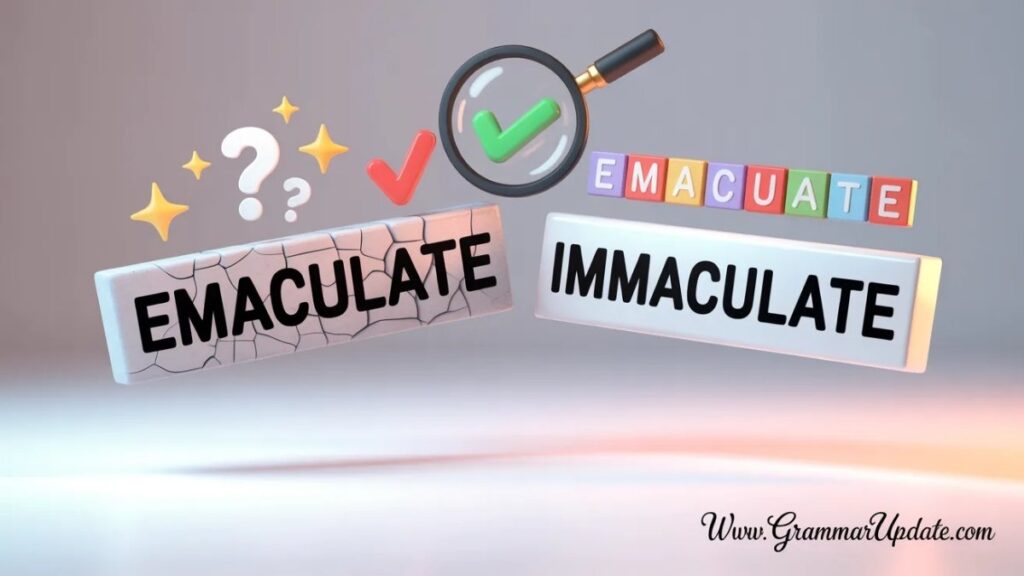
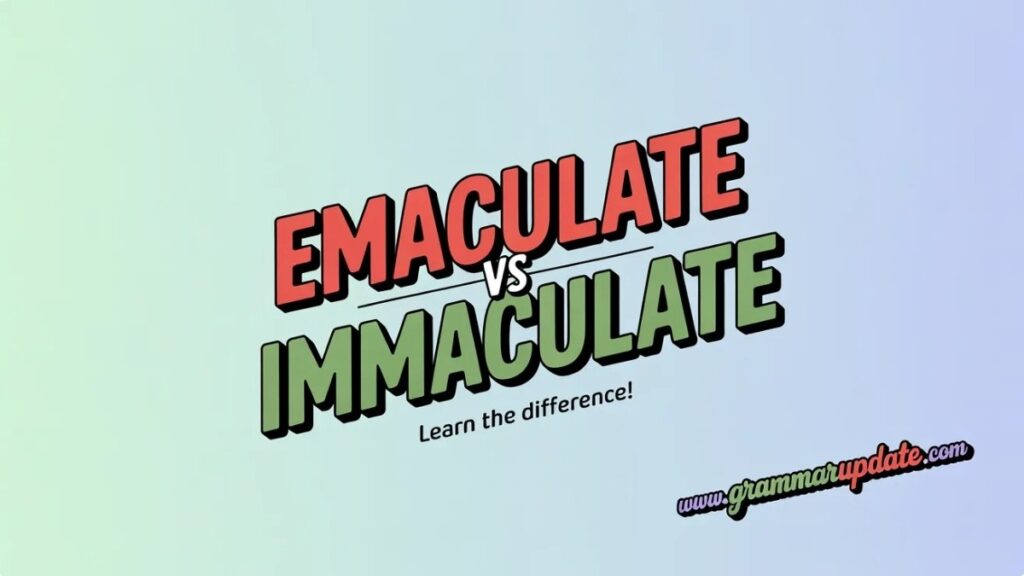
- Correct spelling: immaculate
- Incorrect spelling: emaculate
So if you’re wondering “is emaculate a word?” the answer is no. It’s a misspelling. Always has been.
That simple.
Still, there’s more going on here. Understanding why this mistake happens will help you avoid it forever.
Immaculate Meaning: What Does It Actually Mean?
The immaculate meaning goes beyond just “clean.”
At its core, immaculate means:
- Perfectly clean
- Free from flaws or errors
- Spotless or pristine in appearance or condition
Simple Breakdown
| Term | Meaning |
|---|---|
| Spotless | Completely clean |
| Flawless | Without any mistakes |
| Pristine | In original, perfect condition |
| Pure | Free from contamination |
So when someone uses the word, they’re not just saying “clean.” They’re saying exceptionally clean or flawless.
Immaculate Definition in Grammar and Usage
In grammar, immaculate is an adjective. That means it describes a noun.
Immaculate Definition (Grammar)
- Part of speech: Adjective
- Function: Describes condition, quality, or state
Example:
- “The room was immaculate.”
Here, immaculate describes the room.
Immaculate Adjective Meaning in Context
It can describe:
- Physical spaces → “immaculate kitchen”
- Appearance → “immaculate outfit”
- Performance → “immaculate execution”
This flexibility is what makes it such a powerful word.
Is “Emaculate” a Real Word?
Let’s tackle this directly.
Is emaculate a word?
No. It’s not recognized in standard English dictionaries.
Emaculate Meaning
There isn’t one. Any meaning you’ve seen attached to it comes from confusion with immaculate.
Why This Matters
Using emaculate in:
- Essays
- Emails
- Professional writing
…can instantly signal a lack of attention to detail.
It’s one of those common spelling mistakes in English that people notice, even if they don’t say it out loud.
More Confusing Words Made Simple
Ally vs Allie Differences and Correct Usage
Emaculate vs Immaculate Difference (Side-by-Side)
Here’s the emaculate vs immaculate difference in the clearest possible way:
| Feature | Immaculate | Emaculate |
|---|---|---|
| Correct spelling | ✅ Yes | ❌ No |
| Meaning | Spotless, flawless, pristine | None |
| Dictionary recognition | Yes | No |
| Usage | Formal & informal writing | Should never be used |
| Grammar role | Adjective | N/A |
This table sums up the entire immaculate vs emaculate spelling debate.
Why Do People Misspell “Immaculate”?
This is where things get interesting.
The spelling confusion immaculate causes isn’t random. It follows patterns.
Common Reasons
- Pronunciation shortcuts
People often say “uh-maculate” instead of “im-maculate” - Vowel confusion
The “i” gets replaced with an “e” in fast typing - Pattern bias
English has many words starting with “e” that sound similar - Typing habits
Muscle memory leads the fingers before the brain catches up
Related Examples
These mistakes follow the same pattern:
- Definitely → definately
- Separate → seperate
- Necessary → neccessary
All of these fall under commonly misspelled words in English.
The Origin of “Immaculate” (This Makes It Stick)
If you understand the origin, you won’t forget the spelling.
Immaculate Word Origin
- From Latin: immaculatus
- im- = not
- macula = stain or spot
So the word literally means:
“Not stained”
That’s why the spelling starts with im-, not “em-.”
Why This Helps
Once you connect the prefix im- with “not,” the spelling feels logical instead of random.
How to Spell Immaculate Correctly (Without Second Guessing)
If you hesitate every time, try these simple tricks.
Memory Hacks That Work
- Break it down:
im + maculate - Phrase trick:
“I’m immaculate” → sounds correct - Visual cue:
Words with “im-” often negate something (impossible, improper)
Quick Checklist
Before you write it, ask yourself:
- Does it start with “im”?
- Does it look balanced?
- Would you say “I’m maculate”? (No, so it must be “im-maculate”)
How to Use Immaculate in a Sentence (Real Examples)
Seeing the word in action makes it stick.
Immaculate in a Sentence (Everyday Use)
- “Her house looked immaculate before the guests arrived.”
- “He showed up in an immaculate white shirt.”
- “The report was immaculate, not a single typo.”
Immaculate Example Sentences by Context
Cleanliness
- “The hotel room was immaculate, down to the smallest detail.”
Performance
- “She delivered an immaculate presentation under pressure.”
Appearance
- “His shoes were immaculate despite the muddy streets.”
When to Use Immaculate in English
You don’t need to use it everywhere.
Best Situations
Use immaculate when you want to emphasize:
- Extreme cleanliness
- Precision and perfection
- High standards
Avoid Overuse
Using it too often weakens its impact.
Compare:
- “The room was clean”
- “The room was immaculate”
The second one carries more weight, so save it for when it matters.
Immaculate vs Perfect vs Impeccable
People often mix these up.
Immaculate vs Perfect
- Immaculate → Clean or flawless in condition
- Perfect → No faults in any sense
Immaculate vs Impeccable
- Immaculate → Visual or physical perfection
- Impeccable → Behavior or standards
Comparison Table
| Word | Best Used For |
|---|---|
| Immaculate | Cleanliness, appearance |
| Perfect | General flawlessness |
| Impeccable | Behavior, manners, standards |
More Confusing Words Made Simple
Emersion vs Immersion Differences and Correct Usage
Words Similar to Immaculate (Synonyms and Antonyms)
Expanding your vocabulary helps avoid repetition.
Immaculate Synonym List
- Spotless
- Pristine
- Flawless
- Pure
- Unblemished
These all connect to words that mean perfectly clean.
Immaculate Antonyms
- Dirty
- Messy
- Flawed
- Stained
- Imperfect
Using a mix of these improves your writing naturally.
Common Spelling Mistakes Like “Emaculate”
This isn’t an isolated issue.
Other Grammar Spelling Errors
- Accommodation → accomodation
- Recommend → reccommend
- Occurred → occured
These fall under broader spelling rules in English that confuse even native speakers.
Why It Matters
Even small errors can:
- Reduce credibility
- Distract readers
- Lower trust in professional writing
One Word, Big Impact
Imagine two job applications.
Candidate A
“I maintain an emaculate workspace.”
Candidate B
“I maintain an immaculate workspace.”
Same sentence. One small difference.
But here’s what happens:
- Candidate A looks careless
- Candidate B looks polished
That’s the power of the correct spelling immaculate.
How to Remember the Spelling of Immaculate (For Good)
Let’s lock this in.
Proven Techniques
- Write it 5 times
Muscle memory works - Use it in sentences
Context builds familiarity - Say it slowly
“Im-mac-u-late” - Associate meaning with structure
“Not stained” = im + maculate
Spelling Confusion Immaculate
Whenever you hesitate, run through this:
- ✔ Starts with “im”
- ✔ Means spotless or flawless
- ✔ Looks balanced visually
- ✔ Recognized in dictionaries
If not, fix it.
Key Takeaways (Quick Breakdown)
- Immaculate is the correct spelling
Always use immaculate in writing. It’s the standard, accepted form. - Emaculate is a common mistake
It looks right but isn’t a real word. Treat it as a typo every time. - It means spotless or flawless
Use it to describe something perfectly clean, neat, or without errors. - The origin helps you remember
It comes from Latin meaning “not stained,” which explains the “im-” prefix. - Correct spelling boosts credibility
Small details matter. Getting this right makes your writing look sharper and more professional.
More Confusing Words Made Simple
Uncollectible vs Uncollectable and How to Use Each Word
FAQs
What is the difference between emaculate and immaculate?
The difference between emaculate and immaculate is simple:
immaculate is correct and meaningful, while emaculate is a misspelling.
Is emaculate a correct spelling?
No. If you’re asking “is emaculate a correct spelling?” it isn’t.
Why do people spell immaculate wrong?
Because of pronunciation shortcuts, typing habits, and confusion with vowel sounds.
How to spell immaculate correctly?
Break it into parts: im + maculate.
Remember the meaning: “not stained.”
Can “immaculate” describe a person?
Yes. It can describe:
- Appearance → “immaculate style”
- Behavior → “immaculate manners”
Does immaculate mean perfect?
Not always. In the immaculate vs perfect comparison:
- Immaculate → clean or flawless in condition
- Perfect → flawless in every possible way
Reference Cambridge Dictionary Definitions
Here’s a trusted source for clear word meanings:
Final Thought
So here’s the final verdict on the whole emaculate vs immaculate saga one of them belongs in polished writing, and the other belongs in the “oops” pile. If you’ve ever typed emaculate with full confidence, only to feel a tiny wave of doubt creep in, you’re definitely not alone. English has a habit of throwing curveballs like this. Just when you think you’ve nailed it, a sneaky spelling confusion shows up uninvited.
The good news? Now you know better. You’re officially on team immaculate, armed with the right spelling, the real meaning, and a few handy tricks to remember it. That’s a small win that makes a big difference. After all, clean writing deserves a clean word.
Next time you hesitate, don’t overthink it. Trust your instincts then double check them. And if you ever catch emaculate trying to sneak back in, show it the door without hesitation. Your writing will look sharper, sound smarter, and feel, well… immaculate.

Jhon AJS, the creative mind behind Grammar Update, is an experienced blogger passionate about simplifying English grammar. He focuses on explaining confusing word vs word differences, grammar rules, punctuation, and sentence structure in a clear and practical way. Through easy to understand guides and examples, Jhon helps readers improve their writing and communicate with confidence. With years of blogging experience, he continues to share helpful insights that make learning grammar simple, useful, and accessible for everyone.