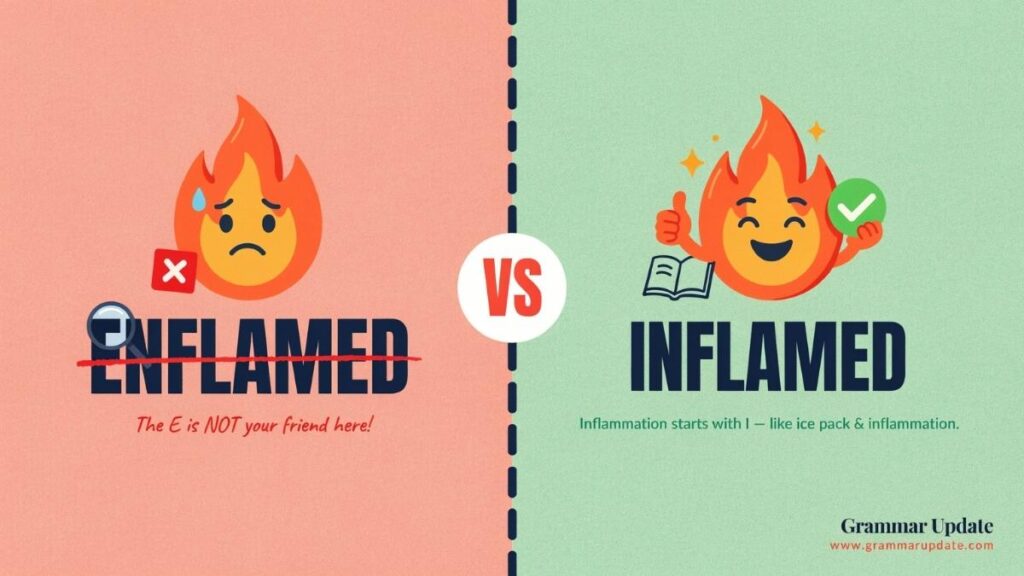
Have you ever stopped while writing because you couldn’t decide between Enflamed vs Inflamed? That tiny extra “e” can confuse almost anyone. Many people think both spellings are equally correct because they look and sound so similar. In reality, only one is the standard spelling used in modern English, while the other is an older variant that rarely appears today. It’s an easy mistake to make, but it’s also easy to fix once you know the difference. This guide explains the meaning, spelling, pronunciation, and correct usage of both words with simple examples, so you can write with confidence every time.
Quick Answer Enflamed vs Inflamed?
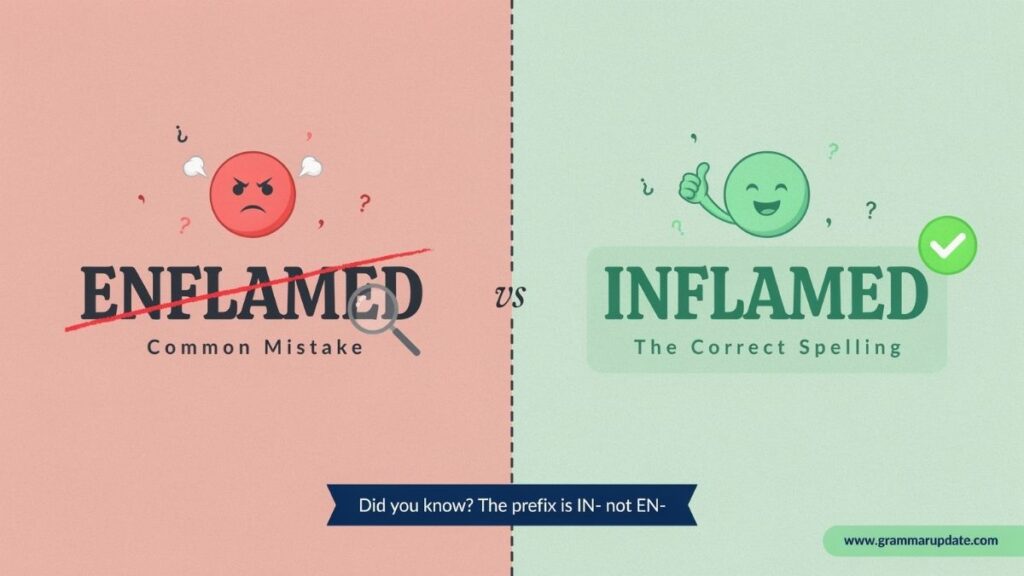
Here’s the short answer.
| Question | Answer |
|---|---|
| Which spelling is correct? | Inflamed |
| Is inflamed a word? | Yes. It’s the standard spelling in modern English. |
| Is enflamed a word? | Yes, but it’s a rare historical variant. |
| Which one should you use? | Inflamed in almost every situation. |
If you’re writing for school, work, healthcare, publishing, or everyday communication, inflamed is almost always the right choice.
You’ll occasionally come across enflamed in older books or historical documents. Some authors also use it for stylistic reasons. Even so, it’s no longer the preferred spelling in either American English or British English.
A simple rule to remember:
When in doubt, write “inflamed.” It’s the spelling readers expect and dictionaries recommend.
What Does Inflamed Mean?
The inflamed meaning is simple. Something is inflamed when it becomes irritated because of an injury, infection, illness, or the body’s natural immune response. The affected area often turns red, swollen, warm, and painful.
The word isn’t limited to medicine. In everyday English, inflamed can also describe emotions, arguments, or situations that suddenly become more intense.
For example:
- The patient’s throat was inflamed after the infection.
- His comments inflamed the debate.
- The announcement inflamed public opinion.
In the first sentence, the word describes physical inflammation. In the other two, it describes emotions becoming stronger.
Learn how to use confusing more words correctly
Oftentimes vs Often Times Which One Is Correct?
Inflamed Definition
The inflamed definition is:
Affected by inflammation, causing redness, swelling, heat, pain, or irritation.
The word comes from the verb inflame, which means to cause inflammation or to stir up strong emotions.
Doctors use the term every day because inflammation is one of the body’s natural defense systems. It helps fight infection, repair damaged tissue, and begin the healing process.
You might hear healthcare professionals talk about:
- Inflamed skin
- Inflamed throat
- Inflamed eyes
- Inflamed gums
- Inflamed joints
- Inflamed muscles
- Inflamed lungs
- Inflamed appendix
- Inflamed colon
Each example describes tissue responding to injury, infection, or disease.
Inflamed Meaning Medical
The inflamed meaning medical refers to tissue reacting to harm.
When part of your body is injured or exposed to bacteria, viruses, allergens, or other harmful substances, your immune system immediately responds. Blood flow increases. White blood cells move into the area. Chemicals are released to begin repairs.
This process is known as the inflammatory response.
Its job is to:
- Fight infection
- Remove damaged cells
- Protect healthy tissue
- Support healing
Although inflammation often helps the body recover, it can become harmful when it lasts too long or becomes excessive.
Common Signs of Inflammation
| Sign | What It Means |
|---|---|
| Redness | More blood flows to the injured area. |
| Heat | Increased circulation warms the tissue. |
| Swelling | Fluid builds up around damaged cells. |
| Pain | Sensitive nerves react to the inflammation. |
| Reduced function | Movement or normal use becomes difficult. |
These five signs have been recognized in medicine for centuries and remain the classic indicators of inflammation.
Learn how to use confusing more words correctly
What Kind of vs What Kinds of, Which One Should You Use?
Medical Meaning of Inflamed
The medical meaning of inflamed goes beyond what you can see on the skin.
Many forms of inflammation occur deep inside the body.
For example, doctors may diagnose:
- Inflamed lungs
- Inflamed appendix
- Inflamed colon
- Inflamed liver
- Inflamed organs
Because these organs aren’t visible, healthcare providers rely on physical examinations, blood tests, imaging scans, and other diagnostic tools.
It’s also important to understand that inflammation isn’t a disease. It’s the body’s response to something that isn’t right.
Common causes include:
- Bacterial infections
- Viral infections
- Allergic reactions
- Autoimmune diseases
- Physical injuries
- Chemical irritation
- Long-term health conditions
Learn the difference between tricky more English words
Reinforce vs Reenforce Which Spelling Is Correct?
What Does Inflamed Mean?
Many people ask, “What does inflamed mean?”
In everyday language, it simply means that part of the body has become irritated while your immune system works to protect and repair it.
Imagine twisting your ankle.
Within a short time, it becomes swollen, warm, red, and sore. That’s inflammation in action.
The same thing happens when you develop a sore throat. The tissues become swollen and painful because your body is fighting an infection.
These are classic examples of body inflammation.
Inflamed Tissue Meaning
The phrase inflamed tissue meaning refers to body tissue that’s actively going through inflammation.
During this process, healthy tissue temporarily changes.
It may become:
- Swollen
- Red
- Warm
- Tender
- Painful
- Puffy
- Irritated
These changes happen because blood vessels widen, fluid collects around damaged cells, and immune cells rush to the area.
One important point is that inflamed tissue isn’t always infected.
For example:
- Arthritis causes inflamed joints without bacteria.
- Allergies can produce inflamed skin without an infection.
- Autoimmune diseases may inflame healthy tissue by mistake.
That’s why infection and inflammation are related but not the same thing.
To Many vs Too Many Difference and Which is Correct?
Inflamed Skin Meaning
The inflamed skin meaning refers to skin that becomes irritated because of injury, infection, allergies, burns, insect bites, or skin conditions.
Common symptoms include:
- Redness
- Swelling
- Warmth
- Itching
- Tenderness
- Rash
Conditions that often cause inflamed skin include:
- Sunburn
- Eczema
- Contact dermatitis
- Cellulitis
- Allergic reactions
Some cases clear up quickly, while others require medical treatment.
Inflamed Lungs Meaning
Another common question is, “What is an inflamed lung?”
The inflamed lungs meaning refers to lung tissue that’s swollen or irritated because of inflammation.
Possible causes include:
- Pneumonia
- Viral infections
- Asthma
- COPD
- Allergic reactions
- Exposure to harmful pollutants
Symptoms often include:
- Shortness of breath
- Persistent coughing
- Wheezing
- Chest discomfort
- Fatigue
Because inflammation affects how oxygen moves through the lungs, breathing may become more difficult until the underlying condition improves.
Learn how to use confusing more words correctly
Wait vs Weight Difference and usage?
Difference Between Inflammation and Inflamed
Although the terms sound similar, they don’t mean exactly the same thing.
| Word | Meaning |
|---|---|
| Inflammation | The body’s biological healing process. |
| Inflamed | The condition of tissue affected by that process. |
A simple way to remember the difference is this:
- Inflammation is the process.
- Inflamed describes the result.
For example:
- The infection triggered inflammation.
- The patient’s throat became inflamed.
Acute Inflammation vs Chronic Inflammation
Not all inflammation behaves the same way.
Acute Inflammation
Acute inflammation develops quickly and usually lasts only a short time.
Common causes include:
- Cuts
- Sprains
- Burns
- Infections
- Insect bites
As healing takes place, the inflammation usually fades.
Chronic Inflammation
Chronic inflammation develops slowly and may continue for months or even years.
It is often linked to conditions such as:
- Rheumatoid arthritis
- Lupus
- Psoriasis
- Inflammatory bowel disease
- Certain heart diseases
Unlike acute inflammation, chronic inflammation can gradually damage healthy tissue if it isn’t properly managed.
Inflame Definition
The inflame definition is:
To cause inflammation or to provoke strong emotions such as anger, excitement, or passion.
The word functions as a verb.
Medical example:
The infection inflamed the surrounding tissue.
Figurative example:
The politician’s remarks inflamed public debate.
Although the contexts are different, both meanings involve something becoming stronger or more intense.
Learn how to use confusing more words correctly
Thats vs That’s diffrance and Which Is Correct?
Inflamed Pronunciation
Inflamed is pronounced:
in-FLAYMD
The emphasis falls on the second syllable.
Breaking it into parts makes it easy to remember:
in + flamed
The pronunciation follows normal English spelling patterns, so native speakers pronounce it consistently.
Common Inflamed Synonym
Several words can replace inflamed, depending on the context.
| Inflamed Synonym | Best Used For |
|---|---|
| Swollen | Visible enlargement |
| Irritated | Mild inflammation |
| Reddened | Skin conditions |
| Tender | Pain when touched |
| Sore | General discomfort |
| Puffy | Mild swelling |
| Reactive | Medical descriptions |
| Aggravated | A condition that has worsened |
While these words share similar meanings, inflamed remains the most precise choice in medical writing because it specifically refers to inflammation, not just general irritation.
What Does Enflamed Mean?
After learning about inflamed, many people naturally ask about enflamed meaning.
The answer is surprisingly simple.
Enflamed carries essentially the same meaning as inflamed, but it is an uncommon and largely outdated spelling. Modern dictionaries recognize it as a historical or variant form rather than the standard choice.
Today, you’ll rarely see enflamed in medical journals, newspapers, academic writing, or professional communication. Instead, inflamed has become the accepted spelling across both American English and British English.
Fix common more word mistakes in English
Counselor vs Councilor Which is the Difference and Usage?
What Does Enflamed Mean?
After learning that inflamed is the standard spelling, many people naturally ask another question: What does enflamed mean?
The answer is straightforward. Enflamed has essentially the same meaning as inflamed. It describes something that has become irritated, swollen, or emotionally stirred. The difference isn’t the definition—it’s the spelling.
Today, enflamed is considered a rare variant spelling. While you’ll still find it in some dictionaries, it appears far less often than inflamed in modern books, medical literature, newspapers, and professional writing.
So, although enflamed is a real word, it isn’t the spelling most readers expect to see.
Enflamed Definition
The enflamed definition is nearly identical to the definition of inflamed.
It means:
Affected by inflammation or stirred up emotionally.
Historically, writers used enflamed in two ways.
The first referred to physical inflammation.
Example
The untreated wound became enflamed after several days.
The second described heightened emotions or conflict.
Example
The speech enflamed the crowd and intensified the debate.
Today, editors would almost always replace enflamed with inflamed, especially in formal or professional writing.
Is Enflamed a Word?
Yes. Is enflamed a word? Absolutely.
The real question isn’t whether the word exists. It’s whether you should use it.
The answer is usually no.
Most major dictionaries include enflamed, but they identify it as an uncommon, historical, or variant spelling. In modern English, inflamed has become the preferred choice.
Here’s a quick summary.
| Question | Answer |
|---|---|
| Is enflamed a real word? | Yes. |
| Is enflamed grammatically correct? | Yes. |
| Is enflamed an acceptable spelling? | Technically yes, but it’s uncommon. |
| Which spelling should you use? | Inflamed in almost every situation. |
Unless you’re quoting an older source or preserving historical language, inflamed is the spelling that readers recognize and expect.
Why Is Inflamed Spelled Without an “E”?
One of the most common questions people ask is:
“Why is inflamed spelled without e?”
The answer goes back hundreds of years.
Both inflamed and enflamed developed from the Latin verb inflammare, meaning “to set on fire” or “to kindle.” As English evolved, writers experimented with different spellings before dictionaries and publishers began standardizing the language.
Over time, inflamed became the accepted form because it stayed closer to the original Latin spelling and matched the established verb inflame.
Once dictionaries, schools, and publishers adopted that spelling, it became the norm across both American English and British English.
That’s why you’ll see inflamed in medical journals, textbooks, newspapers, and everyday writing, while enflamed appears only occasionally in older works.
Fix common more word mistakes in English
Granddad vs Grandad which spelling is Correct and Usage?
Enflamed Meaning in Modern English
Although enflamed is uncommon today, its meaning hasn’t changed.
Like inflamed, it can describe either a physical condition or an emotional reaction.
Physical meaning
Something has become swollen, irritated, or affected by inflammation.
Figurative meaning
Someone’s emotions, opinions, or passions have become stronger or more intense.
Even though both meanings remain valid, modern writers almost always choose inflamed instead.
If you searched thousands of recent books, news articles, and healthcare websites, you’d find inflamed used overwhelmingly more often than enflamed. That widespread preference is why many readers mistake enflamed for a spelling error.
Enflamed Synonym
If you’re looking for an enflamed synonym, the best option depends on the context.
For physical inflammation
- Inflamed
- Swollen
- Irritated
- Tender
- Reddened
- Puffy
For emotional or figurative use
- Provoked
- Agitated
- Stirred
- Excited
- Ignited
- Aroused
In most situations, replacing enflamed with inflamed is the clearest and most natural choice.
Enflamed vs Inflamed Side-by-Side Comparison
Although these words share the same basic meaning, they aren’t used the same way in modern English.
| Feature | Inflamed | Enflamed |
|---|---|---|
| Modern spelling | ✅ Standard | Rare variant |
| Medical terminology | ✅ Yes | Rarely used |
| Academic writing | ✅ Preferred | Generally avoided |
| Professional writing | ✅ Preferred | Uncommon |
| Everyday English | ✅ Common | Rare |
| Dictionary status | Standard entry | Variant spelling |
| American English | Preferred | Rare |
| British English | Preferred | Rare |
| Historical writing | Occasionally | More common |
| Best choice today | ✅ Yes | Usually no |
The takeaway is simple.
Both spellings exist, but inflamed has become the clear standard in contemporary English.
Learn the difference between tricky more English words
Click vs Clique Which is Difference and usage?
Why Do People Confuse Enflamed and Inflamed?
Considering how often the question appears online, it’s easy to assume the two words are equally common. They aren’t. Several factors make them easy to mix up.
They Differ by Only One Letter
At a quick glance, enflamed and inflamed look almost identical.
Because our brains recognize word shapes instead of reading every letter individually, many people don’t notice the difference unless they’re editing carefully.
Both Words Appear in Dictionaries
The confusion becomes even more understandable because enflamed isn’t a made-up word.
Many respected dictionaries include it as a variant spelling, which leads some writers to believe both forms are equally acceptable.
In practice, however, they aren’t used equally.
Modern English overwhelmingly favors inflamed.
Their Shared History Adds to the Confusion
Both words come from the same Latin root, inflammare.
Over the centuries, English adopted several spellings before eventually settling on inflamed as the standard form.
Since older books still contain enflamed, readers continue to encounter it and assume it’s current.
Spell Check Doesn’t Always Catch It
Many people rely on grammar software to catch spelling mistakes.
The problem is that enflamed isn’t technically incorrect.
Because dictionaries recognize it, some spelling tools allow it to pass without any warning. That makes it easy for writers to use an outdated spelling without realizing it.
Older Books Still Use It
If you’ve read classic literature, historical documents, or older religious texts, you’ve probably seen enflamed before.
English spelling wasn’t standardized until relatively recently. As a result, many older publications preserved spellings that later became uncommon.
Those historical examples continue to fuel today’s confusion.
Learn the difference between tricky more English words
Aswell vs As Well Which is Correct and Difference?
Inflame vs Inflamed vs Enflamed
These three words belong to the same family, but they serve different purposes.
| Word | Part of Speech | Meaning |
|---|---|---|
| Inflame | Verb | To cause inflammation or provoke strong emotions |
| Inflamed | Adjective or past participle | Affected by inflammation |
| Enflamed | Variant adjective or past participle | Historical spelling of inflamed |
An easy way to remember the difference is this:
- Inflame describes the action.
- Inflamed describes the result.
- Enflamed is simply an older spelling of inflamed.
Inflame Definition and Examples
The inflame definition is:
To cause physical inflammation or to arouse intense emotions.
Medical example
The bacterial infection inflamed the surrounding tissue.
Figurative example
The controversial remarks inflamed public opinion.
Both meanings remain common in modern English.
Learn the difference between tricky more English words
Perfer vs Prefer Usage and Common Mistakes
Inflamed in a Sentence
Seeing a word in context is one of the fastest ways to remember it.
Medical examples
- The dentist discovered inflamed gums during the examination.
- Her inflamed throat made swallowing difficult.
- The athlete rested because of inflamed muscles after the race.
- Doctors removed the inflamed appendix before it ruptured.
- The allergic reaction left his inflamed skin red and itchy.
Figurative examples
- The rumor inflamed tensions across the community.
- His comments inflamed an already heated debate.
- The announcement inflamed public criticism within hours.
These examples show how the word works in both medical and non-medical contexts.
Enflamed in a Sentence
Although uncommon today, enflamed in a sentence still appears in historical and literary writing.
Examples include:
- The speaker’s words enflamed the audience with passion.
- The poet described enflamed hearts longing for freedom.
- The old manuscript told of an enflamed kingdom consumed by conflict.
In modern writing, editors would almost always replace enflamed with inflamed unless they were preserving the original text.
Which Word Do Professionals Use?
If you’re still unsure which spelling to choose, look at how professionals write.
Doctors, researchers, journalists, educators, and publishers consistently use inflamed.
You’ll frequently see phrases such as:
- Inflamed tissue
- Inflamed skin
- Inflamed throat
- Inflamed lungs
- Inflamed joints
- Inflamed gums
- Inflamed appendix
- Inflamed colon
British English vs American English Does the Spelling Change?
English has plenty of spelling differences. Americans write color, while the British write colour. Americans prefer center, while British English uses centre.
Because of these variations, it’s reasonable to wonder whether enflamed vs inflamed follow the same pattern.
They don’t.
Whether you’re writing in American English, British English, Canadian English, or Australian English, inflamed is the accepted spelling. You won’t find enflamed used as the standard form in any major variety of modern English.
Here’s a quick comparison.
| English Variety | Preferred Spelling |
|---|---|
| American English | Inflamed |
| British English | Inflamed |
| Canadian English | Inflamed |
| Australian English | Inflamed |
So, if you’re asking, “Enflamed vs inflamed which is correct?”, your location doesn’t change the answer. Inflamed is the preferred spelling everywhere modern English is used.
Fix common more word mistakes in English
Useable vs Usable Difference and Correct Usage
What Major Dictionaries Say
When a spelling question comes up, dictionaries provide the clearest answer.
Leading dictionaries consistently recognize inflamed as the standard spelling. Most also include enflamed, but only as a variant or historical form.
Here’s how some of the most trusted dictionaries treat the two words.
| Dictionary | Inflamed | Enflamed |
|---|---|---|
| Merriam-Webster | Standard entry | Variant spelling |
| Cambridge Dictionary | Standard entry | Rare or omitted |
| Oxford English Dictionary | Standard entry | Historical variant |
| Collins Dictionary | Standard entry | Variant form |
Although the wording differs slightly from one dictionary to another, the conclusion is the same. Inflamed is the form used in modern English, while enflamed survives mainly for historical reference.
What Style Guides Recommend
Professional writing depends on consistency. That’s why editors and style guides encourage writers to use the spelling readers expect.
Across academic, medical, business, and journalistic writing, inflamed is the recommended choice.
Academic writing
Universities and research institutions follow standardized English. Using inflamed ensures your writing aligns with modern academic conventions.
Medical writing
In healthcare, precision matters. Medical textbooks, journals, and clinical resources consistently use inflamed because it’s the accepted medical term.
Business writing
Clear language inspires confidence. Choosing the standard spelling keeps your message professional and easy to understand.
Journalism
Newspapers and magazines aim for consistency across every article they publish. Editors almost always replace enflamed with inflamed, unless they’re quoting historical material or preserving an original source.
Common Mistakes to Avoid
Even confident writers occasionally pause when they see these words. Fortunately, the most common mistakes are easy to avoid.
Using enflamed as the standard spelling
While enflamed is a legitimate word, it isn’t the form modern readers expect.
Less preferred
The patient had enflamed skin.
Preferred
The patient had inflamed skin.
Mixing Up Inflame and Inflamed
The two words belong to the same family, but they serve different purposes.
- Inflame is a verb.
- Inflamed describes the result of that action.
Correct examples
- The infection inflamed the surrounding tissue.
- The tissue became inflamed overnight.
Assuming Both Spellings Are Equally Common
This is one of the biggest misconceptions.
Although dictionaries recognize both words, they aren’t used with the same frequency.
Modern books, healthcare websites, academic journals, and newspapers overwhelmingly favor inflamed. In comparison, enflamed appears only occasionally, usually in historical or literary contexts.
Thinking Enflamed Is British English
Some people assume enflamed is simply the British version of inflamed.
It isn’t.
Both British English and American English use inflamed as the standard spelling.
An Easy Way to Remember the Difference
A simple memory trick can save you from second-guessing yourself.
Think of the words you already know:
- Inflame
- Inflamed
- Inflammation
- Anti-inflammatory
Notice the pattern? Every common word in the family begins with in-.
That’s your clue.
If you can remember inflammation, you’ll naturally remember inflamed.
Here’s another tip that’s easy to keep in mind:
Doctors treat inflammation, so they describe tissue as inflamed—not enflamed.
It’s simple, logical, and works every time.
Enflamed vs Inflamed at a Glance
If you only remember one table from this guide, make it this one.
| Feature | Inflamed | Enflamed |
|---|---|---|
| Real English word | ✅ Yes | ✅ Yes |
| Preferred modern spelling | ✅ Yes | ❌ No |
| Used in medicine | ✅ Yes | Rarely |
| Used in academic writing | ✅ Yes | Generally avoided |
| Common in everyday English | ✅ Yes | Rare |
| Found in historical texts | Yes | More common |
| Best choice today | ✅ Always | Only in special contexts |
Practice Session Enflamed vs Inflamed
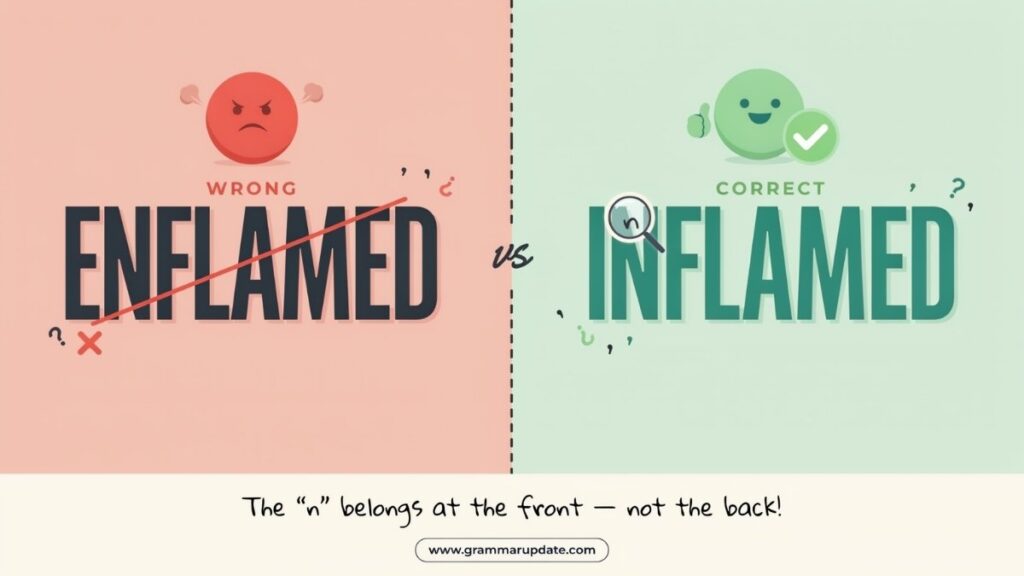
Choose the correct word: inflamed vs enflamed.
Tip: In modern English, inflamed is almost always the correct choice.
- The doctor said my throat was __________.
- Her gums became __________ after skipping dental care.
- The article explained that __________ is the preferred modern spelling.
- His comments __________ the argument even more.
- The patient had an __________ appendix that required surgery.
- The rash left her skin red and __________.
- The infection caused the surrounding tissue to become __________.
- The coach advised the runner to rest because of __________ muscles.
- The dentist treated my __________ gums immediately.
- The smoke __________ public concern about air quality.
- The nurse checked the child’s __________ eyes.
- The cut looked swollen and __________.
- The doctor examined the patient’s __________ joints.
- The speech __________ the audience with excitement.
- The medical report described __________ lungs.
- The allergy caused __________ skin and itching.
- Modern dictionaries recommend using __________ in everyday writing.
- The bacteria __________ the surrounding tissue.
- The old poem used the word __________ instead of inflamed.
- His careless remark __________ tensions between the two teams.
- The surgeon removed the __________ appendix.
- The veterinarian treated the dog’s __________ ear.
- The article explained the meaning of __________ tissue.
- In professional writing, __________ is the preferred spelling.
- Although __________ is a real word, it is rarely used today.
Answers
- inflamed
- inflamed
- inflamed
- inflamed
- inflamed
- inflamed
- inflamed
- inflamed
- inflamed
- inflamed
- inflamed
- inflamed
- inflamed
- inflamed
- inflamed
- inflamed
- inflamed
- inflamed
- enflamed
- inflamed
- inflamed
- inflamed
- inflamed
- inflamed
- enflamed
Here’s a trusted source for clear word meanings:
FAQs
What does enflame mean?
Enflame means to cause something to burn, trigger inflammation, or stir up strong emotions. Although it’s a real word, inflame is the preferred spelling in modern English and is used far more often in everyday, medical, and professional writing.
What does inflaming mean?
Inflaming is the present participle of inflame. It means causing inflammation in the body or making a situation, emotion, or disagreement more intense.
Is it enflame vs inflame?
Inflame is the correct and preferred spelling in modern English. While enflame is recognized as a historical variant, it is rarely used outside older or literary texts.
What is a synonym for enflame?
Depending on the context, common synonyms include ignite, provoke, stir up, arouse, agitate, excite, and inflame. In medical writing, inflame is the more appropriate choice.
How do you use enflame in a sentence?
Example:
The speaker’s emotional words enflamed the audience.
In modern writing, most editors would replace enflamed with inflamed because it is the standard spelling.
What is another word for inflame?
Some common synonyms are provoke, ignite, agitate, stimulate, arouse, excite, and intensify. The best synonym depends on whether you’re describing a physical condition or an emotional reaction.
Is it inflammed or inflamed?
Inflamed is the correct spelling. Inflammed is a common misspelling caused by adding an extra m.
Does inflamed mean infected?
No. An area can be inflamed without being infected. Inflammation is the body’s natural response to injury, irritation, or disease, while an infection is caused by harmful microorganisms such as bacteria, viruses, or fungi.
Does inflamed always mean swollen?
Not necessarily. Swelling is one of the classic signs of inflammation, but inflamed tissue may also be red, warm, tender, or painful without noticeable swelling.
What is the medical term for inflamed?
In medicine, inflamed describes tissue affected by inflammation. It commonly refers to redness, swelling, warmth, pain, or irritation caused by the body’s immune response.
What are the main types of inflammation?
The three main types are:
- Acute inflammation, which develops quickly and usually lasts a short time.
- Chronic inflammation, which persists for months or years.
- Granulomatous inflammation, a specialized immune response seen in certain diseases.
How do you pronounce inflamed?
Inflamed is pronounced in-FLAYMD, with the emphasis on the second syllable.
What is the difference between Enflamed vs Inflamed?
Both words share the same meaning, but inflame is the accepted spelling in modern English. Enflame is an older variant that is now uncommon in everyday, academic, and medical writing.
What is the opposite of inflamed?
Depending on the context, the opposite of inflamed may be healed, healthy, calm, normal, unirritated, or recovered.
What is the origin of the word enflame?
Enflame comes from the Latin word inflammare, meaning “to set on fire.” It entered English as a spelling variant, but over time inflame became the standard form used in modern English.
What’s another word for inflamed?
Common synonyms include swollen, irritated, reddened, tender, sore, puffy, and reactive. Choose the synonym that best fits your context, especially in medical or everyday writing.
Conclusion
The confusion between Enflamed vs Inflamed is completely understandable. The two words look almost identical, sound the same, and even share the same meaning, so it’s easy to assume they’re interchangeable. That’s where many writers get tripped up. In modern English, inflamed is the standard and preferred spelling, while enflamed survives mainly as a historical variant. Remembering this one simple distinction can save you from a common spelling mistake and make your writing more polished and professional. So, the next time that extra “e” tries to sneak into your sentence, give it a friendly wave goodbye and stick with inflamed the spelling your readers expect every time.

Jhon AJS, the creative mind behind Grammar Update, is an experienced blogger passionate about simplifying English grammar. He focuses on explaining confusing word vs word differences, grammar rules, punctuation, and sentence structure in a clear and practical way. Through easy to understand guides and examples, Jhon helps readers improve their writing and communicate with confidence. With years of blogging experience, he continues to share helpful insights that make learning grammar simple, useful, and accessible for everyone.