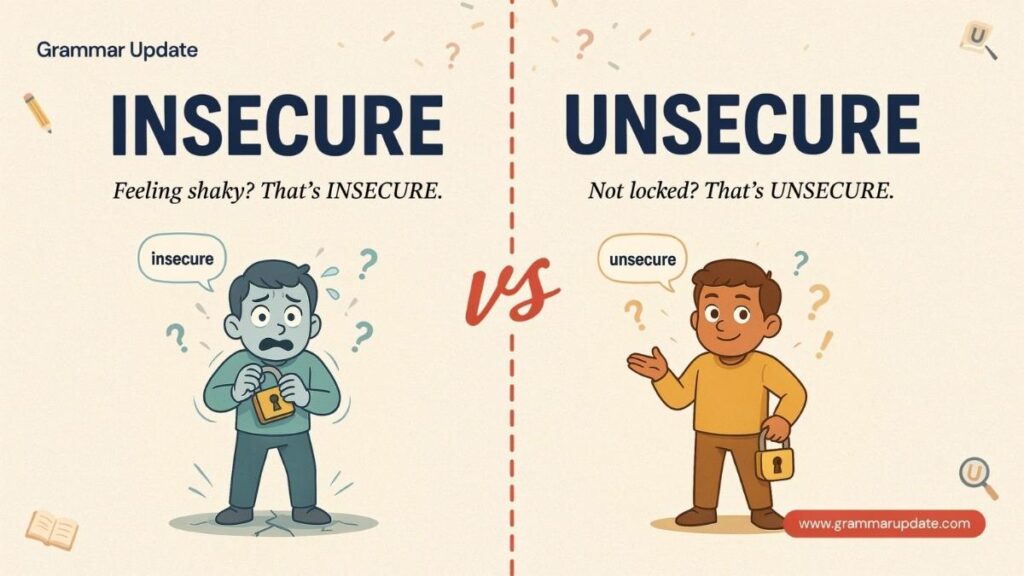
Have you ever written Insecure vs Unsecure and suddenly questioned which one was correct? It happens more often than you might think. Since the two words look so similar, many people assume they can be used interchangeably. That’s where the confusion begins. While both relate to safety or vulnerability, they don’t always mean the same thing. Using the wrong word can make your writing sound awkward or inaccurate. Fortunately, the difference is simple once it’s explained clearly. This guide breaks everything down with easy definitions, real-world examples, and practical tips, so you can avoid common mistakes and use the right word with confidence every time.
Quick Answer Insecure vs Unsecure?
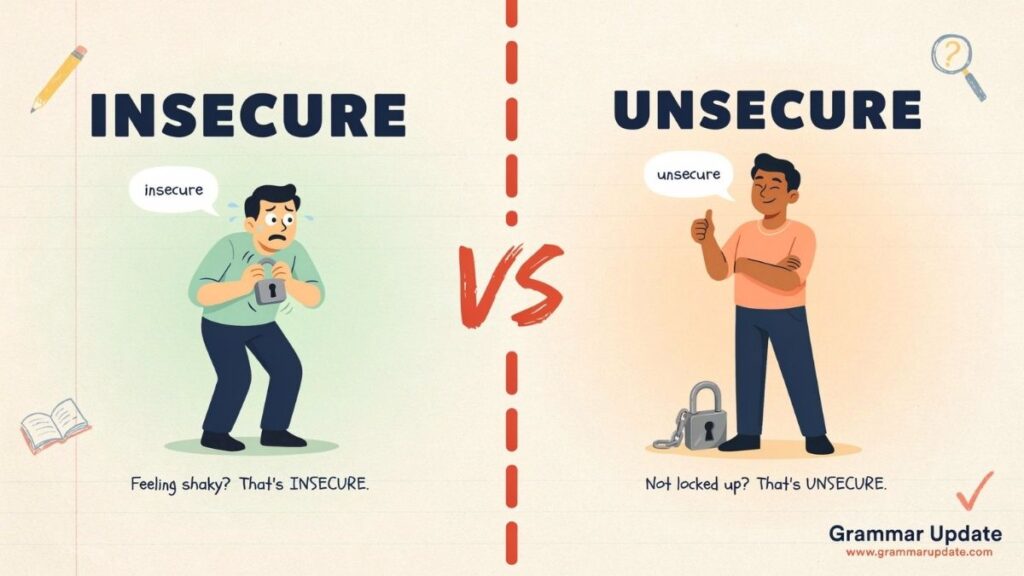
If you’re looking for the short answer, here it is.
- Use insecure when talking about people, emotions, confidence, relationships, or systems with security weaknesses.
- Use unsecure only when you mean not secured, although unsecured is usually the more natural and widely accepted choice.
- In finance and technology, unsecured is almost always the preferred term.
Here’s a quick comparison.
| Context | Correct Word |
|---|---|
| A person who lacks confidence | Insecure |
| Feeling uncertain in a relationship | Insecure |
| A website with security flaws | Insecure |
| A loan without collateral | Unsecured |
| A Wi-Fi network without a password | Unsecured |
| A door left unlocked | Unsecured |
The answer to insecure or unsecure depends entirely on what you’re describing.
What Does Insecure Mean?
The word insecure is common in everyday conversations, psychology, business, and technology. Although its exact meaning changes with the context, the core idea stays the same: it describes someone or something that lacks confidence, stability, or adequate security.
Insecure Definition
The insecure definition is:
Not confident, not fully protected, or vulnerable to harm, loss, or failure.
The word can describe both people and things.
Examples
- She felt insecure before giving her presentation.
- The company discovered an insecure connection on its website.
- His insecure behavior created unnecessary tension.
Insecure Meaning in Everyday English
In daily conversation, insecure meaning usually refers to a lack of confidence rather than physical safety.
An insecure person may:
- Doubt their abilities.
- Worry about what others think.
- Need constant reassurance.
- Feel uncomfortable in social situations.
- Hesitate before making decisions.
For example:
James rarely shared his ideas because he felt insecure about making mistakes.
Here, insecure describes low self-esteem and emotional vulnerability, not a physical danger.
Learn the difference between confusing more English words
What Kind of vs What Kinds of, Which One Should You Use?
Emotionally Insecure Meaning
The phrase emotionally insecure meaning describes someone who struggles with emotional confidence or stability.
An emotionally insecure person may:
- Fear rejection.
- Constantly compare themselves to others.
- Seek frequent approval.
- Overthink conversations.
- Worry about losing important relationships.
Emotional insecurity doesn’t define a person’s entire personality. Someone can feel completely confident at work yet still experience insecurity in friendships or romantic relationships.
Insecure Person Meaning
The insecure person meaning extends beyond being shy or quiet.
An insecure person often experiences:
- Low self-confidence.
- Fear of failure.
- Difficulty trusting others.
- Sensitivity to criticism.
- Persistent self-doubt.
Everyone feels insecure from time to time. The word simply describes a temporary or ongoing lack of confidence rather than a permanent personality trait.
Insecure Meaning in Relationships
One of the most common searches online is insecure or unsecure in a relationship.
The correct expression is insecure in a relationship.
Relationship insecurity often shows up as:
- Jealousy.
- Constant reassurance seeking.
- Fear of abandonment.
- Trust issues.
- Overthinking simple interactions.
Example
Sarah became insecure after several misunderstandings, even though her partner remained supportive and honest.
Native English speakers naturally use insecure in this context. Saying someone is unsecure in a relationship sounds unnatural and is rarely used.
Learn the difference between confusing more English words
Reinforce vs Reenforce Which Spelling Is Correct?
Common Synonyms of Insecure
If you’re searching for an insecure or unsecure synonym, these alternatives work well for insecure, depending on the context.
| Synonym | Best Used For |
|---|---|
| Uncertain | Decisions and confidence |
| Unsure | Everyday conversations |
| Self-conscious | Personal feelings |
| Nervous | Emotions |
| Hesitant | Actions |
| Vulnerable | Emotional or physical situations |
| Doubtful | Opinions or beliefs |
| Anxious | Emotional situations |
Each synonym has its own nuance, so choose the one that best matches your sentence.
What Does Unsecure Mean?
Now let’s look at the less common word.
Many people ask, “Is unsecure a word?” The answer is yes.
However, it’s much less common than insecure, and in many situations unsecured is the preferred alternative.
Unsecure Definition
The unsecure meaning is:
Not secured, protected, locked, or made safe.
Unlike insecure, this word usually refers to objects, systems, or places rather than emotions or personality.
Examples
- The equipment was left unsecure during transport.
- Workers noticed the fence remained unsecure after the storm.
Even in these examples, many editors would recommend using unsecured because it’s more common in modern English.
Is Unsecure a Word?
Yes.
Is unsecure a word? Absolutely.
Most major dictionaries recognize unsecure as a legitimate English word. However, modern usage tells a different story.
Today:
- Insecure is the preferred word for people, emotions, and many security-related contexts.
- Unsecured is the standard choice in finance, technology, and legal writing.
- Unsecure appears only occasionally in contemporary English.
That’s why grammar checkers often suggest replacing unsecure with a more natural alternative.
Learn the difference between confusing more English words
To Many vs Too Many Difference and Which is Correct?
Unsecure Meaning in Technology
Technology is where the distinction becomes especially important.
When discussing computers, networks, or digital systems, professionals often distinguish between insecure and unsecured.
Insecure system
An insecure system has protection in place, but that protection is weak or flawed.
Examples include:
- Weak passwords.
- Missing encryption.
- Poor authentication.
- Software vulnerabilities.
- Outdated security patches.
- Weak firewall settings.
The system is protected, but not protected well enough.
Unsecured system
An unsecured system has not been properly protected in the first place.
Common examples include:
- An unsecured network.
- An unsecured Wi-Fi connection.
- An unsecured account.
- An unsecured device.
These are the terms cybersecurity professionals use most often because they describe the absence of security measures rather than weak ones.
Learn the difference between tricky more English words
Wait vs Weight Difference and usage?
Unsecured Meaning
Many people searching for unsecured meaning are actually referring to unsecured, not unsecure.
The unsecured definition is:
Not protected, locked, guaranteed, or backed by collateral.
You’ll commonly see this word in both technology and finance.
Examples include:
- Unsecured Wi-Fi network
- Unsecured account
- Unsecured connection
- Unsecured loan
- Unsecured debt
- Unsecured door
Compared with unsecure, unsecured is far more common in professional writing.
Unsecured Loan Meaning
Finance provides one of the clearest examples.
An unsecured loan is a loan that does not require collateral, such as a home or vehicle.
Instead, lenders usually evaluate:
- Credit score.
- Credit history.
- Income.
- Existing debt.
- Ability to repay.
Common examples include:
- Personal loans.
- Credit cards.
- Many student loans.
Because lenders take on more risk, unsecured loans often have higher interest rates than secured loans.
Unsecured Debt
Unsecured debt follows the same principle.
Unlike a mortgage or auto loan, it isn’t backed by property that a lender can reclaim if payments stop.
Common examples include:
- Credit card balances.
- Personal loans.
- Medical bills.
- Utility bills.
This is also why it’s important to understand the difference between insecure and unsecured. They describe completely different ideas.
Learn the difference between tricky more English words
Thats vs That’s diffrance and Which Is Correct?
Common Synonyms of Unsecure
Depending on the context, unsecure or unsecured can be replaced with:
- Unprotected
- Exposed
- Unguarded
- Unlocked
- Vulnerable
- Unsafe
- Defenseless
- Unfastened
The best choice depends on exactly what you’re describing.
Insecure vs Unsecure Side-by-Side Comparison
Although these words appear similar, they serve different purposes.
| Feature | Insecure | Unsecure |
|---|---|---|
| Describes emotions | ✅ Yes | ❌ No |
| Describes confidence | ✅ Yes | ❌ No |
| Refers to security weaknesses | ✅ Yes | Sometimes |
| Means “not secured” | Occasionally | ✅ Yes |
| Common in everyday English | ✅ Very common | ❌ Rare |
| Used in technology | ✅ Yes | Limited |
| Preferred in finance | ❌ No | Unsecured is preferred |
| Common in professional writing | ✅ Yes | Rare |
The key difference is simple:
Insecure usually describes people, feelings, confidence, or systems with weak security, while unsecure refers to something that hasn’t been properly secured. In many technical and financial contexts, unsecured is the more accurate and widely accepted term.
Learn the difference between confusing more English words
Enflamed vs Inflamed Which One Is Correct?
Difference Between Insecure and Unsecure
Although both words suggest vulnerability, they aren’t interchangeable.
Think of it this way:
- Insecure means not confident or not sufficiently secure.
- Unsecure means not secured.
For example:
- An insecure person lacks confidence.
- An insecure website has security vulnerabilities.
- An unsecured Wi-Fi network has no password protection.
- An unsecured door has been left unlocked.
Fix common more word mistakes in English
Focussed vs Focused Which Spelling Is Correct?
Insecure vs Unsecure in Relationships
Relationships are one of the most common places where people mix up insecure and unsecure. Because both words suggest vulnerability, it’s easy to assume they mean the same thing. In reality, they don’t.
When you’re talking about emotions, confidence, trust, or self-esteem, insecure is almost always the correct word. Although unsecure is a real English word, native speakers rarely use it to describe a person’s feelings.
What Does Insecure Mean in a Relationship?
The phrase insecure meaning in relationships refers to someone who feels uncertain about themselves or their relationship. These feelings usually come from self-doubt, fear, or low confidence rather than actual problems.
Someone who is emotionally insecure may:
- Need frequent reassurance.
- Worry about being rejected.
- Feel jealous without a clear reason.
- Overthink text messages or conversations.
- Fear losing someone they care about.
Example
Emma often felt insecure after comparing herself to others online, even though her partner consistently supported and encouraged her.
Feeling insecure doesn’t automatically make someone controlling or unhealthy. Most people experience insecurity at different stages of life. The key is recognizing those feelings and addressing them through honest communication, trust, and self-confidence.
Can Someone Be Unsecure in a Relationship?
This question appears frequently online.
The answer is simple: not naturally.
Although unsecure is a legitimate English word, native speakers almost never use it to describe emotions or relationships.
For example:
Less natural
He feels unsecure in the relationship.
Natural
He feels insecure in the relationship.
That’s why searches such as “insecure or unsecure in a relationship” almost always lead to the same conclusion. When you’re talking about feelings, insecure is the word you should choose.
Insecure vs Unsecure in a Relationship
This quick table makes the distinction easy to remember.
| Situation | Correct Word |
|---|---|
| Lacking confidence | Insecure |
| Feeling jealous | Insecure |
| Fear of abandonment | Insecure |
| Low self-esteem | Insecure |
| Trust issues | Insecure |
If the topic involves emotions, confidence, or relationship trust, insecure is the standard and natural choice.
Fix common more word mistakes in English
Traveler vs Traveller Which Spelling Is Correct?
Insecure vs Unsecure in Technology
Technology creates another common source of confusion because you’ll see insecure, unsecure, and unsecured used in different situations.
Although these words are related, they don’t describe exactly the same thing.
Insecure Network vs Unsecure Network
Many people search for unsecure or insecure network, but cybersecurity professionals usually make a clear distinction.
Insecure network
An insecure network has security measures, but they aren’t strong enough.
Common examples include:
- Weak passwords
- Outdated encryption
- Poor authentication
- Software vulnerabilities
- Weak firewall settings
The network isn’t completely unprotected. Instead, its existing security can be bypassed or exploited.
Unsecured network
An unsecured network has little or no protection at all.
Examples include:
- Public Wi-Fi without a password
- Open wireless hotspots
- Devices with security disabled
This is why you’ll almost always hear IT professionals talk about an unsecured Wi-Fi network rather than an unsecure Wi-Fi network.
Fix common more word mistakes in English
Connector vs Connecter Which Spelling Is Correct?
Insecure Website vs Unsecured Website
The same distinction applies to websites.
An insecure website has security weaknesses that could expose users to risks.
Examples include:
- Missing HTTPS
- Expired SSL certificates
- Weak authentication
- Poor encryption
- Known security vulnerabilities
An unsecured website, on the other hand, lacks important security protections altogether.
Although both expressions appear online, insecure website is far more common because it accurately describes a website with weak security rather than no security.
What Is an Insecure Connection?
If your browser warns you about an insecure connection, it usually means your connection can’t be verified or isn’t properly encrypted.
Common causes include:
- Expired SSL certificates
- Invalid certificates
- HTTP instead of HTTPS
- Weak encryption
- Certificate errors
These warnings exist to protect your personal information from online security risks.
Fix common more word mistakes in English
Sponser vs Sponsor Difference and Usage
Why Cybersecurity Experts Prefer “Unsecured”
In cybersecurity, word choice matters.
Professionals generally follow this distinction:
- Insecure means something has security measures, but they contain weaknesses.
- Unsecured means little or no protection has been applied.
Understanding that difference helps explain why technical documentation rarely uses unsecure.
Insecure vs Unsecure Real-World Usage
Looking at real examples is one of the easiest ways to understand how these words are used.
Everyday Conversation
When talking about people and emotions, insecure is the natural choice.
Examples:
- She feels insecure about her appearance.
- He became insecure after losing his job.
- They openly discussed their insecurities.
Using unsecure in these sentences would sound unnatural to most native English speakers.
Business Writing
Professional communication values precise language.
Examples:
- The company identified an insecure communication channel.
- Customer information passed through an insecure system.
When the issue is missing protection rather than weak protection, writers usually choose unsecured.
Example:
Employees accidentally connected to an unsecured network.
Technology
In IT documentation, you’ll regularly see terms such as:
- Insecure website
- Insecure connection
- Unsecured account
- Unsecured Wi-Fi
- Unsecured device
These combinations have become standard across the cybersecurity industry.
Finance
Finance uses unsecured almost exclusively.
Common examples include:
- Unsecured loan
- Unsecured debt
- Unsecured credit
Writing unsecure loan would sound unusual because unsecured is the established financial term.
Learn the difference between tricky more English words
Blankie vs Blanky Difference and Explained
British English vs. American English Does It Matter?
English spelling often changes from one country to another.
For example:
- Color → Colour
- Center → Centre
- Organize → Organise
Naturally, many people wonder whether insecure and unsecure follow the same pattern.
They don’t.
Both American English and British English prefer insecure when describing confidence or weak security. Likewise, both varieties overwhelmingly use unsecured in finance and technology.
| English Variety | Preferred Usage |
|---|---|
| American English | Insecure / Unsecured |
| British English | Insecure / Unsecured |
| Canadian English | Insecure / Unsecured |
| Australian English | Insecure / Unsecured |
No matter where you’re writing, the preferred words remain the same.
Uncollectible vs Uncollectable and How to Use Each Word
What Dictionaries Say
If you’re unsure which word to use, trusted dictionaries provide a clear answer.
They all recognize insecure as the standard word. Most also list unsecure, but they show it’s much less common than unsecured.
| Dictionary | Insecure | Unsecure | Unsecured |
|---|---|---|---|
| Merriam-Webster | Standard | Listed | Standard |
| Cambridge Dictionary | Standard | Limited | Standard |
| Oxford English Dictionary | Standard | Listed | Standard |
| Collins Dictionary | Standard | Listed | Standard |
This explains why modern writers naturally choose insecure or unsecured instead of unsecure.
What Style Guides Recommend
Professional writing values clarity and consistency.
That’s why editors generally recommend:
Academic writing
Use insecure for emotions, psychology, and systems with weak security.
Use unsecured for finance, networking, and legal contexts.
Psychology
Mental health professionals commonly use terms such as:
- Emotional insecurity
- Insecure attachment
- Low self-esteem
- Insecure personality
You’ll rarely encounter unsecure in psychological writing.
Technology
Cybersecurity professionals typically write:
- Insecure website
- Insecure connection
- Unsecured network
- Unsecured device
- Unsecured account
These have become standard technical terms.
Finance
Financial writing consistently uses:
- Unsecured loan
- Unsecured debt
- Unsecured credit
These are the accepted industry terms and appear in banking, lending, and legal documents.
Learn the difference between tricky more English words
Emaculate vs Immaculate Which One Is Correct?
Common Mistakes to Avoid
A few simple mistakes account for most of the confusion.
Using Unsecure for Emotions
Incorrect
She feels unsecure about her future.
Correct
She feels insecure about her future.
Using Insecure Instead of Unsecured
Incorrect
Insecure loan
Correct
Unsecured loan
Confusing Weak Security with No Security
This distinction is especially important in technology.
- Insecure means security exists but contains weaknesses.
- Unsecured means protection hasn’t been applied.
Thinking Unsecure Is Always Wrong
This is another common misconception.
Unsecure is a real English word. However, it appears far less often because insecure and unsecured are usually more accurate and more natural.
A simple rule can help you remember:
- Choose insecure for people, emotions, confidence, relationships, and systems with weak security.
- Choose unsecured for Wi-Fi networks, loans, debts, accounts, doors, and anything that hasn’t been secured.
Learn the difference between confusing more English words
Unenroll vs Disenroll Differences with Complete Guide
Easy Memory Trick to Remember Insecure vs Unsecure
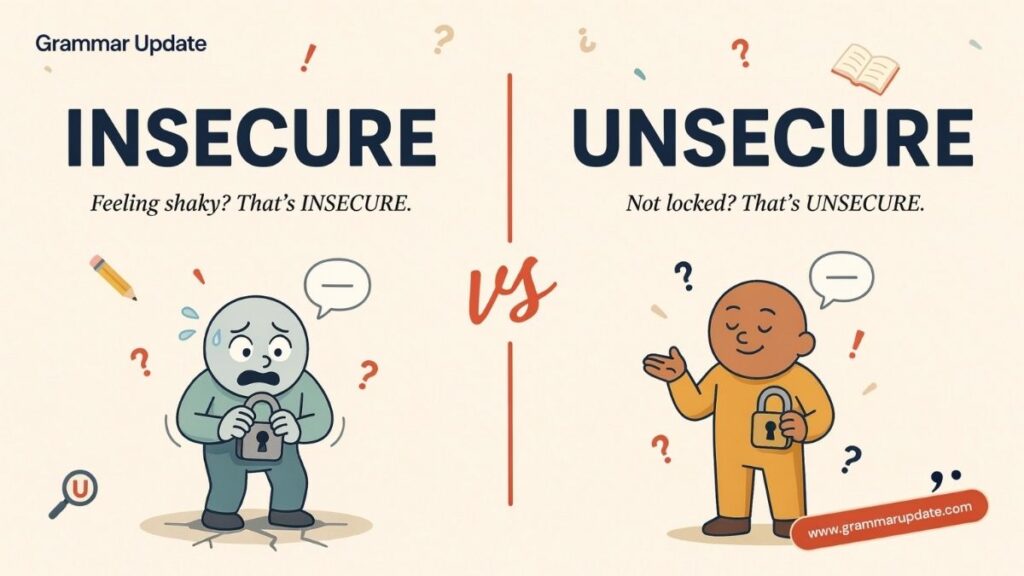
Still hesitating between insecure and unsecure? Don’t worry. A simple memory trick makes the difference easy to remember.
Think of the words this way:
- Insecure relates to inner feelings or weak security.
- Unsecured means something hasn’t been secured or protected.
If you’re describing a person’s confidence, emotions, or relationships, the correct word is insecure.
If you’re talking about a network, loan, door, account, or any object that lacks protection, unsecured is almost always the better choice.
A Simple Rule
Ask yourself one question:
Am I talking about feelings or protection?
- If it’s about feelings, confidence, or trust, use insecure.
- If it’s about missing security measures or collateral, use unsecured.
That’s the easiest way to choose the right word without second-guessing yourself.
Insecure vs Unsecure at a Glance
Need a quick refresher? This table summarizes the key differences.
| Situation | Best Choice | Reason |
|---|---|---|
| A person lacks confidence | Insecure | Refers to emotions and self-esteem |
| Someone has trust issues | Insecure | Describes emotional insecurity |
| A relationship lacks confidence | Insecure | Emotional context |
| A website has security weaknesses | Insecure | Security exists but is weak |
| A Wi-Fi network has no password | Unsecured | No protection has been applied |
| A loan requires no collateral | Unsecured | Standard financial term |
| A door is left unlocked | Unsecured | Not physically secured |
| An account has no protection | Unsecured | Missing security measures |
Correct Usage Examples
Real-life examples make the difference much easier to remember.
Examples Using Insecure
- She felt insecure before the job interview.
- His insecure behavior created unnecessary conflict.
- The company discovered an insecure website during a security audit.
- The software relied on an insecure connection.
- An emotionally insecure person may constantly seek reassurance.
Examples Using Unsecured
- Never connect to an unsecured Wi-Fi network unless necessary.
- The bank approved an unsecured loan based on the applicant’s credit history.
- Staff accidentally left the office door unsecured overnight.
- The customer account remained unsecured after the password was removed.
- Sensitive information was stored on an unsecured server.
Common Mistakes and Their Corrections
Many writing mistakes come from treating these words as interchangeable.
| Incorrect | Correct |
|---|---|
| She feels unsecure. | She feels insecure. |
| He applied for an insecure loan. | He applied for an unsecured loan. |
| Join this unsecure Wi-Fi. | Join this unsecured Wi-Fi. |
| The unsecure website needs HTTPS. | The insecure website needs HTTPS. |
| She’s unsecure in the relationship. | She’s insecure in the relationship. |
Correcting these small mistakes instantly makes your writing sound more fluent and professional.
Practice Session
Test your understanding of insecure vs. unsecure by choosing the correct word for each sentence.
Options: insecure, unsecure, or unsecured
Tip: In modern English, insecure and unsecured are the preferred choices. Unsecure is a real word but is rarely used today.
Fill in the Blanks
- Sarah felt __________ before speaking in front of a large audience.
- The browser warned users about an __________ connection.
- Avoid connecting to an __________ Wi-Fi network in public places.
- His fear of rejection made him feel __________ in the relationship.
- The bank approved an __________ loan because no collateral was required.
- The office was left __________ after employees forgot to lock the main entrance.
- Children sometimes feel __________ when starting at a new school.
- The security audit found several __________ websites.
- Credit card balances are a common type of __________ debt.
- An __________ attachment style can affect long-term relationships.
- The workers accidentally left the equipment __________ during transport. (Accepted but uncommon usage.)
- Weak passwords can make even a modern system __________.
- She became __________ after repeatedly comparing herself with others.
- The café offered an __________ wireless network that anyone could join.
- The report highlighted several __________ communication channels.
- A personal loan is often __________ because it isn’t backed by collateral.
- He felt __________ whenever he had to meet new people.
- The administrator forgot to protect the account, leaving it __________.
- Outdated software can make a computer system __________.
- Her lack of confidence made her feel __________ at work.
- The warehouse gate remained __________ overnight. (Accepted but uncommon usage.)
- A public Wi-Fi hotspot without password protection is considered __________.
- Therapy helped him overcome years of feeling __________.
- The company fixed its __________ website by improving encryption and security settings.
- Although __________ is listed in dictionaries, unsecured is usually preferred in modern technical and professional writing.
Answers
| No. | Answer |
|---|---|
| 1 | insecure |
| 2 | insecure |
| 3 | unsecured |
| 4 | insecure |
| 5 | unsecured |
| 6 | unsecured |
| 7 | insecure |
| 8 | insecure |
| 9 | unsecured |
| 10 | insecure |
| 11 | unsecure |
| 12 | insecure |
| 13 | insecure |
| 14 | unsecured |
| 15 | insecure |
| 16 | unsecured |
| 17 | insecure |
| 18 | unsecured |
| 19 | insecure |
| 20 | insecure |
| 21 | unsecure |
| 22 | unsecured |
| 23 | insecure |
| 24 | insecure |
| 25 | unsecure |
Here’s a trusted source for clear word meanings:
FAQs
Is unsecured grammatically correct?
Yes. Unsecured is grammatically correct and is the preferred term in modern English. It describes something that hasn’t been protected, locked, or backed by collateral, such as an unsecured loan, unsecured debt, or unsecured Wi-Fi network.
When should you use insecure instead of unsecure?
Use insecure when talking about a person’s emotions, confidence, relationships, or something with weak security. Although unsecure is a real word, unsecured is usually the better choice when referring to something that hasn’t been secured.
What does unsecure mean?
Unsecure means not secured or not made safe. While dictionaries recognize it as a valid English word, it is uncommon in modern writing. In most professional contexts, unsecured is the preferred term.
Is a door insecure or unsecured?
It depends on the situation. A door that hasn’t been locked is unsecured. A door with a weak lock or poor protection can be described as insecure because it doesn’t provide adequate security.
Can unsecure be used instead of unsecured?
Technically, yes. However, unsecured is the standard form in finance, cybersecurity, legal documents, and everyday professional writing. It sounds more natural and is widely preferred.
What is another word for unsecure?
Depending on the context, suitable alternatives include unprotected, unlocked, unguarded, exposed, unsafe, and unfastened.
How do you use insecure in a sentence?
Example:
She felt insecure about speaking in front of a large audience.
How do you use unsecured in a sentence?
Example:
Avoid connecting to an unsecured Wi-Fi network because it may expose your personal data.
What is the difference between secure, insecure, and unsecured?
Secure means protected or safe. Insecure means lacking confidence or having weak security. Unsecured means something hasn’t been protected, locked, or guaranteed.
What are the common signs of emotional insecurity?
Emotional insecurity often includes low self-esteem, fear of rejection, constant reassurance seeking, jealousy, self-doubt, overthinking, and difficulty trusting others. These signs can vary from person to person.
What is a more positive way to describe someone who is insecure?
Depending on the context, you can use expressions such as lacking confidence, self-conscious, uncertain, hesitant, or still building confidence. These alternatives sound more supportive while conveying a similar idea.
Why is unsecured more common than unsecure?
Modern English favors unsecured because it clearly describes something that hasn’t been protected or guaranteed. It’s the standard term used in banking, cybersecurity, law, and other professional fields, making it the preferred choice in most formal writing.
Conclusion
The insecure vs unsecure debate confuses many writers because the words look alike and seem to mean the same thing. In reality, each has its own role. Insecure is the right choice when you’re talking about emotions, confidence, relationships, or something with weak security. Unsecured is the standard term for something that hasn’t been protected, locked, or backed by collateral, especially in technology, finance, and legal writing. Although unsecure is a real English word, it’s rarely the most natural option.
A simple way to remember the difference is this: people feel insecure, while networks, loans, and doors are usually unsecured. Keep that rule in mind, and you’ll avoid a common grammar mistake with ease. The next time these words appear, you’ll know exactly which one fits the context and your writing will sound clearer, more accurate, and a lot more polished.

Jhon AJS, the creative mind behind Grammar Update, is an experienced blogger passionate about simplifying English grammar. He focuses on explaining confusing word vs word differences, grammar rules, punctuation, and sentence structure in a clear and practical way. Through easy to understand guides and examples, Jhon helps readers improve their writing and communicate with confidence. With years of blogging experience, he continues to share helpful insights that make learning grammar simple, useful, and accessible for everyone.