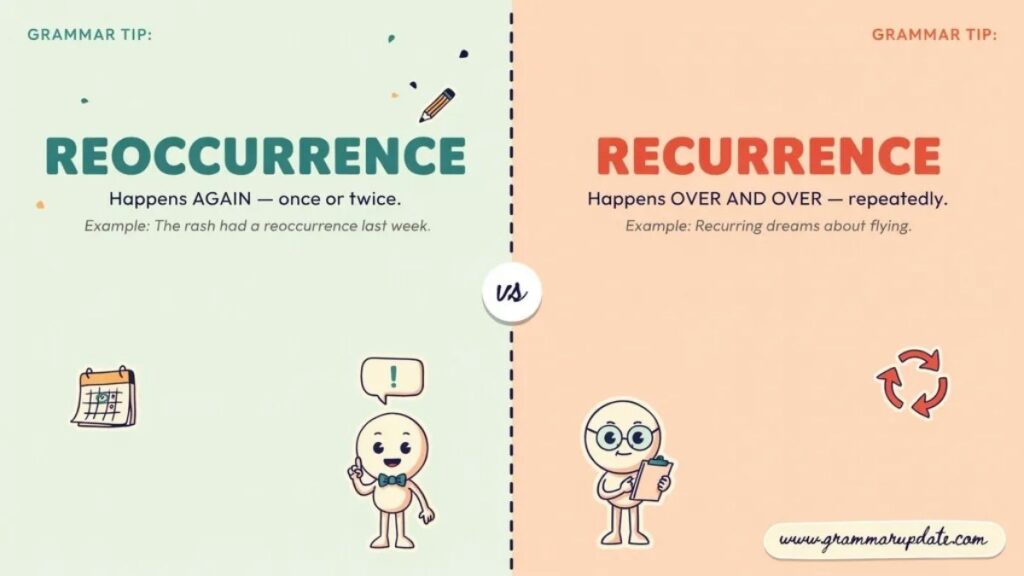
Reoccurrence vs Recurrence is one of those grammar debates that can make even confident writers stop, stare at the screen, and wonder if their spell checker is secretly judging them. Since both words look almost identical and share similar meanings, it’s easy to mix them up. But are they truly interchangeable, or is one the better choice? In this guide, you’ll discover the real difference between recurrence and reoccurrence, learn which word dictionaries and style guides recommend, and see practical examples from everyday and professional writing. By the end, you’ll know exactly which term to use and your grammar mistakes won’t keep recurring.
The Short Answer Reoccurrence vs Recurrence?
If you’re looking for a quick answer, here it is:
Use recurrence in almost every situation.
While reoccurrence is not wrong, recurrence is the word most native speakers, editors, publishers, and professionals naturally choose. It is shorter, more widely recognized, and considered the standard term in both formal and informal writing.
The preference isn’t because reoccurrence is incorrect. Instead, it’s because English generally favors simpler words when two terms have nearly identical meanings. Since recurrence already means “the act of happening again,” adding another re- through reoccurrence often feels unnecessary.
The comparison below makes the difference easy to understand.
| Word | Is It Correct? | How Common Is It? | Recommended? |
|---|---|---|---|
| Recurrence | ✔ Yes | Very common | Yes |
| Reoccurrence | ✔ Yes | Less common | Sometimes |
In other words:
- Recurrence is the standard choice.
- Reoccurrence is acceptable but much less frequently used.
- Most professional editors would choose recurrence unless there is a specific reason not to.
Why Is “Recurrence” More Common?
Language naturally evolves toward simpler, clearer forms. Over time, recurrence has become the preferred noun because it communicates the idea without unnecessary complexity.
Today, you’ll find recurrence used in:
- Medical journals
- Scientific research
- Academic writing
- News articles
- Business reports
- Government publications
- Technical documentation
- Everyday English
Whether someone is describing a repeated event, a recurring issue, a repeat mistake, or a recurring disease, recurrence is usually the word they choose.
For example:
- The patient showed no signs of cancer recurrence.
- Engineers investigated the recurrence of the software bug.
- The yearly flooding has become a predictable recurrence.
Each sentence sounds natural because recurrence is the established choice in standard English.
Why Do People Get Confused?
The confusion comes from the verbs behind these nouns.
- Recur means to happen again.
- Reoccur means to occur again.
Since both verbs are correct, many people assume the nouns recurrence and reoccurrence must be equally common. In reality, English usage has developed differently. Although both nouns exist, recurrence has become the preferred form in dictionaries, editorial style, and professional writing.
This is why you’ll often see grammar experts recommend recurrence first, while still acknowledging that reoccurrence is a valid English word.
A Simple Rule to Remember
If you’re unsure which word to use, follow this easy rule:
When in doubt, choose recurrence.
It works in almost every context, including grammar, medicine, business, education, and everyday conversation.
Think of it this way:
- A disease returns? → Recurrence
- The same mistake happens again? → Recurrence
- A recurring payment is processed every month? → Recurrence
- A software error appears again? → Recurrence
You’ll rarely be criticized for choosing recurrence, but using reoccurrence may prompt an editor to replace it with the more common form.
Learn the difference between more words people mix up
Reinforce vs Reenforce Which Spelling Is Correct?
What Does Recurrence Mean?
To understand the difference between recurrence and reoccurrence, it’s best to start with the word you’ll encounter most often: recurrence.
Whether you’re reading a medical report, a news article, or an academic paper, recurrence is the term that appears most frequently. It has become the standard word for describing something that happens again after a period of time.
Recurrence Definition
Recurrence is a noun that means:
The return of an event, condition, problem, or situation after it has happened before.
In everyday language, a recurrence is simply something that comes back, appears again, or occurs more than once. The event doesn’t have to happen immediately it may return after days, months, years, or even decades.
The word comes from the verb recur, making recurrence the noun form of recur.
Recur Meaning
The verb recur means:
To happen again, especially after a period of time or at regular intervals.
Unlike the verb repeat, which often suggests something happens immediately again, recur usually implies a gap between occurrences.
For example:
- Seasonal allergies recur every spring.
- The software error may recur after the next update.
- Heavy rainfall tends to recur during the monsoon season.
Whenever something returns again, happens repeatedly, or follows a repeated cycle, the noun recurrence is often the most natural choice.
Learn the difference between more words people mix up
To Many vs Too Many Difference and Which is Correct?
Where Is “Recurrence” Commonly Used?
One of the reasons recurrence is preferred is its versatility. It fits naturally in both everyday conversations and highly technical writing.
Medical Terminology
Medicine is where you’ll see recurrence most often.
Doctors use the word when a disease, condition, or symptom returns after treatment or a period of improvement.
Common medical phrases include:
- Cancer recurrence
- Disease recurrence
- Tumor recurrence
- Recurrence risk
- Recurrence rate
- Repeat infection
- Recurring symptoms
For example:
- The patient remains under observation for cancer recurrence.
- Early treatment can lower the recurrence risk.
- Regular follow-up appointments help detect disease recurrence as early as possible.
If you search medical journals or hospital websites, you’ll quickly notice that recurrence is the preferred medical terminology.
Everyday English
Outside medicine, recurrence describes almost any event that happens again.
Examples include:
- The town experienced another recurrence of flooding.
- Engineers fixed the bug to prevent its recurrence.
- The annual parade has become a welcome recurrence.
In each example, something returns again after some time has passed.
Business and Technology
Businesses also use recurrence when discussing ongoing issues or repeated events.
For example:
- The company investigated the recurrence of customer complaints.
- New safeguards reduced the recurrence of billing errors.
- Developers worked to prevent the recurrence of the software bug.
These examples show how naturally the word fits into professional communication.
Science and Mathematics
In technical fields, recurrence has specialized meanings.
You’ll often come across terms such as:
- Recurrence relation
- Recurrence theorem
- Recurrence interval
- Recurrence probability
- Recurrence pattern
Although these meanings are more technical, they all share the same core idea—something follows a pattern and occurs multiple times.
Fix common more word mistakes in English
Thats vs That’s diffrance and Which Is Correct?
Recurrence in a Sentence
Seeing a word in context is one of the easiest ways to remember it.
Here are a few natural examples of recurrence in a sentence.
Everyday Examples
- The recurrence of traffic delays frustrated commuters.
- Everyone hoped there would be no recurrence of last year’s flooding.
- The school introduced new policies to prevent the recurrence of bullying.
Medical Examples
- Doctors are monitoring the patient for disease recurrence.
- The treatment successfully reduced the chance of cancer recurrence.
- Routine checkups help identify recurrence before symptoms worsen.
Professional Examples
- The investigation focused on preventing the recurrence of workplace accidents.
- Engineers redesigned the system to stop the recurrence of the error.
Notice how naturally recurrence fits into every sentence. That’s one of the reasons it has become the preferred word in modern English.
What Does Reoccurrence Mean?
Now let’s look at reoccurrence meaning.
At first glance, reoccurrence seems almost identical to recurrence, and for practical purposes, it usually is. Both words describe something that happens again after it has already occurred.
This similarity is exactly why so many people search for reoccurrence or recurrence meaning or ask which is correct, recurrence or reoccurrence.
Reoccurrence Definition
Reoccurrence is a noun that means:
The act of occurring again after a previous occurrence.
In simple terms, reoccurrence refers to:
- A repeated event
- A repeat incident
- A repeated appearance
- An event that occurs again
- Something that comes back
- A situation that happens more than once
Its meaning closely matches that of recurrence, which is why many people use the two words interchangeably.
Reoccur Meaning
The noun reoccurrence comes from the verb reoccur.
Reoccur means:
To occur again after happening before.
Examples include:
- The problem could reoccur if the underlying cause isn’t fixed.
- Similar weather conditions often reoccur every few years.
- Without proper treatment, the infection may reoccur.
In everyday English, reoccur and recur express almost the same idea. The main difference is that recur is far more common.
Is Reoccurrence a Word?
Yes, it is.
One of the most common questions people ask is:
Is reoccurrence a word?
The answer is yes. Major dictionaries recognize reoccurrence as a legitimate English word, so using it isn’t a spelling or grammar mistake.
However, there’s an important distinction between being correct and being preferred.
Although reoccurrence is valid, it appears far less often than recurrence in books, newspapers, research papers, and professional writing. Many editors choose recurrence because it’s shorter, simpler, and aligns better with modern editorial style.
Reoccurrence in a Sentence
Here are a few examples of reoccurrence in a sentence.
- Engineers investigated the reoccurrence of the network failure.
- New safety procedures were introduced to prevent the reoccurrence of the accident.
- Doctors continued to monitor the patient for the reoccurrence of symptoms.
- The organization hopes to avoid the reoccurrence of last year’s financial problems.
These examples are grammatically correct. Even so, many editors would naturally replace reoccurrence with recurrence because it sounds more concise and is used much more frequently.
Reoccurrence or Recurrence Meaning: Is There a Real Difference?
For most writers, the answer is no.
Both words describe something that:
- Happens again
- Returns after a period of time
- Appears again
- Follows a repeated pattern
- Happens repeatedly
- Occurs multiple times
The real distinction isn’t their meaning it’s their usage.
While reoccurrence remains a correct English word, recurrence has become the standard choice across professional writing, medical terminology, academic publications, and everyday English.
Fix common more word mistakes in English
Enflamed vs Inflamed Which One Is Correct?
Reoccurrence vs Recurrence What’s the Difference?
Now that you know the recurrence meaning and reoccurrence meaning, it’s time to answer the question that brings most people here:
What is the difference between recurrence and reoccurrence?
The honest answer is that the difference is very small. In everyday English, both words describe something that happens again, returns after some time, or occurs more than once. Because their meanings overlap so closely, many people use them interchangeably.
However, if you’re aiming for clear, polished writing, there is one important distinction: usage.
Recurrence has become the standard word in modern English. It’s the term you’ll see in dictionaries, newspapers, academic journals, business documents, and medical literature. Reoccurrence, while still a correct word, is much less common and is often replaced by recurrence during editing.
In other words, the debate over recurrence vs. reoccurrence is less about correctness and more about choosing the word that sounds natural to today’s readers.
A Side-by-Side Comparison
The table below highlights the key differences.
| Feature | Recurrence | Reoccurrence |
|---|---|---|
| Is it a real English word? | ✔ Yes | ✔ Yes |
| Meaning | Something happens or returns again | Something occurs again |
| Common in modern English | ✔ Very common | Less common |
| Preferred in professional writing | ✔ Yes | Rarely |
| Used in medical terminology | ✔ Frequently | Occasionally |
| Recommended by editors | ✔ Yes | Usually replaced |
| Best choice for everyday writing | ✔ Yes | Acceptable but uncommon |
As you can see, the meanings are nearly identical. The biggest difference is how often each word is used.
Why Is Recurrence Preferred?
If both words are correct, why does recurrence appear so much more often?
The answer lies in how English naturally evolves. Over time, speakers and writers tend to favor words that are simpler, shorter, and easier to understand.
Since recurrence already means “the act of happening again,” many language experts see reoccurrence as unnecessarily long. Although it isn’t grammatically wrong, the extra re- doesn’t add any new meaning.
That’s why you’ll almost always find recurrence in:
- Academic research
- Medical journals
- Government publications
- Business reports
- News articles
- Professional emails
- Technical documentation
If you’re writing for a broad audience, recurrence is usually the better choice.
Is “Reoccurrence” Incorrect?
No.
This is one of the biggest misconceptions surrounding these words.
Many people assume reoccurrence is simply a mistake because they don’t encounter it very often. In reality, reoccurrence is listed in respected dictionaries and has been part of the English language for many years.
So why do some editors discourage its use?
Not because it’s wrong—but because recurrence expresses the same idea more efficiently.
Think of it this way:
- Correct? Yes.
- Common? Not really.
- Recommended? Usually not.
That’s an important distinction. A word can be grammatically correct and still be less suitable for modern writing.
Is “Reoccurrence” Redundant?
Some grammar enthusiasts argue that reoccurrence is slightly redundant because it combines the prefix re- with occurrence, even though the idea of “again” is already conveyed by recurrence.
However, this isn’t a strict grammatical rule.
English contains many words that have developed through historical usage rather than perfect logic. As long as dictionaries recognize reoccurrence, it remains a valid word.
Still, if your goal is clear, concise writing, recurrence is generally the stronger option.
When Should You Use “Recurrence”?
For most writing situations, recurrence is the safest and most natural choice.
Use it when you’re writing about:
- A recurring problem
- A recurring disease
- A repeat infection
- A repeated event
- A repeat mistake
- A recurring payment
- A recurring meeting
- A repeated pattern
- An event that happens over time
- Something that returns again
For example:
- The software update prevented the recurrence of the error.
- Doctors discussed the patient’s cancer recurrence.
- The company wants to avoid the recurrence of billing issues.
- Heavy rainfall caused another recurrence of flooding.
Each sentence sounds natural because recurrence is the word readers expect.
When Can You Use “Reoccurrence”?
Although it’s less common, reoccurrence isn’t off-limits.
You can use it if:
- You’re following a source that already uses the term.
- You’re quoting someone directly.
- Your organization or publication prefers it.
- You want to emphasize that something has occurred again.
Even then, consistency matters. If you choose reoccurrence, stick with it throughout the document instead of switching back and forth between both terms.
Fix common more word mistakes in English
Insecure vs Unsecure Which One Is Correct?
Real-World Usage Which Word Will You See More Often?
Here’s a simple observation:
If you open a medical journal, you’ll almost certainly read about disease recurrence, not disease reoccurrence.
If you browse news articles, you’ll see references to the recurrence of wildfires, the recurrence of inflation, or the recurrence of technical issues.
Likewise, style-conscious publications almost always choose recurrence because it aligns with modern editorial standards.
This widespread usage has reinforced recurrence as the default choice across industries.
A Simple Trick to Remember the Difference
Still unsure which word to use?
Here’s an easy memory tip:
If you’re writing for school, work, publication, or professional communication, choose recurrence.
It’s shorter, more familiar, and accepted almost everywhere.
Think of reoccurrence as a perfectly valid guest in the English language but recurrence is the one who gets invited most often.
Quick Comparison at a Glance
| Question | Best Answer |
|---|---|
| Which is correct: recurrence or reoccurrence? | Both are correct. |
| Which word is more common? | Recurrence |
| Which word do dictionaries recognize? | Both |
| Which word do editors usually recommend? | Recurrence |
| Which word is common in medicine? | Recurrence |
| Should I use recurrence or reoccurrence? | Use recurrence unless you have a specific reason to choose reoccurrence. |
Key Takeaway
When comparing reoccurrence vs recurrence, remember that the meanings are virtually the same. The real difference lies in usage, frequency, and style.
Both words are correct, but recurrence has become the preferred choice because it is concise, widely recognized, and commonly used in standard English, medical terminology, academic writing, and professional communication.
Why Recurrence Is Usually the Better Choice
If both recurrence and reoccurrence are correct, why do dictionaries, editors, and professional writers almost always choose recurrence?
The answer isn’t that reoccurrence is wrong. It’s that recurrence has become the accepted standard in modern English. Over time, writers naturally favored the shorter, simpler word because it communicates the same idea without adding unnecessary complexity.
Today, whether you’re reading a research paper, a medical report, a news article, or a business document, you’ll almost always come across recurrence instead of reoccurrence.
That’s why, if you’re wondering which is correct, recurrence or reoccurrence, the safest answer is:
Both are correct, but recurrence is the preferred choice in almost every writing situation.
It’s the Standard Word in Modern English
Language changes over time. Some words become more popular, while others gradually fade into the background.
That’s exactly what happened with recurrence.
Although reoccurrence is still recognized by dictionaries, recurrence has become the word people expect to see. It appears consistently in newspapers, academic journals, government publications, legal documents, business reports, and everyday writing.
For example, you’ll regularly find expressions like:
- Cancer recurrence
- Disease recurrence
- Symptom recurrence
- Recurrence risk
- Recurrence rate
- Recurrence interval
- Error recurrence
- Event recurrence
These phrases are so common that they sound completely natural to native English speakers.
By comparison, replacing recurrence with reoccurrence often makes a sentence feel longer and less familiar, even though it remains grammatically correct.
Learn the difference between everyday English mistakes
Acception vs Exception Difference and Usage?
Professional Writing Favors Clarity
One of the main goals of professional writing is clarity. Readers shouldn’t have to stop and think about the words you’re using they should understand your message immediately.
That’s one reason editors tend to choose recurrence.
Compare these two sentences:
- The engineers investigated the recurrence of the software bug.
- The engineers investigated the reoccurrence of the software bug.
Both sentences are correct, but the first reads more smoothly. Because recurrence is the form readers encounter most often, it feels more natural and requires less mental effort to process.
The same pattern appears in other contexts:
- The recurrence of flooding damaged local roads.
- Doctors discussed the patient’s cancer recurrence.
- The company introduced new measures to prevent the recurrence of billing errors.
Each example is concise, clear, and consistent with standard English usage.
It Aligns with Editorial Style
Professional editors aim for consistency across books, websites, newspapers, and academic publications.
When two words have nearly identical meanings, they usually recommend the one that is more widely accepted. In this case, that’s recurrence.
Although style guides don’t always include a rule specifically comparing recurrence vs. reoccurrence, their general emphasis on concise, standard language naturally favors recurrence.
If you’re writing for school, work, or publication, choosing recurrence is almost always the best decision.
Writing Tip: If you’re ever unsure whether to write reoccurrence or recurrence, choose recurrence. It’s the standard form in modern English and fits almost every context.
Is Reoccurrence Incorrect?
A common misconception is that reoccurrence is simply a mistake.
It isn’t.
One of the most frequently searched questions is:
Is reoccurrence a word?
The answer is yes.
Reoccurrence is a legitimate English word, and you’ll find it listed in respected dictionaries. Using it isn’t a spelling error or a grammar mistake.
However, being correct isn’t the same as being preferred.
Many English words are technically correct but appear far less often because another word has become the standard choice. That’s exactly what has happened here.
Fix common more word mistakes in English
Sneek vs Sneak Which Spelling Is Correct and Use It?
Why Do Some People Think It’s Wrong?
There are several reasons why people mistakenly believe reoccurrence is incorrect.
It’s Rare in Everyday Writing
Most people learn vocabulary by reading books, articles, websites, and news reports.
Since recurrence appears much more frequently, readers naturally become familiar with it. When they later encounter reoccurrence, it can seem unfamiliar or even incorrect.
The reality is much simpler: it’s a valid word that’s used less often.
Editors Usually Replace It
If you’ve ever submitted an article for editing, there’s a good chance an editor has changed reoccurrence to recurrence.
This isn’t because the original word was wrong. Instead, editors generally prefer the version that is shorter, more familiar, and easier for readers to recognize.
The same principle applies to many other word pairs in English. Clear, concise language almost always wins.
The Extra Prefix Adds Little Value
Some language experts also point out that reoccurrence feels slightly repetitive.
The prefix re- already suggests “again.” Since recurrence already conveys the idea of something returning, adding another layer through reoccurrence doesn’t change the meaning in any meaningful way.
This isn’t a grammatical rule it’s simply one reason why many writers naturally gravitate toward recurrence.
So, Should You Ever Use “Reoccurrence”?
Yes but only if there’s a good reason.
For example, you might use reoccurrence when:
- Quoting a source that uses the word.
- Following an organization’s preferred terminology.
- Maintaining consistency in a document where reoccurrence has already been used.
Otherwise, recurrence is usually the better option.
Learn the difference between everyday English mistakes
Instalments vs Installments Which Is Correct and Use It?
Reoccurrence vs Recurrence in Different Contexts
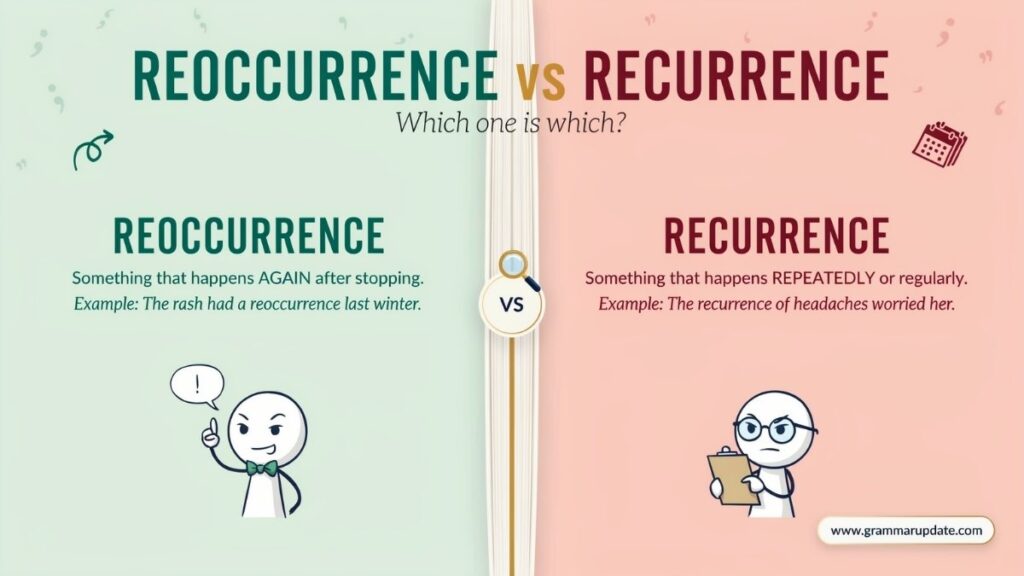
Although recurrence is the preferred term overall, understanding how these words are used in different fields makes the distinction much clearer.
Medical Writing
Medicine provides the strongest example of standard usage.
Healthcare professionals almost always use recurrence when a disease, condition, or symptom returns after treatment or remission.
Common medical expressions include:
- Cancer recurrence
- Disease recurrence
- Tumor recurrence
- Symptom recurrence
- Recurrence risk
- Recurrence rate
- Repeat infection
- Recurring disease
For example:
- The patient is being monitored for cancer recurrence.
- Early treatment reduced the likelihood of disease recurrence.
- Regular follow-up appointments help detect symptom recurrence before complications develop.
Although reoccurrence occasionally appears in medical writing, recurrence is overwhelmingly preferred because it has become established medical terminology.
A Real-World Example Cancer Recurrence
Imagine a patient who completes treatment and is declared cancer-free.
Three years later, routine scans reveal that the same cancer has returned.
Doctors describe this as cancer recurrence because the original disease has come back after a period of remission.
This distinction is important because treatment plans, recurrence risk, and long-term follow-up all depend on identifying whether doctors are dealing with a recurring disease or an entirely new diagnosis.
That’s why discussions about recurrence or reoccurrence cancer almost always use the word recurrence.
Academic Writing
Researchers value consistency and precise terminology.
As a result, recurrence appears throughout academic literature in fields ranging from mathematics and computer science to environmental studies and medicine.
Common terms include:
- Recurrence relation
- Recurrence theorem
- Recurrence interval
- Recurrence probability
- Recurrence pattern
If you’re writing an essay, dissertation, or journal article, recurrence is the form most professors, reviewers, and editors expect to see.
Business and Professional Writing
Businesses often deal with issues that repeat over time.
Examples include:
- Recurring payment failures
- Recurring customer complaints
- Recurring software errors
- Recurring meetings
- Recurring subscriptions
- Recurring maintenance problems
When referring to the repeated event itself, recurrence is the preferred noun.
For example:
- The company introduced new procedures to prevent the recurrence of payroll errors.
- Engineers successfully reduced the recurrence of network outages.
- Better staff training helped prevent the recurrence of customer service issues.
Reoccurrence vs Recurrence in British and American English
Many writers assume that British English prefers one word while American English prefers the other. It’s a reasonable question, especially since English often has regional differences in spelling and vocabulary.
However, when it comes to recurrence or reoccurrence UK usage, there isn’t a meaningful divide.
Both British English and American English recognize recurrence and reoccurrence as correct words. The difference isn’t regional it’s stylistic.
In both varieties of English, recurrence is by far the more common choice.
Whether you’re reading a British newspaper, an American medical journal, or an Australian government report, you’re much more likely to see:
- Disease recurrence
- Cancer recurrence
- Recurrence risk
- Recurrence interval
- Recurrence of symptoms
Rather than:
- Disease reoccurrence
- Cancer reoccurrence
- Reoccurrence of symptoms
This consistency makes life easier for writers. You don’t need to change your word choice depending on your audience.
Is There a UK Spelling Difference?
No.
Unlike pairs such as colour/color or organise/organize, recurrence and reoccurrence are not regional spelling variants.
Both words exist in both forms of English, and both are spelled exactly the same in the UK and the US.
The preference for recurrence comes from common usage—not geography.
Which Word Should You Use?
If you’re writing for readers in:
- the United Kingdom,
- the United States,
- Canada,
- Australia,
- New Zealand, or
- any other English-speaking country,
recurrence is the safest and most natural choice.
It aligns with modern editorial style and is immediately familiar to readers around the world.
Learn the difference between more words people mix up
Copys or Copies Which Is Correct?
Recurrence vs Relapse
Another question that often appears alongside recurrence vs. reoccurrence is:
Is recurrence the same as relapse?
The answer is no.
Although both words describe something returning, they are not interchangeable, especially in medical terminology.
Understanding the distinction is important because doctors, researchers, and healthcare professionals use each word in a specific way.
What Is Recurrence?
A recurrence happens when a disease, condition, or problem returns after it has apparently resolved or gone into remission.
Examples include:
- Cancer recurrence
- Disease recurrence
- Recurrence of symptoms
- Recurrence of infection
For example:
A patient completes cancer treatment, remains cancer-free for several years, and then the same cancer returns.
This is called a cancer recurrence.
What Is a Relapse?
A relapse usually refers to the return or worsening of symptoms after improvement but before the condition is considered completely resolved, or the return of a condition after a period of recovery, depending on the disease.
Examples include:
- Depression relapse
- Addiction relapse
- Multiple sclerosis relapse
- Relapse of an autoimmune condition
In many illnesses, a relapse reflects renewed disease activity rather than the appearance of a completely new problem.
Side-by-Side Comparison
| Recurrence | Relapse |
|---|---|
| A condition returns after remission or successful treatment. | A condition becomes active again after improvement or recovery. |
| Commonly used in cancer and chronic disease discussions. | Often used for addiction, mental health, and autoimmune conditions. |
| Focuses on the return of the disease or event. | Focuses on the return or worsening of symptoms or illness. |
Why the Difference Matters
Imagine two patients.
Patient A
After surgery and treatment, there is no evidence of cancer for four years. During a routine follow-up, doctors discover that the same cancer has returned.
This is a cancer recurrence.
Patient B
A person recovering from alcohol dependence begins drinking again after months of sobriety.
This is a relapse.
Although both situations involve something returning, the medical terms describe different clinical circumstances.
Can the Words Ever Overlap?
Sometimes.
In everyday conversation, people occasionally use relapse and recurrence loosely. However, in professional healthcare settings, doctors choose the term that best matches the patient’s diagnosis and treatment history.
If you’re writing about medicine, it’s best not to treat them as synonyms.
Fix common more word mistakes in English
Protestors or Protesters Which Spelling Is Actually Correct?
Recur vs Reoccur
The same confusion exists with the verbs recur and reoccur.
Since the nouns recurrence and reoccurrence come from these verbs, understanding them makes the distinction much easier.
Recur Meaning
Recur means:
To happen again after a period of time or at regular intervals.
It’s the more common verb and is widely used in both formal and informal English.
Examples:
- Seasonal allergies recur every spring.
- The problem may recur if the underlying cause isn’t addressed.
- Similar weather patterns often recur every few years.
Notice that recur often suggests a pattern or cycle.
Reoccur Meaning
Reoccur means:
To occur again after happening previously.
Its meaning is almost identical to recur, but it appears much less often in modern English.
Examples:
- The issue could reoccur after the next software update.
- Similar incidents may reoccur in the future.
- Without maintenance, the fault may reoccur.
These sentences are correct, but many writers would naturally choose recur instead.
Difference Between Recur and Reoccur
For most situations, there is little practical difference.
Both verbs describe something that happens again.
The real distinction lies in usage.
| Recur | Reoccur |
|---|---|
| More common | Less common |
| Preferred in modern English | Acceptable but less frequent |
| Common in academic and medical writing | Rare in formal writing |
| Produces the noun recurrence | Produces the noun reoccurrence |
If you’re unsure which verb to use, recur is almost always the better choice.
Learn the difference between everyday English mistakes
Unenroll vs Disenroll Differences with Complete Guide
Recurring Or Reoccurring
The same pattern continues with the adjectives.
Recurring
Recurring describes something that happens repeatedly or returns over time.
Examples include:
- A recurring issue
- A recurring payment
- A recurring meeting
- A recurring subscription
- Recurring symptoms
- A recurring problem
These expressions are extremely common in everyday English.
For example:
- We scheduled a recurring meeting every Monday morning.
- The company fixed a recurring error in its billing system.
- Doctors monitored the patient’s recurring symptoms.
Reoccurring
Reoccurring is also correct, but it’s far less common.
Examples:
- A reoccurring problem
- A reoccurring event
- A reoccurring fault
Although these phrases are grammatically acceptable, most editors would naturally replace reoccurring with recurring.
Which Adjective Should You Choose?
Just like recurrence and recur, the shorter form has become the standard.
Use recurring in almost every situation unless you have a specific reason to choose reoccurring.
Learn the difference between everyday English mistakes
Trek vs Treck Confusion and Correct Usage
A Simple Rule You’ll Always Remember
If all these similar words still feel confusing, don’t worry. There’s an easy way to keep them straight.
Think of the most common form in each word family:
| Verb | Noun | Adjective |
|---|---|---|
| Recur | Recurrence | Recurring |
The alternatives reoccur, reoccurrence, and reoccurring are all valid English words, but they appear far less often in modern writing.
Easy Memory Tip: When you’re writing for school, work, publication, or professional communication, choose recur, recurrence, and recurring. They are the standard forms that readers expect, editors prefer, and style guides consistently favor.
Practice Session Reoccurrence vs Recurrence

Instructions: Fill in each blank using the correct word from the options below.
Word Bank: recurrence, reoccurrence, recur, reoccur, recurring, reoccurring, relapse
- Doctors monitored the patient for the __________ of cancer after treatment.
- The software update was designed to prevent the __________ of the same bug.
- Seasonal allergies usually __________ every spring.
- The annual parade has become a welcome __________ in the community.
- Engineers hope the network issue will never __________.
- There was no __________ of symptoms during the patient’s follow-up visits.
- We have a __________ team meeting every Monday morning.
- The company investigated the __________ of customer complaints.
- Similar weather patterns tend to __________ every few years.
- Although less common, __________ is still recognized by major dictionaries.
- The doctor explained the patient’s __________ risk after surgery.
- Better maintenance reduced the __________ of equipment failures.
- The same technical issue continued to __________ despite several updates.
- A monthly subscription is an example of a __________ payment.
- Most editors recommend using __________ instead of reoccurrence.
- After six months of recovery, the patient experienced a __________.
- Researchers studied the __________ interval of earthquakes.
- Without proper repairs, the problem may __________ next winter.
- New safety measures helped prevent the __________ of workplace accidents.
- The company fixed a __________ software error that affected customers.
- Medical journals almost always prefer the word __________.
- The infection could __________ if the patient stopped taking antibiotics too soon.
- Everyone hoped there would be no __________ of last year’s flooding.
- The team investigated the __________ of the system failure after it happened again.
- In modern English, __________ is generally the preferred noun in professional writing.
Answers
| Question | Correct Answer |
|---|---|
| 1 | recurrence |
| 2 | recurrence |
| 3 | recur |
| 4 | recurrence |
| 5 | reoccur (recur is also acceptable) |
| 6 | recurrence |
| 7 | recurring |
| 8 | recurrence |
| 9 | recur |
| 10 | reoccurrence |
| 11 | recurrence |
| 12 | recurrence |
| 13 | recur |
| 14 | recurring |
| 15 | recurrence |
| 16 | relapse |
| 17 | recurrence |
| 18 | reoccur (recur is also acceptable) |
| 19 | recurrence |
| 20 | recurring |
| 21 | recurrence |
| 22 | recur (reoccur is also correct but less common) |
| 23 | recurrence |
| 24 | reoccurrence (acceptable here, though recurrence is more common) |
| 25 | recurrence |
Here’s a trusted source for clear word meanings:
FAQs
Is reoccurrence a real word?
Yes. Reoccurrence is a valid English word recognized by major dictionaries. However, recurrence is the preferred term because it is more common in modern English, academic writing, and professional communication.
Which is correct recurrence vs reoccurrence?
Both words are correct. However, recurrence is the standard choice in most situations because it is shorter, more widely used, and recommended by editors and style guides.
What is the difference between recurrence vs reoccurrence?
The meanings are nearly identical. Both describe something that happens again after a period of time. The main difference is usage: recurrence is the preferred and more frequently used term, while reoccurrence is less common.
What does recurrence mean?
Recurrence is the return of an event, condition, disease, or problem after it has previously occurred. It commonly refers to something that happens again after a period of time.
What does reoccurrence mean?
Reoccurrence means the act of occurring again. Although its meaning is almost the same as recurrence, it is used less frequently in modern English.
Is reoccurrence incorrect?
No. Reoccurrence is not incorrect. It is a recognized English word, but recurrence is generally preferred because it sounds more natural and is more widely accepted.
Is recurrence a word?
Yes. Recurrence is a standard English noun and the preferred term in grammar, medicine, business, and academic writing.
Should I use recurrence vs reoccurrence in professional writing?
Use recurrence. It is the standard term in professional, academic, legal, and medical writing because it is concise, familiar, and consistent with modern English usage.
Is there a difference between British and American English?
No. Both British English and American English recognize recurrence and reoccurrence, but recurrence is the preferred word in both varieties of English.
How do you spell reoccurrence in the UK?
The spelling is reoccurrence, exactly the same as in American English. There is no British spelling variation.
What is the difference between occurrence and recurrence?
An occurrence is any event that happens. A recurrence is an event that happens again after it has already occurred.
What is the difference between recur and reoccur?
Both verbs mean “to happen again.” However, recur is much more common and is the preferred choice in modern English, while reoccur is correct but less frequently used.
What is the past tense of reoccur?
The past tense of reoccur is reoccurred.
Example: The problem reoccurred after the latest software update.
Is reoccur a correct word?
Yes. Reoccur is a correct English verb that means “to occur again.” Even so, recur is generally the preferred verb because it is more widely used.
Which is correct recurring or reoccurring?
Both adjectives are grammatically correct. However, recurring is far more common and is the preferred choice in standard English.
What does reoccurring mean?
Reoccurring describes something that occurs again after a period of time. While it is correct, recurring is the more natural and commonly used adjective.
Is recurrence the same as relapse?
No. Recurrence refers to a disease or condition returning after remission or successful treatment. Relapse usually refers to a return or worsening of symptoms after a period of improvement. The exact meaning depends on the medical condition.
Can recurrence refer to cancer?
Yes. Cancer recurrence is a standard medical term used when the same cancer returns after treatment and a period of remission.
How do you use recurrence in a sentence?
Example: Doctors continue to monitor the patient for cancer recurrence after treatment.
How do you use reoccurrence in a sentence?
Example: Engineers investigated the reoccurrence of the system failure.
Although this sentence is correct, recurrence would be the more natural choice in most writing.
What are some synonyms for recurrence?
Depending on the context, common synonyms include:
- Repetition
- Return
- Reappearance
- Renewal
- Repeat occurrence
- Re-emergence
What are some synonyms for recur?
Common alternatives include:
- Repeat
- Return
- Reappear
- Come back
- Re-emerge
- Happen again
What is another word for something that happens repeatedly?
Depending on the context, you could use recurring event, repeated occurrence, repeated pattern, repeat cycle, periodic event, or ongoing phenomenon.
Why is recurrence preferred over reoccurrence?
Recurrence is preferred because it is shorter, more widely used, and considered the standard term in dictionaries, editorial style, academic publications, and medical terminology. While reoccurrence is correct, it is much less common.
Learn the difference between more words people mix up
Wise vs Wize Usage and Mistakes Explained
Conclusion
The debate over reoccurrence vs recurrence has confused writers, students, professionals, and even experienced English speakers for years. After all, the two words look almost identical, sound nearly the same, and share virtually the same meaning. It’s easy to see why this pair causes so many grammar mistakes.
The good news is that the confusion is easier to solve than it seems. Both reoccurrence and recurrence are correct English words. However, they are not equally preferred. In modern English, recurrence is the standard choice because it is shorter, clearer, and far more common in dictionaries, medical terminology, academic writing, business communication, and everyday usage.
If you’re still wondering which is correct: recurrence vs reoccurrence?, here’s the simple answer:
- Use recurrence for almost all writing.
- Use reoccurrence only when a specific style guide, organization, or quoted source requires it.
Think of it this way: recurrence is the popular student who shows up everywhere, while reoccurrence still belongs in the class but rarely raises its hand.
The difference between recurrence vs reoccurrence doesn’t just improve your vocabulary it helps you write with greater clarity, confidence, and professionalism. Whether you’re describing a recurring problem, cancer recurrence, a repeated event, or something that happens again, you’ll now know exactly which word fits best.

Jhon AJS, the creative mind behind Grammar Update, is an experienced blogger passionate about simplifying English grammar. He focuses on explaining confusing word vs word differences, grammar rules, punctuation, and sentence structure in a clear and practical way. Through easy to understand guides and examples, Jhon helps readers improve their writing and communicate with confidence. With years of blogging experience, he continues to share helpful insights that make learning grammar simple, useful, and accessible for everyone.