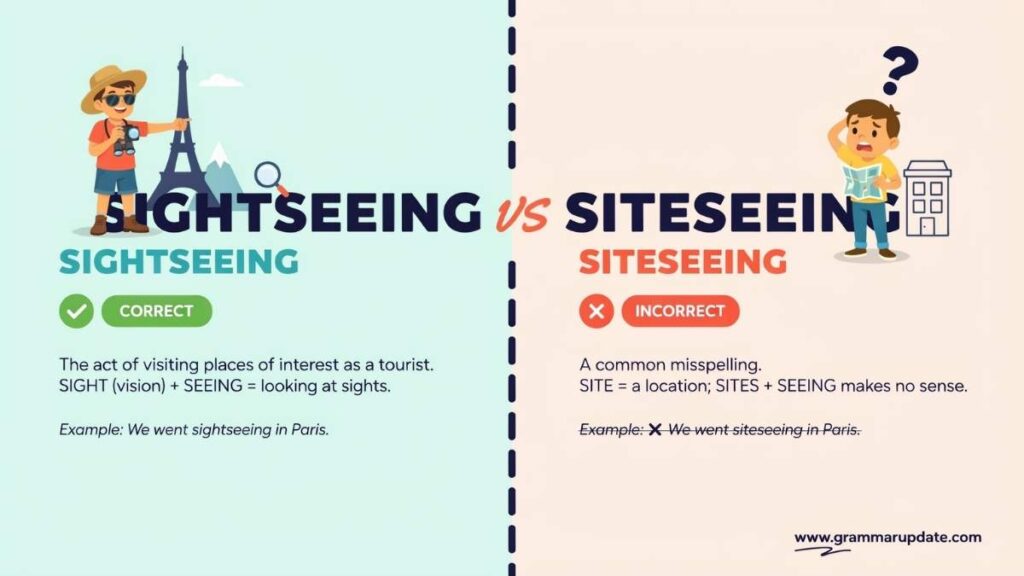
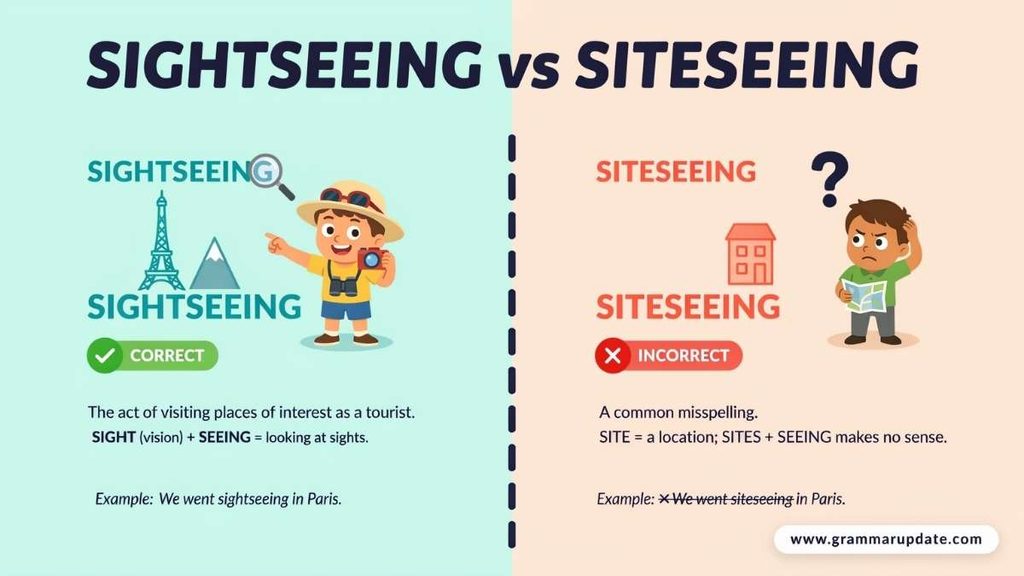
English spelling can sometimes turn a simple word into a tiny puzzle. Sightseeing vs siteseeing is a good example. In sightseeing vs siteseeing, both forms sound almost the same, but only one is correct when you mean visiting interesting places while traveling. Sightseeing is the correct spelling, while siteseeing is a common mistake. The confusion comes from sight and site, which sound alike but have different meanings. Sight relates to seeing, while site means a place or location. Once you understand sightseeing vs siteseeing, the spelling becomes much easier to remember. Whether you’re exploring landmarks, visiting museums, or admiring famous attractions, using sightseeing correctly keeps your writing clear and your spelling on track.
Quick Answer
Sightseeing is the correct spelling when you mean visiting interesting or notable places as a tourist. Siteseeing is not the standard spelling for this activity.
Cambridge defines sightseeing as the activity of visiting interesting places, particularly while on vacation. Oxford gives a similar sightseeing definition and describes it as visiting interesting buildings and places as a tourist. Both dictionaries treat sightseeing as a noun.
Here is the basic difference:
| Word | Standard usage | Meaning | Example |
|---|---|---|---|
| sightseeing | Correct | Visiting interesting places as a tourist | We spent the afternoon sightseeing. |
| siteseeing | Incorrect for this meaning | Usually a misspelling of sightseeing | We spent the afternoon sightseeing. |
| sight seeing | Not the standard travel spelling | Separate words rather than the established compound | We went sightseeing. |
| site seeing | Not the standard travel term | Literal words that do not replace sightseeing | We went sightseeing. |
The easiest rule is simple: you see sights, you visit sites, and you go sightseeing.
Fix common more word mistakes in English
Bass vs Base Differences and usage ?
Why Sightseeing Is the Correct Word
The spelling becomes easier when you look at the meaning of sight.
Sight can refer to something that you see. In tourism, the plural form sights commonly refers to interesting or notable places that visitors want to see. That idea connects directly with sightseeing.
Think about the expression seeing the sights. It means visiting or looking at interesting places. Sightseeing expresses the same general idea in a compact form.
For example, these sentences describe essentially the same activity:
We spent the afternoon sightseeing.
We spent the afternoon seeing the sights.
The first uses the established compound word. The second uses a normal phrase containing the noun sights.
The word site has a different meaning. A site is a physical location or place. An archaeological site, construction site, or building site is a location. Therefore, site can certainly appear in travel writing, but it does not give us the standard spelling of the tourism activity.
That distinction is the key to understanding sightseeing vs siteseeing.
What Does Sightseeing Mean?
So, what does sightseeing mean?
Sightseeing means visiting interesting places, especially as part of a trip, vacation, or tourist experience. Those places might include famous landmarks, museums, monuments, historic buildings, scenic viewpoints, cultural attractions, or other places of interest.
Cambridge classifies sightseeing as an uncountable noun and gives examples such as go sightseeing and do some sightseeing. Oxford likewise lists sightseeing as an uncountable noun and gives common combinations including sightseeing tour and sightseeing trip.
A simple sightseeing definition is:
Sightseeing is the activity of visiting interesting or notable places as a tourist.
For example:
We went sightseeing in New York.
They spent the morning sightseeing around the city.
She enjoys sightseeing whenever she travels.
The hotel is close to several famous sightseeing attractions.
Notice that sightseeing does not describe one particular place. Instead, it describes the activity of exploring places that are interesting to see.
Learn the difference between confusing more English words
Dumbbell vs Dumbell difference and usage?
Sightseeing Meaning in English
The sightseeing meaning in English is closely connected with tourism and travel.
When someone says, “We are going sightseeing,” the listener understands that the person plans to visit or look at notable places. The activity may involve walking, driving, taking a bus, joining a guided tour, riding a boat, or simply exploring independently.
For example, someone visiting Washington, DC, might spend the day seeing monuments and museums. Someone traveling through a historic European city might walk through old streets and visit famous buildings. A traveler in a coastal destination might explore scenic viewpoints.
All of these can fall under sightseeing.
The activity does not require an organized tour. You can go sightseeing with a tour guide, with friends, with family, or entirely on your own.
What Does Siteseeing Mean?
What does siteseeing mean?
In standard travel English, siteseeing is generally a misspelling of sightseeing.
The mistake usually happens because sight and site sound alike. They are homophones, which means they have the same pronunciation but different meanings and spellings.
The word site means a physical location. Because tourists visit locations, someone may naturally assume that site + seeing should produce siteseeing.
However, English does not use siteseeing as the standard name for the tourist activity.
Consider this example:
Incorrect: We spent Saturday siteseeing in Rome.
Correct: We spent Saturday sightseeing in Rome.
The corrected version uses sight because sightseeing relates to seeing sights.
That small spelling distinction removes the confusion.
Learn the difference between confusing more English words
Airplane vs Aeroplane difference and usage?
Sightseeing vs Site Seeing
The comparison between sightseeing vs site seeing creates a second problem.
For the normal tourism activity, sightseeing is written as one word.
The phrase site seeing could theoretically appear as two ordinary words in a special context where someone literally means seeing a site. However, that does not make site seeing an alternative spelling of sightseeing.
For example, a construction company might discuss employees seeing a site before beginning a project. In that case, the words site and seeing retain their ordinary meanings.
Tourism uses a different established word:
We went sightseeing.
This distinction matters because English contains many compound words that function as established vocabulary. Once a particular form becomes standard, simply combining related words does not automatically create an acceptable alternative.
Sight Seeing vs Sightseeing
Sight seeing vs sightseeing is another common spelling question.
When you mean the tourist activity, use sightseeing.
For example:
Correct: We went sightseeing after breakfast.
Incorrect: We went sight seeing after breakfast.
However, seeing the sights is perfectly natural because it is a normal phrase rather than an attempt to split the compound word.
For example:
We spent the afternoon seeing the sights.
We spent the afternoon sightseeing.
Both sentences communicate the same basic travel idea.
The difference lies in the structure. Sightseeing is one word, while seeing the sights contains three separate words.
Learn the difference between confusing more English words
Foreign vs Foriegn difference and usage?
Sight vs Site What Is the Difference?
The difference between sight and site is central to understanding the correct spelling.
Sight is related to seeing. It can refer to the ability to see, the act of seeing, or something that is seen. In travel contexts, sights can mean interesting places or attractions that visitors want to see.
Site means a physical location.
Here is the distinction in simple terms:
| Word | Meaning | Example |
|---|---|---|
| sight | Something seen or something worth seeing | The waterfall was an amazing sight. |
| site | A physical location | The museum was built on an old site. |
The two words sound alike, but their meanings are different.
That is why spelling matters. If you replace sight with site, you are changing the word rather than simply changing its appearance.
Sight Meaning
Sight has several meanings in English.
It can describe the ability to see:
Her sight remained excellent.
It can describe something visible:
The mountain was an impressive sight.
It can also appear in expressions involving notable things or places:
The cathedral is one of the city’s most famous sights.
That last meaning is particularly important because it connects directly with sightseeing.
Site Meaning
Site refers to a location.
For example:
The company chose a site for its new office.
The archaeological site attracts many visitors.
The construction site is closed today.
A site can certainly become a tourist attraction. An archaeological site might be one of the most interesting places on a travel itinerary. However, the activity of visiting interesting places remains sightseeing.
In other words, you can visit a site while sightseeing, but you do not change the spelling of sightseeing to siteseeing.
Is Sightseeing One Word?
Yes. Is sightseeing one word? The answer is yes when you mean the established travel activity.
The standard spelling is sightseeing.
It is not normally written as sight seeing, site seeing, or site-seeing when it functions as the travel term.
Oxford lists sightseeing as a single uncountable noun. It also gives established expressions such as go sightseeing, do some sightseeing, sightseeing tour, and sightseeing trip.
The correct spelling is therefore:
sightseeing
The spelling pattern is worth remembering because it appears in many common travel expressions.
Learn the difference between confusing more English words
Embarrass vs Embarass difference and usage?
Is Sightseeing a Noun?
Yes, sightseeing is a noun.
When you say, “Sightseeing was the best part of our vacation,” sightseeing names an activity.
Here are a few examples:
Sightseeing takes up most of our first day.
We had plenty of time for sightseeing.
The hotel is convenient for sightseeing.
They planned a full day of sightseeing.
Cambridge and Oxford both classify sightseeing as a noun.
Because sightseeing is an activity rather than a countable object, it normally works as an uncountable noun.
You would usually say:
We did some sightseeing.
rather than:
We did three sightseeings.
Is Sightseeing a Verb?
This question needs a little more explanation.
The related verb is sightsee.
Oxford lists sightsee as an intransitive verb and gives sightseeing as its -ing form. Cambridge also defines sightsee as a verb meaning to visit interesting places, especially while on vacation.
For example:
We were sightseeing in Rome.
They are sightseeing around the city.
She spent the afternoon sightseeing.
So, when people ask, “Is sightseeing a verb?” the most accurate answer is that sightseeing can function as the -ing form of the verb sightsee. It can also function as a noun.
The surrounding sentence tells you how it works.
Compare:
Sightseeing can be tiring.
Here, sightseeing functions as a noun.
We were sightseeing all afternoon.
Here, sightseeing is part of the progressive verb phrase.
That distinction is useful because the word looks identical in both cases.
Sightseeing as a Noun
Sightseeing as a noun refers to the activity itself.
It commonly appears after expressions such as go and do:
We went sightseeing.
We did some sightseeing.
It also appears before nouns in common travel phrases:
1.a sightseeing tour
2.a sightseeing trip
3.a sightseeing bus
4.a sightseeing route
The noun form allows you to describe sightseeing as part of a broader travel plan.
For example:
Our vacation included hiking, shopping, and sightseeing.
Here, sightseeing appears alongside other activities.
Learn the difference between confusing word pairs
Fascinating vs Facinating difference and usage?
Sightseeing as a Verb
The related verb sightsee means to visit interesting places as a tourist. Oxford specifically identifies sightseeing as the -ing form of sightsee.
The verb is normally used in progressive constructions.
For example:
I am sightseeing in Paris.
We were sightseeing when it started raining.
They are sightseeing around the historic district.
You would not normally use sightsee like an ordinary transitive verb by placing a city directly after it.
Instead of:
We sightsee Paris.
natural English uses:
We are sightseeing in Paris.
Or:
We went sightseeing in Paris.
That pattern makes the grammar much clearer.
Sightseeing Examples in a Sentence
Good sightseeing examples show how naturally the word fits into everyday English.
We went sightseeing after checking into the hotel.
They spent the entire morning sightseeing around the city.
Our sightseeing tour included several famous landmarks.
She loves sightseeing when she visits a new destination.
The family planned a sightseeing trip for the weekend.
We had only one day for sightseeing, so we chose the most important attractions.
The historic district is ideal for sightseeing on foot.
These examples also show why sightseeing is more than simply looking at something. It usually involves traveling through a place with the purpose of experiencing its notable sights.
Sightseeing Activities
Sightseeing activities can vary dramatically from one destination to another.
A major city might offer museums, monuments, historic buildings, observation decks, and architecture tours. A coastal destination might focus more on scenic viewpoints, historic ports, beaches, and boat tours. A historic town might center on old streets, archaeological sites, churches, castles, and museums.
Common sightseeing activities include visiting museums, exploring landmarks, touring historic districts, viewing monuments, walking through famous neighborhoods, visiting archaeological sites, and taking organized city tours.
The method does not define the activity. The purpose does.
If you take a bus through a city simply to get from your hotel to work, that is transportation.
If you take a sightseeing bus specifically to view landmarks and attractions, that is sightseeing.
Learn the difference between confusing word pairs
Concede vs Conceed difference and usage?
Sightseeing Tour Meaning
A sightseeing tour is a planned trip that takes visitors to notable places or attractions.
The sightseeing tour meaning is therefore more specific than the general meaning of sightseeing.
A sightseeing tour may involve a guide, transportation, a fixed route, scheduled stops, or explanations about the history and significance of different locations.
For example:
We booked a sightseeing tour of the city.
The tour might take visitors past monuments, museums, historic buildings, and scenic viewpoints.
However, you do not need to join a formal tour to go sightseeing. Exploring independently still counts.
That difference is useful:
Sightseeing describes the activity.
A sightseeing tour describes a particular organized way of doing that activity.
Sightseeing Attractions and Tourist Attractions
Sightseeing attractions and tourist attractions often refer to similar places, but the expressions emphasize different ideas.
A tourist attraction is a place, feature, or activity that attracts visitors. A sightseeing attraction is something people may visit or view as part of sightseeing.
For example, a museum can be a tourist attraction.
When you visit that museum during your vacation, you may be sightseeing.
The same applies to landmarks, monuments, historic buildings, natural scenery, cultural centers, and archaeological sites.
This is why travel writing often moves naturally between these terms:
The city has many tourist attractions.
Visitors can explore the attractions while sightseeing.
The famous landmarks are popular sightseeing spots.
The expressions overlap, but they do not mean exactly the same thing.
Learn the difference between confusing word pairs
Aluminum vs Aluminium difference and usage?
Sightseeing Spots, Famous Sights, and Places to See
Travelers often use phrases such as sightseeing spots, famous sights, places to see, and places of interest.
A sightseeing spot is generally a place worth visiting or viewing.
A famous sight is a notable place or feature that many visitors want to see.
Places to see is a broader, more conversational expression.
For example:
The guide lists the city’s best sightseeing spots.
The bridge is one of the area’s most famous sights.
The travel website recommends several places to see.
All three expressions work naturally, although they emphasize slightly different aspects of travel.
The important connection is the word sight. In tourism, sights are things that visitors want to see.
What Does “Seeing the Sights” Mean?
What does “seeing the sights” mean?
It means visiting or viewing interesting places, especially places that attract tourists.
For example:
We spent our first day in London seeing the sights.
This is very close in meaning to:
We spent our first day in London sightseeing.
The phrase seeing the sights is particularly useful because it makes the spelling connection obvious.
You see sights.
Therefore, you go sightseeing.
That is one of the easiest ways to remember why the correct spelling uses sight rather than site.
Learn the difference between confusing word pairs
Guidance vs Guidence difference and usage ?
What Does Sight See Mean?
The phrase sight see meaning usually causes confusion because people sometimes separate the words.
The standard verb is sightsee, written as one word.
Oxford defines sightsee as visiting interesting buildings and places as a tourist. It lists sightseeing as the verb’s -ing form.
For example:
We went to Rome to sightsee.
However, go sightseeing is often the more familiar expression:
We went to Rome to go sightseeing.
The related noun is sightseeing.
The person who does it is a sightseer.
This creates a useful word family:
sightsee → sightseeing → sightseer
Once you recognize that family, siteseeing becomes much easier to reject as the wrong spelling for the travel meaning.
Sight Viewing Meaning
The phrase sight viewing meaning is another search term that can cause confusion.
Sight viewing is not the standard expression for the general tourist activity.
The word viewing can certainly describe looking at something. For example:
Visitors spent an hour viewing the artwork.
However, if you mean traveling around a destination to visit interesting places, sightseeing is the established term.
Therefore:
We went sightseeing around the city.
is natural.
We went sight viewing around the city.
is not the normal way to express the same idea.
The distinction comes down to conventional English usage. A phrase may appear understandable word by word while still not being the normal expression native speakers use.
Common Sightseeing Spelling Mistakes
The most common errors come from confusing sight and site or separating the compound word.
The first mistake is siteseeing.
The second is sight seeing.
The third is site seeing.
The fourth is site-seeing.
For the ordinary travel activity, the standard form is sightseeing.
Consider the difference:
Incorrect: We spent the weekend siteseeing.
Correct: We spent the weekend sightseeing.
Incorrect: They went sight seeing around the capital.
Correct: They went sightseeing around the capital.
Incorrect: The family planned a site-seeing trip.
Correct: The family planned a sightseeing trip.
The correction is simple once you remember that the travel activity connects to sights.
Learn the difference between confusing word pairs
Fluorescent vs Flourescent difference and usage ?
Why Is It Called Sightseeing?
Why is it called sightseeing?
The answer becomes clear when you consider the meaning of sights.
A sight can be something worth seeing. In a tourist context, sights are interesting or notable places that visitors want to see.
Sightseeing therefore describes the activity of seeing those sights.
That relationship explains the spelling much better than simply memorizing the word.
You can remember it as:
seeing the sights = sightseeing
By contrast, a site is simply a location.
An archaeological site might be one of the sights you see while sightseeing, but the two words still have different meanings.
Sightseeing vs Visiting Attractions
Sightseeing and visiting attractions are closely related, but they are not interchangeable in every sentence.
Visit is a very broad verb. You can visit a friend, doctor, restaurant, museum, city, office, or family member.
Sightseeing has a narrower meaning. It focuses on exploring notable places, especially as part of tourism.
Compare these sentences:
We visited the museum.
We went sightseeing.
The first sentence identifies a specific action. The second describes a broader travel activity.
You can combine them naturally:
We went sightseeing and visited three museums.
That sentence works because sightseeing describes the overall activity while visited describes particular actions within it.
Sightseeing Synonyms and Similar Expressions
If you are searching for a sightseeing synonym, the best alternative depends on your sentence.
Touring can work when you are traveling around a place and visiting several locations.
Exploring works when you want to emphasize discovering a place.
Seeing the sights is a very close conversational alternative.
Visiting attractions works when you want to focus on specific tourist destinations.
Taking a tour works when you are describing an organized excursion.
None of these expressions is a perfect replacement in every context. For example, sightseeing emphasizes the tourist activity itself, while exploring can describe many activities that have nothing to do with tourism.
That is why word choice should depend on context rather than on a simple synonym list.
A Simple Way to Remember Sightseeing vs Siteseeing
If spelling mistakes keep getting in the way, use one short rule:
You see sights, but you visit sites.
From that rule, the spelling follows naturally:
sight + seeing = sightseeing
site + seeing does not produce the standard tourism term.
Imagine a traveler standing in front of a famous cathedral.
The cathedral is a sight.
The traveler is seeing that sight.
The traveler is sightseeing.
Now imagine an archaeological location.
That location is a site.
The traveler may visit that site while sightseeing.
The words can appear in the same sentence, but they still carry different meanings.
Sightseeing in a Sentence
If you are wondering how to use sightseeing in a sentence, the word usually fits naturally into travel-related contexts.
We went sightseeing in Boston.
They spent two days sightseeing around the historic district.
The hotel offers easy access to several sightseeing attractions.
Our sightseeing tour begins at the central station.
She planned a sightseeing trip for the weekend.
The family had plenty of time for sightseeing.
These sentences demonstrate the most common patterns without making the grammar more complicated than it needs to be.
Learn the difference between confusing word pairs
Lose vs Loose difference and usage?
practice session Sightseeing vs Siteseeing
Fill in each blank with the correct word: Sightseeing vs Siteseeing.
- We spent the afternoon __________ around the city and visiting famous landmarks.
- The correct spelling is __________, not “siteseeing.”
- __________ is the activity of visiting interesting places as a tourist.
- We went __________ in Rome during our vacation.
- The hotel is an excellent base for __________.
- She booked a __________ tour to explore the historic district.
- They had plenty of time to go __________ before their flight.
- “Siteseeing” is a common spelling __________ of “sightseeing.”
- The word “sightseeing” is generally used as a __________.
- The related verb “sightsee” means to visit interesting places as a __________.
- We spent the morning __________ the famous attractions downtown.
- The __________ attractions included museums, monuments, and historic buildings.
- “Sightseeing” combines “sight” with the __________ form of “see.”
- When you visit famous landmarks for pleasure, you are going __________.
- The tourists enjoyed __________ around the old city.
- “Sight” refers to something that you can __________, while “site” refers to a place or location.
- The phrase “seeing the __________” means visiting interesting or famous places.
- Is “site seeing” the correct spelling for the travel activity? __________
- A bus that takes tourists around famous landmarks can be called a __________ bus.
- The noun “sightseeing” is usually __________, so we do not normally say “sightseeings.”
- Which word is correct: “sightseeing” or “siteseeing”? __________
- A traveler may spend an entire day __________ historical buildings and monuments.
- “Sightseeing” is commonly associated with travel, tourism, and visiting tourist __________.
- The verb form related to “sightseeing” is __________.
- If you are visiting famous places while on vacation, you are probably doing some __________.
Answers
- sightseeing
- sightseeing
- Sightseeing
- sightseeing
- sightseeing
- sightseeing
- sightseeing
- mistake
- noun
- tourist
- seeing
- tourist
- -ing
- sightseeing
- sightseeing
- see
- sights
- No
- sightseeing
- uncountable
- sightseeing
- seeing
- attractions
- sightsee
- sightseeing
Here’s a trusted source for clear word meanings:
FAQs
Is it sightseeing vs siteseeing?
The correct spelling is “sightseeing.” It means visiting interesting, famous, or historic places, especially as a tourist. “Siteseeing” is a common spelling mistake.
Is sightseeing one word or two?
Sightseeing is written as one word. The standard form is “sightseeing,” not “sight seeing” or “site seeing.”
What does sightseeing mean?
Sightseeing means visiting interesting places, landmarks, buildings, or attractions while traveling. For example, visiting famous monuments during a vacation is sightseeing.
Is sightseeing a noun or a verb?
“Sightseeing” is primarily a noun. It names the activity of visiting interesting places as a tourist. The related verb is “sightsee.”
Is sightsee one word or two?
“Sightsee” is one word when it is used as the verb meaning to visit interesting places as a tourist. For example, “We plan to sightsee in Rome.”
What does it mean to sightsee?
To sightsee means to visit interesting or famous places, usually while traveling. For example, “They went to Paris to sightsee.”
What is the difference between sightseeing vs sightsee?
“Sightseeing” is the name of the activity, while “sightsee” is the verb. You can say, “We went sightseeing,” or “We wanted to sightsee around the city.”
Is “site seeing” correct?
No. When you mean visiting attractions as a tourist, the standard spelling is “sightseeing.” “Site seeing” is not the usual spelling for this activity.
Does sightseeing have a hyphen?
No. The standard spelling is “sightseeing,” with no hyphen. Avoid writing “sight-seeing” when referring to the general travel activity.
Why is sightseeing spelled with sight?
“Sight” connects the word to things you see. Sightseeing describes the activity of visiting places and attractions that are interesting to look at. This is why the correct spelling uses “sight,” not “site.”
What is the difference between sight and site?
“Sight” relates to seeing, vision, or something worth seeing. “Site” means a particular place or location. For example, a historic location can be a tourist site, while a famous landmark can be a tourist sight.
Is it beautiful sights or beautiful sites?
Both phrases can be correct, but they have different meanings. “Beautiful sights” refers to attractive things, views, or scenes that you see. “Beautiful sites” refers to attractive places or locations.
What does “seeing the sights” mean?
“Seeing the sights” means visiting or looking at interesting and famous places, especially while traveling. It has a meaning similar to “going sightseeing.”
Should you say go sightseeing or do sightseeing?
“Go sightseeing” is a natural and common expression. “Do some sightseeing” is also correct. For example, you can say, “We went sightseeing in Chicago” or “We did some sightseeing in Chicago.”
What is a sightseeing tour?
A sightseeing tour is an organized trip that allows visitors to see interesting places, landmarks, or attractions. A city bus tour that takes visitors around major landmarks is one example of a sightseeing tour.
What are some examples of sightseeing?
Common examples include visiting historic landmarks, exploring famous buildings, touring museums, viewing monuments, and walking around notable areas of a city. These activities can all be part of a sightseeing experience.
What is a sightseeing trip?
A sightseeing trip is a journey focused on visiting and viewing interesting places. For example, a traveler might take a sightseeing trip to explore the landmarks and historic areas of a new city.
What is another word for sightseeing?
Depending on the context, alternatives include “touring,” “visiting attractions,” “exploring,” and “seeing the sights.” However, “sightseeing” is the most direct term for visiting interesting places as a tourist.
What is a person who goes sightseeing called?
A person who goes sightseeing is called a “sightseer.” The word refers to someone who visits interesting places, particularly as a tourist.
What is the past tense of sightsee?
“Sightsee” does not normally form a simple past tense such as “sightsaw.” Instead, English commonly uses forms such as “was sightseeing” or “went sightseeing.” Oxford lists “sightsee” as a verb used in progressive forms.
Can sightseeing be used as a verb?
No. “Sightseeing” is not normally used as the base verb. Use “sightsee” for the verb. For example, “We plan to sightsee tomorrow.”
What is the easiest way to remember sightseeing vs siteseeing?
Remember the phrase “see the sights.” Since “sightseeing” is connected to seeing sights, use “sight” when spelling the word. This simple connection can help you avoid the common mistake “siteseeing.”
Is “site-seeing” the correct spelling?
No. “Site-seeing” is not the standard spelling for the activity of visiting attractions. The usual spelling is “sightseeing,” written as one word.
How do you use sightseeing in a sentence?
You can use “sightseeing” to describe the activity of visiting interesting places. For example: “We spent the afternoon sightseeing around the historic district.”
What does “sightseeing” mean in English grammar?
In grammar, “sightseeing” functions as a noun when it refers to the activity of visiting interesting places. It is also the -ing form associated with the verb “sightsee.”
Is “sightseeing” countable or uncountable?
“Sightseeing” is generally used as an uncountable noun. You normally say “some sightseeing” or “a lot of sightseeing,” rather than treating individual sightseeing activities as separate “sightseeings.”
Why do people confuse sightseeing vs siteseeing?
The two forms sound very similar, so it is easy to replace “sight” with “site.” However, “sightseeing” is the established spelling for the activity of visiting interesting places. “Site” has a different meaning: a particular location or place.
Conclusion
The difference between sightseeing vs siteseeing is simple once you focus on the word sight. In sightseeing vs siteseeing, sightseeing is correct when you mean visiting interesting places, famous landmarks, or attractions while traveling. It is written as one word, without a hyphen. Siteseeing is a common spelling mistake.
In sightseeing vs siteseeing, remember the phrase “seeing the sights.” It connects sightseeing with the places you visit and see. A site, on the other hand, means a place or location. So, although sight and site sound alike, they have different meanings.
When comparing sightseeing vs siteseeing, use sightseeing for the activity and sightsee for the verb. Remembering this simple difference makes sightseeing vs siteseeing much easier to get right.

Jhon AJS, the creative mind behind Grammar Update, is an experienced blogger passionate about simplifying English grammar. He focuses on explaining confusing word vs word differences, grammar rules, punctuation, and sentence structure in a clear and practical way. Through easy to understand guides and examples, Jhon helps readers improve their writing and communicate with confidence. With years of blogging experience, he continues to share helpful insights that make learning grammar simple, useful, and accessible for everyone.