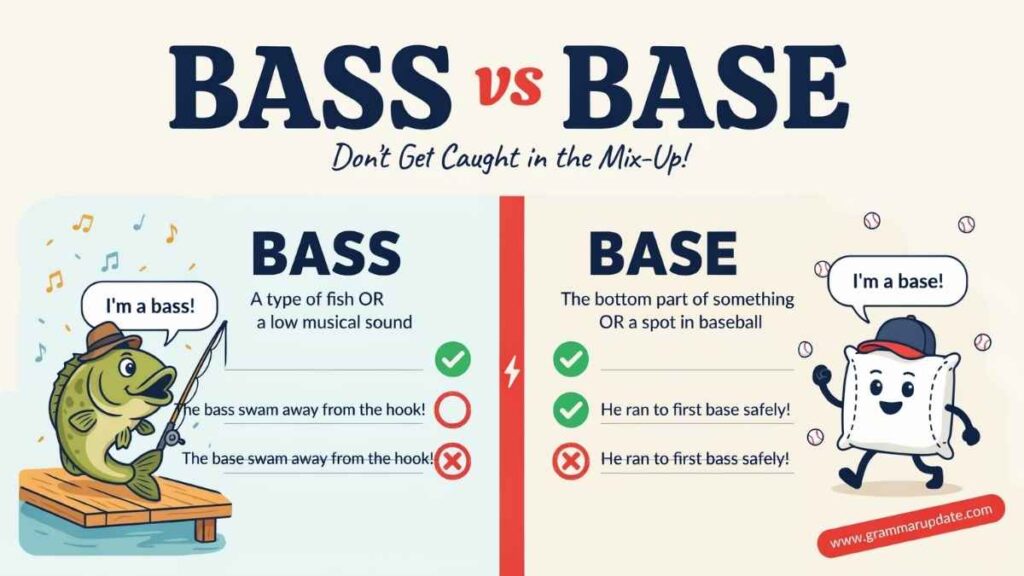
Bass vs base can be confusing because the two words can sound the same, but they have different meanings and spellings. Bass is used when you’re talking about low sounds, bass guitars, or certain types of fish. Base usually refers to the bottom or supporting part of something, a foundation, or a starting point. The tricky part is that your ears may not help you tell them apart. You have to look at the meaning and context instead. Once you know what each word means, the difference becomes much easier to remember. Think music and low sounds for bass, and foundation or starting point for base.
Quick Answer
The simplest way to understand the base and bass difference is to look at what the word describes.
Bass refers to a low musical sound, the lowest musical range, a bass instrument such as a bass guitar, or a type of fish. Base refers to the bottom or supporting part of something, a foundation, a starting point, a main place of operation, or several technical concepts in fields such as mathematics and chemistry.
| Word | Main meaning | Pronunciation | Example |
|---|---|---|---|
| Bass | Low musical sound | /beɪs/ | The bass is too loud. |
| Bass | Musical instrument | /beɪs/ | She plays bass guitar. |
| Bass | Type of fish | /bæs/ | He caught a bass. |
| Base | Bottom or support | /beɪs/ | The lamp has a heavy base. |
| Base | Starting point or main location | /beɪs/ | The city became their base. |
| Base | Mathematical concept | /beɪs/ | Binary uses base 2. |
| Base | Chemical substance | /beɪs/ | The solution contains a base. |
So, if you are asking when to use base or bass, start with the meaning rather than the sound.
Use bass for music, low-frequency sound, bass instruments, and the fish.
Use base for a foundation, bottom, starting point, headquarters, military installation, mathematical system, chemical substance, or something that provides support.
Learn the difference between confusing more English words
Equipment vs Equiptment difference and usage ?
Bass Meaning and Bass Definition
The bass meaning changes according to context. That is important because bass is not limited to one definition.
In music, bass refers to the lowest range of musical notes. It can also describe a person whose singing voice falls in that range. Cambridge Dictionary also defines bass as the set of low musical sounds produced by a radio or music system and as an electric guitar designed to play very low notes.
That gives us several closely connected uses.
Bass in Music
Bass in music refers to the low end of musical sound. A song can contain bass notes, a bass line, a bass part, or a bass instrument.
For example:
The bass gives the song a deep, powerful sound.
Here, bass describes low musical content. It does not mean a foundation or bottom.
A bass line can also play an important structural role in music. It often works with the drums and other instruments to establish rhythm and harmony. That is why bass is much more than simply “a low sound.” It can be a central part of how a piece of music feels and moves.
Bass Guitar
A bass guitar is a stringed musical instrument designed for the lower part of the musical range. A common bass guitar has four strings, although five-string and six-string versions are also widely used.
The correct spelling is bass guitar, not base guitar.
For example:
She bought a new bass guitar for the band.
The spelling makes sense once you connect bass with low musical notes.
If you are wondering about bass guitar vs base, there is no real spelling choice in this context. Bass is the correct word because the instrument belongs to the musical meaning of bass.
Bass as a Low-Frequency Sound
The Bass also describes low-frequency sound in audio.
If someone says that a speaker has powerful bass, they are talking about the speaker’s reproduction of low-frequency sound. This is why audio equipment often has bass controls, bass response specifications, and bass boost settings.
For example:
The new headphones have surprisingly strong bass.
The word base would be incorrect here because the sentence concerns sound rather than a physical foundation.
This distinction becomes especially useful when you see the phrase bass sound in speaker. A speaker can produce bass, while the physical speaker itself can have a base.
The difference is clear in these two sentences:
The speaker produces deep bass.
The speaker sits on a solid base.
The first sentence describes sound. The second describes physical support.
Bass as a Fish
Bass has another completely unrelated meaning. It can refer to several types of fish found in rivers, lakes, and the sea.
The fish meaning has a different pronunciation from the musical meaning. Cambridge Dictionary lists the fish pronunciation as /bæs/, while the musical meaning uses /beɪs/.
For example:
They went fishing for bass.
In this sentence, bass refers to a fish rather than music.
A familiar example is largemouth bass, a freshwater fish that is widely associated with recreational fishing in North America.
This creates an unusual spelling situation. The same written word can represent two different pronunciations and meanings:
Bass in music: /beɪs/
Bass the fish: /bæs/
Context tells you which meaning the speaker intends.
Learn the difference between confusing more English words
Airfoil vs Aerofoil difference and usage?
Base Meaning and Base Definition
The base meaning centers on ideas such as foundation, bottom, support, starting point, or main location.
Cambridge Dictionary defines base as the bottom part of an object on which it rests or the lowest part of something. It also gives meanings involving a main place of work or operation, military locations, mathematics, and other fields.
That broad range explains why base appears in many everyday and technical expressions.
Base as a Noun
As a noun, base often describes the part underneath something.
For example:
The lamp has a heavy base.
Here, the base supports the lamp.
You can use the same idea with many other objects:
The statue has a marble base.
The vase has a wide base.
The machine rests on a metal base.
In each case, base refers to a bottom or supporting part.
Base can also refer to a foundation in a more abstract sense.
For example:
The research provides a strong base for future work.
Here, the word does not describe a physical object. Instead, it describes something that provides support for later work.
Base as a Starting Point
Base can also mean a place from which someone operates or works.
For example:
The team used the city as its base.
A company can have a base in a particular city. A photographer, research team, sports organization, or traveling group can also use a location as a base.
This meaning connects naturally with the idea of a starting point or central location.
Military Base
A military base is a place where armed forces operate and where military personnel may live, train, store equipment, and carry out other activities.
For example:
The aircraft returned to the military base.
The word base fits because the location serves as an operational center.
Writing bass in this sentence would completely change the word and produce an error.
Base as a Verb
Base also works as a verb.
To base something on something means to establish it using that thing as its foundation or main source.
For example:
The researchers based their conclusion on the available evidence.
The company based its decision on customer feedback.
The report is based on facts.
This is one of the most common forms of the word in everyday English.
The underlying idea remains the same. Something rests on or depends on another thing.
Base in Mathematics
Mathematics uses base in a specific technical sense.
A number system has a base that determines how many digits it uses before moving to the next place value.
Decimal is base 10. Binary is base 2. Hexadecimal is base 16.
For example, binary uses only the digits 0 and 1. Decimal uses the digits 0 through 9.
Base also appears in geometry. A triangle can have a designated base, which serves as the reference side when calculating its area or discussing its height.
So the mathematical use of base still connects with the broader idea of a foundation or reference point.
Base in Chemistry
Chemistry uses base as a technical term for a substance with particular chemical properties.
For example:
Sodium hydroxide is a strong base.
The word bass has no place in this chemical meaning.
This is another useful context clue. If the sentence concerns acids, chemical reactions, pH, or related scientific concepts, base is almost certainly the word you need.
Learn the difference between confusing more English words
Disastrous vs Disasterous difference and usage ?
Bass vs Base Pronunciation
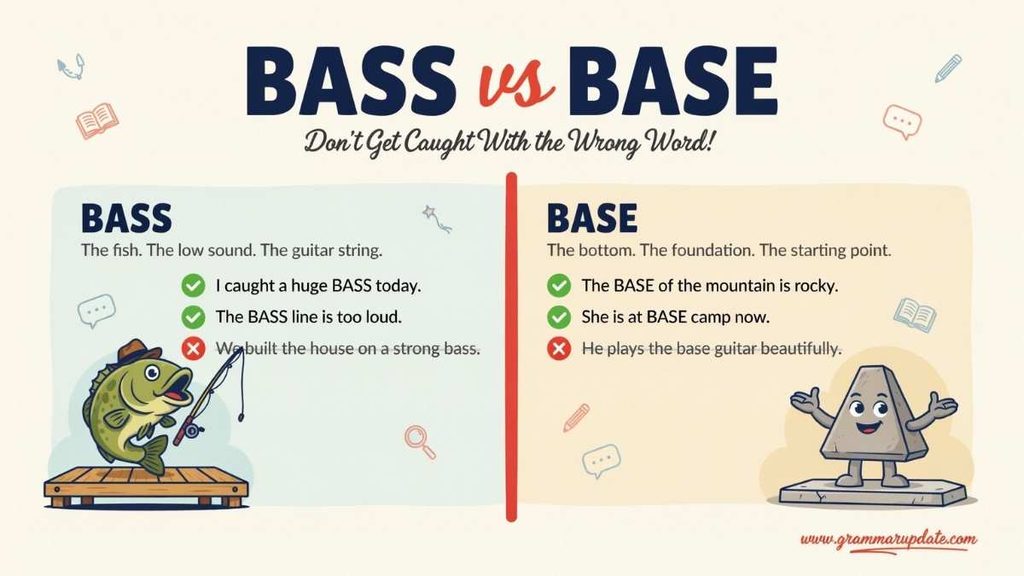
The bass vs base pronunciation question causes so much confusion because the words can sound identical.
Base is pronounced /beɪs/.
Bass has two standard pronunciations depending on meaning.
Musical bass is pronounced /beɪs/.
Fish bass is pronounced /bæs/.
Cambridge Dictionary confirms this distinction in its pronunciation information for bass and base.
| Word | Meaning | US pronunciation |
|---|---|---|
| Bass | Music and low notes | /beɪs/ |
| Bass | Fish | /bæs/ |
| Base | Foundation, starting point, etc. | /beɪs/ |
Bass Pronunciation in Music
The musical word bass sounds exactly like base.
For example:
1.bass guitar
2.bass player
3.bass line
4.bass note
5.bass frequency
All of these use the /beɪs/ pronunciation.
That explains why people sometimes write base when they hear the word. If you only hear the word without seeing it, there is no sound difference between musical bass and base.
Bass Pronunciation for Fish
The fish meaning is different.
Bass, when referring to the fish, is pronounced /bæs/.
So these two words are not always homophones in actual speech.
Musical bass sounds like base.
Fish bass does not.
This is one of the most useful facts to remember when learning English pronunciation.
Base Pronunciation
Base has the /beɪs/ pronunciation.
Whether you mean the bottom of an object, a military installation, a starting point, or a mathematical system, the standard pronunciation remains the same.
Learn the difference between confusing more English words
Possession vs Posession difference and usage?
Bass and Base Homophones
Are bass and base homophones?
They are homophones when bass has its musical meaning because both words are pronounced /beɪs/.
However, the fish meaning of bass is pronounced /bæs/, so that particular use is not a homophone of base.
This makes bass slightly more complicated than many ordinary English homophones.
The words may sound identical, but spelling still matters because pronunciation alone cannot tell the reader which meaning you intended.
That is the central issue behind the base and bass homophones problem.
Base vs Bass in Music and Audio
Music is probably the easiest place to make this mistake.
If you mean low musical sound, use bass.
If you mean a physical supporting structure, use base.
For example:
The bass was too loud.
The speaker has a strong base.
The first sentence concerns audio. The second concerns physical support.
Bass Line vs Baseline
These two terms deserve special attention because the spelling changes the meaning.
A bass line is a musical sequence of low notes.
A baseline is a reference level, starting point, or standard used for comparison.
For example:
The bass line drives the song.
The researchers established a baseline before beginning the experiment.
These are completely different terms.
The extra s in bass matters.
Bass Guitar vs Base
The correct expression is bass guitar.
Not base guitar.
A bass guitar produces low musical notes, so its name comes from the musical meaning of bass.
For example:
He has played bass guitar for ten years.
Bass Player vs Base Player
A musician who plays bass is a bass player.
For example:
The bass player joined the band during rehearsals.
Base player would not normally describe someone who plays a musical instrument.
Learn the difference between confusing more English words
Guarantee vs Guarentee difference and usage ?
Bass in Speakers and Audio
When people talk about audio equipment, bass usually describes low-frequency sound.
A sound system may include separate controls for bass and treble. Bass controls affect the lower end of the audio spectrum, while treble controls affect the higher end.
The exact frequency range associated with bass can vary depending on the technical context, equipment, and classification system. However, in everyday audio language, bass means the low end.
That is why people talk about:
1.bass response
2.bass boost
3.bass frequencies
bass-heavy music
bass speaker
deep bass
The word base would be wrong when referring to the sound itself.
However, a physical speaker can have a base.
For example:
The speaker has a wide base for stability.
This sentence describes the structure supporting the speaker.
The same object can therefore have both a base and produce bass.
That is a perfect real-world example of the difference.
Bass vs Base in Everyday Writing
Context makes the spelling choice much easier.
Consider these examples.
The statue stands on a stone base.
The word refers to the foundation or bottom.
The song has a powerful bass line.
The word refers to music.
The soldiers returned to the base.
The word refers to a military installation.
The fisherman caught a bass.
The word refers to a fish.
The argument is based on evidence.
The word comes from the verb base.
The headphones produce deep bass.
The word refers to low-frequency sound.
The pattern is consistent. Once you know what the sentence means, the correct spelling usually becomes obvious.
Learn the difference between confusing word pairs
Dumbbell vs Dumbell difference and usage?
Bass vs Base Examples
The following bass vs base examples show the difference across several situations.
| Sentence | Correct word | Meaning |
|---|---|---|
| The lamp has a heavy base. | base | Supporting bottom |
| The song has deep bass. | bass | Low musical sound |
| She plays bass guitar. | bass | Musical instrument |
| The statue rests on a stone base. | base | Foundation |
| The aircraft returned to the base. | base | Military location |
| He caught a bass in the lake. | bass | Fish |
| The company is based in Chicago. | base | Main place of operation |
| Binary is a base-2 system. | base | Mathematical system |
| Turn down the bass. | bass | Low-frequency audio |
| The triangle has a long base. | base | Reference side |
These base vs bass sentence examples also reveal an important point: the surrounding words often give you the answer.
If you see guitar, music, player, sound, speaker, note, or line, bass is likely.
If you see foundation, bottom, camp, military, company, mathematics, chemistry, or based on, base is likely.
Learn the difference between confusing word pairs
Airplane vs Aeroplane difference and usage?
Common Bass and Base Mistakes
Base Guitar
Base guitar is a common spelling mistake.
The correct form is bass guitar.
The instrument produces low musical notes, so it uses the musical spelling bass.
Base Sound
If you mean low-frequency audio, use bass sound rather than base sound.
For example:
The headphones produce a rich bass sound.
The word base would suggest a foundation rather than audio.
Bass of an Object
If you mean the bottom or supporting part of an object, use base.
For example:
The base of the statue is made of stone.
Bass would be incorrect because the sentence has nothing to do with music or fish.
Base Line
If you mean music, use bass line.
If you mean a reference point or standard, use baseline.
For example:
The bass line keeps the rhythm moving.
The survey established a baseline for comparison.
These words may sound similar, but their meanings are different.
Base Player
For music, use bass player.
For example:
The bass player performed the opening section.
Base player does not describe the musician.
Learn the difference between confusing word pairs
Foreign vs Foriegn difference and usage?
Base and Bass Difference in Technical Contexts
Technical subjects provide some of the clearest examples because the words have established meanings.
1.In mathematics, use base.
2.In chemistry, use base.
3.In acoustics and music, use bass when referring to low-frequency sound.
For example:
Binary uses base 2.
The solution contains a chemical base.
The speaker produces strong bass.
The three sentences belong to different subjects, so the context immediately separates the words.
How to Spell Base
If you are searching how to spell base, the spelling is:
B-A-S-E
Common examples include:
1.base camp
2.base layer
3.base rate
4.base station
5.base of an object
6.base of a triangle
based on evidence
based on facts
The word generally carries the idea of a foundation, bottom, starting point, or supporting structure.
How to Spell Bass
If you are searching how to spell bass, the spelling is:
B-A-S-S
Common examples include:
1.bass guitar
2.bass player
3.bass line
4.bass note
5.bass sound
6.bass frequency
7.bass fish
largemouth bass
The important thing to remember is that bass has two major pronunciation patterns. The musical meaning uses /beɪs/, while the fish meaning uses /bæs/.
Learn the difference between confusing word pairs
Embarrass vs Embarass difference and usage?
When to Use Base vs Bass
When deciding between base or bass, do not rely on pronunciation alone.
Instead, identify the meaning first.
Use bass when you mean a low musical sound, the lowest musical range, a bass guitar, a bass instrument, a bass player, a bass line, or certain types of fish.
Use base when you mean a foundation, bottom, supporting part, starting point, main location, military installation, mathematical system, chemical substance, or something that provides the foundation for another idea or action.
A quick memory trick can help.
Think of base as something that supports.
Think of bass as something that sounds low or swims in water.
That simple distinction covers most everyday situations.
Base vs Bass Examples in Sentences
Here are more examples that make the spelling difference easier to recognize.
The table has a strong base.
The speaker produces powerful bass.
The musician replaced a broken bass string.
The building has a broad base.
The research team used the town as a base.
The fisherman caught a largemouth bass.
The report is based on reliable data.
The triangle has a twelve-inch base.
The producer increased the bass during the final mix.
The aircraft returned to its military base.
Each sentence gives you a clear context clue.
Learn the difference between confusing word pairs
Fascinating vs Facinating difference and usage?
What Is the Difference Between Base and Bass?
The difference between base and bass is primarily a difference in meaning and spelling.
Base generally relates to a foundation, bottom, starting point, main location, or supporting idea.
Bass generally relates to low musical sound, musical instruments, or fish.
The musical meaning of bass and the word base have the same pronunciation in American English, but they retain different spellings and meanings.
So if you are asking what is the difference between base and bass, remember that sound alone cannot always provide the answer. Meaning does.
Is Bass and Base the Same Word?
No.
Bass and base are separate words.
They can sound identical when bass refers to low musical sound, but they have different spellings and meanings.
For example:
The song has strong bass.
The speaker has a strong base.
The first sentence concerns sound. The second concerns physical support.
The spelling prevents the two meanings from becoming mixed up in writing.
Why Is Bass Pronounced Like Base?
The question why is bass pronounced like base has a historical explanation rather than a simple spelling rule.
The musical word bass entered English through the history of European musical terminology, while its spelling became associated with the pronunciation /beɪs/. English spelling often preserves historical forms even when pronunciation changes over time.
As a result, musical bass and base ended up sharing the same pronunciation.
The fish word bass has a different history and pronunciation, which helps explain why it sounds different.
For everyday writing, however, you do not need to memorize the etymology. The practical rule is enough: musical bass sounds like base, while fish bass does not.
Does Bass Rhyme With Base?
Yes, musical bass rhymes with base.
Both use the /beɪs/ pronunciation.
However, fish bass does not rhyme with base because it uses /bæs/.
That means the answer depends on the meaning.
Bass in music: rhymes with base.
Bass the fish: does not rhyme with base.
Is Bass Pronounced Base in Music?
Yes.
When bass refers to music, low notes, a bass guitar, or a bass player, it is pronounced /beɪs/. Cambridge Dictionary lists this pronunciation for the musical meaning.
For example, bass guitar and base have the same vowel and final consonant sounds.
The spelling remains different because the words have different meanings and histories.
How Is Bass Pronounced for Fish?
When bass refers to the fish, it is pronounced /bæs/.
This is the pronunciation used in phrases such as largemouth bass and striped bass.
So the same spelling has two established pronunciations:
Musical bass: /beɪs/
Fish bass: /bæs/
This is one of the reasons bass stands out among commonly confused English words.
What Does Bass Mean in English?
The bass meaning in English depends on context.
In music, bass refers to the lowest musical range or the low end of musical sound.
In audio, it refers to low-frequency sound.
It can also refer to a bass guitar or another bass instrument.
In biology and fishing, bass refers to several kinds of fish.
The surrounding words usually make the intended meaning clear.
What Does Base Mean in English?
The base meaning in English is closely connected with support, foundation, bottom, starting point, or main location.
Base can describe the bottom of an object, a place where someone works, a military installation, a mathematical system, a chemical substance, or the foundation of an idea.
It can also work as a verb in expressions such as based on evidence and based on facts.
Cambridge Dictionary includes these physical, operational, mathematical, scientific, and grammatical uses of base.
Bass vs Base Grammar and Usage
From an English grammar perspective, both words can perform several roles.
Base commonly works as a noun and verb.
As a noun:
The base of the machine is damaged.
As a verb:
The company based its decision on customer feedback.
Bass most commonly works as a noun when it refers to low musical sound, an instrument, or a fish. It can also work as an adjective when describing something related to low musical sound.
For example:
1.The bass was too loud.
2.The bass frequencies need adjustment.
3.The bass player arrived early.
4.The bass fish moved toward deeper water.
The grammatical context helps reveal the meaning, but the surrounding subject usually provides the strongest clue.
A Simple Way to Remember Bass vs Base
The easiest memory method is to connect each word with a clear image.
1.For base, picture the foundation of a building.
2.For musical bass, picture a bass guitar.
3.For fish bass, picture a largemouth bass in a lake.
You can also remember the core ideas this way:
Base supports.
Bass sounds low.
Bass can swim.
That small distinction can prevent a surprisingly large number of spelling mistakes.
Bass vs Base Usage Guide
Bass vs base becomes much easier once you focus on meaning instead of sound.
Use bass for low musical sounds, bass instruments, bass guitar, bass lines, low-frequency audio, and certain fish.
Use base for foundations, bottoms, starting points, headquarters, military installations, mathematical systems, chemical substances, and things that provide support.
The biggest trap is pronunciation. Musical bass and base sound the same in American English, so listening alone cannot tell you which spelling belongs on the page. Fish bass adds another pronunciation, which sounds like the vowel in words such as “cat.”
The practical difference is simple:
Bass is connected with low sound, music, instruments, or fish.
Base is connected with foundation, support, bottom, starting point, or an operating location.
Once the meaning is clear, the spelling usually follows naturally.
Learn the difference between confusing word pairs
Concede vs Conceed difference and usage?
Practice Session Bass vs Base
Fill in each blank with the correct word: bass or base.
- The speaker produces deep ______ that fills the room.
- The statue rests on a wide stone ______.
- She plays the ______ guitar in her school band.
- The fisherman caught a large ______ in the lake.
- The soldiers returned to the military ______ after the mission.
- Turn down the ______ because the music is shaking the windows.
- The lamp has a heavy ______ that keeps it stable.
- The song has a powerful ______ line.
- The company is ______ in Chicago.
- The triangle has a long ______.
- He bought a new ______ guitar last month.
- We went fishing and caught several ______.
- The argument is ______ on reliable evidence.
- The headphones have excellent ______ response.
- The aircraft returned to its ______ before sunset.
- The machine needs a stronger ______ for better support.
- The musician adjusted the ______ levels during the recording.
- Binary is a number system with ______ 2.
- The museum placed the sculpture on a marble ______.
- The ______ player performed the opening section of the song.
- The fisherman spotted a largemouth ______ near the shore.
- The building has a wide ______ that supports the structure.
- The producer increased the ______ to make the music sound deeper.
- The research team used the town as a ______ for their work.
- The report was ______ on data collected from several sources.
Answers
- bass
- base
- bass
- bass
- base
- bass
- base
- bass
- based
- base
- bass
- bass
- based
- bass
- base
- base
- bass
- base
- base
- bass
- bass
- base
- bass
- base
- based
Here’s a trusted source for clear word meanings:
FAQs
What is the difference between bass and base?
Bass and base are two different words with different meanings. Bass can refer to a low musical sound, a bass guitar, or certain types of fish. Base usually means the bottom or supporting part of something, a foundation, a starting point, or a place used as a center of activity.
Is it bass or base for a musical sound?
Bass is the correct word for a low musical sound. For example, you can say, “The song has deep bass.” Base does not refer to musical sound.
Why is it called a bass guitar instead of a base guitar?
It is called a bass guitar because the instrument produces low-pitched musical notes. The word bass describes its musical range, while base has a completely different meaning. Therefore, bass guitar is the correct spelling.
How do you pronounce bass?
Bass has two common pronunciations because it represents two different words. The musical term is pronounced like “base,” while bass meaning the fish is pronounced with a short vowel sound, similar to the vowel in “mass.”
Why is bass pronounced like base in music?
The musical word bass has a long history and comes from terminology associated with low musical pitch. Although its spelling contains ss, its pronunciation developed to match the sound of base. English has several words whose spelling and pronunciation do not follow the patterns you might expect.
What does base mean?
Base usually refers to the bottom, foundation, or supporting part of something. It can also mean a starting point, central location, or fundamental part of an idea. For example, “The lamp has a heavy base.”
Can bass and base be used interchangeably?
No. Bass and base have different meanings, even though musical bass and base can sound the same. Use bass for low musical sounds, the bass guitar, or certain fish. Use base for a foundation, bottom part, starting point, or central location.
Is bass always related to music?
No. Bass can also refer to several types of fish. In music, bass relates to low sounds and musical instruments. When bass refers to a fish, it has a different pronunciation from musical bass.
What does bass mean in music?
In music, bass refers to the lower range of musical sounds. It can describe low frequencies, low musical notes, or instruments that produce them. The bass often provides a strong foundation for the rhythm and harmony of a song.
What is a bass guitar?
A bass guitar is a stringed musical instrument designed to produce low-pitched notes. It commonly works with drums and other instruments to provide rhythmic support and harmonic depth in a song.
What is a bass player called?
A person who plays the bass guitar is commonly called a bassist or a bass player. Both terms are widely used in everyday music conversations.
Why does bass sound so low?
Bass sounds low because it contains relatively low-frequency vibrations. Lower frequencies are perceived as deeper sounds, while higher frequencies create brighter or sharper sounds. This is why bass gives music its deep, powerful character.
Is bass the same as low-frequency sound?
In music and audio, bass generally refers to the low-frequency range of sound. However, bass can also mean a musical instrument or a type of fish. The meaning depends on the context in which the word is used.
What is the difference between bass and treble?
Bass refers to the lower range of sound, while treble refers to the higher range. Many speakers, headphones, and audio systems allow you to adjust bass and treble separately to create the desired sound balance.
Is bass a noun or an adjective?
Bass can be used as a noun or as a modifier depending on the sentence. For example, “The bass is powerful” uses bass as a noun, while “bass frequencies” uses bass to describe a type of frequency.
What is the plural of bass?
The plural of bass is usually bass. The spelling does not change when you are talking about multiple bass fish or different examples of bass in music. Context helps identify which meaning is intended.
Why do people confuse bass and base?
People often confuse bass and base because musical bass and base have the same pronunciation in many varieties of English. However, their spellings and meanings are different. Remembering the context makes the distinction much easier.
What is an easy way to remember bass vs base?
A simple memory trick is to connect bass with music and low sound, while base connects with a foundation or bottom part. Think of “bass guitar” for music and “base of a building” for a foundation.
Is “base guitar” a correct spelling?
No. When you mean the musical instrument, bass guitar is the correct spelling. Base guitar is a common spelling mistake caused by confusing the words bass and base.
Is “bass line” or “base line” correct in music?
Bass line is correct when you mean a series of low musical notes played in a song. Baseline is a different word that can refer to a starting point, reference level, or line used for comparison.
Can bass refer to a fish?
Yes. Bass is also the name of several types of fish. This meaning is completely different from musical bass, and the fish-related pronunciation is different as well.
Why does bass have two pronunciations?
Bass has two pronunciations because the spelling represents different words with different histories and meanings. The musical term has one pronunciation, while the word for the fish has another. This makes bass an unusual but useful example of English spelling and pronunciation.
Is “base” ever correct in a music sentence?
Yes, but only when base has its normal meaning of a foundation, starting point, or central location. For example, “The band returned to its base” is correct. However, “base guitar” is incorrect when you mean the musical instrument.
What is the difference between bass and bass guitar?
Bass can refer to low musical sounds or the low range of music, while bass guitar specifically refers to the instrument. A bass guitar produces low-pitched notes and often provides rhythmic and harmonic support within a song.
Conclusion
Bass vs base can be confusing because the two words can sound exactly the same, but they don’t mean the same thing. Bass is used for low musical sounds, bass guitars, and certain types of fish. Base usually means the bottom or supporting part of something, a foundation, or a starting point.
The easiest way to remember the difference is to connect bass with music and low sounds. Think of bass guitar, bass notes, and deep bass. For base, think about a foundation, such as the base of a building or the base of a lamp.
So, if you’re talking about music, reach for bass. If you mean a foundation or starting point, use base. Once you connect each word with its meaning, this little spelling trap becomes much easier to avoid.

Jhon AJS, the creative mind behind Grammar Update, is an experienced blogger passionate about simplifying English grammar. He focuses on explaining confusing word vs word differences, grammar rules, punctuation, and sentence structure in a clear and practical way. Through easy to understand guides and examples, Jhon helps readers improve their writing and communicate with confidence. With years of blogging experience, he continues to share helpful insights that make learning grammar simple, useful, and accessible for everyone.