Have you ever stared at your screen wondering whether to write “everywhere vs every where”? You’re not alone. Its a surprisingly common spelling mistake because both versions look believable. The good news is that the answer is simple. If you mean “in all places,” the correct spelling is always “everywhere” as one word. Adding a space turns it into a spelling error in standard English. In this guide, you’ll clear up the confusion once and for all. You’ll learn the correct grammar rule, understand why “everywhere” is one word, explore real-life examples, avoid common mistakes, and write with confidence every time.
Everywhere vs Every Where Quick Answer
If you’re looking for the short answer, here it is:
| Question | Answer |
|---|---|
| Correct spelling | Everywhere |
| Incorrect spelling | Every where |
| Part of speech | Adverb |
| Meaning | In all places |
| Accepted in dictionaries | Yes |
| Standard English spelling | Everywhere |
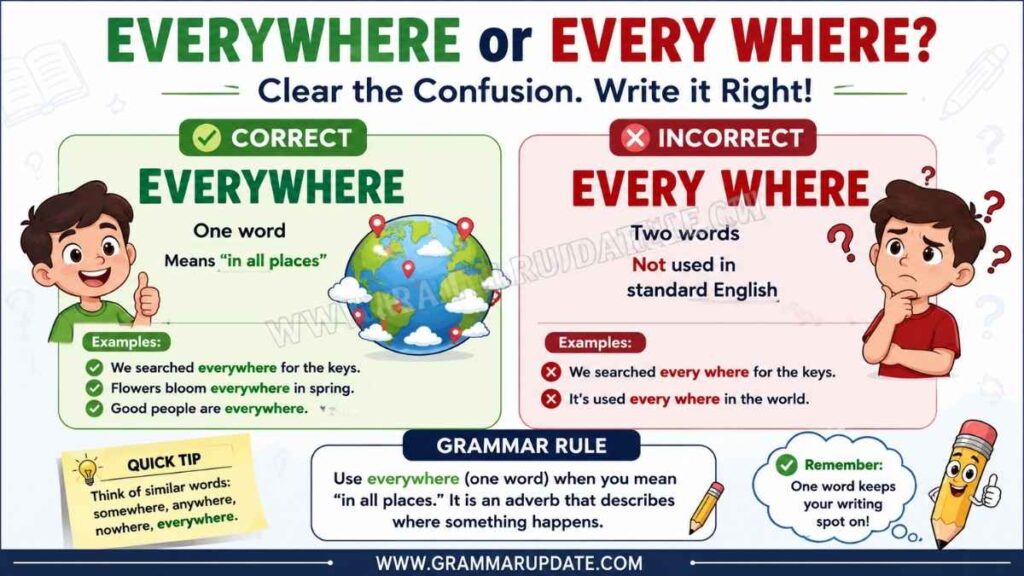
The everywhere correct spelling is “everywhere.” It is a single word that functions as an adverb in English grammar. You should write it as one word whenever you mean “in all places.”
Examples:
- We searched everywhere for the missing keys.
- Tourists were everywhere during the festival.
- Wildflowers bloom everywhere in the valley during spring.
These sentences all use the standard English spelling.
On the other hand, the following example contains an error:
Incorrect:
- We searched every where for the missing keys.
Correct:
- We searched everywhere for the missing keys.
If you’ve ever asked, “everywhere vs every where which is correct,” remember this simple rule:
Use “everywhere.” Avoid “every where” in normal writing.
Learn the difference between often confused words
Bright vs Brite Which Spelling Is Correct?
Is It Everywhere vs Every Where?
Many English learners ask whether the word should appear as one word or two words. The answer comes from how English forms certain location words.
“Everywhere” has become a single compound word over many centuries of English development. Modern dictionaries recognize only this one-word form when it means “in every place.”
The separate version, “every where,” is considered a spelling error in almost every writing situation.
Why “Everywhere” Is Correct
The word “everywhere” combines two older words into one compound adverb. Over time, English speakers began treating the expression as one complete unit rather than two separate words.
Today, trusted dictionaries such as Merriam-Webster, Cambridge Dictionary, and Oxford Dictionary list “everywhere” as the standard spelling.
This means the one-word form appears in:
- Books
- Newspapers
- Academic writing
- Professional emails
- Government publications
- Business documents
- Educational materials
If you’re aiming for correct English usage, always choose “everywhere.”
Why “Every Where” Is Incorrect
The phrase “every where” does not function as a standard English word.
Although “every” and “where” exist as separate words, they do not combine this way when you mean “in all places.”
For example:
Incorrect:
- There were flowers every where.
Correct:
- There were flowers everywhere.
Another example:
Incorrect:
- Children were playing every where in the park.
Correct:
- Children were playing everywhere in the park.
Because “every where” breaks apart a recognized compound word, grammar checkers and proofreading software usually identify it as a spelling error.
Are There Any Rare Exceptions?
Very rarely, “every” and “where” may appear next to each other in unusual sentence structures, but they are not functioning as the compound adverb “everywhere.”
For example:
- Every where that you suggested had already closed.
Even here, most editors would rewrite the sentence to improve clarity.
A more natural version would be:
- Everywhere you suggested had already closed.
For everyday writing, treat “everywhere” as one complete word.
Learn the difference between often confused words
Kindergartner vs Kindergartener Which spelling Is Correct?
What Does Everywhere Mean?
Understanding the everywhere meaning makes the spelling much easier to remember.
The everywhere definition is simple:
“Everywhere” means “in every place” or “throughout all locations.”
It describes something that exists, happens, or appears in many places rather than in one specific location.
Simple definitions include:
- In all places
- Throughout every location
- Across all areas
- Wherever you go
The dictionary meaning remains consistent across major English dictionaries.
Here are a few examples.
- Coffee shops seem to be everywhere these days.
- Smartphones are everywhere in modern society.
- The smell of fresh bread spread everywhere.
- Tourists gathered everywhere along the beach.
In each sentence, “everywhere” tells the reader that something exists in many places.
Literal Meaning
Sometimes “everywhere” refers to physical locations.
Examples:
- We searched everywhere for the missing dog.
- Snow covered everything everywhere.
- Birds nested everywhere around the lake.
Each sentence describes actual places.
Figurative Meaning
The word also has a figurative meaning.
Examples:
- Excitement was everywhere after the championship win.
- Hope spread everywhere during the celebration.
- Creativity can be found everywhere if you pay attention.
Here, “everywhere” expresses a widespread feeling or idea rather than a physical location.
Understanding both meanings helps improve your English vocabulary and writing skills.
Learn the difference between often confused words
Investor vs Investee What’s the Difference and usage ?
Is Everywhere One Word or Two Words?
One of the most common questions online is, “Is everywhere one word?”
Yes.
The answer is straightforward.
Everywhere is one word.
It is not written as two words in standard English.
Many learners become confused because English contains words like:
- Every day
- Every time
- Every person
Since these remain separate, people naturally wonder whether “every where” follows the same rule.
It doesn’t.
English develops through history, not strict logic. Some expressions eventually become compound words because people use them together so frequently.
“Everywhere” is one of those words.
If you’re wondering, “is everywhere one word or two,” remember that dictionaries consistently list it as one word.
Why English Uses Compound Words
English contains thousands of compound words.
Some stay open:
- Ice cream
- High school
- Real estate
Others become hyphenated:
- Well-known
- Long-term
- Full-time
Still others become closed compound words:
- Everywhere
- Somewhere
- Anywhere
- Nowhere
- Inside
- Outside
- Nowadays
Language changes over time. Frequent use often causes separate words to merge into a single word.
That’s exactly what happened with “everywhere.”
Comparison Table
| Correct | Incorrect |
|---|---|
| Everywhere | Every where |
| Somewhere | Some where |
| Anywhere | Any where |
| Nowhere | No where |
Learning these patterns makes writing correctly much easier.
Learn the difference between often confused words
Flatform vs Platform Difference which is correct?
Is Everywhere an Adverb?
Another common question is whether everywhere is adverb or another part of speech.
The answer is yes.
Everywhere is adverb because it tells you where an action happens.
In English grammar, an adverb modifies a verb, an adjective, or another adverb. Place adverbs answer questions like:
- Where?
- Where did it happen?
- Where did someone go?
“Everywhere” answers those questions by meaning “in all places.”
Examples:
- We looked everywhere.
- Birds flew everywhere.
- Children ran everywhere after school.
- Tourists traveled everywhere during the summer.
Notice how the word modifies the action in each sentence.
Everywhere as a Place Adverb
Everywhere belongs to a group called place adverbs.
Other common place adverbs include:
- Here
- There
- Somewhere
- Anywhere
- Nowhere
- Abroad
- Upstairs
- Downstairs
These words all describe location.
Example comparison:
| Sentence | Place Adverb |
|---|---|
| She waited here. | Here |
| We looked everywhere. | Everywhere |
| They traveled abroad. | Abroad |
| He searched somewhere nearby. | Somewhere |
Recognizing these patterns helps English learners understand parts of speech more easily.
Can Everywhere Be a Noun?
No.
“Everywhere” is not used as a noun in standard English.
Incorrect:
- The everywhere was beautiful.
Correct:
- Everywhere was beautiful.
In the correct sentence, “everywhere” still functions as an adverb describing location.
Can Everywhere Start a Sentence?
Yes.
Writers often begin sentences with “everywhere” for emphasis.
Examples:
- Everywhere we looked, colorful flowers filled the hills.
- Everywhere you travel, you’ll find people who enjoy good food.
- Everywhere she went, friends greeted her warmly.
Starting a sentence this way creates a natural rhythm and draws attention to the idea of widespread presence.
Learn the difference between often confused words
Stopping vs Stoping Which Spelling Is Correct?
Everywhere Meaning with Simple Examples
The easiest way to remember the everywhere word is to see it used in everyday situations.
Everyday Conversation
- I looked everywhere for my glasses.
- There are coffee shops everywhere now.
- Kids were running everywhere after school.
- You can buy fresh fruit everywhere in this town.
School Writing
- Plants grow everywhere when conditions are favorable.
- Plastic pollution affects ecosystems everywhere.
- Teachers encourage reading everywhere, not just inside classrooms.
Workplace Communication
- Our new logo appears everywhere in the latest marketing campaign.
- Safety signs are posted everywhere inside the factory.
- Wireless internet is available everywhere in the office.
Travel
- Cherry blossoms were everywhere during our visit.
- Street performers entertained visitors everywhere in the city center.
- Tourists carried cameras everywhere they went.
Literature
Authors often use “everywhere” to create vivid imagery.
Example:
- Mist drifted everywhere, hiding the mountains behind a soft gray curtain.
This single word gives readers a strong sense that the mist covered every visible area.
Learn the difference between often confused words
Focuses vs Focusses Which Spelling Is Correct?
Everywhere vs Every Where Grammar Rule Explained
Once you understand how “everywhere” works, the spelling becomes much easier to remember. The grammar rule is straightforward, and it rarely has exceptions.
The correct form is “everywhere.” It is a single compound adverb that means “in all places.” You should not separate it into two words when writing standard English.
Many English learners ask about the everywhere grammar rule because they notice other expressions beginning with “every,” such as “every day” or “every time.” Those phrases remain separate because they perform different grammatical functions. “Everywhere” does not follow that pattern. It has developed into a single word through centuries of English usage.
If you want to improve your English writing skills, treating “everywhere” as one complete word is the safest and most accurate choice.
Why Is Everywhere One Word?
English constantly changes over time. Some expressions that once appeared as separate words gradually merged into one.
Language experts call this process word formation.
When speakers repeatedly use two words together for hundreds of years, they often become a closed compound word.
That is exactly what happened with “everywhere.”
Today, dictionaries recognize it as one complete word rather than two separate words.
Examples of similar compound words include:
| Compound Word | Meaning |
|---|---|
| Everywhere | In all places |
| Somewhere | In an unspecified place |
| Anywhere | In any place |
| Nowhere | In no place |
| Inside | Within |
| Outside | On the exterior |
These words are part of everyday English vocabulary and always appear as one word in standard English.
Everywhere Grammar Rules
Understanding a few simple grammar rules will help you avoid mistakes.
Rule One Use “Everywhere” for “In All Places”
Correct:
- Birds were everywhere during migration.
- We searched everywhere for the missing wallet.
- Wildflowers bloom everywhere after heavy rain.
Incorrect:
- Birds were every where during migration.
- We searched every where for the missing wallet.
Whenever you mean “in all places,” use the one-word form.
Rule Two: Use Everywhere as an Adverb
The word modifies verbs by describing location.
Examples:
- She looked everywhere.
- They traveled everywhere.
- We searched everywhere before giving up.
In each sentence, “everywhere” answers the question “Where?”
Rule Three Never Split the Word in Standard Writing
Professional editors expect the one-word spelling.
You’ll see “everywhere” in:
- Books
- Newspapers
- Academic journals
- Government publications
- Business reports
- Professional emails
You will not find “every where” used as the accepted spelling in modern English grammar.
Learn the difference between confusing more English words
Anual vs Annual Which Spelling Is Correct?
Everywhere Examples in Sentences
The fastest way to remember correct usage is to read plenty of examples.
Everyday Examples
- I left my phone charger everywhere except where I needed it.
- Children were laughing everywhere.
- The smell of fresh coffee spread everywhere.
- Decorations covered the house everywhere you looked.
- Tourists gathered everywhere near the museum.
School Examples
- Students found examples everywhere in the textbook.
- Good study habits help everywhere in academic life.
- Science explains natural patterns everywhere on Earth.
- Teachers encourage curiosity everywhere inside the classroom.
Workplace Examples
- The company’s logo appears everywhere on its website.
- Employees installed safety signs everywhere in the building.
- Wireless internet works everywhere in the office.
- Security cameras monitor activity everywhere.
Travel Examples
- Street musicians performed everywhere.
- Historic buildings stood everywhere around the old town.
- Local markets were everywhere during the festival.
- Beautiful gardens appeared everywhere we walked.
Nature Examples
- Butterflies fluttered everywhere in the garden.
- Snow covered everything everywhere.
- Birds nested everywhere along the river.
- Green hills stretched everywhere beyond the valley.
These everywhere examples in sentences show how naturally the word fits into different contexts.
Learn the difference between confusing more English words
Submission vs Submittion learn the Difference
Common Spelling Mistakes with Everywhere
Even experienced writers occasionally type “every where.” Most of the time, the mistake happens because people write quickly rather than because they misunderstand the rule.
Here are some of the most common English errors.
Splitting the Compound Word
Incorrect:
- We searched every where.
Correct:
- We searched everywhere.
This remains the most frequent spelling mistake.
Copying Incorrect Online Usage
Not every sentence on the internet follows proper grammar.
Sometimes social media posts, comments, or forums contain spelling errors. If several people repeat the same mistake, it may appear correct even though dictionaries disagree.
Always rely on trusted references instead of random online examples.
Assuming Every + Where Should Stay Separate
Many learners compare these phrases:
- Every day
- Every week
- Every month
Then they assume “every where” should follow the same pattern.
It doesn’t.
“Everywhere” functions as one complete adverb.
Typing Errors
Sometimes automatic spacing inserts an extra space.
For example:
- every where
A grammar checker usually catches this mistake immediately.
Learn the difference between confusing more English words
Bachelor vs Batchelor Difference and Correct Usage
Everywhere vs Every Where
The following comparison makes the difference easy to remember.
| Feature | Everywhere | Every Where |
|---|---|---|
| Standard English spelling | Yes | No |
| Dictionary entry | Yes | No |
| Correct in professional writing | Yes | No |
| Accepted in academic writing | Yes | No |
| Modern English grammar | Yes | No |
| Common spelling mistake | No | Yes |
Whenever you’re unsure about everywhere vs every where, choose the one-word version.
Everywhere Synonym in English
Although “everywhere” works perfectly in most situations, sometimes another expression fits better.
Here are several useful replacements.
| Synonym | Best Use |
|---|---|
| Throughout | Formal writing |
| In all places | General explanation |
| Across all locations | Business writing |
| Far and wide | Informal writing |
| Throughout the area | Geographic writing |
| Across the region | Reports |
| Universally | Formal contexts |
Examples:
Original:
- Flowers were everywhere.
Alternative:
- Flowers appeared throughout the valley.
Original:
- News spread everywhere.
Alternative:
- News spread far and wide.
Using different expressions improves vocabulary and keeps your writing fresh.
Antonyms of Everywhere
Understanding opposites also strengthens your vocabulary.
Common antonyms include:
- Nowhere
- In one place
- Locally
- Nearby
- At one location
Examples:
- We searched everywhere but found nothing.
- The missing document was nowhere to be found.
Learn the difference between confusing more English words
Trek vs Treck Confusion and Correct Usage
Words Commonly Confused with Everywhere
Several English words look similar because they describe location.
Although they share similar patterns, their meanings differ.
| Word | Meaning |
|---|---|
| Everywhere | In all places |
| Anywhere | In any place |
| Somewhere | In an unspecified place |
| Nowhere | In no place |
Examples:
- You can sit anywhere.
- I left my keys somewhere.
- We searched everywhere.
- The missing file was nowhere.
Knowing these differences helps you choose the correct word quickly.
Everywhere Part of Speech
Many students studying ESL ask about the everywhere part of speech.
The answer is simple.
Everywhere is an adverb.
More specifically, it is called a place adverb because it describes location.
Examples:
- Birds fly everywhere.
- Children played everywhere.
- We looked everywhere.
Notice that each sentence answers the question “Where?”
Everywhere Definition and Examples
Here is a simple reference table.
| Word | Everywhere |
|---|---|
| Part of speech | Adverb |
| Meaning | In all places |
| Type | Compound adverb |
| Correct spelling | Everywhere |
| Incorrect spelling | Every where |
Examples:
- Confetti landed everywhere after the celebration.
- Volunteers worked everywhere across the community.
- Fresh flowers decorated everywhere inside the event hall.
- Colorful leaves covered everywhere after the storm.
Fix common more word mistakes in English
Wise vs Wize Usage and Mistakes Explained
Why Do People Write “Every Where”?
Several factors explain this common spelling error.
Pronunciation
When speaking, there is almost no pause between “every” and “where.”
Some learners assume they remain separate words.
Early Language Learning
People learning English often build new words by combining familiar ones.
Since they recognize “every” and “where,” separating them feels logical.
Unfortunately, English spelling does not always follow simple patterns.
Fast Typing
Typing quickly can accidentally insert spaces.
Modern grammar checker software usually catches this problem before publication.
Influence from Informal Writing
Social media rarely follows strict language rules.
Repeated exposure to incorrect spelling can make mistakes seem acceptable.
Professional writing, however, follows standard English spelling.
Everywhere in British and American English
Unlike some English words, “everywhere” does not change between regions.
Both American English and British English use exactly the same spelling.
| English Variety | Correct Form |
|---|---|
| American English | Everywhere |
| British English | Everywhere |
| Canadian English | Everywhere |
| Australian English | Everywhere |
There are no spelling differences.
Whether you read Merriam-Webster in the United States, Cambridge Dictionary in the United Kingdom, or Oxford Dictionary, the accepted spelling remains the same.
Everywhere Usage in Modern English
Professional writers consistently use the one-word form.
You will regularly find “everywhere” in:
- Newspapers
- Academic articles
- Business reports
- Government websites
- School textbooks
- Research papers
- Professional blogs
Major dictionaries, including Merriam-Webster, Cambridge Dictionary, and Oxford Dictionary, define “everywhere” as the standard spelling meaning “in all places.”
That consistency makes this one of the easiest English spelling rules to remember.
Quick Tips for Writing Correctly
Keep these grammar tips in mind whenever you write.
- Think of “everywhere” as one complete location word.
- If you mean “in all places,” write “everywhere.”
- Never split it into “every where” in standard English.
- Compare it with “somewhere,” “anywhere,” and “nowhere.”
- Use a grammar checker when proofreading important documents.
- Read your sentence aloud. If “in all places” fits, “everywhere” is almost certainly the correct choice.
Following these simple language rules will help you avoid common English errors and improve your correct sentence formation.
Quick Comparison Table
| Feature | Everywhere | Every Where |
|---|---|---|
| Standard English spelling | Yes | No |
| Accepted by Merriam-Webster | Yes | No |
| Accepted by Cambridge Dictionary | Yes | No |
| Accepted by Oxford Dictionary | Yes | No |
| Used in formal writing | Yes | No |
| Used in academic writing | Yes | No |
| Used in business writing | Yes | No |
| Part of speech | Adverb | Not a standard form |
| Meaning | In all places | Incorrect spelling |
| Recommended for modern English | Yes | No |
Easy Trick to Remember the Correct Spelling
A simple memory trick can help you avoid this mistake every time.
Think about these four location words:
- Somewhere
- Anywhere
- Nowhere
- Everywhere
Each one is written as a single word.
If the other three stay together, “everywhere” should too.
Another helpful test is to replace the word with “in all places.”
For example:
- We searched in all places.
Now rewrite it naturally:
- We searched everywhere.
If “in all places” fits your sentence, “everywhere” is almost certainly the correct choice.
Common Grammar Tips
Keep these tips in mind whenever you write.
- Always use “everywhere” when you mean “in all places.”
- Never separate it into “every where” in standard English.
- Remember that everywhere is an adverb.
- Use the one-word form in school assignments, business writing, emails, and everyday communication.
- Compare it with similar words like “somewhere,” “anywhere,” and “nowhere.”
- Proofread your work with a grammar checker before publishing important documents.
Fix common more word mistakes in English
Blankie vs Blanky Difference and Explained
Practice Exercise Everywhere vs Every Where
Test your understanding of the Everywhere vs Every Where grammar rule by completing the sentences below. In each sentence, choose the correct spelling.
- We searched __________ for the missing puppy.
- Wildflowers bloomed __________ after the spring rain.
- Tourists were __________ during the holiday season.
- You can find coffee shops __________ in this city.
- The children left their toys __________ around the house.
- Birds gathered __________ before sunset.
- Snow covered __________ after the storm.
- We looked __________ but couldn’t find the receipt.
- The new advertisement appeared __________ online.
- Colorful lights decorated __________ during the festival.
- People carried umbrellas __________ because of the heavy rain.
- The smell of fresh bread spread __________.
- She looked __________ for her glasses.
- Visitors took photos __________ they traveled.
- The company placed safety signs __________ in the warehouse.
- The flowers were __________ along the hiking trail.
- Good restaurants are __________ in the downtown area.
- We noticed wildlife __________ in the national park.
- The children ran __________ after recess.
- Fresh fruit markets were __________ during our vacation.
- The artist’s work appeared __________ across the gallery.
- Volunteers helped __________ after the flood.
- The message spread __________ within hours.
- Confetti landed __________ after the celebration.
- We searched __________ before giving up.
Answers
- everywhere
- everywhere
- everywhere
- everywhere
- everywhere
- everywhere
- everywhere
- everywhere
- everywhere
- everywhere
- everywhere
- everywhere
- everywhere
- everywhere
- everywhere
- everywhere
- everywhere
- everywhere
- everywhere
- everywhere
- everywhere
- everywhere
- everywhere
- everywhere
- everywhere
Here’s a trusted source for clear word meanings:
FAQs
Which is correct, everywhere vs every where?
“Everywhere” is the correct spelling in standard English. It is written as one word and means “in all places.” The two-word form, “every where,” is considered a spelling mistake in modern English.
Is everywhere one word or two words?
Everywhere is one word. Major dictionaries, including Merriam-Webster, Cambridge Dictionary, and Oxford Dictionary, recognize only the one-word form.
Is “everywhere” always one word?
Yes. When you mean “in all places,” “everywhere” is always written as one word in both American and British English.
Is every where correct?
No. “Every where” is not correct in standard English. Use “everywhere” instead in formal, academic, professional, and everyday writing.
What does the word “everywhere” mean?
Everywhere means “in all places” or “throughout every location.” It describes something that exists, happens, or can be found in many places.
What is the meaning of every where?
“Every where” has no separate dictionary meaning because it is not the accepted spelling. If you mean “in all places,” the correct word is “everywhere.”
How do you use everywhere in a sentence?
Use “everywhere” as an adverb to describe where something happens.
Examples:
- We searched everywhere for the missing keys.
- Tourists were everywhere during the holiday.
- Spring flowers bloom everywhere in April.
What is a sentence for everywhere?
Here are a few examples:
- Colorful leaves were everywhere after the storm.
- You can find bookstores everywhere in the city.
- The children scattered their toys everywhere.
When should you use everywhere?
Use “everywhere” whenever you mean “in all places” or “throughout every location.” It works in conversations, essays, emails, reports, and other forms of writing.
Is everywhere an adverb?
Yes. Everywhere is a place adverb. It modifies a verb by telling where an action happens.
Example:
- We looked everywhere.
Is everywhere a preposition?
No. Everywhere is not a preposition. It is an adverb that describes location.
Is everywhere a place?
Everywhere is not a specific place. Instead, it refers to all places or many different locations at once.
Is everywhere singular or plural?
Everywhere is neither singular nor plural because it is an adverb, not a noun. Number does not apply to adverbs.
Why is everywhere one word?
English combines some commonly used expressions into compound words over time. “Everywhere” became a single compound adverb through this natural language development.
What is another way to say “everywhere”?
Depending on the context, you can use:
- Throughout
- In all places
- Across all locations
- Far and wide
- All around
- Universally
What’s a better word for “everywhere”?
If you want more variety in your writing, consider words like “throughout,” “far and wide,” “across the region,” or “in every corner.” The best choice depends on your sentence.
What is a synonym for the word everywhere?
Common synonyms include:
- Throughout
- In all places
- Far and wide
- Across the board
- Universally
- All over
What can I say instead of “every”?
Some alternatives include:
- Each
- Every single
- All
- Any
- Each and every
Choose the replacement based on your sentence because these words are not always interchangeable.
Is it “anywhere I go” or “everywhere I go”?
Both phrases are correct, but they have different meanings.
- “Anywhere I go” means any place you choose to go.
- “Everywhere I go” means every place you visit.
How do you say when something is everywhere?
You can say:
- It’s throughout the area.
- It’s all around.
- It’s widespread.
- It’s found across many locations.
- It’s present in every corner.
How do you say “found everywhere”?
Some natural alternatives include:
- Found throughout
- Widely available
- Seen across many places
- Present in every corner
- Common throughout the area
How is “everywhere” used in daily conversations?
People use “everywhere” to describe something that appears in many places.
Examples:
- Coffee shops are everywhere now.
- I looked everywhere for my wallet.
- Tourists were everywhere this weekend.
Which is correct, wherever or where ever?
“Wherever” is the correct one-word spelling when you mean “at any place” or “no matter where.” The two-word form, “where ever,” is only used in very specific sentence structures where “ever” adds emphasis.
What does Oxford Dictionary say about everywhere?
Oxford Dictionary defines “everywhere” as “in, to, or at every place.” It recognizes only the one-word spelling in standard English.
How do you spell everywhere correctly?
The correct spelling is:
everywhere
Remember that it is always one word when it means “in all places.”
What are the most common spelling mistakes with everywhere?
The most common mistakes include:
- Writing “every where” instead of “everywhere.”
- Assuming it follows the same pattern as “every day.”
- Accidentally adding a space while typing.
How can I remember the correct spelling of everywhere?
Think about these words:
- Somewhere
- Anywhere
- Nowhere
- Everywhere
Conclusion
The confusion between “everywhere” and “every where” is easier to solve than it looks. If you mean “in all places,” the correct spelling is always “everywhere.” The two-word form, “every where,” isn’t accepted in standard English and should be avoided in everyday, academic, and professional writing. A simple trick is to remember that “everywhere” follows the same pattern as “somewhere,” “anywhere,” and “nowhere.” They all stay together as one word, so “everywhere” does too. If an extra space sneaks in, don’t panic. It happens to many writers. Now that you know the rule, you’ll spot the mistake instantly and write with confidence. Sometimes better grammar isn’t about learning complicated rules. It’s simply about knowing where not to put a space.

Jhon AJS, the creative mind behind Grammar Update, is an experienced blogger passionate about simplifying English grammar. He focuses on explaining confusing word vs word differences, grammar rules, punctuation, and sentence structure in a clear and practical way. Through easy to understand guides and examples, Jhon helps readers improve their writing and communicate with confidence. With years of blogging experience, he continues to share helpful insights that make learning grammar simple, useful, and accessible for everyone.