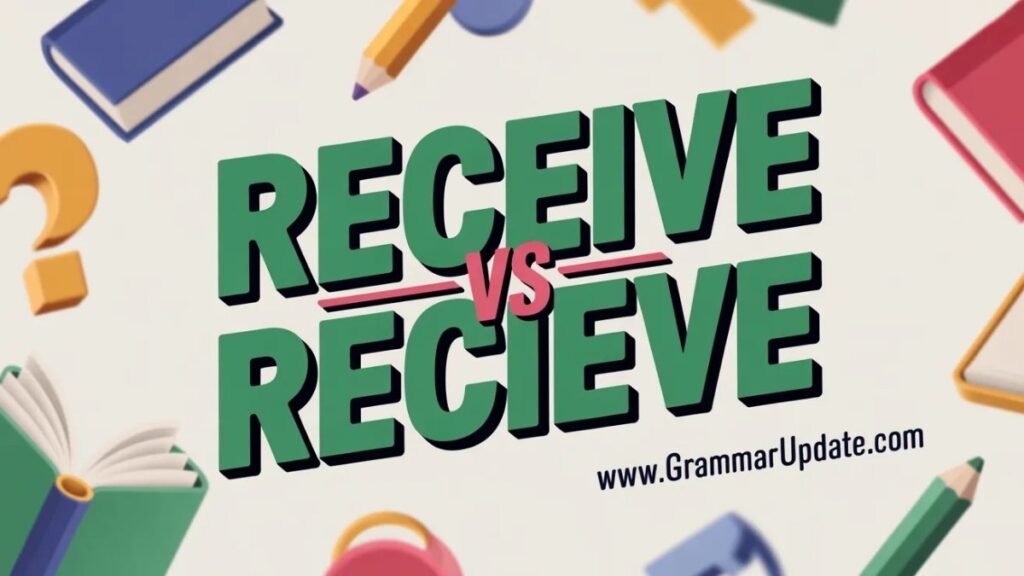
The confusion between receive vs recieve is one of those small English spelling problems that manages to create unnecessary doubt even for confident writers. At first glance, both versions look believable, and that is exactly where the mistake begins. Your brain sees a familiar pattern, your fingers type quickly, and suddenly “recieve” slips into a sentence that was meant to look professional. The funny part is that this error rarely happens when you are relaxed. It usually shows up right when you are trying to sound formal and correct.
The good news is that this confusion is easy to fix once you understand the rule behind it. The spelling is not random, and it is not a trick question. It follows a clear English pattern that you can learn in seconds and never forget again. In this guide, you will see exactly how to spell receive correctly, why “recieve” feels tempting, and how to avoid this mistake in real writing without overthinking every word.
Receive vs Recieve Quick Answer
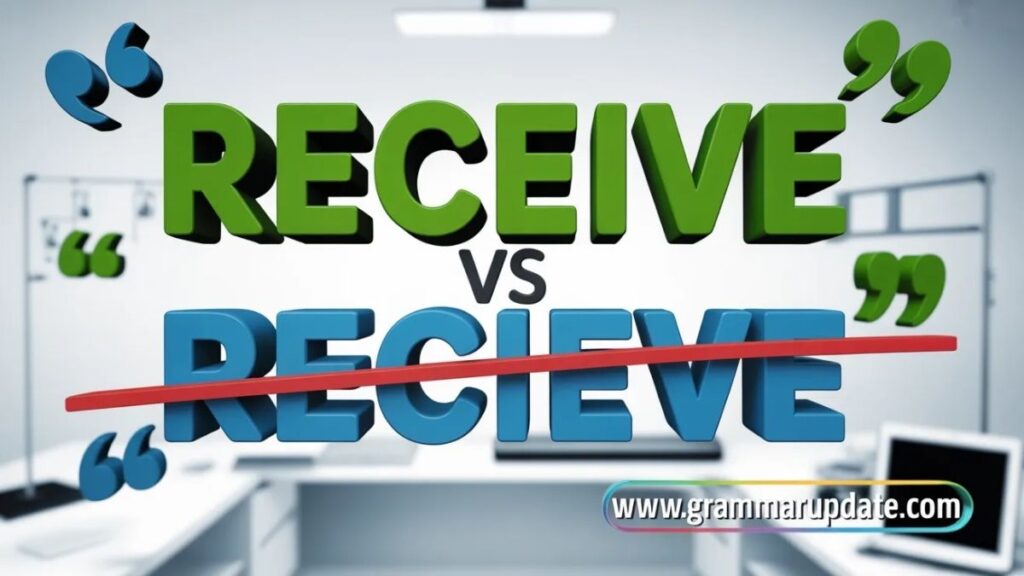
The answer is simple and direct.
The only correct spelling in standard English is receive. The spelling “recieve” is incorrect and considered a spelling mistake in all major English-speaking regions.
- ✔ Receive is the accepted spelling in formal and informal English
Example: Please receive this document before the meeting. - ❌ Recieve is not recognized as a correct English word
Example: Incorrect: I did not recieve your message.
| Spelling | Correct or Incorrect | Usage |
|---|---|---|
| receive | correct | standard English spelling |
| recieve | incorrect | spelling error |
Unlike words that change between British and American English, the spelling of “receive” remains the same worldwide.
What Does Receive Mean?
The word receive is a verb that means to get, obtain, accept, or be given something. It is one of the most frequently used verbs in modern English communication.
People use “receive” in everyday conversation, business communication, education, banking, healthcare, technology, and customer service. The word can refer to physical items, digital information, emotional reactions, payments, invitations, messages, or services.
- Receive means obtaining something from another person or source
Example: She will receive her order tomorrow afternoon. - Receive can also describe getting information, support, or recognition
Example: The employee received praise for excellent performance.
| Word | Meaning | Part of Speech |
|---|---|---|
| receive | to get or accept something | verb |
| received | past tense of receive | verb |
| receiving | ongoing action form | verb |
Because the word appears so frequently in communication, even a small spelling mistake becomes highly noticeable.
Fix common more word mistakes in English
Smoky vs Smokey Differences and Correct Usage
Receive vs Recieve Meaning Explained
Many writers search for receive or recieve meaning because both spellings appear visually convincing. However, only one version exists as a legitimate English word.
The spelling “receive” carries a clear dictionary definition and grammatical function. The spelling “recieve” has no accepted meaning in standard English grammar and exists only as a common misspelling.
- Receive is recognized by dictionaries and grammar systems
Example: Students receive grades at the end of each term. - Recieve is treated as an incorrect spelling variation
Example: Spellcheck tools immediately flag recieve as an error.
| Term | Valid English Word | Meaning |
|---|---|---|
| receive | yes | to obtain or accept |
| recieve | no | spelling mistake |
This distinction applies equally in academic writing, professional communication, and everyday English usage.
Why People Confuse Receive Vs Recieve
The confusion exists because English spelling relies heavily on memory patterns rather than sound consistency. The pronunciation of “receive” does not clearly indicate whether the letters should appear as “ei” or “ie.”
As a result, many writers instinctively reverse the letters during typing.
Another reason involves visual familiarity. English contains many common “ie” words, which causes the brain to assume the same structure belongs in receive.
- The pronunciation creates uncertainty about letter order
Example: Receive sounds similar regardless of spelling arrangement. - Fast typing habits increase accidental spelling reversals
Example: Writers often type recieve during quick drafting.
| Cause of Confusion | Explanation |
|---|---|
| pronunciation similarity | sound does not reveal spelling order |
| typing speed | increases letter reversal mistakes |
| visual memory habits | “ie” appears more familiar |
This is why “recieve spelling” remains one of the most searched grammar questions online.
Learn how to use confusing more words correctly
Treet vs Treat Spelling Confusion and Usage
The Grammar Rule Behind Receive
The spelling of receive follows one of the most widely taught English spelling rules:
“I before E, except after C.”
This rule explains that the letters usually appear as “ie,” unless they come after the letter “c.” When the combination follows “c,” the order changes to “ei.”
Since the vowel sound in “receive” appears after the letter “c,” the correct spelling becomes receive.
- Receive correctly follows the “except after C” structure
Example: The word uses “ei” because it follows the letter c. - Several other English words follow the same pattern
Example: deceive, perceive, ceiling
| Word | Correct Pattern |
|---|---|
| receive | ei after c |
| deceive | ei after c |
| perceive | ei after c |
| ceiling | ei after c |
This rule is one of the most important spelling foundations taught in English grammar education.
Why “Recieve” Is Incorrect
The spelling “recieve” breaks established English spelling conventions. Dictionaries, educational institutions, grammar guides, and publishing standards universally recognize it as incorrect.
Even though the typo appears frequently online, repetition does not make it grammatically valid.
- Dictionaries classify recieve as a misspelling
Example: Grammar tools automatically correct it to receive. - Schools and professional editors reject the spelling entirely
Example: Teachers mark recieve incorrect in examinations.
| Spelling | Dictionary Status |
|---|---|
| receive | valid word |
| recieve | invalid spelling |
This applies equally across American, British, Canadian, and Australian English.
Learn how to use confusing more words correctly
Phoenix vs Pheonix Difference and Usage
British English vs American English Spelling
Many spelling confusions happen because American and British English often use different versions of the same word. However, receive is not one of those cases.
Both systems use exactly the same spelling.
- American English uses receive as the official form
Example: US business communication follows receive spelling. - British English also uses receive without variation
Example: UK dictionaries list receive as standard spelling.
| Region | Correct Spelling |
|---|---|
| United States | receive |
| United Kingdom | receive |
| Canada | receive |
| Australia | receive |
This means “recieve” remains incorrect everywhere.
Receive Pronunciation and Meaning
The standard pronunciation of receive is:
ri-SEEV
The second syllable receives the stress in both American and British English pronunciation.
- American English pronunciation emphasizes the second syllable
Example: ri-SEEV - British English pronunciation remains nearly identical
Example: ri-SEEV
| English Version | Pronunciation |
|---|---|
| American English | ri-SEEV |
| British English | ri-SEEV |
Because the pronunciation stays consistent, writers must rely on spelling memory rather than sound patterns alone.
Fix common more word mistakes in English
Flys vs Flies Correct Spelling and Common Mistakes
Receive Examples in Everyday Sentences
Reading correct sentence examples helps strengthen spelling recognition naturally.
- Receive appears frequently in professional communication
Example: You will receive confirmation within 24 hours. - The word is equally common in casual conversation
Example: Did you receive my message yesterday?
| Sentence Type | Example |
|---|---|
| business | We received your application today. |
| casual | I received your text message. |
| academic | Students received their results online. |
Repeated exposure to correctly written examples improves long-term spelling accuracy.
Common Mistakes with Receive
The most common issue involves reversing the “ei” into “ie.” However, related forms also create confusion.
Writers frequently misspell “received,” “receiving,” and similar forms because the same letter-order problem continues.
- Many writers incorrectly type “recieved” instead of “received”
Example: Incorrect: She recieved the package yesterday. - Typing quickly increases spelling reversal mistakes
Example: Emails often contain accidental recieve errors.
| Incorrect Form | Correct Form |
|---|---|
| recieve | receive |
| recieved | received |
| recieveing | receiving |
Even small spelling errors reduce writing quality immediately.
Learn the difference between tricky more English words
Authorization vs Authorisation Which is Correct?
Receive vs Accept vs Get
These verbs share related meanings, yet each serves a slightly different purpose in communication.
“Receive” focuses on obtaining something. “Accept” focuses on agreeing to take something. “Get” is broader, more informal, and commonly used in casual speech.
- Receive describes obtaining something from another source
Example: He received an award during the ceremony. - Accept focuses on agreement or willingness
Example: She accepted the invitation immediately.
| Word | Main Meaning |
|---|---|
| receive | obtain |
| accept | agree to take |
| get | casually obtain |
Understanding these distinctions improves sentence clarity and vocabulary precision.
Understand confusing English more words simply
Rumor vs Rumour Difference and Usage
Easy Tricks to Remember Receive Spelling
Memory techniques make spelling recall much easier during fast writing.
The most effective trick is remembering:
“After C comes EI.”
Visual repetition also helps strengthen spelling confidence over time.
- The “after C use EI” rule prevents reversal mistakes
Example: receive follows the c + ei structure. - Repetition improves long-term spelling memory
Example: Writing receive repeatedly strengthens recall.
| Memory Trick | Purpose |
|---|---|
| after C use EI | prevents spelling reversal |
| repeated writing practice | improves memory retention |
These methods work especially well for students and ESL learners.
Understand confusing English more words simply
Bachelor vs Batchelor Difference and Correct Usage
Why Correct Spelling Matters in Professional Writing
Small spelling errors create larger credibility problems than many writers realize. Misspelling common words immediately affects how readers judge professionalism, accuracy, and communication quality.
Readers naturally expect frequently used words like receive to appear correctly.
- Correct spelling improves professionalism and readability
Example: Error-free emails appear more trustworthy. - Misspellings distract readers from the intended message
Example: Resume spelling mistakes weaken first impressions.
| Writing Area | Importance |
|---|---|
| resumes | professionalism |
| business emails | credibility |
| academic papers | accuracy |
Strong spelling habits instantly improve communication quality.
Receive in Digital Communication and Search Trends
The spelling mistake “recieve” appears constantly online because modern communication encourages speed over careful proofreading.
Search engines recognize this confusion so frequently that “receive or recieve reddit” and similar phrases generate thousands of monthly searches.
- Social media increases accidental spelling errors
Example: Fast texting often produces recieve mistakes. - Search engines automatically suggest receive corrections
Example: Google identifies recieve as a common typo.
| Digital Platform | Common Issue |
|---|---|
| texting | speed typing errors |
| social media | reduced proofreading |
Technology improves communication speed, but it also increases careless spelling habits.
Understand confusing English more words simply
Dought vs Doubt Avoid Common English Mistakes
Receive Word Origin and Language History
The word “receive” comes from the Old French word receivre and the Latin root recipere, meaning “to take” or “to obtain.”
Over time, English adopted the spelling structure while preserving the “ei” pattern after “c.”
- Latin roots shaped the modern spelling structure
Example: recipere influenced receive formation. - French language history affected English spelling development
Example: many English words preserve French-style vowel patterns.
| Language Origin | Historical Root |
|---|---|
| Latin | recipere |
| Old French | recevoir |
Understanding word origins often explains why English spelling appears unusual.
Fix common more word mistakes in English
Submission vs Submittion learn the Difference
Practice Session Receive vs Recieve
Fill in the blanks with the correct word: receive, received, receiving, or recieved.
Fill in the Blanks
- I did not __________ your email yesterday.
- She __________ a scholarship from the university last week.
- Please confirm once you __________ the package.
- We are __________ positive feedback from customers.
- He accidentally wrote “__________” instead of “receive.”
- Students will __________ their exam results tomorrow.
- The company __________ thousands of applications this month.
- Did you __________ my text message?
- Incorrect spelling: “__________”
- The bank __________ the payment successfully.
- You should always spell __________ with “ei” after “c.”
- She is __________ calls from clients all afternoon.
- They never __________ the invitation email.
- The teacher corrected the word “__________” in the essay.
- We hope to __________ your response soon.
- The office __________ several complaints yesterday.
- Correct spelling: “__________”
- I am not __________ notifications on my phone.
- Have you __________ the documents yet?
- He typed “__________” too quickly and missed the spelling mistake.
- Employees __________ bonuses at the end of the year.
- She has __________ excellent support from her team.
- Always double-check the spelling of __________ in formal writing.
- The customer never __________ the confirmation message.
- Writers often confuse __________ and recieve.
Answers
- receive
- received
- receive
- receiving
- recieved
- receive
- received
- receive
- recieved
- received
- receive
- receiving
- received
- recieve
- receive
- received
- receive
- receiving
- received
- recieve
- receive
- received
- receive
- received
- receive
Here’s a trusted source for clear word meanings:
FAQs
Which is correct, recieve or receive?
The correct spelling is receive. The spelling “recieve” is incorrect in standard English and is considered a common spelling mistake.
Have not receive or recieve?
The correct phrase is usually “have not received” because the sentence requires the past participle form.
Correct example: I have not received your email yet.
How do Americans spell received?
Americans spell it as received, which is exactly the same spelling used in British English. There is no regional difference for this word.
Why can’t I spell receive?
Many people struggle with the word because the “ei” letter combination feels unusual. The confusion happens because writers often reverse the letters into “ie” automatically while typing.
What does receive mean?
The word receive means to get, obtain, accept, or be given something. It can refer to objects, messages, payments, information, or emotional support.
What’s the correct way to say “receive”?
The standard pronunciation is:
ri-SEEV
The second syllable carries the stress in both American and British English.
Is it “receive” or “recieve” help?
The correct spelling is always receive.
Correct example: Did you receive help from customer support?
What’s the difference between British and American spelling?
British and American English sometimes use different spellings, such as “colour” vs “color.” However, both systems spell receive exactly the same way.
Is received correct grammar?
Yes, received is grammatically correct. It is the past tense and past participle form of “receive.”
Correct example: She received the package yesterday.
Is there an American version of received pronunciation?
No. “Received Pronunciation” refers to a traditional British accent often associated with formal UK speech. It is unrelated to the word “received” in grammar.
What’s a better word for received?
Depending on context, alternatives include accepted, obtained, collected, gained, or acquired.
Which spelling is correct, receive or recieve?
The only correct spelling is receive. The spelling “recieve” is always considered incorrect in modern English writing.
What does receive mean biblically?
In biblical usage, “receive” often means to accept spiritually, welcome blessings, gain wisdom, or accept teachings from God.
What’s a good sentence for receive?
Here is a correct example sentence:
You will receive your order confirmation within a few minutes.
Is “receive” a commonly misspelled word?
Yes. “Receive” is one of the most commonly misspelled English words because many writers accidentally reverse the “e” and “i” letters.
conclusion
The confusion between receive vs recieve is less about complexity and more about a simple spelling habit that catches writers off guard. At first, both forms may look acceptable when typed quickly, especially when you are focused on meaning rather than structure. However, only one form is correct in standard English, and that is receive.
Once the rule becomes clear, the mistake is easy to eliminate. English spelling does not change based on speed, assumption, or guesswork. It follows consistent patterns, and “receive” is one of those words that strictly follows the correct structure. The incorrect form “recieve” continues to appear mainly due to fast typing and visual confusion, not because it is valid.
So the practical takeaway is simple: slow down just enough to trust the rule, not the instinct. With a little attention, this common error disappears completely, leaving your writing clearer, more accurate, and far more professional.

Jhon AJS, the creative mind behind Grammar Update, is an experienced blogger passionate about simplifying English grammar. He focuses on explaining confusing word vs word differences, grammar rules, punctuation, and sentence structure in a clear and practical way. Through easy to understand guides and examples, Jhon helps readers improve their writing and communicate with confidence. With years of blogging experience, he continues to share helpful insights that make learning grammar simple, useful, and accessible for everyone.