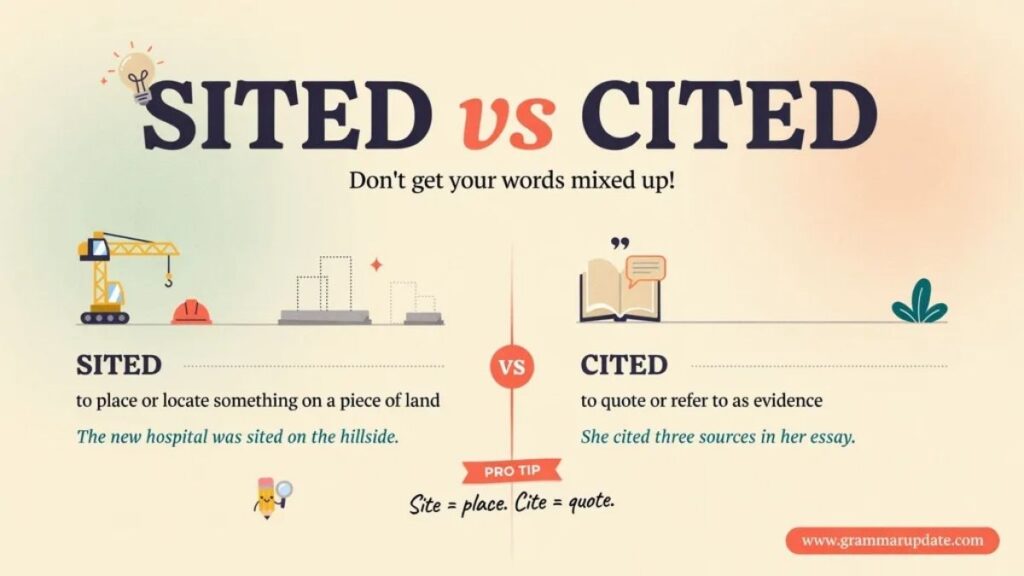
English can turn a simple spelling choice into a tiny grammar mystery, and sited vs cited is a perfect example. These words sound exactly alike, but they don’t mean the same thing. Sited relates to placing or locating something, while cited means referring to a source, example, or piece of evidence. Then sight and sighted enter the picture and add another layer of confusion. If you’ve ever stopped and wondered which word is correct, you’re not alone. This guide makes the sited vs cited difference easy to understand with simple definitions, clear examples, and practical grammar tips. By the end, you’ll know exactly which word to use.
Sited vs Cited The Quick Difference
The easiest way to understand the sited vs cited difference is to connect each word with its base verb.
| Word | Base word | Main meaning | Typical context | Example |
|---|---|---|---|---|
| Sited | Site | Placed or located somewhere | Buildings, facilities, construction, planning | The hospital was sited near the highway. |
| Cited | Cite | Referred to, mentioned, quoted, or used as evidence | Research, essays, reports, law | The researcher cited three studies. |
| Sight | Sight | The ability to see or something seen | Vision, observation, scenery | The mountain came into sight. |
| Sighted | Sight | Saw or noticed something | Observation, wildlife, reports | The hikers sighted an eagle. |
This distinction answers most questions about sited or cited.
1.If you mean place something in a location, use sited.
2.If you mean reference a source, use cited.
3.If you mean see something, use sight or sighted, depending on the sentence.
For example:
- The new factory was sited close to the river.
- The report cited several research papers.
- The researchers sighted a rare bird.
The spelling changes because the meaning changes.
Learn the difference between confusing word pairs
Calendar vs Calender difference and Which Spelling Is Correct?
What Does Sited Mean?
The sited meaning is straightforward: placed, positioned, or located in a particular place.
Sited is the past tense and past participle of the verb site when site means to place or locate something.
The word often appears when someone chooses a particular physical location for something.
Think about an architect deciding where to build a hospital. The architect might consider traffic, land, drainage, nearby services, and access to transportation. Once the location has been chosen, the hospital can be described as sited there.
For example:
- The new hospital was sited near the highway.
- The factory was sited close to the river.
- The building was sited in the city center.
- The structure was sited near the road.
- The wind turbines were sited along the ridge.
The sited definition therefore has a strong connection with physical placement and a specific location.
Sited in a Sentence
Here are several examples of sited in a sentence:
The new hospital was sited near the highway to improve access for emergency vehicles.
The factory was sited close to the river because the location provided convenient access to water.
The building was sited in the city after planners reviewed several possible locations.
The solar panels were sited on the southern side of the property.
Notice the common thread. Every sentence concerns the location or placement of a building, facility, structure, or physical object.
Sited Sentence Examples in Different Contexts
Construction:
The apartment complex was sited on previously developed land.
Transportation:
The new station was sited near a major intersection.
Environmental planning:
The facility was sited away from protected wetlands.
Business:
The company sited its distribution center near a major highway.
Infrastructure:
The treatment plant was sited outside the residential district.
In each case, sited describes the decision or action of choosing a location.
Learn the difference between confusing word pairs
Strips vs Stripes Difference and which is correct?
What Does Cited Mean?
The cited meaning is quite different.
Cited is the past tense and past participle of the verb cite. It generally means referred to, mentioned, quoted, or brought forward as an example, authority, reason, evidence, or precedent.
This is the word you need when you reference a source.
For example:
- The researcher cited three research papers.
- The article cited several sources.
- The student cited evidence from a peer-reviewed study.
- The report cited previous research.
- The lawyer cited a court decision.
- The author cited references throughout the paper.
The word appears frequently in academic and professional writing because writers need to identify where information, ideas, evidence, or quotations came from.
Cited in a Sentence
Here are clear examples of cited in a sentence:
She cited three research papers in her essay.
The researcher cited evidence from several independent studies.
The report cited a previous investigation as support for its conclusion.
The professor asked students to use properly cited sources in an essay.
The lawyer cited a previous court ruling to support the argument.
In these examples, cited means that someone referred to something as a source, authority, example, evidence, or precedent.
Cited Can Have More Than One Meaning
Academic citation is probably the meaning you encounter most often, but cite has other uses.
A person can be cited for bravery, meaning officially recognized or commended.
A person can also be cited for speeding, which has a legal meaning involving an official traffic citation.
For example:
The officer cited him for speeding.
Here, cited for speeding does not involve academic writing. It refers to an official traffic citation.
The same verb can therefore appear in very different situations.
Learn the difference between confusing word pairs
Bellwether vs Bellweather difference and usage?
Sited vs Cited Grammar
Understanding sited vs cited grammar becomes much easier when you start with the base verbs.
Site → Sited
Site is a verb when it means to place or locate something.
Its past tense is:
site → sited
Example:
The company sited its new factory outside the city.
Cite → Cited
Cite is a verb meaning to refer to, mention, quote, or bring forward as evidence.
Its past tense is:
cite → cited
Example:
The company report cited several economic studies.
So the verb forms are:
| Base verb | Past tense | Meaning |
| Site | Sited | Place or locate |
| Cite | Cited | Refer to or mention |
| Sight | Sighted | See or notice |
This also answers two common questions.
What is the past tense of cite?
The past tense of cite is cited.
What is the past tense of site?
The past tense of site is sited.
Both are regular past tense forms, but they belong to different verbs.
Learn the difference between confusing word pairs
Acreage vs Acrag difference and Which Spelling Is Correct?
Why Do People Confuse Sited and Cited?
The main culprit is pronunciation.
Sited and cited sound alike. They are homophones, meaning they have the same pronunciation but different spellings and meanings.
That creates a problem when you’re writing from memory.
You might hear:
The study cited several sources.
The sound doesn’t tell you whether the spelling should be cited or sited. You have to know what the word means.
The same problem appears in:
The building was sited near the highway.
Again, pronunciation doesn’t provide the answer.
This is why commonly confused words often require a meaning-based approach. Trying to memorize pronunciation won’t help when several spellings produce the same sound.
The Three-Word Connection
Think about the words this way:
Cite → citation → source
Site → situation → location
Sight → eyesight → seeing
This simple connection is more useful than memorizing three dictionary definitions.
Sited vs Cited vs Sight
The sited vs cited vs sight comparison becomes much clearer when all three words appear together.
Sited
Means placed or located.
The laboratory was sited near the university.
The laboratory was placed or located there.
Cited
Means mentioned, referenced, quoted, or used as evidence.
The article cited the laboratory’s research.
The article referred to the research.
Sight
Means vision, the act of seeing, or something seen.
The laboratory came into sight as we approached the campus.
These words may sound identical, but their meanings are completely different.
| Word | Think about | Example |
| Sited | Location | The hospital was sited outside town. |
| Cited | Reference | The study cited earlier research. |
| Sight | Seeing | The hospital came into sight. |
The cited vs sited vs sight distinction is therefore based on meaning, not pronunciation.
Learn the difference between confusing word pairs
Lend vs Lent difference and which is Correct?
Sited vs Cited vs Sighted
Now add sighted, and the difference becomes even clearer.
Sighted is the past tense of the verb sight. It means saw, noticed, or caught sight of something.
Compare these sentences:
The factory was sited near the highway.
The factory was located there.
The report cited the factory as an example.
The report referred to the factory.
The inspector sighted the factory from the road.
The inspector saw the factory.
That is the entire sited vs cited vs sighted distinction in action.
Sited vs Sighted
The difference between sited vs sighted is particularly important because both can appear in descriptions of physical places.
Sited means located or placed.
Sighted means seen or observed.
Compare:
The building was sited near the coast.
The building’s location was chosen near the coast.
The building was sighted from the coast.
Someone saw the building from the coast.
One letter changes the meaning dramatically.
Learn the difference between confusing word pairs
Agast vs Aghast difference and Which one Is Correct?
Cite vs Site
The cite vs site distinction is one of the most useful pieces of English word usage to understand.
Cite
Use cite when you mean:
- Refer to a source
- Mention an authority
- Quote evidence
- Give an example
- Mention a precedent
- Officially recognize someone
- Issue certain legal citations
Example:
The researcher will cite a source in the essay.
Site
Use site when you mean:
- A physical location
- A place where something happens
- A location for a building
- A construction location
- A website or online location
- To choose a location for something
Example:
Engineers will site the building near the highway.
This explains the site vs cite difference in one sentence:
Cite is generally about referring to information.
Site is generally about location.
Site vs Sight
The site vs sight difference is equally important.
Site is about place.
Sight is about seeing.
For example:
The construction site is closed today.
Here, site means the physical location where construction occurs.
The new bridge is an impressive sight.
Here, sight means something worth seeing.
Site in a Sentence
The workers arrived at the site early in the morning.
Sight in a Sentence
The waterfall was an incredible sight.
The words sound alike, but the meanings don’t overlap in these examples.
Cite vs Sight
The cite vs sight distinction can be reduced to two ideas:
Cite = reference.
Sight = seeing.
Compare:
The author cited the historical record.
The author referred to the historical record.
The author sighted the historical record.
The author saw the historical record.
The second sentence is grammatically possible, but it has a completely different meaning.
Sighted Meaning
The sighted meaning is generally connected with seeing or noticing something.
For example:
The researchers sighted a rare bird near the wetlands.
This means they saw the bird.
It does not mean they referenced the bird in a report.
Learn the difference between confusing word pairs
Achieve vs Achive Difference Which Spelling Is Correct?
Cited or Sighted a Document?
This is one of the most useful real-world distinctions.
If you reference a document as a source, you cited the document.
If you saw the document, you sighted the document, although “saw the document” is usually more natural in everyday American English.
Consider the difference:
I cited the document in my report.
Meaning: I referred to the document as a source.
I sighted the document on the desk.
Meaning: I saw or noticed the document.
So if you’re searching for cited or sighted a document, ask yourself one question:
Did you reference it or see it?
Reference it → cited.
See it → sighted.
This also explains sighted vs cited document usage.
A Better Everyday Choice
Although sighted is a valid word, native speakers will often simply say:
I saw the document.
So:
- Academic reference → cited the document
- Physical observation → sighted the document
- Ordinary conversation → saw the document
Learn the difference between confusing word pairs
Amateur vs Amatuer difference and Which one Is Correct?
Cite an Example or Site an Example?

The correct expression is usually cite an example.
If you mean “mention an example to support or illustrate a point,” use cite.
The writer cited an example from a recent study.
The teacher cited an example from everyday life.
The report cited several examples of successful conservation projects.
So if you’re wondering should you cite or site an example, the answer is cite when you mean mention or provide an example as evidence.
Why “Site an Example” Is Usually Wrong
The verb site means to place or locate something.
Therefore, site an example would suggest physically placing an example somewhere, which isn’t the normal meaning people intend.
Compare:
The researcher cited an example from the study.
Correct for reference.
The company sited a factory near the river.
Correct for location.
The difference is simple:
Cite an example.
Site a building.
That’s the pattern to remember.
Learn the difference between confusing word pairs
Pretty vs Prety difference and Which Spelling Is Correct ?
Common Mistakes With Sited and Cited
A few errors appear repeatedly because the words sound identical.
Using Sited for a Source
Incorrect:
The researcher sited three research papers.
Correct:
The researcher cited three research papers.
The researcher referred to the papers. Nothing was physically located.
Using Cited for a Location
Incorrect:
The new hospital was cited near the highway.
Correct:
The new hospital was sited near the highway.
The hospital was placed or located there.
Using Sighted for a Citation
Incorrect:
The student sighted three sources in the essay.
Correct:
The student cited three sources in the essay.
The student referenced the sources.
Using Sight for Site
Incorrect:
The construction sight is closed.
Correct:
The construction site is closed.
The sentence refers to a location.
Using Site for Sight
Incorrect:
The waterfall was a beautiful site.
If you mean something visually impressive, the intended word is usually:
The waterfall was a beautiful sight.
Sited vs Cited Examples You Can Compare
The best sited vs cited examples place similar ideas side by side.
| Sited | Cited |
| The factory was sited near the highway. | The report cited the factory as an example. |
| The hospital was sited outside the city. | The researcher cited the hospital’s records. |
| The structure was sited near the road. | The article cited a study about the structure. |
| The facility was sited close to a river. | The environmental report cited evidence about the river. |
| The building was sited in the city. | The author cited references about the building. |
The pattern is remarkably consistent.
Location → sited.
Reference → cited.
Cite, Site, and Sight in a Sentence
You can use all three words in a single sentence when the context calls for it.
For example:
The report cited a historical account describing the site, which later became a popular sight for tourists.
Here:
- cited = referred to a source
- site = location
- sight = something worth seeing
Another example:
The historian cited records about the archaeological site, while tourists visited the area as a major sight.
This is a useful way to understand cite site sight examples because each word has a distinct job.
Use Site and Sight in a Sentence
If you need to use site and sight in a sentence, try:
The historic site became a popular sight for visitors.
The first word refers to the location. The second refers to something people see.
You can also write:
The castle site offers a spectacular sight of the valley.
This is exactly why site vs sight can be confusing in travel and historical writing. Both can logically appear in the same sentence.
Learn the difference between often confused words
Absorption vs Absorbsion difference and Which Is Correct?
Cite vs Site vs Sight A Simple Memory Trick
When three homophones start fighting for attention, give each one a mental anchor.
Cite = Citation
Think:
cite → citation → source
If you’re referring to a book, study, author, quotation, or evidence, use cite.
Site = Situation
Think:
site → situation → location
If you’re talking about where something is located or where something will be built, use site.
Sight = Eyesight
Think:
sight → eyesight → seeing
If you’re talking about vision or something you see, use sight.
This gives you a fast decision-making system:
Source? → cite.
Location? → site.
Seeing? → sight.
Learn the difference between often confused words
Ether vs Either which is correct and Difference?
Sited vs Cited in Academic Writing
Academic writing heavily favors cited because research depends on identifying sources.
A student might:
- cite a journal article
- cite a book
- cite a study
- cite a statistic
- cite evidence
- cite a quotation
- cite a theory
- cite a previous researcher
For example:
The researcher cited several sources to support the conclusion.
The student cited research papers in an essay.
The author cited evidence from earlier experiments.
The phrase academic citation refers to the practice of identifying the sources used in scholarly work. Different academic styles have different formatting rules, but the underlying meaning of cite remains the same: you are identifying or referring to a source.
Cited Sources in an Essay
Consider:
Climate patterns have changed significantly over the past century.
If this statement comes from research, an academic writer may need to support it with a source citation according to the required style.
The key vocabulary is:
- cited sources
- cited references
- research paper citation
- citation in academic writing
- reference a source
- mention a source
- give credit to a source
The verb remains cite.
Sited in Professional and Technical Writing
You may see sited less often than cited in everyday writing, but it has an important role in professional fields.
It is particularly useful when discussing:
- Architecture
- Construction
- Urban planning
- Engineering
- Environmental planning
- Infrastructure
- Geography
- Real estate
- Industrial development
For example:
Engineers recommended that the facility be sited away from flood-prone areas.
Here, sited communicates more than simply “located.” It can emphasize the decision or planning process involved in choosing a location.
Compare:
The factory is located near the river.
with:
The factory was sited near the river.
The first sentence simply describes where the factory is.
The second can emphasize the choice or planning involved in putting the factory there.
That distinction makes sited especially useful in technical and planning documents.
How to Site a Building
If you’re asking how to site a building, you’re talking about choosing its location.
The decision may involve factors such as:
- Accessibility
- Land use
- Drainage
- Environmental restrictions
- Transportation
- Utilities
- Safety
- Terrain
- Nearby infrastructure
- Local planning requirements
For example:
The planners decided to site the hospital near the highway.
Here, site functions as a verb.
You can also use the same construction with other structures:
Engineers planned to site a factory near a river.
Developers chose to site a building on the eastern side of the property.
The agency decided to site a new facility outside the residential area.
This is the practical meaning behind site a building, site a structure, site a hospital, and site a factory.
Learn the difference between often confused words
Fourteen vs Forteen Which Spelling Is Correct?
British English vs American English
The distinction between sited and cited does not change between standard American and British English.
Both varieties use:
- site → sited
- cite → cited
- sight → sight
- sight → sighted
The meanings remain the same.
There can be differences between American and British English in spelling, vocabulary, punctuation, and usage, but this particular distinction isn’t one of them.
So if you’re writing in American English, use the same meaning-based rule:
Location = sited.
Reference = cited.
Seeing = sighted or sight.
Sited vs Cited Pronunciation
The sited pronunciation and cited pronunciation are the same in standard English.
The words are homophones, so pronunciation cannot solve the spelling problem.
Likewise:
- cite
- site
- sight
are pronounced alike.
That is why pronunciation cannot tell you which spelling belongs in a sentence.
1.If you’re talking about citation, spell it cite.
2.If you’re talking about location, spell it site.
3.If you’re talking about vision, spell it sight.
The same principle applies to their past-tense forms:
- cited
- sited
- sighted
Their meanings, not their sounds, determine the correct spelling.
Why Grammar Checkers May Not Catch the Error
A spelling checker can recognize sited and cited as correctly spelled words. That’s where things get tricky.
Consider:
The researcher sited three studies.
Every individual word is spelled correctly. The sentence is still wrong if the writer intended to say that the researcher referred to three studies.
A spell checker may not flag it because sited is a legitimate English word.
Now consider:
The factory was cited near the highway.
Again, cited is a correctly spelled word. The problem is meaning. The sentence needs sited if the intended meaning is that the factory was located there.
This teaches an important lesson about spelling and grammar:
A correctly spelled word isn’t necessarily the correct word.
Context matters.
That is why careful proofreading should involve more than checking for spelling errors.
Learn the difference between often confused words
Favs vs Faves Difference Which Is Correct?
Practice Session Sited vs Cited
Choose the correct word for each sentence: sited, cited, site, cite, sight, or sighted.
- The new hospital was ______ near the highway for easier access.
- The researcher ______ three studies to support the argument.
- The construction ______ will remain closed until Monday.
- The hikers ______ a bald eagle flying over the valley.
- The mountain came into ______ as the clouds cleared.
- The company plans to ______ its new factory outside the city.
- The author ______ several sources in the research paper.
- The old castle is a popular tourist ______.
- The engineers ______ the bridge away from the flood-prone area.
- The student forgot to ______ the source of the statistic.
- The police officer ______ the driver for speeding.
- The researchers ______ a rare species near the wetlands.
- The factory was ______ close to a major transportation route.
- The report ______ evidence from several previous studies.
- The workers arrived at the construction ______ early in the morning.
- The ship finally came into ______ after several hours at sea.
- The company decided to ______ the warehouse near the airport.
- The professor asked students to ______ their sources correctly.
- The building was carefully ______ to avoid damaging the protected trees.
- The journalist ______ a government report in the article.
- The tourists stopped to admire the beautiful ______.
- The scientists ______ several birds during their field survey.
- The new school was ______ near the center of the community.
- The lawyer ______ a previous court decision during the trial.
- The historic ______ attracts thousands of visitors every year.
Answers
- sited
- cited
- site
- sighted
- sight
- site
- cited
- site
- sited
- cite
- cited
- sighted
- sited
- cited
- site
- sight
- site
- cite
- sited
- cited
- sight
- sighted
- sited
- cited
- site
Here’s a trusted source for clear word meanings:
FAQs
Can “sited” describe where a facility was built?
Yes. “Sited” can describe the location chosen for a facility, building, factory, hospital, or other structure.
Example: “The new treatment center was sited outside the residential area.”
Does “cited” always refer to academic sources?
No. “Cited” has several uses. It can mean referring to a source or authority, mentioning something as evidence, giving an example, or officially recognizing someone. It can also appear in legal contexts, such as when someone is cited for a violation.
Can “site” be used as a verb?
Yes. “Site” can function as a verb meaning to choose or place something in a particular location.
Example: “The developers plan to site the new facility near the airport.”
Can “cite” be used without mentioning a formal source?
Yes. “Cite” can mean mention or give an example, so it doesn’t always require an academic reference.
Example: “The manager cited poor communication as the main reason for the delay.”
Why does “sited” have a different spelling from “sighted”?
They come from different base words. “Sited” comes from “site,” meaning to place or locate something. “Sighted” comes from “sight,” meaning saw or noticed something.
Can “cited” refer to a person rather than a source?
Yes. A person can be cited when someone officially recognizes their actions or refers to them as an authority or example.
Example: “The scientist was cited for her contributions to the field.”
Does “sited” imply that someone deliberately chose a location?
Often, yes. In formal or technical writing, “sited” can emphasize the decision to place something in a particular location rather than simply describe where it happens to be.
Example: “The facility was sited away from the floodplain.”
Is “sited” common in everyday conversation?
It is correct English, but everyday speakers often choose simpler words such as “located” or “placed.” “Sited” appears more often in planning, construction, engineering, environmental, and architectural writing.
Can “cite” mean to give a reason?
Yes. “Cite” can introduce a reason or factor that someone identifies as an explanation.
Example: “The company cited rising costs as a reason for the price increase.”
What kind of information can be cited?
You can cite many kinds of information, including research findings, statistics, quotations, books, articles, reports, court decisions, historical records, and other authoritative material.
Can a report cite another report?
Yes. A report can cite another report when it refers to that document as a source, authority, or supporting piece of evidence.
Example: “The environmental assessment cited an earlier government report.”
Can “sited” describe something other than a building?
Yes. It can describe many physical things or facilities whose location has been selected or established. Examples include roads, turbines, equipment, stations, factories, and treatment plants.
Is “cited” used in legal writing?
Yes. Legal writing frequently uses “cited” when referring to statutes, court decisions, legal authorities, previous cases, or other sources.
Example: “The attorney cited a previous ruling in support of the argument.”
Can “sited” be used with “near”?
Yes. “Sited near” is a natural construction when describing the placement of something.
Example: “The new station was sited near the main entrance.”
Can “cited” be followed by a person’s name?
Yes. “Cited” can be followed by a person’s name when the person is being referenced as an authority, example, source, or recipient of official recognition.
Example: “The report cited Dr. Lee as an authority on the subject.”
Why can both “sited” and “cited” look correct in the same sentence?
Both are legitimate English words, so a sentence can contain either spelling without creating a spelling error. The intended meaning determines which one belongs.
For example:
“The factory was sited near the airport.”
“The factory was cited in the report.”
Both sentences are grammatically correct because they express different ideas.
Can “cited” be used with “as”?
Yes. “Cited as” is common when something or someone is mentioned as an example, reason, authority, or cause.
Example: “The study was cited as evidence supporting the proposal.”
Can “sited” be followed by a location?
Yes. A location often follows “sited” because the word describes where something was placed.
Example: “The new facility was sited on the northern edge of the town.”
Is “sited” appropriate in environmental writing?
Yes. Environmental and planning documents often use “sited” when discussing where infrastructure or facilities should be located.
Example: “The wind farm was carefully sited to reduce its impact on nearby habitats.”
Does “cited” have to involve quoting exact words?
No. You can cite a source without directly quoting it. A citation can identify the source of an idea, fact, statistic, argument, or paraphrased information.
Can you cite an idea without quoting it?
Yes. Academic and professional writing often cites sources for paraphrased ideas or information. Quotation marks are generally used for exact wording, while a citation can accompany a paraphrase.
Is “sited” useful when describing planning decisions?
Yes. “Sited” can be especially useful when the location itself results from a planning or design decision.
Example: “The emergency center was sited close to major transport routes.”
Can “cited” describe a reason for an action?
Yes. Writers often use “cited” to introduce a reason or factor that someone gave for a decision.
Example: “The company cited reduced demand as the reason for the closure.”
What is the easiest way to choose between “sited” and “cited”?
Focus on the action.
If something was placed or located somewhere, choose “sited.”
If someone referred to, mentioned, or used something as support, choose “cited.”
That meaning-based test works even when the words sound identical.
Conclusion
Sited vs cited sound exactly alike, but they have completely different meanings. That’s what makes these words so easy to mix up. Add sight and sighted to the picture, and English starts to feel like it’s playing a little spelling prank.
The fix is simple: focus on the meaning, not the sound.
Use sited when you mean placed or located somewhere. and Use cited when you mean referred to, mentioned, or used as evidence. Use sight when you mean something seen or the ability to see. and Use sighted when you mean saw or noticed something.
Here’s the easiest rule to remember:
Location → sited
Reference → cited
Seeing → sight or sighted
For example, a new hospital can be sited near a highway. A researcher can cite a study about that hospital. A traveler can then enjoy the sight of the building from the road.
Same sound. Different meanings. Different spellings.
So, when you’re unsure whether to use sited or cited, stop listening to the pronunciation and look at the meaning. Once you know what you’re trying to say, choosing the correct word becomes much easier.

Jhon AJS, the creative mind behind Grammar Update, is an experienced blogger passionate about simplifying English grammar. He focuses on explaining confusing word vs word differences, grammar rules, punctuation, and sentence structure in a clear and practical way. Through easy to understand guides and examples, Jhon helps readers improve their writing and communicate with confidence. With years of blogging experience, he continues to share helpful insights that make learning grammar simple, useful, and accessible for everyone.